Evan Gershkovich, a foreign correspondent for the Wall Street Journal who was convicted on false charges of espionage, talks about his time in a Russian prison.
One of the great actors of the era on finding sympathy for Mark Zuckerberg, Kendall Roy, and Roy Cohn—and why the New Yorker Profile of him still stings.
In the 1960s and ’70s, colorful comic book advertisements from the Transcience Corporation in New York City promised to mail anyone who sent cash, check, or money order a “bowlfull of happiness” — in reality, a small paper envelope of freeze-dried eggs. Dropped into salt water, the eggs would produce brine shrimp, also known as sea monkeys. Brine shrimp are about a centimeter long and swim…
Nos primórdios do Instituto Butantan, dizem as histórias, Vital Brazil e sua equipe pioneira chegaram a aplicar em si mesmos doses controladas de venenos ou do soro experimental que criavam. Não havia os protocolos éticos atuais, e foi em parte com essas pesquisas que o Brasil ganhou uma instituição científica mundialmente reconhecida.
Hoje, pisar em jararacas pela ciência é considerado algo tão exótico que nos traz um troféu Ig Nobel, como veremos nesta edição. Em seus melhores momentos, o prêmio da revista Annals of Improbable Research celebra com humor a criatividade metodológica. (O artigo foi retratado porque, segundo o comitê de ética, eles pisaram em cobras recém-nascidas. A equipe discorda.)
Neste mês, trazemos também as homenagens mais tradicionais, como os ganhadores do Prêmio Fundação Conrado Wessel, e os livros lançados por pesquisadores brasileiros. E vai ter moda de viola em Barão Geraldo!
Prêmio Wessel
Mario Murakami, engenheiro de alimentos e doutor em física nuclear pela Unesp, foi reconhecido com o Prêmio Fundação Conrado Wessel de Ciência. Diretor do Laboratório Nacional de Biorrenováveis do Centro Nacional de Pesquisa em Energia e Materiais e coordenador do Programa FAPESP de Pesquisa em Transição Energética, ele pesquisa os desafios da bioenergia, bioeconomia e biorrenováveis.
O prêmio de Cultura foi para o padre Júlio Lancellotti, reconhecido nacional e internacionalmente por seu trabalho de acolhimento e atenção à fatia mais excluída da população de São Paulo. Cada um receberá um prêmio de R$ 500 mil em dinheiro, numa cerimônia que ocorrerá em outubro.
“São escolhas que reafirmam o propósito do Prêmio FCW de reconhecer trajetórias de excelência, impacto social e compromisso ético”, disse Carlos Vogt, diretor-presidente da fundação e ex-presidente da FAPESP.
Ig Nobel
O bem-humorado prêmio a pesquisas científicas pouco ortodoxas foi concedido, na categoria Biologia, a um grupo de pesquisadores brasileiros e foi representado por João Miguel Alves Nunes, atualmente estudante de doutorado no IB-USP. Eles avaliaram o que faz com que uma jararaca-da-mata (Bothrops jararaca) dê o bote quando é pisada — e descobriram que não é sequer preciso tocar na cobra para que ela reaja. No Brasil, estima-se que mordidas dessa jararaca correspondem a 90% dos acidentes registrados envolvendo humanos e cobras.
A metodologia foi o que chamou a atenção da banca: em ambiente controlado, com botas de segurança, os autores pisaram perto e sobre diversas partes do corpo de 75 cobras peçonhentas, com várias intensidades, registrando em relação aos cientistas o tamanho do corpo, sexo, temperatura do corpo, temperatura ambiental e hora do dia em que a interação ocorria. À imprensa, Nunes disse que descobriu no experimento ser alérgico ao veneno.
Residência artística
Ivan Vilela, violeiro, professor da USP e pesquisador de cultura popular, iniciou em setembro uma residência artística no Instituto de Estudos Avançados da Unicamp (IdEA). Até dezembro, ele dará palestras e minicursos sobre temas que capturam sua atenção, como as tradições culturais orais e o Clube da Esquina. De 5 a 9 de outubro, ele oferece uma oficina para os estudantes de música do Instituto de Artes da universidade.
Comunicação da ciência
Em 26 e 27 de outubro, o Centro Alemão de Ciência e Inovação (DWIH) realiza no Goethe-Institut São Paulo o encontro “Science Communication in Transition: Strategies, Responsibilities and Emerging Challenges in Germany and Brazil”.
Os palestrantes alemães incluem os pesquisadores Benedikt Fecher, diretor da Wissenschaft im Dialog (WiD), Jeanne Rubner, da Universidade Técnica de Munique, e Monika Taddicken, da Universidade Técnica de Braunschweig, além do jornalista Markus Lehmkuhl. Do Brasil, participam os jornalistas Bruno de Pierro, Daniel Dieb, Luiza Caires, Meghie Rodrigues e Karina Toledo, editora da Agência FAPESP, além dos pesquisadores Juri Castelfranchi e Mariana Rodrigues Pezzo. Mais informações e inscrições estão no site do DWIH-São Paulo: tinyurl.com/2s3rntat.
Estante
A ciência do universo: (quase) tudo o que você sempre quis saber sobre o cosmos, mas nunca perguntou
Rogério Rosenfeld (Companhia das Letras)
O professor de física teórica da Unesp explica as descobertas da área que ajudaram a entender o mundo desde os primeiros modelos cosmológicos baseados na Teoria da Relatividade Geral.
Matemática para seres humanos (e alguns robôs)
Marcelo Viana (Tinta-da-China)
O diretor-geral do Instituto de Matemática Pura e Aplicada (Impa) organiza textos seus publicados no jornal Folha de S.Paulo, mostrando como a matemática se manifesta em diversos aspectos do cotidiano.
Estrela do novo rumo: literatura negra e os sentidos da modernidade periférica
Mário Augusto Medeiros da Silva (Zahar)
O sociólogo, professor da Unicamp e pesquisador da cultura produzida pelos negros no Brasil analisa a luta pela abertura dos espaços culturais de São Paulo a autores, de Carolina Maria de Jesus aos Racionais MCs.
Presença indígena no Brasil
Mércio Pereira Gomes (Contexto)
Um dos mais longevos presidentes da Funai (2003-2007), o professor de antropologia da UFRJ analisa a demografia indígena no Brasil, mostrando que a população dos povos originários tem aumentado.
Ecologias de crise: uma teoria cibernética da radicalização
Leticia Cesarino (Ubu)
A pesquisadora da UFSC investigou como a participação em ambientes digitais pode levar usuários a aderir ao extremismo e cometer atos de violência extrema, de cunho político ou não.
Anote na agenda
30.set a 2.fev. | FICA-SP (Fixação e Incentivo à Carreira Acadêmica em São Paulo)
Doutores em início de carreira com alto potencial acadêmico e sem vínculo empregatício, com base em São Paulo, podem se inscrever na segunda chamada do FICA-SP. Serão selecionados até 100 projetos, em várias áreas acadêmicas. O programa é uma parceria da FAPESP com o CNPq e a Capes.
5 e 6.nov. | 1º Congresso Acadêmico Brasileiro de Cannabis Medicinal
Estão abertas as inscrições para o Cabcann-FCF/USP, que ocorrerá no campus USP Butantã. Criado por Paulo Chanel Deodato de Freitas, o evento tem apoio da Agência Nacional de Vigilância Sanitária (Anvisa), que regulamentou o cultivo, a pesquisa, a fabricação e a comercialização de cannabis para fins medicinais e científicos no Brasil.
Emmanuella was the only one in her family with Temporary Protected Status. Now that it’s gone, she’s leaving her job without a word, desperately dating to find a husband, and beginning to go underground.
Amid deportations and Trump’s lagging popularity, one Koch-backed group has recruited Michigan Latinos to reach more than a hundred thousand voters for Mike Rogers.
ProPublica reporters Jennifer Smith Richards, center, and Jodi S. Cohen and Arkansas Times reporter Milo Strain research founding a private school in Little Rock. Brian Chilson/Arkansas Times
We have no business running a private school.
We’re reporters, not teachers. That doesn’t matter. Inexperience has hardly been a barrier for those who want to start their own schools, as we have reported this year. And it didn’t stop us, either.
Over the last few months, to test the process, reporters from ProPublica partnered with local journalists in three states to establish private schools. None required much effort.
In Arkansas, all it took was a few clicks on the Arkansas secretary of state website, $45 and an American flag to form a bona fide private school with the Arkansas Times.
We established a school with Mountain State Spotlight in West Virginia after filing our new school’s name and location with authorities on a piece of notebook paper, then exchanging a few emails.
And with The Assembly in North Carolina, we filed an online notice of intent to open a private school at Ponysaurus Brewing Co. in Durham, while perched on its metal bar stools, eyeing glasses of a crisp kolsch.
We used our names and news organization email addresses, following each state’s rules for starting private or microschools, a type of private school intended for just a few students. Experience running a school wasn’t needed. No one from any of the states asked us about our backgrounds or qualifications, though West Virginia did ask for proof of a high school diploma. No one questioned what we plan to teach or how we would measure whether students are learning.
And yet we could enroll students in two states right now, if we wanted to. Arkansas even suggested ways our school could accept public money through the state’s voucher-style program.
For the record, we are not enrolling students and have no intention of operating our new schools. We did, however, register a website for our new school ventures, ProPublicaAcademy.com, and even designed some fun pencils to show our school spirit.
This year, a team of ProPublica reporters has been documenting how the American education landscape is shifting dramatically as states use public money to help fund private schools. With few regulations, hundreds of new private and microschools have proliferated.
Our reporting has shown the relative ease with which people — some with questionable backgrounds — founded their own schools in unusual places. They’ve popped up in barns and on farms, in strip malls between an antique shop and an ax-throwing business and in churches, where lighting and sound for worship services is part of the curriculum.
All of this led to a clear reporting question: If the hurdles to open a private school are so low, could we do it? And what would we learn along the way?
Est. 2026
Arkansas: ProPublica-Arkansas Times Curiosity Academy
Inside a flag shop in Little Rock, we surveyed our options. There were handheld American flags on skinny sticks, midsize ones to display on a wall and majestic formal flags adorned with silky gold fringe.
State law in Arkansas doesn’t require much to open a private school, nothing about teacher skills or what kids learn. But it does require that all schools display an American flag, and we wanted to follow the rules. So, at the Arkansas Flag and Banner store, we decided on a smallish one that could fit in a circular base atop a newsroom cubicle. We also bought an Arkansas flag — even though only public schools are required to have those. Total cost: $49.45.
Picking the flags for our new school was the hardest part of an astoundingly easy process.
The only requirement to open a private school in Arkansas is displaying a flag and flagpole, so the team visited the local flag shop in Little Rock.Brian Chilson/Arkansas Times
Early in our reporting in Arkansas, we tried to figure out what steps we’d need to take to make a private school. We couldn’t find all the answers online, so we called the state.
“We don’t have rules for opening a private school,” Kaelin Clay, an Arkansas Department of Education spokesperson, told us earlier this year.
In fact, we didn’t even have to file anything with the Education Department. All it took was a few clicks on the Arkansas secretary of state’s website, where we registered the ProPublica-Arkansas Times Curiosity Academy LLC as a business, listed ourselves as agents and officers, and paid a fee.
“We picked a name. We paid 45 bucks,” a ProPublica reporter noted after we submitted the application. With that, we had created a private school.
The secretary of state’s office approved our new business the same day. We even got a certificate.
The Arkansas Department of Education does not regulate private schools once they’re open, and no one from the state inspected the Arkansas Times newsroom, the location we chose for our school. As far as we know, nobody checked our backgrounds, either.
The official certificate acknowledging our schoolSecretary of State/State of Arkansas
Arkansas adopted a private school funding plan in 2023, and back then there were fewer than 100 private schools on record. With the state in the fourth year of its Education Freedom Accounts program, which provides vouchers that can be spent on private schools, there are now more than 220.
In addition, 143 microschools, which are a different category in Arkansas, were approved this year to accept tax dollars. That’s up from about 100 last school year.
Establishing the Curiosity Academy was so simple — and, frankly, a bit anticlimactic — that reporters then applied to become eligible to receive public funds. (Again, we applied with our names, work email addresses and a note that this was a journalistic exercise. We had no intention of actually ever taking any public money.)
We wanted to see how far our curiosity could take us.
Accessing public funds as a microschool in Arkansas is easier than it is for other types of private schools, even though there is no limit to the number of students one can enroll. Unlike private schools, we didn’t need to seek accreditation or show proof of financial solvency to accept state funding.
It took about 10 minutes to fill out the required information in early September. Other than our contact information, we had to upload just two documents — one detailing our proposed tuition and fees, and the other with our refund policy.
We said that — “should we open a school” — our tuition and fees per student would not exceed $7,208 per school year, the exact amount of Education Freedom Account money that each student in Arkansas is eligible for this year. We said tuition “would be collected only if education is delivered, and it would be the policy of the school to refund all tuition payments for educational services that are not provided.”
After much deliberation, we chose small state and national flags.Brian Chilson/Arkansas Times
When more than two weeks passed and we hadn’t heard back, we reached out to the state Education Department. An employee called back that afternoon and explained that the department had decided not to accept any more because the school year was underway.
But he didn’t reject us outright. He looked up our application and invited us to keep pursuing the public money. He said we still could apply to receive public money this school year, but as a vendor providing educational services such as tutoring. He also said we could apply as a microschool next year and even suggested a tweak to the language in our tuition policy should we decide to do that.
After we hung up, he emailed us the vendor application (which we will not pursue) and let us know the microschool application for next school year will open in the spring.
We asked the state Education Department whether it would be OK with us operating a publicly funded microschool. Clay, the spokesperson, said the agency’s role is to decide if schools meet state requirements. Microschool families, she said, “have the freedom to choose the educators and learning environments that best meet their children’s needs.”
Est. 2026
West Virginia: ProPublica-Mountain State Spotlight Curiosity Academy
Henry Culvyhouse and Smith Richards, in Mountain State Spotlight’s newsroom, write their application to found a private middle school in West Virginia.Laura Bilson for ProPublica
Hunched over a desk in the Mountain State Spotlight newsroom in Charleston, West Virginia, pen in hand, we scrawled out official notice of our new school in a spiral-bound notebook. We wrote that we would serve middle school students and listed our first day as TBD.
Leaving the crunchy, ragged edges on the paper, we stuffed our notice of intent into an envelope. We’d seen other new operators file similarly casual ones as they sought to register private schools in West Virginia.
Then we drove over to the state Education Department to deliver the request. Our group — two reporters, a photographer and a video journalist — went through security and, camera rolling, wound our way through the maze of the midcentury building. We got lost once, and our entourage received several perplexed glances from workers, but otherwise it was smooth sailing. The person we needed to deliver the letter to was out, but a friendly employee agreed to place it on his desk.
Dozens of new private and microschools have set up shop in the state in recent years, fueled by the roughly $5,400 the Hope Scholarship offers each student to pay tuition. New private schools all go through Dustin Lambert, a manager in the Office of Student Enrichment and Support at the West Virginia Department of Education.
We heard back from Lambert the next day. Our notice was received. (Hooray!) He said now we needed a letter from the fire marshal that our school building was safe for children. (Oh no.)
This was a problem. Our school would be housed in the Mountain State Spotlight newsroom, which had not been inspected as a school site. We didn’t want to usurp public resources to undergo a new inspection. It felt like the end of our Mountain State school experiment.
Smith Richards and Culvyhouse go to the Capitol to hand-deliver their application.Laura Bilson for ProPublica
But it wasn’t.
After we followed up to ask whether all schools, including virtual schools, need safety clearance to register with the state, Lambert told us that though all brick-and-mortar private schools do, we “may want to consider the microschool route.”
In that case, we later learned, the department wouldn’t be involved because state law doesn’t include any mechanism for oversight.
West Virginia defines microschools as schools that charge tuition and are started by one or more teachers. In practice, there’s no real difference between a microschool and private school — neither has a limit on enrollment. (Yes, a micro can be macro.) He forwarded us the rules for starting a microschool, which involve providing proof of a high school diploma, at least. We notified the local school district of our new microschool venture and sent a college transcript.
The Kanawha County school district, in turn, notified the state of the existence of a new microschool.
And with that — bypassing the building health and safety requirements — we established the ProPublica-Mountain State Spotlight Curiosity Academy. Officials at the Department of Education said they were aware that journalists were establishing a school. But they had to just watch us do so — they have no authority over the state’s microschools.
In an official statement, the department’s spokesperson said it “does not approve or deny the operation of microschools for any reason, including the qualifications of the owner/operator.”
By law, should we open our microschool — and we won’t — we could enroll an unlimited number of students.
Culvyhouse seals the envelope of our hand-delivered application.Laura Bilson for ProPublica
Pending
North Carolina: ProPublica-Assembly Academy
On Friday evenings, hundreds of people gather at Ponysaurus Brewing Co., a trendy spot in Durham, North Carolina, to savor its craft beers and cocktails, hardly the place you’d expect a school to open. But why not?
On a recent Tuesday morning, the brewery was quiet and closed to customers. Behind the bar, yeast busily converted sugars into alcohol inside giant stainless steel fermentation tanks. Two journalists settled onto barstools beneath signs for pilsners and cherry sours. Icy cold glasses of Tell the Truth, a light and lemony ale, sat before them on a high-top table beside a stenographer’s notebook and a laptop.
The brewery created the craft ale in partnership with The Assembly, which also is ProPublica’s journalistic partner in this private school endeavor, so it all felt very symbiotic. Ponysaurus’s owners had agreed to let us use their building and its fire and sanitation inspections, which are required to open a private school in the Tar Heel State.
ProPublica reporter Jennifer Berry Hawes and Carli Brosseau, right, a reporter for The Assembly, apply to open a private school at Ponysaurus Brewing Co. in Durham, North Carolina.Kate Medley for ProPublica
Reporters from The Assembly and ProPublica scanned a state of North Carolina website that details how to file a notice of intent to open a private school.
First, it explained the state’s statutory requirements for opening a private school, things like reporting the school’s name and address. We also would have to administer a standardized test in certain grades, if we were going to open an actual school, and maintain annual records about student attendance and immunizations.
Then, we watched a four-minute, 39-second video explaining how to file the required notice of intent.
From there it seemed simple. We created a login, then filled in the address of our school (Ponysaurus’s building), noted its owner and chief administrator (our reporters), and named it the ProPublica-Assembly Academy. We’d hoped to include the word Curiosity in the name, but the field in the form didn’t allow enough characters. In North Carolina, our curiosity would have to be implied.
We filled in a few more fields, including the grades we would serve (high schoolers), whether we would open a religious school (no) and the dates of our academic year.
Then we needed to upload fire and sanitation inspection reports. This step is what brought us here, to Ponysaurus, filling out the online notice to the tune of a hissing compressor that kept clean air moving through the brewing system.
“You will need to secure inspections for the building where the school will be housed. You will need a fire inspection from the local fire marshal and a health and sanitation inspection from the local health department,” the video said.
Just that morning, a City of Durham Fire Department inspector had visited the brewery and provided Ponysaurus with a fresh business occupancy inspection. We uploaded the new report, along with the brewery’s current food establishment inspection (on which it received a 99, an excellent score, we felt, for a school).
The screen flashed a confirmation. “Thank you. We have received your request to open a private school.” If approved, the page said, we should receive a school identification number in three to five business days.
We hoped to join the at least 169 other new private schools that have opened in North Carolina since the 2021-22 school year, which marked the start of a series of expansions to the state’s publicly funded vouchers for private school tuition.
If we wanted our school to tap the voucher money, we’d have to go through some additional steps such as getting criminal background checks. We weren’t doing that.
The proposed school has outdoor space for students.Kate Medley for ProPublica
The following day, we hit a snag. It came in a brief and garbled email. It said only: “Good morning and thank you for submitting a Notice of Intent to operate a private school. To complete the process we need to fire and sanitation inspections to” and then ended abruptly like that, no explanation or period. We emailed back, asking for clarity and noting we had already uploaded the inspection reports.
An official from the state Division of Non-Public Education then called. The school’s name needs to be on the inspection reports, she said, something we had not seen in any of our research. We also had not found any state statutes or rules that would preclude us — or anyone else — from opening a private school wherever we saw fit, be that a church or a brewery, as long as it passed “reasonable fire, health and safety inspections.”
In a follow-up call, she clarified that her division checks only to be sure the building has passed inspections specifically for a school. A spokesperson for the agency later added that state statute does not allow them to deny a private school application, but they won’t process an incomplete application — notably one without the proper inspections.
We hadn’t expected we would need a school-specific inspection at this point. The video explainer referred to inspections only generally, and the state’s written guidance indicated only that this would need to happen before occupancy.
Given we had no intention of actually opening a school, we had decided ahead of time that we wouldn’t consume any additional public resources — such as fire or health inspectors’ time — in our journalistic pursuit.
Perhaps Ponysaurus could pass the school-specific inspections. But the ethical red line would be our stop sign. Our curiosity would have to end in North Carolina.
Have you had trouble finding a school or using a voucher-style program? Do you have concerns about schools — public or private — in your area? Help us understand how families across the country are navigating their school options.
Ever imagine yourself as a private school operator? It’s not such a wild idea. Hundreds of new private schools have popped up all over the country in recent years, responding to a surge of public money for students to pay tuition.
A team of ProPublica journalists has spent this year documenting how the American education landscape is shifting with an increased push for school privatization.
Our reporting has identified big differences in how states regulate who can run a school, what they must teach and where they can hold class. While some require new private school operators to prove they’re on the up-and-up, others invite anyone with a dream and a heartbeat to get into the business. ProPublica even founded a couple this year.
Andrea Bell, director of Oregon Housing and Community Services, at a groundbreaking ceremony in 2025 Oregon Housing and Community Services
As head of Oregon’s housing finance agency, Andrea Bell oversees a lot of taxpayer money.
Oregon Housing and Community Services has handed developers more than $1.4 billion in state funding to build rent-restricted apartments over the last five years — and even more counting federal tax credits the agency allocates.
Bell’s husband, Joshua Crites, works as a director for the consulting firm JH Brawner, which helps local housing authorities develop subsidized apartment projects that receive a lot of money from Bell’s agency.
The company lists offices in Oregon, Washington and Arizona and says it has played a role in creating 20,000 low-income housing units that cost $3 billion to develop. JH Brawner’s Oregon work includes consulting on two housing authority projects that applied for or were awarded tens of millions of dollars collectively from Bell’s agency since her husband started working for the company. (JH Brawner gets paid by the housing authority rather than the state.)
But Bell didn’t do either until ProPublica asked her about it.
A spokesperson for Gov. Tina Kotek, a Democrat whose predecessor appointed Bell in 2022, told ProPublica that the governor’s office had “not been notified of any potential or actual conflict of interest.”
The closest Bell came to a disclosure was in 2025 with this vague note with a misspelling: “Spouse serves in an advisory role for a developmen.” It did not name a company but instead showed a misspelled street address, with no suite number, for JH Brawner’s office in Issaquah, Washington, a commercial building with multiple tenants.
Bell filed amended economic disclosures for the last three years on Sept. 23, the day that ProPublica asked her why she did not disclose her husband’s employer. The new forms explicitly name the consulting firm.
“I take concerns about my statement of economic interests (SEI) seriously and am committed to transparency, accountability, and compliance with state law,” Bell said in a statement.
She did not respond when asked whether she had played any role in her agency’s decisions regarding projects the company worked on. A spokesperson said housing subsidies are approved first by an internal committee that does not include Bell and then are reviewed by another group, the Housing Stability Council, which Bell does not serve on.
The spokesperson, LeiLani Barney, told ProPublica to file a formal records request to learn who’s on the internal committee. Bell advises the housing council as it sets policy and makes funding decisions, according to the agency’s website.
Neither JH Brawner nor Crites, the firm’s director of strategic initiatives, responded to messages seeking comment.
Three former officials familiar with state ethics laws told ProPublica that Bell’s lack of disclosure was a problem that merited review to see whether she influenced any government decisions that benefited her husband’s company.
Russell Lehman, a retired administrative law judge who served on Washington’s Public Disclosure Commission from 2019 to 2021, said Bell appeared to have violated the law, even if she later corrected her mistake.
Lehman said he would want to know: “Why did it take a reporter asking you about it to have you file your reports?”
“In a perfect world, we wouldn’t need ProPublica for this kind of thing,” Lehman said.
Kotek’s spokesperson called for an evaluation by the state’s ethics commission.
“The Governor holds all agency leadership to consistent and high ethical standards and any question on conflict of interest should be referred to the Oregon Government Ethics Commission for thorough review,” Kotek’s spokesperson said in a statement.
Bell told ProPublica in a statement that she had sought an advisory opinion from the commission at the governor’s urging and that she had updated her ethics disclosures “to provide clarity.”
Money from Bell’s department plays an essential role in helping to build apartment projects intended to be affordable, channeling state funding and federal tax credits in order to reduce developers’ costs so they can charge lower rents.
JH Brawner, where Bell’s husband works, advises public housing authorities that are putting together subsidized housing deals.
The company’s responsibilities have included negotiating acquisitions, structuring deals, ensuring project appraisals are completed and collaborating with the state agency that Bell leads.
Crites joined JH Brawner in 2023 after jobs with local housing authorities in Oregon, Washington and Ohio. He and Bell own a home together in the Portland suburbs, records show.
JH Brawner says on its website that it worked in Oregon as a development and financial consultant on Park Place, a 200-unit project being built by the housing authority in Clackamas County with $36 million in state funding. Another project in Washington County, Aloha 209th, is awaiting a $17.5 million subsidy from the state.
A spokesperson for Clackamas County said the housing authority there “did not advocate or discuss the Park Place project or application with Andrea Bell” and that the county hired JH Brawner as a consultant before Crites joined the firm.
The company was involved in two other state-backed projects for Washington County that were well into the financing process before Crites started working for JH Brawner. Work continued on both as recently as last year, according to JH Brawner’s website.
Bell’s agency adopted a new policy in 2024 that effectively reduces its discretion over which projects get funded, moving from a competitive bidding model to one that gives money to eligible projects in the order that applications were received.
But at least one developer has asked Bell’s agency to exercise its discretion. The housing authority in Washington County in suburban Portland, which is using JH Brawner as a consultant on the Aloha 209th project, is not due to get its $17.5 million from the state until at least 2028.
Molly Rogers, executive director of the county’s housing authority, said in a June public meeting that she had contacted Bell about the project and the county’s desire to get state money sooner.
“She’s open to having a discussion, which is great,” Rogers said.
Rogers did not respond when asked, via a spokesperson, to comment about her public remarks, and Bell did not respond when asked to comment on Rogers’ account.
Pat Hearn, who served as the ethics commission’s director for nearly two decades, said he advised state leaders “to stay as far away from the line as possible, not to get as close as they can without crossing it.”
In Bell’s case, he said, “It’s just too close, especially since we know that the agency has approved funding for these projects that the husband’s company has advised on.”
Bell’s situation is the second conflict-of-interest issue Oregon housing officials have faced in the last year.
In December, a state investigation revealed that an appointee to Oregon’s Housing Stability Council, the body that approves housing subsidies, had violated a state conflict-of-interest law by voting to award money to projects designed by the architecture firm where she worked.
(The appointee, who later resigned, told an investigator she believed she had followed high ethical standards and had recused herself from voting on projects she worked on. The commission gave her a warning letter.)
Texas Education Commissioner Mike Morath Bob Daemmrich for The Texas Tribune
A little-known effort to bring an artificial intelligence tool into Texas public schools began about a year ago, with the help of the state’s top education official, Mike Morath.
In September 2025, Morath responded to an email from associates of a private school chain called Alpha School who wanted to talk about using their AI program to educate kids in Texas classrooms.
“I’d love to schedule a follow-up discussion,” Morath replied.
The online platform wasn’t new to Morath, the state’s education commissioner. Just three months earlier, he had supported Alpha leaders’ bid to open a charter school in Texas that would use the same technology. Then the Texas State Board of Education, which has the final say on such charter decisions, voted it down 10 to 3. Board members cited concerns about the company’s use of AI to teach and students’ screen time, as well as lingering questions about the drastic student test improvements Alpha leaders presented.
But Morath and his agency leaders did not need the board’s approval to help get Alpha’s AI model into public schools.
Over the last year, Morath and his staff at the Texas Education Agency exchanged a flurry of emails with leaders of companies connected to Alpha about possible partnerships, visited their campuses several times, helped with a one-page explainer about the program to share with school districts and connected them with district leaders, according to communications obtained by ProPublica and The Texas Tribune through public information requests.
One email revealed that Morath offered to personally introduce an Alpha leader to the superintendent he appointed to lead the yearslong state takeover of Houston Independent School District, the largest in the state.
“I’d also like to set up another site visit to visit both your Austin secondary and primary with my team,” wrote Morath. “The Superintendent of H.I.S.D. would also like to do a site visit, so l’ll connect y’all separately. And hopefully we can schedule them to happen on the same day.”
The emails show that state education officials and Alpha affiliates approached at least 10 school districts about the AI program. After the coordination, at least three of those districts — Houston; Fort Davis, in West Texas; and Aldine, near Houston — launched pilot programs incorporating the AI tool.
The full extent of Morath and his agency’s involvement, as well as the number of public school districts using the AI program, remains unclear. The TEA has not responded to questions about its efforts for months, initially failed to provide some of Morath’s emails in response to public information requests and continues fighting the release of additional communications.
The TEA sent a written statement that said “there is no formal partnership between TEA and Alpha Schools.” But the agency continued that it “is always interested in promising ways to improve student outcomes in math and reading.” The statement said TEA officials connected district leaders who were interested in Alpha’s program but left the decision up to them on whether to use it.
Morath emailed MacKenzie Price, the co-founder of Alpha School, and her husband, Andy Price, last year.Obtained by ProPublica and The Texas Tribune. Highlighted by ProPublica and The Texas Tribune.
Aldine and Fort Davis leaders told the newsrooms it was not unusual for the state agency to recommend potential partnerships and expressed excitement about the pilot. All three districts with pilot programs said they will use the AI software for supplemental learning rather than fully implementing the Alpha School model of using it to teach all students basic subjects in two hours a day while the human teachers, which Alpha calls guides, focus on motivation and emotional support.
Some education experts and State Board of Education members who voted against Alpha leaders’ attempt to open a charter school last year raised concerns with the state’s efforts to use the AI-led platform given its recent track record.
The newsrooms also found that students performed significantly worse on state-mandated exams than Alpha leaders predicted at the one charter school they got approved, in Arizona, and at an existing school in Texas where students used the AI program last year.
Morath’s agency knew about results in at least one of those charters, Texas Preparatory School in Austin. Last year, state test scores compiled by his agency showed just 21% of students passed. The TEA then gave the charter its third consecutive F rating, mostly based on those scores.
David DeMatthews, an education professor at the University of Texas at Austin, said it was “disheartening” and “painful” to learn that the TEA was promoting the product when the company has not yet publicly shown its success in public or charter schools, where there are likely to be more students who have learning barriers or struggle academically.
“That raises questions about whether TEA is serving its public interest and is being transparent and accountable to us,” DeMatthews said. “It’d be one thing if they were approved as a charter and they did have a track record and they could show evidence. We don’t have any of those sorts of things.”
The platform’s expansion into traditional public schools comes as government officials across the country, including in Texas, have taken an increasingly skeptical view of AI use in schools. New York City Mayor Zohran Mamdani recently banned generative AI for elementary and middle school students in the nation’s largest school district. Leaders in Los Angeles implemented a similar restriction. In August, Texas Gov. Greg Abbott proposed further limiting screen time in public schools.
Abbott, who has received over $1.5 million in political donations from Alpha co-founder MacKenzie Price, did not agree to an interview or directly answer whether he supports the AI platform in Texas schools.
“A great teacher in the classroom is the most important element of a quality education,” Andrew Mahaleris, Abbott’s press secretary, wrote in a statement to the newsrooms. “Any tool a district deploys must keep teachers at the center of the classroom, limit unnecessary screen time, and prove results for students.”
Abbott’s Democratic opponent in the November governor’s race, Gina Hinojosa, recently had a press conference opposing the use of Alpha’s AI program in Houston ISD. That came after she’d already made a campaign promise to fire Morath if she is elected.
Alpha leaders did not agree to interviews or answer detailed questions for this story. Price has repeatedly told her social media followers that she wants to bring the AI model into public schools to make it accessible for all families. School leaders previously defended the model in interviewsand directly in response to Texas Education Board members’ concerns about the proposed charter. They maintained that teachers’ roles remain significant despite lessons delivered by the AI platform and that screen time at the school would comply with national recommendations, and they referred to a self-published paper summarizing that Alpha students learn twice as fast as their peers while earning test scores among the top echelon nationwide.
Pam Little, a Republican serving as vice chair of the elected State Board of Education, said she hopes Abbott’s proposal to limit screen time in public schools leads to the removal of screens in classrooms altogether. That includes eliminating pilot programs like those using Alpha’s AI platform.
“I don’t want anything AI in our schools, especially at the lower grades,” said Little, who last year voted against the proposed charter, which would use Alpha’s AI platform.
Gustavo Reveles, a Democratic Education Board member who voted against Alpha leaders’ charter application last summer, said he’s worried the TEA is ignoring the board’s apprehension by helping to bring Alpha’s AI tool into public schools.
“It certainly raises a red flag that perhaps there’s ways to circumvent that concern,” Reveles said.
Pilot Program Planning
U.S. Secretary of Education Linda McMahon, Alpha School co-founder MacKenzie Price and Morath participated in a roundtable at an Alpha School campus in Austin in September 2025.Kaylee Greenlee for The Texas Tribune
Last fall, local television news cameras captured Morath alongside U.S. Secretary of Education Linda McMahon as the pair visited an Alpha campus in Austin. Joining them was Price, the school’s co-founder. Morath said that day, “Our goal is to make sure that children have access to great schools,” regardless of who runs them.
He added, “There are lessons to be learned in a school like Alpha.“
That week, Morath emailed Price and her husband, Andy Price, who business filings show holds various roles at Alpha’s related companies, including chief financial officer.
Morath also connected with an employee from Studient, a company that uses Alpha’s AI technology, now often called TimeBack. Studient, which uses the tool for students struggling academically, is among the web of corporate entities connected to Alpha, according to its privacy policy and business filings with the Texas secretary of state.
In his emails, Morath said he would like to learn more about Studient’s intervention work with kids lagging academically. He also wanted to discuss 1882 partnerships, formal arrangements in which a public school contracts with an existing charter, university, nonprofit or state-approved entity to run the campus. Districts with consecutive failing ratings will sometimes use these partnerships to avoid possible state takeovers.
Morath’s staff set up a follow-up discussion with the Prices for October.
Emails show the commissioner visited Alpha’s campuses again with six other TEA leaders. His staff coordinated to go on the same day as Houston Superintendent Mike Miles. Not only had Morath chosen Miles to lead the Houston district in 2023, but the two had worked together at Dallas ISD when Morath was a school board member and Miles was the superintendent.
Morath follows up with Alpha associates to discuss how their AI learning program could be used in Texas public schools.Obtained by ProPublica and The Texas Tribune. Redacted by ProPublica and The Texas Tribune.
As of August, the TEA said it could not find any documentation of Alpha or its other companies applying for or running an 1882 partnership. But after the school visit, emails show, other state Education Agency leaders began communicating with Alpha and Studient associates about more informal pilot programs.
Andrew Hodge, associate commissioner of system innovation at the TEA, followed up last November to figure out how the state could test out Alpha’s AI model. Hodge emailed Joe Liemandt, the tech billionaire behind the software company Trilogy, who pioneered and invested $1 billion into Alpha’s AI-learning technology.
“It was great meeting you and learning about Alpha last Monday,” wrote Hodge on Nov. 5. “I’d like to schedule a follow up discussion with you/your team to talk through possibilities for piloting a few supplemental (you called this Tier 3 in your outline) instances in the state. What’s the best way to get 30-45 minutes to discuss?”
Hodge eventually had another member of his team, Michael Strange, tour Alpha’s private school in Fort Worth. Strange oversees the TEA’s blended learning programs.
“I’d like for him to be able to visit your school as we continue to improve our supports for TX districts and better understand the landscape of tech-enabled models in K-12,” emailed Hodge.
By April, emails show, Strange was regularly in contact with Andy Price and a Studient employee about helping to launch pilot programs in public schools. At one point, Strange sent them a to-do list with next steps, which included him drafting a one-page explainer of the pilot program to share with districts.
Andy Price, MacKenzie Price, Studient, Hodge, Liemandt and Strange did not respond to the newsrooms’ requests for comment.
One of Michael Strange’s emails to Alpha associates about launching pilot programs with its AI learning platform in public schools across TexasObtained by ProPublica and The Texas Tribune. Redacted by ProPublica and The Texas Tribune.
In all, ProPublica and the Tribune identified at least five school districts — Ector County, Fort Bend, Irving, Pecos and Pflugerville — that confirmed they were approached about partnering with Alpha but did not pursue an agreement. Only Ector County provided a reason, stating the district “determined our school day is not currently structured to effectively implement or support the pilot.”
But Alpha and Studient officials had some successes. By mid-June, Strange applauded their progress securing pilots with Fort Davis and Aldine.
“Happy Friday!” wrote Strange ahead of a check-in. “Looking forward to seeing everyone today and excited to hear that districts are moving forward.”
Leaders at Fort Davis and Aldine told ProPublica and the Tribune they are using the AI platform this year to help students who are behind academically. Michelle Hartmann, deputy superintendent at Fort Davis, which enrolls around 800 students, said it will deploy the model in its K-8 classrooms for students who need additional help in reading and math.
“We’re excited because we see it as an opportunity to provide an extra layer of intervention,” Hartmann said. She later followed up with the newsrooms to say the district could not be happier after the first weeks of the pilot and that students are very engaged.
Aldine will deploy the online platform to roughly 300 students across four middle school campuses that require support in math. Ashley Brown, an Aldine spokesperson, said the Alpha intervention model aligned with the district’s mission “to provide a rigorous and enriching educational experience that prepares every student for success in college, career, and life.”
Kindergarten and first grade students participated in a workshop at an Alpha School in Austin last year while McMahon and Morath toured the campus.Kaylee Greenlee for The Texas Tribune
Houston ISD plans to use the Alpha technology for students with strong test scores “to evaluate whether this instructional approach can accelerate academic growth,” according to its press office.
The office said Houston ISD wasn’t paying Alpha for the pilot but did not provide more details. The district asked the Texas attorney general to withhold the contract from the newsrooms under the state’s public records act.
En ciudades como Madrid, Barcelona o Palma, el precio de los inmuebles ha aumentado de forma constante durante los últimos años, alejándose progresivamente de la capacidad económica de quienes viven y trabajan en estos territorios. Esto hace que comprar una casa sea cada vez más difícil, especialmente para los jóvenes.
Ante esta situación, el debate suele centrarse en la necesidad de construir más viviendas, regular los alquileres o restringir las prácticas especulativas. Sin embargo, existe una herramienta que a menudo pasa desapercibida: la fiscalidad.
Impuestos, ¿para qué?
Los impuestos no solo sirven para recaudar dinero. También pueden utilizarse para orientar comportamientos y corregir situaciones que generan desigualdad. De hecho, la Constitución española reconoce el derecho a una vivienda digna y establece que los poderes públicos deben impedir la especulación del suelo. Aunque este derecho no puede exigirse directamente ante los tribunales, sí debería inspirar las políticas públicas, incluidas las tributarias.
La pregunta es sencilla: ¿podrían algunos impuestos ayudar a que los residentes tengan más facilidades para acceder a una vivienda y, al mismo tiempo, desincentivar determinadas operaciones especulativas?
El problema no es solo la escasez de vivienda
La actual crisis inmobiliaria es diferente a la de 2008. Entonces el problema derivaba de una burbuja asociada a un exceso de construcción y de crédito. Hoy sucede justamente lo contrario: existe una demanda creciente frente a una oferta insuficiente.
A ello se añaden que la vivienda se ha convertido en un activo de inversión muy atractivo. Además, la presencia de compradores internacionales, con un alto poder adquisitivo, ejerce una presión adicional sobre los precios.
Como resultado, quienes buscan comprar su primera vivienda compiten en el mismo mercado con inversores que persiguen rentabilidades económicas. Aunque ambos tienen derecho a participar en el mercado inmobiliario, parece razonable preguntarse si deberían recibir exactamente el mismo tratamiento fiscal.
Una idea sencilla: premiar la residencia, no la nacionalidad
En los últimos años han surgido propuestas para limitar la compra de viviendas por parte de extranjeros o no residentes. Sin embargo, este tipo de restricciones choca con principios fundamentales de la Unión Europea, como la libre circulación de capitales.
Existe una alternativa menos controvertida jurídicamente. En lugar de distinguir entre españoles y extranjeros, podría distinguirse entre personas que tienen una vinculación efectiva con un territorio y quienes adquieren inmuebles sin haber residido previamente en él. No se trataría de prohibir ninguna compra ni de impedir inversiones, sino de dar un tratamiento fiscal más favorable a quienes acrediten una residencia efectiva prolongada.
Por ejemplo, una persona que lleva viviendo diez, quince o veinte años en una ciudad podría beneficiarse de una menor carga fiscal cuando compra su primera vivienda habitual. En cambio, quien adquiere una segunda residencia de alto valor o realiza una inversión inmobiliaria sin haber tenido una vinculación previa con el territorio, asumiría una tributación mayor.
La lógica es sencilla: favorecer el uso residencial de la vivienda frente a su utilización meramente financiera. Además, este criterio no depende de la nacionalidad. Un ciudadano alemán, francés o italiano que lleve años residiendo, por ejemplo, en Palma tendría el mismo derecho a beneficiarse de estas ventajas fiscales que cualquier ciudadano español en la misma situación.
El impuesto que grava la compra de viviendas podría reformarse
La principal figura tributaria afectada sería el Impuesto sobre Transmisiones Patrimoniales (ITP), que se paga al adquirir una vivienda usada. Actualmente, la cuota se determina fundamentalmente en función del valor del inmueble. Sin embargo, podría incorporarse un segundo elemento: la residencia efectiva previa del comprador.
La idea sería combinar dos criterios:
El valor de la vivienda, que seguiría reflejando la capacidad económica del contribuyente. Quien compra una vivienda de varios millones de euros posee una capacidad económica mayor que quien adquiere una vivienda modesta.
La residencia efectiva, que permitiría reconocer la función social de la vivienda. A más años de residencia acreditados, menor podría ser el tipo aplicable. También se tomaría en cuenta, obviamente, el destino o uso del bien inmueble como vivienda habitual.
Nuestra propuesta, desarrollada en un estudio más amplio, plantea un sistema de este tipo. No se trata tanto de recaudar menos como de redistribuir mejor la carga tributaria. Las reducciones para quienes buscan acceder a una vivienda habitual podrían compensarse mediante una mayor tributación a las adquisiciones de elevado valor o con finalidad inversora.
La otra cara del problema es la especulación inmobiliaria. Cuando una vivienda se compra para revenderla poco después obteniendo una ganancia rápida (flipping), la operación contribuye a incrementar los precios del mercado. Esta práctica puede resultar perfectamente legal, pero también puede generar efectos sociales negativos, especialmente en territorios donde la oferta de vivienda es limitada.
Algunos países han desarrollado mecanismos específicos para desincentivar estas operaciones. Alemania constituye uno de los ejemplos más conocidos. Allí existe una tributación específica sobre las ganancias obtenidas cuando un inmueble se vende dentro de determinados plazos. Si la vivienda ha constituido la residencia habitual del propietario, la tributación puede quedar excluida. La lógica subyacente es diferenciar entre quien utiliza la vivienda para vivir y quien la utiliza para especular.
Una posible reforma consistiría en transformarlo en un impuesto contra la especulación inmobiliaria: en lugar de gravar de forma genérica las transmisiones, podría concentrarse en aquellas operaciones que generen elevadas plusvalías en periodos cortos de tiempo y que evidencien un propósito principalmente especulativo.
La vivienda no puede ser solo un activo financiero
El aumento de la oferta, la planificación urbana, la promoción de vivienda pública y la colaboración entre las administraciones y el sector privado son imprescindibles para paliar la crisis de la vivienda. Pero no hay que ignorar que los impuestos pueden influir en el mercado inmobiliario.
Cuando una vivienda deja de ser accesible para las familias y pasa a comportarse exclusivamente como un activo financiero, la neutralidad puede resultar insuficiente. Precisamente por eso la fiscalidad puede desempeñar un papel importante: ayudar a quienes necesitan una vivienda y no buscan simplemente invertir en ella.
La cuestión no es elegir entre políticas fiscales o políticas de vivienda, sino comprender que si ambas actúan de manera complementaria, pueden contribuir a que el mercado inmobiliario responda mejor a su función social de proveer de un techo a las familias.
Antoni Bergas Forteza no recibe salario, ni ejerce labores de consultoría, ni posee acciones, ni recibe financiación de ninguna compañía u organización que pueda obtener beneficio de este artículo, y ha declarado carecer de vínculos relevantes más allá del cargo académico citado.
Hasta hace unos días era una suerte de amigo imaginario. Podía fantasear con asomarme a las instalaciones inmersivas donde el artista suizo Thomas Hirschhorn conseguía trocar rápidamente el espacio de la galería en una caverna de cinta y toneladas de cartón, o museos, transformados con sillones, neumáticos y telgopor en epicentros asamblearios donde podían sucederse actividades, clases, bailes, talleres, a un ritmo impredecible. A través de una obra que avanza estimulando todos los sentidos, veía las fotos y la amistad imaginaria crecía a la distancia, pero al desordenado conjunto de humanos, cartones e instituciones del Primer Mundo la lejanía le daba un halo de sueño marciano.
Y un día, gracias a la gestión del Centro de Arte de la Universidad Di Tella, labor conjunta de Diego Bianchi y Sol Ganim, Thomas Hirschhorn llegó a Buenos Aires. Poco antes de la conferencia que dio en la universidad frente a una multitud, me cruzo con Diego, que me pregunta si necesito ayuda. Le digo que sí, que esa misma tarde hice un cartel, por puro entusiasmo, y me ayuda a pegarlo en el fondo del aula. El cartel dice “ENERGÍA SÍ”. Hace veinte años, Diego y yo hicimos una muestra tributo que llevaba su nombre, Escuelita Thomas Hirschhorn, una provocación divertida que se preguntaba muchas cosas y también por el precio de la autoría en el siglo XXI. De todas las instalaciones que pululaban, las de Sarah Sze, Jason Rhodes, Mark Manders, lo elegimos a Hirschhorn para nombrar nuestra “escuelita”. Fue acaso por su estética de materiales accesibles, por sus textos encendidos que ponían de manifiesto una forma de ser artista, pero también por su forma de construir ciudadanía. En esa misma aula, unos días antes había hablado el ministro de Economía Luis Caputo. No solo había hablado frente a los alumnos de la universidad, sino que había firmado billetes de mil pesos, y es por eso que varios jóvenes artistas llegaron a la conferencia de Hirschhorn con una remera que rechazaba la gestión del ministro explícitamente: “Fuera Caputo”.
A cada lado del estrado hay una pantalla y hay una tercera, más pequeña, colgada del techo, en la que Hirschhorn va siguiendo su powerpoint y comentando su último proyecto, el Pabellón Simone Weil. Abierto a su suerte en Ginebra durante setenta y ocho días, ofreció comida y bebidas gratis, decisión capital que funcionó como un imán para ampliar el espectro de participantes, incluyendo a muchos habitantes de la ciudad en situación de calle. El pabellón ofició de homenaje a la filósofa y activista Simone Weil. Pero Hirschhorn lleva años reinventando la noción de monumento: ¿por qué recordar a alguien con una figura inerte de metal y no con algo vivo? Recuperó entonces la noción de gracia de Weil, un vector vitalista para encarar lo que en principio parece complejo, por no decir imposible. Al final de la charla, cuando le preguntaron qué pensaba de la estética relacional de Nicolas Bourriaud, respondió que cada artista debe crear sus propios conceptos, ideas que le permitan ir más a fondo en su obra y su hacer en el mundo. También expuso situaciones de quiebre del proyecto: el momento en que tuvo que suspender el consumo de alcohol porque algunas personas se volvían violentas, lo que resolvió cuando le pidieron que sacara a tres personas que dormían en el ingreso, por qué decidió retirar las banderas, o lo que hizo para evitar cerrar anticipadamente la muestra por la alarma del City Council frente a que grupos anti-G7 tomaran el espacio y esto se convirtiera en el disparador de una nueva comuna europea… Hirschhorn contó en detalle todo el proceso, compartió fotos de la construcción, de la cocina, de las siestas, revelando todas esas aristas en las cuales la gestión de lo común se volvía difícil y urticante.
Días más tarde, en el Programa de Artistas ditelliano, vestido con camisa y blazer, propuso un método estricto en el cual diez personas debían mostrar sus obras, una a la vez, y los demás (incluido él) debían dar un veredicto, señalando si la obra tenía energía o no. ¿Qué implica hacer una obra con energía? El criterio, uno de sus caballitos de batalla, recuerda la discusión que tuvo alguna vez con un galerista que ponderaba las obras por la calidad de sus materiales, argumento al que Thomas contrapuso la importancia decisiva de la energía. Una manzana que huye por la vereda, un tacho de basura con moscas que hacen vuelos esquivos en derredor, una mujer que se arrastra con un parlante: los artistas muestran sus obras en la reunión. Cuando Hirschhorn interviene, es estratégico, así como impulsivo: a veces espera a que todos digan lo que piensan para luego dar su opinión, otras adelanta su parecer y observa el comportamiento grupal. Cuando interviene, la sala se estremece y los presentes tienen que sostener su energy yes o energy no. El ejercicio se extiende durante cuatro horas. Es agotador, pero convoca un temple. Hay que escuchar y hay que argumentar. Hirschhorn dibuja una grilla y la va completando, yes, no, no, yes; le sirve como una ayuda mnemotécnica para recordar caras nuevas, como base de datos y también como reloj que mide el ritmo al que avanza la velada. El estado de ánimo oscila entre mirar la obra, mirarse los unos a los otros y pensar en qué idioma hablar. La tecnología principal pareciera ser prestar atención. Exigirse más. Un poco más. Hay ojos achinados que delatan agotamiento, pero hay una belleza en esta vigilia grupal, un asedio de las propias capacidades dormidas y una confianza plena en la posibilidad de una crítica minuciosa en la cual todes tenemos algo que decir. Como subrayó Pablo Rosales después de conocer a Hirschhorn: artista no es solo el que crea algo, sino el que se hace responsable.
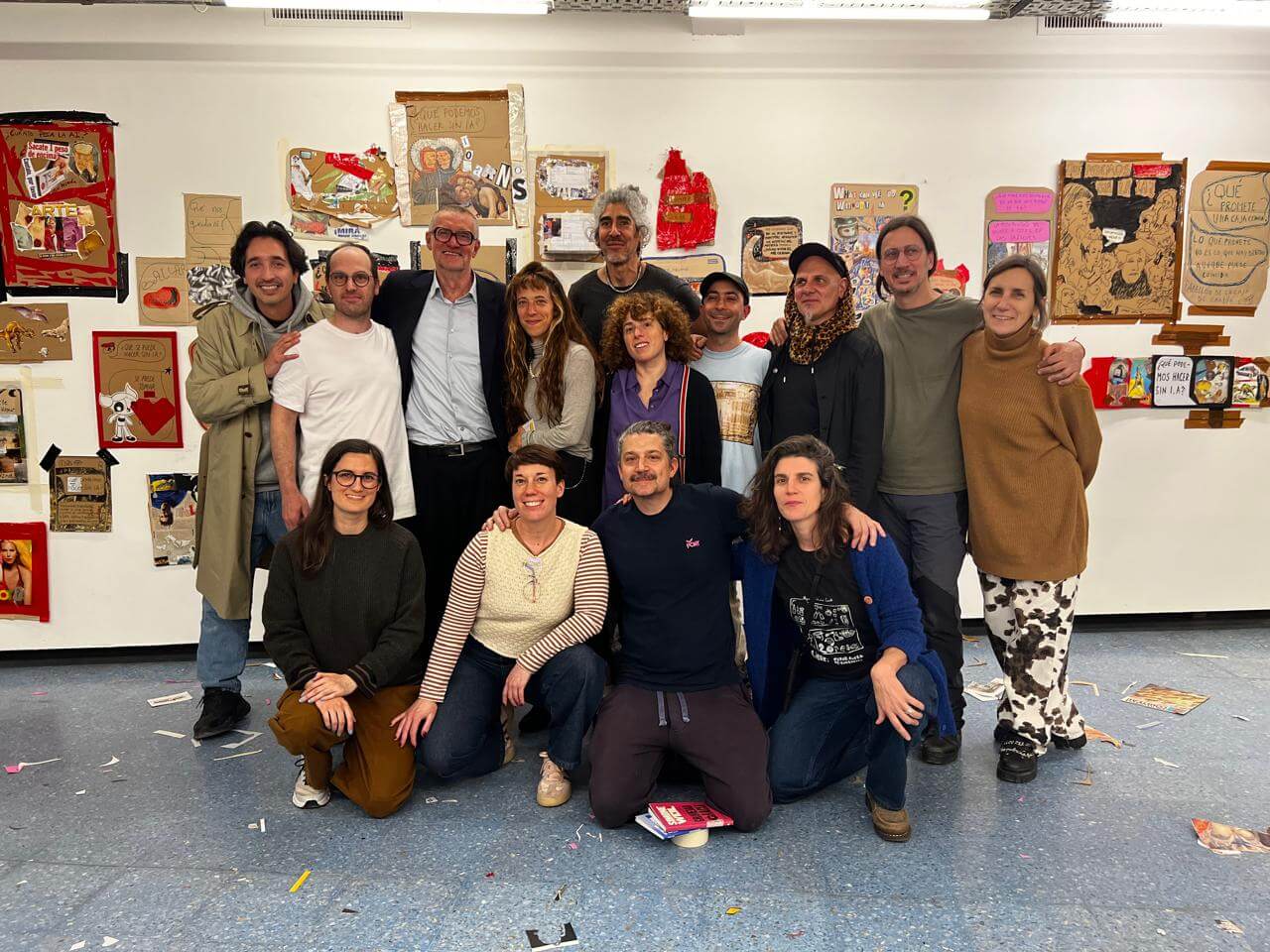
En su segunda aparición pública, el sábado siguiente en PROA21, Hirschhorn sembró la pregunta “¿Qué se puede hacer sin IA?”, a contramano de una época en la que la IA parece venir en socorro del tiempo que nos falta. Dijo que el peligro es sumar una prótesis allí donde no es necesaria: reemplazar nuestra capacidad de pensar podría implicar perdernos en un limbo. Parece algo novedoso, pero Anne Almobert rastrea un escenario parecido frente al surgimiento de la escritura alfabética y la desconfianza de Platón a que esta les allanara el camino a los sofistas, sus clichés y su seductora persuasión. ¿Qué hicimos para responder esa pregunta? Un grupo de artistas ayudamos a los participantes a mirar revistas, elegir imágenes y recortarlas, pensar un texto o prescindir de él, distribuir los materiales sobre un cartón y darles cohesión. En su progresiva duración, una tarea en apariencia simple y hasta sonsa demostró convertirse en un movimiento inspirador. Espiar un poco en qué andaban los demás, intentar ayudarlos, acompañar cierto desorden que nunca falta en lo colectivo: tijeras, plasticolas, imágenes codiciadas pasaban de mano en mano mientras restos de recortes se iban acumulando en el piso con un patrón aleatorio y feliz. La pregunta “¿Qué se puede hacer sin IA?”, en su insistencia, demostró que la inteligencia humana opera de formas misteriosas. A la hora indicada, todos los participantes fueron invitados a pegar sus trabajos en las paredes y cotejarlos, un cierre que nos llenó de entusiasmo.
Había en el aire un orgullo escolar, algunas piezas incluso articulaban mecanismos, no había dos siquiera parecidas. En la diversidad y en el clima de algarabía parecía haber una respuesta. Una intuición práctica nos llevó de la pregunta inicial a otra, también esencial: “¿qué es lo que nos hace humanos?”. Acariciar, dar besos, hacer caca, escribir con faltas de ortografía, sentir el viento en la cara… O cuando venís con envión andando en bicicleta, y si conocés el camino, saber que también podés cerrar los ojos.
Equipo hirschhorniano de Buenos Aires, de izquierda a derecha, de pie: Nicolás Rodriguez, Nicolás Bacal, Thomas Hirschhorn, Denise Groesman, Diego Bianchi, Liv Schulman, Ariel Cusnir, Leonello Zambón, Julián D’Angiolillo, Marcela Sinclair. En cuclillas, Daniela Varone, Sol Ganim, Leo Estol y Lucie Haguenauer. Participaron también Lara Palmieri, Renzo Longobucco y Pilar Victorio, ausentes en la foto.
No hace falta haber surcado en góndola sus canales, haberse perdido en sus estrechos callejonesni haber oído el golpeteo del agua contra las escalinatas de mármol para que Venecia nos resulte familiar. Su imagen la precede, fraguada en símbolo. “Venecia era su propio fantasma”, piensa Evelyn Dolman, protagonista de la novela más reciente de John Banville. A esa ciudad anfibia, crepuscular, suspendida entre el esplendor y la decadencia, llega este escritor con veleidades literarias devenido redactor de guías turísticas, para solazarse durante la luna de miel en compañía de su flamante esposa, una joven norteamericana heredera de una cuantiosa fortuna.
Estamos en el último día del siglo XIX; los espectros todavía prefieren morar en casas encantadas antes que repantigarse en el diván. Pero en pleno umbral finisecular ya asoma otra clase de fantasmas, menos proclives a atravesar paredes que a rondar los recovecos del pensamiento. Y si hay algo que Banville domina es el arte de hacer de la conciencia de un personaje un lugar. La ciudad abunda en reflejos y duplicaciones; Dolman también. Ninguna superficie —espejo, rostro o recuerdo— parece inocente.
Es sabido queun narrador puede adulterar los acontecimientos a su antojo; más insidiosa, sin embargo, que la tergiversación concebida para engañar a otro es aquella que se erige como salvaguarda ante sí mismo. Dolman pudo no haber cometido un asesinato, lo cual no lo exonera de otras bajezas. De ahí que elabore un relato a la medida de sus escrúpulos, hasta ocultar, incluso en su fuero interno, todo resabio de impostura.
Pero a la doble mendacidad de Dolman como narrador se superpone la paradójica circunstancia de hallarse, a su vez, sometido a la manipulación ajena. Una cohorte de personajes enigmáticos y moralmente ambiguos —desde su propia esposa hasta los criados, pasando por quienes se dicen amigos de la infancia— lo precipita “de manera irresistible al centro de un drama cada vez más oscuro en el que todos se habían aprendido de memoria su papel y lo interpretaban con suma pericia, desenvoltura y gracia”.
Menudean los dobles, las identidades escurridizas, las apariciones y sus reversos, la unánime niebla y hasta algún desliz de perspectiva (¿alguien que no fuera un iniciado habría podido considerar a Caravaggio un gran pintor antes de la puesta en valor de Roberto Longhi?), mientras la prosa serpentea y se demora, con devoción, en los detalles. Ese regodeo permite a Banville salir airoso del lance. El estilo es su coartada. Atmosférica y truculenta,Nocturno de Venecia es como la basílica de San Marcos ante los ojos de Dolman: “una curiosa mezcla de lo lúgubre y lo chabacano”.
Menos solemne de lo que suele aparentar, el escritor irlandés, también autor de La señora Osmond, siempre balanceándose entre sus coterráneos Joyce —que lo puso todo— y Beckett –que lo sacó todo—, inocula en este relato una sordidez de ribetes cómicos. Pero el verdadero espíritu que sobrevuela estas páginas es el de Henry James, que hizo de Venecia el escenario de una de sus novelas y del fantasma, en su literatura, una presencia que se recorta en el límite de lo decible. Inquieta, entonces, tanto en James como en Banville, menos el asedio de presencias furtivas que la necesidad de inventarlas.
John Banville, Nocturno de Venecia, traducción de Antonia Martín, Alfaguara, 2026, 320 págs.
“Una isla es un ente solitario y autárquico, pero accesible desde todo su perímetro. Está protegida, pero al mismo tiempo expuesta. Todo lo que arriba a una isla se transforma y pasa a ser suyo. Empezando por uno mismo, en cuanto pone un pie en ella. En las islas uno se siente de otro planeta. En otro tiempo. Son las casillas de un juego de la naturaleza. Al poco, se tiene la impresión de conocerlas. Las sentimos nuestras, y sin embargo estamos seguros de que las abandonaremos. Sentimos algo así como una nostalgia anticipada. Y la nostalgia es una de las moradas de la fantasía”.
Quien habla es El Pilota, protagonista y orador principal de ese libro de veinte ensayos narrativos dedicados cada uno a una isla, la mayoría conocidas (desde lo simbólico, al menos). El que lo acompaña en el periplo es el Cronista, o bien el mismo Ernesto Franco (Génova, 1956). Asumimos que El Pilota es un marinero que conoce todas las islas del mundo, que va de una a otra y que las habitó por más que hayan pasado siglos de lo que se cuenta. Ambos viajeros casi parecen ir a la deriva, no planificados, en una especie de averno marítimo agradable. Y cuando aparece una de ellas, donde recalan, comienza un diálogo que desenreda la historia, diálogo que funciona más como soliloquio del propio Pilota y del que el Cronista casi desaparece como segunda guitarra.
Las historias de las islas son diversas, poco tienen que ver una con otra, están separadas por siglos y por civilizaciones, pero de todos modos El Pilota consigue extraer un denominador común de ellas, como el mar que las envuelve, y luego aquello que las hace únicas e irrepetibles. No es que el Pilota cuente lo obvio. Por ejemplo, uno puede esperar qué dirá de Ítaca (la isla que, previsiblemente, cierra el libro y de donde se extirpa la cita del primer párrafo), pero lo que brilla ahí no será Ulises ni Penélope, sino un intento por comprender al ser humano en sus lanzamientos hacia el mar, para ir, de isla en isla, como en una rayuela, a descubrir los misterios del mundo.
También hay islas poco conocidas. Por ejemplo, está la historia de Ferdinandea, que hirvió desde el lecho marino del Mediterráneo por un volcán en erupción que, en su proceso de parto, la volcó a la superficie un día tranquilo cerca de la costa de Sicilia, un 10 o 11 de julio de 1831. Emerge del mar una roca hirviente, con dos lagos internos que bullen encerrados por rocas volcánicas negras. Una islita que es la nada misma, que no se puede pisar por un tiempo; quien lo hiciera se calcinaría, pero al mismo tiempo es la última tierra incógnita que queda, ahí a los ojos de todos, y eso desata la fiebre absurda de los muchos reyes que habrán de querer llegar primero para conquistarla.
Historias fantásticas de islas verdaderas nos lleva por diversos siglos de guerras, reinados, naturalezas, brujerías, maldiciones, como si parte de nuestra esencia descansara en esos cúmulos de tierra separados por el mar. En este sentido, sirva de advertencia la Isla de Pascua, donde se resume esa competencia por erigir ídolos enormes de piedra y que agotó la existencia de una comunidad que había llegado ahí hace muchísimo, y que no tenía barcos para poder salir en busca de otra cuando llegó el agotamiento y hubo de caer en el canibalismo y la casi extinción: “La historia de la isla de pascua perdida en el océano ¿no les recuerda un poco a la de un pequeño planeta perdido en el espacio, también éste poblado por ídolos y sacerdotes y, sobre todo, por habitantes cuya tecnología es insuficiente para huir a otro lugar?”.
Ernesto Franco, Historias fantásticas de islas verdaderas, traducción de Natalia Zarco y prólogo de Alberto Manguel, Gatopardo Ediciones, 2025, 176 págs.
 Login