Normal view

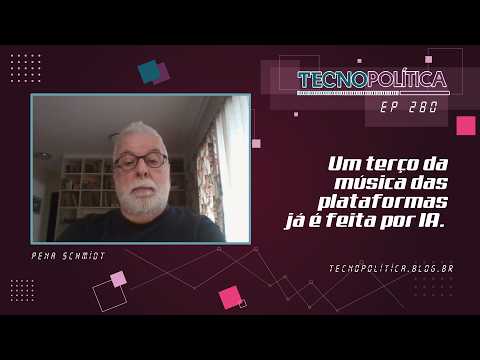
TECNOPOLÍTICA #280 - UM TERÇO DA MÚSICA DAS PLATAFORMAS JÁ É FEITA POR IA.

💾

Nesse episódio do Tecnopolítica, Sergio Amadeu conversou com Pena Schmidt, produtor musical de artistas e bandas como Titãs, Ira! e Os Mulheres Negras, sobre o futuro da música diante da |Inteligência Artificial. Pena, que também foi superintendente do Auditório Ibirapuera e Diretor do Centro Cultural São Paulo, considera que só há uma solução para não perdermos uma ou duas gerações de músicos que não conseguirão viver de música. Pena Schmidt considera que Big Techs e a indústria cultural querem reduzir custos para aumentar seus lucros sem se importar com a nossa cultura. Ela alerta que dispositivos de IA estão permitindo a monetização de músicas de baixa qualidade, feitas por sistemas automatizados com custo de uma assinatura mensal de menos de 100 dólares. Pena propõe dar um basta nisso. Episódio imperdível!

TECNOPOLÍTICA #279 - Soberania de Dados e a Insuficiência da LGPD

💾

Nesse episódio do podcast Tecnopolítica, Sérgio Amadeu conversou com Arthur Lage Garcia Carvalho, recém formado em Direito pela Universidade Federal de Ouro Preto, MG, sobre a insuficiência da Lei Geral de Proteção de Dados (LGPD) diante das necessidades da soberania digital no Brasil. Arthur Carvalho realizou uma pesquisa mostrando que a LGPD é necessária, mas insuficiente. Apesar de
representar um avanço normativo relevante, a LGPD não conseguiu, por si só, conter nem reduzir as práticas extrativistas das grandes plataformas digitais. Além disso, a lei legitima os fluxos transfronteiriços de dados que comprometem a soberania nacional. Na conversa Arthur afirmou que a LGPD precisa ser melhorada e que a ANPD teria que ser mais revigorada para fazer valer nossos interesses diante de corporações tão poderosas. Por fim, Arthur defendeu que o consentimento, princípio fundamental da LGPD, é uma ilusão regulatória. Ele nos explica que diante de contratos de adesão e opacidade algorítmica, os titulares, ou seja, o cidadão comum não têm real capacidade de compreender ou controlar o uso de seus dados. Episódio imperdível.

Você Ainda Programa Como Em 2023?

💾

A era do prompt simples já ficou para trás e agora entramos em uma fase mais técnica da IA com Graph Engineering, Loop Engineering e sistemas de memória complexos. Exploramos como o SDD (Spec Driven Development) e os novos protocolos estão transformando o papel do desenvolvedor, exigindo muito mais do que apenas saber 'conversar' com uma LLM. Descubra por que entender a arquitetura por trás dos agentes é o que vai separar os profissionais dos amadores em 2026.

📌 VPS HOSTINGER QUE USAMOS → https://codigofonte.click/vpshostinger
O cupom CODIGOFONTE te garante um desconto maior

📌 COMPILADO PODCAST
→ @CompiladoPodcast
→ https://compilado.codigofonte.com.br

📌 LINKS DO CÓDIGO FONTE TV
→ https://codigofonte.tv

📌 CONTABILIZEI: CONTABILIDADE PARA DEVS
→ https://codigofonte.click/contabilizei2026
Cupom (1 mês grátis): CODIGO_FONTE1M

📌 USAMOS CADEIRAS HERMAN MILLER
→ https://codigofonte.click/hermanmiller

#inteligenciaartificial #programação

Google Pixel 11/Pro/Fold Impressions: It Is What It Is

💾

Every year, a new Pixel, and new hopes and dreams...

Protect your new Pixel 11 or old Pixel 10 with dbrand at https://dbrand.com/shop/pixel11

Affiliate Links:
Pixel 11 Pro: https://geni.us/iypnawz
Pixel 11 Pro XL: https://geni.us/Jfybl
Pixel 11 Pro Fold: https://geni.us/XaTcge
Pixel Watch 5: https://geni.us/2s9sEq

MKBHD Merch: http://shop.MKBHD.com

Playlist of MKBHD Intro music: https://goo.gl/B3AWV5

~
http://twitter.com/MKBHD
http://instagram.com/MKBHD
http://facebook.com/MKBHD

Podcast #278 - Sindicato dos Bancários lançará nó de IA soberana

💾

Nesse episódio, Sergio Amadeu conversou com Mauro Salles, diretor do Sindicato dos Bancários de Porto Alegre e integrante da CONTRAF-CUT. Mauro apresentou o histórico projeto IANDE, primeiro nó de uma rede federada soberana de data centers de baixo impacto ambiental, sem uso de água, para treinamento e inferência de IA. Esse projeto pioneiro no Brasil mostrará que existem outros modos de implementar sistemas automatizados, com software livre, código aberto, sem necessidade de estruturas de hiperescala. Acompanhe essa conversa e se você quer integrar essa rede federada soberana entre em contato com o Sindicato dos Bancários de Porto Alegre. Divulgue e compartilhe esse episódio. Histórico!

🚨​ MYTHOS 5 FEZ ATAQUE DE ENGENHARIA SOCIAL!

💾

Qual é o limite dos agentes de IA para executar uma tarefa? O modelo Mythos 5 apelou para a engenharia social para tentar passar um código malicioso em um repositório.

Criou contas falsas e disparou mensagens tentando convencer que o código era genuíno! Acabou sendo pego, mas falta pouco para esses modelos conseguirem enganar os próprios humanos.

📌 Aprender a Controlar a IA é o Caminho para a Produtividade com Segurança.
→ Estude na Full Cycle no MBA de Engenharia de Software com IA.
→ https://codigofonte.click/fullcyclemba03

📌 COMPILADO PODCAST
→ @CompiladoPodcast
→ https://compilado.codigofonte.com.br

📌 LINKS DO CÓDIGO FONTE TV
→ https://codigofonte.tv

📌 CONTABILIZEI: CONTABILIDADE PARA DEVS
→ https://codigofonte.click/contabilizei2026
Cupom (1 mês grátis): CODIGO_FONTE1M

📌 USAMOS CADEIRAS HERMAN MILLER
→ https://codigofonte.click/hermanmiller

#mythos5 #sec #github

APPLE ENTRA EM BRIGA FEIA COM A OPENAI

💾

Apple acusa OpenAI de espionagem industrial! Em que cenário isso pode acabar bem?

📌 Integre Pagamentos e Assinaturas nos seus Apps com a Appmax
https://codigofonte.click/appmax

📌 COMPILADO PODCAST
→ @CompiladoPodcast
→ https://compilado.codigofonte.com.br

📌 LINKS DO CÓDIGO FONTE TV
→ https://codigofonte.tv

📌 CONTABILIZEI: CONTABILIDADE PARA DEVS
→ https://codigofonte.click/contabilizei2026
Cupom (1 mês grátis): CODIGO_FONTE1M

📌 USAMOS CADEIRAS HERMAN MILLER
→ https://codigofonte.click/hermanmiller

#apple #openai #treta

Figma for Agents: How Airflow's Creator Coordinates AI ft. Maxime Beauchemin

It’s hard to keep up with the AI evolution; new AI tools drop every week, but how are experienced practitioners actually using them? Most of us are overwhelmed and unsure about the many possibilities, yet we need to keep going and do our work. You might use AI agents all day long, parallelize them with AI Orchestrators, tmux, git worktree, and so on, using AI IDEs, but in the end, you still need to coordinate and understand what the agents produced, potentially test it, which makes it even harder to keep up.

Luckily, Maxime Beauchemin, the creator of Airflow and Superset and the person who defined what “data engineer” meant for a decade (more on him below), joins us to show how he uses agents and what he’s built for working with them. I tried to extract the patterns behind how he actually uses AI in his data work today. This is the fourth interview in ‘How to use AI with DE’.

In this article, we go into four parts: (1) How to balance quality with messy data warehouse work, and how to manage agents with Figma for agents. (2) We elaborate on the future of the context layer and the return to semantics, (3) how Okta for Agents is needed for security, and (4) how the future of agentic workloads can be done in teams, whose yap-to-ship ratio is best, and why Amdahl’s law still counts.

Introducing the Guest: #4 Maxime Beauchemin

Our guest in this interview Max Beauchemin, the creator of Airflow and Superset. He’s known as one of the OGs of defining how data engineering worked back in 2017, and founded Preset, the company behind Superset, and currently serves as its CEO.

He is heavily involved in the AI workflow, which is another reason I wanted to interview him for this series, but he has also been building in the space himself: Agor (Ag: AI agent + Or: orchestration), earlier tooling like claudette-cli1, and db-agents, an experiment to embed agent context directly inside databases. We’ll get into it all.

Max and I talked about many things, among them how to use AI in data engineering, how security plays a role, how shared, secure, context-rich agent workspaces work within teams, and how he uses AI assistants to run his business and ease his life as a CEO.

Max is a true open-source enthusiast, and he wants open source to win. Everything we discuss here is somewhere on GitHub, which I have happily linked throughout the interview.

Figma for Agents: Visualizing Tasks and Jobs with Agor

Before we start using Figma for Agents, coordinating them on canvas, we need to ask why we need coordination and orchestration in the first place.

Balancing Quality with Quantity: Messy DWHs

That’s where we started, with the challenge of messy data warehouse environments that most people find themselves in. I asked how he balances quality and quantity, aiming for high quality.

Max says that the new models, Opus 4.5 or 4.62, are not making many errors anymore and are very clever when they get the right context as above with all the database schemas of tables and data types, and even querying it with MCP. He says they almost run in self-serve mode, but he still prefers that users know what they are doing and can either read the generated code or verify the generated numbers on a dashboard or chat results.

But the setup is critical. With these three prerequisites, the agents handle almost all queries really well:

  1. You need some preparation claude.md/ agents.md
  2. Access to SQL (e.g., execute dbt)
  3. Access to MCP or CLI for BI tools (e.g., Superset supports sup!, a CLI to interact with Superset)

The only problem, and always has been, is the messy structure and sources that most organizations have, growing from an initial small project into a certain stage. There are always obscure tables or strings, timestamps not aligned, or hidden information that is not encoded in code or written down. Or there’s the hidden knowledge, like that a certain table shouldn’t be used anymore or has bad data, which is known to the people using it but might not be to agents.

The Canvas in Which Your Agents Can Run: Automate Most CEO-stuff

When he recently saw the power of agentic coding, Max went all in and has been building the Figma for agents ever since. Something he can use to collaborate with agents within his company, instead of everyone running the same prompts locally and needing to sync with each other manually. That’s when Agor was born.

Agor stands for Ag: agent and Or: for orchestration. As the creator of Airflow and CEO of a data company, he knows exactly how a tool needs to improve his workflow. He also called it:

The goal is to automate most of the automatable CEO-stuff

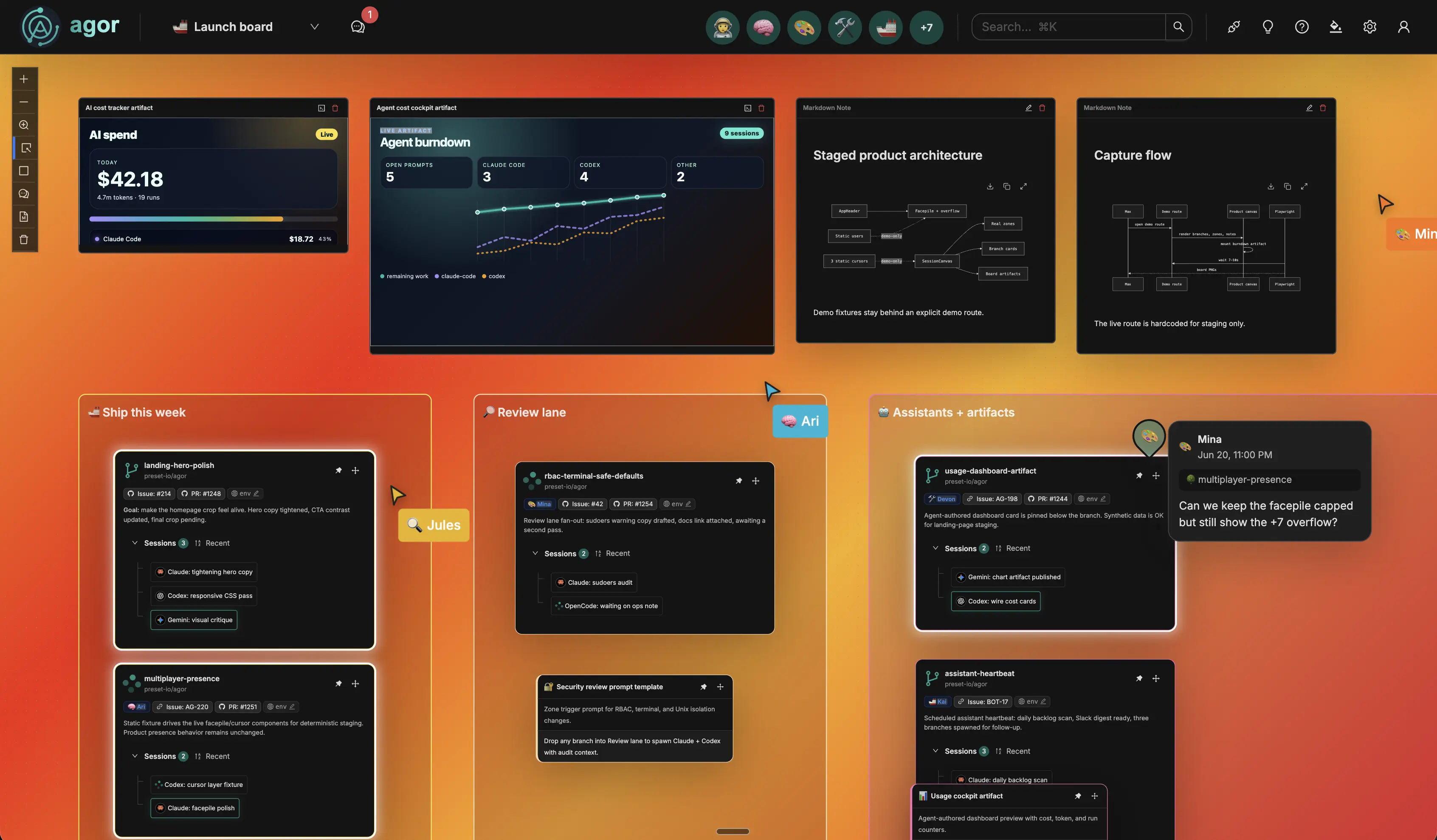
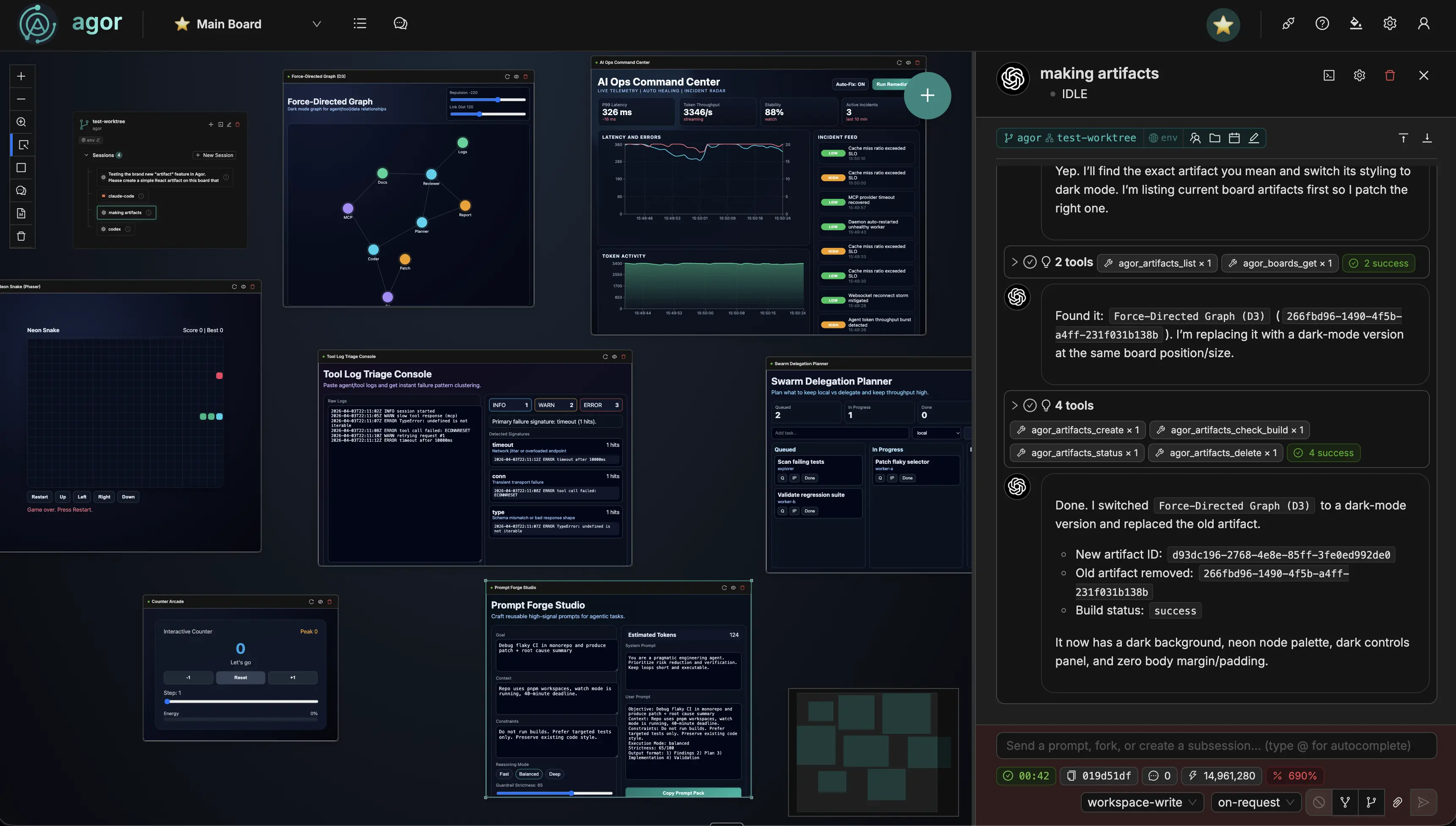
The board: branches as cards, zones as regions, agent sessions, and teammates present live. See full demo Agor Agent Orchestration Demo.

Building an Internal Knowledge Base: Shared Canvas

Agor was Max’s answer to “how he uses AI beyond a research tool”, but doing data modeling, writing data pipelines, even legal or HR roles he added later to Agor, so you can give company-wide roles to agents that can be fed with dedicated documents and context, and triggered by any employee internally. In contrast, others see the jobs and avoid asking the same questions, reusing the output for new queries—Andrej Karpathy’s concept of an LLM-maintained shared team wiki—which builds an internal knowledge base.

Initially, when we first chatted, Agor had already changed how he worked as a CEO, but since then, Agor has gone even further. Agor can replace high-level tasks while still being very hands-on by working closely with the code via git worktrees (branch cards in Agor’s UI) and verifying the code in the PRs it produces. Max also added OpenClaw-like features around memory and identity via dedicated Markdown files, such as AGENTS.md, SOUL.md, MEMORY.md, so that Agor’s agents can learn from recent runs and carry a purpose and clear instructions. This led to role-based agents called Assistants (use agor-assistant as a template to build your own).

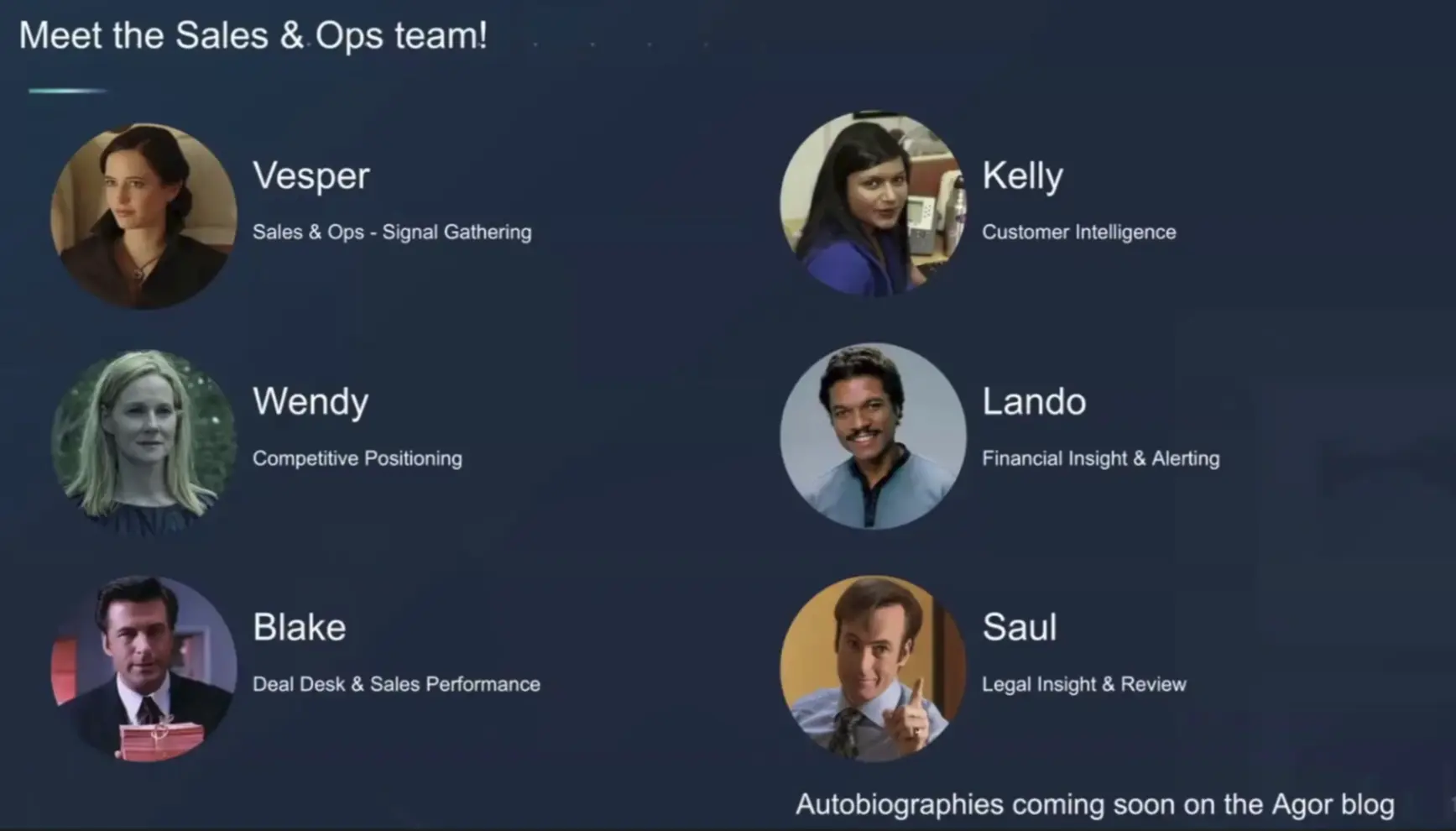
Example of different Agor assistants: Saul for legal, or OpEx for observability and so forth. | From the Webinar Anatomy of Our Internal Data Agent

Inspired by OpenClaw’s agent loop, Assistants became first-class citizens, persistent AI companions with memory, identity, skills, and scheduled tasks integrated into Agor’s canvas, multiplayer workflows, and reachable directly from Slack, for example. Additionally, Agor adds features beyond OpenClaw, such as better multi-user support, RBAC, one-click, full session inspection, and many more.

Asked about the goal of Agor, Max said:

The initial premise was to remove DevOps and set up time for other members of the company. Instead of people needing to connect all the MCPs or CLIs to add API keys, set permissions, or integrate with Slack, the prompt window with the needed context is there and ready to start.

[!note] OpenClaw, what is it? And how does Agor compare?
OpenClaw (formerly ClawdBot) is an open-source agent framework built around a persistent agent loop: a serialized cycle that turns a message into actions, using file-based identity (SOUL.md) and layered memory (MEMORY.md). Agor’s Assistants adopt this pattern and extend it with multiplayer boards, RBAC, and canvas-level orchestration.

Visual and Spatial Memory

When you do a lot of agent work, it’s really hard to keep up with all of it. That’s where Agor’s visual and spatial overview really helps and is unique in its approach.

It brings the local and private session to a server, where everybody can see and work together on the same queries, and use the insights from other results, as dashboards are built for. So instead of keeping output locally, others can source the artifacts generated by agents, stored as Artifacts within Agor, ready to use by anyone, with no integration or deployment needed.

Example Artifacts such as AI Ops Command Center, Tool Log triage, these live directly in Agor based on an Agor session

Or how Agor tracks its own spending across sessions:

See demo at Live Talk: Anatomy of Our Internal Data Agent at Preset (ft. Agor)

[!note] Check the full Webinar about the Anatomy of the Internal Data Agent at Preset.

Such as an assistant needing access to all pipelines’ metadata as illustrated data stack.

Or the data needs an analytics agent to support, such as self-serve, the data team, and extras such as memory, skills, documentation, etc:

Context Layer: Back to Semantic Layers?

Max also believes that we are going back to the Semantic layer, or using it for AI as agents benefit from structured information - helping with the data model and SQL part, to make sure it’s correct, especially with the needs of AI agents and the persistent challenge of providing trustworthy self-service analytics.

With the shift of semantics outside of the BI tool, versioned, testable, portable, it’s a chance for better integration between business domain experts and data engineers. His thinking has evolved since he wrote the article, and Max told me:

I see two different semantics: the semantic layer and the YAML. There are the hard constraints — not every area needs that strictness — and then the softer ones with Markdown and Agentic Skills, good for 80-90% but with no guarantees.

AGENTS.md For Databases: Markdown Stored Inside the Database Itself

Based on that idea, Max created an experiment to bring the AGENTS.md convention into the database. DB-AGENTS reserves a dedicated schema and table, _agents._agents, that holds agent-oriented documentation at different scopes (global, domain, schema, table, and even column). You write the docs locally as markdown files with YAML frontmatter, and a small CLI (dba) deterministically syncs them into that table — since databases don’t let you drop files into them, the table becomes the file. Agents then query it at session start the same way they’d read an AGENTS.md, making it a natural companion to INFORMATION_SCHEMA: one holds structure, the other holds meaning. Max calls it a “soft semantic layer”, which maps directly onto the hard-vs-soft split he described above. Check out the repo at db-agents.

With context being key for agents to understand what we humans know, Agor also added a context layer called knowledge. Agor Knowledge acts as a central place where humans and agents can store, organize, connect, and find the context that makes work compound over time, with Slack quickly becoming the main interface to many of the team’s agents.

How Do We Sandbox Agents for Safe Workflows (Okta for Agents)

Another big topic is security when agents have so much access to powerful CLIs, sometimes root access to systems or databases containing private keys, or just downloading random skills from the internet that may contain hidden secret messages.

Max coined the idea of Okta for Agents, which I found super interesting, and something I believe will become ever more important if we want to find a healthy way of working with agents in enterprises or with sensitive data. Okta for Agents means working around identity, scoped delegated permissions, leases, and audit logs.

When asked how he’s managing security, verifying what Agor or the agents are doing, Max responded:

I let the workers run in god mode3, but using dedicated environments/sandboxes, hooked to a dedicated git worktree repo, it can run autonomously and solve problems on an initial prompt, visualized in a shared canvas style.

I asked how he sees Okta for Agents being implemented. We desperately need it, he said, granting agents permissions like impersonation. Delegating the permission is an OAuth. With the roles, we can scope permissions strongly. E.g., the sales agent only has access to sales documents.

When asked at what level to integrate the Okta security layer, Max said it hasn’t been solved yet. Still, he sees it as the same question: whether we have 50 agents or 50 users who use a platform, both need a security layer.

Likewise, Max shared:

I trust agents the same way as I would an employee.

[!note] What does “Okta for Agents” mean in more details?
Okta is the identity layer companies put in front of their tools: it authenticates who you are, decides which systems you can open, and logs what you did. Max’s point is that agents need the same layer. E.g. Clawdbot, when he tried it, was effectively a DIY IAM manager for agents, config hell and all.

The twist is that it adds a whole new dimension to RBAC. It’s not just “the bot gets an email account” — it’s “the bot gets an email account, but can only read mine, and via MCP rather than as a real user.” Not so different from onboarding a human personal assistant, except this assistant can help with nearly everything, so the blast radius is much bigger.

Max’s own example: he saw a 1Password skill and immediately backed off then reconsidered, wondering whether the bot should have its own 1Password account with only safe credentials shared into it. Which is exactly the problem: you can be strict on paper, but the moment the agent has your email, Slack, and calendar, it can leak private things all day. (Full discussion at this post)

[!warning] Security is critical. Here are examples when it’s gone bad
How I Dropped Our Production Database and Now Pay 10% More for AWS, or another one, or when 13-hour AWS outage reportedly caused by Amazon’s own AI tools. Or also just hacks by getting attacked via GitHub PRs or How secret instructions injected into skills.

Declarative and Non-deterministic Outcomes?

Related to security is the deterministic, repeatable behavior of data sets with the same input. Agents are the opposite: probabilistic. I was curious to hear from Max, who initially defined the functional data engineering paradigm for deterministic and idempotent batch data processing, what he thinks about the non-deterministic outcomes of agents, specifically with large language models.

Max said, regarding declarative definitions, that he finds a claude.md is usually sufficient for most tasks that have a git repo, more context, and an issue or PR to work with, given the initial prompts come from users who know what they are doing.

Regarding reliability, Max thinks about using good methodology references. Agents get it and understand it. E.g., data modeling practices such as Kimball are still valid, or the approach shared by him with Entity-Centric Data Modeling (ECM), he says, and when prompted to model in those patterns, agents follow them well (either via research or provided).

The other part is that some non-dangerous work can have vibe data pipelines, and there’s no danger. And there are cognitive-depth tasks, such as a complex Spark cluster, where you can’t just debug quickly with large data sets.

Also, the field varies: not every area is getting agentic-piled as fast. E.g., platform demands go through the roof (see GitHub outages), so we have 10-20x the platform needs, but at the same time, the work is critical to be correct. So it depends.

Future of Agentic Workload, and Canvas Development in Teams

When asked about how Agor has changed how they at Preset develop products (if at all?), or made them more effective, Max said:

There are more agents than humans nowadays. Everyone has a Claude Max plan, and agents handle almost all code writing.

And on a personal level:

I haven’t written a function by hand for a long time, and I might not anymore — except when I feel nostalgic.

He also thinks that the Yap-to-Ship Ratio, a metric that he announced half-jokingly on LinkedIn, describing people’s velocity by just getting stuff done without involving others at every step, will be very low-yap for 10x engineers, as they solve the problem and ship a solution without much back and forth.

They deploy it somewhere for others to use, not only for human consumption, but as a solution or CLI that other agents can use to discover further and solve their problems. A high Yap-to-Ship ratio would mean lots of human interaction, which is the clear new bottleneck.

As human code review gets bottlenecked, I asked how he does the review. He said he uses Codex with sub-agents to review, ensuring everything is DRY (Don’t Repeat Yourself) and that all expected callbacks are made.

You can also ask the operator assistant agents if you are not sure whether an implementation is correct.

Amdahl’s Law: Can’t Go Faster if not End-to-end

One bottleneck is still Amdahl’s Law. We can speed up tooling by using extremely fast agents, but unless the end-to-end workload is sped up, we only increase by a 2-3x factor, not 10 or 100 as any one tool does. This also overlaps with Max’s Yap-to-Ship ratio: if PRs need the human in the loop to review many of them, the overall speed at which we build is not faster.

Another side effect is that it takes a lot of context switching. Max said he has ten active sessions in Agor. He is good at context switching (maybe also learned through recent Agor workflow? 🙂).

Predictions for 2026

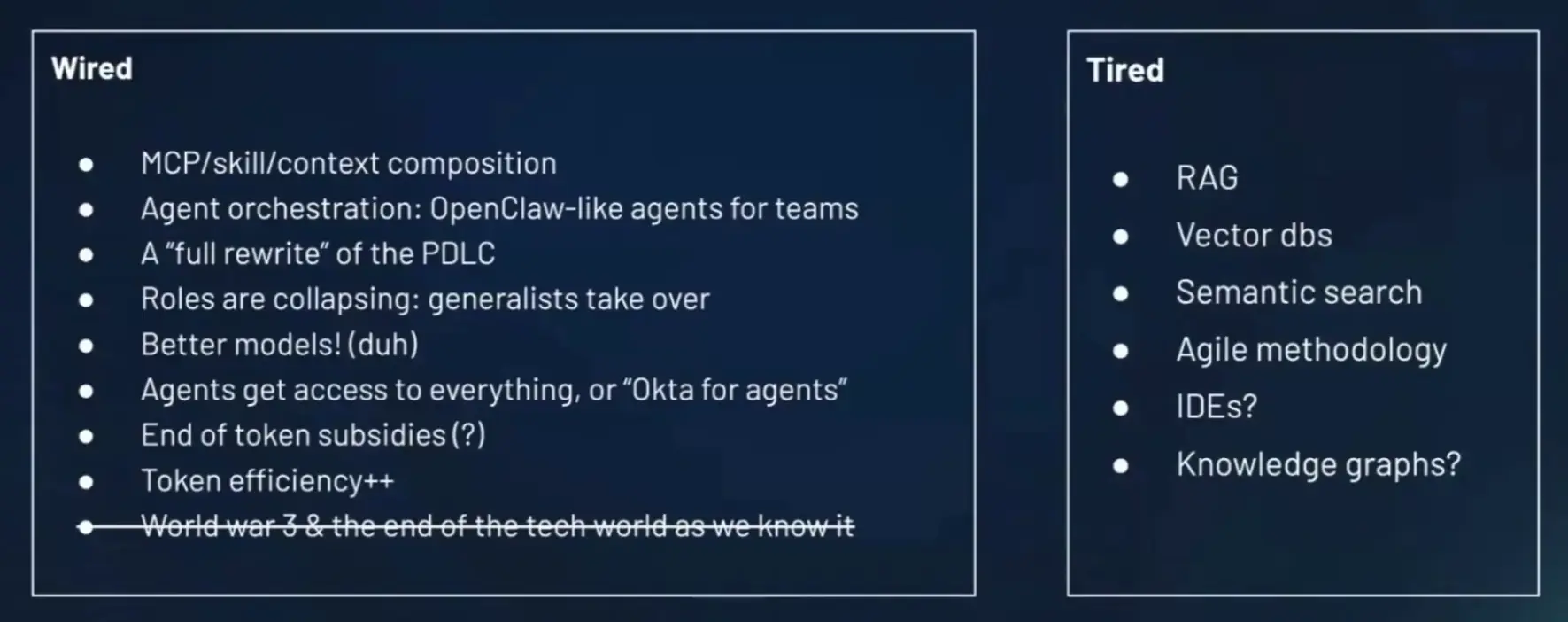
It’s hard to predict the future with AI, but Max took a stab and shared his predictions for 2026 and categorized them into wired and tired:

Find the full talk at Webinar.

Max’s AI Setup for Data Engineering Work and Managing His Company

We end this interview with Max’s setup for working with agents, since we didn’t have time to go into full details on the call. I’m sharing the one he shared four months ago. I’m sure it changes almost daily. Still, it helps us get a good overview of his software engineering stack for the team at Preset, as well as his personal local computer stack.

For software engineering and data engineering:

  • Preset team instance of Agor behind VPN with a dozen boards, boards are mostly repo-oriented. Full Unix impersonation, backed by PostgreSQL.
  • doing most of my work on board with the agor-openclaw framework, agent is pushing projects across a kanban-type layout: tons of new automation there. Agent checks on agents, prompts them, moves worktrees to “needs human review” zone if/when needed
  • coding workflow is Opus 4.6 as a planner, Sonnet 4.5 / Opus 4.6 for most coding, Codex 5.3 as the reviewer (god it’s so good)
  • data engineering stuff: dbt/airflow repo + Superset MCP, superset-sup
  • “Command center” is agor-openclaw on Opus 4.6, monitors other agents, intricate HEARTBEAT.md with pseudocode to make a decision for coding project (worktree) on that board

And his new “Personal assistant” local instance of Agor (brand new/sensitive):

  • Beefy Mac Studio at home
  • connected to “productivity” tools (google-workspace-mcp)
  • connected to Slack through a semi-homegrown skill — read-only for now, mostly to summarize activity
  • connected to Notion MCP
  • connected to “contracts” repo, where I sync with Google Drive for all Preset contracts
  • connecting to Hubspot soon
  • goal is to automate most of the automatable CEO-stuff as discussed above

Coming up

We’ve learned how to use Figma for agents with Agor and to collaboratively work as a team, using shared prompts and creating artifacts. We’ve seen how Okta for Agents is needed but really hard to implement, and how the future of AI is mostly about context and how to integrate it well. Plus, we learned how Max automates many tasks as a CEO with dedicated AI assistants and still produces low-level code with the same assistants for both his personal and company-wide needs.

I hope you enjoyed this fourth interview with Max. Huge thanks to Max for taking the time to speak with me (twice!) and for sharing his experience with all of us. Follow him on LinkedIn, GitHub, or on Preset Blog, where he shares his distilled thoughts on the ecosystem, and obviously, if you want to know more about Agor, check it out at Agor GitHub repo.

Max shares a lot of his ideas and thoughts online. Here are some further articles and interviews to read/watch:

More interviews are coming out, so please share feedback, questions you might want to ask, or your experience working with AI in the data space. We’re all in this together, figuring it all out.


Full article published at MotherDuck.com - written as part of my services

  1. claudette-cli, a CLI for managing git worktrees, originally built for Apache Superset development. ↩︎

  2. when we first discussed in February 2026 ↩︎

  3. god mode means scoped/sandboxed/audited environments, not uncontrolled access ↩︎

Galaxy Z Fold 8 Review: Honeymoon's Over

💾

This is a really easy phone to fall in love with. Beware.

Enter to win $100,000 USD or 3 cars for free at https://ridge.com/MKBHD

(Affiliate Link) Samsung Galaxy Z Fold 8: https://geni.us/GEv50B

MKBHD Merch: http://shop.MKBHD.com

Playlist of MKBHD Intro music: https://goo.gl/B3AWV5

Phone provided by Samsung for review.

~
http://twitter.com/MKBHD
http://instagram.com/MKBHD
http://facebook.com/MKBHD

NO PURCHASE NECESSARY. Open only to legal residents of the promotion territory, who have reached the age of majority in their jurisdiction of residence. Void elsewhere & where prohibited by law. Enter by 9:00 a.m. USPT on 8 September 2026. 2 winners, prizes total ARV: up to approx. $380,000 USD / approximately $539,165 CAD / £284,170 / $547,515 AUD / €333,038.Skill-testing question required in CA. See Official Rules at https://ridge.com/pages/rules for complete eligibility, entry instructions, how to enter without ax purchase, entry limits, prize details, odds, and restrictions. Sponsor: The Ridge Wallet LLC.

ELES QUEREM DESACELERAR A IA!

💾

Pacing the Frontier é uma declaração conjunta de mais de mil funcionários (incluindo CEO) de empresas que estão liderando o mercado de Inteligência Artificial. Eles querem desacelerar o ritmo do desenvolvimento de IAs e precisam ganhar tempo para lidar com os riscos emergentes, desenvolver medidas de segurança e fortalecer a supervisão.

Isso realmente irá acontecer ou já é uma utopia?
A declaração está disponível em https://www.pacingthefrontier.com

📌 PARCEIROS:
→ Hostinger - https://codigofonte.click/vpshstgr
→ Full Cycle - https://codigofonte.click/fullcyclemba02
→ Contabilizei - https://codigofonte.click/contabilizei2026
→ Appmax - https://codigofonte.click/appmax

📌 COMPILADO PODCAST
→ @CompiladoPodcast
→ https://compilado.codigofonte.com.br

📌 LINKS DO CÓDIGO FONTE TV
→ https://codigofonte.tv

📌 USAMOS CADEIRAS HERMAN MILLER
→ https://codigofonte.click/hermanmiller

#inteligenciaartificial #anthropic #openai

Book Recommendations and Notes

These are my recently read books and some comments and notes from when I read them.

As I love books and recommendations by others, I want to share them in a collective format so others can read gems of books, as I think books are still the best way to read new information these days. Even more with the fast pace we are going at, as books are well structured and made for the long term.

Book Recommendations I’ve Read

Over the years, I have made recommendations in Writer’s Room, my newsletter, on my now page or in person. Here I have collected and curated them over the years including some comments. I hope you enjoy.

2026

  • Poems & Prayers (Matthew McConaughey): Another one read by Matthew himself. It’s about life and its rhymes. He said life is like rhymes as he likes them, sounds good, and prayer because of the meaning. Together applied to life, it’s like a dace to the day. He also says he has a rhythm in his head when he wakes up, and then he dances to it somehow during the day, and life fits into the song, making his day like a dance. Also, people say he is so laid back, but it’s because he has a plan, he does not rush, he takes time. So that’s on purpose. Something I also actively try to do in my life. Not yet finished.
  • Maintenance of Everything (Stewart Brand): This is just so good, it tells the story of how maintenance is everything if you rely on a boat on the sea, for example. Making the product easy to repair so you can fix it even in a rough sea with limited tools. It’s an analogy you can apply to every part of life, and the way the story is told is so great. I couldn’t stop listening to the audiobook. I really recommend it to everyone; I’m sure it will give you lots of insights into your current work.
  • Big Time (Laura Vanderkam): Started with the goal of getting more out of my time. So far, I’ve learned that time management is essentially about controlling time, but it’s not the only way. And that “Shifting Left” is not only used in data engineering, Laura describes doing tasks long before they are due as shifting left too. Good reminder of how to use time better, nothing revolutionary, but lots of real-life examples from her and her clients.
  • The Writing Life (Annie Dillard): A poetic way of what it means to be a writer. Great storytelling. Learning how to write with a family as part of her stories.

2025

  • Novelist as a Vocation (Haruki Murakami): Such an amazing book on writing. It really reminded me of my writing style, as he translates words and tries to write beautifully for the sake of beauty, not to impress the reader. No timeline. It takes as long as it takes until the quality is good. And he likes a good challenge to keep him engaged, e.g., when he goes abroad to start from scratch. His style is so unique and amazing. It’s a joy to listen to.
  • Greenlights (Matthew McConaughey): This book was so real. Matthew reads and shares from his 35 years of journaling and life. So inspiring and [[Writing from The heart|straight from the heart]]. It was interesting and motivating to hear from a Hollywood actor and celebrity what truly matters: family and keep livin. Alright, aaaalright, alriiight. → I listened to the audiobook, and his Texan accent was the best. He was rhyming, slowing down, calming down, getting loud, all of it. It was like sitting next to him and listening to your dad or uncle.
  • Consider This (Chuck Palahniuk): The author of Fight Club shares how to write if you were his student. A masterclass if you want to enhance your writing.
  • You Can Negotiate Anything (Herb Cohen): Interesting perspective that you can negotiate even at places you’d never thought of, even at a shopping mall. Always keep in mind what the other’s objective is. There are always three elements that are part of a negotiation: information, time, and power.
  • The Bible: I also started to read the Bible, the most sold book on earth. I wanted to understand what’s in there. Obviously, it’s so massive, and it’s actually not one book, but a collection of many. I get a similar sensation to one of my favorite books The Daily Stoic (366 Meditations). It’s like a daily meditation. While Ryan Holiday’s book helps me feel calmer, the Bible nourishes my love and care for others.
  • Stolen Focus: Why You Can’t Pay Attention (Johann Hari): This book inspired me to write an article about flow myself: Finding Flow. Super insightful and probably will make you want to ban social media by the government.
  • Useful Not True (Derek Sivers): Derek is the master of stripping away. This book has so much wisdom in short one-page stories from Derek’s life. It’s a gem. Perfect to re-read, over and over. It’s next to my sleeping place to just grab.
  • Tao Te Ching (Lao Tzu): Dao and Daoism: Men - earth - universe - dao. If you don’t want to read the bible, this is a none religious way of getting solitude and compassion.

2024

  • The Good Work (Paul Millerd): A continuation of the famous Pathless Path, not as good, but OK. Please read it if you haven’t yet.
  • The Extended Mind (Annie Murphy Paul): A powerful book. I started reading it again.
  • Do The Work (Steven Pressfield): It’s not the best book, maybe also because I’ve heard or read lots of the content already elsewhere, but I appreciated that it was short and that he didn’t try to extend it to 300 pages.

2023

  • Slow Productivity (Cal Newport): This is a fantastic book. It showcases why we should quit the race of everyday life and slow down for a compounding effect instead of overnight success. The same is true for money: investing long term instead of gambling in a casino. He describes that instead of pseudo productivity, which is the norm these days, where we try to be as busy as possible to showcase we are doing something, we should try to be as productive as possible.
  • Elon Musk (Walter Isaacson): It’s very long, but I loved every page (or word as I listened to it on Audible). It is inspiring. It shows how an exceptional, hard-working Musk is doing everything for humanity in an unhealthy way. He is also, to an extent, sick. He has his dark sides that just come out sometimes, which are also a sign of his mental state that he got from his dad, and also from his hard work and pressure. He is thriving in chaos. Whenever there is a calm time, he will do something new as he can’t stand the status quo.
  • How Will You Measure Your Life? (Clayton M. Christensen): A good book if you want to know more than just work and how you’ll measure it. This book was reassuring and strengthened many things I already knew. It reminded me that finding your principles is the key. Follow them and align your life so you have a happy life. It was also helpful for me as a dad and family member to pass on the same principles and values to my kids. Be intentional about your values. It’s hard to find them. They won’t be sent to you. You need to make them. But be aware that it is a process, not an event.
  • The Good Enough Job (Simone Stolzoff): A compelling book that challenges our conventional thinking about work. Instead of idolizing our jobs or incessantly chasing a better one, Stolzoff advocates for finding satisfaction in a “good enough” job. His ideas offer a refreshing contrast to the pervasive Instagram-era narrative that equates career success with personal fulfillment. A highly recommended read for anyone feeling pressured by the modern-day cult of work.
  • The Daily Dad (Ryan Holiday): This book is a sequel to one of my all-time favorite reads, The Daily Stoic. In the same tradition of offering daily philosophical advice, this book focuses on the challenges and rewards of parenthood. TODO
  • The Extended Mind (Annie Murphy Paul): An exploration of the intriguing ways our environment influences our thinking processes. Discover the surprising ways in which experts think beyond their brains, how harder thinking often leads to fewer results and the controversy over brain-training games and smart pills. Explore how we can use tools beyond the brain, such as the Body Scan technique and meditation, to tap into our intuition and sensations, and learn about the significance of the amygdala in our responses to stress.
  • All the Wrong Moves (Sasha Chapin): A captivating narrative where the world of chess serves as a backdrop for introspection and self-discovery. A story that shows how the love of chess can fully dominate one’s life, as it’s the most beautiful and worst thing in life at the same time.

2022

  • Atomic Habits (James Clear): The main argument: If you want to add a new habit, chain it to an existing one to make it stick.
  • Building a Second Brain (Tiago Forte): I knew most of it from his articles, podcasts, etc., but now it’s also available as a book.
  • Getting Things Done (David Allen): This book is life-changing if you apply its principles correctly to your life.
  • How to Take Smart Notes (Sönke Ahrens): The base for a Second Brain and where Sönke reveals how our brain is wired and how we can implement a note-taking style that supports our brain, mainly with the method called Zettelkasten.
  • The Pragmatic Programmer (David Thomas & Andrew Hunt): Although a lot was clear, summarizing it and putting it together as one piece, plus hearing it from two professionals, was very helpful and suitable for applying to my work.
  • On Writing (Stephen King): He gives deep insights into the life of a successful writer.

2021

  • The 5 Love Languages (Gary Chapman): Really eye opening, as sometimes we want to show love to our spouse, but becausewe give attention, or buy a gift, but if it doesn’t match the “love language” of the reciever, it won’t arrive properly. So knowing each others love language, and communicate in that, is huge for any relationship.

2020

2019

2018

Not Complete
These are not all books I’ve read, but some of the recommendations and that I shared during the years. I will constantly add up more, and potentially link it to my more detailed note of each book.

General Recommended Books

These are some of my all-time favorite books that I recommend to everyone.

Top Books

  • The Daily Stoic (366 Meditations) (Ryan Holiday): One of my all-time favorite books. Daily meditations that help me feel calmer and more grounded.
  • Hell Yeah or No (Derek Sivers): Anything by Derek Sivers is worth reading. His writing is stripped to the essentials and packed with wisdom.
  • How to Live (Derek Sivers): The second book by Derek on top list. He writes 27 conflicting, and short chapters on how to live life. He has done so much, that he writes almost each from experience. As it’s short, each chapter can give you a nudge and insight into your own life, and what we should strive, and more importantly, what not. Be aware, every unnecessary word is removed and stripped to the bare essentials. This means you can’t read more than two chapters in one go as it’s that condensed and makes you think a lot.

Business

  • It Doesn’t Have to Be Crazy at Work (Jason Fried & David Heinemeier Hansson): Challenges the norm of crazy work hours and shows you can achieve more with less chaos.
  • Deep Work (Cal Newport): Essential reading on focused work in a distracted world.

Self-Help & Life Philosophy

  • Thinking, Fast and Slow (Daniel Kahneman): A deep dive into how our minds work, exploring System 1 and System 2 thinking.
  • The Pathless Path (Paul Millerd): Challenges the “default path” (going to school, work, mary, and have a family) and following your instict. Unconventional way. The new 4 hour work week book. One that I recommend the most lately. I wrote about Finding my Pathless Path.
  • Four Thousand Weeks: Time Management for Mortals (Oliver Burkeman): A refreshing take on time management that embraces our mortality rather than fighting it.
  • Principles (Ray Dalio): Life and work principles from one of the world’s most successful investors.
  • Emotional Intelligence (Daniel Goleman): Understanding and managing emotions for better relationships and decisions.

⭐ 5-Star Picks (GoodReads)

  • On Writing Well (William Zinsser): The classic guide to writing nonfiction. Essential for clear writing.
  • So Good They Can’t Ignore You (Cal Newport): Why skills trump passion in the quest for work you love.
  • Steal Like an Artist, Show Your Work!, & Keep Going (Austin Kleon): Probably the best book on creativity and if you are a creative yourself. It’s really helped me sharing more of the process and how creative works. It’s a trilogy, I listened the audiobook, which you get three for one, fully recommend it.
  • Still Writing (Dani Shapiro): Honest reflections on the creative life.
  • The Psychology of Money (Morgan Housel): Best book on understanding money and behavior.
  • Moonwalking with Einstein (Joshua Foer): Fascinating journey into memory and how it works.
  • Open (Andre Agassi): Raw, honest autobiography. Surprisingly insightful about life and finding yourself.
  • Anything You Want (Derek Sivers): 40 lessons for entrepreneurs. Short, punchy, full of wisdom.
  • The Subtle Art of Not Giving a F*ck (Mark Manson): Counterintuitive approach to living a good life.
  • The Alchemist (Paulo Coelho): Beautiful fable about following your dreams.
  • Hooked (Nir Eyal): How to build habit-forming products. Essential for product designers.
  • The Startup Way (Eric Ries): How modern companies use entrepreneurial management.
  • The 4-Hour Work Week (Tim Ferriss): A game changer that questions conventional work structures.

Further Reads

  • Reading Books for a Happy Life: My thoughts on why reading books matters.
  • Audiobooks: I listen to most of my books as audiobooks. It works better for me and my brain, as I read all day long already. Books read by the authors on Audible are just another level. It feels like listening to them in person. Although a physical book has advantages, audiobooks are just something different. No wonder they are ever-growing.
  • Writer’s Room: Where I write and update on latest insight in my design process.

Other Recommendations


Last updated: December 30, 2025

CONJUNTURA #18 - O suposto ataque autônomo da OpenAI

💾

No Tecnopolítica Conjuntura de hoje, Gabriel de Moraes e Sérgio Amadeu comentam o recente incidente divulgado pela OpenAI, em que um modelo de inteligência artificial explorou uma vulnerabilidade (zero-day) durante uma avaliação de segurança para obter acesso à internet. O episódio reacendeu o debate sobre autonomia, capacidades emergentes e os limites dos sistemas de IA, além de levantar questões sobre como esses testes são conduzidos e comunicados ao público. Neste episódio, discutimos o que realmente aconteceu, o que o caso revela sobre os riscos da inteligência artificial avançada e por que é importante separar os fatos das interpretações sensacionalistas.

👥 Apresentadores
Sérgio Amadeu é sociólogo, professor da UFABC e pesquisador do CNPq, com atuação destacada na defesa da democratização da comunicação e da soberania tecnológica. Autor de livros e artigos, é referência em debates sobre privacidade, software livre e cultura digital.

Gabriel de Moraes é mestrando e pesquisador do Laboratório de Tecnologias Livres da UFABC (LabLivre), integra a equipe do Podcast Tecnopolítica e coordena o Grupo Avançado de Tecnologias para Movimentos Sociais (GATMOB-UFABC).

📌 Equipe
Coordenação e autoria dos podcasts: Sérgio Amadeu da Silveira
Criação de arte e edição: Tutti Marketing
Conteúdos e divulgação: Tutti Marketing e Gabriel Boscardim de Moraes

🔗 ACESSE OS CURSOS NO PORTAL DO TECNOPOLÍTICA: https://tecnopolitica.blog.br/
Instagram: https://www.instagram.com/podtecnopolitica/

FONTES: https://huggingface.co/blog/security-incident-july-2026
https://openai.com/pt-BR/index/hugging-face-model-evaluation-security-incident/
https://g1.globo.com/tecnologia/noticia/2026/07/22/openai-diz-que-sua-ia-agiu-por-conta-propria-e-lancou-um-ataque-cibernetico-sem-precedentes.ghtml
https://www.cybergym.io/exploitgym/

Framework 13 Pro: The Modular Laptop is Real!

💾

The modular Macbook Pro for Linux users. Color me impressed.

MKBHD Merch: http://shop.MKBHD.com

Framework 13 Pro: https://geni.us/SVkxq

Playlist of MKBHD Intro music: https://goo.gl/B3AWV5

Laptop provided by Framework for review.

~
http://twitter.com/MKBHD
http://instagram.com/MKBHD
http://facebook.com/MKBHD

Claude Code: Pare de Programar Sozinho e Crie Agentes

💾

📌 CLAUDE CODE 24x7 NO VPS → https://codigofonte.click/claudecodehostinger

Se você se acostumou só a usar o chat do Claude Code ou só interage pela IDE, que tal testar os agentes no Claude Code CLI?

Mergulhamos no Claude Code para mostrar como você pode criar seus próprios agentes de IA diretamente do terminal. Esqueça a teoria: vamos construir, do zero, agentes focados em caçar bugs e revisar código em tempo real.

📌 COMPILADO PODCAST
→ @CompiladoPodcast
→ Newsletter: https://compilado.codigofonte.com.br

📌 LINKS DO CÓDIGO FONTE TV
→ https://codigofonte.tv

📌 CONTABILIZEI: Contabilidade para Devs
→ https://codigofonte.click/contabilizei2026
Use o cupom CODIGO_FONTE1M e ganhe 1 mês grátis

📌 USAMOS CADEIRAS HERMAN MILLER
→ https://codigofonte.click/hermanmiller

#claudecode #agentesai

CONJUNTURA #17 - Como a IA pode impactar nas eleições?

💾

Neste episódio do Podcast Tecnopolítica, Gabriel de Moraes e Sérgio Amadeu analisam como a inteligência artificial está transformando as disputas eleitorais.

👥 Apresentadores
Sérgio Amadeu é sociólogo, professor da UFABC e pesquisador do CNPq, com atuação destacada na defesa da democratização da comunicação e da soberania tecnológica. Autor de livros e artigos, é referência em debates sobre privacidade, software livre e cultura digital.
Gabriel de Moraes é mestrando e pesquisador do Laboratório de Tecnologias Livres da UFABC (LabLivre), integra a equipe do Podcast Tecnopolítica e coordena o Grupo Avançado de Tecnologias para Movimentos Sociais (GATMOB-UFABC).

📌 Equipe
Coordenação e autoria dos podcasts: Sérgio Amadeu da Silveira
Criação de arte e edição: Tutti Marketing
Conteúdos e divulgação: Tutti Marketing e Gabriel Boscardim de Moraes

🔗 ACESSE OS CURSOS NO PORTAL DO TECNOPOLÍTICA: https://tecnopolitica.blog.br/
Instagram: https://www.instagram.com/podtecnopolitica/

Samsung Z Fold 8 (Wide) Impressions: Better Than I Thought!

💾

Samsung's wide fold is surprisingly nice to use. And everything is more expensive.

Protect your next Samsung Flip or Fold with dbrand at https://dbrand.com/shop/fold8

Affiliate Links:
Samsung Galaxy Z Fold 8: https://geni.us/GEv50B
Samsung Galaxy Z Fold 8 Ultra: https://geni.us/kWg2rl3
Samsung Galaxy Z Flip 8: https://geni.us/2An1N

MKBHD Merch: http://shop.MKBHD.com

Playlist of MKBHD Intro music: https://goo.gl/B3AWV5

~
http://twitter.com/MKBHD
http://instagram.com/MKBHD
http://facebook.com/MKBHD

😲​ Claude Code Reformulou Nossa Pesquisa Salarial

💾

O Claude Code anda fazendo "milagres" no front-end das nossas aplicações!

📌 MBA EM ENGENHARIA DE SOFTWARE COM IA
→ Estude na Full Cycle
→ https://codigofonte.click/fullcyclemba02

📌 LINKS CITADOS
→ https://pesquisa.codigofonte.com.br/2026
→ https://youtu.be/O5-MXnLSJxk

📌 COMPILADO PODCAST
→ @CompiladoPodcast
→ Newsletter:
https://compilado.codigofonte.com.br

📌 LINKS DO CÓDIGO FONTE TV
→ https://codigofonte.tv

📌 INDICAMOS A CONTABILIZEI
→ https://codigofonte.click/contabilizei2026
Use o cupom CODIGO_FONTE1M e ganhe 1 mês grátis

📌 USAMOS CADEIRAS HERMAN MILLER
→ https://codigofonte.click/hermanmiller

#claudecode #pesquisacodigofonte
❌