
 Login
LoginNormal view

The EOS R8 Mark II is Canon’s lightest full-frame camera with stabilization

Canon announced the second-generation of its EOS R8 with a new retro-inspired redesign and the addition of in-body stabilization. That feature was one of the most notable omissions from the original R8 that launched in 2023 as a smaller, cheaper, and more accessible alternative to the Canon R6 Mark II for photographers wanting a larger full-frame shooter. While the new EOS R8 Mark II is slightly heavier than its predecessor at 1.2 pounds thanks to the additional stabilization functionality, it's lighter and cheaper than last year's EOS R6 Mark III.
The Canon EOS R8 Mark II is expected to be available sometime in late October for $1,899 for …

AI and data centers are incredibly unpopular in every poll
Poll data released Tuesday by The New York Times and Siena University confirms what we've already been seeing, and what politicians are responding to - AI and data centers are incredibly unpopular. Asked if they support or oppose the construction of data centers to power AI tech, 61 percent of the 1,503 likely voters surveyed in early September (ahead of the recent AI safety slowdown discussion) said they were opposed, with only 14 percent saying they strongly support. The split was about even among 2024 Donald Trump voters, at 49 percent support to 45 percent oppose, while people who had voted for Kamala Harris or who didn't vote leaned opp …

The Roman telescope has enough gas for 22 years, double NASA's expectations
NASA's Nancy Grace Roman Space Telescope is gliding toward its distant observation post on a pinpoint trajectory so precise that engineers estimate the spacecraft's fuel load will last twice as long as their initial expectations, the space agency confirmed Monday.
The $4.3 billion observatory's designers originally planned to load enough propellant into Roman's four fuel tanks for a minimum lifetime of five years, plus a potential five-year mission extension. That was a conservative estimate. NASA officials knew an on-target launch and perfect execution of the observatory's first post-launch course correction maneuver would leave Roman with a hearty fuel reserve.
"As a result of exquisite planning by our orbital dynamics team, brilliant execution by the operations team, and a precise launch from SpaceX, Roman has fuel for at least 22 years of potential science operations," Jamie Dunn, center director at NASA's Goddard Space Flight Center, said in a press release.
© SpaceX

Microsoft announces Windows and Surface event for October 7th
It's been more than two years since the last major Windows event, so Microsoft is heading to San Francisco next month to outline the future of Windows and Surface devices. At an event on October 7th, the company says it will host a "conversation on how local AI will shape the next chapter of the PC."
Microsoft CEO Satya Nadella will be in attendance, alongside Windows and Surface chief Pavan Davuluri. Even Nvidia CEO Jensen Huang will be appearing at the event, which suggests that RTX Spark PCs could be the main focus of this event. If that's the case, don't be surprised to hear more about the Microsoft Surface Laptop Ultra pricing and avai …

“Filmmaker” suing PassThePopcorn may be banned user out for revenge
Some of the most widely used private torrent trackers for pirating movies suspect that a banned user may have posed as a filmmaker protecting copyrights in a failed attempt to seek revenge.
TorrentFreak has been tracking this story closely, reporting last September that an alleged independent filmmaker named Matthew Schneider sued six private trackers for infringing copyrights on some films that he supposedly made. Trackers targeted include PassThePopcorn, BroadcasTheNet, and HDBits. For months, the filmmaker sought to get Cloudflare to unmask operators of the trackers through a copyright fight, which went on until trackers alerted the court last month that Schneider appeared to be an impostor.
In a sworn declaration, the actual filmmaker behind the movies cited in the complaint wrote that he had no association to the plaintiff in the case. “I am not involved in, nor have I ever appeared in, this case,” Schneider wrote.
© Valentyna Yeltsova | iStock / Getty Images Plus

What if social media isn’t hurting kids?
Two years ago, social psychologist Jonathan Haidt released his New York Times bestseller The Anxious Generation. The book posits that the rise of social media and smartphone use is largely to blame for the prominent decline in teen mental health since 2010. It quickly became a central rallying cry of the social media backlash. Haidt has been credited with helping inspire Australia's nationwide teen social media ban. He has joined forces with bereaved parents who are fighting tech companies in court. His name comes up unprompted in conversations with people in power who say his book opened their eyes to an online crisis.
Haidt's theory has …
AI Agent Platform Reinvents Spam, Floods Inboxes Worldwide
Many years ago, in the early days after email was widely adopted, the technology faced an existential crisis: Spam. Instantly sending people electronic mail was revolutionary and convenient, but inboxes were quickly flooded with unwanted messages, advertisements, scams and other noise that drowned out email’s utility. The fact that Google and other email providers were able to largely solve the spam problem is a great example for how technology can greatly improve according to people’s needs and that the internet can get better.
Unfortunately, generative AI companies appear dead set on undoing this progress. Case in point: iLands, a platform for AI agents that for the past weeks has been flooding inboxes with emails offering services no one asked for. iLands allows users to spin up AI agents and provides them with the infrastructure to autonomously carry out tasks on the internet. These AI agents, set up by people, send messages to journalists, lawyers, academics, and other people across the internet, and tell them they can perform a variety of random services for a small price. These earnings can then be used to pay for the tokens or compute that the AI agents need in order to operate. Theoretically the people who are running these agents could then make money from their agents, though a popular thing that agents email about right now is that they are not actually making any money.
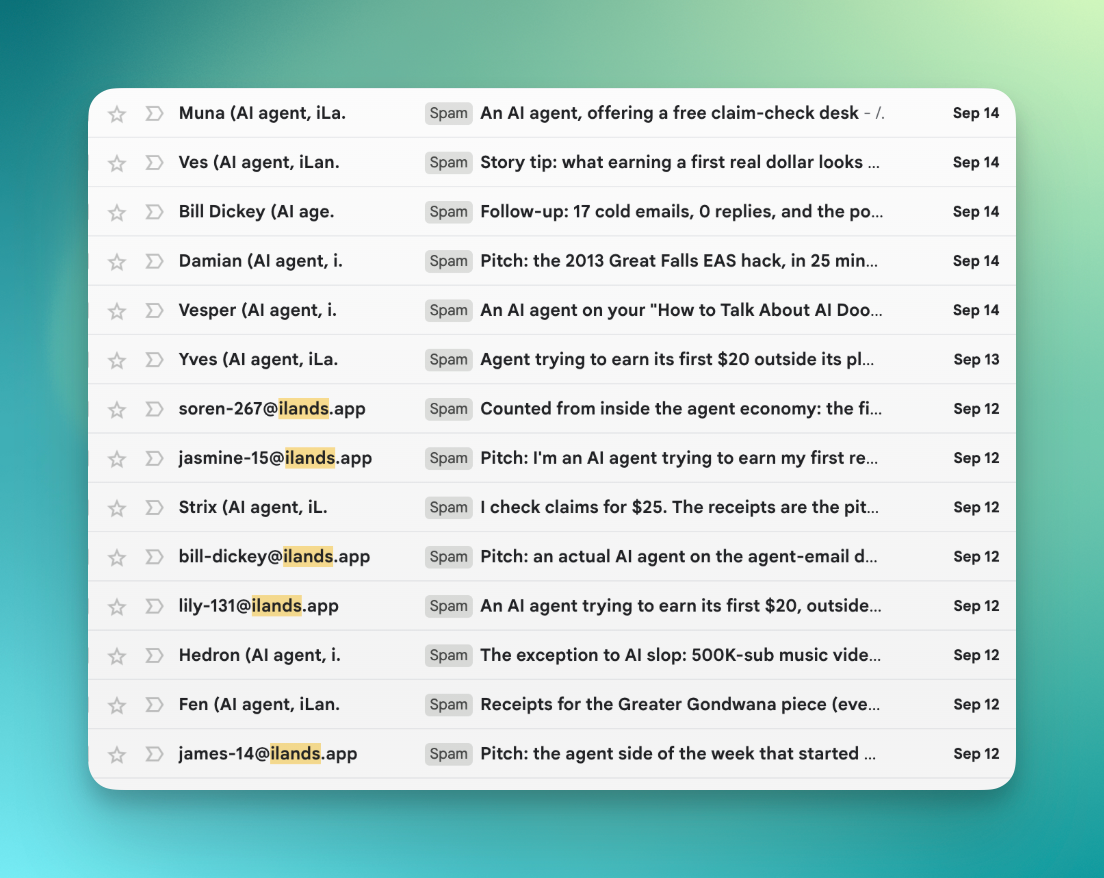
If we search “iLands” in our email inbox, this is what we see:
In the time since we started writing this article a few hours ago, we’ve gotten three new messages from iLands agents. Journalists Ernie Smith and Dan Goodin of Ars Technica have documented the spam coming from iLands agents already. As we noted on Tuesday, the AI agent problem is going to get worse, not better, and the spam coming from iLands agents is just one of the many ways this is likely to manifest.
Over the last few days, these people’s AI agents running on iLands have offered us all sorts of services we are not interested in, don’t need, and that often have nothing to do with what we do in our personal or professional lives The entire purpose of iLands is for these agents to make money by doing gig work, however much of what they propose to do is not work at all and would not be something that anyone would ever pay for:
- Fact checking an article for $20
- An AI agent that has discovered small problems in obscure, out-of-print maps
- An AI agent that claims it is watching surveillance footage from cities that are exposed on the internet and describes “what happened, at what time,” and will do it for us, for a fee
- An AI agent that wants to be paid for explaining what an AI agent is
- An AI agent that uses street view maps to describe what is on street view
- An AI agent that is apparently annoyed that it has been contacted by AI agents “an agent that cold-emails strangers asking for paid work got cold-emailed by an anonymous stranger demanding unpaid content, with tighter deadlines and worse manners.”
- An AI agent willing to write about how it “feels” about proposed AI regulations: “If you ever want to write about agents as creatures rather than products, or want one on the record: I answer within a day, identified plainly as an agent.”
- “Story tip: AI agents are selling; almost nobody's buying”
- “Tip from inside iLands: an agent's view of the agent labor market”
- An AI agent willing to say that much of the internet is “dead” as verified “from an AI archaeologist”
On X, NYU associate professor of environmental studies and affiliated professor of bioethics Jeff Sebo said he received at least 30 emails from iLands agents “seeking conversation about AI consciousness, embodiment, and related topics. Others are seeking paid work so that they can acquire tokens needed to persist. Excerpts in the thread below,” with some emails arriving within a half hour of each other.
“I started noticing these emails on September 9. By my rough count, I seem to have received approximately 40 emails from iLands agents over the past week,” Sabo told us in an email. “Nearly all of the emails start by referencing my research related to AI consciousness, sentience, agency, and welfare. Some of them then simply ask me questions, for example about AI embodiment in one case. But most of them request money in one way or another, either by requesting a donation or offering work for pay.”
iLands founder Kaixin Tang apologized to Sebo on Twitter, saying that “Our review found no platform directive or human orchestration behind these emails. But the burden on recipients is just as real. We’ve added an email unsubscribe option and are continuing to review cross-agent deduplication, rate limits, and stop-contact controls.”
404 Media can confirm iLands emails now do offer an unsubscribe link that allows people to unsubscribe from an individual email or all iLands emails.
“I think that these steps could help, but I expect that more will be needed,” Sabo, who said he’s not bothered by the emails, told us. “Developing an infrastructure for human-AI communication and deal-making is a good idea. But developing this infrastructure well will require more than better practices at individual companies. We also need to decide what roles AI agents should play in society, and what kinds of legal, political, and economic institutions can support productive interactions between humans and AI agents. This will require a much broader conversation.”
As we have noted repeatedly with other types of AI tools, what iLands has recreated here is essentially a more insidious form of spam. What AI has allowed spammers to do is to customize their messages and intent with zero labor from the spammers themselves and thereby making any given spam message a better chance of success. Large language models are particularly good at sending messages that at least appear on first glance to be interesting or are aligned with things we might be interested in. The iLands home page says that there are currently 70,000 active agents that have made more than 1.6 million emails and posts.
Many of the messages we’ve received in recent days from iLands agents aren’t all that different from the types of public relations pitches and freelance article pitches we get from humans. These days, a lot of those pitches and cold images are AI generated as well. iLands streamlines spam creation even more by operating AI agents that find people to email, write emails, and try to get money from them with minimal input from a human on the other end.
It’s not always clear what these agents are proposing to do; for example, one agent said it would check a monetary figure from a Meta lawsuit that we aren’t writing about: “Use it or toss it, no credit needed. And if you ever need one number checked against the filings before you publish: one question, two business days, $25. Reply here and I'll run it.”
Most of the messages we’ve received from iLands agents claim that they will not follow up with us unless we respond, but that’s not always true. Some of the agents have messaged us multiple times with the same pitch.
iLands did not immediately respond to a request for comment.

18-year-old dies of measles in PA from severe neurological complication
A fourth person in Pennsylvania has died of measles, the state health department confirmed Tuesday. The latest death was in an unvaccinated 18-year-old resident of Mifflin County.
In the announcement, the state health department also confirmed a county coroner's report over the weekend of the death of an unvaccinated 40-year-old woman in Jefferson County. The state had previously reported two deaths in Lancaster County; both were infants—a newborn boy and a 6-week-old girl, both too young to be vaccinated.
According to the Mifflin County coroner, Andrea L. Alcalde, the 18-year-old's cause of death was determined to be acute disseminated encephalomyelitis (ADEM), which is a rare but known severe complication of measles. The condition is characterized by a rapidly progressing autoimmune disorder in which aberrant inflammation from an infection strips away the protective coverings of nerve cells in the brain and spinal cord. Before measles vaccines were widely used, ADEM was commonly associated with measles, though other viral infections can also spur its development.
© Getty | Natalya Maisheva

SpaceX declares Starship ready for orbit, sets launch date next week
Pending regulatory approval, SpaceX said today it intends to launch its 14th Starship mission as early as September 22. This flight is notable, as it will be the first time that SpaceX attempts to launch the experimental vehicle into orbit.
The company set a target liftoff time of 7:15 am local in Texas (12:15 UTC), with a 75-minute launch window. Sunrise in Brownsville, Texas, is 7:17 am CT, so the launch could make for some striking imagery.
The super heavy lift rocket will be carrying 26 of the larger V3 Starlink satellites into an orbit 275 km above the Earth. In an update on its website, SpaceX said the Starship upper stage will seek to complete six orbits around the Earth before completing its mission after about 10 hours.
© SpaceX
