Cloudflare's Disallow AI Training keeps mixed-use crawlers available for search. Google and Apple honor training opt-outs; Bing robots.txt support is pending.
WooCommerce has spent the last few years investing heavily in the block editing experience for merchants and developers. The only thing missing was an official block theme we could recommend, built specifically for Woo.
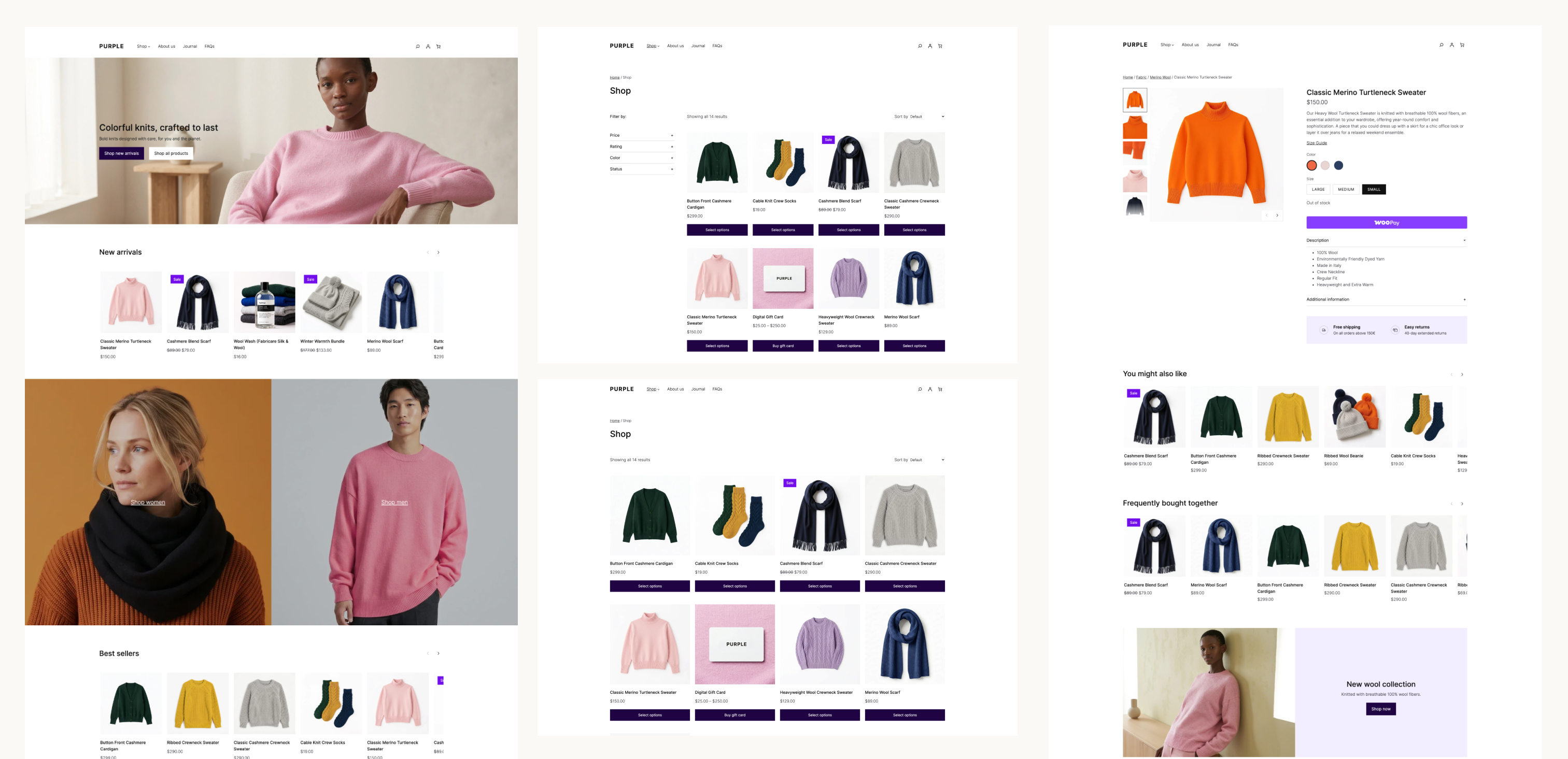
Purple is the open source WooCommerce starter theme made by Woo. The theme includes templates for most block-enabled WooCommerce pages, ten color palettes and ten font pairings, and custom styles for WooCommerce and WordPress core blocks. It also includes a pattern library focused on ecommerce with product grids, filters, collections, call-to-actions, product detail pages, and more.
For merchants launching on Woo, Purple is designed to give your store a modern and performant starting point. However, thanks to the customization options built into blocks, developers and agencies can modify and extend the templates and styles and use the theme as a starting point for bespoke store designs.
With everything WordPress and Woo have to offer, a good block theme is intentionally lean and modular. They don’t require the traditional layers of functionality and lock-in that older theme framework typically included.
When you compare Purple to our classic flagship theme, Storefront, you might wonder where all the featured extensions have gone. When using Storefront, you might have needed extensions for product hero designs, custom homepages and product galleries, a mini-cart, or even a more advanced header and footer. With WooCommerce’s block library and the block editor, those customizations are already possible within any block theme, including Purple.
The work is landing in WooCommerce core
The larger project is the work that Purple helped drive in WooCommerce core: more granular style controls in blocks, templates that showcase your product catalog, and an easy path to defining your store’s brand consistently across your site.
The improvements below are a small example of what’s available to any block theme that uses the affected blocks and APIs.
WooCommerce 11.0 made block themes lighter and more consistent
WooCommerce 11.0 established several foundations for the work that followed:
Pattern content is loaded on demand. WooCommerce registers patterns by file path and loads their content when the editor requests it, reducing work on requests that do not need pattern content (#65922).
Product images work better with theme settings. The Product Image block uses larger thumbnails and preserves the correct aspect ratio for cropped images (#66191, #66354).
Product collections compose more reliably. The Product Collection block now keeps the right context when nested inside a Query Loop, so its inner product blocks render correctly in composed templates and patterns (#65637).
More blocks participate in global styles. The Breadcrumbs block supports theme.json styling, including custom font sizes (#65460, #65537).
Product filters are easier to compose. The Product Filters block gained an option to disable its filter drawer and fixes synchronization across multiple filter instances (#65671, #65622).
Cart markup is more accessible. Cart table headers now expose the appropriate ARIA roles and scope attributes for assistive technology (#65364).
WordPress 7.1 introduced responsive design controls for the block editor. WooCommerce 11.1 gives those controls more useful WooCommerce blocks to work with:
Product Price supports responsive styling for typography, colors, padding, and margins, with the editor and frontend using the same responsive states (#67007).
Product Reviews now follows the WordPress wrapper used for responsive styling, so review content and the review form can reflect the styles selected for each viewport (#67360).
Product Details supports padding, margin, background, and border settings through the block and Global Styles (#67409).
Product Gallery supports custom aspect ratios and keeps the large image area and thumbnail rail in sync (#66441).
The release also completed some initial performance improvements for block registration. WooCommerce skips block and pattern registration for recognized requests that cannot render blocks, making Store API and REST requests 30–42% faster in the published measurements (#65781). This release also introduces experimental support for unified block editor assets while editing your site, with a 48.3% reduction in network transfer size.
WooCommerce 11.2 continues refining the storefront building blocks
WooCommerce 11.2 is still in development, and it contains some of the most visible examples of the theme work moving into core:
Product Filters has responsive overlay and sticky-positioning controls. The block can stay inline, switch to an overlay on mobile or tablet, or use an overlay at every viewport. The behavior works in the editor and on the frontend, respects the configurable responsive breakpoints in WordPress 7.1, and can keep filters visible as shoppers move through a product catalog (#67696, #68256).
Product Quantity exposes more styling controls. Text color, background color, border radius, and border and shadow styles can be configured through block styles. Grouped product quantity controls use the same styling model (#68040, #68000, #68148).
Product images can use theme-defined borders. The Product Image block now supports border styles, giving product grids and collection patterns another way to express a store’s visual system (#68342).
Chips are more themeable. The Chips block, used by Product Filters and Add to Cart + Options, adds typography and border-radius controls that can be styled consistently with the rest of the store (#68105).
WooCommerce patterns are easier to find and customize. The inserter category is being renamed from “WooCommerce” to “Shop,” and customized template parts no longer take priority over template parts queried directly (#67874, #67892).
This is just a subset of the most recent work done to improve the block editing experience, but Purple has been a long project, and a key factor in our work to improve the foundations of WooCommerce for all users.
How to test Purple
Please test Purple on a staging or local site. Use the latest version of WordPress and WooCommerce so you can exercise the responsive controls described above.
Install the purple directory as a theme, either by uploading a zip of that directory or copying it into wp-content/themes.
Activate Purple and open Appearance > Editor.
Review the front page, Shop or Product Catalog, Single Product, Cart, Checkout, My Account, and search templates.
Test the Product Filters block at desktop, tablet, and mobile widths. Try the inline and overlay modes, then test a custom settings.viewport configuration.
Test Product Price, Product Details, Product Reviews, Product Gallery, Product Quantity, Catalog Sorting, and Mini-Cart with simple, variable, and grouped products.
Add your usual extensions and child-theme customizations, then repeat the tests on the frontend and in the editor.
Purple is a beta. Expect the templates, patterns, and styling to continue changing as we learn from testing. Note: when downloading Purple directly from GitHub, it will not receive automatic updates.
Share your feedback
Please open an issue in the Woo Themes repository when you find a problem or have a suggestion. Include the WordPress, WooCommerce, PHP, and Purple versions; the template or block you were testing; the steps to reproduce the problem; and screenshots or a recording when the issue is visual.
Your feedback will help us improve the default WooCommerce storefront and the blocks and templates available to every block theme.
CallRail’s Meagan McLoughlin explains what to audit before/after Local Services Ads migrate into Google Ads, from historical reports to tracking numbers and lead quality.
Count AI marketing's hidden rework and maintenance costs before claiming efficiency gains, or risk repeating programmatic's mistake and starving long-term strategy.
If you’re a regular reader, you might be wondering why I’m in your inbox instead of Birgit. She’s off on a well-earned three-month sabbatical and handed over editorial duties to me while she’s away. The one change: for the next few months, the Weekend Edition will arrive every two weeks or so instead of every week.
As an Automattic employee, I’d be lying if I said I wasn’t feeling a range of emotions about the shifts in the company. I cannot talk about internal company conversations, but I can’t exactly avoid the biggest news in the WordPress world, either.
So, for my first Weekend Edition, I want to offer my support to Matt, my fellow Automatticians, and the people in the WordPress community. I’m just as passionate about the WordPress project today as I’ve ever been. Neither the core philosophy of democratizing publishing nor our principles around free software have changed. The only thing we can do is push forward and keep building a tool that so many people’s lives and businesses rely on.
With that, let’s get down to the latest news.
WordPress 7.1.1 is on track for Thursday, September 17. It’s a bug-fix release, so if you maintain anything built on 7.1’s newer features, grab the release candidate and give it a spin before then. More on that below.
And if you need a break this weekend, WordCamp World is an unofficial pixel-art adventure set at a fictional flagship WordCamp, complete with a Contributor Day and a closing ceremony. The game was released by The WP World, an independent community project run by Marcus Burnette. Jonathan Bossenger took it for a spin in his latest stream.
Have fun this weekend and enjoy life!
Your friendly WordPress developer advocate, Justin Tadlock
Table of Contents
Developing Gutenberg and WordPress
Finding the inserter on some block selections has been a small, constant annoyance, and Gutenberg 23.9 finally fixes that. The what’s new in Gutenberg 23.9 post leads with inserting blocks straight from the block toolbar. Global Styles also gets dot indicators for blocks with custom style overrides, plus a filter to show only those blocks. Theme authors get separate vertical and horizontal gap control for the Group block, theme.json styling for <label> elements, Global Styles controls for citations, inputs, and selects, and custom Duotone colors.
WordPress 7.1.1 RC1 is out, with the final release scheduled for Thursday, September 17. It’s a bug-fix-only maintenance release covering 16 Core tickets and 22 Gutenberg pull requests, all for issues that surfaced during the 7.1 cycle or were deferred at the end of it. Adam Silverstein, Adrian Duffell, and Andra Ganescu are co-leading, and the 7.1.1 release schedule has the details. If you maintain anything that leans on responsive styles, the Icon Registration API, or the iframed editor, test the RC now.
On the Developer Blog, I rounded up what’s new for developers (September 2026). The consistent theme this month is things that already existed have become more declarable, documented, or schema-valid. You’ll find blocks declaring their own keyboard shortcuts through variations and transforms, theme.json schema fixes so valid responsive styles stop showing up as errors, and schema support for PHP-only blocks.
Contributors, check your local setup. As of September 8, trunk in both wordpress-develop and gutenbergrequires Node.js 24 and npm 11. Manzoor Wani shared the specifics: the minimums are Node.js 24.18.0 and npm 11.16.0, and the required CI checks now run on Node.js 24. If you have a pull request based on an older trunk, rebase it to pick up those checks. Older branches keep their previous requirements.
On the road to WordPress 7.2
The 7.2 cycle is officially underway. Jeffrey Paulannounced the WordPress 7.2 release squad, with Matt Mullenweg as release lead, David Baumwald on release coordination, and George Mamadashvili and Peter Wilson as tech leads. Theme folks will want to note the default theme leads: Henrique Iamarino on design, and Maggie Cabrera and Carolina Nymark on development. Beta 1 is scheduled for October 20–22, with the final release set for December 8–10. Jb Audras also posted the bug scrub schedule for 7.2 if you want to pitch in.
Notes has grown a lot since WordPress 6.9, picking up @mentions, rich text, and the ability to resolve and respond along the way. Anne McCarthy explains where it stands: “Notes are hard to discover, cumbersome to use, and tricky to track where and when they are left.” Her plan for elevating and refining the WordPress Notes feature aims to fix that by 7.2 Beta 1. It calls for a more visible spot in the block toolbar, a suggestion mode, Notes open alongside the Settings sidebar, and emoji reactions. If your clients or editorial team use Notes, now’s a good time to weigh in.
Icon fonts have had a good run but are feeling very dated in 2026. Joen Asmussen makes the case for replacing Dashicons in the admin bar and menu with SVG icons rendered through wp_get_icon(), which was introduced in WordPress 7.1. Screen readers handle icon fonts inconsistently, and they don’t render properly in Windows High Contrast Mode. SVGs with aria-label and currentColor behave predictably. A couple of design questions are still open, including whether the Posts icon becomes a quill pen. Block developers, take note of the follow-up: future work to let block.json icon registration use WordPress icons instead of Dashicons.
Share your feedback
How did the 7.1 cycle go in your opinion? Benjamin Zekavica opened the WordPress 7.1 release retrospective, and it isn’t only for people who contributed code. You can share feedback through the linked form or in the comments until September 30. Submissions are anonymized in the follow-up summary.
Joe Dolson shared the next steps in planning for the Accessibility Lab plugin. The plugin, which recently moved to the WordPress GitHub organization, is a space for exploring and experimenting with accessibility solutions. The team wants input on features, priorities, and how to measure success, in the comments or as issues on the repository. There’s also a planning meeting on Thursday, September 17, at 15:00 UTC.
Plugins, Themes, and Tools for #nocode site builders and owners
WooCommerce 11.1 is out, and the big news for store owners is that variation image galleries are now on for every store. Karol Manijak explains that additional variation images are now part of WooCommerce core, so the standalone extension deactivates itself on update and existing galleries migrate automatically. The release also adds an opt-in right of order withdrawal for EU compliance, beta support for video in product galleries, and noticeably faster Store API requests (more on that below). Test the update on staging first, especially if you have a large catalog of variations.
Looking ahead a bit more: WooCommerce is prepping to drop PHP 7.4 and 8.0 support. Brian Coords shared a proposal to require PHP 8.1 or newer starting with WooCommerce 11.5, targeted for January 2027. If you’re an agency, host, or extension developer, the team wants to hear about migration barriers before the decision is final. Given one of the most-used WordPress plugins in the world is ready to make this version leap, I’d say it’s worth other plugins following suit.
Should you create a post type, a taxonomy, or a custom field? It’s one of the first questions you’ll face when structuring content models. A guest author on the Meta Box blog answers it with a three-question framework for choosing between custom post types, taxonomies, and custom fields. A book library example ties it together with a book post type, a genre taxonomy, and fields for the ISBN and page count. The rule of thumb: plan early, because turning fields into taxonomies later can get complicated.
The latest WordPress.com changelog rolls out a redesigned Hosting Dashboard, WordPress 7.1 arriving on WordPress.com sites, and a new MCP-based integration. That integration lets ChatGPT, Claude, and other compatible agents connect to your site to draft posts, moderate comments, and fix alt text. Two smaller updates are worth checking out if you work with clients: you can share a link to a specific post revision for review, and the Playlist block now has per-track toolbars.
Theme Development for Full Site Editing and Blocks
Patterns or synced patterns or template parts? WordPress has several ways to build a reusable component, and each comes with its own constraints or drawbacks. In his recap of agency workflows, components, and highlights from WCUS, Brian Coords digs into what that overlap means for agencies building block themes, including governance and version control in the Site Editor. He also points to a pull request that lets registered synced patterns be used inside PHP-only blocks, and floats it as a proof of concept for a future component model.
WordPress now has multiple ways to say, “make this look right on mobile,” such as fluid typography and spacing, hiding blocks by viewport, and the responsive styles that shipped in 7.1. Anne McCarthy has a plan for bringing together responsive features into one connected system. As she puts it, “We’ve built some great individual features but they don’t work coherently nor are they connected well visually.” She links the open issues and a pull request reworking the switch between responsive styling and preview modes, so theme builders have a clear place to weigh in.
“Keeping up with Gutenberg – Index 2026” A chronological list of the WordPress Make Blog posts from various teams involved in Gutenberg development: Design, Theme Review Team, Core Editor, Core JS, Core CSS, Test, and Meta team from Jan. 2024 on. Updated by yours truly.
Why pay for block registration on a request that will never render a block? That’s the thinking behind WooCommerce 11.1 skipping block registration on Store API, REST API, variation AJAX, and product webhook requests, which are now 13–18 ms (30–42%) faster. If a description contains WooCommerce blocks, they’re registered on demand, so rendering isn’t affected. If your extension relies on those blocks being registered during API requests, the new woocommerce_should_register_blocks filter lets you opt back in. The post also marks AbstractBlock as internal and points you to the standard Block API and block.json instead.
What if an AI agent could work with WordPress right in your browser tab, with no server in between? Fellyph Cintra introduces WordPress Playground and WebMCP, which lets Playground expose its actions as tools that agents can discover. There are 16 of them, covering site management, running PHP, navigation, and reading and writing files, and plugins can register their own. You can try it in the ChatGPT desktop app’s built-in browser, where the demo has an agent build a full landing page from core blocks like Cover, Columns, and Button. WebMCP is still a W3C Community Group draft, so expect it to change.
Playground is quietly becoming the thing WordPress documentation runs on. Adam Zieliński announced that runnable code examples are now live in the Code Reference. Open a page with an interactive example, click Run, and the snippet executes against a real WordPress install in your browser. The examples are written right in the DocBlocks with a php interactive code fence, so each one stays next to the function it documents. More examples are planned during the 7.2 cycle.
AI in WordPress
The Core AI team’s weekly summary for September 2 is a good snapshot of where things stand. Jeffrey Paul reports that the MCP Adapter is ready for submission to the plugin directory, the next AI plugin release is expected later this month, and embeddings work in the PHP AI Client is heading toward a 1.5.0 release. The team is also collecting input for the 7.2 roadmap and looking for more maintainers for the AI Client packages and connector plugins. If that sounds like you, the #core-ai Slack channel is the place to start.
Rae Morey shared the story of Andy Peatling leaving Automattic after 17 years and building Miles, an AI design agent for block themes. Miles works only with native blocks, global styles, and theme settings, so what you get is a standard block theme you can keep editing. It’s designed as a back-and-forth rather than a one-shot generator, and you can start free at bymiles.ai with monthly credits.
Nathan Wrigley had AI on the mind for two straight episodes of the WP Tavern podcast. Chris Reynolds, Senior Manager of Developer Relations at Pantheon, explains building trust with project contracts for reliable AI development: Markdown checklists, reviewer agents, and pre-commit hooks that keep AI-written code from skipping your standards. In the episode before, Aaron D. Campbell of Monarx covers navigating WordPress security in the AI era, from AI-chained exploits to shrinking patch windows.
Now also available via WordPress Playground. There is no need for a test site locally or on a server. Have you been using it? Email me with your experience.
Questions? Suggestions? Ideas? Don’t hesitate to send them via email or send me a message on WordPress Slack or Twitter @bph.

 Login
Login