Nuevo capítulo con dos invitadas muy especiales, una madre Asha Ismail y su hija Hayat Traspas. La historia de Asha Ismail es una de las millones de mujeres que ha sufrido la mutilación genital femenina además de ser forzada a casarse, ser violada y acabar embaraza. Su primera hija, Hayat Traspas, es el motivo de su lucha, una lucha que le ha trasladado a ella para así formar la asociación "Save a Girl, Save a Generation". Nunca se sabe cómo, pero a pesar de los relatos tan espeluznantes que narra ASHA consigue junto a su hija Hayat entrar en la dinámica de humor, sarcasmo y locura en los anfitriones.
00:00 Inicio
01:30 Así ha sido nuestra semana
05:50 Presentación de Asha y Hayat
07:15 Nombres africanos en documentos oficiales
16:50 ¿Cómo nació su ONG?
18:15 El día de la ablación de Asha
26:00 La enfermera que salvó la vida de madre e hija en Mogadiscio
37:35 La mutilación genital femenina no ocurre solo en África
45:50 Proyectos en Kenia de "Save a Girl, Save a Generation"
51:40 Las consecuencias médicas
55:35 Creando una red de mujeres
Hoy visita el Tíbet una artista, actriz entre muchas otras cosas, una personalidad que prácticamente no necesita presentación y que se ha atrevido a venir a la mesa de No hay negros en el Tíbet.
Viene a reír, a contar anécdotas como la estrella que es, a reflexionar, y a debatir cuestiones que podrían llegar a ser incómodas. Sin duda, una de las grandes: Rossy de Palma. Bienvenida al Tíbet.
00:00 Inicio
01:55 ¿Fiesta de cumpleaños sorpresa o Shin Chan?
05:20 Presentación de Rossy de Palma
07:55 ¿Qué hicieron Frank y Rossy durante el apagón?
14:20 Momento escatológico de Lamine
21:00 Ser sororas, racismo y activismo
25:40 Rossi: 'Yo nunca me he sentido blanca'
27:50 Las cosas no se hacen por ignorancia
32:40 Hay muchas personas blancas que no quieren venir al Tíbet
42:50 El padre ausente
48:15 El espermatozoide es un emigrante
Work With Me - https://ericlenz.net/colour-for-creators/
00:00 - What All Beginners Do Wrong
01:04 - Can You Trust Your Monitor?
05:44 - Should you Rely on the Video Scopes?
07:23 - What is Colour Balance?
15:07 - My Balancing Process
En este capítulo recibimos la visita de un comediante afrodescendiente, nacido en Caracas (Venezuela) pero residente en Buenos Aires, detalle importante en esta descripción ya que marca buena parte del contenido de la conversación. Su nombre es César Aramis y el de su manager Pablo Andrés Moracci. ¿Que por qué ponemos esto? porque es un detalle importante para entender algunas cosas "raras" que ocurren en el episodio... Bueno, ¡como en todos! 😅
Sus monólogos hablan de su vida, se basan en anécdotas, traumas y conflictos sociales vividos, que pone sobre la mesa a través de la risa, y analizar y, ¿por qué no?, intentar solucionarlos. Todo con humor y ritmo muy particulares.
00:00 Inicio
03:00 Las peores pesadillas de Lamine y Frank T
09:50 Presentación de César Aramis, cómico venezolano
12:40 El verdadero nombre del invitado
17:30 César y Lamine Yamal
23:15 ¿Hay negros en Argentina?
36:20 El peor año de la vida de Frank
41:50 ¿Camilo? ¿Quién es Camilo? ¿Sesto?
48:50 Lo blanco es lo estándar
54:00 Los chistes antirracistas de César en redes
In this video we'll explore the future of wireless power delivery! Also, supercharge your business with Odoo today! https://www.odoo.com/r/KH6
Big thanks to ETI for sending the wireless power sytem over for me to experiment with. If you want to design a product with one (even just a prototype) send them your ideas! https://www.etherdyne.net/evalkit and check out more demos by them here: https://www.youtube.com/@ether-power
Forum thread for further discussion, and file downloads for the speakers etc: https://forum.diyperks.com/general-general/3d-wireless-power-delivery/
I’ve made a fair amount of patterned wood before — some of it pretty complicated — but this time I wanted to try something quicker and more approachable. In this video, I’m turning plywood scraps into thin pattern veneers and using them to upgrade regular plywood. It’s pretty fast, surprisingly effective, and a great way to make a cool looking panel for furniture projects.
As always I'm happy to answer any questions.
If you would like to support this channel you can do so here
https://www.patreon.com/PaskMakes
You can also help me out by purchasing one of my shirts, you can find them here https://paskmakes.threadless.com
Check out my new website
http://paskmakes.com/
Check out my Instagram to see more of my work https://www.instagram.com/paskmakes/
Also you can check out my photography at my website (nothing to do with making but you may be interested in what I do) http://www.neilpaskinphotography.com
My email can be found in the about section of this channel.
For real mail,
Pask Makes
P.O BOX 768
Yandina
Queensland
4561
Australia
Zineb Rimi, exjugadora marroquí de baloncesto que llegó a vestir la camiseta de la selección nacional de Marruecos, en la actualidad entrenadora en España, visita el Tíbet para hablarnos de cómo nació su amor por este deporte.
Todo empezó en Casablanca. Zineb nació en el seno de una familia musulmana tradicional, lo que dificultó sus primeros pasos bajo los aros, al considerarse una actividad destinada a los hombres. Ella perseveró y llegó a jugar en la selección nacional absoluta de Marruecos, con la que recorrió buena parte del planeta.
Hablamos de su llegada a España, a Petrer (Alicante) localidad donde nacieron sus dos hijos, de las dificultades laborales y personales que tuvo hasta llegar a ser la gran entrenadora que es hoy, y de los logros que ha ido sumando. Una experiencia de vida que cuenta en su libro "Más allá del juego. Cómo una pelota naranja une el mundo", y que nos presenta ahora en el Tíbet.
00:00 Inicio
02:30 El gran apagón premium de Lamine termina casi en pelea
08:40 Frank T, Lamine y el basket
10:10 "La princesa del baloncesto de las 2 orillas"
14:16 Zined era la única chica en un equipo de chicos
18:43 Sin apoyo familiar, pero terminó en la selección nacional marroquí
25:50 Tuvo que ser ebanista con su padre para poder jugar
28:40 Al casarse se traslada España y deja de jugar
33:10 O baloncesto o matrimonio
46:10 ¿Hay formas de entrenar más allá del miedo?
54:30 Proyecto "Canchas sin fronteras"
🎶 Listen to new album "Sou Kora": https://idol-io.ffm.to/soukora.OYD
🔔 Subscribe to Nø Førmat!: https://bit.ly/NoFormatYT
📀 Join the PASS: https://pass.noformat.net/
The physical CD & Vinyl of SOU KORA is now available exclusively for NØ FØRMAT! PASS members. Complete your collection today: https://pass.noformat.net/
Ballaké Sissoko - Kora
Vincent Segal - Cello
Emile Parisien - Soprano Saxophone
Vincent Peirani - Accordion
Vincent Peirani
https://www.instagram.com/vpeirani/
https://www.facebook.com/vincentpeiranimusic
ON TOUR
07.07 KARLSRUHE Tollhaus 🇩🇪
26.07 LA RÉUNION Jazz Dann Port 🇫🇷
01.08 CREST Crest Jazz Festival 🇫🇷
22.08 EDINBURGH Edinburgh International Festival 🇬🇧
05.10 WARWICK Warwick Art Center 🇬🇧
06.10 BRISTOL Bristol Beacon 🇬🇧
07.10 LONDON Cadogan Hall 🇬🇧
08.10 TARBES Le Parvis 🇫🇷
11.10 FRANKFURT Alte Oper 🇩🇪
17.10 FIGEAC L’Astrolabe 🇫🇷
16.11 OFFENBURG Jazzpassage 🇩🇪
22.11 WEIKERSHEIM Tauberphilharmonie 🇫🇷
26.11 AMSTERDAM Muziekgebouw 🇳🇱
27.11 ROTTERDAM De Doelen 🇳🇱
28.11 TURNHOUT De Warande 🇧🇪
29.11 MONACO Monte Carlo Jazz Festival 🇲🇨
13.12 CAEN Théâtre de Caen 🇫🇷
💌 WHAT'S THE NØ FØRMAT PASS ?
Join the PASS to get all of our productions of the year:
‣ Albums in CD, Vinyl or Digital
‣ Invitations to our private shows
‣ Discount on our shop
‣ Limited edition silkscreeen prints, music scores
‣ Access to exclusive content
Starting at 40€/year. Become a PASS member: https://pass.noformat.net/
Emile Parisien and Vincent Peirani appear courtesy of ACT
#SissokoSegalParisienPeirani
“A cópia na era de sua proliferação técnica” ocorreu ao vivo em 24 de outubro, às 19h, no BaixaCultura (link na bio). Nela, Rafael Bresciani e Leonardo Foletto remixaram artefatos sonoros e visuais em live-coding (no Hydra/Flok) para compor a conferência, centrada nesta primeira parte nas práticas e reflexões de cópia no início do século XX. Teve participação nas vozes (e textos) de Walter Benjamin, Marcel Duchamp, Conde de Lautréamont e Tommaso Marinetti. Na música, Neu!, Talking Heads e Kaisoku Tokyo. Nas imagens, Pablo Picasso, Okumura Masanobu, Kunisada, J Borges, Louis Daguerre, Hugo Ball, Kurt Schwitters, Man Ray, Niepce, Abraham Salm, Marinetti, entre outros.
O vídeo é parte de uma investigação que estamos fazendo desde 2023 sobre o papel da cópia ao longo dos últimos séculos na história da arte, o que passa pela questão histórica do desvio - como se sabe, a arte é marcada pelo plágio, o roubo, o desvio, a cópia e apropriação. A segunda parte irá centrar-se na segunda metade do século XX, período essencial da proliferação técnica das cópias a partir dos gravadores, samplers, fotocopiadoras, vídeos, computadores, algoritmos.
“Tanto a poesia sonora, as colagens e o cinema são artes que foram potencializadas nessa primeira metade do século XX com a expansão da reprodução técnica. Os aparatos técnicos são protagonistas tanto como método de produção (caso das collages) quanto de gravação e apresentação ao público (poesia sonora e o cinema).
Eu intuo também que as tecnologias digitais de reprodução tornam mais difícil a negação e a escolha. É como um loop da desintegração: o meio é abstraído na hiperconexão do e e e, com menos possibilidade de ou ou. Às máquinas de reprodução técnica digital não é facultado a possibilidade de fim, mas sim a reprodução contínua e infinita de presente. Tudo passa a ser conectado ao propósito da reprodução contínua de cópias. Nada mais é criado, tudo passa a ser apenas repetição sem diferença. Todas as obras já existentes remixam as anteriores: tudo é cópia.”
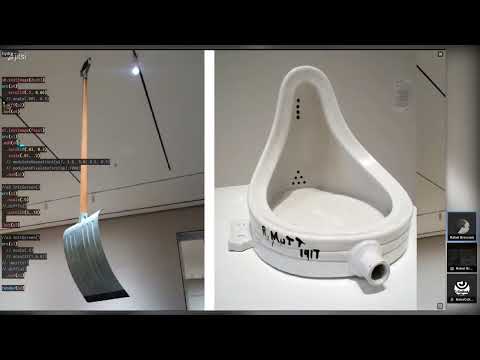
Marcel Duchamp é um dos personagens em “A Cópia na Era de Sua Reprodutibilidade Técnica”, primeira parte do projeto Cópia & Desvio. Ele fala sobre o ready-made, prática que consistia em pegar objetos em relação aos quais se era indiferente e recontextualizá-los de maneira a deslocar seus significados. Foi uma das práticas artísticas pioneiras no mundo da arte ocidental em usar e deixar explícita a recombinação de informações e outros elementos para criação de uma nova obra. No vídeo, é a voz de Duchamp - treinada no Eleven Labs por diversos vídeos e áudios disponíveis no Youtube - que fala um texto seu publicado em 1961:
“Em 1913 tive a feliz ideia de fixar uma roda de bicicleta a uma banqueta de cozinha e vê-la girar. Uns poucos meses depois comprei uma reprodução barata de uma paisagem de uma noite de inverno, a qual chamei de “Farmácia” depois de adicionar dois pequenos pontos, um vermelho e um amarelo, no horizonte. Em Nova York em 1915 comprei numa loja de ferramentas uma pá de neve na qual eu escrevi “À frente do braço quebrado”. Foi por essa época que a palavra “ready-made” me veio à mente para designar esta forma de manifestação. Um ponto que desejo muito esclarecer é que a escolha destes “ready-mades” nunca foi ditada pelo deleite estético. Essa escolha era baseada numa reação de indiferença visual com ao mesmo tempo uma total ausência de bom ou mau gosto... de fato uma completa anestesia.
Um outro aspecto do “ready-made” é sua impossibilidade de ser único. A réplica de um “ready-made” carrega a mesma mensagem. De fato quase que nenhum dos “ready-mades” existentes hoje é um original no sentido convencional”.
Limited Time Plans Bundle: https://paskmakes.com/premier-top-tier-woodworking-plans-bundle
In this video, I’m making a pair of dividers entirely by hand using only basic tools the only power tool I use is a drill. It was an awesome challenge which I really enjoyed. I’ve wanted to make a pair of these for a few years, and after seeing a pair made by Seth Gould during a recent scissor-making course with my mate Matt, I finally decided to give it a go.
The design is more difficult than it needed to be but I really liked the unique wing so I went with it.
If you're interested in getting hold of some quality hand tools like many of the ones I use in this video, check out my good friend Corin's website and support a small scale workshop https://www.niroc.com.au
As always I'm happy to answer any questions.
If you would like to support this channel you can do so here
https://www.patreon.com/PaskMakes
You can also help me out by purchasing one of my shirts, you can find them here https://paskmakes.threadless.com
Check out my new website
http://paskmakes.com/
Check out my Instagram to see more of my work https://www.instagram.com/paskmakes/
Also you can check out my photography at my website (nothing to do with making but you may be interested in what I do) http://www.neilpaskinphotography.com
My email can be found in the about section of this channel.
For real mail,
Pask Makes
P.O BOX 768
Yandina
Queensland
4561
Australia
To listen to more of Gerald Fischbach’s stories, go to the playlist: https://youtube.com/playlist?list=PLVV0r6CmEsFx3DRAuU3bpy3bxgC3OzmB6
Gerald Fischbach (b. 1938) is an American neuroscientist and pioneering researcher. He pioneered the use of nerve cell cultures to study the electrophysiology, morphology and biochemistry of developing nerve-muscle and inter-neuronal synapses. [Listener: Christopher Sykes; date recorded: 2023]
TRANSCRIPT: Harvard was a different story. I loved teaching. One reason I moved, left the NIH, was I missed interacting with students and I loved teaching in classes and seminars. I gave a course at Harvard at one of the houses [Leverett House], which was terrific, the students loved me. There was not a lot of credit for that, but I'd go over to the college once a week and teach, and it was such a joy to see the enthusiasm of students. I miss that.
I joined the pharmacology department at Harvard, which had been in the past chaired by Otto Krayer. That name is not prominent today, but it was in the '30s, '40s and '50s and the '60s. Krayer was brilliant. He married a Jewish woman and, hence, could not get a job in Germany anymore, so he moved. Had a couple of stops before Harvard but ended up chairing the department of pharmacology at Harvard. When I went there it was chaired by Irving Goldberg, who was a biochemist.
One reason I went there to Harvard, I was offered a job at Caltech, MIT and a couple of other places, was that it was near Steve Kuffler and the neurobiology department. That department was the first neurobiology department in the country. Neurosciences were usually tucked into physiology departments or anatomy. This was the first recognition of neurobiology as a separate discipline. They became very aloof, the neurobiologists, and arrogant, so I was happy to be a safe distance away from them, across the quadrangle. But I liked them very much, especially Steve Kuffler and Dave Potter and Story Landis, who I'll say more about in a minute, and Paul Patterson, who also passed away at a very young age with a lung disorder. Shocking when this happens to someone, one of your colleagues. But I was accepted by the neurobiologists; many other people were not.
To listen to more of Gerald Fischbach’s stories, go to the playlist: https://youtube.com/playlist?list=PLVV0r6CmEsFx3DRAuU3bpy3bxgC3OzmB6
Gerald Fischbach (b. 1938) is an American neuroscientist and pioneering researcher. He pioneered the use of nerve cell cultures to study the electrophysiology, morphology and biochemistry of developing nerve-muscle and inter-neuronal synapses. [Listener: Christopher Sykes; date recorded: 2023]
TRANSCRIPT: While I was chairman of the department we recruited nine people, each one a long search, so that took a lot of time and effort and consensus. Eight of those nine were promoted to tenure, which was unheard of for any department, let alone the stodgy neurobiology group. But they've all worked out well and I think people there are extremely happy. In fact, I have the urge now to go back to Boston. Not to live, but to spend time, take a train up and spend a couple of days just trying to learn more about neural circuits and molecular science going on there. We'll see if that works. I could take a train up and hang out at the local hotel. I think I'd be welcome. And I feel badly about all the friends who I miss. One of them, Rod MacKinnon, left Harvard and went to Rockefeller, where he had a cryo-EM and won a Nobel Prize studying potassium channel structure. We had dinner at Rod's house with Bruce [Bean] two years ago, I think it was two years, on Long Island. And pledged that we would get together more frequently than every 20 years, and it's up to me to get us together. But I think my interests in individuals and in the department actually grew beyond that, to issues of the school and the university.
To listen to more of Gerald Fischbach’s stories, go to the playlist: https://youtube.com/playlist?list=PLVV0r6CmEsFx3DRAuU3bpy3bxgC3OzmB6
Gerald Fischbach (b. 1938) is an American neuroscientist and pioneering researcher. He pioneered the use of nerve cell cultures to study the electrophysiology, morphology and biochemistry of developing nerve-muscle and inter-neuronal synapses. [Listener: Christopher Sykes; date recorded: 2023]
TRANSCRIPT: The trip to St. Louis was terrific. The time in St. Louis, the drive out there was a long way and en route my daughter, who had been accepted at Amherst College and who was encouraging me and Ruth to take the job in St. Louis, because it's exciting and you need to do something different. On the drive out, she said – as we were passing corn fields in Idaho – she said this is so far from any place I'd ever want to be. She was so keen to get into college and break free, which she did do. But, despite that, we got out there and we had lunch with the then-chairman of biochemistry. It was about a 100 degrees and moist, but we got through that and bought a lovely home which backed onto the university campus, across a beautiful park which I had to traverse to get to the medical school every day. This was in a small town called Clayton. Forest Park was the name of the park. It had beautiful museums and sports fields and a number of other things, so it was fun to walk across the park or ride my bike across the park.
The community felt like I was back in high school in the '50s. It was not a bustling New York or Boston community, but it was wonderful. Our kids, our sons loved it. They went to high school there, played sports, and have friends even today, now that they're in their 50s, have friends from that era.
St. Louis' suburbs are beautiful. And Washington University, to the effort of Bill Danforth, who was then president. He was an MD. He raised tremendous amounts of money and interests in the university, and I got involved with that. We created a neuroscience center. I was the chairman of the Department of Anatomy and Neurobiology. Subsequently, it changed to the Department of Neuroscience after I left.
I tried to do both; I took part in teaching gross anatomy. Until one day, I was in the lab and one of the students who happened to be the son of a high school friend of mine, came up to me and said, 'Dr Fischbach, the rumor in the class is you don't know what you're talking about.' I said, 'Bob, anatomy is straightforward,' but he wouldn't believe it. But I helped organize that, make it a vital course. More and more my time and my interests diverged from laboratory science to university-wide affairs, both at the medical school and the college.
Our neighbor [Bob McDowell] in Clayton was Chairman of the Math Department. He and his wife [Attie] became very close friends, and his kids. So, I enjoyed St. Louis enormously and recommended… I'd get very annoyed when the snooty, arrogant kids from New England say, 'How could you ever go to St. Louis if you had a job in Boston?' They just don't know what the world is like. We loved St. Louis and were there for about 10 years, when I was recruited to come back to Harvard as chairman of neurobiology.
To listen to more of Gerald Fischbach’s stories, go to the playlist: https://youtube.com/playlist?list=PLVV0r6CmEsFx3DRAuU3bpy3bxgC3OzmB6
Gerald Fischbach (b. 1938) is an American neuroscientist and pioneering researcher. He pioneered the use of nerve cell cultures to study the electrophysiology, morphology and biochemistry of developing nerve-muscle and inter-neuronal synapses. [Listener: Christopher Sykes; date recorded: 2023]
TRANSCRIPT: We moved back, lived in the campus for a year, then moved into a brand-new apartment building on the 15th floor. It was beautiful, walking distance from the NIH. The whole city had changed dramatically from the time we were there before. Bethesda was now a thriving metropolis. The NIH, because of the Vietnam War, was an armed camp. You couldn't get into the NIH without a pass and without being identified at one of the several entrance points. Disappointing, in a way, with no more baseball games, but it was secure. The first time I was there in the '60s, we would demonstrate against the war on the steps of the administration building, and no one bothered us, crowds gathered around. Today, if you did that, you'd be arrested in 10 minutes and dragged off the campus. What a change in the place.
Ruth, in the earlier years, had become the president of the Maryland Mothers of Twins Association, we had twin boys. She was articulate and outspoken. They finally fired her because she was so outspoken. But she wanted to have her say and one of her clear memories is taking this group to the Capitol to demonstrate. Where they would hold hands and circle the building. My daughter, Elissa, who went with her, remembers being stretched so much that she could hardly raise her arms after that. But that was Ruth, her passion and skill was organizing in community events. She had another job at the NIH, she worked at the director's office in Varmus and another woman, who was the assistant director, who she helped organize many projects. We were both very happy there.
And then I got fired. It was not my choice. I had been nominated by Donna Shalala, who was then the Secretary of Health and Human Services, to succeed Harold Varmus as director of the NIH. But this occurred near the end of the president's term, who is a Democrat. And the Republicans in the House Committees didn't want to make another appointment for a Democrat at the end of his term. This was Bill Clinton.
To listen to more of Gerald Fischbach’s stories, go to the playlist: https://youtube.com/playlist?list=PLVV0r6CmEsFx3DRAuU3bpy3bxgC3OzmB6
Gerald Fischbach (b. 1938) is an American neuroscientist and pioneering researcher. He pioneered the use of nerve cell cultures to study the electrophysiology, morphology and biochemistry of developing nerve-muscle and inter-neuronal synapses. [Listener: Christopher Sykes; date recorded: 2023]
TRANSCRIPT: My time at Columbia was interesting and challenging, being concerned with national matters of healthcare and survival of schools and the profession of medicine. The students were wonderful at Columbia. Very smart, very committed, and full of interesting ideas. And the staff was great. The professors and the administrators were very good and thrilling and challenging. The staff was terrific. I met and worked closely with Kevin Kirby and Marian Jakubiak, who remained good friends during my next step. But there were many people like that on the faculty who I'd known throughout my career from the early days at the NIH to then. So, regardless of the agony of the financial world, there were rewards that I appreciated.
But after a period of time, I think I was then 65 or older, I decided it was time to step down as dean, as Executive Vice President. At that time, I was at a loss of what to do, and then I met Jim and Marilyn Simons. Helped them with making a decision about a particular request they had from a faculty member at Columbia, and I advised against doing it because I didn't think the faculty member was up to the job. But we became associates, Marilyn and Jim and I, and then friends.
To listen to more of Gerald Fischbach’s stories, go to the playlist: https://youtube.com/playlist?list=PLVV0r6CmEsFx3DRAuU3bpy3bxgC3OzmB6
Gerald Fischbach (b. 1938) is an American neuroscientist and pioneering researcher. He pioneered the use of nerve cell cultures to study the electrophysiology, morphology and biochemistry of developing nerve-muscle and inter-neuronal synapses. [Listener: Christopher Sykes; date recorded: 2023]
TRANSCRIPT: I, and also Steve Hyman [director of NIMH], felt that it was time to bring disciplines together, rather than have neuroscience in the Institute of Mental Health in neurological disorders and stroke, in aging, in infectious disease. Wouldn't it be good if all the neuroscience was closer together? We proposed to Harold Varmus, who was director at the time, that a new structure be put up, a new building, and they did. It took years to get it passed and built, and now it's named the John Porter Centre for Neuroscience.
John Porter was probably one of the most successful congressmen who championed science and the NIH, so I was very happy when I was invited back to give a talk at the opening of the center. And it's thriving today. I don't know where John Porter is now, but I hope he's still very involved. It's way up on the Old Georgetown Road side of the campus with beautiful grounds around it, right across from the Cancer Center. There's no place like it in the country, I think, or in the world.
That's how I moved, not away from, but beyond my own lab. Very rewarding times. So when, after 10 years at Harvard, and very satisfying years, I had a very tearful departure from the department. Me crying, them crying, why was I doing that? After all, I just recruited them, didn't I want to see them succeed? I said, 'Yes, I did, but I had been offered the directorship of the National Institute of Neurological Disorders and Stroke.' And I figured why not? Washington was one of our, certainly Ruth's, favorite place to live. Boston is my favorite place. I had great friends, and I miss Boston today. But she had put up with so much for so long, and I was very interested in the NIH and in directing an institute, that we decided to do it.

 Login
Login