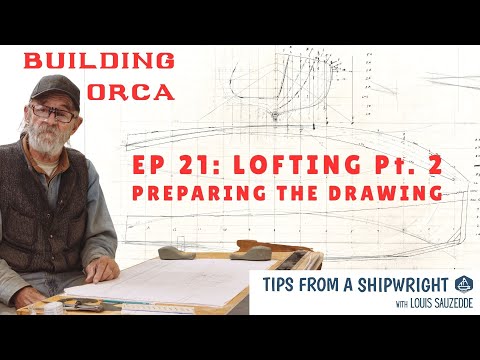
Part 2 of the Tips From A Shipwright lofting series for Project ORCA is out now. Lou reviews the working drawings for Orca, explaining the Profile, Half-Breadth, and Body Plan, the classic Novi lobster boat hull shape, and practical techniques for transferring lines and using French curves to fair the hull.
Subscribe to our channel to stay up to date on our Project Orca build!
In this episode of Tips From A Shipwright, Lou walks viewers through the working drawings for the boat Orca, explaining how these plans guide the entire build process. This video is Part 2 in a multi-part lofting series focused on developing the final hull shape of Orca.
Lou breaks down the primary drawing views—Profile, Half-Breadth, and Body Plan—and explains what the various dimensions, reference lines, and notations mean in a real-world boat shop. He also discusses the defining characteristics and overall hull form of classic Novi lobster boats, providing context for the shape and proportions seen in the drawings.
The episode continues with practical, shop-tested techniques for transferring drawings to full size, maintaining accuracy, and laying out fair curves. Lou demonstrates how and when to use French curves to refine lines and ensure smooth, fair shapes before cutting wood.
This video is ideal for boatbuilders, restorers, and anyone interested in understanding how traditional working drawings translate into a finished hull and set the foundation for accurate lofting.
Check out our new merchandise, including our limited run of ORCA Plaques, at our webstore:
https://tipsfromashipwright.com/store-2/
Thanks for watching, and stay tuned for more hands-on boatbuilding!
We want to thank all our supporters and followers for helping us get this far! Keep following us on this journey and check out our website and social feeds for additional content.
In this Project Orca update Lou introduces the core team coming together to build Orca—a boat designed and constructed through collaboration, experience, and shared standards of craftsmanship. Lou walks viewers through who’s involved, what each partner brings to the project, and why their participation matters to the success of the build.
The Orca build team includes:
Jimmy Diresta — @jimmydiresta
Cort Corino — @alwaysanotherproject
Seakeeper — https://www.seakeeper.com/
Mack Boring — https://mackboring.com/
Selden Corp — https://www.seldenmast.com/
South Shore Boatworks — https://www.southshoreboatworks.com/
Timeless Tube — https://www.timelesstube.com/
From fabrication and systems to propulsion and rigging, each contributor plays a critical role in turning the Orca concept into a seaworthy vessel. This video sets the foundation for the build ahead and gives viewers a clear picture of how collaboration at a high level drives quality boatbuilding.
Subscribe for ongoing updates as the Orca build progresses, with in-depth shop work, real-world problem solving, and practical shipwright knowledge shared along the way.
Check out our new merchandise, including our limited run of ORCA Plaques, at our webstore:
https://tipsfromashipwright.com/store-2/
Thanks for watching, and stay tuned for more hands-on boatbuilding!
We want to thank all our supporters and followers for helping us get this far! Keep following us on this journey and check out our website and social feeds for additional content.
This series, produced in association with the BBC, chronicles the lives of the most important and well-known figures of the 20th century, whether they be politicians, musicians, or sports stars.
Dies ist ein Ausschnitt aus dem Film "Hitler über Berlin": https://youtu.be/osT2UWXItUs
Alle Folgen der "Hitler über Berlin"-Reihe findest du hier: https://bit.ly/Hitler_ueber_Berlin
Nach der Machtübernahme inszenierte Joseph Goebbels ein weihnachtlies Fest der nationalsozialistischen Nächstenliebe - die Volksweihnachtsfeier. Das politische Fest war nur mit weihnachtlichen Symbolen wie Kerzenschein und Weihnachtsbaum aufpoliert, hatte aber die Lobpreisung des Nationalsozialismus als zentrales Element. Im Anschluss wurden die Kinder mit Spielzeug, Kleidung und Süßigkeiten beschenkt, die Erwachsenen erhielten Lebensmittelpakete und teilweise sogar Tannenbäume.
Der Ausschnitt zeigt, wie Weihnachten im Dritten Reich inszeniert und gefeiert wurde.
Das zum Teil stark beschädigte schwarz-weiß und farbige Originalmaterial wurde in einem Durchlauf mithilfe von künstlicher Intelligenz restauriert.
Die Prozesse gegen die Beteiligten und Mitwisser des Attentates auf Adolf Hitler am 20. Juli 1944 fanden vom 7. August 1944 bis in den März 1945 statt. An 9 Verhandlungstagen, zwischen dem 7. August und dem 20. Oktober 1944, wurde der Verlauf der Prozesse gefilmt. Ursprünglich für die Deutsche Wochenschau und Dokumentarfilme zusammengestellt, wurden die Aufnahmen von Reichspropagandaminister Goebbels zur "Geheimen Reichssache" erklärt. Goebbels erschienen das Auftreten und die Antworten der Verschwörer vor dem Volksgerichtshof für eine Veröffentlichung nicht geeignet, auch nicht die Verhandlungsführung und die entwürdigenden Äußerungen des Vorsitzenden des Volksgerichtshofes Dr. Roland Freisler, der die Angeklagten kaum zu Worte kommen ließ.
Es werden Ausschnitte des Films "Verräter vor dem Volksgericht" gezeigt, den Goebbels über den Prozess gegen die Beteiligten des Aufstands vom 20. Juli 1944 mit versteckten Kameras drehen ließ: Der Film sollte die Widerständler verächtlich machen, was aber nicht gelang, da alle tapfer zu ihren Taten standen. Daher wurde er im Dritten Reich auch nicht gezeigt, sondern als "Geheime Reichssache" behandelt.
Die Prozesse gegen die Beteiligten und Mitwisser des Attentates auf Adolf Hitler am 20. Juli 1944 fanden vom 7. August 1944 bis in den März 1945 statt. An 9 Verhandlungstagen, zwischen dem 7. August und dem 20. Oktober 1944, wurde der Verlauf der Prozesse gefilmt. Ursprünglich für die Deutsche Wochenschau und Dokumentarfilme zusammengestellt, wurden die Aufnahmen von Reichspropagandaminister Goebbels zur "Geheimen Reichssache" erklärt. Goebbels erschienen das Auftreten und die Antworten der Verschwörer vor dem Volksgerichtshof für eine Veröffentlichung nicht geeignet, auch nicht die Verhandlungsführung und die entwürdigenden Äußerungen des Vorsitzenden des Volksgerichtshofes Dr. Roland Freisler, der die Angeklagten kaum zu Worte kommen ließ.
Es werden Ausschnitte des Films "Verräter vor dem Volksgericht" gezeigt, den Goebbels über den Prozess gegen die Beteiligten des Aufstands vom 20. Juli 1944 mit versteckten Kameras drehen ließ: Der Film sollte die Widerständler verächtlich machen, was aber nicht gelang, da alle tapfer zu ihren Taten standen. Daher wurde er im Dritten Reich auch nicht gezeigt, sondern als "Geheime Reichssache" behandelt.
In this episode of Tips From A Shipwright, Lou prepares the lofting floor by laying out a precise grid—an essential first step in accurate boatbuilding. He demonstrates clear, straightforward techniques for striking true straight lines, shows how to establish perfect right angles using the Pythagorean theorem, and shares practical shop tips along the way, including how to properly sharpen a contractor’s pencil for clean, accurate marks. Whether you’re new to lofting or refining your fundamentals, this video covers the core skills that make everything that follows more accurate.
Check out our new merchandise, including our limited run of ORCA Plaques, at our webstore:
https://tipsfromashipwright.com/store-2/
Thanks for watching, and stay tuned for more hands-on boatbuilding!
We want to thank all our supporters and followers for helping us get this far! Keep following us on this journey and check out our website and social feeds for additional content.
Precision starts with the basics. In this reel, Lou walks through his method for sharpening a pencil using a hand plane—an old-school shop trick that delivers a perfectly consistent marking point for layout and lofting. Small details like this make a real difference in fine woodworking and boatbuilding. Follow along and add this technique to your toolkit.
We want to thank all our supporters and followers for helping us get this far! Keep following us on this journey and check out our website and social feeds for additional content.
Hier Teil 1 ansehen: https://youtu.be/RKZoVOpH2lI
Hier Teil 2 ansehen: https://youtu.be/r9HwFnMmqsk
Das Bild Berlins um 1900, gestaltet aus frühen Filmaufnahmen, Fotos und anderen Dokumenten, vielfarbig, bewegt und überraschend wie der Blick in ein Kaleidoskop. Die mit vielen Preisen ausgezeichnete Dokumentarfilmerin Irmgard von zur Mühlen stellt dem Glanz der Metropole und den imposanten Bauten des Wilhelminismus die Hinterhöfe und das harte Los der Fabrikarbeiter gegenüber. Gezeigt wird der Alltag der Berliner*innen, das bunte Treiben in den Einkaufsstraßen und die Not der Obdachlosen. In der Nacht locken Bars, Restaurants, Theater und Lichtspielhäuser.
Hier Teil 1 ansehen: https://youtu.be/RKZoVOpH2lI
Hier Teil 3 ansehen: https://youtu.be/3QRx3qL1KfY
Das Bild Berlins um 1900, gestaltet aus frühen Filmaufnahmen, Fotos und anderen Dokumenten, vielfarbig, bewegt und überraschend wie der Blick in ein Kaleidoskop. Die mit vielen Preisen ausgezeichnete Dokumentarfilmerin Irmgard von zur Mühlen stellt dem Glanz der Metropole und den imposanten Bauten des Wilhelminismus die Hinterhöfe und das harte Los der Fabrikarbeiter gegenüber. Gezeigt wird der Alltag der Berliner*innen, das bunte Treiben in den Einkaufsstraßen und die Not der Obdachlosen. In der Nacht locken Bars, Restaurants, Theater und Lichtspielhäuser.
Looking for the perfect gift for the boat lover in your life? Our Orca plaques and Project Orca hats are now available in the Tips From a Shipwright online store—unique pieces inspired by the iconic vessel and crafted for fans of the project.
Lofting for Orca is moving steadily along, and we’re excited to share that new lines drawings for both Orca and Lou’s flat bottom skiff will be released soon. Big steps forward as we bring these classic boats back to life!
Shop now and support the build ➤ https://tipsfromashipwright.com/store-2/
We want to thank all our supporters and followers for helping us get this far! Keep following us on this journey and check out our website and social feeds for additional content.
Hier Teil 2 ansehen: https://youtu.be/r9HwFnMmqsk
Hier Teil 3 ansehen: https://youtu.be/3QRx3qL1KfY
Das Bild Berlins um 1900, gestaltet aus frühen Filmaufnahmen, Fotos und anderen Dokumenten, vielfarbig, bewegt und überraschend wie der Blick in ein Kaleidoskop. Die mit vielen Preisen ausgezeichnete Dokumentarfilmerin Irmgard von zur Mühlen stellt dem Glanz der Metropole und den imposanten Bauten des Wilhelminismus die Hinterhöfe und das harte Los der Fabrikarbeiter gegenüber. Gezeigt wird der Alltag der Berliner*innen, das bunte Treiben in den Einkaufsstraßen und die Not der Obdachlosen. In der Nacht locken Bars, Restaurants, Theater und Lichtspielhäuser.

 Login
Login