Flaubert did the thing that we’re supposed never to do. He sat two friends down and said, ‘I’m going to read out my novel to you.’
In the first episode of his Close Readings series ‘Who’s afraid of realism?’, James Wood looks at the grammar of realism established by Flaubert’s Madame Bovary in 1856, and why realism has caused so much anxiety ever since.
This is from the first episode of 'Who's afraid of realism?', a Close Readings podcast series from the London Review of Books, with James Wood.
A ausência de festivais de frevo no Recife levou muita gente a se inscrever no Festival Frevo do Sertão, cuja final foi realizada nesse sábado, 26 de setembro, em Arcoverde. Entre os finalistas de frevo canção, por exemplo, apenas uma não era de músico que atuam no Recife e/ou Olinda. A categoria foi vencida por Isadora Melo e Rafael Marques, parceiros em Clima Tempo.
Nascido em Sertânia, mas morando há anos no Recife, Reginaldo Siqueira venceu em frevo de rua com Nas Quebradas do Sertão, e ficou em segundo lugar em frevo de bloco com Aquarela Divina. O Vencedor da categoria frevo de bloco também veio do Recife, Roberto Silva e sua Regresso Regresso dos Corações Delirantes.
O guitarrista Luciano Magno, um campeão de festivais de frevo, ganhou o prêmio de melhor instrumentista como solista do seu frevo de rua Revoada. Melhor intérprete foi a cantora Sofia Souza.
Produzido pela Cocar, e apoios da Fundarpe, prefeitura de Arcoverde, a segunda edição do festival teve um bom público, foi um sucesso em todos os sentidos. Bem organizado e com frevos de ótima qualidade. Teve shows no intervalo,de Pablo Sotero, com André Rio, e canja de Ed Carlos, (também da comissão julgadora). O maestro Marcos César, homenageado, mandou ver clássicos do frevo de bloco no bandolim.
O festival merece apenas umas poucas modificações. Entre estas, a permissão de um mesmo autor ganhar em mais de uma categoria (até nas três, dependendo da nota conferida pela comissão julgadora).
Outra seria se incluir uma categoria para Melhor Arranjo. Visto que é a roupagem que faz com que um frevo mediano caia no gosto do povo, ou um bom frevo se torne um clássico.
Não perguntei a Kleber Araújo, que estava à frente da organização do festival, se as finalistas vão para às plataformas de streaming. Espero que sim
(foto: músicos interpretes, artistas, e comissão julgadora.que participram do festival)
Tree ring dating, or dendrochronology, uses the widths of tree rings to date wood against regional tree ring data banks that have created timelines stretching back thousands of years.
In the first episode of ‘London Revisited’, a Close Readings podcast series, Rosemary Hill and Dominic Perring explain how this archaeological tool allows us to date ancient Roman finds.
Listen:
Apple Podcasts: https://lrb.me/lrep1apple
Spotify: https://lrb.me/lrep1spotify
LRB website: https://lrb.me/lrep1web
This video was made in partnership with @TheLondonArchives (City of London Corporation). Explore more of London's history in the London Picture Archive, their online collection.
ABOUT CLOSE READINGS
Close Readings is a multi-series podcast subscription from the London Review of Books which looks at different periods and themes in literature through selections of key texts, covering poetry, fiction, history and philosophy from Ancient Greece to the present day.
Subscribe: https://lrb.me/closereadingsyt
ABOUT THE LRB
The LRB is Europe’s leading magazine of books and ideas. Published twice a month, it provides a space for some of the world’s best writers to explore a wide variety of subjects in exhilarating detail – from culture and politics to science and technology via history and philosophy. In the age of the long read, the LRB remains the pre-eminent exponent of the intellectual essay, admired around the world for its fearlessness, its range and its elegance.
As well as essays and book reviews each issue also contains poems, an exhibition review, ‘short cuts’, letters and a diary, and is available in print, online, and offline via our app. Subscribers enjoy unlimited access to almost 15,000 articles in our digital archive. Our website features a regular blog and a channel of audio and video content, including podcasts, author interviews and highlights from the events programme at the London Review Bookshop.
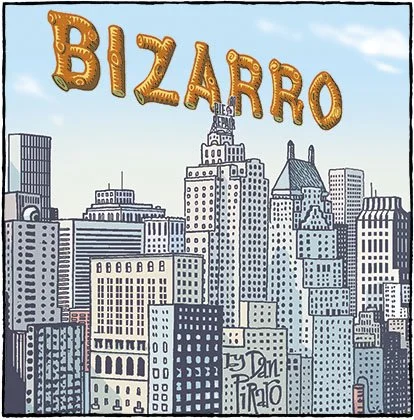
I’m Dan Piraro, the creator of the Bizarro newspaper comic, and this is my weekly blog post. The large Sunday comic above is mine, as are all of the comments below.
Since January 2018, the Monday-Saturday Bizarro comics have been written and drawn by my comics partner, Wayno. They follow this commentary. For more fun, check out Wayno’s weekly blog post.
I normally spend a half hour Sisyphusizing every morning before I get to work, but today I got up a little late, so I went straight to the task of pushing this blog boulder up the weekly hill.
Longtime Jazz Pickle, Kevin M, donated the title phrase of today’s comic as an idea for a new exercise craze, and I made the above comic from it. Thanks, JP First Class Kevin M! I’m promoting you to colonel.
On Friday, I posted an article on my Naked Cartoonistcreative writing thing that is one of my favorites. It’s a bit of Buddhist kung fu titled “Are God and Bigfoot the Same Person?”
Whatever you’re thinking it’s about, it’s probably not about that. (But maybe it is. A little. It depends on what you’re thinking it’s about.)
Nonetheless, I had a llama-load of fun writing it, and I want to share the audio version of it with you today. I record each of my articles for the hard-of-reading, and this recording turned out very fun, I think. Have a listen and let me know what you think.
You can get my articles —one every two weeks, plus access to the entire archive—for $5 a month. It’s a great way to help support what Wayno and I do here each week, since the industry that used to support us is quickly going the way of the stegasaurus.
IMPORTANT NOTE: We like to advertise our Bizarro products sold through the ComicsKingdom website, and we appreciate your support. But I want to make readers outside the US aware that international shipping has gone crazy! Read the shipping charges info carefully before you hit the final button.
All right already. It’s time to make little crescent moon shapes with our mouths as we become enchuckled by Wayno’s Bizarro comics from the week. Let the mooning begin!
That cracker Graham Bell was on his leave-a-message list.
We hope that no normal people are offended by this cartoon. That is never our intent.
We also hope that no peg-legged sea captains are offended by this cartoon. (If you have a prosthetic leg but are not a sea captain, this cartoon is not about you.)
We’ve all been there, dude. Some of us more than once.
This may be the only jury that would be sympathetic to a defendant who’s torn down part of a national monument like, say, the White House or something, and then began building a grotesque monument to himself in the form of a Golden Barbie Ballroom. Not that that would ever happen.
Coming soon to your neighborhood. Probably to kill you.
Well, JPs, I’ve pushed this week’s boulder as far up the hill as I can manage, so I’m going to let it rolll back down till next week. If you’d like to feel the joy of supporting our art and thoughts, the list below includes several ways. Thanks for being here.
'As a child, I had a running commentary in my head.'
In the first episode of their Close Readings series The Man Behind the Curtain, Tom McCarthy and Thomas Jones examine Cervantes’ masterpiece through the narrative, theoretical, economic and psychological systems that underpin it.
For both Don Quixote and Zidane, the media they consume becomes part of how they experience the world.
Gustave Flaubert recalled in a letter that the critic Sainte-Beuve compared his style to a surgeon’s scalpel, an image taken from 'Madame Bovary'. This was not a compliment: Sainte-Beuve was anxious about the ambition of Flaubert’s ‘realism’ to cut to the bone of its characters and society at large. Karl Marx, on the other hand, praised realist writers who ‘issued to the world more political and social truths than have been uttered by all the professional politicians, publicists, and moralists put together’.
In the first episode of his series 'Who's afraid of realism?', James Wood considers the fears and criticisms that have dogged realism from its emergence in the 19th century through its long history of transformations up to the present day. He examines the ways in which Flaubert used detail (both significant and significantly insignificant), impersonal narration, lifelike dialogue and free indirect style to create realism’s essential grammar.
James Wood is professor of the practice of criticism at Harvard and author of many books including 'How Fiction Works'.
Find the full episode and series on the Close Readings podcast:
Apple Podcasts: https://lrb.me/realismseriesapple
Spotify: https://lrb.me/realismseriesspotify
ABOUT CLOSE READINGS
Close Readings is a multi-series podcast subscription from the London Review of Books which looks at different periods and themes in literature through selections of key texts, covering poetry, fiction, history and philosophy from Ancient Greece to the present day.
Subscribe: https://lrb.me/closereadingsyt
ABOUT THE LRB
The LRB is Europe’s leading magazine of books and ideas. Published twice a month, it provides a space for some of the world’s best writers to explore a wide variety of subjects in exhilarating detail – from culture and politics to science and technology via history and philosophy. In the age of the long read, the LRB remains the pre-eminent exponent of the intellectual essay, admired around the world for its fearlessness, its range and its elegance.
As well as essays and book reviews each issue also contains poems, an exhibition review, ‘short cuts’, letters and a diary, and is available in print, online, and offline via our app. Subscribers enjoy unlimited access to almost 15,000 articles in our digital archive. Our website features a regular blog and a channel of audio and video content, including podcasts, author interviews and highlights from the events programme at the London Review Bookshop.
'If it weren’t for London Bridge there would be no London.'
Why and when was London built where it is? The city has many origin stories, but the most likely one involves invading Romans, slippery Britons and a bridge approximately where London Bridge stands today.
In the first episode of ‘London Revisited’, a Close Readings podcast series, Rosemary Hill and Dominic Perring discuss the Roman invasion of Britain and the earliest evidence of what eventually became the capital.
Listen to the full episode in
Apple Podcasts: https://lrb.me/LRep01apple
Spotify: https://lrb.me/LRep01spotify
This video was made in partnership with @TheLondonArchives (City of London Corporation). Explore more of London's history in the London Picture Archive, their online collection.
ABOUT CLOSE READINGS
Close Readings is a multi-series podcast subscription from the London Review of Books which looks at different periods and themes in literature through selections of key texts, covering poetry, fiction, history and philosophy from Ancient Greece to the present day.
Directly in Apple Podcasts: https://lrb.me/applecryt
In other podcast apps: https://lrb.me/closereadingsyt
ABOUT THE LRB
The LRB is Europe’s leading magazine of books and ideas. Published twice a month, it provides a space for some of the world’s best writers to explore a wide variety of subjects in exhilarating detail – from culture and politics to science and technology via history and philosophy. In the age of the long read, the LRB remains the pre-eminent exponent of the intellectual essay, admired around the world for its fearlessness, its range and its elegance.
As well as essays and book reviews each issue also contains poems, an exhibition review, ‘short cuts’, letters and a diary, and is available in print, online, and offline via our app. Subscribers enjoy unlimited access to almost 15,000 articles in our digital archive. Our website features a regular blog and a channel of audio and video content, including podcasts, author interviews and highlights from the events programme at the London Review Bookshop.
Em 2002, um publicação do governo do Piauí sobre a cultura do estado, dava o cantor Roberto Müller (de Piracuruca, a 200 km de Teresina) como falecido (ainda jovem). Muller só tomou conhecimento do equívoco em 2007, (quando comemorava 50 anos de carreira), e processou o governo piauiense, pelos prejuízos que o erro lhe causou. Sua agenda diminuiu porque muitos contratantes o consideravam morto.
Hoje, 25 de setembro, foi noticiada a morte, verdadeira, de José Ribamar da Silva, nome de batismo do cantor, que estava com 89 anos, com graves problemas de saúde, recebendo dois salários mínimos do INSS, mais um salário da UBC (União Brasileira de Compositores). Direito autoral quase nada. Ele ganhou muito dinheiro, acumulou muitos bens, comércio, postos de gasolina, mas perdeu tudo
Roberto Müller teve histórias que dariam uma biografia interessante.
No Rio, foi crooner da orquestra do maestro Astor Silva. Dividia o microfone com a adolescente Wanderléa, Gravou na CBS que detinha então o maior cast da jovem guarda. Namorou nessa época com uma cantora mineira iniciante, Clara Nunes. Conviveu com Roberto Carlos, Jerry Adriani, Renato Barros, dos Blues Caps, colegas de gravadora.
Müller é um dos pais do brega brasileiro, com extenso repertório de bolerões ao estilo mexicano. Seu último grande sucesso é de 1968, Entre Espumas (Roberto Marquetti), ironicamente, em pleno tropicalismo, e sob o AI-5. Não foi preso mas teve músicas proibidas, Mulher de Cabaré e Colecionador de Chifres.
inválido em consequência de um AVC (depois veio um infarto), ele foi cuidado por Dagmar Pereira, ex-divulgadora de gravadora, fã de Muller e depois sua esposa. Ela se dedicou a cuidar do cantor até sua morte. Viviam num humilde apartamento térreo num velho prédio do IPSEP. Entrevistei-o em sua casa em 2017. Roberto Müller não se queixava de suas condições precárias. No final da conversa me disse:
“A vida é assim, a família era grande e a gente tinha que dar cobertura, nunca deixei de ajudar a família. Hoje eu aceito tudo que Deus manda pra mim”.
Foto: Noite Ilustrada, Dalva de Oliveira e Roberto Muller – Revista do Rádio
What distinguishes intellectuals from the technocrats, academics, experts, polemicists, thought leaders, gurus and utopians who compete for our attention, and is there still a role for them in the public realm?
On the latest episode of On Politics on the LRB Podcast, William Davies joins James Butler to consider what’s happened to the intellectual. They look back to Weber's and Gramsci’s ideas about the autonomy and responsibility of the intellectual and discuss the ways in which Hayek’s anti-intellectualism has shaped discourse up to the present day. Where do politicians look for ideas and does the modern marketplace of algorithmic video platforms pose a challenge to independent thought?
Watch the episode: https://youtu.be/fG1RRmjv760
ABOUT THE LRB
The LRB is Europe’s leading magazine of books and ideas. Published twice a month, it provides a space for some of the world’s best writers to explore a wide variety of subjects in exhilarating detail – from culture and politics to science and technology via history and philosophy. In the age of the long read, the LRB remains the pre-eminent exponent of the intellectual essay, admired around the world for its fearlessness, its range and its elegance.
As well as essays and book reviews each issue also contains poems, an exhibition review, ‘short cuts’, letters and a diary, and is available in print, online, and offline via our app. Subscribers enjoy unlimited access to almost 15,000 articles in our digital archive. Our website features a regular blog and a channel of audio and video content, including podcasts, author interviews and highlights from the events programme at the London Review Bookshop.
William Davies joins James Butler to consider what distinguishes intellectuals from the technocrats, academics, experts, polemicists, thought leaders, gurus and utopians who compete for our attention, and to ask whether there’s still a role for them in the public realm. They look back to Weber's and Gramsci’s ideas about the autonomy and responsibility of the intellectual and discuss the ways in which Hayek’s anti-intellectualism has shaped discourse up to the present day. Where do politicians look for ideas and does the modern marketplace of algorithmic video platforms pose a challenge to independent thought?
Subscribe to the LRB: https://lrb.me/youtube
ABOUT THE LRB
The LRB is Europe’s leading magazine of books and ideas. Published twice a month, it provides a space for some of the world’s best writers to explore a wide variety of subjects in exhilarating detail – from culture and politics to science and technology via history and philosophy. In the age of the long read, the LRB remains the pre-eminent exponent of the intellectual essay, admired around the world for its fearlessness, its range and its elegance.
As well as essays and book reviews each issue also contains poems, an exhibition review, ‘short cuts’, letters and a diary, and is available in print, online, and offline via our app. Subscribers enjoy unlimited access to almost 15,000 articles in our digital archive. Our website features a regular blog and a channel of audio and video content, including podcasts, author interviews and highlights from the events programme at the London Review Bookshop.

 Login