
❌

Normal view

Naomi Klein on climate fear and the politics of scapegoating

💾

As climate change makes the world feel increasingly unfamiliar, the far right offers someone else to blame.

Naomi Klein and Astra Taylor talked to Adam Shatz on the LRB Podcast about what fascism looks like in the age of AI, drone warfare and influencers, and why we have reached a point where tech billionaires declare they are ‘unapologetically on Team Humanity’.

Watch: https://youtu.be/u6VCQF2sKHs

ABOUT THE LRB

The LRB is Europe’s leading magazine of books and ideas. Published twice a month, it provides a space for some of the world’s best writers to explore a wide variety of subjects in exhilarating detail – from culture and politics to science and technology via history and philosophy. In the age of the long read, the LRB remains the pre-eminent exponent of the intellectual essay, admired around the world for its fearlessness, its range and its elegance.

As well as essays and book reviews each issue also contains poems, an exhibition review, ‘short cuts’, letters and a diary, and is available in print, online, and offline via our app. Subscribers enjoy unlimited access to almost 15,000 articles in our digital archive. Our website features a regular blog and a channel of audio and video content, including podcasts, author interviews and highlights from the events programme at the London Review Bookshop.
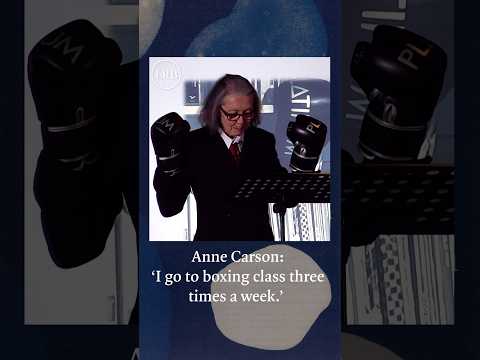
Why Anne Carson does boxing

💾

Parkinson’s disease turns off certain genes in the cells of the brain. What does it mean for a writer to confront scriptural disintegration and can boxing help rewire the spluttering brain?

From Anne Carson’s 2025 Winter Lecture for the London Review of Books.

Watch it: https://youtu.be/g8fPmTtG0qw

ABOUT THE LRB

The LRB is Europe’s leading magazine of books and ideas. Published twice a month, it provides a space for some of the world’s best writers to explore a wide variety of subjects in exhilarating detail – from culture and politics to science and technology via history and philosophy. In the age of the long read, the LRB remains the pre-eminent exponent of the intellectual essay, admired around the world for its fearlessness, its range and its elegance.

As well as essays and book reviews each issue also contains poems, an exhibition review, ‘short cuts’, letters and a diary, and is available in print, online, and offline via our app. Subscribers enjoy unlimited access to almost 15,000 articles in our digital archive. Our website features a regular blog and a channel of audio and video content, including podcasts, author interviews and highlights from the events programme at the London Review Bookshop.

Geoff Mann: What’s the truth?

Beneath a list of current bets on whether there will be a coup in this or that country by a certain date, Polymarket answers the FAQ ‘Why use Polymarket for coup predictions?’ with the response: ‘It cuts through the noise. You get an unbiased view of what thousands of traders think will actually happen, often more accurate than polls.’

Aziz Huq: Short Cuts

Driving from Kenosha to Racine to Janesville to Milwaukee, I’m conscious that the rules for early voting, absentee ballots, drop boxes (where you put your completed postal vote) and election timetables change every few miles. This fragmentation makes it hard for anyone, even a president unwilling to countenance his party losing, to rig election outcomes. But localisation also creates problems.

Mimi Jiang: A Day in the Age of AI

As a lazy writer and an even lazier translator, I have found myself without much work in recent years. Five years ago, I was quite confident that AI couldn’t replace human translators. Now, I am forced to admit that only a small amount of the writing we produce requires or deserves a human translator.

Deborah Friedell: In the Public Closet

Roy Cohn​ has been dead for forty years, but Donald Trump still yearns for him, his first lawyer and his fiercest. Who else could take an attack meant for Trump and return it a thousand – a million! – times harder? He still sometimes calls out for him: ‘Where’s my Roy Cohn?’ No one was better at making him feel indefeasible.

Susannah Clapp: On Shelagh Delaney

Shelagh Delaney had written A Taste of Honey when she was nineteen; it took her ten days. It was staged by Joan Littlewood’s Theatre Workshop in 1958 and filmed by Tony Richardson in 1961. She had a cushion of money; she had critical acclaim: Graham Greene proclaimed her to be as ‘fresh’ as John Osborne and (not a very high bar) more ‘mature’.

Paul Keegan: Eat Me

Desire is the great leveller in these pictures, and Wayne Thiebaud’s Boston cremes or pumpkin pie slices are like close-ups in the movies. They make us swoon. Even alone in a room with one of his small canvases, the viewer is a ‘We’ rather than an ‘I’. 

Toril Moi: Fredric Jameson as Reader

Fredric Jameson seemed to me to have read absolutely everything. He was the very antithesis of the intellectual type I think of as an empty theoriser, by which I mean someone who endlessly conjectures without having a genuine command of any relevant archive. To look at Fred as a reader of literature is not to reduce the scope of his work, but rather to try to understand its origins.

Elizabeth Goldring: At the YCBA

The Yale Centre for British Art is home to the largest collection of British art outside the UK. At the museum’s core is a foundational gift of works from Paul Mellon, who used his banking fortune to breed racehorses and acquire beautiful objects. ‘As anyone who has started to collect anything knows,’ he wrote, ‘it is impossible to stop.’

Iain Sinclair: Biblio-voodoo

Among the warring tribe of unsponsored fundamentalist poets, a full flush of broadsheet obituaries – the Times, Telegraph, Guardian, New York Times – is a light-deflecting singularity. But there are special cases. As if to make recompense for the substantial reviews they never delivered, the major culprits gave generous space to Prynne, who died, aged 89, on 22 April.

Nick Richardson: At the Royal Academy

The Royal Academy’s exhibition sets out to show that there is more to Richard Dadd than the mad artist away with the fairies. Had he not been an inmate of Bedlam then Broadmoor, he would have been, perhaps, a Pre-Raphaelite. Instead, he pursued his own course, developing a visionary style laden with mysterious personal symbolism and private jokes.

Camille Ralphs: Eejip-Eejip

Clare was born in 1793 in the village of Helpston in Northamptonshire. When the bookseller Ned Drury met him in 1819, he immediately saw an opportunity to market him as a ‘peasant poet’. Describing Clare in a letter to the publisher John Taylor, Drury wrote: ‘He is low in stature ... ungaitly – awkward – is a fiddler – loves ale – likes the girls – somewhat idle – hates work.’

Walter Johnson: Signs in the Heavens

My father told me about Nat Turner’s revolt when I asked him, as a child, if enslaved people had ever fought back. I’m still not sure how much of the story he knew. He didn’t talk about the revolt itself, but told me what had happened to Turner after his capture.

Diane Williams: He Seemed a Little Excited

Beyond the range of the dog, I knew there were snaky corridors at Meara’s, as well as a door that leads to a garden with the big round pond, which is a big surprise in summer, presenting its...

Colin Kidd: Antidote to Glibness

Whereas in the 18th century David Hume’s irreligion made him a bogeyman, now it is his views on race that have tarnished his reputation. Most obviously, we observe here the shifting parameters of what a society finds unacceptable. However, behind these controversies lurks a much deeper connection between religion and race.

Alexander Bevilacqua: Under a Cloud

It can be hard​ to imagine a world in which people justified slavery, yet for most of recorded history enslavement met with little intellectual opposition. Seneca was a rare dissenter. In his 47th letter to Lucilius, he wrote: ‘Remember that he whom you call your slave sprang from the same stock, is smiled on by the same skies and on equal terms with yourself breathes, lives and dies.’

Leo Robson: Sick of the Subject

If Invisible Man risked a too easy transcending of the pain it described, fulfilling one half of the ‘tragicomic’ or ‘blues’ formula but stinting on the other, Ralph Ellison’s essays went much further. One of his oddest rhetorical manoeuvres was to emphasise resilience while at the same time minimising adversity. There was so much silver lining in Ellison’s account of African American history that the cloud is barely visible.

Michael Wood: Near a Dying Star

There is a less binary way of thinking about the real and the imaginary and we slip into it (perhaps without knowing) as soon as we start to read almost any novel by Zola. Crudely evoked, the movement is based on the notion that reality itself is often fantastic; that language is a wonderful accomplice in this view; that ordinary talking life is full of tropes, exaggerations and indirection.

Ange Mlinko: Four Pints of Gelato

The title, Switzy, is a flippant nickname for Switzerland, a place like old age: snow-topped, dim and cold. Emma Cline’s novel hums with luxury: the private plane, the voguish hotels and restaurants, the limousine. And yet those pristine spaces end up merging seamlessly with the institutional nihility of the euthanasia clinic.
❌