❌

Normal view

Flashing Feathers

I’m Dan Piraro, the creator of the Bizarro newspaper comic, and this is my weekly blog post. The large Sunday comic above is mine, as are all of the comments below. 

Since January 2018, the Monday-Saturday Bizarro comics have been written and drawn by my comics partner, Wayno. They follow this commentary. For more fun, check out Wayno’s weekly blog post.

And here’s this week’s ANSWER KEY to my Sunday comic’s Secret Symbols.


Aloha, jazzy pickled Bizarro readers. Thanks for eyeballing us today.

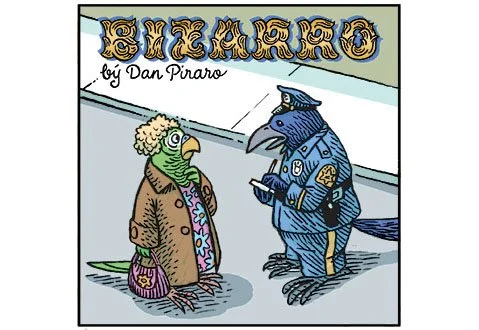
The theme of this week’s post is nudity. My Sunday comic above refers to a flasher—someone who foists their momentary nakedness on unsuspecting strangers—in this case, a jaybird. Why jaybirds were chosen for this idiom is a matter for linguistic historians and ornithologists.

Speaking of nudity, my article this week in my creative writing project, The Naked Cartoonist, is titled, “Surprising Benefits of Sleeping in the Nude and Better Reasons Not To.” It is an amusing, true story that happened to me sans apparel, which readers have reported enjoying in the following ways:

“I actually have a bellyache laughing so much at this.” —Samantha M. 

My apologies, Samantha.

“One of your funniest pieces!” —Raymond H.

Thanks, Raymond!

“OMG!! I am laughing so hard that I am crying and hiccuping all at the same time. It makes a strange rhythmic noise that my cat finds quite annoying! You made me laugh, and I thank you!” —Patricia P.

In all honesty, I don’t think Patricia’s reaction was typical, but I appreciate her enthusiasm. And I apologize to her cat.

You can get my articles —one every two weeks, plus access to the entire archive—for $5 a month. 

I post the same articles on medium.com behind their paywall, also $5 a month, but that price gives you access to all of their writers. 

And I post my stories on Substack for free.

I like to offer my work for free—as Wayno and I do with our comics here each week—because I’m not a greedy bastard who wrenches as much money as possible from others in every situation, like some very famous and odious people we all know. But I deeply appreciate those of you who voluntarily help us keep our creative efforts going.


BREAKING: Mi buen amigo and Spanish tutor, Ricardo, has a couple of openings in his schedule, and, due to the craptastic economy a certain narcissistic authoritarian felon has unleashed on the planet, he could really use some new students.

You’ll meet with him online, and you’ll enjoy your conversations with him. He’s a published novelist (in Spanish, under his pseudonym, which I cannot recall), speaks fluent English, and has a fascinating history and a great sense of humor. Contact him now and improve (or start) your Spanish! Ricardo Plaisant, kayuko1@gmail.com


Time now to appreciate Wayno’s efforts to enchucklenate the masses with his Bizarro comics from the week…

“Loam” is off camera.

Because of his copious archive of clown gags, Wayno has been chosen to receive the prestigious Order of the Rubber Nose.

If I had a nickel for every time I’ve heard this…

Dont’ miss that the tan circle is his eye. Chameleon eyes are crazy cool!

The medical deep state won’t admit it, but that knocking sound that MRIs are famous for is caused by radioactive hamsters on a plutonium wheel.

I’m sorry to say I used to smoke six to eight cigars each day; I’m happy to say I gave up cigar smoking over ten years ago, and I’m sorry to say I still miss it. But such is the nature of addiction, and I’ll never go back.


If you’ve been eager for the hilarity to end, I have good news: We’re done. Please consider helping us keep our comics and commentary free with a little love donation via the links below.

And before you do that, sign up for some entertaining Spanish conversation with mi buen amigo, Ricardo!

The Naked Cartoonist…My every-other-week creative-writing subscription service.

Limited edition, signed & numbered prints of BIZARRO CARTOONS, and some ORIGINALS!

Bizarro TIP JAR …One-time or repeating. Your choice!

WAYNO’S TIP JAR …One-time or repeating. Your choice!

My (free) graphic novel in progress, PEYOTE COWBOY.

Watch my PITCH VIDEO and become a supporter of Peyote Cowboy here.

Super fun BIZARRO SWAG from ComicsKingdom, including women’s V-neck styles! (IF ORDERING FROM CANADA or anywhere outside the US, CHECK SHIPPING COSTS CAREFULLY!)‍ ‍

Paul McCartney: ainda nas paradas depois de tantos anos

Décadas depois de transgredir quando nos Beatles, todas as regras, estender os mais diversos limites na indústria fonográfica e de comportamento, Paul McCartney está derrubando mais um,  desta feita nas artes.
Escritores, cineastas, ou artistas plásticos não têm habilidades postas em xeque se produzem depois da velhice. Suas obras da maturidade são quase sempre elogiadas. A artista da música popular é aposta data de validade.

McCartney depois dos 80 está compondo compulsivamente, e gravando alguns dos seus melhores álbuns. O mais recente, The Boys of Dungeon Lane, teve uma reedição nessa quarta-feira, 7 de outubro, com três  canções inéditas, City Fox, One Night Stand, e Chelsea Boots. A trinca foi produzida para o álbum, mas ficou na gaveta. Junta-se agora às demais deixando o disco com 28 faixas,equivalente a um CD duplo ou álbum triplo em vinil.

Aos 84 anos, fazendo música pop há 70, Paulo McCartney teve The Boys of Dungeon Lane incensado pela critica, estreou na Inglaterra como n° 1 nas paradas, e recebeu 23,5 milhões de plays nas plataformas. O álbum, lançado em junho, tem performance ainda melhor do que o também elogiado McCartney III, que também estreou no topo das paradas em ambos os lados  do Atlântico.

Em tempo. Na bolsa de apostas para a categoria mais importante do Grammy, a de Melhor Álbum (quem haveria de dizer 60 anos atrás?) os mais cotados são o citado The Boys of Dungeon Lane, e Foreign Tongues, do The Rolling Stones, que tem participação de Paul McCartney.

Foto: Mary McCartney

The Roman god found under London

💾

In 1954 archeologists were given a short time to excavate a site off Cannon Street in London before construction began of a new office block. They expected to find the remains of a Christian church. Instead, they found the head of a Roman god.

In the first episode of ‘London Revisited’, a Close Readings podcast series, Rosemary Hill and Dominic Perring discuss the remarkable archaeological discoveries that have changed our understanding of Roman London.

Listen:
Apple Podcasts: https://lrb.me/lrep1apple
Spotify: https://lrb.me/lrep1spotify
LRB website: https://lrb.me/lrep1web

ABOUT CLOSE READINGS

Close Readings is a multi-series podcast from the London Review of Books which looks at different periods and themes in literature through selections of key texts, covering poetry, fiction, history and philosophy from Ancient Greece to the present day..

ABOUT THE LRB

The LRB is Europe’s leading magazine of books and ideas. Published twice a month, it provides a space for some of the world’s best writers to explore a wide variety of subjects in exhilarating detail – from culture and politics to science and technology via history and philosophy. In the age of the long read, the LRB remains the pre-eminent exponent of the intellectual essay, admired around the world for its fearlessness, its range and its elegance.

As well as essays and book reviews each issue also contains poems, an exhibition review, ‘short cuts’, letters and a diary, and is available in print, online, and offline via our app. Subscribers enjoy unlimited access to almost 15,000 articles in our digital archive. Our website features a regular blog and a channel of audio and video content, including podcasts, author interviews and highlights from the events programme at the London Review Bookshop.

Naomi Klein on climate fear and the politics of scapegoating

💾

As climate change makes the world feel increasingly unfamiliar, the far right offers someone else to blame.

Naomi Klein and Astra Taylor talked to Adam Shatz on the LRB Podcast about what fascism looks like in the age of AI, drone warfare and influencers, and why we have reached a point where tech billionaires declare they are ‘unapologetically on Team Humanity’.

Watch: https://youtu.be/u6VCQF2sKHs

ABOUT THE LRB

The LRB is Europe’s leading magazine of books and ideas. Published twice a month, it provides a space for some of the world’s best writers to explore a wide variety of subjects in exhilarating detail – from culture and politics to science and technology via history and philosophy. In the age of the long read, the LRB remains the pre-eminent exponent of the intellectual essay, admired around the world for its fearlessness, its range and its elegance.

As well as essays and book reviews each issue also contains poems, an exhibition review, ‘short cuts’, letters and a diary, and is available in print, online, and offline via our app. Subscribers enjoy unlimited access to almost 15,000 articles in our digital archive. Our website features a regular blog and a channel of audio and video content, including podcasts, author interviews and highlights from the events programme at the London Review Bookshop.

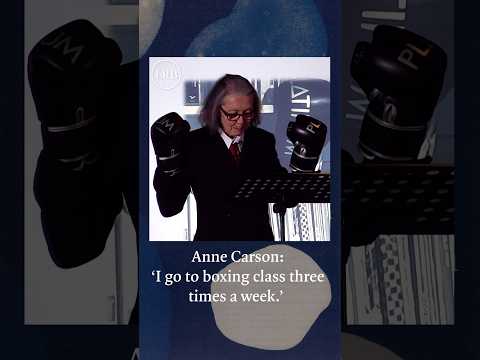
Why Anne Carson does boxing

💾

Parkinson’s disease turns off certain genes in the cells of the brain. What does it mean for a writer to confront scriptural disintegration and can boxing help rewire the spluttering brain?

From Anne Carson’s 2025 Winter Lecture for the London Review of Books.

Watch it: https://youtu.be/g8fPmTtG0qw

ABOUT THE LRB

The LRB is Europe’s leading magazine of books and ideas. Published twice a month, it provides a space for some of the world’s best writers to explore a wide variety of subjects in exhilarating detail – from culture and politics to science and technology via history and philosophy. In the age of the long read, the LRB remains the pre-eminent exponent of the intellectual essay, admired around the world for its fearlessness, its range and its elegance.

As well as essays and book reviews each issue also contains poems, an exhibition review, ‘short cuts’, letters and a diary, and is available in print, online, and offline via our app. Subscribers enjoy unlimited access to almost 15,000 articles in our digital archive. Our website features a regular blog and a channel of audio and video content, including podcasts, author interviews and highlights from the events programme at the London Review Bookshop.

Geoff Mann: What’s the truth?

Beneath a list of current bets on whether there will be a coup in this or that country by a certain date, Polymarket answers the FAQ ‘Why use Polymarket for coup predictions?’ with the response: ‘It cuts through the noise. You get an unbiased view of what thousands of traders think will actually happen, often more accurate than polls.’

Aziz Huq: Short Cuts

Driving from Kenosha to Racine to Janesville to Milwaukee, I’m conscious that the rules for early voting, absentee ballots, drop boxes (where you put your completed postal vote) and election timetables change every few miles. This fragmentation makes it hard for anyone, even a president unwilling to countenance his party losing, to rig election outcomes. But localisation also creates problems.

Mimi Jiang: A Day in the Age of AI

As a lazy writer and an even lazier translator, I have found myself without much work in recent years. Five years ago, I was quite confident that AI couldn’t replace human translators. Now, I am forced to admit that only a small amount of the writing we produce requires or deserves a human translator.

Deborah Friedell: In the Public Closet

Roy Cohn​ has been dead for forty years, but Donald Trump still yearns for him, his first lawyer and his fiercest. Who else could take an attack meant for Trump and return it a thousand – a million! – times harder? He still sometimes calls out for him: ‘Where’s my Roy Cohn?’ No one was better at making him feel indefeasible.

Susannah Clapp: On Shelagh Delaney

Shelagh Delaney had written A Taste of Honey when she was nineteen; it took her ten days. It was staged by Joan Littlewood’s Theatre Workshop in 1958 and filmed by Tony Richardson in 1961. She had a cushion of money; she had critical acclaim: Graham Greene proclaimed her to be as ‘fresh’ as John Osborne and (not a very high bar) more ‘mature’.

Paul Keegan: Eat Me

Desire is the great leveller in these pictures, and Wayne Thiebaud’s Boston cremes or pumpkin pie slices are like close-ups in the movies. They make us swoon. Even alone in a room with one of his small canvases, the viewer is a ‘We’ rather than an ‘I’. 

Toril Moi: Fredric Jameson as Reader

Fredric Jameson seemed to me to have read absolutely everything. He was the very antithesis of the intellectual type I think of as an empty theoriser, by which I mean someone who endlessly conjectures without having a genuine command of any relevant archive. To look at Fred as a reader of literature is not to reduce the scope of his work, but rather to try to understand its origins.

Elizabeth Goldring: At the YCBA

The Yale Centre for British Art is home to the largest collection of British art outside the UK. At the museum’s core is a foundational gift of works from Paul Mellon, who used his banking fortune to breed racehorses and acquire beautiful objects. ‘As anyone who has started to collect anything knows,’ he wrote, ‘it is impossible to stop.’

Iain Sinclair: Biblio-voodoo

Among the warring tribe of unsponsored fundamentalist poets, a full flush of broadsheet obituaries – the Times, Telegraph, Guardian, New York Times – is a light-deflecting singularity. But there are special cases. As if to make recompense for the substantial reviews they never delivered, the major culprits gave generous space to Prynne, who died, aged 89, on 22 April.

Nick Richardson: At the Royal Academy

The Royal Academy’s exhibition sets out to show that there is more to Richard Dadd than the mad artist away with the fairies. Had he not been an inmate of Bedlam then Broadmoor, he would have been, perhaps, a Pre-Raphaelite. Instead, he pursued his own course, developing a visionary style laden with mysterious personal symbolism and private jokes.

Camille Ralphs: Eejip-Eejip

Clare was born in 1793 in the village of Helpston in Northamptonshire. When the bookseller Ned Drury met him in 1819, he immediately saw an opportunity to market him as a ‘peasant poet’. Describing Clare in a letter to the publisher John Taylor, Drury wrote: ‘He is low in stature ... ungaitly – awkward – is a fiddler – loves ale – likes the girls – somewhat idle – hates work.’

Walter Johnson: Signs in the Heavens

My father told me about Nat Turner’s revolt when I asked him, as a child, if enslaved people had ever fought back. I’m still not sure how much of the story he knew. He didn’t talk about the revolt itself, but told me what had happened to Turner after his capture.

Diane Williams: He Seemed a Little Excited

Beyond the range of the dog, I knew there were snaky corridors at Meara’s, as well as a door that leads to a garden with the big round pond, which is a big surprise in summer, presenting its...

Colin Kidd: Antidote to Glibness

Whereas in the 18th century David Hume’s irreligion made him a bogeyman, now it is his views on race that have tarnished his reputation. Most obviously, we observe here the shifting parameters of what a society finds unacceptable. However, behind these controversies lurks a much deeper connection between religion and race.

Alexander Bevilacqua: Under a Cloud

It can be hard​ to imagine a world in which people justified slavery, yet for most of recorded history enslavement met with little intellectual opposition. Seneca was a rare dissenter. In his 47th letter to Lucilius, he wrote: ‘Remember that he whom you call your slave sprang from the same stock, is smiled on by the same skies and on equal terms with yourself breathes, lives and dies.’
❌