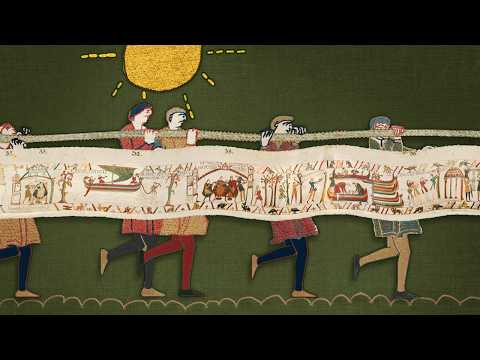
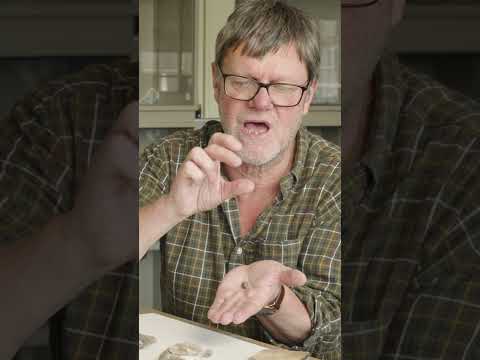
As we approach the opening of the Bayeux Tapestry at the British Museum on 10 September, we needed to hire the best of the best to lead our Security team.
Unfortunately, their first day wasn't a quiet one...
Get closer to the Bayeux Tapestry. More tickets are released on 21 October.
How did the Bayeux Tapestry survive for nearly 1,000 years?
Battles, revolutions and world wars – the Bayeux Tapestry has survived them all. But how did something made from linen and wool almost 1,000 years ago survive to tell its story today?
In this film, you’ll discover:
- How the Bayeux Tapestry was made using linen, wool and skilled embroidery
- Who may have made and commissioned it – and why
- How storage may have helped it survive for centuries
Designed for learners aged 11+, this short animation is equally suitable for families, teachers, students and anyone with an interest in history.
Discover the Bayeux Tapestry:
See the Bayeux Tapestry at the British Museum, on display from 10 September 2026 to 11 July 2027, or explore more online:
Bring the Bayeux Tapestry live into your classroom!
Join the British Museum’s live schools broadcast on 14 October 2026, for an action-packed journey through the Bayeux Tapestry, with expert guests, fascinating stories and a live student Q&A. Created especially for learners aged 7–14.
Book your class now https://www.britishmuseum.org/learn/schools/ages-7-14/live-schools-broadcast-bayeux-tapestry
Explore our wider schools offer:
https://www.britishmuseum.org/learn/schools
Subscribe to the British Museum for more films exploring history, archaeology and the world’s cultures.
The people of the ancient world didn't have 70mm film. But they did have clay, bronze, and gold, and their physical creations depicting the Odyssey demonstrate an astounding level of creativity and imagination. These objects go far beyond simply depicting scenes of the Odyssey, creating levels of interaction with their audience that's rarely seen today.
Join Curator of the Greek World, David Saunders, as he delves through the collection, guiding you through these diverse objects from the collection, and showing you how they told one of the most enduring stories of all time.
You may have noticed this is NOT a Curator's Corner. This is because we are still working on the 100th episode... subscribe so you don't miss it when it releases.
Chapters:
00:00 Intro
01:28 Chalcidian jar showing the blinding of the Cyclops
05:40 Italian mixing bowl showing the blinding of Polyphemus
11:00 Roman bronze figure - Odysseus
14:00 Bronze dish - Skylla
17:05 Black-figured skyphos - Circe
20:16 Gold ring - Penelope
Please note at 21:45 there is a small spelling error in the word 'circa'.
This armour was made from a crocodile. As conservators worked on the leather, it slowly returned to the shape of the animal it once was. The result is a rare object combining Roman military culture with ancient Egyptian belief.
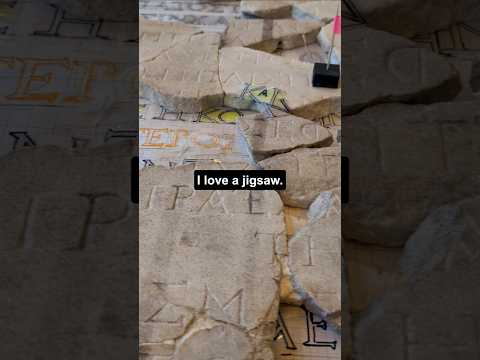
This is a Roman jigsaw puzzle - with missing pieces. More than 150 stone fragments once formed a letter from Emperor Antoninus Pius. Putting it back together means questioning every letter and line.
Discover one of the world's most famous medieval objects and uncover the dramatic events that lead to the Battle of Hastings in 1066.
Stretching nearly 70 metres, the Bayeux Tapestry is far more than a remarkable piece of embroidery. It tells a story of ambition, rivalry and conquest that changes England forever.
In this film you'll discover:
🏹 What the Bayeux Tapestry is and why it is so extraordinary
🏹 The dramatic events shown across its remarkable length
🏹 The rival claimants to the English throne
Designed for learners aged 11+, this short animation is equally suitable for families, teachers, students and anyone with an interest in history.
Discover the Bayeux Tapestry:
https://www.britishmuseum.org/learn/schools/bayeux-tapestry-schools
This ancient Egyptian model boat was created around 4,000 years ago to carry its owner on an eternal journey on the rivers of the afterlife. Placed in the tomb of a wealthy Egyptian as a funerary offering, it was intended to help the deceased navigate the world beyond.
In this film, we chart the course of this remarkable vessel from the tombs at Meir to the British Museum in 1894, before continuing its extraordinary journey to Museums and galleries around the world.
After four thousand years, this little craft has travelled farther than anyone could have imagined. Weathering empires, crossing oceans, and circumnavigating the globe many times over. Join us as we navigate just one small stretch of its endless voyage from London to the Chhatrapati Shivaji Maharaj Vastu Sangrahalaya Museum in Mumbai India.
00:00 - 00:37 Introduction
00:37 - 03:37 Journey one - (that is actually the second journey) Meir to London
03:37 - 03:52 Journeys around the world
03:53 - 05:09 Journey two - (that is actualy the first journey) The journey in the afterlife
05:10 - 07:10 Packing for the journey
07:10 - 08:04 Flying to Mumbai
08:04 - 08:46 Unpacking and initial checks.
08:47 - 09:48 Cross referencing the condition reports.
09:48 - 10 :58 Displaying the boat in the new gallery
Photos and line drawings of walls in the tombs of Wekhhotep III and Pepyankh the Black at Meir, Courtesy of The Australian Centre for Egyptology. N. Kanawati and L. Evans, The Cemetery of Meir. Volume II: The Tomb of Pepyankh the Black. The Australian Centre for Egyptology: Reports 34. Aris and Phillips Ltd., 2014, pls. 31a, 31b, 83; N. Kanawati and G. Barker, The Cemetery of Meir. Volume V: The Tomb of Wekhhotep III. The Australian Centre for Egyptology: Reports 45. Abercromby Press, 2022, pl. 2
These intricate objects were buried at Sutton Hoo in the early 600s — long before the Vikings.
Their quality has transformed our understanding of early medieval Britain, revealing a society that was far more connected, sophisticated and skilled than once believed.
Watch the full video via the link, or explore more on the British Museum channel.
 Login
Login