Perhaps you’ve ditched algorithmically curated playlists for vinyl and enjoy DVDs rather than streaming
Are you turning your back on hi-tech forms of entertainment to escape algorithmically curated content?
Perhaps you are enjoying listening to vinyl rather than the constant flow of music playlists. Or maybe you have ditched streaming services to watch DVDs instead.
As diet trends proliferate on social media, it can be hard to work out which are backed by science and which should be ignored. From paleo to keto, raw food to intermittent fasting, each attracts a tribe of ardent followers. Now Daniel Lieberman, professor of biological sciences at Harvard University, has written a book to try to cut through the noise. In Fed Up, he uses his background as an evolutionary anthropologist to scrutinise the evidence, turning himself into a guinea pig in the process and trying various diets. In this podcast, he tells Ian Sample which one has remained part of his routine
Combination of Miuccia Prada with Belgian designer Raf Simons once again spins gold for fashion house
Miuccia Prada’s style formula is simple: begin with a great skirt. Her personal uniform is a knee-length skirt, A-line or pleated, most often with a plain sweater and kitten heels.
The Prada collection that opened Milan fashion week made a compelling case for her favourite outfit, with a skirt the star of every one of the 63 looks – no dresses, no trousers. It won the room over, so expect to see the personality skirt on a high street near you soon.
In her new book, The Case for Quitting: The Surprising Benefits of Opting Out, Lindsay Crouse discusses the costs and traps of never giving up – and how she set herself free
Lindsay Crouse used to define herself as not a quitter.
She went to Harvard University, where she learned to become even more high-achieving and ambitious, then landed an assistant job at the New York Times and worked her way up to become an opinion writer and producer. On the weekends, Crouse ran marathons and did endurance sports, clocking new personal bests throughout her thirties.
Jackfruit is a blank canvas that absorbs flavour brilliantly – it’s all about seasoning it generously and giving it enough time for the aromatics and spices to do their work
I’ve just made yet another disappointing jackfruit curry. Any tips for making it more flavourful? Sally, by email “The trick with jackfruit is not to rush it,” says Eroshan Meewella, founder of Sri Lankan street-food joint Adoh! in central London. “It absorbs flavour brilliantly – spice, curry leaves, coconut milk, tamarind – so you just need to give it time.” Don’t be shy with those flavours, either, because, as Sally has discovered, jackfruit is something of a blank canvas. Sanjana Modha, author of Modern Masala, suggests treating it a bit as you would tofu: “You really have to build flavour around it. Think of jackfruit as a sponge that’s going to absorb your masala. And I cannot emphasise enough how you’ll need more onions than you think.” And she ain’t kidding: for a curry to feed four to six, Modha uses “at least” four large onions. “You must spend time caramelising them properly, so start by getting those onions really golden by frying them with a couple of cinnamon sticks, cloves and cardamom pods.” That will take a good 45 minutes. “Then add ginger, garlic and chillies – don’t be afraid to season generously with all your ground spices.” You’ll want some acidity, too: “Lemon, lime or tamarind towards the end to balance everything.”
On to the jackfruit itself, which Luke Larsson, head chef at Khao Bird in London, always uses fresh from an Asian supermarket: “It’s just a hundred times better [than tinned], and it’s such a delicious fruit when fresh.” Modha, meanwhile, tends to go for tinned young green jackfruit in brine: “Drain and rinse it really well, then pat it completely dry using kitchen towel.” She fries it first in neutral oil (rapeseed, sunflower), until golden and slightly caramelised: “This gives it much more flavour, then I marinate it in ground spices and a spoonful of mustard oil for a few hours, or even overnight, before adding it to my curry.”
As animal behaviorists increasingly use AI in their research, they grapple with how to wield the technology responsibly
I’m sitting in a small boat in Shark Bay, Australia, eavesdropping on a conversation between some of Earth’s most intelligent beings. The motor is off, the turquoise sea is glassy, and Stephanie King and I are motionless, transfixed by the whistles, clicks and squeezy, whirring noises made by the dolphins swimming below us.
If anyone could tell me what these big-brained social mammals are saying, it would be her. Based at the University of Bristol, she co-leads Shark Bay Dolphin Research, one of the longest-running wild dolphin research projects in the world. She has spent thousands of hours watching and listening to this population.
A teenager struggling with climate anxiety searches for hope in an unexpected place – writing letters to imprisoned activists. Max, 14, is on a quest to understand the human stories behind direct action and why so many climate protesters are in prison. As replies begin to arrive, a dialogue bridging generations unfolds and connection transforms despair into purpose. When Max writes to the judge presiding over a high-profile trial, he is surprised to hear the letter referred to in the judge's closing remarks
John Green is probably as famous as an author can get. His 2012 young adult novel The Fault In Our Starssold more than 20m copies, got adapted into a Hollywood hit film, and catapulted to a level of success that he’d always longed for. And yet, all that left him feeling empty. Now, after nearly a decade away from fiction, Green is back with his first novel for adults, Hollywood, Ending.In a very meta conversation with Carter Sherman, Green explains how interviews can be maddening, explores his own insecurities around fame, and argues that social media has trained all of us to sell our private lives as products. Carter and John also talk about his success as a pioneering YouTube creator alongside his brother Hank Green and Hank's recent dustup over his use of AI.
PlayStation 5, Xbox, PC; Remedy A surprisingly conventional game from a famously weird developer, this sequel to 2019’s Control is accomplished but safe
This is an arthouse action game from Finnish developer Remedy, masters of exactly this type of thing. It’s a sequel, however, so not only must it clear the high bar that its strikingly distinctive predecessor has set – it must also ideally arrive with a bushel of new ideas. There are clear and valuable strengths here in character progression and the lustrous presentation of its paranormal world, but Resonant doesn’t feel as enjoyably recondite or expansive in its influences as 2019’s Control did. As you wander New York brandishing supernatural abilities against glowing orange foes, the sad sense creeps in that you might be playing any number of games.
As paranormal event survivor Jesse Faden, your journey through the original Control was like a sequence of playable Twilight Zone episodes, battling prosaic household objects with supernatural properties that teased and twisted reality inside an endlessly fascinating supernatural government bureau called the Oldest House. You’d navigate architecturally impossible spaces bridging the subconscious and the bricks-and-mortar world, in order to defeat a malevolent fridge. That’s broadly true again in Resonant, albeit with diminishing returns. This time you’re playing as Jesse’s brother Dylan, waking up after years of containment in the Oldest House to find its contents have escaped into downtown Manhattan. So you head out of the interesting place, and into a setting you’ve explored before in Marvel’s Spider-Man, The Division, Max Payne, and others ad infinitum.
This recklessly ambitious doorstopper follows the 16 days of England’s medieval uprising from a vast array of viewpoints, and in startlingly rich prose
AK Blakemore’s third novel tells the story of the Peasants’ Revolt of 1381, when commoners of all classes – not only peasants, but merchants, servants, smugglers, and some local lords and officials – rebelled at the imposition of a poll tax and rampaged through southern England, burning records of debts, killing their oppressors and laying waste to their homes. The book closely follows the events of the rebellion’s 16 days, employing a vast array of points of view, including the young king Richard II, several of his courtiers, dozens of elements of the rebellious Commons, a porpoise and a runaway horse. The title suggests the novel’s portrayal of these events as an inevitable reckoning; a “doom painting” was a picture of the Last Judgment on the wall of a medieval church.
As a book of this scope must be, it’s a doorstopper. As any novel by Blakemore will be, it’s dazzlingly rich in lexical glamour, and this is likely to be any reader’s lasting impression of the book. Sometimes it feels as if the author is out to use every word in the English language in a startling, aestheticised, puckish way that expands both the word and the world. The result can be joyously silly. Who else would give us slugs that “blurb their elementary forms from out of the undergrowth to begin a dank and toothless festa”, or “lunar-brilliantined mud”? But there is also gravity and passion here, especially when she intimately imagines the lives of the commoners: “they rise, to fry eggs in butter and pork fat; they rise, to whet knives on scarred stone; they rise, to braid the manes of their draught horses; they rise, to count arrows; they rise, setting aside their glitchy dreams of hairy stars and blue-skinned devils; they rise, fearful and powerful, into the bright day.” The cheekily anachronistic appearance of “glitchy” in this medieval scene is typical of Blakemore’s method. All forms of language, high and low, archaic and modern, are here. Her use of detail to convey a historical scene is also extraordinary: the barber’s chair where “a crowd has gathered beneath the ribboned pole to watch the draining of a cyst”; the brewer with “a grotty beard, chlorotic with hops, [that] hangs down almost to his belt”; or “the horseflies waltzing over the liquefying flesh of severed heads”.
A long-distance walking route in the south of France devised by the celebrated land artist offers intrepid hikers an opportunity to immerse themselves in nature and art
At 69, I had never hiked with a backpack and I had no idea what land art was. Nonetheless, when my friend Jackie, a nature documentary film-maker, invited me to join her and her friends Wendy and Sasha on a hiking trip to Refuges d’Artin the mountainous countryside of Haute-Provence, I said a resounding “yes”. We would be sleeping alongside sculptures by the renowned land artist Andy Goldsworthy.
First, I watch Rivers and Tides, a documentary on Goldsworthy’s work, and discover he has built exquisite ice sculptures and stone cairns in my own country, Canada. His work seems to speak to an older part of the soul. Then, I start walking up hills, gradually adding weights to my backpack until I can comfortably carry 9kg (20lb).
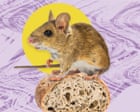
At first the mice were just a distant pitter-patter. But soon they had an unblinking confidence that they owned the entire house and all the food in it
Living in a nine-person house in Vancouver, Canada, far from my UK home, came with plenty of benefits. Cleanliness was not one of them. A dish left behind quickly multiplied and bins overflowed in little more than a day. I’m not saying the endless strew of disposable coffee cups was the cause of our year-long mice infestation, but it no doubt helped.
In the winter of 2023, one of my housemates began to hear the sound of creatures rattling around in the ceiling of her basement room. The pitter-patters grew louder and louder; others began to report sightings from across the house. It wasn’t long before I was waking to the sound of my bedroom bin rustling. I had to accept it: we had mice.
A rich Levantine fusion dish of sumac-spiced roast chicken, onion and flatbread with tahini yoghurt, and a simple, textured salad
Fattet musakhan, a celebration of two beloved Palestinian dishes, takes centre stage here, bringing together crisp bread, creamy yoghurt, sumac-spiced onions, tender chicken and fragrant olive oil in one rich and comforting dish. Alongside, the salad brings a welcome freshness, with crisp cucumber, creamy avocado and bright acidity cutting through the richness of the chicken. Together, they make a beautifully balanced meal, bringing the generous, communal spirit of Palestinian cooking to the table.
Cheyenne Roundtree, an investigative reporter at Rolling Stone, was as shocked as anyone when allegations of rape and sexual abuse were made against the music mogul. Then she began digging into his past life. In her first interview, she paints a horrifying picture of lost police reports, repeat behaviours, rumours and run-ins
For Cheyenne Roundtree, an investigative reporter at Rolling Stone, the civil lawsuit that dropped on Sean “Diddy” Combs in November 2023 seemed to come from nowhere. Filed by his ex-partner, the singer Cassie Ventura, it alleged that Combs had beaten and raped her, plied her with drugs and forced her into sexual encounters with male sex workers throughout their decade-long relationship.
Roundtree, along with much of the world’s media, was shocked. “I’d grown up in the era of Diddy and Cassie and viewed them as this power couple,” she says. “Her hit Me & U was my song. Diddy was this mogul – I knew him for the music – and she was this style inspiration, this beautiful, talented woman living an amazing life.”
Drug gangs have moved off Britain’s streets and into vulnerable people’s homes. Addicts like my friend are easy targets, but the reality can be more complicated than it seems
Duncan is a good friend of mine. He looks like a Dickensian rock’n’roller: tall and skinny, long hair, retro clothes. He’s read the Flashman novels three times. We met in secondary school in west London in the early 1980s. We got drunk, smoked Rothmans and banana skin spliffs and played Dungeons & Dragons. At 14, we got into punk together and spent our teens playing music and seeing live bands. As we moved into our 20s, I trained as a journalist and Duncan, a talented songwriter and guitarist, carried on with music.
At the age of 23 he got involved in heroin. He found the lifestyle immediately seductive, his partner at the time, Lucy, told me. He would often befriend his dealers. “I remember more than once waiting in his car as he’d gone up some tower block to score, thinking where on earth is he?” Lucy said. “He’d be hanging out chatting. There were some genuinely fascinating characters with incredible stories to tell.”

 Login