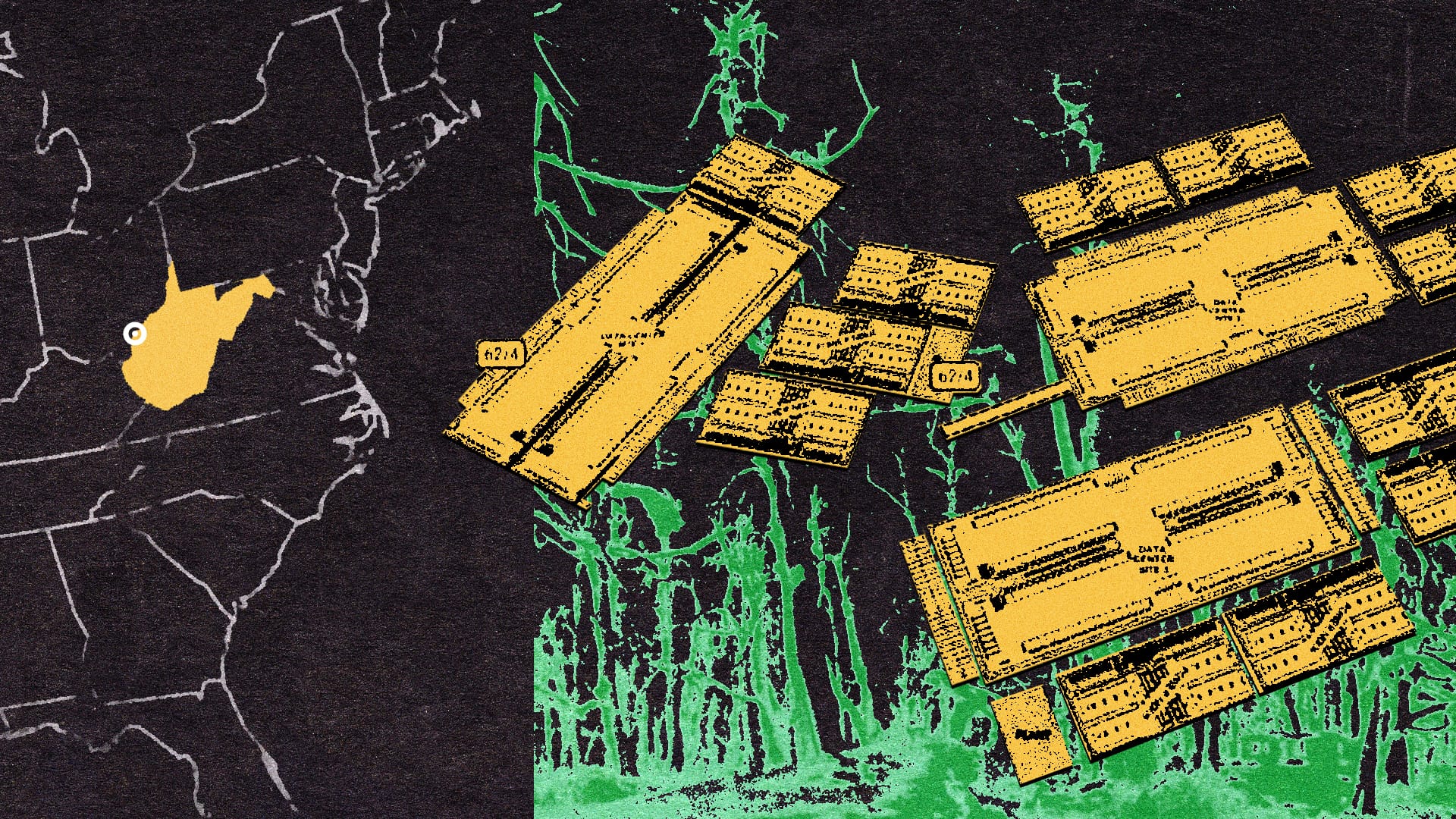
Texas has shut down the web portal for its automated construction permit filing system and suspended construction permits of 17 data center projects. The change came after 404 Media reported that a group of Texans discovered the state had continued to issue construction permits related to data centers despite Governor Greg Abbott calling for a pause in September.
On Monday, the watchdog groups FracTracker Alliance and Public Citizen published reports detailing more than two dozen permits issued to Texas data center projects. On Tuesday, the website for STEERS – an application filing system for construction projects run by the Texas Commission on Environmental Quality (TCEQ) – returned a 404 error.
The TCEQ portal as it appeared on Wednesday afternoon.
By Wednesday, the site had this message on it: “TCEQ’s electronic filing application used for automatic authorizations has been temporarily shut down to ensure all applications are reviewed by agency staff to determine if they are related to data centers.”
Before TCEQ shut the portal down, 404 Media viewed 17 different permits related to data center projects and saw that they’d been moved from “active” to “suspended” in the TCEQ central registry.
“STEERS is a portal that TCEQ uses to rubber stamp construction approvals,” Sam Law, a researcher at FracTracker Alliance told 404 Media. “It seems like they forgot about it and the portal has been quietly issuing approvals since the governor’s order for a pause, including for OpenAI and Amazon this Monday and Tuesday.”
The 17 suspended permits are related to stormwater construction, an approval that allows construction companies to raise and level ground. It’s a key, and sometimes final, part of the approval process for any construction project in Texas.
“Now they’ve taken the unprecedented step of suspending 17 approvals and taking down the whole site as they switch to a more involved human review process,” Law said. “The irony is not lost on me. When fighting the AI data centers build out, it’s nice to have a clear example of how some work is better left to humans.”
Law said he reached out to TCEQ and didn’t hear anything from them. The commission also didn’t respond to 404 Media’s request for comment. “I am very concerned that since contractors are accustomed to this automated approval process, they might not be aware of the suspension and continuing construction at some of the largest hyperscale facilities in Texas,” Law said.
First: Can you imagine sitting in jail for days without knowing why, and then finding out that it's because someone hacked CashApp to impersonate you? I would be kind of mad! And elsewhere on 404 this morning, we have some prescient thoughts from an autonomous weapons expert on the state of AI in war, what's going on with cybersecurity experts in the wake of the PHPocalypse, and more insights into how cops view anti-Flock activists.
Amanda Smith answered the door one afternoon in April and came face to face with the local Sheriff’s department in upstate Pennsylvania. The officers said they had a warrant for her arrest for a crime she had allegedly committed more than a thousand miles away in Arkansas.
“I was completely confused,” Smith recalled. For one, she had never been to Arkansas. Second, the warrant was for computer fraud. By her own admission, Smith was not a very tech savvy person.
She had a feeling she was being set up. After discussing with the officers the practicalities of what was about to happen — she was allowed to get her contact lenses — they took her away in handcuffs to the local jail where she spent three nights.
The reason for Smith’s arrest, she learned later, was that a scammer had tricked someone on Facebook Marketplace into sending $1,000 to a CashApp account in her name that the scammer controlled. The scammer created the account using her Social Security number and date of birth. Smith said she has never used CashApp.
What developed over the next few days, and has now stretched across six months, is a Kafkaesque situation in which Smith, in her telling, is being asked to prove her innocence in an ongoing criminal case, while CashApp refuses to provide her any information about the account because she couldn’t prove that she was the owner.
“Suspicious behavior:” A federal intelligence center warned police that city council meetings about Flock “may be viewed by extremists as a desirable target,” and told them to be on the lookout for “emotional confrontations” between people who oppose surveillance and government officials, according to a copy of the warning obtained by 404 Media.
“Black October?” For much of the last month, many cybersecurity experts have been warning of an AI-powered “Black Swan” event, saying they’re alarmed by the number of vulnerabilities suddenly discovered, and of the apparent power of AI agents to find and exploit previously unknown bugs. So, what’s really going on?
The UN met this week to discuss autonomous weapons.“The technology is developing at a pace that is very concerning,” Laurent Gisel, the head of the International Committee of the Red Cross’s (ICRC) legal warfare team, told 404 Media. Gisel was in NYC this week to address the UN about all the things that are driving conflict across the planet. His prepared remarks include a statement on the illegal arms trade, nuclear weapons, mines, and, of course, AI.
FROM AROUND THE WEB
That’s a W for the Rebel Alliance. In San Diego, where Darth Vader famously spoke in favor of Flock cameras and mass surveillance, the city council just voted to end its contract with Flock. The decision still has to be confirmed, NBC 7 reports, but this is huge news for a city where council members have voted multiple times to keep Flock watching its citizens.
For much of the last month, many of the cybersecurity experts I talk to and follow have been posting like they are very scared. Many have been warning of an AI-powered “Black Swan” event, have been alarmed by the number of vulnerabilities suddenly discovered, and of the apparent power of AI agents and large language models more broadly to find and exploit previously unknown bugs.
The rhetoric has ranged from worried-but-measured (things are about to get weird), to run-of-the-mill advice like update your software and make sure you have two-factor authentication on, to vagueposting about AI-powered attacks, to things like ‘the internet was nice while it lasted,’ to outright prepper-level terror.
To give you a sense of what I’m seeing, Matthew Green, a Johns Hopkins professor and one of the most respected cryptographers in the world, posted “we’re in the part of the movie where you need to throw whatever you can in the path of the zombies and hope it slows them down,” and “so many people discovering that the whole Internet is dry tinder and the only thing keeping it from burning is the fact that teenagers haven’t found the matches yet,” Green is alluding to the fact that hackers and researchers driving AI tools and agents are getting better at finding and exploiting all sorts of bugs in important systems. I’ve also seen numerous AI employees, as mentioned, go full prepper, suggesting people pull money out of their bank accounts, disconnect from the internet, purchase shelf-stable food, hoard water, put money in gold and cash, and purchase hand-crank emergency radios.
And all those posts came before people using AI-powered tools found vulnerabilities in PHP, the programming language that powers much of the internet. In the last few days, major vulnerabilities or issues have been found in eMudhra (an Indian entity that provides website security certificates), Node.js (an alternative to PHP), Gitlab (a software development platform), Plex (media server software), Railway (a cloud provider), OpenCode (a coding agent platform), and several other companies and services, though, rightfully, none of these has gotten as much attention as the vulnerabilities in PHP, called PHP2Shell, which researchers from Wiz, Calif, and OpenAI discovered using AI.
Matthew Prince, the CEO of Cloudflare, a service that has wide insight into the general health of the internet, posted, “In the 10 hours before [PHP2Shell] was publicly announced, across the Cloudflare network we saw thousands of attempts to exploit it. That jumped to tens of thousands in the 45 minutes post announcement, hundreds of thousands within 2 hours, and millions now.”
So much is happening, and so quickly, that it has been difficult for me — someone who has been reporting and editing stories on security and hacking for a decade — to fully understand what’s going on, to have a sense of what could happen next, or predict where this is going. And I think that that is largely where we are at the moment, as I am writing this.
But it has become clear that AI, broadly defined, has fundamentally changed both offensive hacking and defensive cybersecurity. This is not because AI has become sentient or because human beings have lost control of it or because of “swarms” of “rogue agents,” but because AI is proving something that we have always known: much of the software that runs the internet, our devices, our accounts, and our lives is vulnerable, or out of date, or has security flaws that human beings never noticed, or was installed by someone at a company who left the company six years ago and has been replaced four times and no one knows how to find them now or how to update it. This doesn’t mean that all of the vulnerabilities that have been found with the help of AI have been obvious or trivial; skilled hackers and researchers, driving AI tools, seem to be better than humans alone at finding vulnerabilities. But, critically, AI and large language models have made it extremely easy to essentially brute force the internet; if every piece of software is a door, AI makes it exceptionally easy to turn turn the knobs of every door to see if it’s unlocked, even on buildings that human beings had never really bothered to try to open. What we are learning at an alarmingly fast pace is that not only are some of the locks easy to pick, in some cases the door is wide open or there’s a giant hole in the wall. The recent spate of people using AI to hack their internet of things devices to run new software shows that, in some cases, it takes essentially no expertise to actually use AI to hack something.
Meanwhile, we've seen the rise of "abliterated" AI models that are designed to not say no and open weights models that can be used for pentesting and potentially offensive hacks without the guardrails that exist in many off-the-shelf commercial models.
In a blog post explaining the PHP vulnerability discovery, OpenAI said the findings highlight “how AI can uncover security flaws with internet-scale impact, but the same capabilities can also help attackers rapidly develop offensive tools and exploits.” OpenAI basically argues that it did all of this research ethically, and that its discovery opened a “Defender’s Window” that allowed governments and critical infrastructure to prepare for the disclosure of the bug. ‘Researcher finds bug, ethically discloses it to company, company fixes it’ is the preferred course of action in cybersecurity, but AI is shortening the window for all of this, is leading more people to do more research more easily, and is making both bug finding and bug fixing much faster. Whether those fixes are actually deployed by individual companies any faster is another, much more complicated question. The answer in many cases is, probably, no.
AI is also making all of this much more unpredictable. The security company Chainguard was criticized for breaking the embargo on the PHP vulnerability disclosure because it posted fixes for the vulnerabilities several hours before it was officially disclosed. Critics, including the PHP Foundation, said this could have let attackers figure out how to exploit the issues before website owners had a chance to protect their systems. In a LinkedIn post, Chainguard CEO Dan Lorenc said that his company independently found the same bugs by typing “find bad vulnerabilities in PHP” into a frontier AI model. Amazon, meanwhile, said that it saw exploit attempts before the official disclosure. These facts raise questions about whether the bug was exceptionally easy to find, whether the AI models that originally found the vulnerabilities incorporated that information into the model somehow therefore making it easier for someone else to find, or whether there was a leak along the way from someone connected to the disclosure process. Any option is concerning.
After the PHP2Shell vulnerabilities were discovered, some infosec experts started calling this “Black October,” and highlighted the fact that the National Security Agency, the Prime Minister of Japan, and various governments around the world told people to patch their websites and services immediately, and to take down services that couldn’t be patched. 4chan, several Wikimedia services, and Archive.org were all temporarily taken offline so that they could be updated.
As The Atlantic has already suggested, one of the biggest impacts of PHP2Shell could be the fact that many historic websites can’t or won’t be updated, may be proactively pulled offline, might eventually be hacked, and might never come back. The link rot could be horrendous, and a lot of history could be lost.
For such a high-profile incident, most of the actual impacts thus far have been related to the proactive patching or removal of potentially insecure websites, and we have not seen immediate, widespread exploitation of the bug. Various low-effort, LLM-developed exploits have been dropped online; many of them will not work. A blog post called “There isn’t an easy exploit for this PHP vulnerability,” written by Elias Taylor, quickly went viral and was dissected on Hacker News, especially by people pointing out that the website eliastaylor.com had been recently registered and that it wasn’t clear who Elias Taylor was. 404 Media reached Taylor by Signal; he said “I am real and on a delayed train.”
“Lots of people are being tricked by AI into thinking they have an exploit when they don't, because they can't read or understand what the LLM gave them,” Taylor told 404 Media. “It doesn't appear to be anywhere near as exploitable as the other ‘stop the world’ vulnerabilities i.e log4j, heartbleed. But patch your servers, it’s still a vulnerability. Please do not paraphrase me as saying ‘there is no vulnerability’ for any reason. There is, and people should patch.”
Dan Guido, the CEO of Trail of Bits, a well-respected cybersecurity company that partners with OpenAI on the Patch the Planet initiative, posted that his company had created “a working exploit,” and that “Will Tan built it in 1 day with Codex, drawing on ~10 years of system security and vulnerability research. AI accelerates exploit development. Knowing how to turn a bug into a shell still takes expertise. AI makes that expertise more productive.”
It should also be noted that Taylor’s other blog post is called “Anything connected to the internet is going to get hacked to pieces,” which includes the lines “software engineers have spent the past 40 years writing vulnerable, dogshit software. LLMs are easily above the bar needed to break into said software.”
It remains unclear, at the moment, what the ultimate impact of all of this is going to be, or where we’ll be in one hour, one week, one year, or 10 years. But AI is changing how cybersecurity and hacking works. It is making finding and exploiting bugs faster and easier. We’re about to find out how insecure the internet really is.
The UN met this week to discuss, among other things, the threat of autonomous weapons.
“The technology is developing at a pace that is very concerning,” Laurent Gisel, the head of the International Committee of the Red Cross’s (ICRC) legal warfare team, told 404 Media. Gisel was in NYC this week to address the UN about all the things that are driving conflict across the planet. His prepared remarks include a statement on the illegal arms trade, nuclear weapons, mines, and – of course – AI.
Autonomous weapons have been a hot topic at the UN this year. In September, the UN attempted to pass a treaty that would govern the use of killer AI weapons. Diplomats from Russia and the US stripped it of its power.
But the UN has pressed forward. On Tuesday, the international governing body announced a new initiative that would grapple with the issue. But, as Gisel said: “multilateral processes take quite some time” and “we already see the effects on the battlefield.”
AI is already picking targets and killing people. Gisel said the technology is “amplifying the destruction, amplifying the violation of the law, amplifying the humanitarian harm caused by conflicts.”
Israel used an AI powered by Microsoft to pick targets in Gaza. In Ukraine, AI-powered Russian drones are deciding which humans to kill. The United States military is pitching itself as an “AI-first” fighting force. Secretary of Defense Pete Hegseth recently announced Project Meridian, an initiative to guide the AI-powered autonomous weapons of the future. Three of Meridian's leads are Elon Musk, defense contractor Palmer Luckey, and Newt Gingrich.
For Gisel, one of the biggest dangers of AI is how fast it is. A core selling point for the tech is that it can help commanders make decisions faster. But that also accelerates the pace of mistakes. “Targets are created at higher speed and higher frequency, and are actually then prosecuted quicker, and with that give us great concerns in terms of the level of human control that is retained,” he said. “The human is supposed to remain in the loop.”
The human does not always remain in the loop. The Israel Defense Forces told journalists it did not thoroughly vet the kill lists generated by Lavender, the AI system it used to pick targets in Gaza. “It's known in the [civilian world] [...] that humans tend to trust the systems,” Gisel said. “That it's more the case when the humans are tired, when the humans are under stress, when the humans have to deliver quickly, and that's of course exactly the situation in which soldiers are in. So all of that gives us a lot of concerns in terms of retaining control on the use of force in armed conflict.”
AI boosters often pitch AI as an “easy button,” a way for people to brute force a complicated task and get it over with. But the consequences are much different when someone in Silicon Valley is parsing spreadsheets or reverse engineering code than when they’re prosecuting a war in the Middle East.
“That's something that the developers of those systems don't necessarily realize either, because some of those systems are developed by technological companies very far away from the battlefield, and they are not naturally all developed for battlefield use,” Gisel said.
International humanitarian law is an ever-evolving legal negotiation between world powers meant to limit the devastating effects of war. It’s imperfect and countries with vast armies like the US and Russia often do not abide by it. The ICRC, which Gisel represents, exists explicitly to shape these rules and laws. Some of the laws are old, far older than AI, but according to Gisel humanitarian law applies to “all weapons, means, and methods of warfare. Those of yesterday, those of today, and those of tomorrow.”
Beyond the opportunity to code humanitarian law into AI, Gisel said there should be new rules and regulations for the new technology. “Not to prohibit them all, but to prohibit specific categories of autonomous weapon systems and put specific restrictions on others,” he said.
"...Once the genie is out of the bottle, it's very, very much difficult to put it back in the bottle"
But he does have redlines. The first is any AI support system that removes a human being from the kill chain. “That requires specific limits and guardrails and restrictions from our perspective,” he said.
“The other type of autonomous weapon system that we recommend prohibiting is those that would target human beings directly, where the target profile is the human being, as opposed to a tank, weapon systems, or another typical military objective, and the reason why is based on ethical concerns, humanitarian concerns, and a moral line,” he added.
Autonomous weapons have existed for a long time. Some US warships have gatling guns that track and destroy incoming targets automatically. The difference is that those weapons track ships and missiles, not human beings.
According to Gisel, one problem with autonomous weapons that target humans or AI support systems that pick targets is that they’re unpredictable. He said banning unpredictable weapons should be a non-brainer. “Military discipline is about your forces [...] delivering the commander's intent,” he said. “If you have a weapon that is unpredictable in its effect, how can you deliver the commander's intent?”
But it’s been a sticking point in negotiations. “We would have thought, military considerations, would align. But actually, that has also faced quite some pushback. Strangely enough,” he said. He spoke about the negotiations in August and September from earlier in the year. “There were references in the last proposal by the chair of the group on precisely all those questions: that the autonomous weapon systems need to be reliable, explainable, understandable, and predictable. And all of that was taken out by some states.”
Gisel also opposes AI in nuclear command and control. In 1983, the Soviet Union’s early warning systems reported that the US had launched a nuclear weapon at the country. Soviet lieutenant colonel Stanislav Petrov decided the computer had made a mistake and decided not to report the attacks up the chain. He was right.
“States will continue to use satellite systems and therefore algorithms that go with those satellites,” he said. “But it's so important to ensure that it remains entirely under human control and a really meaningful human control.”
While the UN deliberates and the ICRC wrangles with how to regulate all this, the wars continue and military forces continue to embrace AI. “That's why it's urgent to have decisions being made by the international community on what to prohibit and what to restrict [...] once the genie is out of the bottle, it's very, very much difficult to put it back in the bottle,” he said.
Gisel said the world needs to act now. “Otherwise, it's the technology that will decide what is acceptable, and that's not the world we want to live in, right?”
A federal intelligence center warned police that city council meetings about Flock “may be viewed by extremists as a desirable target,” and told them to be on the lookout for “emotional confrontations” between people who oppose surveillance and government officials, according to a copy of the warning obtained by 404 Media.
The warning, obtained by 404 Media, was issued by the Orange County Intelligence Assessment Center (OCIAC)—a government fusion center—in July to police in California. 404 Media recently obtained the bulletin using a Freedom of Information Act request.
This surveillance bulletin to cops is the latest evidence that police around the country have been told to be on edge during public meetings where people are participating in democracy and utilizing their First Amendment rights about unpopular things the government is doing. We have reported on a spate of people being illegally arrested for extremely minor procedural violations or for cursing at city council meetings about Flock and data centers while participating in constitutionally protected activities.
The warning is similar to others obtained by 404 Media and other journalists about the broader DeFlock movement and vandalism of Flock surveillance cameras. But this warning specifically tells police that there have been “no specific and credible threats found” related to city council meetings about Flock, but warns they should be on the lookout anyway. The warning noted that anti surveillance organizers could have been emboldened by the news that the Los Angeles Police Department ended its Flock contract, and may expect other local governments to do the same. The LAPD’s decision was “providing organizers and participants with a high-profile local example that could increase turnout and place additional public pressure on City Council members” to end their Flock contracts, the bulletin claims.
“City-hosted events (i.e., city council meetings) may be viewed by extremists as a desirable target. Partners are encouraged to review for signs of suspicious activity,” the warning reads. This suspicious activity includes “excessive clothing,” “unusual questions or behavior,” people loitering,” or “unattended bags or packages.”
The warning goes on to say that genuine interest in ending mass surveillance at a city council meeting “may present public safety risks,” which includes “large turnout exceeding room capacity,” “emotional confrontations,” counterdemonstrations,” “media presence,” “social media amplification,” and “disruption of council proceedings.”
Here is a full excerpt of the portion of the warning about protected activities that could apparently “present public safety risks:”
_
Large turnout exceeding room capacity: If organizers mobilize significantly more attendees than the council chambers can accommodate, this can lead to long lines, frustrated attendees, overflow areas, or delays in the meeting.
Emotional confrontations: Because the issue involves surveillance, privacy, immigration concerns, and public safety, speakers and attendees may have strong emotions. Verbal confrontations between supporters and opponents are more likely than at routine council meetings.
Counterdemonstrations: Individuals who support the Flock camera program or emphasize its crime-fighting benefits may attend and express opposing views, increasing the potential for verbal conflict.
Traffic and parking impacts: A well-attended meeting can create localized congestion around City Hall before and after the meeting.
Media presence: Local television, newspapers, livestreamers, and independent journalists may attend because the issue has recently received regional media coverage.
Social media amplification. Attendees may livestream or record interactions. Minor disputes can quickly spread online, increasing public attention.
Disruption of council proceedings. Possible issues include:
Interrupting speakers
Shouting from the audience
Refusing to yield the podium after time limits
Coordinated chanting inside the chambers
Attempts to delay or prevent the meeting from continuing
Physical altercations: Heated disagreements between attendees with opposing viewpoints could escalate into minor physical altercations, particularly during emotionally charged interactions before, during, or after the meeting.
Targeted threats or intimidation: Any credible threats, harassment, or intimidation directed toward elected officials, city staff, organizers, or attendees should be treated as a significant public safety concern and evaluated promptly.
Extremist-related activity: Although there is no publicly available information indicating extremist involvement, politically contentious events may attract isolated individuals seeking to promote unrelated ideological causes.
“The OCIAC recognizes that Americans have constitutionally protected rights to assemble, speak, and petition the government,” the warning ends. “The OCIAC safeguards these rights and only reports on First Amendment protected activities for operational planning in the interest of assuring the safety and security of the demonstrators and the public.”
Amanda Smith answered the door one afternoon in April and came face to face with the local Sheriff’s department in upstate Pennsylvania. The officers said they had a warrant for her arrest for a crime she had allegedly committed more than a thousand miles away in Arkansas.
“I was completely confused,” Smith recalled. For one, she had never been to Arkansas. Second, the warrant was for computer fraud. By her own admission, Smith was not a very tech savvy person.
She had a feeling she was being set up. After discussing with the officers the practicalities of what was about to happen — she was allowed to get her contact lenses — they took her away in handcuffs to the local jail where she spent three nights.
The reason for Smith’s arrest, she learned later, was that a scammer had tricked someone on Facebook Marketplace into sending $1,000 to a CashApp account in her name that the scammer controlled. The scammer created the account using her Social Security number and date of birth. Smith said she has never used CashApp.
What developed over the next few days, and has now stretched across six months, is a Kafkaesque situation in which Smith, in her telling, is being asked to prove her innocence in an ongoing criminal case, while CashApp refuses to provide her any information about the account because she couldn’t prove that she was the owner.
Near the bank of the Ohio River, a historic American chestnut grove in Mason County, West Virginia has become the epicenter of a fight against a planned 2,250 acre data center campus. Plans for the UK-based startup Nscale’s Monarch Compute Campus, with clients including Anthropic, Nvidia and Microsoft, encompass the former Clements State Nursery and the American chestnut trees still growing there.
For thousands of years, the American chestnut tree was a staple of life. Its natural range spanned hundreds of millions of acres from Maine to Mississippi, centuries before those names existed. As many as four billion trees provided a hearty nut crop for humans and provided miraculously rot-resistant lumber for railroad ties and housing. It sustained black bears as they prepared to hibernate, fed white-tailed deer and turkey, and shed nutrient-dense leaves. The largest American chestnut trees once grew 100 feet tall and 13 feet wide and represented one-fourth of all hardwoods; a squirrel could scamper along their branches from New England to Georgia without touching the ground, as an old saying goes.
In 1904, a forester at the Bronx zoo noticed something alarming among their American chestnuts: The trees were dying en masse, struck by a mysterious blight. Within 40 years, that blight — thought to be brought to America on Asian chestnut trees — wiped out the tree’s population to near-extinction. Since then, conservationists have worked to restore American Chestnut trees and breed blight-resistant specimens. Typically, threats to groves include pests, climate change, and the fungus that destroyed their ancestors. Today, however, a new threat has entered the picture: data centers.
Library of Congress: American Chestnut Tree, Negative No. 6032 (Photographer and date unknown). "THIS GHOST FOREST OF BLIGHTED CHESTNUTS ONCE STOOD APPROXIMATELY AT THE LOCATION OF THE BYRD VISITOR CENTER." - Skyline Drive, From Front Royal, VA to Rockfish Gap, VA, Luray, Page County, VA
Across the country, communities are pushing back against massive hyperscale data center projects, protesting against the noise pollution, environmental impacts, and blow to property values near these computer warehouses. In many places, elected officials are forging ahead to allow these multi-billion dollar deals in direct defiance of their constituents' wishes. Earlier this year, an Oklahoma farmer was arrested at a town hall meeting for speaking over his time against a 255-acre data center. Data centers are easy to build but much harder and slower to power, and their workarounds are egregious; For example, Elon Musk’s xAI Colossus 2 data center in Tennessee skips the local grid and runs its own natural gas turbines, worsening pollution and disproportionately impacting Black neighborhoods. But this tiny plot of American chestnut trees, just a little over an acre of land, has become a site of resistance in West Virginia.
I first heard about the Clements chestnut grove after a 404 Media reader emailed me about it earlier this month, saying that the trees faced “potential destruction after November 1, 2026.” Social media posts called the threat “urgent,” and claimed bulldozers are lined up, with headlines declaring the grove is “about to be destroyed.” In the last few weeks, the plight of a grove of fragile chestnut trees trembling in the shadow of a data center has gone viral. Goldberry Grove, a local regenerative chestnut orchard, posted “They’re bulldozing the American chestnuts after November 1st,” sparking more outrage.
In 2023, Governor Jim Justice announced a multi-billion dollar deal with Fidelis New Energy for a lifecycle carbon neutral hydrogen production facility, including the “Mountaineer GigaSystem” and the Monarch Compute Campus. Nscale acquired the American Intelligence & Power Corporation, sponsored by Fidelis New Energy and including the Monarch campus, in March.
“The citizens of Mason County are elated with the announcement of Fidelis New Energy selecting Mason County, West Virginia, for its multibillion-dollar state of the art carbon neutral, clean hydrogen complex,” John Musgrave, the Executive Director of the Mason County Development Authority said in Justice’s 2023 press release about the new data center plans.
With construction of the campus underway today, citizens do not seem elated. In September, heavy storms reportedly caused neighborhoods nearby to flood, as runoff from the construction site sent water and debris into adjacent properties as a section of the site’s fencing gave out. The Department of Environmental Protections (DEP) ordered Nscale “to immediately repair and strengthen the stormwater controls that failed, install additional erosion and sediment controls where needed, and take whatever actions are necessary to prevent similar releases from occurring in the future.”
Nscale told local news outlet WOWK 13 that it would pay for the damage. Separately, the company is trying to buy out homeowners, but the people living there are resistant. “What they’re saying is one thing, but they’ve got to prove it,” one homeowner told WOWK 13. “I’m staying. Fight for every one of these people.”
The fate of the trees has been a conversation among conservationists in the area for years. The American Chestnut Foundation (TACF) raised the issue in its May 2024 monthly newsletter: “Several communications have been made with [West Virginia Secretary of Commerce James Bailey] and he is aware of the chestnut trees at Clements. He assured the WV chapter that the trees will remain and be taken care of by Fidelis.”
The newsletter bulletin continued: “Mr. Bailey stated, ‘We value the chestnuts and will ensure that they are cared for. The state maintains ownership and control of the property, but if that ever changes, then the trees will be taken care of.’” The TACF noted that the future of the grove was “unclear.” Three years later, the picture is sharpening, as chestnut experts and the data center developers clash.
Sixty-two years ago, the first seedlings shipped out from West Virginia’s newly-designated Clements State Tree Nursery. The nursery was once owned by Mark Twain’s grandparents. The West Virginia Division of Natural Resources bought it in 1961 and the Division of Forestry operated it for decades onward. The nursery sold seedlings of several varieties of trees and kept 15 to 20 chestnut trees that showed promising traits of blight resistance. In 2021, the Charleston Gazette-Mail reported that the DNR quietly ceased operating the nursery, citing funding issues. “It was never set up to make money, but it was also never set up to lose the kind of money it’s been losing in the past 10 years,” then-Division of Forestry Director Tom Cover told the Gazette-Mail at the time.
"The Dying Chestnut Tree, My Teacher" (1927) and "The Dying Chestnut" (1919), by Alfred Stieglitz.
Today, all of the American chestnut trees remaining at the former nursery site are infected with the blight fungus, Mark Double, a past president of the West Virginia Chapter of TACF told me. Many have died over the years, he said, but most of the trees still have sufficient resistance to have survived for 35 years, in spite of multiple infections. “The WV chapter of The American Chestnut Foundation has been harvesting nuts from this orchard for more than a decade,” Double told me over email.
Nscale’s Monarch campus is one of two data center projects planned for the area. Project Tamarack, which is owned by Starwood Digital Ventures, is planned for 10 miles south of the Monarch campus. West Virginia Governor Patrick Morrisey announced the project early last month. Morrisey promises 1,000 temporary jobs but just 300 permanent positions as a result of the project. Research shows that data centers rarely live up to promises about bolstering local economies. “Data centers do not bring high-paying tech jobs to local communities because they operate as infrastructure projects rather than traditional jobcreating businesses,” University of Michigan researchers wrote in a 2025 brief. “Although the construction of data centers can create many jobs, those are short lived.”
Residents were stunned to hear that another data center was coming to their community, telling local news outlet WSAZ that they felt blindsided. Despite not being located on the former nursery’s site, the fate of the American chestnuts have forced Starwood to address it, too.
I emailed Starwood on Oct. 8 asking if its campus threatened the trees. “I checked, and that grove isn’t on Starwood’s land,” a spokesperson told me. Sometime after Sept. 24, according to archives of the site, Project Tamarack added a line to its FAQ section about the grove: “The former Clements State Tree Nursery is a separate property and is not part of the Project Tamarack development site. Project Tamarack has no ownership, control, or management responsibility for the property. Questions regarding the chestnut grove, the former nursery, or the property’s management should be directed to the West Virginia Division of Forestry, which operated the facility prior to its closure in 2021.”
Nscale also claims that the trees aren’t on land it owns, either — yet. That section of land is technically still under a “plan to purchase agreement.”
“We understand the deep community connection to the former Clements State Tree Nursery site, and we look forward to working closely with the Morrisey Administration—including the Department of Agriculture and Division of Forestry—and The American Chestnut Foundation regarding the American Chestnut trees while responsibly developing the Monarch Compute Campus,” a spokesperson for Nscale told 404 Media. They continued:
“We want to be clear — there was never a plan to bulldoze the nursery or cut down the trees. Nscale does not currently own the former Clements State Tree Nursery but we are under a plan for purchase agreement. Once we own the land, we are focused on how to best care for the trees which, according to a recent assessment by an arborist, suffer from blight and adverse health conditions. We have always planned to incorporate the American Chestnut trees into the Monarch Compute Campus. As construction progresses, we will work closely with professional arborists and experts to determine how best to preserve and integrate them, covering all costs.”
Nscale Senior Vice President Pete Hollis told West Virginia Public Broadcasting: “There’s never been a plan to and there will never be a plan to bulldoze or cut down the trees.”
On October 10, Morrisey announced that the trees would eventually be moved, framing this as a way to appease everyone. “Under the preservation plan, the existing trees will be relocated to a more suitable environment within the property, potentially as part of an arboretum or integrated landscaping. That work is scheduled for late 2027, during the trees' dormant season, under professional arborist supervision,” the governor’s office wrote in a press release.
Amy Metheny, a forest pathologist for the West Virginia American Chestnut Foundation, told WCHS-TV that relocating the trees would inevitably kill them. “It’s my professional opinion that if the trees were moved they would die within two to five years,” she said.
I asked Morrisey’s office if they’re aware that experts say the trees will die if moved. A spokesperson for Morrisey’s office replied:
“We are aware of the concerns about transplanting and have discussed them directly with a member of the West Virginia chapter of The American Chestnut Foundation. The West Virginia Department of Agriculture’s assessment found that the trees are expected to continue dying under current site conditions. It also found that relocating chestnut clumps with proper care may improve their health, although some losses are expected.
“Mature chestnut trees from the same original source as the Clements planting are growing in and producing nuts in Tyler County. Approximately 500 nuts from those trees are expected to be used for additional planting to support continued restoration efforts.
“The company has said relocation remains its plan and that it will cover the cost. The property is subject to a legally binding purchase option signed in 2023 by the previous administration. We are working with the company and conservation experts to help secure the best possible preservation outcome. Specific questions about those relocation plans should be directed to the company.”
Much of the information floating around about the future of the grove — including the claims of looming bulldozers, the timeline for the actual threat to the trees, the “not it” statements between both data center projects, and the governor’s promises — has been a game of rumors and conflicting information. A representative for Goldberry Grove declined to provide an on-the-record source for their claims of a November 1 deadline, or the bulldozer claims.
Illustration: Isa Heller / Spumoni Cooperative for 404 Media
But the attention turned to an otherwise largely overlooked and tragically rare tree species has stirred up the kind of public action that data center developers around the country have had to contend with when they want to throw miles of humming warehouses up in communities. On October 20, the West Virginia DEP hosted an in-person public comment session about Monarch’s air quality analysis and permitting, with a virtual meeting to come on October 29.
The campus’s environmental impact could extend beyond the handful of trees at Clements, according to documents filed with the DEP. The Charleston Gazette-Mail reported, based on those documents: “Construction activities would result in permanent impacts to over 8,400 linear feet of streams and over 1.7 acres of wetlands on one permit and over 5,900 linear feet of streams and more than 26 acres of wetlands on the other, according to the applications.”
In addition to being overwhelmingly unpopular with the communities where they’re built, and despite the trillions of dollars dumped into their development, data center projects and the industry at large around the world are starting to flounder. Australia’s NextDC AI data center operator’s shares dropped 40 percent on Wednesday after the company cited power delays and local pushback. Last week, Microsoft pulled out of its deal with Nscale’s Essex-based campus, following reports that the project might not be able to receive a power supply until 2030. Local community opposition to data centers has spurred legislation that’s slowed or halted these projects around the country, with some, including Microsoft in Wisconsin, canceling projects outright following petitions and protests.
Over the weekend, it became fashionable to use AI to replace the operating systems on smart TVs with vibe coded or AI reverse-engineered ones to make them less bloated. People have taken proprietary internet-of-things devices that were bricked and abandoned by their creators and used AI to hack them and install new software on them, giving functionality the original developers took away.
In the last few days I have seen people hack smart picture frames to become AI-powered smart calendars, baby monitors to remove all ads, and bricked Lululemon mirrors to bring them back to life with new software. And dozens and dozens of TVs to install AI-written software that removes bloatware, ads, and simplifies the user interface.
What we’re seeing is vibe coding, but instead of making something from scratch, people are using AI to take an existing piece of software and replicate its features, its functionality, or cloning it wholesale. In some cases, people are using AI to take a proprietary piece of hardware and install some version of open source software on it. All of this is some mix of “decompiling,” “reverse-engineering,” “hacking,” vibe coding, AI slop, and stealing. It is the plagiarism machine being used for plagiarism, but also it is random people using AI to take control back over devices whose proprietary software was used to arbitrarily lock away basic functionality, to add advertisements, surveillance, and bloat to devices that probably shouldn’t have them, or whose functionality was bricked altogether.
“All I am hearing from software engineers is that software-as-a-service is dying as a business model,” Mike Nolan, who studies the politics of open source software, told 404 Media about the recent spate of AI-driven clones. “It’s becoming so easy to recreate the functionality that you want [with AI.]”
“The barrier for recreating this stuff is lower, so a lot of people are doing it for fun,” he added. “But there’s a lot of work associated with maintaining software so there may be a lot of instances where the software may not be reliable enough to use—I don’t know how many companies are going to be adopting these clones.”
In one example, a user named Gathin wrote in a post on X: “Vibe coded my parents’ TV this afternoon! It was showing a sponsored ad before you could even get to Netflix. Gave Claude Code the model number, it found the TV on wifi, removed 25 Xiaomi packages and wrote a new launcher.” That post has allegedly been viewed more than 6 million times. “Looks like an Apple TV now lol.”
It has been possible to do a lot of this for a long time using open source, human-coded repositories. There are many communities of people who have spent hundreds of hours bringing bricked internet-of-things hardware from the dead or finding vulnerabilities that allow one to modify or repair devices that have proprietary software on them.
But over the weekend, a project called “Reverse Engineer Anything” became one of the most viral GitHub repositories in recent memory, with more than 342,000 stars as of the time I’m writing this. The project uses AI to deconstruct features in other pieces of software, and allows the user to replicate them: “See a feature in an app that you want in your own product? Ask your agent to investigate it with REA. It can inspect the app without its source code, explain how the feature works, show the evidence, and build a version for your project.”
What this promises is a way to easily clone and modify other people’s products; it is the same general principle that has in recent weeks allowed for the viral, AI-driven clones of Adobe’s Creative Cloud software, Microsoft Office and the “decompilation” of hundreds of different video games. This tactic is being used not just on software you run on your computer, but also to reverse-engineer and modify the embedded software on physical devices.
A person who claims to make guitar pedals, for example, claimed on Hacker News that he used AI to clone the effects algorithms of three of his competitors using AI: “In the past 72 hours I have ONE-SHOT decompiled 3 of my main competitors products. Like, I could in theory just stick them in a box and resell them […] Basically, anyone with a Claude subscription can now rip off [sic] any best-in-class algorithm from any competitor.”
It is not necessarily the case that everyone will be writing and running their own software or that Adobe or Microsoft are screwed. But I’ve seen enough to say that the “decompiling” or “reverse-engineer anything” craze is going to have an actual real-world impact on software companies, coding communities, and open-source projects.
One of the criticisms I heard last week after writing about video game “decompiling” communities being overrun with AI-powered decompilations, ports, and clones is that a lot of the AI decompilations are not actually “decompiling” anything — that the resulting source code usually isn’t the same as the original, and that the resulting software has weird bugs, is of low quality, or doesn’t fully work.
But that’s one of the main problems here: AI-powered, cloned software often has bugs that the person using the AI doesn’t understand or know how to fix, and people are doing it anyway, using the software anyway, and unleashing it on the world and on these communities at a speed with which it cannot be vetted or moderated. Part of the reason that this will have an impact is specifically because, at least in the short term, a lot of this software will suck: The ability to cheaply and quickly clone software and modify features is going to have some sort of sloppifying impact on society whether you vibecode software or not. Unlike some of Silicon Valley’s wildest sickos, I do not expect most people to vibe code their own software or to hack their baby monitors, but like AI slop on social media or on menus, flyers, and billboards, you do not need to actually use AI or think that it’s good in order to be affected by this.
Inevitably, poorly coded, barely-functional, insecure software is going to be installed on critical hardware, which will lead to devices and networks being hacked; reverse-engineering communities and open source projects are going to be overrun with people Kool-Aid manning in with “their” AI projects and code.
All of this has been enabled by the agentification of AI, improving models, and the removal of guardrails. It is now possible to tell an AI to go do something, and to generally have it do that thing. This is leading to more people making more things and more AI agents acting in annoying and perhaps antisocial ways on the internet—we are likely to see an onslaught of semi-functional software and hardware slop, which will have knock-on effects for us all.
We are going to see hastily-created hardware startups using poorly cloned software that barely works, we are going to go to restaurants and be asked to order through a touch screen using cloned software with bizarre bugs. We are going to see people installing and using random code that they know nothing about on internet-connected physical hardware; and we are likely to see hackers try to infiltrate this process to include malware on some of that code. We are going to see smaller software and hardware companies killed by competitors who used AI to steal their products and undercut them. But what people use this for is likely to be a bit of a mixed bag; we are also likely going to see decompiled software used to remove manufacturer guardrails on products that never should have existed in the first place.
Scientists have discovered that an exotic particle that existed at the birth of the universe might solve one of the biggest mysteries in cosmology and help explain reality as we know it, according to a new study in Physical Review Letters.
Our modern universe is dominated by matter, but it also contains fleeting amounts of antimatter, which is like a bizarro version of matter made of particles with the same mass, but opposite electrical charges. For instance, matter contains positively-charged protons and negatively-charged electrons, whereas antimatter is made up of the inverse: negatively-charged antiprotons and positively-charged positrons.
As a result of these opposite features, matter and antimatter particles annihilate each other when they meet. This mutual destruction is the source of a major cosmic mystery, given that equal amounts of matter and antimatter are predicted to have formed in the split-seconds following the Big Bang. Yet somehow, matter emerged as the far more dominant substance in the cosmos, an asymmetry that has yet to be explained.
Now, a pair of scientists have pinpointed an overlooked particle, known as the heaviest decoupled right-handed neutrino (RHN), as a solution to this problem—plus, they predict that their hypothesis could be experimentally tested in the future.
🌘
Subscribe to 404 Media to get The Abstract, our newsletter about the most exciting and mind-boggling science news and studies of the week.
“No one talks about this decoupled right-handed neutrino,” Rishav Roshan, a research fellow at the University of Southampton and a co-author of the study, told 404 Media. “We realized that this decoupled right-handed neutrino could alter the expansion of the universe and affect the matter-antimatter asymmetry of the universe.”
“This thing was present in the literature for a very long time, and for some reason people did not pay that much attention to this particular point,” he added.
A graphic summary of the new study.
This particle is the heaviest of a trio of hypothetical decoupled RHNs that existed briefly after the Big Bang, and are key to the “minimal seesaw model” that explains the origin of modern neutrinos, which are extremely lightweight particles that are abundant in the universe today.
“The heaviest decoupled right-handed neutrino is a particle that exists in the minimal seesaw model but interacts very weakly with regular matter, making it nearly invisible to current experiments,” Roshan told 404 Media. For this reason, he noted that this particle has been “overlooked because many researchers focus on the lighter neutrinos” and view “the heavy states as irrelevant due to their minimal influence on observable physics.”
Roshan and co-author Sudipta Show, a postdoctoral researcher at the Indian Institute of Technology Kanpur, had a hunch that this exotic heavy particle could have played a role in the domination of matter in the early universe. In their new study, they included the particles in models of the primordial universe, which suggested that the particle could have slowly decayed, creating an imbalance in particles known as “leptons”—a class that includes different “flavors” such as electrons, muons, and neutrinos—that was then amplified into the larger matter-antimatter imbalance.
“In the early universe, when this heavy neutrino was produced, the temperature of the universe was extremely high, much greater than the mass energy of this neutrino, and it behaved as radiation,” Roshan explained over email. “As the universe began to expand, its temperature slowly decreased.”
“Once the temperature fell below the mass energy of the heavy neutrino, the particle became non-relativistic and started to behave like matter due to its extremely weak interactions, influencing the dynamics of the universe's expansion and affecting the creation of matter versus antimatter,” he continued.
Scientists have already pinpointed the process of uneven lepton and antilepton formation—known as leptogenesis—as a leading explanation for how matter dominated the universe. Roshan and Show now demonstrate that the heaviest decoupled RHN is key to this hypothesis and should be included in future models.
Moreover, the team noted that a new generation of observatories could potentially detect this process hidden in gravitational waves, which are ripples in spacetime. Current detectors, such as the Laser Interferometer Gravitational-Wave Observatory (LIGO) can pick up gravitational waves made by cataclysmic events, such as mergers between black holes. But a spate of advanced detectors, due to come online in the 2030s and 2040s, are designed to tune into “primordial” waves from the split-seconds after the Big Bang, which may contain spectral signs of the heaviest decoupled RHN.
“Future detectors like SKA, LISA, DECIGO, and ET could potentially observe these signatures. These instruments are being developed to detect gravitational waves, with some expected to come online within the next few years. If successful, they could pick up signals related to the heavy neutrino’s effects on the early universe,” Roshan wrote over email.
“Solving the matter-antimatter asymmetry question could transform our understanding of cosmic evolution and the fundamental laws of physics,” he added. “It may challenge or refine the Standard Model and influence theories of the universe's formation and structure. A new understanding of this asymmetry could also lead to insights about dark matter and the early moments of the universe, potentially reshaping our view of cosmic history.”
A group of Texans believe they’ve discovered evidence that the state’s environmental regulatory agency has continued to issue permits to data centers despite Governor Greg Abbott’s call for it to stop.
The nonprofits Public Citizen and FracTracker Alliance, working with local activists in Texas, looked through the public database of the Texas Commission on Environmental Quality (TCEQ) and discovered that the organization has worked on multiple permits for data center projects since Abbott called for a pause in the process on September 21. Abbott’s office denied approving any new permits in a statement to 404 Media.
According to Public Citizen and the FracTracker Alliance, which cite documents publicly available on the TCEQ’s website, the agency has reviewed documents and assigned engineers related to more than a dozen permits related to data center projects in the state. Public Citizen listed more than 15 and the Fractracker Alliance found 35. The same day the nonprofits announced their findings, The Texas Tribune published a report that Abbott had received $9 million in donations from developers and owners of data centers.
According to the documents reviewed by 404 Media, TCEQ issued air-emission limit certificates to a large data center in Houston; approved the construction of stormwater coverage for data centers in Abilene, Barstow, and Royse City; and fast tracked gas power plants for more than a dozen data center projects.
“The TCEQ’s own data indicates that it’s business as usual for data centers and affected communities were promised a freeze. And instead what they’re getting is another reason to distrust the TCEQ and ultimately ineffective attempts to govern by press release,” Kathryn Guerra of Public Citizen said during a press conference on Monday about the findings. “Absent any comprehensive guardrails imposed by the Texas legislature, the industry will continue to move forward as fast as it can, and the TCEQ may let it.”
"They're still putting in that power plant, and there ain't nothing me and my people can do about it. We're just going to have to keep that boot on our neck. It ain’t right.”
Texas is poised to be the data center capital of the world. Three hundred already operate in the state, 100 are under construction, and 200 more are being planned. The projects include Big Tech companies like Meta — which is constructing a $14 billion data center in El Paso — smaller scale local projects like one in Taylor that would be built on land meant for a public park, and massive startups like the nuclear-powered Fermi data center in Amarillo.
In general, people hate data centers and it’s become a major political issue for voters in Texas. On September 21, Abbott directed the TCEQ to “halt all permits sought by data centers.” Abbott said he’d told the state’s water and electric utility agencies to audit all the projects and directed “the TCEQ to pause the issuance of all permits related to data center projects until [the Electric Reliability Council of Texas] completes its review.”
Abbott’s order is broad and data centers are large and complicated construction projects with a lot of moving parts that require dozens of permits and plans. It’s possible that some of the permits uncovered by the nonprofits were filed before Abbott’s September 21 pause.
Many, however, were clearly issued afterward. Twelve of the 14 applications for gas plants and generators were filed in October. TCEQ used an expedited review process for eight of them. One was an air permit for engines and turbines that would power a data center in the Dallas suburb of Irving, Texas. The builder submitted the permit for expedited review on October 6 and a TCEQ engineer completed the initial review two days later, according to publicly available documents reviewed by 404 Media.
“No permits have been approved,” Governor Abbot’s press secretary Andrew Mahaleris told 404 Media. “In line with the Governor’s directive, TCEQ has not taken and will not take any proactive actions related to the approval of data center permits. Likewise, no other state agency will approve data center-related permits until the Public Utility Commission, ERCOT, and the Water Development Board have the information they need to make informed decisions. Texans must come first.”
404 Media asked Abbott’s office why there are multiple data center related stormwater construction projects listed as “approved” and was told to talk to TCEQ. "The Commission has not issued any permits related to data centers and is complying with Governor Abbott’s directive," TCEQ told 404 Media.
💡
Do you know anything else about this story? I would love to hear from you. Using a non-work device, you can message me securely on Signal at +1 347 762-9212 or send me an email at matthew@404media.co.
Sam Law, a researcher and manager of communications at FracTracker Alliance, told 404 Media that TCEQ gave him “a more exacting interpretation of their own situation,” he said. “Which is that they are accepting applications, but not moving forward with reviewing them. That was shown to not be true.”
Law also noted that the stormwater construction permits that read as “approved” in the TCEQ system are the result of a regulatory loophole. “The state has just approved a generic construction stormwater permit, and then to get onto that permit, people file a notice of intent and then they add them to a pre-existing permit,” Law said.
The stormwater construction permit is required to raise and level ground. “It’s often the final approval needed to move forward to prepare the site to actually build the physical structure," he added. In areas where there’s no zoning restrictions or the city is unincorporated, then that permit is all a company needs to start building.
“The Caldwell Technology Park [...] the Stargate facility, and a bunch of other very large hyperscale facilities have gotten regulatory approvals in the form of this notice of intent, so it's not like a real pause,” he said.
Law said he believes Abbott is trying to project opposition to data centers without doing the real regulatory work. “If the point of the pause is to stop the sort of approvals of data centers, that's not what's been happening,” he said.
Multiple data center projects are underway in Abilene, Texas — including OpenAI’s Stargate project. According to TCEQ’s records, it issued a water quality permit for the Abilene data center on September 23. “We are, in fact, going to get a massive gas turbine plant right to people’s houses,” Abilene resident and Democratic state senate candidate Riley Rodriquez said during Public Citizen’s press conference.
Rodriquez said that residents had gotten letters from TCEQ about the incoming gas plant and how it might affect air quality in the region. The people of Abilene have fought and won the right to testify at upcoming public hearings.
“At the end of the day they’re going to flip that switch. Doesn't matter what we have to say at that public hearing, and I know that is a doom and gloom way to look at this. But that's the fact,” Rodriquez said. “The fact of the matter is, we can go to that. We can have the best comments. We can have the best information [...] and I could have 500,000 people behind me, and it doesn't matter because they're going to flip that switch because they put the money on it anyways. And we got to live with that — with those consequences.”
Rodriquez said the people of the region found out about Stargate too late to do anything about it. “We're in a unique situation for us because we didn't have a chance to do any of the things that these great people are doing. We didn't have a chance to do any of that. ‘It was built, concrete's poured, generators are going in, boys. Sorry,’” he said.
“So Abbott made his announcement. That's really great, that's really awesome,” Rodriquez said. “Guess what? They're still putting in that power plant, and there ain't nothing me and my people can do about it. We're just going to have to keep that boot on our neck. It ain’t right.”
In his September 21 letter, Abbott said he’d ordered the pause because “the goal is to put Texans first.”
Update 10/19/26 at 8:20PM: This story has been updated to include a response from TCEQ.
A Florida police department claims that scammers used AI to clone a sheriff’s voice, with scammers increasingly using voice clones that trick people into thinking they’ve missed jury duty or have a warrant out for their arrest are increasing.
“They cloned his voice and was using Steve’s picture as well to say it was him making the phone call, and it was not,” Sheriff Chris Blackmon told News6.
💡
Have you been the target of deepfake video or AI voice cloning scams? I would love to hear from you. Using a non-work device, you can message me securely on Signal at sam.404. Otherwise, send me an email at sam@404media.co.
Impersonating a police officer is a third-degree felony in Florida. The Osceola County sheriff’s office did not immediately respond to a request for comment.
This particular scam cloning cops is spreading across several states, with reports of jury duty and arrest warrant scams targeting people in Georgia and Pennsylvania in the last week. These other reports don’t mention AI voice cloning explicitly, but note that the scammers sometimes have similar voices and tones as local police officers.
Voice cloning scams have been around for years, with scammers using commercially available AI voice impersonation tools to target the elderly, families, and businesses. Last year, 404 Media investigated real-time deepfake scams that incorporated voice and video to defraud people. In 2024, we reported on the ways scammers cloned celebrity voices and use AI videos in YouTube ads to scam people.
Scammers often impersonate company executives or leadership to trick employees into sending money, and voice cloning appears to be an increasing part of that. In February, scammers cloned a managing partner of a law firm with AI. Ultimately, a private bank ended up transferring $108 million.
A Chinese organized crime group hacked into retail giant Staples, used that access to fraudulently issue millions of dollars worth of gift cards for stores like Target and Sephora, then went on a nationwide shopping spree, shipping many of the stolen electronics and other products back to China as part of a massive retail theft operation, 404 Media has learned.
The finding, based on a review of court records, reveals the scale at which some organized crime groups are fleecing U.S. retailers, with entire warehouses dedicated to housing the merchandise. The hack of Staples, which has not been previously reported, signals just how sophisticated some of these operations have become.
💡
Do you know anything else about this case? I would love to hear from you. Using a non-work device, you can message me securely on Signal at joseph.404 or send me an email at joseph@404media.co.
Welcome back to the Abstract! Here are the studies this week that lived and died by the spear, drew unequal lots, paged Fox Mulder, and peered at an alien moon.
First, scientists discover a mortal spear wound in a Neanderthal who lived 75,000 years ago, possibly opening a window into the origins of hominid violence. Then: disparities from beyond the grave, an unexplained population of near-Earth objects, and the word from Jupiter’s moon Ganymede.
Some 75,000 years ago, an adult Neanderthal died from a brutal strike to the chest by a sharpened wooden spear, and was subsequently laid to rest by their kin.
Eons later, in 2020, the remains of this individual were unearthed from deep in the floor of Shanidar Cave, an ancient Neanderthal hangout in what is now Iraqi Kurdistan. The bones of the deceased, named Shanidar A, preserve the spear puncture in the shoulder blade, suggesting that they were impaled with the weapon through the heart to their back.
Shanidar A—whose sex is unknown—also sustained a brutal face injury that had partially healed at their time of death, suggesting that this individual had been cared for while they recovered from this non-fatal wound. The body appears to have been carefully interred in a small area of the cave that contained other Neanderthal remains, implying it was an intentional burial ground.
The entrance to Shanidar Cave. Image: Osama Shukir Muhammed Amin FRCP(Glasg)
“Shanidar A’s shoulder injury appears to have been fatal, but the apparent placement of the body in a location that subsequently became part of a tight cluster of Neanderthal individuals, who were likely intentionally deposited within living memory of each other, strongly suggests a level of care during and immediately after death,” said researchers led by Emma Pomeroy of the University of Cambridge.
Taken together, the discovery of Shanidar A adds to the evidence that Neanderthals nurtured each other in life and performed symbolic funerary rituals after death. These bones may also represent one of the earliest direct examples of interpersonal violence in any hominin, the term for humans and their close relatives, assuming that the Shanidar A was intentionally slain.
However, it’s hard to distinguish whether the death blow was an attack from another Neanderthal—or perhaps a member of our own species Homo sapiens—or if it was an accidental injury sustained while hunting.
Shanidar Cave was occupied by Neanderthals for at least 50,000 years leading up to their mysterious extinction. While we will never know the complexity of their stories, our human cousins were clearly capable of compassion, care, and respect for the dead.
For the past several years, researchers led by astronomer Beatriz Villarroel have discovered strange “transients”—unexplained objects or phenomena in space—in historical photographic plates from before the launch of the first spacecraft, Sputnik, in 1957. The nature of these transients has become hotly debated among astronomers, with theories ranging from instrumentation defects to lurking alien spaceships.
In a recent study, the team re-analyzed the transients with machine learning, an effort reinforced previous findings that “transient numbers diminish significantly in Earth’s shadow”—hinting they are real objects that reflect less sunlight in our planet’s shade—and that they are more likely within one day of atmospheric nuclear tests during the mid-20th century.
The left image presents examples of three transients (green circles) identified on the POSS-I red plate taken on August 11, 1953. The image at right is the same region in a POSS-II red image taken on September 3, 1989. The yellow circle indicates a plate defect on the left image. Bruehl, Stephen et al.
“If one accepts that both key findings in this study represent real phenomena…we are left with a very small set of provocative hypotheses that would be considered highly implausible by most,” said researchers led by Stephen Bruehl of Vanderbilt University and co-authored by Villarroel.
“For example, is it possible that unknown to the public there were multiple launches of artificial satellites long before Sputnik with some launches timed to coincide with U.S. nuclear tests? Or rather, do the current findings represent detection of a non-human technosignature? Finally, might our results represent detection of an entirely new yet unknown physical phenomenon?”
“Additional research on this topic is clearly warranted,” the team concluded.
Hard agree. When a mystery’s leading explanations include 1) secret satellites that upend spaceflight history, 2) ALIENS (!!!), and 3) exotic novel phenomena, it’s fair to keep digging for answers. My own preference is that it turns out to be some unholy combination of all three, but for now, we will have to just keep literally watching this space.
Let’s keep playing in haunted graveyards—it's spooky season, after all. This time, we’ll take a long walk through about 2,300 ancient burials in the Central Plain of China. In a new study, scientists probed the emergence of wealth inequalities in these ancient communities by studying this huge sample dating from 9,000 to 3,500 years ago.
The team assessed the relative wealth of the deceased individuals with a number of proxies, including the value of grave goods buried with them, their physical health, and chemical clues about the quality of their diets, which can be preserved in bones.
The results suggest that inequality was present in many of these communities long before the rise of an official state hierarchy, and that “no single pathway led to persistent inequality across early centers of social complexity,” according to the study. However, one clear correlation that emerged in the analysis was the association between violence and inequality, with the former exacerbating the latter.
Geographic setting and archaeological sites in the Central Plain. Archaeological site locations were compiled and mapped by the authors based on published excavation reports. Image: Li, Dongdong et al
“In the Central Plain…the emergence of violence signals a structural transformation” that suggests that “violence contributes to the amplification and structuring of inequality, although reverse or reciprocal dynamics cannot be excluded,” said researchers led by Dongdong Li of the Chinese Academy of Social Sciences.
While the rise of organized states and kingdoms can accelerate wealth stratification, this study proves that humans are capable of pioneering local homegrown inequalities in myriad ways.
We’ll close with an update from Ganymede, the largest moon in the solar system, which orbits Jupiter. As the only moon with its own magnetic field and a candidate in the search for alien life due to its subsurface ocean, Ganymede has long fascinated scientists.
Now, a team has compiled comprehensive observations of Ganymede’s surface terrain using observations from a range of advanced telescopes, including the Very Large Telescope in Chile and the James Webb Space Telescope. The aim of the study, in part, is to prepare for two spacecraft currently en route to Jupiter—the European JUICE mission, and NASA’s Europa Clipper—which will arrive in the early 2030s.
Ganymede being Ganymede. Image: Juno Mission – NASA/JPL-Caltech/SwRI/MSSS/Kevin M. Gill
Ganymede “remains a cornerstone object of planetary science due to its geological complexity, internal magnetic field, and potential astrobiological interest based on the presence of a subsurface conducting ocean,” said researchers led by Clement Royer of Paris-Saclay University. “Its surface morphology…argues for a history of significant endogenic activity, possibly including plate-like tectonics and cryovolcanism.”
Indeed, one of Ganymede’s most interesting surface features is a mysterious “darkening agent" that extends over much of the moon’s equatorial regions. The composition of the darkening agent “remains unresolved,” according to the study, though likely guesses include carbon-rich graphite or iron-rich magnetite.
The team anticipates that the Jupiter-bound spacecraft “will provide an unprecedented view of the surfaces of the Jovian moons” that will reveal many of their secrets. At least that’s one thing we can look forward to from the 2030s.
This is Behind the Blog, where we share our behind-the-scenes thoughts about how a few of our top stories of the week came together. This week, we discuss a new pod setup, video games, and Elon's spending habits.
JASON: Exciting news: I am building a podcast studio / riso printing room / place to film videos in. I believe all of my colleagues and many people in my life have been laughing at me about this, but this also may just be the narrative I’ve created for myself to inspire me to prove the haters wrong. Since the beginning of 404 Media, I’ve worked out of my garage, but feel like I’ve been going a bit crazy sitting mostly in the same room since essentially the start of the pandemic. And so I found not a coworking space but a very affordable windowless box that I shall turn into a content palace.
I’m just going to try it for a few months to see if it makes sense or if I should return to working from the couch, but I’m quite excited about building it out. I only got it a few days ago and so at the moment it’s largely a bunch of boxes and random furniture I no longer had space at my apartment for. It’s got a drop ceiling with fluorescent lighting and landlord special laminate floors, but I also can do whatever I want to it, so I will likely do some sort of design on the walls, throw a rug down, whatever.
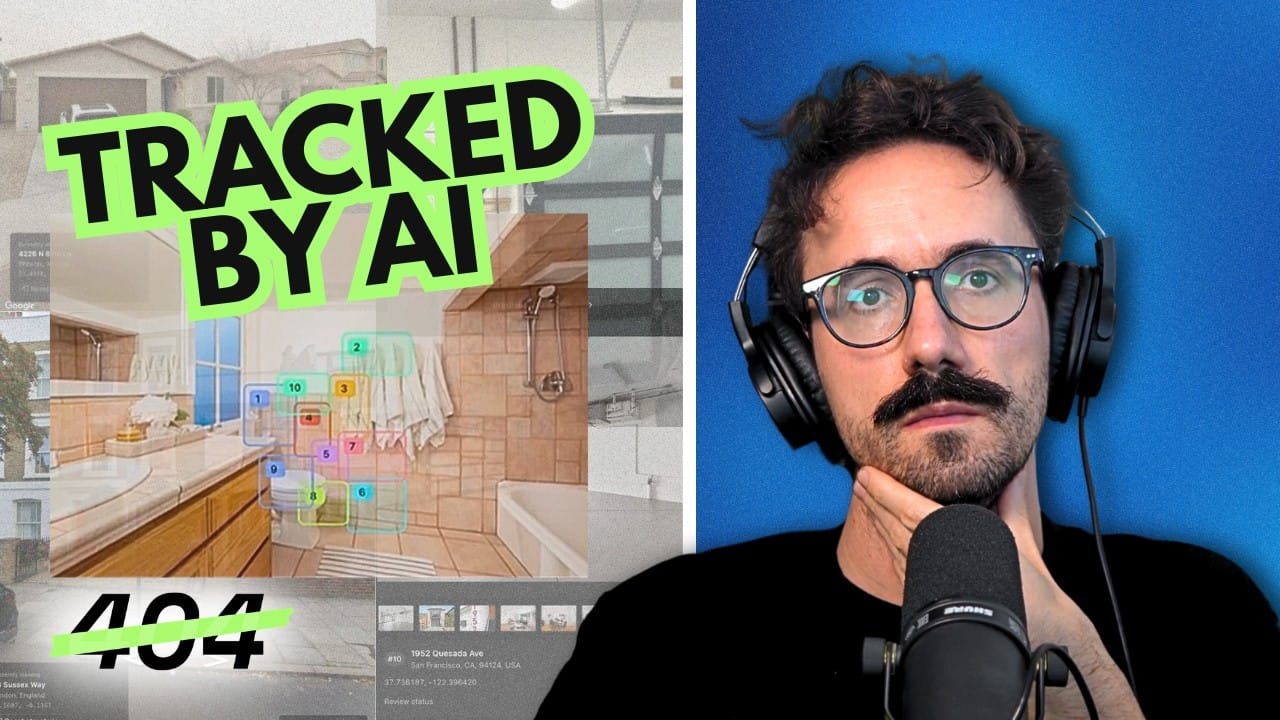
We start this week with Joseph’s article about Raven, previously known as Geospy. This is an AI tool that can geolocate photos, and now says it can pinpoint a specific house based just on one photo taken inside. After the break, Jason explains why a judge ruled a particular Flock search as unconstitutional. In the subscribers-only section, we talk about the wild AI video that has derailed a manslaughter case.
Listen to the weekly podcast on Apple Podcasts,Spotify, or YouTube. Become a paid subscriber for access to this episode's bonus content and to power our journalism. If you become a paid subscriber, check your inbox for an email from our podcast host Transistor for a link to the subscribers-only version! You can also add that subscribers feed to your podcast app of choice and never miss an episode that way. The email should also contain the subscribers-only link for the extended video version too. It will also be in the show notes in your podcast player.
Police arrested a Chicago area high school maintenance worker who attempted to meet a child for sex after investigators posed as a 15-year-old boy using AI generated images.
Christopher Thomas Mertens started talking to who he thought was a child through a dating app in September. According to an affidavit written by the department’s FBI Task Force Officer McKailey Scott, the investigation was done by the Livonia Undercover Resistance to Exploitation Unit (LURE), which identifies and prosecutes child sex offenders. Scott set up an account on the queer-focused dating app Taimi with “an AI generated image of a teenage-appearing male with the name ‘Caleb,’ and no age listed on the profile.
Scott wrote that an unknown user messaged “Caleb,” and they moved to Whatsapp. After a few minutes of talking, the man asked Caleb for their age, and when Scott — posing as Caleb — said he was 15, the man said “Im interested” and “Im hard now.”
The investigator used a combination of tools, including checking the man’s phone number using Thomson Reuters CLEAR and running images of his face through Clearview AI to identify him as Mertens. For days, Caleb and Mertens exchanged sexually explicit text messages and Mertens made plans to drive to meet Caleb on his day off, believing Caleb’s (non-existent) parents weren’t home. Cops used Flock to look up and track Mertens’ car and see that he was driving to the meetup spot, but Mertens was also texting Caleb the entire time to let him know he was on the way and when he arrived. When he got out of the car, Livonia police took him into custody.
Two hours after being booked, Mertens told jail attendants that he wanted to speak to Scott. When Scott got to the jail, Mertens admitted everything, including that he works at a high school in Illinois. The complaint doesn’t mention which high school.
Investigators have been generating images of children for years. One of the earliest examples of these is Sweetie, a computer generated child developed by Dutch children’s rights organization Terre des Hommes in 2013 that the organization used to talk to men online. Today, police departments at the U.S. border use AI-generated online personas designed to interact with and monitor protestors and activists, according to documents obtained by 404 Media.
In August, a 24-year-old Connecticut man was arrested after soliciting an undercover police officer who used what was reported as “age regression technology” to appear as a 14 year old in videos. He was charged with enticing a minor and criminal attempt to commit risk of injury to a child.
In 2025, a 45-year-old man was arrested after investigators used AI generated images of children to catch him distributing child sexual abuse material. He was recently sentenced to 12 years in federal prison.
And in 2024, the state of New Mexico sued Snapchat after investigators set up a fake account, including AI generated images of children, that the platform allegedly recommended to “dangerous accounts, including ones named ‘child.rape’ and ‘pedo_lover10,’ in addition to others that are even more explicit,” according to the New Mexico Department of Justice.
AI generated child sexual abuse material is a rapidly growing problem for law enforcement. The National Center for Missing and Exploited Children has reported a massive rise in generative AI child abuse material, with criminals using it to extort and entice children, and children using it to bully and harrass other children.
Livonia police did not respond to a request for comment.
Scientists have made a breakthrough toward the mind-bending goal of creating computers made of brains by demonstrating that human neural tissue can classify letters of the Braille alphabet, according to a study published on Friday in Frontiers in Artificial Intelligence.
A team transmitted electrical signals corresponding to Braille letters to human brain organoids, which are living neural tissues derived from stem cells. The results revealed that a single organoid, consisting of about 10,000 neurons, could classify the letters with about 61 percent accuracy, while teams of three organoids reached 83 percent accuracy.
“The human brain can perform incredibly complex information processing while consuming relatively little energy, and artificial neural networks were originally inspired by biological nervous systems,” said Tianyi Liu, a PhD candidate at Bristol University who led the new study, in an email to 404 Media.
“If we've been trying to imitate biological neural networks all along, why not try using real biological neural networks directly?” she continued. “What kind of information processing capabilities might these tiny neural organoids have? Could they show some form of learning or adaptation? These are all questions we're very interested in.”
The new study falls under the emerging field of organoid intelligence, which aims to use organoids as biological “wetware” for computing applications. Previous studies have established that organoids are capable of recognizing speech Japanese vowels or even playing the classic game Pong.
Since Liu and her team specialize in how robots sense and respond to touch, they homed in on Braille as a way to convert tactile information into electrical stimuli that an organoid could receive, process, and classify.
In their experimental setup, the researchers used a tactile sensor to scan data from the 26 letters of the Braille alphabet, which is built from arrangements of raised dots. This data was converted into electrical stimulation patterns that were fed to the organoids, which are smaller than a millimeter in scale and positioned on arrays that keep them alive.
“Our original goal wasn't to prove that organoids could read Braille like humans, or that they were already ‘intelligent’ enough to understand Braille,” she added. “Rather, we wanted to use this task to explore whether real biological neural networks could participate in processing information from robotic tactile sensors.”
The tactile sensor used to scan Braille letters. Image: Dr Benjamin Ward-Cherrier.
In other words, the researchers aimed to discover if these stimulated inputs could be decoded by the organoids and returned back in discernable responses corresponding to the Braille letters. The results revealed that a single organoid could accurately classify the letters nearly two thirds of the time, while an "ensemble" of three organoids performed even better, with an accuracy of 83 percent.
“We still don't know the exact mechanism behind this improvement,” Liu said. “Our hypothesis is that different organoids respond to the same stimulation in similar, but not identical, ways.”
She added that “you can think of it as three people looking at the same object. Although they're all looking at the same thing, each person might notice different details. Some features might not be obvious to one person but could be quite easy for another to spot. By combining their observations, you might be able to make a more accurate and reliable judgement.”
🌘
Subscribe to 404 Media to get The Abstract, our newsletter about the most exciting and mind-boggling science news and studies of the week.
The results are undeniably trippy, conjuring up the classic scifi trope of a hyperintelligent brain-in-a-vat. But Liu emphasized that this was an open-loop experiment, meaning that the organoids only received initial inputs without getting new feedback about their performance on the tasks. For this reason, the study does not prove that the organoids actually learned Braille, or were altered in any permanent way, just that they could classify Braille letters after receiving the electrical inputs.
“In the future, if we can build closed-loop systems where neural activity from the organoids actually participates in a robot's perception, decision making, and control, while the results of the robot's interactions with its environment are fed back to the organoids, we could begin to investigate whether these biological neural networks can adapt to new tasks through ongoing interaction,” she said.
Liu also noted that while there are many potential advantages to organoid intelligence, there are plenty of limitations to biological computing systems. For example, organoids cannot be standardized, leading to natural variations that can complicate results, plus they have to be kept alive in cultures that are more difficult to maintain than electronic devices.
“Compared with established computing chips, organoid systems still have a long way to go in terms of reliability, reproducibility, and scalability,” Liu said.
Even so, organoid intelligence “gives us the opportunity to explore a way of computing that's very different from traditional computers,” she concluded.

 Login