

Normal view

New York Seizes 12 Celebrity Deepfake Websites

New York Seizes 12 Celebrity Deepfake Websites

The New York District Attorney announced on Monday that it has seized 12 websites hosting AI-generated non-consensual intimate imagery, primarily of celebrities and public figures. 

The DA’s office said it believes that this marks the largest seizure of such sites in history. The people using and running these sites who are now under investigation used AI tools to turn approximately 1,200 people’s photos into “hyper-realistic” images and videos of them engaged in sexual conduct, according to the DA’s office.

The images allegedly depicted “politicians, first ladies of multiple countries, primarily public-facing individuals, including actors, politicians, athletes, musicians, social justice advocates, and social media influencers.

New York has had laws specifically criminalizing sexually explicit deepfakes in place since 2023. Bragg referenced this legislation when asked what law the office is acting on.

“While the victims of these sites are largely celebrities, we know that anyone can be a victim in these crimes, particularly in domestic violence cases, many of our intimate violence cases involve threats to at least images and videos, and we know that deepfakes are being used in the same way,” District Attorney Alvin Bragg said in the press conference Monday. “So, whoever you are, the message to survivors is the same: You are not alone. Help is available. If you let us know that an image has been posted without your permission, without your consent, we can take action as long as that website is accessible from Manhattan.”

Bragg declined to answer whether images of minors were included in these websites, saying, “The investigation is ongoing.” 

In June, the U.S. Departments of Justice and Homeland Security seized two domains that were being used to publish “thousands of digitally forged images and videos depicting famous women as nude and sometimes engaged in sexual activity, without their consent,” and featured topics like “rape,” “forced,” and “degradation,” according to a press release. Images on those sites allegedly depicted politicians, first ladies of multiple countries, royalty, journalists, television presenters, athletes, entertainers, and others.

And in May 2025, the massive deepfakes hosting site and forum MrDeepfakes.com shut down following an investigation by the Canadian Broadcasting Company, Der Spiegel, and Bellingcat.

Earlier this month, the first man in the country to be convicted of violating the Take It Down Act was sentenced to 15 years in prison, after investigators found more than 3,000 real and AI-generated abuse images on his devices. 

Slightly altered images of women who are public figures are taking over social media sites like X.com, 404 Media reported last month. These images are often not completely nude AI images of women, or face-swapped sexual material, but depict women as wearing more revealing clothing than they did in the real photo or video, or with digitally altered bodies.

The DA’s office is encouraging victims of deepfakes to contact its Cyber Crime Bureau at (212) 335-9600. Bragg said targets of deepfakes might not know that something can be done, and wants them to know there’s a “cop on the beat.”  

“Our message to the people who are creating and publishing this content: What you are doing is a crime. We are investigating, and support survivors in taking down this content and seeking accountability for folks who break the law,” Bragg said.

Cops Search Thousands of Flock Cameras for Reasons of ‘LMAO,’ ‘IDK,’ ‘Hehe,’ and ‘asdfg’

Cops Search Thousands of Flock Cameras for Reasons of ‘LMAO,’ ‘IDK,’ ‘Hehe,’ and ‘asdfg’

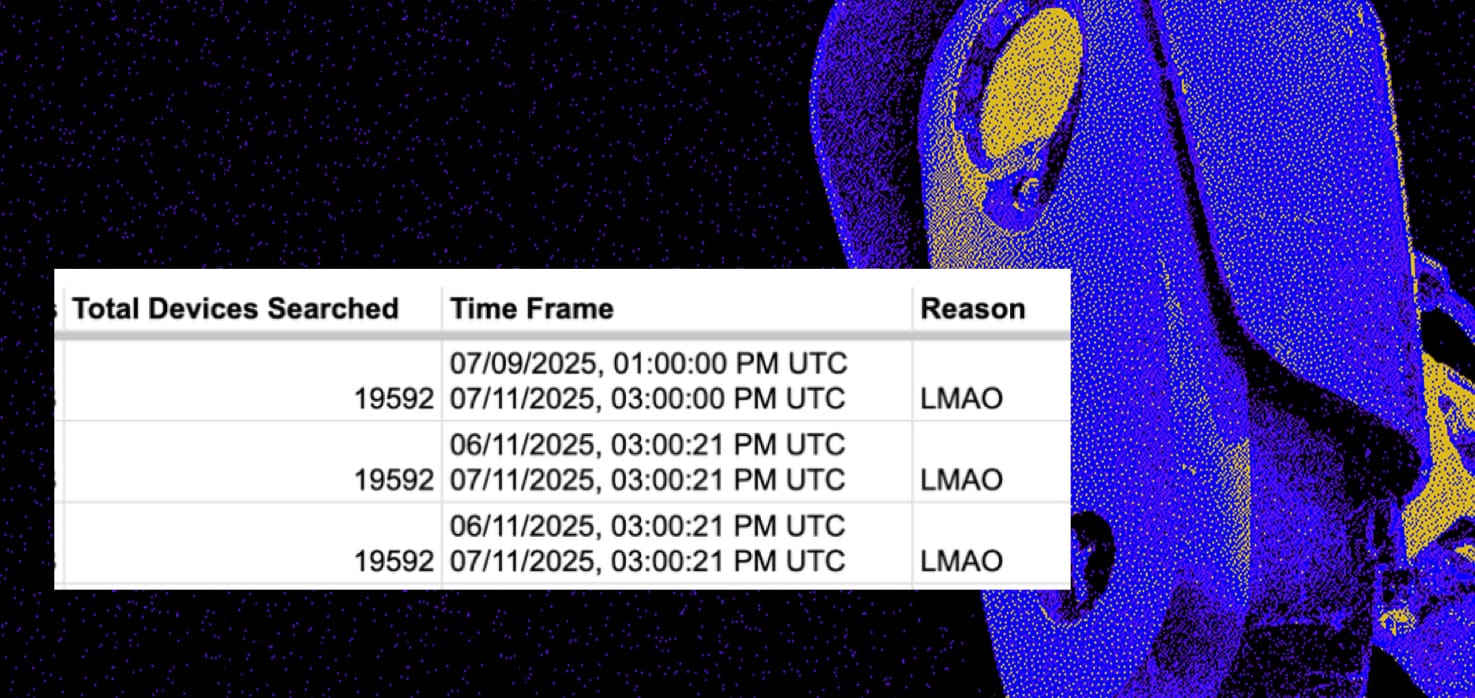
Last summer, a cop with the Lake County, Indiana Sheriff’s Department used Flock’s surveillance search engine to look for a license plate across more than 19,000 cameras in 1,558 cities and towns. The cop’s stated reason for the search, according to a record of Flock’s system, was “LMAO.” 

The cop is one of dozens who put gibberish, jokes, or other nonsense into Flock’s “reason” box, highlighting the casualness and lack of care some cops have when searching an incredibly powerful surveillance system. This is on top of the thousands upon thousands of cops who simply wrote something like “investigation,” “test,” or left the box blank as their search “reason,” according to a new analysis by the Electronic Frontier Foundation and shared with 404 Media. 

EFF’s investigation found cops across dozens of jurisdictions writing “LMAO,” “LOL,” “Hehe,” “Haha,” “idk,” “blah,” “TBD,” and “robbery I don’t remember the case number leave me alone” in Flock’s “reason” box for searches. They found cops writing “idiot,” “fuck this new search engine,” “dickhead,” “shithead,” and “WEIRD KID” in the reason box. And they found an entire class of police button mashers, who ran searches for reasons of “asdfg,” “gyghkkghghjkghjk,” “jhjhjkhj,” “jkhhkjhjk,” “nmbvcbnm,” and so on and so forth. The searches came from police departments across the country from 2023 through late 2025, when Flock changed how the “reason” box in its search system functions.

Cops Search Thousands of Flock Cameras for Reasons of ‘LMAO,’ ‘IDK,’ ‘Hehe,’ and ‘asdfg’

As Flock’s automated license plate reader system comes under fire for privacy abuses, the perception of mass surveillance, and cases of police abuse, the company and police departments around the country have tried to paint those who want to limit the technology as wanting to take away a powerful tool that police use to solve very serious crimes. While Flock has been used in high profile cases, the searches published by the EFF and the cases of abuse reported by 404 Media and other news outlets around the country show that police often aren’t taking their responsibilities seriously.

“When law enforcement and tech salespeople pitch ALPRs to city councils, they stick to a familiar script. They trumpet the technology, which is often provided by private companies like Flock Safety, Motorola Solutions, or Axon, as an essential tool for solving high-stakes crimes, such as car jacking, kidnapping, or murder,” the EFF wrote in a blog post about its findings. 

“Police are routinely searching the Flock database without providing any legitimate justification, making a mockery of our civil liberties by logging reasons like ‘LOL,’ ‘LMAO,’ ‘sexy,’ and ‘idk’ to access sensitive ALPR location data […] With no warrant requirements, limited guardrails, and deficient audit processes, ALPR databases have fostered a culture of unrestricted access to everyone’s location information. This culture of abuse has allowed police to treat a mass surveillance network like their own personal search engine, permitting the tracking of the movements of everyday citizens for low-level complaints, personal whims, and sometimes, seemingly, for the lols.”

Cops Search Thousands of Flock Cameras for Reasons of ‘LMAO,’ ‘IDK,’ ‘Hehe,’ and ‘asdfg’

The EFF was able to do this analysis because of the way that Flock documents police use of the system. Each time a search is performed, a record of it is saved in the Flock system, which can be obtained by the public using government records requests. These audit logs show hundreds of thousands of searches of the system; after 404 Media and other news outlets used these types of logs to show police using the Flock system to look for undocumented immigrants on behalf of ICE, a woman in Texas who had an abortion, and protesters, cops were warned by government surveillance centers to be “as vague as permissible” about the reasons for their searches. Late last year, Flock changed its system; rather than having to type in a reason, Flock now has a drop-down list of prepopulated reasons, which the EFF called “a loss for transparency.” 

The EFF contacted departments whose cops performed these “joke” searches, and found that many of them did not do anything about cops who button mashed or put jokes. Cops who wrote “hehe” and “idk” were “counseled,” they were told. A cop who wrote “idiot” got away with it because by the time the department learned about it, it had passed a 90-day time period in which the cop’s union contract allowed for internal investigations. Several other police departments said they would investigate the behavior. The Fishers Police Department in Indiana said that a detective who searched Flock for reasons of “blah” only did so “when he has issues with the technology,” or when “the technology is not moving fast enough for him.” A police department said it investigated a cop who wrote “driving around being weird” in the reason field but found it was for “legitimate public safety purposes.”

“The fact that these searches were not only missed by the agency supervising the officer, but by the often thousands of other agencies whose systems were searched, demonstrates how agencies cannot be trusted to oversee themselves,” the EFF wrote. “Mass surveillance is incompatible with a free society, and especially so when the people with access to this data are treating it like a joke.”   


Fighting for the Future of Libraries (With Jennie Rose Halperin)

Fighting for the Future of Libraries (With Jennie Rose Halperin)

This week we’re joined by Jennie Rose Halprein, executive director of Library Futures, a non-profit that advocates for a fair digital future for libraries and the communities they serve. We have written a bunch of stories about libraries over the years, and I have talked to Jennie a few times for those stories. I always have really interesting conversations with her, but a lot of what we talk about never makes it into my articles. That’s why I wanted to share one of those conversations with you today. We of course touch upon censorship but also many other subjects, so I hope you enjoy this conversation as much as I did. 

Listen to the weekly podcast on Apple Podcasts, Spotify, or YouTube

Become a paid subscriber for early access to these interview episodes and to power our journalism. If you become a paid subscriber, check your inbox for an email from our podcast host Transistor for a link to the subscribers-only version! You can also add that subscribers feed to your podcast app of choice and never miss an episode that way. The email should also contain the subscribers-only unlisted YouTube link for the extended video version too. It will also be in the show notes in your podcast player.

Inside ‘Project Lily’: The Humans Reading Your ChatGPT Chats

Inside ‘Project Lily’: The Humans Reading Your ChatGPT Chats

OpenAI is hiring hundreds of contractors who read a massive stream of real users’ ChatGPT prompts, with the prompts sometimes including sensitive personal information, 404 Media has learned. The prompts these people review can include whole conversations between users and the chatbot, conversations that most of ChatGPT’s more than 900 million users probably don’t realize may be read by actual people.

The goal of these prompt review teams is to improve the responses ChatGPT gives to its users, with the contractors rating and critiquing the chatbot’s generated replies. Internal documents seen by 404 Media show contractors training ChatGPT to not anthropomorphize itself, and to be less sycophantic, a key problem for OpenAI whose over-sycophantic 4o model led in part to multiple peoples’ suicides, according to various lawsuits.

💡
Do you work as a prompt reviewer for OpenAI or Anthropic? I would love to hear from you. Using a non-work device, you can message me securely on Signal at joseph.404 or send me an email at joseph@404media.co.

The news presents a major privacy risk for ChatGPT’s users, with people often using ChatGPT as a therapist, professional assistant, or digital friend, and providing it with all sorts of intimate details about their lives. The contractors don’t see ChatGPT usernames, and OpenAI says it tries to remove personal information before prompts reach the reviewers, but the company acknowledged sensitive details can still get through. 

The news also dispels the misconception that these models are improving only because of OpenAI’s mass scraping of the internet, the talent of its well-paid engineering and AI teams, or the power of its newer models. An important and overlooked part are the outside contractors paid to read and review ChatGPT responses to real prompts over and over again. Anthropic confirmed to 404 Media it is also using human review to improve its models.

“No,” someone who works with the prompts said when asked if they think ChatGPT users know that humans are reading their chats. “I don’t think they would imagine some contractor somewhere [...] is analyzing the conversations.”

❌