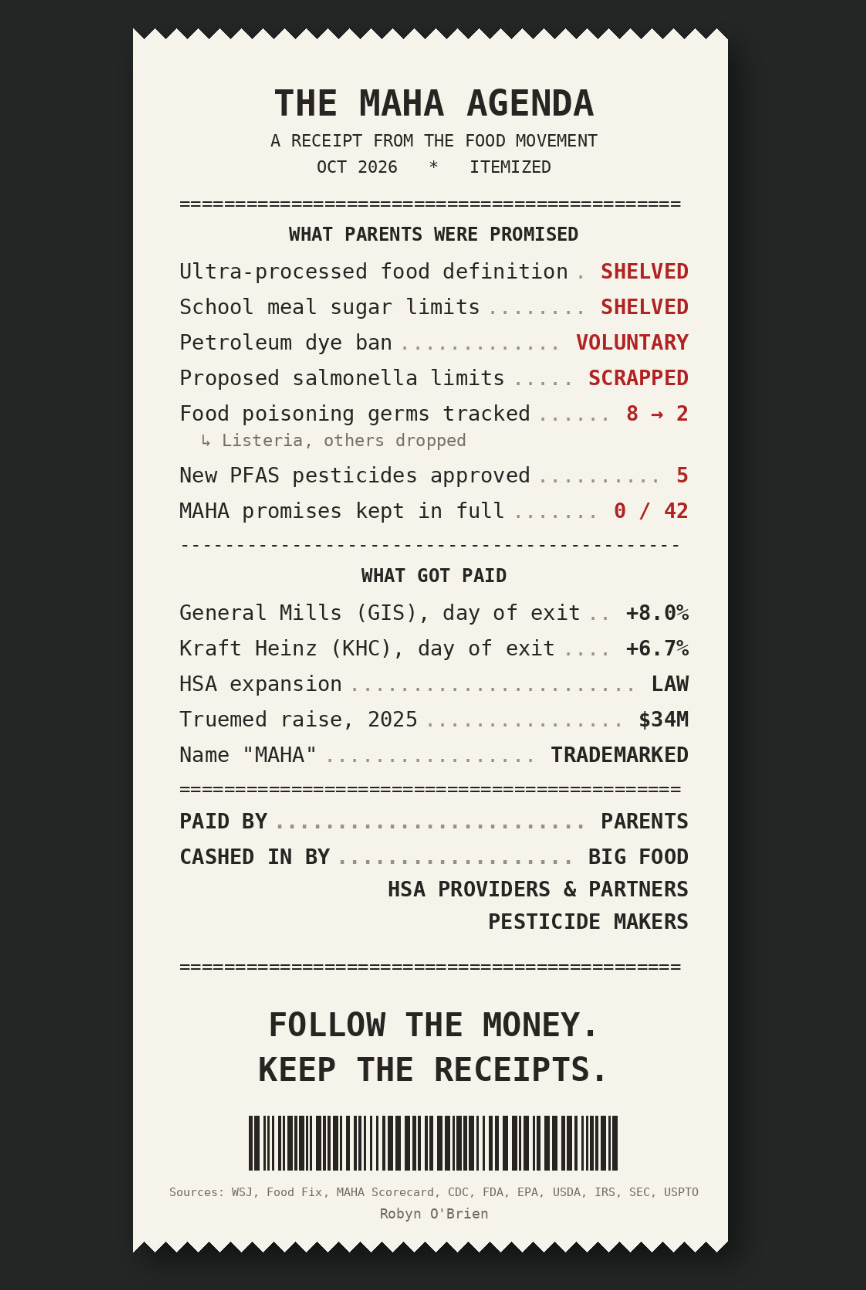
I have long admired Robyn O’Brien’s clear thinking about food issues and thought this recent piece, from her Substack “The Signal” especially worth reading. Be sure and scroll down to the Appendix, where she posts her scorecard.
I used to analyze food companies for a living. I joined a team that managed $20 billion in assets. We launched the company’s first hedge fund. As the only woman on the team, I was assigned to cover the food industry. Long before I was a mother reading labels, I was reading balance sheets, SEC filings and income statements.
So when I want to know what’s really happening in food policy, I don’t follow the press releases. I follow the money.
Like countless others, I helped build the food movement years before anyone called it MAHA. I’ve watched as new leaders emerged, with a “dizzying rise,” and took over what so many others built. Then the name itself became property. A company called MAHA TM LLC, whose owners aren’t named in the trademark records, now holds registered trademarks on both “MAHA” and “Make America Healthy Again,” covering everything from clothing and software to retail, financial and health services.
But the food movement? It was always and only about what’s in our food and how to make clean and safe food affordable and accessible to all who wanted it.
Last Thursday, when Calley Means, MAHA’s most visible food voice, told The Wall Street Journal he was leaving the administration, General Mills jumped 8 percent and Kraft Heinz closed up 6.7 percent.
One day’s trading doesn’t prove anything. Both stocks had been smacked down for a year as weight-loss drugs eat into snack sales, and markets overreact. But a stock price is a bet on the future, and that day’s bet was clear: investors judged that tougher food rules had just become less likely.
People close to Means said he’d grown disillusioned, convinced food companies had too much sway inside the White House. The reforms parents were promised, including a federal definition of ultra-processed food, addressing glyphosate levels products and limits on sugar in school meals, have been shelved. Means called the rally a misread.
I’d call it a signal. And it wasn’t the only one.
In May, the president’s own financial disclosure showed his portfolio bought shares of Kraft Heinz, General Mills, PepsiCo, Coca-Cola, and pesticide maker Corteva in the first quarter of the year, among hundreds of companies, according to Civil Eats. More recent disclosures include PepsiCo and Walmart. The Trump Organization says outside managers make the trades. Maybe it means nothing. But it’s a signal worth noting, especially while MAHA leaders promised to rein in Big Food.
Now take stock. Literally.
A scorecard from Tiffany Cianci, a former Kennedy campaign adviser, measured 42 MAHA promises on food, farming, chemicals and health: 37 broken, five partially kept, none kept in full. There were some wins: dietary guidelines that finally name ultra-processed food and promises to drop petroleum dyes. But dye pledges are voluntary, and the rules with teeth, are the ones that got shelved.
So as efforts to advance reform in the food industry stalled, another part of the administration’s agenda took off: health savings accounts.
Health savings accounts let people set aside money tax-free for medical costs. They sound like they help everyone. They don’t. The benefit goes to people who have spare income to put in and a tax bracket high enough to make the break worth something, which is why the wealthiest Americans use them most. The One Big Beautiful Bill Act, signed in July 2025, expanded them anyway. The CEO of HealthEquity, one of the biggest companies that manages HSAs, called it the biggest change to the HSA business since the accounts were created.
Then came the push for more. In January, the White House’s Great Healthcare Plan proposed sending federal health subsidies straight into HSAs instead of to insurers. And the executive order that created the MAHA Commission called for more flexibility in health coverage to pay for lifestyle changes and prevention, the opening a business like Truemed depends on.
The prize is big.
Before he joined the government, Means estimated that about $150 billion was already sitting in HSAs and FSAs. Even the movement’s name is being positioned for that market: a company called MAHA Worldwide has applied to trademark “Make America Healthy Again” for uses including HSA administration, credit cards and cryptocurrency.
Now picture two tracks.
On the first, wellness brands push to widen what HSA dollars can buy. In 2024, Truemed helped launch a coalition called End Chronic Disease, with Means as a co-founder. Its members were leaders of wellness brands that stand to gain. Its agenda included real food reform. It also included expanding HSAs to pay for food, exercise and supplements, which is exactly what Truemed and the founding companies of End Chronic Disease sell.
On the second track, the financial industry pushes to grow how much money flows into those accounts. This year, HSA companies formed the Great American Health Alliance. GAHA. Its members include HealthEquity, one of the largest HSA administrators, and the American Bankers Association, whose members hold about 90 percent of HSAs. It’s run by Keith and Ken Nahigian; Ken was Robert F. Kennedy Jr.’s guide to senators during his confirmation. As a 501(c)(4), GAHA can lobby without limit, spend on elections and keep its donors secret, which is why STAT described it as a dark money group.
The two tracks don’t need to coordinate. They just need the same policy. And that’s the policy that moved, as MAHA policies stalled.
Who benefits when tax-free health dollars can buy saunas, ice baths and supplements? Companies like Truemed, which collects fees on the letters of medical necessity that unlock that spending.
The administration says Means divested. But the business he co-founded is booming while the food reforms so many championed sit in a drawer. Truemed says its revenue has tripled two years running.
Why does that matter? Because the food movement spent two decades creating the market that MAHA’s corporate leaders captured.
Marion Nestle spent a career exposing how food companies shape nutrition science. Eric Schlosser taught a generation to ask where their food comes from. Alice Waters brought real food into schools. Groups like the Center for Science in the Public Interest documented and petitioned for years. And millions of moms, farmers and parents of kids with allergies, ADHD, pediatric cancer and diabetes read the labels and changed what companies put on the shelves.
MAHA’s corporate leaders borrowed that energy. SEC filings show that in February 2025, Truemed began selling shares in a roughly $34 million offering, raising $32.6 million within weeks, with Means listed as a director. Weeks later, he joined the White House as an adviser. The raise wasn’t announced until a press release was that December, as a Series A led by Andreessen Horowitz. In the meantime, the policies that benefit companies like Truemed moved forward.
Means says he’ll keep fighting from the outside, and maybe he will. But it’s fair to notice the timing. He walked out less than two weeks before a midterm many see as a verdict on MAHA, nearly a year after Democratic lawmakers pressed him on his Truemed stake. Whether this is a reformer who lost or a brand repositioning for its next chapter, the receipts will tell us. Watch where the money goes next.
Meanwhile, the policies parents care about most haven’t just stalled. Some have been reversed. Proposed salmonella limits for chicken: scrapped. Tracking of foodborne illness: cut. Glyphosate, the weedkiller MAHA’s own commission flagged as a concern for children’s health: declared a national security priority. New “forever chemical” pesticides: approved for the crops used in the food our families eat.
So here’s my invitation: measure progress the way an analyst would. Not by speeches, but by final rules, share prices and who profits. And if a definition of ultra-processed food suddenly appears before Election Day, read the fine print. A non-binding white paper changes nothing on a grocery shelf. It’s another press release, not a policy.
Our health is not a commodity. It is not a trade, a ticker or a tax break.
It is the one investment we cannot afford to lose, and the bottom line that matters most.
We built this movement to protect children.
In order to do that, you have to watch the policies, not the press releases.
And always follow the money.
Appendix: The Record
Status as of October 2026.
MAHA food promises that failed or stalled
Ultra-processed food definition: shelved. The federal definition meant to lead to labels was set aside by the White House, as reported in October 2026.
School meal sugar and protein rule: shelved. The rule requiring less added sugar and more protein in school meals was deferred.
Petroleum-based food dyes: voluntary only. FDA revoked Orange B, a dye no longer in use, and proposed revoking Citrus Red No. 2. Removing the main petroleum dyes depends on voluntary company pledges.
Front-of-package nutrition label: stalled. Proposed in January 2025, it missed its spring 2026 target. In March 2026 FDA said everything was on the table, including revising or rescinding it.
Post-market review of food chemicals: process only, no rule. FDA finalized an internal review process in May 2026, but no new binding rule requires removing chemicals already on the market.
GRAS loophole: proposed, not final. FDA proposed in August 2026 that companies notify it of self-declared safe ingredients. It is not yet in force.
MAHA Scorecard verdict. Of 42 MAHA promises on food, farming, chemicals and health, tracked through July 2026, 37 were rated broken, five partially kept and none kept.
Policies put in place that work against the MAHA food agenda
Glyphosate executive order (Feb 2026). Invoked the Defense Production Act to prioritize production of glyphosate-based herbicides and elemental phosphorus.
Five new PFAS pesticides approved (Nov 2025 and July 2026). Approved for food crops including tomatoes, lettuce, wheat and citrus. EPA disputes that they meet its PFAS definition.
Bifenthrin and chlormequat expanded (July 2026). New crop uses for bifenthrin, which EPA classifies as a possible human carcinogen, and the first food use of chlormequat.
Dicamba re-registered (Feb 2026). Re-approved for over-the-top spraying on soybeans for 2026 and 2027, after federal courts twice ruled earlier approvals unlawful.
Salmonella limits for poultry withdrawn (April 2025). Scrapped proposed enforceable salmonella limits for raw chicken and turkey.
Faster slaughter line speeds (proposed Feb 2026). Would raise chicken lines from 140 to 175 birds per minute and remove the pork line speed cap. Not yet final.
Food traceability rule delayed to 2028. Pushed compliance from January 2026 to July 2028; Congress barred enforcement before then.
FoodNet surveillance cut (July 2025). Active tracking reduced from eight foodborne pathogens to two, dropping listeria, cyclospora and others.
Food safety advisory committees dissolved. USDA eliminated its two scientific advisory committees on microbial food safety and meat and poultry inspection.
Inspection workforce cut. FDA lost 3,859 employees agency-wide in 2025, including 89 food safety staff whose firing prompted its food deputy commissioner to resign. USDA’s inspection service lost about 775 employees who are not expected to be replaced. Foreign food inspections fell sharply.
Policies put in place that advance health savings accounts
MAHA Commission executive order (Feb 2025). Called for more flexibility in health coverage to pay for lifestyle changes and disease prevention. It does not name HSAs, but critics, including Rep. Jake Auchincloss, say it opened the door to wellness spending through them.
One Big Beautiful Bill Act: marketplace plans (law, effective Jan 2026). Made bronze and catastrophic plans, the cheapest marketplace tiers, HSA-eligible whether or not they are bought through the exchange.
One Big Beautiful Bill Act: telehealth and membership-fee doctors (law). Made pre-deductible telehealth coverage permanent and let people who pay a doctor a monthly fee keep contributing to an HSA.
Treasury and IRS implementing guidance (Dec 2025). Explained how the new HSA eligibility rules apply.
Great Healthcare Plan (proposed Jan 2026). Would send federal health subsidies directly into HSAs instead of to insurers. Requires Congress.
Sources
Wall Street Journal, STAT, Food Fix, Politico on the Means resignation and shelved food rules (Oct 2026)
MAHA Promises Scorecard, mahascorecard.com (Oct 2026); FDA, Federal Register and Covington on GRAS, front-of-package and post-market review (2026); Supermarket News on dyes (July 2026); Marion Nestle, Food Politics (July 2026); Connector Inc., The MAHA Report Card (Oct 2026)
CNBC and The Hill on the glyphosate order (Feb 2026); Center for Biological Diversity, EWG, Civil Eats and CNN on PFAS pesticides (2025-2026)
Federal Register and FSIS on the Salmonella framework; USDA and Civil Eats on line speeds; Food Safety Magazine and SeafoodSource on FSMA 204
NBC News and AP on FoodNet; Investigate Midwest, FoodNavigator and CBS News on staffing cuts
CNBC and IRS on HSA changes; Reuters and Newsweek on the Great Healthcare Plan; the MAHA executive order (EO 14212); Rep. Auchincloss; STAT on GAHA; FITT Insider on End Chronic Disease
SEC Form D and Form D/A for True Medicine Inc. (CIK 0002004109), signed March 4, 2025; Reuters (Nov 2025) and Rep. Auchincloss and Sen. Schiff (Oct 2025) on Means’s White House role; Bloomberg (Dec 2025) on the Series A
STAT (Oct 22, 2026), Food Fix (Oct 2026) and The Wall Street Journal on Means’s resignation, his statements afterward and his earlier clashes with White House officials; Rep. Jake Auchincloss and Sen. Adam Schiff, letter of inquiry on Means’s Truemed interests (Oct 2025)
StockAnalysis.com (S&P Global Market Intelligence) daily closes for General Mills and Kraft Heinz, Oct 2026; Bernstein downgrades of General Mills, Kraft Heinz, Conagra and Campbell’s citing GLP-1s (Investing.com, 2026); Journal of Marketing Research study (Dec 2025) on GLP-1 households’ grocery and snack spending, via the Motley Fool (Oct 11, 2026)
Trademark records via Trademarkia and Justia for MAHA TM LLC registrations (USPTO Serial Nos. 98730861, 98978027, 98978173) and the MAHA Worldwide LLC application (Serial No. 98904507)
Office of Government Ethics financial disclosure of President Trump (filed May 2026), as reported by Civil Eats (May 29, 2026) and Sludge (May 14, 2026)
Newsweek (Jan 2026) and the Center on Budget and Policy Priorities on who benefits from HSAs; HealthEquity CEO Scott Neeleman’s earnings-call remarks, via Charles Gaba (2026)
Truemed’s Series A announcement (Dec 2025, via Pulse 2.0) on revenue growth; AP (June 2025) and KFF Health News (2025) on Truemed’s fees, products and Means’s departure; NewsBreak (2024) on Means’s $150 billion estimate; Reuters (Nov 2025) on HHS’s divestment statement
Thanks to Earlene Cruz, a doctoral student in my NYU department, for sending this contribution to my collection, a press release from the University of Reading.
Natural Trans Fats in Dairy Do Not Raise Heart Disease Risk:Researchers at the University of Reading found that naturally occurring trans fats in dairy foods are not linked to higher risk of heart disease or type 2 diabetes, distinguishing them from industrial trans fats. Read More
Trans fatty acid (TFA)-enhanced vs. regular dairy show no lipid biomarker differences.
Circulating dairy TFA shows no association with type 2 diabetes risk.
Circulating dairy TFA shows no association with cardiovascular disease risk.
TFA from dairy foods is not associated with adverse cardiometabolic outcomes.
Sources of support: This research was funded by the National Dairy Council (NDC), USA, and Centre National Interprofessionnel de l’Economie Laitière (CNIEL).
Author declarations: C.S. received research funding from Dairy Management, Inc. C.G.-B. and F.T.-A. work for the French dairy organization, CNIEL. M.T.-G. works for the National Dairy Council. D.-I.G. has received funding from various international dairy organizations.
Comment: This is a literature review funded by the dairy industry and conducted by employees or recipients of research funding from dairy companies or trade associations. Industrially hydrogenated trans fats demonstrably raise the risk of heart disease. Ruminant animals naturally hydrogenate unsaturated fats and convert them to trans fats. These differ in some ways from industrial trans fats, but are still trans fats. Whether naturally occurring trans fats are as harmful as industrial trans fats is of great concern to the dairy industry, which would like to prove that dairy fats do not raise the risk of heart disease. Animal welfare groups such as the Physicians Committee for Responsible Medicine argue that dairy fats do raise such risks. Hence, this review. This question would be easier to resolve if the investigators doing the research were independent.
Chart of Note: Pumpkins harvested on more than 99,000 acres across the Nation: Pumpkins are grown in all 50 States and were harvested from more than 99,000 acres on about 15,000 farms, according to the latest comprehensive data from the 2022 Census of Agriculture published by USDA, National Agricultural Statistics Service (NASS)
What food companies need to do
Halloween candy sales are down. Here’s what’s driving it: Halloween candy sales are down as rising living costs and sharply higher chocolate prices tighten consumer budgets, leading shoppers to buy smaller packages, wait for discounts, and shift spending patterns, though overall Halloween spending is still expected to grow.
I am seeing more and more notices of food factory closures. Here are some examples:
Nestlé to close Ohio factory by end of 2027: The food giant will shift production to South Carolina, saying it is “the most sustainable path forward” as consumer needs and volumes shift.
JBS to close meat plants in manufacturing reshuffle:The company plans to lay off at least 2,000 workers as it shutters a Pennsylvania beef processing facility and makes changes at majority-owned Pilgrim’s Pride.
Thousands of cereal-related jobs have disappeared over the years in Battle Creek, which at the beginning of the 20th century was home to more than 100 companies producing the breakfast staple.
During the last decade, cereal consumption has fallen as shoppers view the product as highly processed, sugar-laden and lacking many of the daily nutrients they need. Hurried consumers also are turning to more on-the-go options, such as bars, or just skipping breakfast altogether instead of eating a bowl of cereal at home.
II. Kim Severson in the New York Times: Cereal Is in a Crunch. Can a Health Pitch Save It? As more Americans turn away from the snap, crackle and sugar, the industry is trying to capitalize on our current obsession with wellness.
Cereal is in trouble. Despite a brief glimmer of growth during the pandemic, the nearly $13 billion business in the United States has gone soggy. Shoppers last year bought 13 percent less cereal than in 2021, according to Nielsen IQ. Despite price hikes, dollar sales are declining, too.
Mix in pressure from the “Make America Healthy Again” movement’s push for less-processed food, in addition to the rise of GLP-1 drugs and higher prices for what used to be a budget-stretcher, and you can understand why cereal executives are worried.
She wrote it with Lisa Sutherland, a former vice president for nutrition at the Kellogg Company and the interim president of Jacksonville University. “The more things change, the more things stay the same in the cereal industry,” Dr. Sutherland said. “They just keep cycling back to their roots.”
Kyle produced this terrific AI illustration of my current favorite example of hilarious marketing.
And then there’s this item:
WK Kellogg bets on nutrition and schools to revitalize cereal: As cereal sales come under pressure, the company is reformulating iconic brands with more protein and fiber and less sugar while introducing school-focused products designed to win over the next generation of eaters… Read more
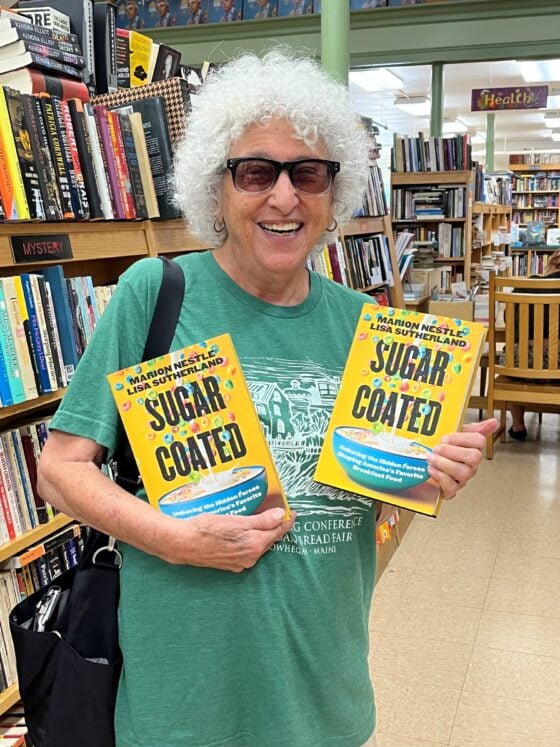
Comment: Sugar Coated explains the history of all this and why it is happening. Enjoy!
The authors drew on findings from randomized controlled trials (RCTs), observational research, and international agricultural policy guidance to examine how cattle production intersects with global nutrition, environmental pressures, and rural livelihoods.
The synthesis suggested that, when consumed within balanced dietary patterns, beef serves as a nutrient-dense, whole-food source of bioavailable micronutrients and high-quality protein without consistently worsening measured cardiometabolic risk markers in controlled trials.
The authors also argued that sustainable food policy must account for nutrient density, agricultural land use, and rural livelihoods alongside environmental impacts, without relying solely on mass- or calorie-based comparisons.
This is a research-based review and opinion study. It evaluates the contribution of beef to nutrition and health, and to meeting the United Nations’ Sustainable Development Goals.
Its conclusions:
Beef provides a concentrated source of high-quality protein and essential, bioavailable micronutrients, alongside important socio-economic contributions, particularly in LMICs [Lower and Middle Income Countries].
The case for moderate beef consumption within healthy, balanced dietary patterns is supported by the totality of evidence across nutrition, chronic disease risk, and micronutrient adequacy.
As reflected in the Sustainable Development Goals framework, sustainable food systems must simultaneously address nutrition, poverty, environmental stewardship, and economic resilience. Sustainable beef production intersects with these objectives across multiple domains.
Conflict of interest statement. Julia Sekula is employed by Beef + Lamb New Zealand Inc, an organization that represents the interests of New Zealand beef and lamb producers. Shalene McNeill is employed by National Cattlemen’s Beef Association, a contractor to the Beef Checkoff, that represents the US’s beef cattle farmers and ranchers. Ruaraidh Petre is employed by the Global Roundtable for Sustainable Beef, a multistakeholder network of beef value chain partners and NGOs that leads, measures and communicates improvements in beef sustainability. Zachary Gould has no disclosures to make.
Acknowledgments: This manuscript was invited for submission by the US Roundtable for Sustainable Beef. The views expressed in this publication are those of the author(s) and do not necessarily reflect the views or policies of the USRSB, the journal, or the publisher.
Comment: This is a study commissioned by the beef industry and conducted by researchers who work for the beef industry. It’s purpose was to demonstrate that beef intake is consistent with sustainable food systems. It makes “the case for moderate beef consumption.”
“Moderate,” of course, means different things to different people. The study does not define it.
Christopher Gardner. Food Sense: The Science and Practice of Eating Well. Simon Element, 2026 (287 pages).
Christopher Gardner and I were doing book events at the same time within a couple of miles of each other in Marin County, mine at Book Passage in Corte Madera, and his at Copperfields in Larkspur. We met for lunch after our talks (thanks to Will Rosenzweig).
I had done a blurb for his book:
Here is Christopher Gardner’s remarkably sensible and easy-to-read philosophy of how to eat healthfully and enjoyably, based on his extensive and deep scientific training, experience running clinical trials, and—delightful surprise–cooking skills (the book has recipes!). He uses all this to weigh in on your most perplexing questions about diet and health. Food for thought!
And here is a brief excerpt:
It makes sense that as a culture we’d be so interested in diet because we’ve been told for decades now that we as a society need to eat better, but the reality is that we’re up against a really powerful and entrenched food system that may have started with good intentions but hasn’t had our best interests at heart for some time. The competing priorities of taste, cost, and convenience can make even simple and straightforward nutrition guidance seem complicated. It’s a perfect environment for people to try to sell you miracle cures and quick fixes…So what do we do? Well, we need to empower ourselves with everything we’ve got to cut through the noise…[the approach you take] has to be louder than the messages you’re getting from, well, everywhere…most importantly, it needs to offer you a strong foundation based in science with lots of room for flexibility (pp. 6-7).
I have a long-standing interest in pet food and subscribe to Pet Food Industry, a truly superb trade publication. It recently carried this item (don’t miss its AI illustration):
Apparently, Russia is transferring Nestlé’s assets to LEV Management based in Moscow. Not much is known about that company; it was created in 2025 and nobody knows what it does, according to the account in Le Monde,
Russian authorities have seized the businesses and assets of Swiss food giant Nestlé and three French groups, a move the Kremlin defended Friday, September 18, as a justified measure against firms representing “unfriendly countries” that back Ukraine.
Le Monde quotes Nestlé as saying the company is “assessing the situation and its options.” Nestlé is said to have 6 factories in Russia employing around 7,000 people, who produce coffee, pet care, infant nutrition and confectionary products. Russia accounts for about 1% of the group’s sales, down from around 2% before the Ukraine war.
Nestlé (no relation) is a huge company in 185 countries with 271,000 employees, sales of $89.5 billion and 30 brands generation a $billion or more annually.
The seizure won’t hurt Nestlé much (we can ask why Nestlé was in Putin’s Russia in the first place) but it’s a sure sign that US food companies need to get out of there.
As I keep saying, the food industry is in big trouble these days. Here is one more piece of evidence.
Of 69 articles from 2009 to 2025 criticizing the Nova classification system for ultra-processed foods or defending ultra-processed foods:
91.3% involved at least 1 industry-affiliated author
68.5% of 232 total authors had food industry ties
65.2% of articles were published in journals associated with nutrition societies with disclosed industry partnerships.
Arguments defending or promoting ultraprocessed foods appeared in
39.7% of articles with direct industry ties
60.0% with organizational or governmental industry ties
16.7% of articles with no identified ties.
Conclusion
Given the tobacco industry’s well-documented strategy of manufacturing academic doubt about its products’ harms, these findings raise concern that the food industry may be following a similar playbook as evidence for the health risks of ultraprocessed foods continues to grow.
Comment
These results certainly do raise concern. They confirm what I’ve long suspected. The food industry does not like the concept of ultra-processed food. Defining it makes research possible. This research shows diets high in ultra-processed foods to be bad for health. If people eat less of them, sales and profits will decline (and this is already happening). The main opposition to defining ultra-processed foods and advice to eat less of them comes from the food industry (other opposition comes from nutrition researchers who object to the focus on processing rather than nutrient content). This study provides further evidence for the bias introduced by industry funding of research.
The bottom line: not eating too much ultra-processed junk food is likely to improve health.
Purpose: The aim of this study was to provide robust evidence on the long-term use of non-nutritive sweetened (NNS) beverages on weight management.
Method: Compare NNS beverages to water during 1 year of assisted weight management followed by a voluntary, unassisted 1-year extension.
Results: Participants consuming water maintained a weight loss of 3·7 kg over 104weeks, compared with 4·8 kg with NNS beverages (not statistically significant).
Conclusion: Our findings suggest people can lose weight and maintain it for 2 years, when drinking either NNS beverages or water and taking part in weight-management programmes.
Financial support. This trial was fundedby the American Beverage Association. The American Beverage Association was not involved in the design, conduct, analysis of data or interpretation of this trial; a representative from the American Beverage Association was provided with the opportunity to review the manuscript. Final decisions regarding the content were made by the authors. The manuscript was developed with the assistance of a medical writer, funded by the American Beverage Association, under the direction of the authors. A third-party organisation (Biofortis) audited data at the clinical site to check for the accuracy and integrity of the data.
Competing interests. Joanne A. Harrold reports funding (paid to the University of Liverpool) from the American Beverage Association for the present study. Outside of the submitted work, she reports a grant from the European Commission for the Horizon 2020 project SWEET. Scott Hill reports funding (paid to the University of Liverpool) from the American Beverage Association for the present study. Cristina Radu reports funding (paid to the University of Liverpool) from the American Beverage Association for the present study and funding from Coca Cola for a PhD studentship outside of the submitted work. Paul Thomas reports funding (paid to the University of Liverpool) from the American Beverage Association for the present study. Paula Thorp reports funding (paid to the University of Liverpool) from the American Beverage Association for the present study. Charlotte A. Hardman reports funding (paid to the University of Liverpool) from the American Beverage Association for the present study. Outside of the submitted work, she reports honoraria from the International Sweeteners Association, International Food Information Council and Mars Global Nutrition Advisory Council (paid to the University of Liverpool); grants from the European Commission for the Horizon 2020 project SWEET, the Biotechnology & Biological Sciences Research Council and the Natural Environment Research Council (paid to the University of Liverpool); primary supervisor on a PhD studentship funded by Coca Cola (awarded to CR); personal fees for her role on the Food Standards Agency Advisory Committee on Social Sciences and an unpaid role as a trustee of Feeding Liverpool. Paul Christiansen reports funding (paid to the University of Liverpool) from the American Beverage Association for the present study. Outside of the submitted work, he reports grants from the European Commission for the Horizon 2020 project SWEET, the National Institute for Health and Care Research, the Home Office UK and the Federal Bureau of Investigation and personal fees from Kaplan and Crohn’sandColitisUK. Una Masic reports funding (paid to the University of Liverpool) from the American Beverage Association for the present study. Lauren McGale reports funding (paid to the University of Liverpool) from the American Beverage Association for the present study. Outside of the submitted work, she reports funding (paid to the University ofLiverpool) fromtheWHO,andfunding(paid to the University of Wollongong) from the Australian Government’s Department of Health and Aged Care. Daniel J. Cuthbertson reports funding (paid to the University of Liverpool) from the American Beverage Association for the present study. Outside of the submitted work, he reports funding from Novo Nordisk and AstraZeneca for investigator-initiated research and consultancy (paid to the University of Liverpool) and educational grants from Perspectum. Jason C.G. Halford reports funding (paid to the University of Liverpool) from the American Beverage Association for the present study. Outside of the submitted work, he reports a grant from the European Commission for the Horizon 2020 project SWEET; consultancy fees from Boehringer Ingelheim, Dupont and Mars (all paid to the University of Leeds); honoraria from Novo Nordisk (paid to the University of Leeds); support for attending meetings from Novo Nordisk; financial support for participation in an advisory board for Dupont (paid to the University of Leeds); unpaid participation in an advisory board for the Sweet Tooth Project and unpaid board membership of the European Coalition of People Living with Obesity. He is treasurer of the World Obesity Federation.
Comment: This study was commissioned by, paid for, and reviewed by the American Beverage Association. The authors were paid by the ABA to do the study (the University of Leeds must be a hotbed of research funded by the soda industry). Why do this? People consuming artificially sweetened drinks sometimes are shown to gain weight on them. This study aimed to demonstrate—and did—that artificially sweetened drinks are as good as water during weight loss. The ABA got what it paid for.
In the most complete analysis yet, Protect Our Care has issued a devastating report card on the failure of the Trump administration to keep its MAHA promises.
For over a year, Donald Trump and his Health Secretary Robert F. Kennedy Jr. promised the Make America Healthy Again movement that this administration would finally take on Big Food, Big Ag, and Big Chemical. Instead, they have delivered a steady diet of broken promises, corporate quid pro quos, and foodborne illnesses….But a year into his [RFK Jr’s] tenure, the receipts tell a different story: cancer-linked chemicals back on the market, food safety agencies gutted, families paying more for groceries, and even the movement’s founders wondering whether they’ve been put out to political pasture.
The report details and documents broken promises about chemicals, pesticides, and corporate capture, especially to women.
Here is one item as an example:
Kennedy Stays Silent While EPA Betrays MAHA on Toxic Chemicals. While MAHA leaders have spoken out about air and water pollutants, Trump’s EPA has now shut down plans to release a MAHA agenda and the NIH has stopped accepting submissions for its flagship journal on environmental health and yanked research grants.. EPA scientists were pressured to alter safety reviews of chemicals in household cleaners and cosmetics to make risks appear less serious than the data shows — whitewashing health risks of the products MAHA’s core constituency was promised would be regulated. At a chemicals summit, Kennedy praised an Oregon State researcher’s microplastics study from the podium — unaware, or unbothered, that an hour earlier she’d learned EPA had just terminated the grant funding that research.
Kennedy has stayed similarly silent as EPA rolls back the very mercury rules he spent decades fighting for. As an environmental attorney, he sued over mercury pollution and personally developed “word retrieval and memory problems” from mercury-tainted fish. EPA announced its rollback of mercury emissions rules the day after the MAHA Commission, which Kennedy and Zeldin both sit on, held its first meeting. A recent report from Climate Power and Protect Our Care details how Trump has eliminated 31 pollution protections that, together, were set to deliver $275 billion in benefits per year and prevent 30,000 deaths annually.
Take a look at the report. The list is long, alas.
I was interested to see this chart from the USDA: Chart of Note: U.S. food system required greater share of national water use compared to employment or energy use:Water, labor, and energy are resources relied upon throughout the U.S. food system. The food system comprehensively required more than a quarter of total U.S. freshwater use each year from 2010 to 2023….In 2023, the U.S. food system relied on 27.7 trillion gallons of freshwater, or 29.3 percent of total freshwater withdrawals.
While I’m thinking about food fraud (see last week’s post), I’ve always said that the fish counter is the wild west of the supermarket. The Food and Agriculture Organization of the UN would agree.
provides information on tools that can be used to fight food fraud for aquatic products, and international case studies illustrate the scope and impact of fraud. The report reviews regulatory frameworks as well as standards such as those set by Codex Alimentarius, FAO guidelines, and GFSI‑benchmarked schemes, advocating for harmonized labelling, mandatory scientific names, and improved traceability. It emphasizes the role of consumer awareness and industry transparency in combating fraud.
The major new study was published in the British Journal of Nutrition and provides long-term clinical evidence that NNS beverages – specifically those containing aspartame, acesulfame potassium (acesulfame K), and sucralose – are equivalent to water in supporting weight loss and long-term weight maintenance.
The press release explains the rationale for doing this: “Overall, the results do not support concerns that NNS beverages disrupt appetite regulation or have long term metabolic harm.”
Who would be most interested in debunking this idea?
High marks to the press release for disclosing the funder: The American Beverage Association.
And why would the American Beverage Association care so much?
Policy impact: Importantly, the findings directly address recent World Health Organization (WHO) guidance, which advised against using non-sugar sweeteners for weight control due to uncertainty in observational studies. The SWITCH trial provides long-duration, randomised controlled evidence which can be used to inform global guidelines.
Isn’t it handy that the results can be used to argue against the WHO’s advisory.
This is one reason why beverage companies and their trade associations invest in research.
Financial support: This trial was funded by the American Beverage Association. The American Beverage Association was not involved in the design, conduct, analysis of data or interpretation of this trial; a representative from the American Beverage Association was provided with the opportunity to review the manuscript. Final decisions regarding the content were made by the authors. The manuscript was developed with the assistance of a medical writer, funded by the American Beverage Association, under the direction of the authors. A third-party organisation (Biofortis) audited data at the clinical site to check for the accuracy and integrity of the data.
Competing interests: Joanne A. Harrold reports funding (paid to the University of Liverpool) from the American Beverage Association for the present study. Outside of the submitted work, she reports a grant from the European Commission for the Horizon 2020 project SWEET. Scott Hill reports funding (paid to the University of Liverpool) from the American Beverage Association for the present study. Cristina Radu reports funding (paid to the University of Liverpool) from the American Beverage Association for the present study and funding from Coca Cola for a PhD studentship outside of the submitted work. Paul Thomas reports funding (paid to the University of Liverpool) from the American Beverage Association for the present study. Paula Thorp reports funding (paid to the University of Liverpool) from the American Beverage Association for the present study. Charlotte A. Hardman reports funding (paid to the University of Liverpool) from the American Beverage Association for the present study. Outside of the submitted work, she reports honoraria from the International Sweeteners Association, International Food Information Council and Mars Global Nutrition Advisory Council (paid to the University of Liverpool); grants from the European Commission for the Horizon 2020 project SWEET, the Biotechnology & Biological Sciences Research Council and the Natural Environment Research Council (paid to the University of Liverpool); primary supervisor on a PhD studentship funded by Coca Cola (awarded to CR); personal fees for her role on the Food Standards Agency Advisory Committee on Social Sciences and an unpaid role as a trustee of Feeding Liverpool. Paul Christiansen reports funding (paid to the University of Liverpool) from the American Beverage Association for the present study. Outside of the submitted work, he reports grants from the European Commission for the Horizon 2020 project SWEET, the National Institute for Health and Care Research, the Home Office UK and the Federal Bureau of Investigation and personal fees from Kaplan and Crohn’s and Colitis UK.
Una Masic reports funding (paid to the University of Liverpool) from the American Beverage Association for the present study. Lauren McGale reports funding (paid to the University of Liverpool) from the American Beverage Association for the present study. Outside of the submitted work, she reports funding (paid to the University of Liverpool) from the WHO, and funding (paid to the University of Wollongong) from the Australian Government’s Department of Health and Aged Care. Daniel J. Cuthbertson reports funding (paid to the University of Liverpool) from the American Beverage Association for the present study. Outside of the submitted work, he reports funding from Novo Nordisk and AstraZeneca for investigator-initiated research and consultancy (paid to the University of Liverpool) and educational grants from Perspectum. Jason C.G. Halford reports funding (paid to the University of Liverpool) from the American Beverage Association for the present study. Outside of the submitted work, he reports a grant from the European Commission for the Horizon 2020 project SWEET; consultancy fees from Boehringer Ingelheim, Dupont and Mars (all paid to the University of Leeds); honoraria from Novo Nordisk (paid to the University of Leeds); support for attending meetings from Novo Nordisk; financial support for participation in an advisory board for Dupont (paid to the University of Leeds); unpaid participation in an advisory board for the Sweet Tooth Project and unpaid board membership of the European Coalition of People Living with Obesity. He is treasurer of the World Obesity Federation.
Comment
This is an industry study through and through. I consider it marketing, not science.
In these essays, the authors consider how food is produced, distributed, purchased, shared, consumed, and experienced.
But instead of thinking only about what’s wrong, they think about how to create a better, safer, and more nourishing world. By investing in food, we cultivate strong bonds that strengthen families, economies, and the planet.
Here’s my Foreword but do read the essays; they are at the link above.
Estimating how frequently food fraud occurs or its exact economic impact can be hard because food fraud is designed to avoid detection. Outside estimates by experts have found that food fraud affects 1% of the global food industry at a cost of about $10-$15 billion a year, although some more recent expert estimates put the cost as high as $40 billion a year.
California signs voluntary non-UPF label into law: Gov. Gavin Newsom’s signing of AB 2244 into law creates the first state-backed, voluntary label for non-UPF qualifying products, amid a pending federal UPF definition. Read more.California is the first state with a government-backed label for qualifying foods that are not considered ultra-processed, following Gov. Gavin Newsom’s signing of Assembly Bill 2244, legislation introduced by Assembly member Jesse Gabriel, D-Encino.
The new law establishes a voluntary “Non-Ultraprocessed Certified” label intended to help consumers more easily identify foods that meet California’s non-UPF standard. The label is the latest step in California’s broader effort to address ultra-processed foods, with implications to set a blueprint for the rest of the country. According to the governor’s office, the label will provide front-of-package information for shoppers while also improving visibility of qualifying products on shelves.
While the federal government is dithering about what it sees as a vexing problem—defining ultra-processed foods—California has just passed its own non-UPF standard. Its definition:
Existing law defines, for certain school-related purposes, “ultraprocessed food” as any food or beverage that contains a specified substance and either high amounts of saturated fat, sodium, or added sugar or a nonnutritive sweetener or other substance, as specified.
The school food definition specifies amounts per serving of trans fats, salt, sugar, and calories, and artificial colors. This definition adds artificial sweeteners.
Why is the federal government having so much trouble with this? Well, the makers of ultra-processed foods don’t want it defined unless the definition focuses on nutrients.
The Institute of Food Technologist, for example, wants “policymakers to focus on the nutritional quality of foods rather than processing level alone and cautioned against relying on existing UPF classification systems as the basis for public policy (view IFT comments).”
Many commonly used UPF classification systems focus primarily on processing intensity rather than nutritional value. As a result, foods such as whole-grain bread, yogurt, fortified cereals, infant formula, allergy-friendly foods, and medical nutrition products can be categorized as ultra-processed despite providing important nutritional benefits. That distinction matters. Policies based largely on processing criteria could unintentionally penalize foods that help consumers meet nutrient needs and support broader public health objectives.
Medical foods could easily be exempted from the definition. So could those considered “healthy” by the FDA.
The arguments aren’t really about the science; they are about protecting sales of ultra-processed foods.
By this time, it’s pretty obvious that eating real food and reducing intake of ultra-processed foods is likely to promote health.
California’s new Non-UPF label is a good first step,
Fighting our toxic food environment: what can I do?
Making the healthiest choice the easiest choice
We are living in the era of diet and nutrition hype. Top up your protein! Don’t spike your glucose! Take these supplements! The advice is both omnipresent and inescapable. A Kaiser Family Foundation Poll of US adults found 72 percent reported seeing weight loss, diet, or nutrition content on social media over the last month, making it among the most popular content categories. Even people who didn’t seek out the diet advice and don’t have social media said they were exposed.
And yet, what we’ve learned spending decades researching nutrition and diet-related diseases is that this industry of wellness products and individual diet protocols amounts to a great big distraction. Eating well is not that complicated, and it’s not a problem of individual choices and will. It’s a collective action problem. If junk food inundates people everywhere, even the best nutrition advice is going to be impossible to follow. If healthy food is the most expensive and laborious to prepare, eating well becomes a privilege few can afford.
Instead of more individual diet advice, we need to use our power to tackle the systemic and structural drivers of the toxic food environments around us. We need to fight to make healthy food the default.
Since we published our books, one of the most common questions we’ve received is: ‘Ok, but what can I do to help?’
We’ve learned a lot from discussions and responses to that question, in different settings. Drawing on this and the literature on activism and action in the food and health space, here are six key things individuals can do. (We promise, they don’t involve protein or supplements.)
Vote for a better food environment
As citizens in democracies, we have the power to vote in the governments we believe will act in the public interest. Elected officials have a range of policy and regulatory tools they can use to make food environments healthier for all. We detail them in our books, but briefly they include:
Using government budgets to procure healthy foods (and limit ultra-processed foods) for institutions such as schools, government agencies, hospitals and clinics.
Regulating advertising, labelling, marketing and the commercial promotion of unhealthy ultra-processed foods — including infant foods — using enforceable mandatory standards.
Deploying economic tools to push people away from unhealthy foods (e.g. taxing harmful products, reforming agricultural subsidies) and toward healthier options (e.g. earmarking tax dividends to subsidize healthy diets for low-income families, supporting businesses that offer convenient and healthy ready meals in marginalized communities).
Ridding advisory bodies, food regulatory bodies and dietary guideline committees of conflicts of interest, and cleaning up industry lobbying practices (via public registers, disclosure and bans on the ‘revolving door’ from food industry into public office).
Look out for representatives or parliamentarians who make these issues part of their platform, and support or vote for them. But don’t stop there. Hold them accountable once they’re in power. Write to them to ask what they’re doing on regulating food environments, especially to protect young children from harmful products.
Advocate for healthy food at work, school, and in our communities
At a more personal level, the food environments at the places we spend a lot of time outside the home — like our offices, schools, or community spaces — shape what and how much we eat every day, even below the level of conscious awareness. If you find you or your kids are being nudged in unhealthy directions by the lunches at school, or bottomless snacks at work, push for change. Form a coalition with other colleagues or parents who want to improve the food environment. Document the status quo, and how it’s harming collective health. Use that evidence to demand change. Convene a regular workplace committee meeting to discuss how your school or employer responds to your concerns. (For inspiration, Chefs in Schools is one group that’s organizing on the education front.)
There are other measures you can take to affect change locally. These include joining public campaigns, signing petitions to demand local governmental action, or using local media to get the word out.
You also have a right to protest. This can be digital (online, social media) or, physical (like marches, or protests outside industry HQs and government offices). ‘Democracy’ after all derives from the Greek for ‘people power’. (For more inspiration, Stuart provides examples of ‘food fighters’ who’ve had success in his book.)
The media part is easier than ever. You can reach out to your local, national or global media outlet of choice, or develop your own newsletter or social media campaign.
Build social movements orjoin civil society organizations
Savvy social movements can help raise awareness and affect change. One of our favorites is Bite Back, the UK’s leading youth-led activist movement on food and health. Their campaign started with a film about how marketing influences young people’s food choices below the level of conscious awareness. Eight adolescents were shown ads for unhealthy ‘triple dipped chicken’ and later asked to choose from a menu of 50 items. All picked the triple dipped chicken. (Julia and Kevin detail the group’s work in their book.)
In the last few years, the campaign has done more than just raise awareness. Its petitions and advocacy have helped expand the number of schools offering healthy free school meals, and restrict junk food advertising to kids in the UK.
You can join or support these or other civil society organizations. Many provide resources, expertise and platforms for citizen action. They also do a great job of raising public awareness about the way our food system operates, exposing problems, lobbying politicians and proposing alternative solutions, including drafting legislation, policies and standards.
Closer to home, you can start or join local food groups and volunteer on community schemes and social innovations, including local food partnerships that share ideas and resources across a national network.
Invest for health
Use your skills, energy, time and money to invest in a healthier world. Do you work for an organization that’s positive, negative (or neutral) with its impact on food and health?
What can you do, in your workplace, to push for change? How can your employer help create a healthier food environment for all?
Ask about your pension fund: what’s it invested in? Speak to your colleagues or workplace committee and challenge investment decisions. If your funds are invested in a Black Rock, Vanguard, State Street ‘ESG fund,’ dig deeper and ask which companies sit within the fund (recent research has shown that many such funds invest in harmful ultra-processed food corporations). Outside work, you have agency in where you invest your personal savings.
Shareholder activism and advocacy are gaining traction. NGOs purchase shares to acquire voting rights, which they use to challenge big food transnationals. These can shift their portfolios towards healthier products. ShareAction in the UK has been attending company AGMs and coordinating shareholders for several years, most notably with Nestlé. In 2023, it persuaded Tesco to report on the percentage of its profits that derive from healthy foods; Unilever soon followed suit.
Vote with your wallet by buying foods that reflect the kind of food system you want to live in. This can involve boycotting unhealthy and unsustainable or unethical foods, while ‘buycotting,’ or switching to, better products and brands.
Sue Big Food
Of everything on this list, we think the litigation lever is the one that has the potential to have the most impact on our food environment. Again and again in the history of public health, protections and regulations don’t arrive with just a damning pile of research evidence. They arrived following litigation.
More specifically, smart lawyers sue companies on behalf of individual plaintiffs who allege they’ve been harmed by products. Those lawsuits pile up, and often through legal discovery, even when the plaintiffs lose, secrets revealed change public opinion and embolden governments to act in the interest of public health. This happened with asbestos, cigarettes, and opioids. And as Julia recently detailed in the New York Times, such lawsuits have begun to pile up in the US against ultra-processed food companies. But we’ll need a lot more of them to really affect change and it’ll take time. We’ll also need cities and state governments to start to sue, too — something San Francisco took the lead on last December. You can get involved in this legal effort by launching a suit, as a lawyer, a plaintiff, or a city or state.
The lawsuits could also gain strength from proposed regulatory actions. The former US Food and Drug Administration commissioner David Kessler — who was a leading anti-smoking crusader — proposed a way to regulate ultra-processed foods using existing agency rules. Kessler filed a petition with the FDA to ask the agency to reconsider whether a broad category of refined carbohydrates used in many ultra-processed foods should still be considered safe according to FDA regulation. The petition has gained traction among US health leadership, but that hasn’t translated to any action yet.
Run the research, support the science, and build awareness
As we’ve seen with public health menaces of the past, we need a solid body of evidence to make the case that inaction on food environments is no longer an option. It took decades to build that case when it came to smoking, as well as lots of litigation. Right now, we have an overwhelming body of evidence on the links between diet and health, but we need more on how various factors in a food environment exert different levels of influence on peoples’ food choices. Nutrition research now is dominated by studies that focus on the impact of individuals foods or diets, and much of that evidence is observational, not causal. We need more high-quality, randomized control trials on the impacts of food environments.
This research needs to be free from conflicts of interest. It’s not enough to disclose a conflict. Industry-funded research is likely to generate a significant and systematic bias so conflicts need to be avoided.
One group that’s trying to address these problems in nutrition research is UPF.RAN (Ultra-Processed Food Research Action Network), a global network of researchers committed to advancing knowledge and action on ultra-processed foods. They’re focused on sharing documents and resources, grounded in scientific evidence and translating that evidence for policymakers, advocates, journalists, and educators.
Beyond the science and evidence, we need to get the message about toxic food environments out, and support those who do. Investigative and independent media are key players here. These groups include Lighthouse Reports which, along with others, highlighted the shocking degree of corporate litigation against governments who had introduced pro-health regulation. BMJ Investigations, meanwhile, exposed the rampant conflicts of interest within the UK’s foremost nutrition advisory body (Scientific Advisory Committee on Nutrition). In the US,
US Right to Know and Open Secrets have been using Freedom of Information legislation in their pursuit of truth and transparency in public health.
We can strengthen our own awareness and knowledge by enrolling in online or physical courses, discussion groups, summer schools, and webinars, or just listening to podcasts and lectures. (Stuart was recently involved in the launch of a new series of short courses, run by the Brighton & Hove Food Partnership, for example). There’s no need to start from scratch. Many of the NGOs mentioned above provide technical support and training and they’ve developed adaptable toolkits.
In sum, these are the six actions we think go a long way towards tapping into the latent power we hold, as individuals and collectively. But what do you think? Let us know what you find most compelling and if there’s anything — or group— we’ve missed.

 Login