Normal view

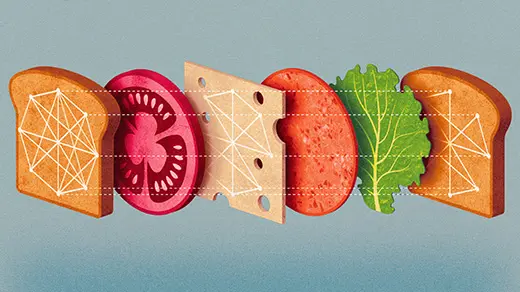
Mathematicians Build Long-Awaited Graph Sandwich

In 2004, two mathematicians hypothesized a powerful kind of sandwich. They were studying graphs, which are collections of points (called vertices) and lines (called edges). Graphs might represent anything from social groups to the internet to neurons in the brain. The mathematicians hoped to understand properties of one type of graph — a type that’s ubiquitous in mathematics and computer science…


Source

Where Does the Quantum World End and Ours Begin?

Quantum mechanics may be one of the most precisely tested paradigms in science, but there’s still no universally accepted interpretation of what it tells us about reality. How do we get from the wave-like behavior of quantum systems to the solid, macroscopic world of objects and the universe at large? Jonathan Halliwell, a professor of theoretical physics at Imperial College London…

Source

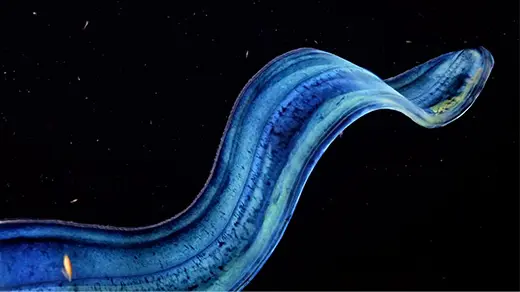
Ctenophores Aren’t Just Beautiful. They’re Biological Wonders.

Around 700 million years ago, a group of organisms resembling little more than glowing, gelatinous blobs split off from the rest of the animals, forming possibly the earliest branching animal lineage. Nearly 200 species of ctenophores, commonly known as comb jellies (but unrelated to jellyfish), live today in environments ranging from the cold depths of the sea to warm coastal surface waters.

Source

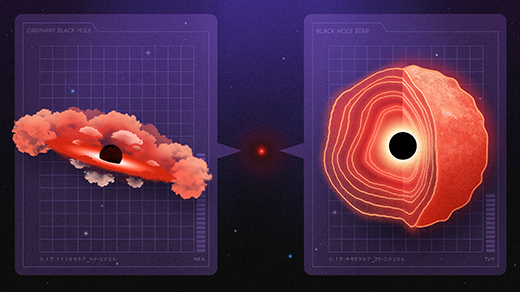
Black Holes or Black Hole Stars? Astronomers Spar Over Webb Telescope’s ‘Little Red Dots.’

Astronomers built the James Webb Space Telescope to pick up faint light from the first billion years after the Big Bang, a chaotic era when vast swaths of hydrogen and helium gas gathered into the chains of galaxies we see today. Even in the telescope’s first images, astronomers could see a whole zoo of mysterious smears of light. One batch of objects proved especially difficult to interpret.

Source

Why Do These Fossil Shells Flip Their Spirals Every Few Millennia?

For thousands and sometimes millions of years, marine plankton all over the world built their spiral shells in one direction. Then, suddenly, the spirals switched direction at the same time, everywhere, only to switch back again later. These microorganisms are types of foraminifera, or forams. Found in all oceans, from the tropics to high latitudes, they’re among the most abundant eukaryotic…

Source

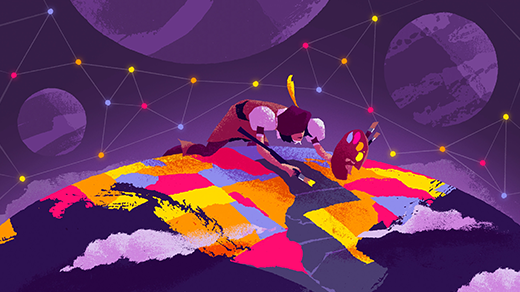
The Four-Color Theorem Gets a Rare New Proof

Some math problems continue to haunt researchers long after they’ve been solved. A proof emerges, is even celebrated, and yet dissatisfaction lingers. Perhaps the argument is too convoluted — the hunt persists for the elusive one-page paper — or perhaps it fails to give a deeper theoretical insight into why something is true. Whatever the reason, mathematicians return, again and again…

Source

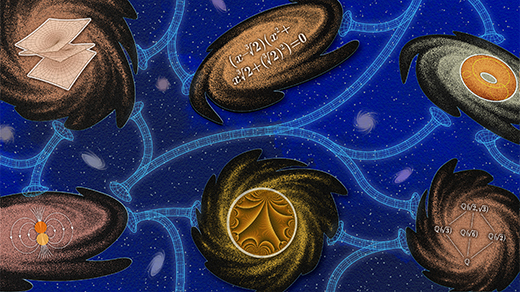
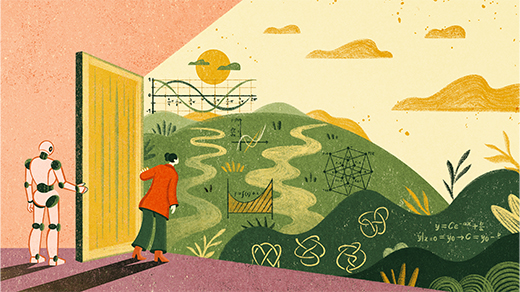
What Is Math’s Mysterious Langlands Program Really About?

The mathematical universe is boundless and heterogeneous, encompassing, over here, truths about numbers and equations; there, the logic of shapes and spaces; and over there, the study of change and probability. Its domains have grown organically over centuries, each centered around its own objects, methods, and questions. That’s why it’s so surprising when direct connections between different…

Source

AI Has Solved One of Math’s $1 Million Millennium Prize Problems

On the morning of Tuesday, September 8, mathematicians at OpenAI announced that a group of 10,000 autonomous AI agents under their direction, running on an advanced model not available to the public, had found a “singularity” in the Navier-Stokes equations in three dimensions — thus resolving one of the six remaining Millennium Prize Problems posed in 2000 by the Clay Mathematics Institute…

Source

Live from ICM 2026: What Is Math For in the Age of AI?

Mathematicians are witnessing a profound shift in their field. AI systems are now producing proofs, spotting connections between distant fields, and, in a few cases, solving problems that had stumped mathematicians for decades. The pace of progress over the past several months has raised challenging questions: What can AI systems actually do? And what happens to the more human…

Source

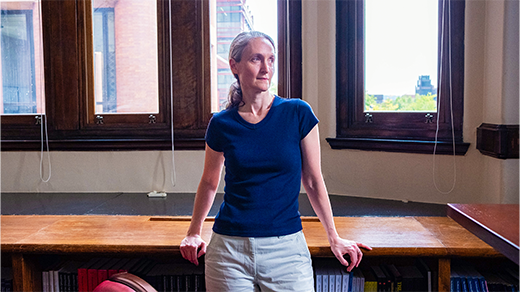
In an Age of AI, a Physicist Seeks What Endures

In July 2026, the U.S. Department of Energy selected 278 projects to fund as part of its Genesis Mission, meant to incorporate artificial intelligence into the scientific process. One project will use AI to help physicists search for a vanishingly rare particle transformation — a muon becoming an electron — by controlling different aspects of the Mu2e experiment at Fermi National Accelerator…

Source

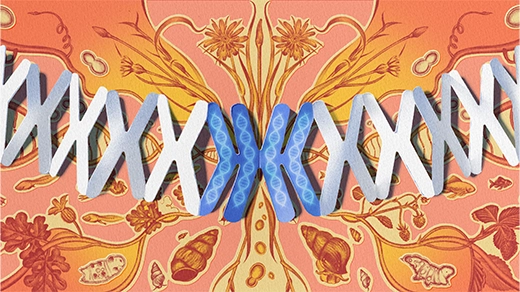
Genome Duplication Is a Radical Evolutionary Gamble

No larger than the head of a match, Potamopyrgus antipodarum doesn’t look very impressive. Few people visiting New Zealand’s Lake Alexandrina even notice the tiny gastropods littering the shores. The snail’s diminutive size, however, conceals a massive secret. Sometime in the recent past, its genome doubled. Instead of having two sets of chromosomes and two copies of every gene…

Source

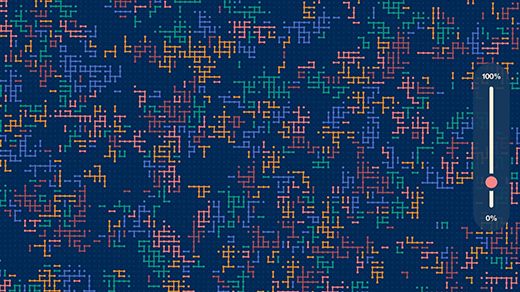
‘Stunning’ Percolation Proof Solves Decades-Old Puzzle About Phase Transitions

The week before Christmas 2025, five mathematicians were holed up in a classroom at ETH Zurich. The mood was electric: They were this close to a career-defining breakthrough. The group — consisting of then-postdocs Sahar Diskin and Philip Easo, graduate student Ritvik Ramanan Radhakrishnan, Benny Sudakov, and Vincent Tassion — was perfecting a solution to one of the biggest open problems in…

Source

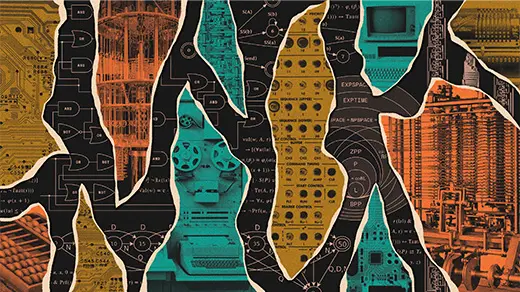
Does Computer Science Need Computers?

The pioneering computer scientist Edsger Dijkstra, winner of the 1972 A.M. Turing Award and inventor of one of the most iconic algorithms in all of computing, was nothing if not opinionated. Certain programming languages drew his ire, for example: He once dubbed Fortran “the infantile disorder” and stated that “the use of COBOL cripples the mind; its teaching should, therefore, be regarded as a…

Source

In Hilbert Space, All Things Are Quantumly Possible

At the heart of quantum mechanics lie a few sacred rules for how to use the theory. First and foremost is, roughly, that thou shalt not think about ordinary objects presently whizzing through ordinary space. Rather, quantum mechanics predicts — in exquisite detail — all the possible ways that an object might turn out to be in the future. Exploring those possible futures requires tracking an…

Source

A New Framework for How the Brain Compresses Our Noisy World

Every moment of our lives, our bodies are awash in sensory signals. Photons hit our retinas. Waves of compressed air collide with our eardrums. Volatile molecules bind to receptors in our nostrils, and chemicals slather our taste buds. Pressure and heat activate nerve endings in our skin. We are able to navigate this torrent because the brain does an enormous amount of data compression.

Source

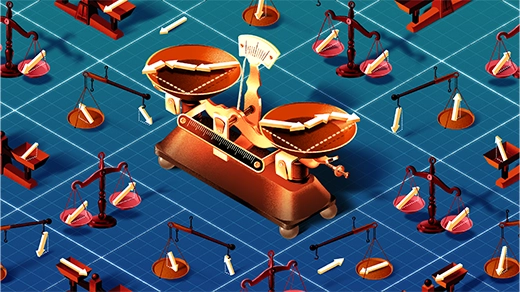
‘Huge Breakthrough’ in the Math of Imbalance

One does not need a doctorate in mathematics to split 12 eager trivia buffs into two competitive teams. But consider that each person arrives with unique strengths and liabilities: One may be a geography obsessive with no ear for music, another could be a naturalist who doesn’t own a television, and another could be a cinephile who never reads. Balancing traits between two camps becomes a lot…

Source

❌