❌

Normal view

Ctenophores Aren’t Just Beautiful. They’re Biological Wonders.

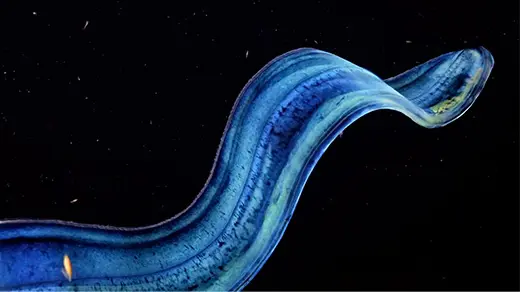
Around 700 million years ago, a group of organisms resembling little more than glowing, gelatinous blobs split off from the rest of the animals, forming possibly the earliest branching animal lineage. Nearly 200 species of ctenophores, commonly known as comb jellies (but unrelated to jellyfish), live today in environments ranging from the cold depths of the sea to warm coastal surface waters.

Source

Black Holes or Black Hole Stars? Astronomers Spar Over Webb Telescope’s ‘Little Red Dots.’

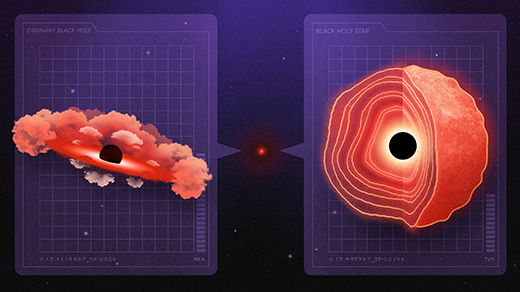
Astronomers built the James Webb Space Telescope to pick up faint light from the first billion years after the Big Bang, a chaotic era when vast swaths of hydrogen and helium gas gathered into the chains of galaxies we see today. Even in the telescope’s first images, astronomers could see a whole zoo of mysterious smears of light. One batch of objects proved especially difficult to interpret.

Source

Why Do These Fossil Shells Flip Their Spirals Every Few Millennia?

For thousands and sometimes millions of years, marine plankton all over the world built their spiral shells in one direction. Then, suddenly, the spirals switched direction at the same time, everywhere, only to switch back again later. These microorganisms are types of foraminifera, or forams. Found in all oceans, from the tropics to high latitudes, they’re among the most abundant eukaryotic…

Source

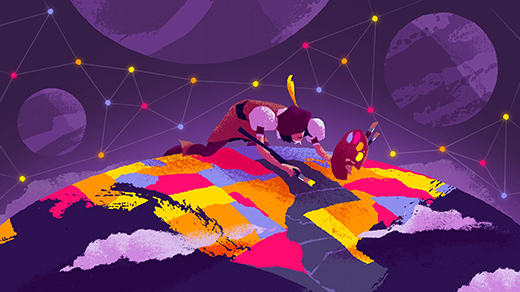
The Four-Color Theorem Gets a Rare New Proof

Some math problems continue to haunt researchers long after they’ve been solved. A proof emerges, is even celebrated, and yet dissatisfaction lingers. Perhaps the argument is too convoluted — the hunt persists for the elusive one-page paper — or perhaps it fails to give a deeper theoretical insight into why something is true. Whatever the reason, mathematicians return, again and again…

Source

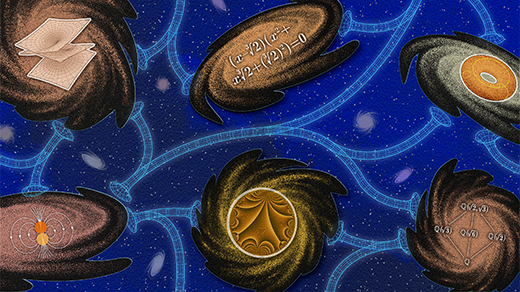
What Is Math’s Mysterious Langlands Program Really About?

The mathematical universe is boundless and heterogeneous, encompassing, over here, truths about numbers and equations; there, the logic of shapes and spaces; and over there, the study of change and probability. Its domains have grown organically over centuries, each centered around its own objects, methods, and questions. That’s why it’s so surprising when direct connections between different…

Source

AI Has Solved One of Math’s $1 Million Millennium Prize Problems

On the morning of Tuesday, September 8, mathematicians at OpenAI announced that a group of 10,000 autonomous AI agents under their direction, running on an advanced model not available to the public, had found a “singularity” in the Navier-Stokes equations in three dimensions — thus resolving one of the six remaining Millennium Prize Problems posed in 2000 by the Clay Mathematics Institute…

Source

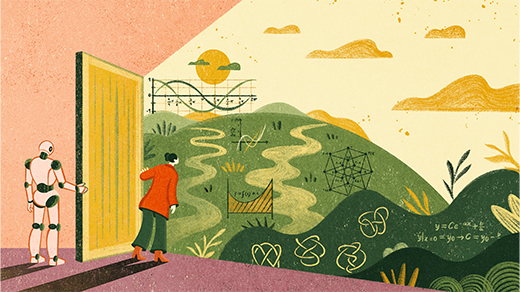
Live from ICM 2026: What Is Math For in the Age of AI?

Mathematicians are witnessing a profound shift in their field. AI systems are now producing proofs, spotting connections between distant fields, and, in a few cases, solving problems that had stumped mathematicians for decades. The pace of progress over the past several months has raised challenging questions: What can AI systems actually do? And what happens to the more human…

Source

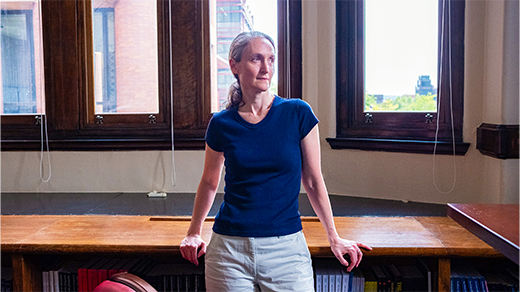
In an Age of AI, a Physicist Seeks What Endures

In July 2026, the U.S. Department of Energy selected 278 projects to fund as part of its Genesis Mission, meant to incorporate artificial intelligence into the scientific process. One project will use AI to help physicists search for a vanishingly rare particle transformation — a muon becoming an electron — by controlling different aspects of the Mu2e experiment at Fermi National Accelerator…

Source

Genome Duplication Is a Radical Evolutionary Gamble

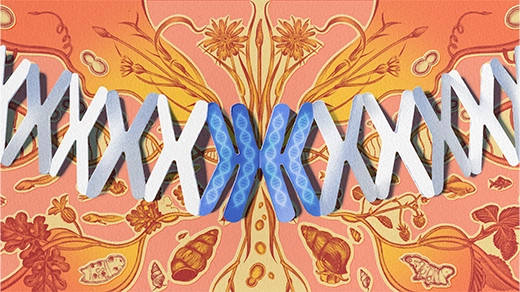
No larger than the head of a match, Potamopyrgus antipodarum doesn’t look very impressive. Few people visiting New Zealand’s Lake Alexandrina even notice the tiny gastropods littering the shores. The snail’s diminutive size, however, conceals a massive secret. Sometime in the recent past, its genome doubled. Instead of having two sets of chromosomes and two copies of every gene…

Source

❌