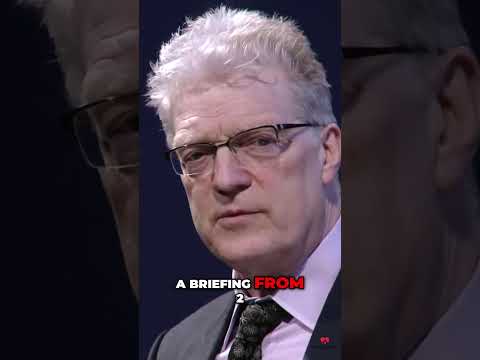
The accident that changed Sir Ken Robinson's view on attitude - and why the power of the mind may matter more than circumstance.
Sir Ken's father survived a falling beam of teak wood that broke his neck from 30 feet. A cigarette paper's width from instant death. He lived as a quadriplegic for 18 years (twice the average life expectancy) sustained, Sir Ken believed, by sheer willpower and an unshakeable default for happiness.
His house never stopped laughing.
This story shaped everything Sir Ken came to believe about human potential, attitude, and what it means to truly find your element.
What is education really for? Sir Ken Robinson's answer involves two world - and most schools only teach one of them.
There's the world that existed before you arrived and will continue after you leave - events, systems, people, circumstances. Education has always tried to prepare students for that.
But Sir Ken argued there's a second world equally deserving of attention: the one that only exists because you do. Your consciousness, your perceptions, your inner life. A world that came into being when you did, and ends when you do.
Education that ignores that isn't just incomplete. It misses half the person.
What do you think education should prepare us for? 👇
As a school teacher, your classroom is the education system. Sir Ken Robinson explains why teaching methods and school leadership matter more than policy.
When the door closes behind you and the class begins - what you do next is the education system for the kids in that class.
It’s easy to feel like the system is something that happens above you. Sir Ken Robinson argued it’s something that happens through you - every day, in every room, at every level.
If you can change your classroom, if you can change your school, and work for changes within your district, you will change the world for the people in the system.
Sir Ken Robinson, the education system, and the aesthetic experience: why are we anesthetizing kids instead of engaging their minds?
When a child stops paying attention, we treat it as a problem with the child. Sir Ken Robinson saw it differently. The modern education system has become so misaligned with how our minds actually work that switching off becomes the only rational response.
“An anesthetic is where you close your senses down so you don’t feel the discomfort.”
Instead of fostering an aesthetic experience - where a student is fully alert, their senses are alive, and they are resonating with the present - schools are putting them to sleep.
We’re anesthetizing far too many kids just to keep them with the program. And the truth is, they aren't paying attention because the program is boring, and their minds are working faster than the system allows.
It is time for a generational shift. Share this if you agree. 👇
Human creativity, creative thinking, and the power of imagination: Sir Ken Robinson explains why cultivating these human evolution skills is our generation's highest strategic priority.
Nobody predicted the world we live in today, and nobody can predict the next one.
We are no longer dealing with business as usual. Imagination is the exact power that carried humanity from caves to conference halls, and from eating carrion to cuisine. It has driven every single masterpiece, scientific breakthrough, and leap forward in human history.
Sir Ken Robinson believed this isn’t a talent reserved for the few—it is a natural human power inside every single one of us. Yet, our current systems continue to diminish it instead of making it flourish. Cultivating this gift systematically in our schools, our businesses, and our communities is the defining challenge of our generation.
Share this if you believe it’s time to change how we value creativity.
#sirkenrobinson #creativity #creativethinking #imagination #futureofwork #educationreform #innovation
Will artificial intelligence completely rewrite the future of work? As AI takes jobs across the professional sector, it's predicted to eliminate 40% of roles in medicine and law - not just repetitive tasks, but jobs that require judgment.
Sir Ken Robinson asked the question most education systems haven't caught up to yet: what is it about us, and our children, that a machine cannot replicate?
He called it the human advantage. The capacity to imagine, connect, and create - the things that make us human, and that school has spent decades quietly pushing aside.
The Industrial Revolution shaped our education system. The AI revolution is ending that world. The question is whether we change with it.
Sir Ken Robinson shares a striking image from Bihar, India - parents climbing a school building to pass cheat sheets through windows during a high-stakes exam.
He wasn’t criticising the parents. That’s the system they’re in.
This short explores what happens when a single test decides a child’s future, and why it’s happening everywhere.
When people say “times change but values don’t” they are making a fundamental mistake. Values DO change over time, but they changed by the people and from the ground up.
Sir Ken Robinson brilliantly reframes how we should view our time on earth. It’s not a boring, predictable commute from point A to point B. It’s a messy, exciting, uncertain QUEST.
"A quest is a journey you undertake whose outcome is not certain."
While you might get blown off course or end up on unexpected shores, it turns out those foreign places might be a better option than the one you originally had in mind.
But the defining principle of the quest?
"Nobody has ever lived your life, and nobody else ever will. You're a unique moment in the whole of human history."
Watching this archive lecture in 2026, as the world becomes increasingly standardized by technology, Sir Ken’s message about reclaiming our individual uniqueness is more critical than ever.
Are you on a commute, or a quest? Comment below! 👇
Sir Ken Robinson (1950–2020) was a legendary voice on creativity, education, and human potential.

 Login
Login