“I like to surprise people. Perhaps even shock my readership.”
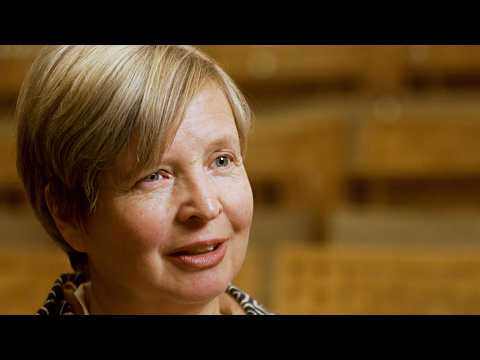
We met German writer Jenny Erpenbeck, winner of the 2024 International Booker Prize, for a very personal conversation about reading, writing, and growing up in first a divided and then a reunified Germany.
“I would love to enter the worlds of others. And I always liked to become someone else.”
”I think in language, the sound and the thinking, the music and the writing, come together. So, the language is always, even if you read silently, something that you imagine as a sound.”
“I like to tell a story in the way in which I use the language to give it a rhythm, to slow down, to speed up, to give a feeling of hesitating. Also, the sound of the voids is interesting. What interests me most is to write something in a way so that the silence between two passages, two words, is to be heard. Language is also a way to produce silence. Like a cliff. You give the reader a cliff to look into the abyss.”
Jenny Erpenbeck (b. 1967 in East Berlin) is an opera director, playwright, and award-winning novelist. She first trained as a bookbinder, then worked as a theatre props manager before studying musical theatre direction and enjoying a successful career as an opera director from the late 1990s.
She published her debut novella, Geschichte vom alten Kind, in 1999. Susan Bernofsky’s English translation, The Old Child, was published in 2005. Erpenbeck’s other translated works include The Book of Words (2008), Visitation (2010), and The End of Days (2014, winner of the Independent Foreign Fiction Prize), and Go, Went, Gone (2017, which was longlisted for the International Booker Prize in 2018), as well as Not a Novel: Collected Writings and Reflections (2020).
Her work has been translated into over 30 languages. In 2019, her novel Visitation was named one of the 100 best books of the 21st century by the Guardian. In the United States, her novel Kairos, translated by Michael Hofmann, was longlisted for 2023’s National Book Award for Translated Literature. In May 2024, Kairos won the International Booker Prize.
Jenny Erpenbeck was interviewed by Marc-Christoph Wagner in October 2024. The conversation took place at the Louisiana Museum of Modern Art in Humlebæk, Denmark.
Camera: Jarl Therkelsen Kaldan
Edit: Nanna Dahm
Produced by: Marc-Christoph Wagner
Copyright: Louisiana Museum of Modern Art, 2026
Louisiana Channel is supported by Den A.P. Møllerske Støttefond.
Subscribe to our channel for more videos on literature: https://www.youtube.com/thelouisianachannel
SIGN UP FOR OUR NEWSLETTER:
https://channel.louisiana.dk/newsletter
FOLLOW US HERE:
Website: http://channel.louisiana.dk
Instagram: http://www.instagram.com/louisianachannel
Facebook: https://www.facebook.com/LouisianaChannel
To mark the milestone, we asked New York Magazine’s senior art critic, Jerry Saltz, to select his 12 favourite pieces of advice from the series: “It’s getting them from the horse’s mouth as opposed to the horse’s you-know-what.”
Sign up for our newsletter for an exclusive preview of his selection:
https://channel.louisiana.dk/newsletter
Photo: Lucia Bell-Epstein
Subscribe to our channel for more videos: https://www.youtube.com/thelouisianachannel
SIGN UP FOR OUR NEWSLETTER:
https://channel.louisiana.dk/newsletter
FOLLOW US HERE:
Website: http://channel.louisiana.dk
Instagram: http://www.instagram.com/louisianachannel
Facebook: https://www.facebook.com/LouisianaChannel
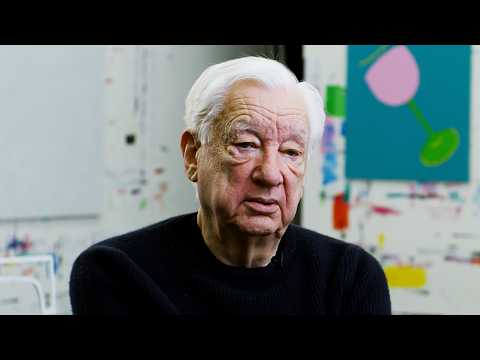
We celebrate the 100th episode of our Advice to the Young series with legendary artist and teacher Michael Craig-Martin, who shares his thoughts on what to treasure in life.
“Pay attention to what you are happy doing. To what you are good at. People take their gifts for granted. If something comes naturally to you, you kind of assume that it is natural to everybody. And you are wrong. The things that are natural to you aren’t natural to anybody else. They are yours.”
Michael Craig-Martin was born in Dublin, Ireland, in 1941. He grew up and was educated in the United States, studying Fine Art at the Yale School of Art and Architecture. He has lived and worked in Britain since 1966.
His first solo exhibition was at the Rowan Gallery in London in 1969. He participated in the definitive exhibition of British conceptual art, The New Art at the Hayward Gallery in 1972. His best known works include An oak tree of 1973, in which he claimed to have changed a glass of water into an oak tree; his large-scale black and white wall drawings; and his intensely coloured paintings, installations, and commissions, including the European Investment Bank in Luxembourg, the Laban Dance Centre in London (in collaboration with Herzog and de Meuron), the DLR station at Woolwich Arsenal, and, most recently, the HDI Gerling Headquarters in Hannover.
Over the past forty-two years, he has had numerous exhibitions and installations in galleries and museums across the world, including the Centre Pompidou, Paris, and MoMA, New York; the Kunstvereins in Düsseldorf, Stuttgart, and Hannover; IVAM in Valencia; and Kunsthaus Bregenz. He represented Britain at the 23rd São Paulo Biennial. A retrospective of his work was presented at the Whitechapel Art Gallery, London, in 1989; a second at the Irish Museum of Modern Art in Dublin in 2006; and a third at the Serpentine Gallery, London, in 2015.
Craig-Martin is well known for being an influential teacher at Goldsmiths College, London. He was a Tate Trustee from 1989 to 1999, was awarded a CBE in 2000, and was elected an RA in 2006. In 2016, he was knighted in the Queen’s Birthday Honours for his services to art.
Michael Craig-Martin was interviewed by Marc-Christoph Wagner in his London studio in February 2026.
Camera: Simon Weyhe
Edit: Nanna Dahm
Produced by: Marc-Christoph Wagner
Copyright: Louisiana Museum of Modern Art, 2026
Louisiana Channel is supported by Den A.P. Møllerske Støttefond.
Subscribe to our channel for more videos on art: https://www.youtube.com/thelouisianachannel
SIGN UP FOR OUR NEWSLETTER:
https://channel.louisiana.dk/newsletter
FOLLOW US HERE:
Website: http://channel.louisiana.dk
Instagram: http://www.instagram.com/louisianachannel
Facebook: https://www.facebook.com/LouisianaChannel
Colson Whitehead, Olga Tokarczuk, and five other writers share their approach to the blank page.
“There’s so much freedom on this blank page,” says German writer Charlotte Gneuss. For Colson Whitehead, known for his novels ‘Nickel Boys’ and ‘The Underground Railroad’, there’s no such thing as writer’s block; “I think it’s really just a problem I haven’t solved yet,” he says.
For the Nobel Prize laureate, Polish Olga Tokarczuk, she simply has too many ideas to cope with them all at once: “I have never experienced a creative emptiness.” For her namesake, Danish writer Olga Ravn, the feeling of innocence that comes from starting something new “is wonderful.”
The video also features Johan Harstad, Jonas Hassen Khemiri, Sayaka Murata and Claire-Louise Bennett.
Interviews by Tonny Vorm, Roxanne Bagheshirin Lærkesen, Caroline Albertine Minor, Marc-Christoph Wagner, Nanna Rebekka, and Marie Tetzlaff.
Cameras: Klaus Elmer, Rasmus Quistgaard, and Simon Weyhe.
Edited and produced by Roxanne Bagheshirin Lærkesen
Copyright: Louisiana Channel, Louisiana Museum of Modern Art, 2026.
Louisiana Channel is supported by Den A.P. Møllerske Støttefond.
Subscribe to our channel for more videos:
https://www.youtube.com/thelouisianachannel
FOLLOW US HERE:
Website: http://channel.louisiana.dk
Instagram: http://www.instagram.com/louisianachannel
Facebook: https://www.facebook.com/LouisianaChannel
Shigeru Ban (b. 1957) is a Japanese architect known for his innovative work with recycled cardboard tubes, which he used to quickly and efficiently house disaster victims. In the 1980s, he studied under John Hejduk at Cooper Union’s School of Architecture in the United States. Notable buildings include Centre Pompidou-Metz in France, Cardboard Cathedral in New Zealand, and the Aspen Art Museum. Shigeru Ban has won several awards, including the prestigious Pritzker Architecture Prize 2014. He is currently a professor at Keio University.
Shigeru Ban was interviewed by Jens H. Jensen at Simose Art Museum, which he designed, in Hiroshima in March 2023.
Camera: Yudai Maruyama
Edited by Roxanne Bagheshirin Lærkesen
Produced by Christian Lund
Copyright: Louisiana Channel, Louisiana Museum of Modern Art, 2026
Louisiana Channel is supported by Den A.P. Møllerske Støttefond
Subscribe to our channel for more videos:
https://www.youtube.com/thelouisianachannel
FOLLOW US HERE:
Website: http://channel.louisiana.dk
Instagram: http://www.instagram.com/louisianachannel
Facebook: https://www.facebook.com/LouisianaChannel

 Login
Login