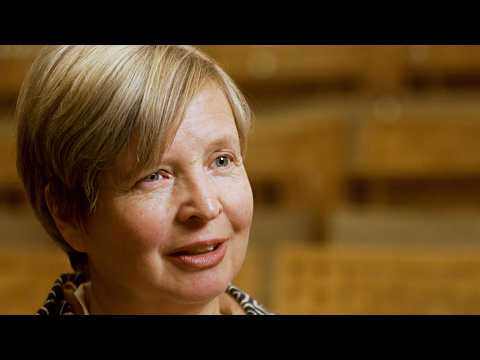
We visited Brazilian-German artist Janaina Tschäpe in New York and found a passionate painter with endless energy for discovering the world.
Full interview via our YouTube channel.
Brazilian-German artist Janaina Tschäpe (b. 1973 in Munich, Germany) lives and works in New York. She has a multidisciplinary practice that spans painting, drawing, photography, performance, video art, sculpture, murals, and installations. Drawing from the natural world, Tschäpe presents dreamlike abstract landscapes inspired by memory and myth. Balancing fluidity with precision, her work is imbued with a universality that reflects the various topographies she has traveled through or calls home – from Germany, Brazil, and America to beyond.
Tschäpe received her BFA from the Hochschule für Bildende Künste Hamburg (HFBK) in 1997 and her MFA from the School of Visual Arts, New York, in 1998. Her work is in the collections of – among others – the Centre Pompidou, Paris, Musée National d’Art Moderne, Paris; Moderna Museet, Stockholm; MAM Rio – Museu de Arte Moderna do Rio de Janeiro, Rio de Janeiro; Museu Nacional Centro de Arte Reina Sofía, Madrid; National Gallery of Art, Washington, D.C.; S.M.A.K. – Stedelijk Museum voor Actuele Kunst, Ghent; Solomon R. Guggenheim Museum, New York; Nasjonalmuseet, Oslo.
Janaina Tschäpe was interviewed by Marc-Christoph Wagner in her New York and Long Island studios. The conversations took place in March 2026.
Camera: Simon Weyhe
Edit: Nanna Dahm
Produced by: Marc-Christoph Wagner
Copyright: Louisiana Museum of Modern Art, 2026
Music via Upright:
Floating Dots by Kaspar Kaae, Brian Batz Andersen
Weightless by Peter Hellemann, Noah Rosanes
Droplets by Mat Andasun Eagerly
Waiting by Bjarni Biering Margeirsso
Louisiana Channel is supported by Den A.P. Møllerske Støttefond.
Subscribe to our channel for more videos on art: https://www.youtube.com/thelouisianachannel
SIGN UP FOR OUR NEWSLETTER:
https://channel.louisiana.dk/newsletter
FOLLOW US HERE:
Website: http://channel.louisiana.dk
Instagram: http://www.instagram.com/louisianachannel
Facebook: https://www.facebook.com/LouisianaChannel
Peter Fischli (born 1952, Zurich) is a Swiss artist known for his long‑standing collaboration with David Weiss (1946–2012). Together, Fischli & Weiss produced some of the late 20th century’s most influential works, including The Way Things Go (1987), the Equilibres series, and the Polyurethane Objects. Their practice spans film, sculpture, photography and installation, often examining everyday materials with humor and philosophical depth. Fischli has exhibited widely, including at the Venice Biennale, MoMA, Tate Modern and the Walker Art Center, and is regarded as one of the most significant European artists of his generation.
Peter Fischli was interviewed at the Louisiana Museum of Modern Art, in June 2026 by Christian Lund.
Camera & edit: Jarl Therkelsen Kaldan
Produced by Christian Lund
Copyright: Louisiana Museum of Modern Art, 2026.
Louisiana Channel is supported by Den A.P. Møllerske Støttefond.
TwitterFacebook
Tags
Art
Peter Fischli
Subscribe to our channel for more videos on art: https://www.youtube.com/thelouisianachannel
SIGN UP FOR OUR NEWSLETTER:
https://channel.louisiana.dk/newsletter
FOLLOW US HERE:
Website: http://channel.louisiana.dk
Instagram: http://www.instagram.com/louisianachannel
Facebook: https://www.facebook.com/LouisianaChannel
”We live in this world of objects that we have created ourselves.” For artist Nina Beier, the endless number of objects surrounding us is anything but neutral. They carry histories, desires, contradictions, and traces of the society that created them.
Nina Beier started as a photographer but soon moved on to work with sculpture and performance. From her studio in Copenhagen, Denmark, she compares her artistic process to a camera trying to focus: “You feel like you recognise it and you know what you’re looking at, but then it opens up in a different way. It shows this foggy version of itself where you start understanding the complexity of the object.” Throughout her work, Beier returns to objects that have lived many lives – bronze busts, marble countertops, Hermes ties, and remote-controlled luxury cars. But rather than transforming them completely, she destabilises them, revealing hidden stories and relationships.
During her childhood, Nina Beier lived partly in Mozambique, where her parents worked for a Danish aid organisation. Beier developed an early awareness of how objects, people, and power circulate across borders. That experience shaped her suspicion of simple narratives: “I’ve always been wary of anything that’s said or done in the name of righteousness.” For Beier, art is not about providing answers or being mediated. Instead, it should create situations where meaning remains open and unresolved: “I’m trying to unlock something in these objects,” she continues, “where they basically become signs in a way.”
In Nina Beier's work, seemingly ordinary, familiar objects can trigger a shared visual language with the viewer. Books scattered on a floor might evoke a study hall, a graveyard, or a flock of birds in flight. The objects have their own language and the ability to generate images and associations beyond themselves. This makes Beier cautious about overexplaining her work: “What happens when we start mediating the art is, of course, that we’re speaking on top of that language.” In an ideal world, she adds, she would rather people encounter the work first and discover their own associations before any explanation intervenes.
Nina Beier (b. 1975, Aarhus, Denmark) lives and works in Copenhagen, Denmark and Berlin, Germany. Beier has presented solo exhibitions at ARoS, Denmark (2026); Bozar, Brussels (2025); Museuo Tamayo, Mexico City (2024); Museum of Contemporary Art Kiasma, Helsinki (2024); Highline, New York (2022); Rønnebæksholm, Denmark (2020); Spike Island, Bristol, England (2018); Kunstverein Hamburg, Germany (2015); Contemporary Art Centre (CAC), Vilnius, Lithuania (2015); and the Yerba Buena Center for the Arts, San Francisco, California (2010). Her work has been included in group exhibitions at institutions including the Louisiana Museum of Modern Art (2024); Hammer Museum, Los Angeles, California (2022); the High Museum of Art, Atlanta, Georgia (2019); YUZ Museum, Shanghai, China (2018); Centre Pompidou, Paris, France (2014 and 2013); and Tate Modern, London, England (2012 and 2007). Her work has been featured in major international exhibitions, including the São Paulo Bienal, Brazil (2021); Glasgow International, Scotland (2021); the Riga International Biennial of Contemporary Art, Latvia (2020); 20th Sydney Biennale, Australia (2016) and 13th Biennale de Lyon, France (2015).
Nina Beier was interviewed by Roxanne Bagheshirin Lærkesen at her studio in Copenhagen in April 2026 and at Bozar in Brussels in October 2026.
Camera: Jarl Therkelsen Kaldan
Edited and produced by Roxanne Bagheshirin Lærkesen
Music via Upright:
Guitar Hi 1 Reverse by Drew J. Lerdal, Darren Mark Drew and Brian Burke Reidinger
Urban Hermit by Paul Aigner
Rostockk by Paul Elliott
Reversed Reflections by Maria Martine Jadg and Ida Duelund Hansen
Iorana by Penelope Fasy
Leaving Me by Anthony Francisco Ranere and Christian Campbell Celaya
Moments of Solitude by Bjarni Biering Margeirsson
Copyright: Louisiana Channel, Louisiana Museum of Modern Art, 2026
Louisiana Channel is supported by Den A.P. Møllerske Støttefond.
Subscribe to our channel for more videos on art: https://www.youtube.com/thelouisianachannel
SIGN UP FOR OUR NEWSLETTER:
https://channel.louisiana.dk/newsletter
FOLLOW US HERE:
Website: http://channel.louisiana.dk
Instagram: http://www.instagram.com/louisianachannel
Facebook: https://www.facebook.com/LouisianaChannel
“Living with contrasts is something very meaningful.”
We went to Paris and visited the architectural studio Mikoü, founded by the French-Moroccan twins Salwa and Selma Mikoü.
”Actually, we are twins, but we have very different ways of looking at architecture. We are very complementary, so when approaching a new project, we like to work together, but we also like to work separately at the beginning. We like drawing, we like sketching, but above all, we love speaking because words and exchanging ideas have a very deep resonance for us.”
Salwa and Selma Mikoü (b.1975 in Fez, Morocco) are French–Moroccan architects, twin sisters, and founders of Mikoü Architecture, a Paris-based practice at the intersection of architecture, cultural narratives, and material research. They founded the studio in 2008 after working at Ateliers Jean Nouvel and Renzo Piano Building Workshop, respectively. From 2016 to 2018, they led Intermediate Unit 16 at the Architectural Association School of Architecture in London.
Rooted in France and Morocco, the practice brings the intelligence of craft into dialogue with the demands of complex public programs. For Mikoü, every site contains traces, resources, and collective imaginaries that can become active materials for design.
”We are interested in engineering because for us all this inner structure is something like the fundamentals of architecture. It's like a skeleton. It's something that sometimes we don't see, but you know it's something so important.”
”Also, regarding climate issues, ecological transition, we had from the beginning this intuition that contemporary construction processes could embody this issue and could bring some solutions for the project and for the future of architecture. We like to assemble things because, for us, it's very smart and also allows us to think and push forward the concept of prefabrication. We really like the idea of industrializing architecture because, for us, it's a kind of gesture of progress. It's a way to think architecture differently, to make it smart, but still not standard at all.”
The studio’s Atlas of Resonance is a way of reading territories through memory, local narratives, geology, climate, and craft traditions. Construction is understood as a form of writing — one that articulates relationships, makes latent structures legible, and engages with the cultural depth of a place.
Salwa and Selma Mikoü define their practice as a Manufacture of Architecture, in which technology and craftsmanship converge through a Poetics of Assembly. Prefabrication, dry construction, craft knowledge, and off-site processes are approached not only as construction strategies but as cultural and social acts that bring different histories, identities, and forms of knowledge into relation.
“I tend to say that as architects, we are building also our own personality, our own culture, our own way to see the world. And project after project, we push boundaries that could also be our own boundaries as women,” Salwa says.
Built works include Aquazena, a swimming pool and wellness center in Greater Paris; Balsanéo, an Olympic aquatic center and spa in Châteauroux; the Simone Veil School Campus in Boulogne-Billancourt; a residential tower in Nanterre; and the transformation of the former studio of Yves Saint Laurent and Pierre Bergé in Paris. Current projects include Art de Rives, a mixed-use development along the Garonne in Bordeaux; a cultural campus within rehabilitated industrial halls in Casablanca; a museum park in Normandy; and a metalworking facility for Hermès in Champigny-sur-Marne.
Salwa and Selma Mikoü also lecture internationally.
Camera: Simon Weyhe
Edit: Simon Weyhe
Produced by: Marc-Christoph Wagner
Copyright: Louisiana Museum of Modern Art, 2026
Louisiana Channel is supported by Den A.P. Møllerske Støttefond.
Subscribe to our channel for more videos on architecture: https://www.youtube.com/thelouisianachannel
SIGN UP FOR OUR NEWSLETTER:
https://channel.louisiana.dk/newsletter
FOLLOW US HERE:
Website: http://channel.louisiana.dk
Instagram: http://www.instagram.com/louisianachannel
Facebook: https://www.facebook.com/LouisianaChannel
Elif Shafak (b. 1971, Strasbourg, France) is an award-winning British Turkish novelist, whose work has been translated into fifty-eight languages. She is a bestselling author of twenty books, thirteen of which are novels, in many countries worldwide. Shafak’s novel, 10 Minutes 38 Seconds in this Strange World, was shortlisted for the Booker Prize and the RSL Ondaatje Prize. The Island of Missing Trees was a Sunday Times bestseller and was shortlisted for the Costa Novel Award and the Women’s Prize for Fiction. There are Rivers in the Sky, which won an Edward Stanford Award for Fiction, is her latest novel. Shafak holds a PhD in political science and is a Fellow and a Vice President of the Royal Society of Literature. She was awarded the Chevalier de l’Ordre des Arts et des Lettres medal and, in 2024, was awarded the British Academy President’s Medal for ‘her excellent body of work which demonstrates an incredible intercultural range’.
Elif Shafak was interviewed by Roxanne Bagheshirin Lærkesen in London, England, June 2025.
Camera: Rasmus Quistgaard
Produced and edited by Roxanne Bagheshirin Lærkesen
Copyright: Louisiana Channel, Louisiana Museum of Modern Art, 2026
Louisiana Channel is supported by Den A.P. Møllerske Støttefond
Subscribe to our channel for more videos on literature: https://www.youtube.com/thelouisianachannel
SIGN UP FOR OUR NEWSLETTER:
https://channel.louisiana.dk/newsletter
FOLLOW US HERE:
Website: http://channel.louisiana.dk
Instagram: http://www.instagram.com/louisianachannel
Facebook: https://www.facebook.com/LouisianaChannel
Paul McCarthy (b. 1945) is an American artist. McCarthy’s often provocative works – frequently taking aim at consumerism, popular culture, and our innermost fears and neuroses – encompass performance, photography, film, multimedia installations, sculpture, drawing and painting. He regularly appropriates icons of popular culture including Santa Claus and Snow White, recasting them as violent, malicious and depraved. McCarthy’s work has been exhibited at prominent venues worldwide, and solo exhibitions have been held at Monnaie de Paris, Neue Nationalgalerie in Berlin, Whitney Museum in New York, and Moderna Museet in Stockholm, among others. He has also participated in the Berlin Biennial (2006), the Whitney Biennial (1995, 1997, 2004), and the Venice Biennale (1993, 1999, 2001).
Paul McCarthy was interviewed by Marc-Christoph Wagner at his studio in Los Angeles in November 2018.
Swiss artist Peter Fischli, who walks viewers through the logic and contradictions behind Fischli & Weiss’ long-running sculpture Snowman. Speaking in front of the vitrine containing the work, Fischli describes the piece, which is a quietly meticulous exploration of energy, entropy and human caretaking.
The sculpture, however, is anything but simple. Fischli explains that the figure is built around a copper “skeleton” cooled from within, allowing real snow to accumulate on its surface. “Some water is added from time to time and this builds up snow on the figure and it grows and grows and grows,” he says, noting that museum staff must actively maintain the work. The snowman’s dependence on energy, infrastructure and human attention is central to Fischli’s thinking. “We wanted to have something that would disappear… if the energy is no more there,” he recalls of the work’s origins in 1987, when he and his late collaborator David Weiss were commissioned to create a public sculpture for a power plant in Saarbrücken, Germany.
The interview traces how Snowman has evolved across decades and institutions. Later versions were powered not by industrial plants but by solar energy, a shift Fischli calls a “nice coincidence,” because “the snowman needs the most energy on a hot and sunny day and this is the day where solar energy produces the most.” The work’s changing energy sources mirror broader cultural shifts: from post Chernobyl debates about nuclear power to contemporary concerns about climate change. Fischli acknowledges the tension embedded in the piece, noting that “one could say… this is producing climate change,” even though its energy use is comparable to an ordinary refrigerator.
Fischli reflects on the snowman as a cultural symbol—once a threatening figure of winter hardship, now a benign icon of childhood. Yet in a museum vitrine, especially under summer sun, the sculpture becomes uncanny. “The more you see it… then you see something like a certain perversity or absurdity in it,” he observes, describing how viewers oscillate between empathy and recognition. The snowman’s simplicity is part of the point: “Every child can do that,” Fischli says, invoking the modernist joke that art can appear deceptively easy.
Peter Fischli (born 1952, Zurich) is a Swiss artist known for his long standing collaboration with David Weiss (1946–2012). Together, Fischli & Weiss produced some of the late 20th century’s most influential works, including The Way Things Go (1987), the Equilibres series, and the Polyurethane Objects. Their practice spans film, sculpture, photography and installation, often examining everyday materials with humor and philosophical depth. Fischli has exhibited widely, including at the Venice Biennale, MoMA, Tate Modern and the Walker Art Center, and is regarded as one of the most significant European artists of his generation.
Peter Fischli was interviewed at the Louisiana Museum of Modern Art, in June 2026 by Christian Lund.
Camera & edit: Jarl Therkelsen Kaldan
Produced by Christian Lund
Copyright: Louisiana Museum of Modern Art, 2026.
Louisiana Channel is supported by Den A.P. Møllerske Støttefond.
Music via Upright:
Dream Delight by Ane Østergaard
Heavenly Stars by Ane Østergaard
Delicate Memories by Ane Østergaard
Subscribe to our channel for more videos on art: https://www.youtube.com/thelouisianachannel
SIGN UP FOR OUR NEWSLETTER:
https://channel.louisiana.dk/newsletter
FOLLOW US HERE:
Website: http://channel.louisiana.dk
Instagram: http://www.instagram.com/louisianachannel
Facebook: https://www.facebook.com/LouisianaChannel
From her iconic Infinity Mirror Rooms to her mesmerising paintings and sculptures, Kusama’s remarkable vision has captivated generations of Louisiana visitors.
Thank you for everything 🕊️
We have interviewed Yayoi Kusama several times throughout the years. Watch the interviews here on our YouTube channel:
https://www.youtube.com/@thelouisianachannel/search?query=yayoi%20kusama
Subscribe to our channel for more videos on art: https://www.youtube.com/thelouisianachannel
SIGN UP FOR OUR NEWSLETTER:
https://channel.louisiana.dk/newsletter
FOLLOW US HERE:
Website: http://channel.louisiana.dk
Instagram: http://www.instagram.com/louisianachannel
Facebook: https://www.facebook.com/LouisianaChannel
We visited Brazilian-German artist Janaina Tschäpe in New York and found a passionate painter with endless energy for discovering the world.
”Painting makes you dive into a universe that is not linear. It’s not an illustration of something,
but it makes you dream. It makes you question certain things. It makes you want to go places and discover.”
In this personal portrait, Tschäpe also reflects her lifelong fascination with water – a recurring theme in her paintings:
”I grew up in Brazil. We would go to the sea every weekend or to the countryside where there were a lot of waterfalls. So obviously, there was a stream of water, an ocean around me growing up. My name, Janaína, is the goddess of the sea, which at some point in my life fascinated me as well.
I think everybody tries to find out what their name means. But also, I was always fascinated by
the idea of the sea. You know, in terms of why someone would try to build a boat, a ship to go from one country and discover something else? Like what was this longing?”
”Longing is a feeling that I think is the most poetic and beautiful way of going on about your day. It also contains sadness, and sadness is beautiful in the same way as happiness.”
Brazilian-German artist Janaina Tschäpe (b. 1973 in Munich, Germany) lives and works in New York. She has a multidisciplinary practice that spans painting, drawing, photography, performance, video art, sculpture, murals, and installations. Drawing from the natural world, Tschäpe presents dreamlike abstract landscapes inspired by memory and myth. Balancing fluidity with precision, her work is imbued with a universality that reflects the various topographies she has traveled through or calls home – from Germany, Brazil, and America to beyond.
Tschäpe received her BFA from the Hochschule für Bildende Künste Hamburg (HFBK) in 1997 and her MFA from the School of Visual Arts, New York, in 1998. Her work is in the collections of – among others – the Centre Pompidou, Paris, Musée National d’Art Moderne, Paris; Moderna Museet, Stockholm; MAM Rio – Museu de Arte Moderna do Rio de Janeiro, Rio de Janeiro; Museu Nacional Centro de Arte Reina Sofía, Madrid; National Gallery of Art, Washington, D.C.; S.M.A.K. – Stedelijk Museum voor Actuele Kunst, Ghent; Solomon R. Guggenheim Museum, New York; Nasjonalmuseet, Oslo.
Janaina Tschäpe was interviewed by Marc-Christoph Wagner in her New York and Long Island studios. The conversations took place in March 2026.
Camera: Simon Weyhe
Edit: Nanna Dahm
Produced by: Marc-Christoph Wagner
Copyright: Louisiana Museum of Modern Art, 2026
Music via Upright:
Floating Dots by Kaspar Kaae, Brian Batz Andersen
Weightless by Peter Hellemann, Noah Rosanes
Droplets by Mat Andasun
Eagerly Waiting by Bjarni Biering Margeirsso
Subscribe to our channel for more videos on art: https://www.youtube.com/thelouisianachannel
SIGN UP FOR OUR NEWSLETTER:
https://channel.louisiana.dk/newsletter
FOLLOW US HERE:
Website: http://channel.louisiana.dk
Instagram: http://www.instagram.com/louisianachannel
Facebook: https://www.facebook.com/LouisianaChannel
Michael Craig-Martin was born in Dublin, Ireland, in 1941. He grew up and was educated in the United States, studying Fine Art at the Yale School of Art and Architecture. He has lived and worked in Britain since 1966.
His first solo exhibition was at the Rowan Gallery in London in 1969. He participated in the definitive exhibition of British conceptual art, The New Art at the Hayward Gallery in 1972. His best known works include An oak tree of 1973, in which he claimed to have changed a glass of water into an oak tree; his large-scale black and white wall drawings; and his intensely coloured paintings, installations, and commissions, including the European Investment Bank in Luxembourg, the Laban Dance Centre in London (in collaboration with Herzog and de Meuron), the DLR station at Woolwich Arsenal, and, most recently, the HDI Gerling Headquarters in Hannover.
Over the past forty-two years, he has had numerous exhibitions and installations in galleries and museums across the world, including the Centre Pompidou, Paris, and MoMA, New York; the Kunstvereins in Düsseldorf, Stuttgart, and Hannover; IVAM in Valencia; and Kunsthaus Bregenz. He represented Britain at the 23rd São Paulo Biennial. A retrospective of his work was presented at the Whitechapel Art Gallery, London, in 1989; a second at the Irish Museum of Modern Art in Dublin in 2006; and a third at the Serpentine Gallery, London, in 2015.
Craig-Martin is well known for being an influential teacher at Goldsmiths College, London. He was a Tate Trustee from 1989 to 1999, was awarded a CBE in 2000, and was elected an RA in 2006. In 2016, he was knighted in the Queen’s Birthday Honors for his services to art.
Michael Craig-Martin was interviewed by Marc-Christoph Wagner in his London studio in February 2026.
Camera: Simon Weyhe
Edit: Nanna Dahm
Produced by: Marc-Christoph Wagner
Copyright: Louisiana Museum of Modern Art, 2026
Louisiana Channel is supported by Den A.P. Møllerske Støttefond.
Subscribe to our channel for more videos: https://www.youtube.com/thelouisianachannel
SIGN UP FOR OUR NEWSLETTER:
https://channel.louisiana.dk/newsletter
FOLLOW US HERE:
Website: http://channel.louisiana.dk
Instagram: http://www.instagram.com/louisianachannel
Facebook: https://www.facebook.com/LouisianaChannel
“I like to surprise people. Perhaps even shock my readership.”
We met German writer Jenny Erpenbeck, winner of the 2024 International Booker Prize, for a very personal conversation about reading, writing, and growing up in first a divided and then a reunified Germany.
“I would love to enter the worlds of others. And I always liked to become someone else.”
”I think in language, the sound and the thinking, the music and the writing, come together. So, the language is always, even if you read silently, something that you imagine as a sound.”
“I like to tell a story in the way in which I use the language to give it a rhythm, to slow down, to speed up, to give a feeling of hesitating. Also, the sound of the voids is interesting. What interests me most is to write something in a way so that the silence between two passages, two words, is to be heard. Language is also a way to produce silence. Like a cliff. You give the reader a cliff to look into the abyss.”
Jenny Erpenbeck (b. 1967 in East Berlin) is an opera director, playwright, and award-winning novelist. She first trained as a bookbinder, then worked as a theatre props manager before studying musical theatre direction and enjoying a successful career as an opera director from the late 1990s.
She published her debut novella, Geschichte vom alten Kind, in 1999. Susan Bernofsky’s English translation, The Old Child, was published in 2005. Erpenbeck’s other translated works include The Book of Words (2008), Visitation (2010), and The End of Days (2014, winner of the Independent Foreign Fiction Prize), and Go, Went, Gone (2017, which was longlisted for the International Booker Prize in 2018), as well as Not a Novel: Collected Writings and Reflections (2020).
Her work has been translated into over 30 languages. In 2019, her novel Visitation was named one of the 100 best books of the 21st century by the Guardian. In the United States, her novel Kairos, translated by Michael Hofmann, was longlisted for 2023’s National Book Award for Translated Literature. In May 2024, Kairos won the International Booker Prize.
Jenny Erpenbeck was interviewed by Marc-Christoph Wagner in October 2024. The conversation took place at the Louisiana Museum of Modern Art in Humlebæk, Denmark.
Camera: Jarl Therkelsen Kaldan
Edit: Nanna Dahm
Produced by: Marc-Christoph Wagner
Copyright: Louisiana Museum of Modern Art, 2026
Louisiana Channel is supported by Den A.P. Møllerske Støttefond.
Subscribe to our channel for more videos on literature: https://www.youtube.com/thelouisianachannel
SIGN UP FOR OUR NEWSLETTER:
https://channel.louisiana.dk/newsletter
FOLLOW US HERE:
Website: http://channel.louisiana.dk
Instagram: http://www.instagram.com/louisianachannel
Facebook: https://www.facebook.com/LouisianaChannel
To mark the milestone, we asked New York Magazine’s senior art critic, Jerry Saltz, to select his 12 favourite pieces of advice from the series: “It’s getting them from the horse’s mouth as opposed to the horse’s you-know-what.”
Sign up for our newsletter for an exclusive preview of his selection:
https://channel.louisiana.dk/newsletter
Photo: Lucia Bell-Epstein
Subscribe to our channel for more videos: https://www.youtube.com/thelouisianachannel
SIGN UP FOR OUR NEWSLETTER:
https://channel.louisiana.dk/newsletter
FOLLOW US HERE:
Website: http://channel.louisiana.dk
Instagram: http://www.instagram.com/louisianachannel
Facebook: https://www.facebook.com/LouisianaChannel
We celebrate the 100th episode of our Advice to the Young series with legendary artist and teacher Michael Craig-Martin, who shares his thoughts on what to treasure in life.
“Pay attention to what you are happy doing. To what you are good at. People take their gifts for granted. If something comes naturally to you, you kind of assume that it is natural to everybody. And you are wrong. The things that are natural to you aren’t natural to anybody else. They are yours.”
Michael Craig-Martin was born in Dublin, Ireland, in 1941. He grew up and was educated in the United States, studying Fine Art at the Yale School of Art and Architecture. He has lived and worked in Britain since 1966.
His first solo exhibition was at the Rowan Gallery in London in 1969. He participated in the definitive exhibition of British conceptual art, The New Art at the Hayward Gallery in 1972. His best known works include An oak tree of 1973, in which he claimed to have changed a glass of water into an oak tree; his large-scale black and white wall drawings; and his intensely coloured paintings, installations, and commissions, including the European Investment Bank in Luxembourg, the Laban Dance Centre in London (in collaboration with Herzog and de Meuron), the DLR station at Woolwich Arsenal, and, most recently, the HDI Gerling Headquarters in Hannover.
Over the past forty-two years, he has had numerous exhibitions and installations in galleries and museums across the world, including the Centre Pompidou, Paris, and MoMA, New York; the Kunstvereins in Düsseldorf, Stuttgart, and Hannover; IVAM in Valencia; and Kunsthaus Bregenz. He represented Britain at the 23rd São Paulo Biennial. A retrospective of his work was presented at the Whitechapel Art Gallery, London, in 1989; a second at the Irish Museum of Modern Art in Dublin in 2006; and a third at the Serpentine Gallery, London, in 2015.
Craig-Martin is well known for being an influential teacher at Goldsmiths College, London. He was a Tate Trustee from 1989 to 1999, was awarded a CBE in 2000, and was elected an RA in 2006. In 2016, he was knighted in the Queen’s Birthday Honours for his services to art.
Michael Craig-Martin was interviewed by Marc-Christoph Wagner in his London studio in February 2026.
Camera: Simon Weyhe
Edit: Nanna Dahm
Produced by: Marc-Christoph Wagner
Copyright: Louisiana Museum of Modern Art, 2026
Louisiana Channel is supported by Den A.P. Møllerske Støttefond.
Subscribe to our channel for more videos on art: https://www.youtube.com/thelouisianachannel
SIGN UP FOR OUR NEWSLETTER:
https://channel.louisiana.dk/newsletter
FOLLOW US HERE:
Website: http://channel.louisiana.dk
Instagram: http://www.instagram.com/louisianachannel
Facebook: https://www.facebook.com/LouisianaChannel
Colson Whitehead, Olga Tokarczuk, and five other writers share their approach to the blank page.
“There’s so much freedom on this blank page,” says German writer Charlotte Gneuss. For Colson Whitehead, known for his novels ‘Nickel Boys’ and ‘The Underground Railroad’, there’s no such thing as writer’s block; “I think it’s really just a problem I haven’t solved yet,” he says.
For the Nobel Prize laureate, Polish Olga Tokarczuk, she simply has too many ideas to cope with them all at once: “I have never experienced a creative emptiness.” For her namesake, Danish writer Olga Ravn, the feeling of innocence that comes from starting something new “is wonderful.”
The video also features Johan Harstad, Jonas Hassen Khemiri, Sayaka Murata and Claire-Louise Bennett.
Interviews by Tonny Vorm, Roxanne Bagheshirin Lærkesen, Caroline Albertine Minor, Marc-Christoph Wagner, Nanna Rebekka, and Marie Tetzlaff.
Cameras: Klaus Elmer, Rasmus Quistgaard, and Simon Weyhe.
Edited and produced by Roxanne Bagheshirin Lærkesen
Copyright: Louisiana Channel, Louisiana Museum of Modern Art, 2026.
Louisiana Channel is supported by Den A.P. Møllerske Støttefond.
Subscribe to our channel for more videos:
https://www.youtube.com/thelouisianachannel
FOLLOW US HERE:
Website: http://channel.louisiana.dk
Instagram: http://www.instagram.com/louisianachannel
Facebook: https://www.facebook.com/LouisianaChannel
Shigeru Ban (b. 1957) is a Japanese architect known for his innovative work with recycled cardboard tubes, which he used to quickly and efficiently house disaster victims. In the 1980s, he studied under John Hejduk at Cooper Union’s School of Architecture in the United States. Notable buildings include Centre Pompidou-Metz in France, Cardboard Cathedral in New Zealand, and the Aspen Art Museum. Shigeru Ban has won several awards, including the prestigious Pritzker Architecture Prize 2014. He is currently a professor at Keio University.
Shigeru Ban was interviewed by Jens H. Jensen at Simose Art Museum, which he designed, in Hiroshima in March 2023.
Camera: Yudai Maruyama
Edited by Roxanne Bagheshirin Lærkesen
Produced by Christian Lund
Copyright: Louisiana Channel, Louisiana Museum of Modern Art, 2026
Louisiana Channel is supported by Den A.P. Møllerske Støttefond
Subscribe to our channel for more videos:
https://www.youtube.com/thelouisianachannel
FOLLOW US HERE:
Website: http://channel.louisiana.dk
Instagram: http://www.instagram.com/louisianachannel
Facebook: https://www.facebook.com/LouisianaChannel

 Login
Login