With Stig Abell and Thea Lenarduzzi – 500-plus years since Thomas More coined the term “Utopia”, denoting a too-good-to-be-true land, Chloë Houston considers the relevance, and importance, of Utopian thinking, and asks if we feel more at home in dystopia; prompted by a magisterial new biography by Jonathan Eig, J. Michael Lennon describes the transformation of Cassius Clay into Muhammad Ali (and tells us what it was like to meet Ali at Normal Mailer’s seventy-fifth birthday party); TLS editor Lucy Dallas speaks to the novelist Nick Harkaway, no stranger to grim (not necessarily) alternative realities, about his new novel Gnomon
This is becoming a sort of tradition for me to post something giving thanks around this holiday.
I think it’s because this community has become such a large part of my life (even if I don’t have nearly as much time to spend on it as I’d like).
Also, I think it helps to remind ourselves once in a while of the good things that happen to us. So in that spirit…
I want to start things off by acknowledging those that go the extra mile and help offset the costs of the infrastructure to keep this crazy ship afloat (sorry, I’m an ocean engineer by training and a sailor - so nautical metaphors abound!).
Once again the amazing Dimitrios Psychogios has graciously covered our server expenses (and then some) for another full year.
On behalf of the community, and particularly myself, thank you so much!
Your generosity will cover infrastructure costs for the year and give us room to grow as the community does.
We also have some awesome folks who support us through monthly donations (which are nice because we can plan better if we need to). Together they cover the costs of data storage + transfer in/out of Amazon AWS S3 storage (basically the storage and transfer of all of the attachments and files in the forums).
So thank you, you cool froods, you really know where your towels are:
Thank you all!
If you happen to see any of these great folks around the forum consider taking a moment to thank them for their generosity!
If you’d like to join them in supporting the site financially, check out the support page.
The community has just been amazing, and we’ve seen nice growth this past year.
Since the end of August we’ve seen about a 50% increase in weekly sessions on discuss.
We’re currently hovering around 2,500 daily pageviews on the forums:
We’ve added almost 950 new users, or almost 3 new users every day!
I figure @LebedevRI will yell at me if I forget to mention raw.pixls.us (RPU) again.
Back in January @andabata built a new site to help pick up the work of the old rawsamples.ch website to collect raw sample files for testing.
So thank you @andabata and @LebedevRI for your work on this!
A big thank you to everyone who has taken the time to check the site and upload missing (or non-freely licensed) raw files to include!
While we’re talking about RPU, please consider having a look at this post about it on discuss and take a few minutes to see if you might be able to contribute by providing raw samples that we are missing or need (see the post for more details).
If you don’t have something we need, please consider sharing the post on social media to help us raise awareness of RPU!
Thank you!
If you’re not aware of it, one of the things we try to do here beside run the site and forum is to assist projects with websites and design work if they want it.
Earlier this year the digiKam team needed to migrate their old Drupal website to something more modern (and secure) and @paperdigits figured, “why not”?
So we rolled up our sleeves and got them setup with a newly designed static website built using Hugo (which was completely new to me).
We were also able to manage their comments on the website for them by embedding topics from right here on discuss.
This way their users can still own their comments and we can manage spam and moderate things for them.
The best part, though, is the addition of their users and knowledge to the community!
I want to personally take a moment to thank @darix for all the work he does keeping things running smoothly here.
If you don’t see him, it means all the work he’s doing is paying off.
I speak with him daily and see firsthand the great work he’s doing to make sure all of us have a nice place to call home.
Thank you so much, @darix!
As usual @paperdigits (https://silentumbrella.com) also has a great attitude and pro-active approach to the community which I am super thankful for.
He also does things that aren’t always visible, but are essential to keeping things running smoothly, like moderating the forum, checking the health of sites we are helping to manage, and writing/editing posts.
I can’t stress enough how much it helps to keep your interest and spirits engaged in the community when you have someone else around who’s so positive and helpful. Thank you so much, @paperdigits!
At the end of the day this is a community, and it’s vibrancy and health is a direct result of all of you, its members.
So above all else this is by far the thing I am most thankful for - getting to meet, learn, and interact with all of you.
O artista Hélio Ziskind fala sobre o processo de criação da musica Chuva, chuvisco e chuvarada e fala qual foi a inspiração para compor essa canção.
Conheça a nova versão de Chuva, Chuvisco, Chuvara: https://goo.gl/LxNHKH
This week we're joined by TLS editors Lucy Dallas and Toby Lichtig to pick through the "books of the year", as nominated by a roster of TLS contributors, including Lydia Davis, Hilary Mantel, William Boyd and Tom Stoppard; plus, we bite the literary bullet and share our own nominations, from Reni Eddo-Lodge's account of entrenched racism to Laurent Binet's riotous fictional homage to Roland Barthes
We're joined this week by the TLS's Classics editor Mary Beard to discuss Emily Wilson's new translation of the Odyssey – the first ever by a woman – as well as other issues surrounding women in Classics and women in power more generally; Andrew Motion considers the life of the editor Edward Garnett, “one of the great taste-makers of the twentieth century”; and finally, could you name anything by Dorothy Dunnett? Rohan Maitzen fills us in on The Lymond Chronicles, the most rollicking historical novels you might never have heard of
Conheça o novo canal do Hélio Ziskind, o ZiS: http://goo.gl/j9YhRn
Parlendas são clássicos da cultura brasileira. As letras não têm significação, feitas para brincar por brincar. O Hélio conta um pouco sobre a cantiga de roda Onça-Pintada e o mundo de brincadeira dos pequenos com as palavras!
With Toby Lichtig and Lucy Dallas – London has a brand-new theatre: the Bridge, the latest venture by Nicholas Hytner and Nick Starr, based in Southwark and dedicated to original writing. And it starts its life with a new play by Richard Bean and Clive Young: Young Marx features Rory Kinnear as a delinquent Karl Marx, with a dash of Monty Python thrown in. The TLS’s Michael Caines joins us in the studio to discuss it; The “common view” of atheists is that religion is a combination of cosmology (a theory of the universe) and morality (or how best to behave) – but for the TLS’s Philosophy Editor Tim Crane this conception seems “deeply inadequate”. Crane identifies a third category, too often ignored: religious practice itself. He joins us on the line to discuss the religion of belonging, along with this week’s other philosophy pieces; The Austrian author Marianne Fritz was hailed in the late 1970s as a literary wunderkind, for a debut novel that described the descent into madness of a young mother in post-war Vienna. But as the decades progressed, her work grew increasingly obscure: brilliant for some, maddening for others. Jane Yager offers her insights into the author often dubbed, perhaps unfairly, “the female James Joyce”.
Conheça a nova versão de Banho é Bom (Ratinho Tomando Banho) no novo projeto do Hélio Ziskind, o ZiS: https://goo.gl/ADpdCo
Ratinho Tomando Banho ou Banho é Bom? Com certeza você já cantou essa música no chuveiro, mas qual é o nome certo? Hélio Ziskind fala sobre o nome da música que é um dos seus grandes sucessos!
Conheça a nova versão de Banho é Bom (Ratinho tomando Banho) no novo canal do Hélio Ziskind, o ZiS: https://goo.gl/ZKvNnj
Tchau preguiça, tchau sujeira! Adeus cheirinho de suoooooor... Todo mundo já cantou essa música debaixo chuveiro, não é mesmo? Assista ao vídeo e veja como foi o processo de criação de Banho é Bom, canção feita pelo músico Hélio Ziskind!
Georgina Colby joins us in the studio to discuss our growing recognition of the punk writer Kathy Acker, an experimental late-modernist; Alev Scott on 'Weinsteining' in publishing and what we should do about it; Tove Jansson is best known as the creator of the Moomins, but there is a great deal more to her oeuvre than those strange hippopotamus-like creatures – TLS Arts editor Lucy Dallas visits a new retrospective of Jansson's work
A Iara é um ser mitológico do folclore brasileiro, é a sereia que vive nos rios... Mas como ela faz pra cantar embaixo d'água? Fica soltando bolinhas? Hélio Ziskind comenta a canção Iara.
Conheça a nova versão da música Iara no novo projeto do Hélio Ziskind, o ZiS: http://goo.gl/j9YhRn
With Stig Abell and Thea Lenarduzzi – The Mexican-born novelist Valeria Luiselli joins us to discuss her new book, Tell Me How It Ends: An essay in 40 questions, about America's role in an ongoing immigration crisis where tens of thousands of Mexican and Central American children arrive at the border, unaccompanied and undocumented; Is Matthew Arnold responsible for the worst opening line of a sonnet in English? Seamus Perry gives an impassioned defence of the poet's dissonant and awkward verse; "If you are transgender, and if you come out as an adult in a position of authority (a tenured professor, say), non-trans people may treat you as an expert." So argues Harvard Professor Stephanie Burt, who has reviewed two accounts of being a trans person, Trans Like Me, by C. N. Lester and The Gender Games by Juno Dawson. She joins us to discuss.
The Mexican-born novelist Valeria Luiselli joins us to discuss her new book, Tell Me How It Ends: An essay in 40 questions, about America's role - and her own - in an ongoing immigration crisis where tens of thousands of Mexican and Central American children arrive at the border, unaccompanied and undocumented.
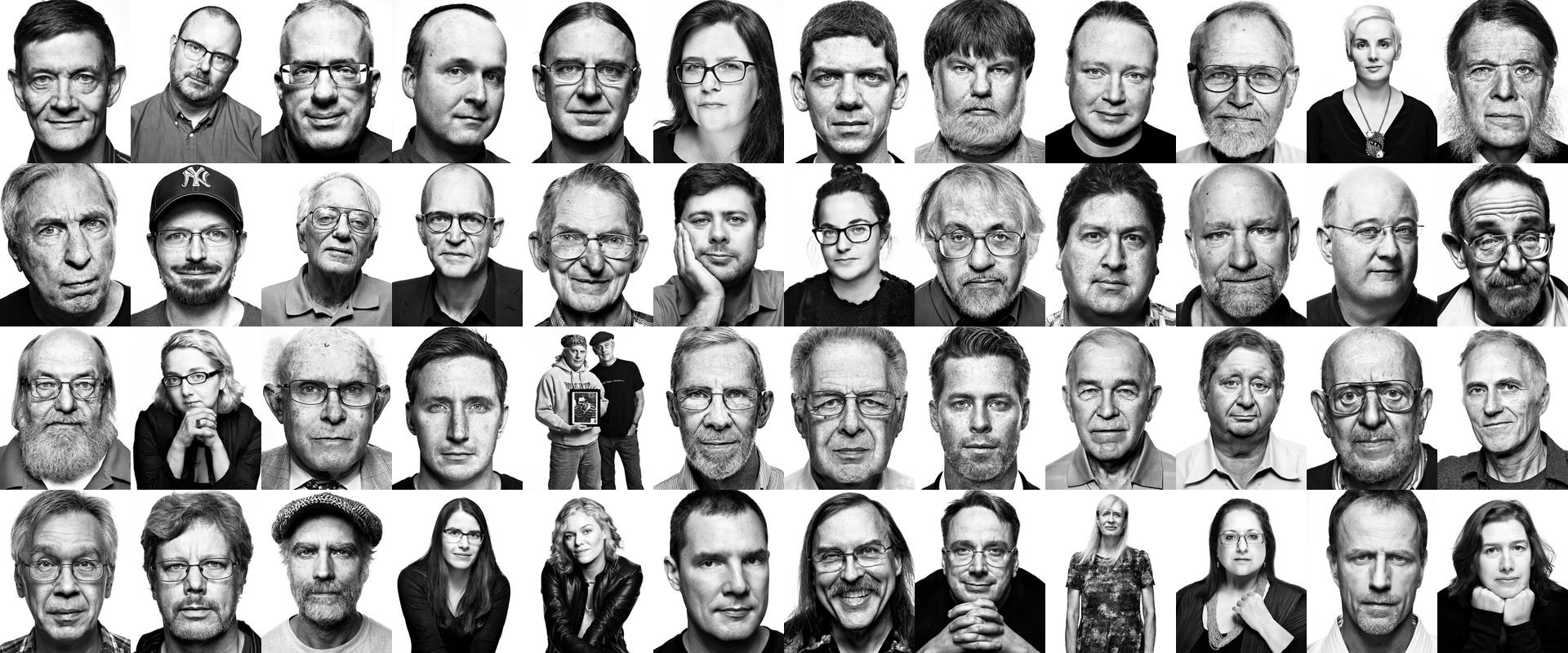
Peter really (ahem) throws a light on many amazing luminaries from not only the Free/Open Source Software community, but in some cases the history and roots of all modern computing.
He has managed to coordinate portrait sessions with many people that may be unassuming to a layperson, but take a moment to read any of the short bios on the site and the gravity of the contributions from the subjects to modern computing becomes apparent.
This project is my attempt to highlight a revolution whose importance is not broadly understood by a world that relies heavily upon the fruits of its labor.
That’s really what Peter has done here.
He has collected individuals whose contributions all add up to something far greater than their collective sums to shape the digital world many take for granted these days, and is presenting them in a powerful and thoughtful way more befitting their gifts.
A Chat with Peter Adams
I was lucky enough to be able to get a little bit of time with Peter recently, and with some help from the community had a few questions to present to him.
He was kind enough to take some time out of his day and be patient while I prattled on…
Linus Torvalds, Santa Fe, New Mexico, 2016 by Peter Adams
What was the motivation for this particular project for you? Why these people?
I had a long career working in the tech industry, and kind of grew up on a lot of this software when I was in college. Then got to apply it throughout a career as senior technologist or CTO at a bunch of different companies in the valley.
So I went from learning about it in college, to being someone that used it, to then being somebody that contributed to it and starting my own open source project back in 2006.
That open source ethos, the software, and the people that created, maintained and promoted it - it’s something that’s been right there in my face for, really, the last 25 years.
I wanted to marry my knowledge of it with my passion for photography, and shine a light on it.
I went through a few different chapters of the story myself in the 80’s and then the mid-90’s with linux.
I kind of felt like the story was starting to slip into obscurity, not because it’s less important - in fact I think it’s more important now than it’s ever been.
The software is actually used by more people now than it has ever been.
The smartphone revolution, mobile, has brought that to a forefront and all of these mobile platforms are based on this open source technology.
Everything Apple does is based on BSD, and everything Google/Android does is based on Linux.
I feel like it’s a more impactful story now than ever, but very few people are telling the story.
As a photographer I’ve always cringed at the photographic response to the story.
Podium shot after podium shot of these incredible people.
So I wanted to put some faces to names, bring these people to life in a more impactful way than I think anyone has done before. Hopefully that’s what the project is doing!
I started this project in 2013/2014, in earnest probably late 2014.
Of all of the people that you’ve shot, I’m curious, who would you say is one that maybe stuck out with you the most, or even better, did you get any cool stories out of some of the subjects?
Everyone that I’ve photographed has been absolutely wonderful. I mean, that’s the first thing about this community: it’s a very gracious community.
Everybody was very gracious with their time, and eager to participate.
I think people recognize that this is a community they belong to and they really want me to be a part of it, which is really great.
So, I enjoyed my time with everybody.
Everybody brought a different, interesting story about things.
The UNIX crew from Bell Labs had particularly colorful stories, very interesting sort of historical tidbits about UNIX and Free Software.
I talked to Ken Thompson about going to Russia and flying MIGs right after the collapse of the Soviet Union.
Wonderful stories from Doug McIlroy about the team and the engineering - how they worked together at Bell labs.
Just a countless list of cool stories and cool people for sure.
Ken Thompson, Menlo Park, California, 2016 by Peter Adams
Doug McIlroy, Boston, Massachusetts, 2015 by Peter Adams
P: It must have been fascinating!
It’s been really fun. A lot of these folks, I’ve really looked up to them over the years as sort of heroes, and so when you get people in front of your lens like that, it’s a really wonderful experience.
It’s also a challenging experience because you want to do justice to them.
Many of these folks that I’ve thought about for 20+ years, finally getting to shoot them is a real treat.
Where are you shooting these? Are you mostly bringing them into your studio in the valley?
I shot a lot of people when I had a studio in Silicon Valley.
I brought a lot of people there and that was great.
Now typically I’m doing shoots on the coasts.
So I’ll do shoots in NY and I’ll rent a studio and bring 6 or 7 people in there or we’ll do a studio up in SF for some people.
But I’ve done shoots in back alleyways, I’ve done shoots in tiny little conference rooms,
I’ll bring the studio to people if that’s what I have to do.
So I’d say so far it’s been about 50-50.
The lighting setups are wonderful and do justice to the subjects, and I think somebody in the community was curious if you had decided on B&W from the beginning for this series of photos? Was this a conscious decision early on?
B&W on a white background was a conscious choice right from the beginning.
Knowing the group, I felt like that was going to be the best way to explore the people and the faces.
Every one of these faces just tells, I think, a really interesting story.
I try to bring the personality of the person into the photo, and B&W has always been my favorite way to do that.
The white background just puts the emphasis right on the person.
How much of it would you say is you that goes into the final pose and setup of the person, or do you let the subject feel out the room and get comfortable and shoot from there?
It’s a little bit of both.
I wish I got to spend a lot of time up front with the person before we started shooting, but the way everybody’s schedule worked is - none of these shoots are more than an hour and many of them are much shorter than an hour.
There’s definitely the pleasantries up front and talking for a little bit, but then I try to get people right in front of the camera as quick as possible.
I don’t really pose them.
My process is to sit back and observe, and I always tell people “if I’m not taking photos, it’s not because you’re doing anything wrong - I’m just waiting for you to settle or looking, examining”.
Which is, for most people, a really uncomfortable process, I try to make it as comfortable as possible.
Then we’ll start taking pictures.
I may move them a little bit, or we may setup a table so they can rest their hand on their chin or something like that.
Generally the photos that come out are not pre-meditated.
It’s very rare that I go into any of these shoots with an actual “I want the person like this, setup like that, etc…”.
I’d say 99% of these shots, the expressions, the feeling that comes out, that I’m capturing is organic.
It’s something that comes up in the shoot.
I just try to capture it whenever I see it by clicking the shutter, that’s basically what I’m doing there.
You list what equipment you shot each portrait with, but I’m curious about the lighting setup. Is there a “go-to” lighting setup that you like to use?
The lighting is literally the same on every shot, though there’s slightly different positions.
It’s a six light setup: there are four lights on the background, there’s a beauty dish overhead, and generally a fill light.
The fill is either a big Photek or PLM, basically a big umbrella, or a ringflash depending on how small the room is.
That’s the same lighting setup on all of them.
Four lights on the background, two lights on the subject.
I’ll vary the two lights on the subject positionally, but for the most part they’re pretty close.
Do you use Free Software in your normal photographic workflow at all?
I don’t use as much Free Software as I’d like in my own workflow.
My workflow, because I shoot with Phase One, the files go into Capture One and then from there they go into Photoshop for final edits.
I have used GIMP in the past.
I really would like to use more Free Software, so I’m a learner in that regard for what tools would make sense.
Spencer Kimball (co-creator of GIMP), Menlo Park, 2015 by Peter Adams
Peter Mattis (co-creator of GIMP), New York City, 2015 by Peter Adams
Did that habit grow out of the professional need of having those tools available to you?
Phase One, which makes the Medium Format digital back and camera that I use for all of my portrait work, also makes Capture One.
They have basically customized the software to get the most of their own files.
That’s pretty much why I’ve wound up there instead of Lightroom or another tool.
It’s just that that software tends to bring out the tonality, especially in the B&W side, better I’ve found than any other tool.
This project was self financed to start with?
Yes, this is a self-financed project.
I do hope that we’ll get some sponsors, especially for the book, just because it tends to be a pretty heavy upfront outlay to produce a book.
I’m going to think about things like Kickstarter but the corporate sponsors I think will be really helpful for the exhibits and the book.
Speaking of the book, is it ready - have you already gone to print?
No, the book isn’t ready yet.
I still have probably another 10-12 people that I need to photograph and then we’ll start producing it.
I’ve done some prototypes and things on it but it’s still a little bit of a ways away.
The biggest hurdle on this project is actually scheduling and logistics.
Getting access to people in a way that is economical.
Instead of me flying all over the place for one shot, I try to stack up a number of people into a day.
It’s tough - this is a busy crowd, very in demand.
Did your working in open source teach you anything beyond computer code in some way? Was there an influence from the people you may have worked around, or the ethos of Free Software in general that stuck with you? Working with this crowd, was there a takeaway for you beyond just the photographic aspects of it?
Absolutely!
First of all it’s an incredibly inspiring group of people.
This is a group of people that have dedicated, in some cases most of, their lives to the development of software that they give away to the world, and don’t monetize themselves.
The work they’re doing is effectively a donation to humanity.
That’s incredibly inspiring when you look at how much time goes into these projects and how much time this group of people spends on that.
It’s a very humbling thing.
I’d say the other big lesson is that Open Source is such a unique thing.
There’s really nothing like it.
It’s starting to take over other industries and moving beyond just software - it’s gone into hardware.
I’ve started to photograph some of the open source hardware pioneers.
It’s going into bio-tech, pharmaceuticals, agriculture (there’s an open source seed project).
I think that the lessons that are learned here and that this group of people is teaching is really affecting humanity on a much much larger level than the fact that this stuff is powering your cell phone or is powering your computer.
Open source is really sort of a way of doing business now.
Even more than doing business it’s a way of operating in the world.
More and more people, industries, and companies are choosing that.
In today’s world where all you read is bad news, that’s a lot of really good news.
It’s an awesome thing to see that accelerating and catching on.
It’s been incredibly inspiring to me.
P: I think even all the way back to the Polio vaccine, is one of those things. The effect that it had on humanity was immeasurable, and the fact that it wasn’t monetized by Salk was amazing.
Look at how many lives were saved because of that.
If you think about the acceleration of the innovation we’ve had just in the technology sector - could things like the iPhone or the Android operating system - would these things have happened now, or over the last decade, without this [open source], or would we be looking at those types of innovations happening twenty years from now?
I think that’s a question you have to ask.
I don’t think it’s an obvious answer that Apple or Google or somebody else would have just come up with this without the open source [contributions].
This stuff is so fundamental, it’s such a basic building block for everything that’s happening now.
It may be responsible for the golden age that we’re seeing now.
I think it is.
The average teenager they pick up and post a photo to Instagram - they don’t realize that there’s a hundred open source projects at work to make that possible.
P: And the fact that the people that underlay that entire stack gave it away.
Right.
And that giving it away was necessary to create the Instagrams to create all these networks.
It wasn’t just this happenstance thing where people didn’t know any better.
In some cases obviously that did exist, but it’s the fact that consciously people are contributing into a commons that makes it so powerful and enables all of this innovation to happen.
It’s really cool.
To close, is there another photographer, book, organization - that you’d like any of the readers to know about and maybe spend some time to go and check out. Something that maybe you’ve long admired or recently discovered?
Sure!
You’ve mentioned Martin Schoeller, who is one of my personal favorites and inspirations out there.
I’d say the other photographer who has had probably the most impact on my photography over the years has been Richard Avedon.
For people that aren’t familiar with his work I’d say definitely go check out the Avedon foundation.
Pick up any of his books which are just wonderful.
You’ll definitely see that influence on my photography, especially this project, since he shot black and white on white background.
Such stunning work.
I’d say that those are two great ones to start with.
Alright! Avedon and Schoeller - I can certainly think of worse people to go start a journey with. Thank you so much for taking time with me today!
Hey no problem! It’s been fun to talk to you.
There are many more fascinating portraits awaiting you over on the project site, and every one of them is worth your time!
See them all at:
Joining Stig Abell and Lucy Dallas this week: Muriel Zagha, to discuss the redolent funk of French cinema; and James O'Brien, to summarise the rancid political mess of Great Britain. Meanwhile, Sam Graydon goes to see the National Poetry Library in London.
With Stig Abell and Thea Lenarduzzi – As a new anthology of stories brings the thrills-and-chills of genre writing to bear on the experiences of the "wrongfully convicted", the author and essayist Leslie Jamison discusses competing impulses in the writer–convict–reader relationship, why we need to talk about guilt rather than innocence, and her own correspondence with three prisoners; Federico García Lorca is well-known as a modernist, avant-garde poet and playwright, but what of his proficiency in haiku? And how does this Japanese tradition relate to the Spanish art of flamenco? We're joined by Paul Chambers, himself a haiku poet who has translated a number of Lorca's poems for the first time
Our friendly neighborhood @LebedevRI pointed out to me a little while ago that we had reached some nice milestones for https://raw.pixls.us.
Not surprisingly I had spaced out and not written anything about it (or really any sort of social posts). Bad Pat!
For anyone not familiar with RPU, a quick recap (we had previously written about raw.pixls.us earlier this year).
There used to be a website for housing a repository of raw files for as many digital cameras as possible called rawsamples.ch.
It was created by Jakob Rohrbach and had been running since March of 2007.
Back in 2016 the site was hit with a SQL injection attack that left the Joomla database corrupted (in a teachable moment, the site also didn’t have a database backup).
With the rawsamples.ch site down, @LebedevRI and @andabata worked to get a replacement option in-place and working: https://raw.pixls.us!
We grabbed all the files we could salvage from rawsamples.ch and @andabata setup the new page.
We’ve had a slowly growing response as folks have filled in gaps for camera models we still don’t have.
For reference, we currently have
unique cameras, and
unique samples.
We have many raw samples that were not licensed as freely as we would like.
Ideally we are looking for images that have been released Creative Commons Zero (CC0).
This list is all samples we already have that are not licensed CC0, so if you happen to
have one of the cameras listed below please consider uploading some new samples for us!
Canon IXUS900Ti
Canon PowerShot A550
Canon PowerShot A570 IS
Canon PowerShot A610
Canon PowerShot A620
Canon PowerShot A630
Canon Powershot A650
Canon PowerShot A710 IS
Canon PowerShot G7
Canon PowerShot S2 IS
Canon PowerShot S5 IS
Canon PowerShot SD750
Canon Powershot SX110IS
Canon EOS 10D
Canon EOS 1200D
Canon EOS-1D
Canon EOS-1D Mark II
Canon EOS-1D Mark III
Canon EOS-1D Mark II N
Canon EOS-1D Mark IV
Canon EOS-1Ds
Canon EOS-1Ds Mark II
Canon EOS-1Ds Mark III
Canon EOS-1D X
Canon EOS 300D
Canon EOS 30D
Canon EOS 400D
Canon EOS 40D
Canon EOS 760D
Canon EOS D2000C
Canon EOS D60
Canon EOS Digital Rebel XS
Canon EOS M
Canon EOS Rebel T3
Canon EOS Rebel T6i
Canon PowerShot A3200 IS
Canon Powershot A720 IS
Canon PowerShot G10
Canon PowerShot G11
Canon PowerShot G12
Canon PowerShot G15
Canon PowerShot G1
Canon PowerShot G1 X Mark II
Canon PowerShot G2
Canon PowerShot G3
Canon PowerShot G5
Canon PowerShot G5 X
Canon PowerShot G6
Canon PowerShot Pro1
Canon PowerShot Pro70
Canon PowerShot S30
Canon PowerShot S40
Canon PowerShot S45
Canon PowerShot S50
Canon PowerShot S60
Canon PowerShot S70
Canon PowerShot S90
Canon PowerShot SD450
Canon Powershot SX110IS
Canon PowerShot SX130 IS
Canon PowerShot SX1 IS
Canon PowerShot SX50 HS
Canon PowerShot SX510 HS
Canon PowerShot SX60 HS
Canon Poweshot S3IS
Epson R-D1
Fujifilm FinePix E550
Fujifilm FinePix E900
Fujifilm FinePix F600EXR
Fujifilm FinePix F700
Fujifilm FinePix F900EXR
Fujifilm FinePix HS10 HS11
Fujifilm FinePix HS20EXR
Fujifilm FinePix S200EXR
Fujifilm FinePix S2Pro
Fujifilm FinePix S3Pro
Fujifilm FinePix S5000
Fujifilm FinePix S5600
Fujifilm FinePix S6500fd
Fujifilm FinePix X100
Fujifilm X100S
Fujifilm X-A2
Fujifilm XQ1
Hasselblad CF132
Hasselblad CFV
Hasselblad H3D
Kodak DC120
Kodak DC50
Kodak DCS460D
Kodak DCS560C
Kodak DCS Pro SLR/n
Kodak EOS DCS 1
Kodak Kodak C330
Kodak Kodak C603 / Kodak C643
Kodak Z1015 IS
Leaf Aptus 75
Leaf Leaf Aptus 22
Leica Leica Digilux 2
Leica Leica D-LUX 3
Leica M8
Leica M (Typ 240)
Leica V-LUX 1
Mamiya ZD
Minolta DiMAGE 7
Minolta DiMAGE 7Hi
Minolta DiMAGE 7i
Minolta DiMAGE A1
Minolta DiMAGE A200
Minolta DiMAGE A2
Minolta Dimage Z2
Minolta Dynax 5D
Minolta Dynax 7D
Minolta RD-175
Minolta RD-175
Nikon 1 S2
Nikon 1 V1
Nikon Coolpix P340
Nikon Coolpix P6000
Nikon Coolpix P7000
Nikon Coolpix P7100
Nikon D100
Nikon D1
Nikon D1X
Nikon D2X
Nikon D300S
Nikon D3
Nikon D3X
Nikon D40
Nikon D60
Nikon D70
Nikon D800
Nikon D80
Nikon D810
Nikon E5400
Nikon E5700
Nikon LS-5000
Nokia Lumia 1020
Olympus C5050Z
Olympus C5060WZ
Olympus C8080WZ
Olympus E-1
Olympus E-20
Olympus E-300
Olympus E-30
Olympus E-330
Olympus E-3
Olympus E-420
Olympus E-450
Olympus E-500
Olympus E-510
Olympus E-520
Olympus E-5
Olympus E-600
Olympus E-P1
Olympus E-P2
Olympus E-P3
Olympus E-PL5
Olympus SP350
Olympus SP500UZ
Olympus XZ-1
Panasonic DMC-FZ150
Panasonic DMC-FZ18
Panasonic DMC-FZ200
Panasonic DMC-FZ28
Panasonic DMC-FZ30
Panasonic DMC-FZ38
Panasonic DMC-FZ70
Panasonic DMC-FZ72
Panasonic DMC-FZ8
Panasonic DMC-G1
Panasonic DMC-G3
Panasonic DMC-GF3
Panasonic DMC-GF5
Panasonic DMC-GF7
Panasonic DMC-GH2
Panasonic DMC-GH3
Panasonic DMC-GH4
Panasonic DMC-GM1
Panasonic DMC-GX7
Panasonic DMC-L10
Panasonic DMC-L1
Panasonic DMC-LF1
Panasonic DMC-LX1
Panasonic DMC-LX2
Panasonic DMC-LX3
Panasonic DMC-LX5
Panasonic DMC-LX7
Panasonic DMC-TZ60
Panasonic DMC-TZ71
Pentax *ist D
Pentax *ist DL2
Pentax *ist DS
Pentax K100D Super
Pentax K10D
Pentax K20D
Pentax K-50
Pentax K-m
Pentax K-r
Pentax K-S1
Pentax Optio S4
Polaroid x530
Ricoh GR DIGITAL 2
Samsung EX2F
Samsung NX100
Samsung NX300
Samsung NX300M
Samsung NX500
Samsung WB2000
Sigma DP2 Quattro
Sigma DP1s
Sigma DP2 Merrill
Sigma SD10
Sigma SD14
Sigma SD9
Sony DSC-R1
Sony DSC-RX100
Sony DSC-RX100M2
Sony DSC-RX100M3
Sony DSC-RX100M4
Sony DSC-RX10
Sony DSC-RX10M2
Sony DSLR-A100
Sony DSLR-A200
Sony DSLR-A300
Sony DSLR-A330
Sony DSLR-A350
Sony DSLR-A550
Sony DSLR-A580
Sony DSLR-A700
Sony DSLR-A850
Sony DSLR-A900
Sony NEX-3
Sony NEX-5R
Sony NEX-7
Sony SLT-A35
Sony SLT-A58
Sony SLT-A77
Sony SLT-A99
We are really working hard to make sure we are a good resource of freely available raw samples for all Free Software imaging projects to use.
Thank you so much for helping out if you can!
With Stig Abell and Thea Lenarduzzi – "For every competent feminist book”, Camille Paglia wrote in 1995, “there are twenty others shot through with inaccuracies, distortions, and propaganda.” Charlotte Shane runs us through a clutch of recent books by, among others, Laurie Penny, Rebecca Solnit and Paglia herself; How do we account for the extraordinary and enduring popularity of the French theorist Roland Barthes? Might it have something to do with his incurable boredom? Samuel Earle joins us in the studio to discuss the bundle of contradictions that was, and is, Barthes
A bonus episode: Stig Abell hosts a debate at the Brooklyn Literary Festival in which the New Yorker's Jelani Cobb, the New York Times' Michelle Goldberg and Pen America's Suzanne Nossel consider what is going on in American universities and beyond when it comes to debates about race, gender and identity.
With Stig Abell and Thea Lenarduzzi – Would you take fashion advice from Beckett? Was John Updike an early advocate of "norm-core"? We're joined in the studio by Laura Freeman to discuss a new book, Legendary Authors and the Clothes they Wore; addiction represents the height of paradox: the quest for fulfilment of individual desire that embraces the destruction of the individual self. Eric Iannelli considers a clutch of studies and memoirs that seek to describe the causes and consequences of the addict's “self-perpetuating vortex”; Charlottesville, the college city in Virginia, has impinged on the global consciousness in recent weeks, since a rash of neo-Nazi-instigated violence spread from the University of Virginia's campus into the streets. Krishan Kumar, a sociology professor at UVA, reflects on the institution's legacy, and that of its founder Thomas Jefferson

 Login
Login