A special end-of-year edition of the podcast, with highlights, including: Sudhir Hazareesingh came on thew show back in March, ahead of the French election, to share his thoughts on Emmanuel Macron, the underdog philosopher-politician soon to become President; before Weinstein and #metoo, Charlotte Shane drew our attention to problems and divisions in feminism, and called for responsible, serious literature to take things forward; Clive Stafford-Smith, liberal lawyer and campaigner against the death penalty, on the rise of 'kill lists', an almost-blatant programme of state-sanctioned murder that goes on around the world; finally, in 2017 we marked the bicentennial of the death of Jane Austen by inviting Austen expert Claire Harman for a game of “rank your favourite Austen novels”. A refresher for regular listeners and a sampler for newcomers – with thanks to all.
Stig Abell and Thea Lenarduzzi are joined in the studio by TLS Arts editor Lucy Dallas and Fiction editor Toby Lichtig to discuss the best (and worst) arts events of 2017.
With Stig Abell and Thea Lenarduzzi – The American author and cultural critic Naomi Wolf explores connections between Oscar Wilde and Edith Wharton, taking us from gay rights to "strong" women; Dinah Birch turns to John Ruskin, the great polymath of his age – and ours?; finally, continuing the theme of Victorian excellence, Charles Darwin is the subject of a number of recent books, including an excoriating criticism by A. N. Wilson – Clare Pettitt sets the record straight
There are two libre graphics related meetings coming up early next year.
The annual Libre Graphics Meeting (in Spain this year), and something entirely new: a
libre graphics track at SCaLE.
How exciting!
The Libre Graphics Meeting is going to be in Seville, Spain this year.
They recently published their Call for Participation and are accepting presentation and talk proposals now.
Unfortunately, I won’t be able to attend this year, but there’s a pretty good chance some friendlier folks from the community will be!
We’ll update more about who will be making it out as soon as we know, and maybe we can convince someone to run another photowalk with everyone.
(On a side note, if anyone from the community is going to make it and wants a hand putting anything together for a presentation just let us know - we’re here to help.)
This year we have a neat announcement - due to some prodding from Nate Willis, we have been given a day at the Southern California Linux Expo (SCaLE) to hold a Libre Graphics focused track!
The expo is at the Pasadena Convention Center, March 8-11, 2018.
We first had a chance to hang out with LWN editor Nate Willis during the Libre Graphics Meeting 2016 in London, and later out at the Texas Linux Fest.
GIMP was able to have both Akkana Peck and myself out to present on GIMPy stuff and host a photowalk as well.
The organizer for SCaLE, Ilan, was kind enough to give us a day (Friday, March 9th) and a room for all the libre graphics artists, designers, programmers, and hackers.
You could come meet the face behind these avatars.
I will be in attendance promoting GIMP stuff in the main track, Dr. Ullah (Isaac Ullah) will hopefully be presenting, and Mica will be there (@paperdigits) as well.
I’m pretty certain we’ll be holding a photowalk for attendees while we’re there - and we may even setup a nice headshot booth in the expo to take free headshots for folks.
We would love to see some folks out there.
If you think you might be able to make it, or even better submit a talk proposal, please come and join us!
(I was thinking about getting an AirBnB to stay in, so if folks let me know they are going to make it out we can coordinate a place to all stay together.)
The libre graphics community is thrilled to announce that a special,
one-day track at SCaLE 16x will be dedicated to libre graphics
software and artists. All those who work with free and open-source
tools for creative graphics projects are invited to submit a proposal
and join us for the day!
SCaLE 16x will take place from March 8 to 11 of 2018 in Pasadena
California. Libre Graphics Day: SCaLE will take place at the main
SCaLE venue on Friday, March 9.
The libre graphics track is an opportunity for teams, contributors and
practitioners involved in Libre Graphics projects to share their
experiences, showcase new developments, and hear new and inspiring ideas.
By libre graphics we mean “free, Libre and Open Source tools for
creative uses”. Libre graphics is not just about software, but extends to
standards and file formats used in creative work.
People from around the world who are passionate about
Free/Libre tools and their creative applications are encouraged to
submit a talk proposal. Sessions will be 30 minutes in length.
Developers, artists, and activists alike are invited. First-time
presenters and established projects of all sizes are welcome to submit.
We are looking for:
Reflections and practical sessions on promoting the philosophy
and use of Libre Graphics tools.
Technical presentations and workshops for developers.
Showcases of excellent work made using Libre Graphics tools.
New tools and workflows for graphics and code.
Reflections on the activities of existing Free/Libre and Open Source communities.
Jairus Banaji has posted a beautiful memoir in Facebook showing the linguistic and practical history of Arab mediation between the ancient Greeks and 13th century Venice with reference to a building allocated to German merchants there (the Fontego dei Todeschi). The task of breaking down the imperialist separation of Europe from its African and Asian neighbours is still an important one; but it is not news. Mozart and many Victorians thought Egypt was the source of world civilization and Niall Ferguson, in The Ascent of Money, traced the history of the main financial instruments (bonds, stocks etc) through an oversimplified line from the Arabs via the Italian Renaissance and 17th century England to the world. The Indian novelist and social anthropologist, Amitav Ghosh, in In an Antique Land, recreated the 12th century trade network linking India to Andalusia with Cairo as its hub. Mansah Musa, a 14th century king of Mali, on a pilgrimage to Mecca, spent so much gold in Egypt as to cause runaway inflation there for 30 years. Deconstruction of European self-regard should also be extended to the Arabs and Indians.
The point of my intervention is to argue that the roots of this historical interdependence go much further back into prehistory as well as much wider more recently. I did most of the work for this in the 1980s; but it was never a professional specialism of mine and, apart from philological exploration of the non-Indo-European origins of English, which is recorded on a thousand small white cards, my empirical sources are even more bitty and would never withstand interrogation by an army of specialist academics. I pine for when this kind of story could be told to a gullible public without any need for attributable evidence. Instead, like Amitav Ghosh and Gore Vidal in Creation, if I publish at all, it will probably have to be as fiction. I have three amateur projects, all aimed at blowing up nationalist history: the “blackness” of the first British; the Norman conquest of England and the Mediterranean; the Burgundians, Habsburgs and the New World. For brevity and because it is the oldest, I will focus here on the first with some comments on the second and nothing on the third.
My main published sources for the English language study are Carl D. Buck A Dictionary of Selected Synonyms in the Principal Indo-European Languages and Calvert Watkins’ “Appendix of Indo-European roots” in the American Heritage Dictionary. One must always keep in mind that the traditional method for getting to the top of the philological pile is to learn 40 languages, beat off all-comers and then write the dictionary yourself with considerable poetic licence. This is a game I could never play. I did however once teach courses on “The transition from bronze to iron in the Eastern Mediterranean, 1600-500 BC” and “Expansion into the Western Mediterranean, 1000-500 BC”. It is fun to observe no disciplinary limits, while taking in what I can of X-ray crystallography, blood types, carbon dating, family and place names, megaliths, ecology and books like the reproduction of a two-volume Scottish history of the Black British, published in 1884, that I picked up in a Philadelphia Black book fair.
The notion of an Indo-European group of languages and societies has come under justified attack in recent decades, but for now we have to work through it. The first Indo-European speakers to reach the British Isles were the Celts around 700 BC, but Stonehenge — the largest megalithic monument in a network going back to Malta around 4000 BC and spreading on both sides of the western Mediterranean, then North to the Baltic and South to the Senegal River — was begun 2,000 years before that. By whom? It seems by sea-faring pastoralists via North Africa, precursors of the Phoenicians in the first millennium BC. Copper and tin mined in Cornwall have been found in Egyptian implements around the time of Stonehenge’s origins, so the trade network is unlikely to have stopped at Malta. Geoffrey of Monmouth, in his 12th century History of the British Kings which goes back 2,000 years, says that “Stonehenge came from Ireland, but before that it came from Africa”. English is notable for adding registers through time, not synthesizing them. It is highly unlikely that the register of its formation has disappeared. Since no-one studies it, we can only guess where it came from. Mine is that it will be found to be part of the Semitic group.
The megalith-builders by-passed the North Sea and took the Western route to the Baltic, probably because they were blocked militarily or were seeking the climatic benefits of the Gulf Stream. This is why Stonehenge was built in the West and Wessex was for a long time the most advanced of the British kingdoms.
In looking for a pre-Celtic/Roman/Anglo-Saxon/French register of English, I identified possible words initially by looking for sailing and herding preoccupations; then linguistically by no attested links to Celtic, Germanic and Romance languages; known in Old or Middle English; and in time phonemic and morphological regularities. I only identified a word as probable if it could be ticked on these last three, but the range of reference became much wider. Thus there are no words like pig and dog anywhere else and they share a unique suffix -ca in Old English. Most words are monosyllables of the CVC type like these two. The comparatively-speaking rare initial j (dj) is commonplace (jug, job, jaw — jack has the most different meanings in English, 17, and its root is I believe erect penis). Mug meant face, so that a drinking mug had a face on it, to mug was to make frightening faces etc. Sky is usually traced to Old Norse, but then they were part of the same Mediterranean diaspora. Bird has no links elsewhere and in Middle English could refer to any young animal, including people (as it still does to young women in some circles).
I have collected some 2000 words, most of them long ago. The register has its own distinctive sound. Because of invasions from the East and South, the words and probably speech rhythms appear more strongly in regional dialects of the North and West. I have often wondered why so many great comedians come from my home county, Lancashire: George Formby, Gracie Fields, Eric Morecambe. But then the speech of conquered and otherwise marginalized peoples often seems funny to the winners; think of Black comedians in the US from Al Jolson on or the current scandal of English women’s soccer where white coaches used fake Caribbean accents when addressing black players.
Thomas Huxley wrote with a straight face about the two races that make up the British peoples whom he called xanthochroi (fair-skinned) and melanochroi (dark-skinned). Most British enumeration districts have 75% or more A blood type (Northern European farmers) or O (Mediterranean sailors) and these are distributed in the East/South and North/West respectively, with a line from the Wash to the Bristol Channel dividing them. A town in North Wales has the same highly specific blood type as a place in the Atlas mountains. DNA analysis makes all of this much more precise. The staples of the Southeast are traditionally pork and wheat/corn, in the Northwest, sheep and oats/barley. This reflects lowland and upland terrains. All these differences have been obscured by nationalism, but were intrinsic to scientific discourse in the 19th century.
To bring all this crank bricolage into more recent history, the English have always traced their own political history to Julius Caesar and William the Conqueror. But what was William up to when he crossed the sea from Normandy to Sussex? First let us remind ourselves about who the Normans were: they were Vikings with ships (of course), but also with state of the art heavy cavalry that they could use the ships to take wherever they liked. They were in Normandy to guard the English Channel, entrance to the North Sea, but the Danes made that route to the Baltic (where they came from) difficult. William attacked Southern England for this reason. Albion (the bigger of the two islands) stood between the Baltic and the Mediterranean, access to the latter still being blocked by the Arab invasion centuries before. He had to go West, young man.
Harold’s English army had to meet Harald Hadrada of Norway at Stamford Bridge in Northeast England before marching South to be beaten at Hastings. This is treated in school history books as typical English bad luck, rather like the national football team being drawn against Germany and Brazil in succession. The idea that Harald and William were coordinating their assaults is hardly considered. Also in 1066 Normans began seizing Calabria, attacking the Byzantine Balkans, driving the emirate out of Sicily and annexing Malta. Of course that is just something for the Italian historians. After shoring up his place men in London (already installed there), William felt safe enough to march immediately to West Wales where he built castles protecting the North-South sea route through the Irish Sea. In the 10th century, Vikings drove to the Black Sea via the Russian rivers and began besieging Constantinople. Jerusalem fell to the first crusade in 1099. Britain was just a staging post in a continent-wide campaign to push not only the Arabs, but the Byzantine empire out of the Mediterranean.
The roots of all this never left the shared memory of the Northern peoples who, in a variety of guises, recaptured in three decades what the Arabs had seized 400 years earlier. As for bit players like the English, who saw the elephant only from their local angle, the whole story passed them by.
So what’s the point? We live in an interconnected world where inequality is often expressed as a claim to be exclusive and superior made by religions, nationalities, ethnicities, races and so on. Either humanity will make a viable world society in this century or there won’t be a 22nd. A major obstacle is an approach to history that puts one group so much into the foreground as to marginalize all the rest. We will never be able to find a way forward if our idea of where we all came from is so limited. This is the message of my two examples, both offering new perspectives on the history of my own country. We were part of the larger world at all points in our history, as we are now, so much so that national history prevents us from understanding the world we live in.
It is no good taking an established commonplace and showing that in one respect it is defective. Somehow – and academic specialization may be an obstacle to this – we have to develop more inclusive narratives that tell history as it is, not as it is supposed to be. Georg Lukacs told a parable that has since been widely cited, but generally without attribution. It concerns “bourgeois scepticism” and takes place in the Atlas Mountains. A sage asserts that the world is suspended on the backs of four elephants. One smart young man (the bourgeois sceptic) asks, “But what are the elephants standing on?” and the sage replies, apparently to the questioner’s satisfaction, “A large turtle”.
With Stig Abell and Thea Lenarduzzi – Elizabeth Hardwick, the critic, co-founder of the NYRB, and, yes, stoic wife of Robert Lowell, died ten years ago this month – a new Collected Essays is cause for celebration; Suzannah Lipscomb delves into early modern French court records to tell us about the lives of women at a time when moral crimes were punished by strange rituals of public shaming; Leaf Arbuthnot, one of this year's judges of the Michael Marks Poetry Pamphlet Awards, discusses the importance of this playful format, bringing us poems to be read, heard – and sniffed
O Compositor Hélio Ziskind fala um pouco sobre o processo de crianção da canção Dente por Dente.
Conheça o novo canal do Hélio Ziskind, o ZiS: http://goo.gl/j9YhRn
ouça todas as minhas músicas: http://bit.ly/Spotify_HZ
compre os produtos: http://bit.ly/Helio_Ziskind
site oficial: http://www.helioziskind.com.br
There are many different approaches to blending exposures in the various projects, and they can range from extremely detailed and complex to quick and simple.
Today we’re going to look at the latter.
I was recently lucky enough to attend an old friends wedding in upstate NY.
Mairi got married!
(For those not familiar with her, she’s the model from An Open Source Portrait as well as A Chiaroscuro Portrait tutorials.)
Mairi’s chiaroscuro portrait.
I had originally planned on celebrating with everyone and wrangling my two kids, so I left my camera gear at home.
Turns out Mairi was hoping that I’d be shooting photos.
Not wanting to disappoint, I quickly secured a kit from a local rental shop.
(Thank goodness for friends new and old to help wrangle a very busy 2 year old.)
During the rehearsal I was experimenting with views to get a feel for the room I’d have and how framing would work out.
One of the shots looked from the audience and right into a late afternoon sun.
My inner nerd kicked in and I thought, “This might be a neat image to use for a tutorial!”.
Exposure Fusion (Mapping)
The idea behind exposure fusion (or mapping) is to extend the dynamic range represented in an image by utilizing more than one exposure of the same subject and choosing relevant bits to fit in the final output.
I say “fit” because usually you are trying to put a larger amount of data than a single image might have been able to capture.
So you choose which parts you want to use to get something that you’ll like.
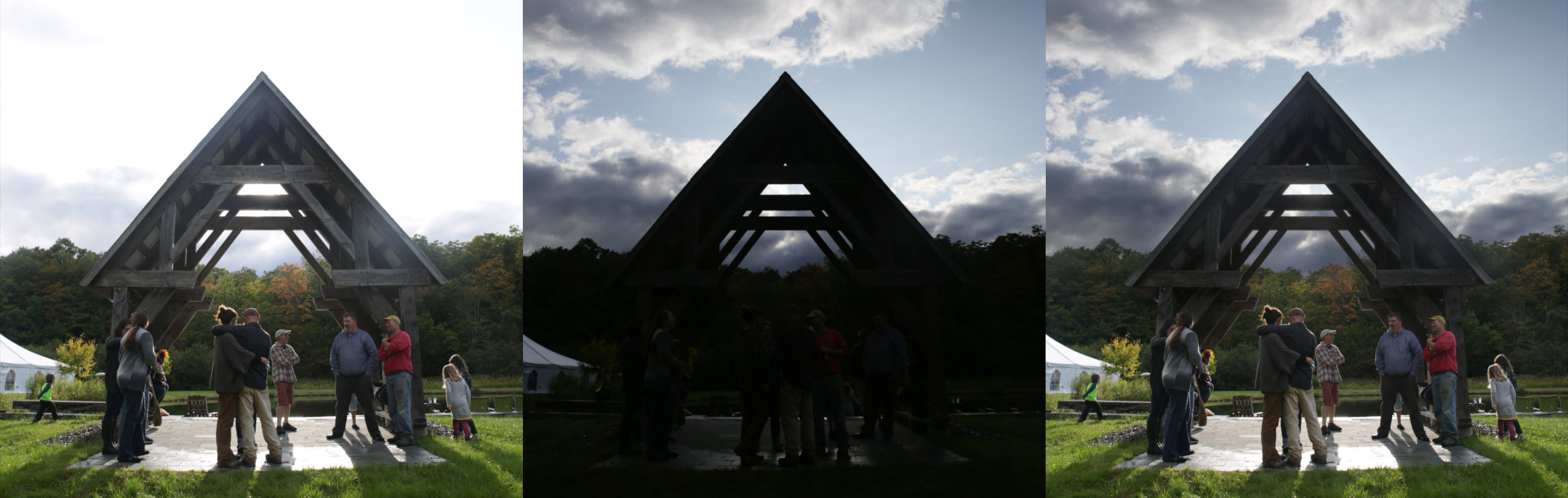
For example, here we have two images that will be used in this article where the image showing the foreground correctly causes the sky to blow out, while exposing for the sky causes the foreground to go almost black.
By selectively combining these two images, we can get something that might show a larger dynamic range than would have been possible in a single exposure:
This porridge is too hot, this porridge is too cold, but this porridge is just right.
This is one common use case scenario for creating HDR/EXR imaging (and tonemapping is the term for doing exactly what we’re describing here - squishing data into the viewable range in a way that we like).
In fact, at the end of this article I’ll show how Enfuse handled merging these image exposures (spoiler: pretty darn well).
Exposing
In exposing for the subjects in this image, I used the structure to block the sun from direct view (though there’s still a loss of contrast and flaring).
The straight out of the camera jpg looks like this:
Foreground exposure
This gave me a well exposed foreground and subjects.
I then gave the shutter speed a quick spin to 1⁄1000 (about 4-stops) to get the sky better exposed.
The camera jpg for the sky looked like this:
Sky exposure
In retrospect I probably would have been better to shoot for 2-stops difference to keep the sky exposed higher in the histogram, but c’est la vie.
It also helps to avoid going too far in the extremes when exposing, so as to avoid making it look too unrealistic (yes - the example above probably skirts that pretty close, but it’s exaggerated to make a good article).
This gives us a nice enough starting point to play with some simple exposure mapping.
Alignment
For this to work properly the images do need to line up as perfectly as possible.
Imperfect alignment can be worked around to some extent, usually determined by how complex your masking will have to be, but the better aligned the images are the easier your job will be.
As usual I have had good luck using the align_image_stack script that’s included as part of Hugin.
This makes short work of getting the images aligned properly for just this sort of work:
/path/to/hugin/align_image_stack -m -a OUT FILE1 FILE2
On Windows, this looks like:
c:\Program Files\Hugin\bin\align_image_stack.exe -m -a OUT FILE1 FILE2
Once it finishes up, you’ll end up with some new files like OUT0001.tif.
These are your aligned images that we’ll now bring into GIMP!
Masking
The heart of fusing these exposures is going to rely entirely on masking.
This is where it usually pays off nicely to take your time and consider carefully an approach that will keep things looking clean and with a natural transition between the exposures.
If this had simple geometry it would be an easy problem to solve, but the inclusion of the trees in the background makes it slightly more complex (but not nearly as bad as hair masking can get).
The foreground and sky are very simple things to mask overall, where we know we may want 100% of the foreground to come from one image, and 100% of the sky from another. This helps simplifies things greatly.
Rough mask (temporary - for reference only) where we can see we want all of the sky from one image, and all of the foreground from another.
I tend to keep the darker sky layer on the bottom and the lighter foreground layer above that.
The hard edges of the structure make it an easy masking job there, so the main area of concern here is getting a good blend with the treeline in the background.
There are a couple of approaches we can take to try and get a good blend, so let’s have a look…
Luminosity (Grayscale) Mask
A common approach would be to apply an inverted grayscale mask to the foreground layer.
If there’s a decent amount of contrast between the foreground/sky layers then this is a quick and easy way to get something to use as a base for further work:
Applying this mask yields pretty good looking results right away:
You can also investigate some of the other color channel options to see if there might be something that works better to create a clean mask with.
In GIMP 2.9.x I also found that using Colors > Components > Extract Component using CMYK Key produced another finely separated option.
This makes a nice starting point.
As we said we wanted all of the sky from one exposure and the rest of the image from the other exposure, we can start roughing in the overall mask.
For this simple walkthrough we can make our job a bit easier by using two copies of the foreground layer and selectively blending them over the sky layer.
Why Two Layers?
If you take your foreground layer and start cleaning up the mask for the sky by painting in black, it should be relatively easy.
Until you get down to the treeline.
You can use a soft-edged brush and try to blend in smoothly, but in order to let the sky come through nicely you may find yourself getting more of the dark exposure trees showing through.
This will show as a dark halo on the tops of the trees:
A nice way to adjust the falloff along the tops of the trees is by using a second copy of the foreground layer, and using a gradient on the mask that will blend smoothly from full sky to full foreground along the tops of the trees.
This will ease the dark halo a bit until the transition looks good to you.
You can then modify/update the gradient on the copy until the transition is smooth or to your liking.
At this point my layers would look like this in GIMP:
The results of using a second fore layer with a gradient to help ease the transition:
Top: Original grayscale mask only
Middle: Manual mask painting down to treeline
Bottom: Second layer with gradient mask
When pixel-peeping it may not seem perfect, but in the context of the entire image it’s a nice way to get an easy blend for not too much extra work.
Left: Grayscale mask, Right: final mask with gradient
At this point most of the exposure is blended nicely.
The only place in this particular image I would work some more would be to darken the structure a little bit to lessen the flaring and maybe bring back a little darkness.
This can be accomplished by painting over the top mask.
I used black with a smaller opacity of around 25% to paint over the structure and allow the darker version underneath to show through a bit more:
Left: gradient masked, Right: structure darkened slightly to taste
Enfuse Comparison
I have previously used Enfuse and gotten great results even more quickly.
For comparison here is the result of running Enfuse against the same images:
I prefer our manually blended result personally, but I could see another future article or post about using the Enfuse blend for areas of complexity and blending the Enfuse output into the final image to help.
Might be interesting.
(I prefer our blended result because Enfuse considered extremely bright areas as candidates for fusion with the other exposure - so the bricks and tent highlights got pushed down automatically.)
Fin
From here any further fiddling with the image is purely for fun.
The two versions of the image have been merged nicely.
If you wanted to adjust the result to not appear quite as extreme you could modify each of the layers to taste.
For instance, you could lighten the sky layer to decrease the extreme range difference between it and the foreground layer.
Where’s the fun in keeping it too realistic though? :)
For reference, here’s my final version after masking with a bit of a Portra tone thrown in for good measure:
Not bad for a relatively quick approach.
Resources
This wouldn’t be complete with some resources and further reading for folks!
I have saved the GIMP 2.9.x .XCF file I used to write this.
It has all of the masks and layers I used to create the final version of the image:
With Stig Abell and Thea Lenarduzzi – Who reads Anthony Powell now? A. N. Wilson celebrates the muted comedy of a British novelist best-known (only known?) for his twelve-novel sequence A Dance to the Music of Time; TLS Fiction editor Toby Lichtig talks to the novelist and essayist Geoff Dyer at the 2017 Hay Festival in Arequipa, Peru; Imogen Russell Williams rounds up the brightest and most inspiring new children's books
With Stig Abell and Thea Lenarduzzi – 500-plus years since Thomas More coined the term “Utopia”, denoting a too-good-to-be-true land, Chloë Houston considers the relevance, and importance, of Utopian thinking, and asks if we feel more at home in dystopia; prompted by a magisterial new biography by Jonathan Eig, J. Michael Lennon describes the transformation of Cassius Clay into Muhammad Ali (and tells us what it was like to meet Ali at Normal Mailer’s seventy-fifth birthday party); TLS editor Lucy Dallas speaks to the novelist Nick Harkaway, no stranger to grim (not necessarily) alternative realities, about his new novel Gnomon
This is becoming a sort of tradition for me to post something giving thanks around this holiday.
I think it’s because this community has become such a large part of my life (even if I don’t have nearly as much time to spend on it as I’d like).
Also, I think it helps to remind ourselves once in a while of the good things that happen to us. So in that spirit…
I want to start things off by acknowledging those that go the extra mile and help offset the costs of the infrastructure to keep this crazy ship afloat (sorry, I’m an ocean engineer by training and a sailor - so nautical metaphors abound!).
Once again the amazing Dimitrios Psychogios has graciously covered our server expenses (and then some) for another full year.
On behalf of the community, and particularly myself, thank you so much!
Your generosity will cover infrastructure costs for the year and give us room to grow as the community does.
We also have some awesome folks who support us through monthly donations (which are nice because we can plan better if we need to). Together they cover the costs of data storage + transfer in/out of Amazon AWS S3 storage (basically the storage and transfer of all of the attachments and files in the forums).
So thank you, you cool froods, you really know where your towels are:
Thank you all!
If you happen to see any of these great folks around the forum consider taking a moment to thank them for their generosity!
If you’d like to join them in supporting the site financially, check out the support page.
The community has just been amazing, and we’ve seen nice growth this past year.
Since the end of August we’ve seen about a 50% increase in weekly sessions on discuss.
We’re currently hovering around 2,500 daily pageviews on the forums:
We’ve added almost 950 new users, or almost 3 new users every day!
I figure @LebedevRI will yell at me if I forget to mention raw.pixls.us (RPU) again.
Back in January @andabata built a new site to help pick up the work of the old rawsamples.ch website to collect raw sample files for testing.
So thank you @andabata and @LebedevRI for your work on this!
A big thank you to everyone who has taken the time to check the site and upload missing (or non-freely licensed) raw files to include!
While we’re talking about RPU, please consider having a look at this post about it on discuss and take a few minutes to see if you might be able to contribute by providing raw samples that we are missing or need (see the post for more details).
If you don’t have something we need, please consider sharing the post on social media to help us raise awareness of RPU!
Thank you!
If you’re not aware of it, one of the things we try to do here beside run the site and forum is to assist projects with websites and design work if they want it.
Earlier this year the digiKam team needed to migrate their old Drupal website to something more modern (and secure) and @paperdigits figured, “why not”?
So we rolled up our sleeves and got them setup with a newly designed static website built using Hugo (which was completely new to me).
We were also able to manage their comments on the website for them by embedding topics from right here on discuss.
This way their users can still own their comments and we can manage spam and moderate things for them.
The best part, though, is the addition of their users and knowledge to the community!
I want to personally take a moment to thank @darix for all the work he does keeping things running smoothly here.
If you don’t see him, it means all the work he’s doing is paying off.
I speak with him daily and see firsthand the great work he’s doing to make sure all of us have a nice place to call home.
Thank you so much, @darix!
As usual @paperdigits (https://silentumbrella.com) also has a great attitude and pro-active approach to the community which I am super thankful for.
He also does things that aren’t always visible, but are essential to keeping things running smoothly, like moderating the forum, checking the health of sites we are helping to manage, and writing/editing posts.
I can’t stress enough how much it helps to keep your interest and spirits engaged in the community when you have someone else around who’s so positive and helpful. Thank you so much, @paperdigits!
At the end of the day this is a community, and it’s vibrancy and health is a direct result of all of you, its members.
So above all else this is by far the thing I am most thankful for - getting to meet, learn, and interact with all of you.
O artista Hélio Ziskind fala sobre o processo de criação da musica Chuva, chuvisco e chuvarada e fala qual foi a inspiração para compor essa canção.
Conheça a nova versão de Chuva, Chuvisco, Chuvara: https://goo.gl/LxNHKH
This week we're joined by TLS editors Lucy Dallas and Toby Lichtig to pick through the "books of the year", as nominated by a roster of TLS contributors, including Lydia Davis, Hilary Mantel, William Boyd and Tom Stoppard; plus, we bite the literary bullet and share our own nominations, from Reni Eddo-Lodge's account of entrenched racism to Laurent Binet's riotous fictional homage to Roland Barthes
We're joined this week by the TLS's Classics editor Mary Beard to discuss Emily Wilson's new translation of the Odyssey – the first ever by a woman – as well as other issues surrounding women in Classics and women in power more generally; Andrew Motion considers the life of the editor Edward Garnett, “one of the great taste-makers of the twentieth century”; and finally, could you name anything by Dorothy Dunnett? Rohan Maitzen fills us in on The Lymond Chronicles, the most rollicking historical novels you might never have heard of
Conheça o novo canal do Hélio Ziskind, o ZiS: http://goo.gl/j9YhRn
Parlendas são clássicos da cultura brasileira. As letras não têm significação, feitas para brincar por brincar. O Hélio conta um pouco sobre a cantiga de roda Onça-Pintada e o mundo de brincadeira dos pequenos com as palavras!
With Toby Lichtig and Lucy Dallas – London has a brand-new theatre: the Bridge, the latest venture by Nicholas Hytner and Nick Starr, based in Southwark and dedicated to original writing. And it starts its life with a new play by Richard Bean and Clive Young: Young Marx features Rory Kinnear as a delinquent Karl Marx, with a dash of Monty Python thrown in. The TLS’s Michael Caines joins us in the studio to discuss it; The “common view” of atheists is that religion is a combination of cosmology (a theory of the universe) and morality (or how best to behave) – but for the TLS’s Philosophy Editor Tim Crane this conception seems “deeply inadequate”. Crane identifies a third category, too often ignored: religious practice itself. He joins us on the line to discuss the religion of belonging, along with this week’s other philosophy pieces; The Austrian author Marianne Fritz was hailed in the late 1970s as a literary wunderkind, for a debut novel that described the descent into madness of a young mother in post-war Vienna. But as the decades progressed, her work grew increasingly obscure: brilliant for some, maddening for others. Jane Yager offers her insights into the author often dubbed, perhaps unfairly, “the female James Joyce”.
Conheça a nova versão de Banho é Bom (Ratinho Tomando Banho) no novo projeto do Hélio Ziskind, o ZiS: https://goo.gl/ADpdCo
Ratinho Tomando Banho ou Banho é Bom? Com certeza você já cantou essa música no chuveiro, mas qual é o nome certo? Hélio Ziskind fala sobre o nome da música que é um dos seus grandes sucessos!

 Login
Login