Ada Lovelace: tech prophet and trophy wife
Hosted on Acast. See acast.com/privacy for more information.

Hosted on Acast. See acast.com/privacy for more information.
The IMAGE team of the GREYC laboratory (UMR CNRS 6072, Caen, France) is pleased to announce the release of a new 2.2 version of G’MIC, its open-source, generic, and extensible framework for image processing. As we already did in the past, we take this opportunity to look at the latest notable features added since the previous major release (2.0, last June).
Note 1: click on a picture to view a larger version. Note 2: This is a translation of an original article, in French, published on Linuxfr.
G’MIC is a free and open-source software developed since August 2008 (distributed under the CeCILL license), by folks in the IMAGE team at the GREYC, a French public research laboratory located in Caen and supervised by three institutions: the CNRS, the University of Caen, and the ENSICAEN engineering school. This team is made up of researchers and lecturers specialized in the fields of algorithms and mathematics for image processing. As one of the main developer of G’MIC, I wanted to sum up the work we’ve made on this software during these last months.
G’MIC is multi-platform (GNU/Linux, MacOS, Windows …) and provides many ways of manipulating generic image data, i.e. still images or image sequences acquired as hyperspectral 2D or 3D floating-point arrays (including usual color images). More than 950 different image processing functions are already available in the G’MIC framework, this number being expandable through the use of the G’MIC scripting capabilities.
Since the last major version release there have been two important events in the project life:
When we released version 2.0 of G’MIC a few months ago, we were happy to announce a complete rewrite (in Qt) of the plugin code for GIMP. An extra step has been taken, since this plugin has been extended to fit into the open-source digital painting software Krita.

This has been made possible thanks to the development work of Boudewijn Rempt (maintainer of Krita) and Sébastien Fourey (developer of the plugin). The G’MIC-Qt plugin is now available for Krita versions 3.3+ and, although it does not yet implement all the I/O functionality of its GIMP counterpart, the feedback we’ve had so far is rather positive.
This new port replaces the old G’MIC plugin for Krita which has not been maintained for some time. The good news for Krita users (and developers) is that they now have an up-to-date plugin whose code is common with the one running in GIMP and for which we will be able to ensure the maintenance and further developments.
Note this port required the writing of a source file host_krita.cpp (in C++) implementing the communication between the host software and the plugin, and it is reasonable to think that a similar effort would allow other programs to get their own version of the G’MIC plugin (and the 500 image filters that come with it!).
Another major event concerns the new license of use : The CeCILL-C license (that is in the spirit of the LGPL) is now available for some components of the G’MIC framework. This license is more permissive than the previously proposed CeCILL license (which is GPL-compatible) and is more suitable for the distribution of software libraries. This license extension (now double licensing) applies precisely to the core files of G’MIC, i.e. its C++ library libgmic. Thus, the integration of the libgmic features (therefore, all G’MIC image filters) is now allowed in software that are not themselves licensed under GPL/CeCILL (including closed source products).
The source code of the G’MIC-Qt plugin, meanwhile, remains distributed under the single CeCILL license (GPL-like).
If you’ve followed us for a while, you may have noticed that we very often refer to the work of illustrator David Revoy for his multiple contributions to G’MIC: mascot design, ideas of filters, articles or video tutorials, tests of all kinds, etc. More generally, David is a major contributor to the world of free digital art, as much with the comic Pepper & Carrot he produces (distributed under free license CC -BY), as with his suggestions and ongoing bug reports for the open-source software he uses. Therefore, it seems quite natural to devote a special section to him in this article, summarizing the different ideas, contributions and experiments he has brought to G’MIC just recently. A big thank you, David for your availability, the sharing of your ideas, and for all your work in general!
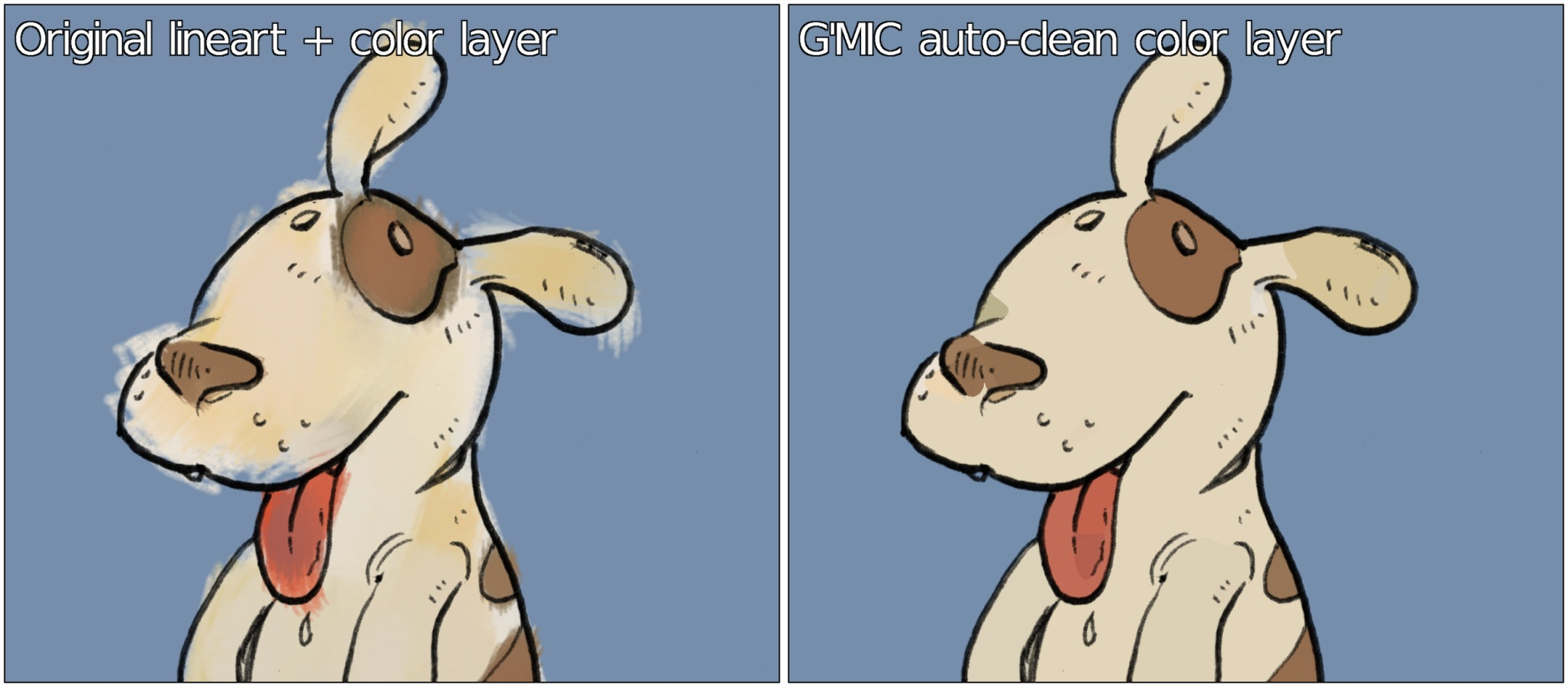
Let’s first mention the progress made on the Black & White / Colorize lineart (smart-coloring) filter that had appeared at the time of the 2.0 G’MIC release. This filter is basically a lineart colorization assistant which was developed in collaboration with David. It tries to automatically generate a colorization layer for a given lineart, from the analysis of the contours and the geometry of that lineart. Following David‘s suggestions, we were able to add a new colorization mode, named “Autoclean“. The idea is to try to automatically “clean” a coloring layer (made roughly by the user) provided in addition to the lineart layer, using the same geometric analysis as for the previous colorization modes. The use of this new mode is illustrated below, where a given lineart (left) has been colorized approximately by the user. From the two layers line art + color layer, our “Autoclean“ algorithm generates an image (right), where the colors do not overflow the lineart contours (even for “virtual” contours that are not closed). The result is not always perfect, but nevertheless reduces the time spent in the tedious process of colorization.
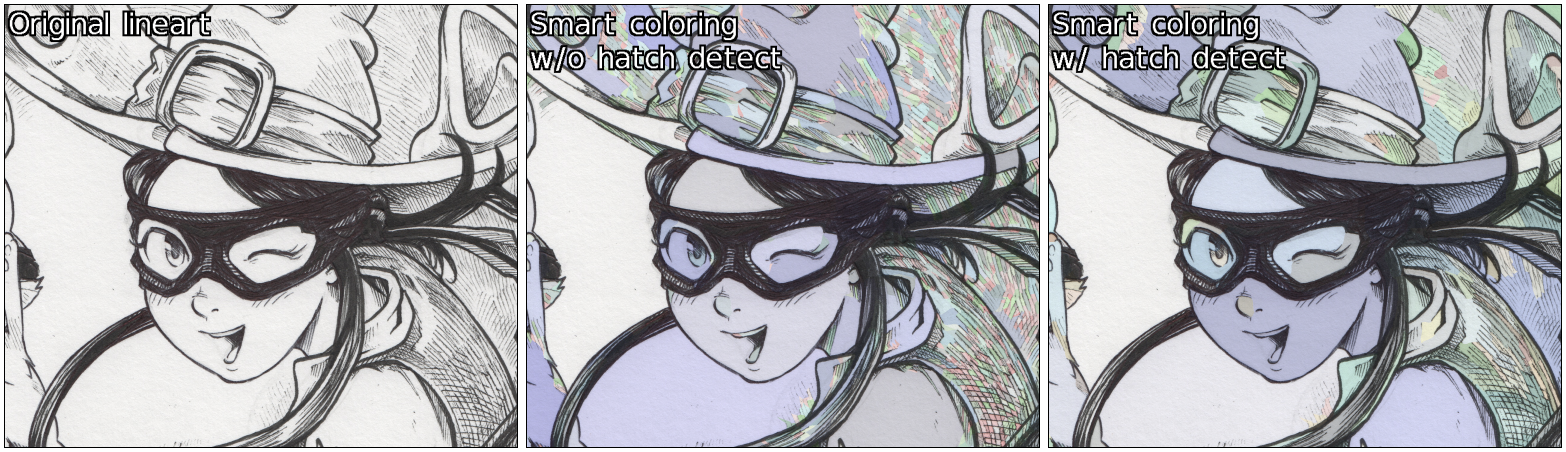
Note that this filter is also equipped with a new hatch detection module, which makes it possible to avoid generating too many small areas when using the previously available random colorization mode, particularly when the input lineart contains a large number of hatches (see figure below).
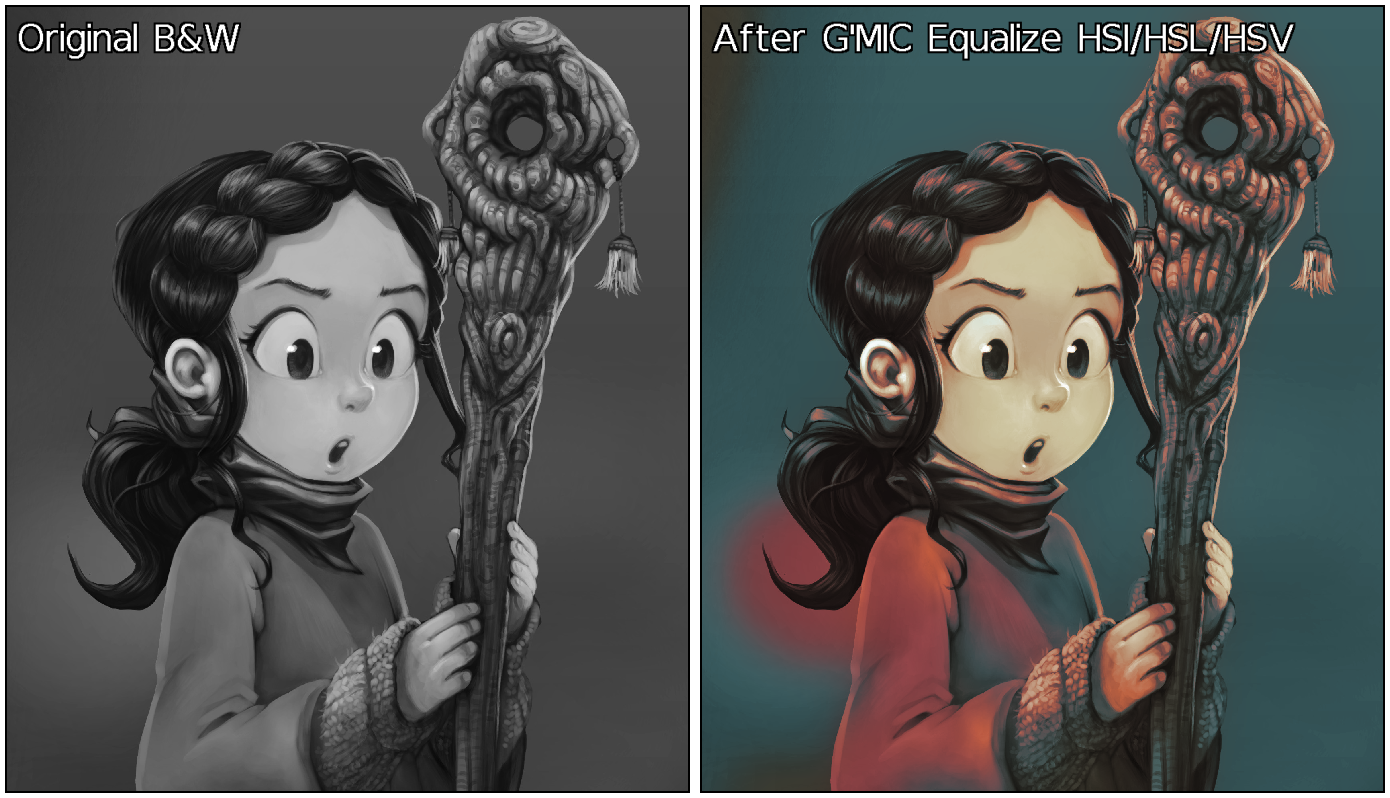
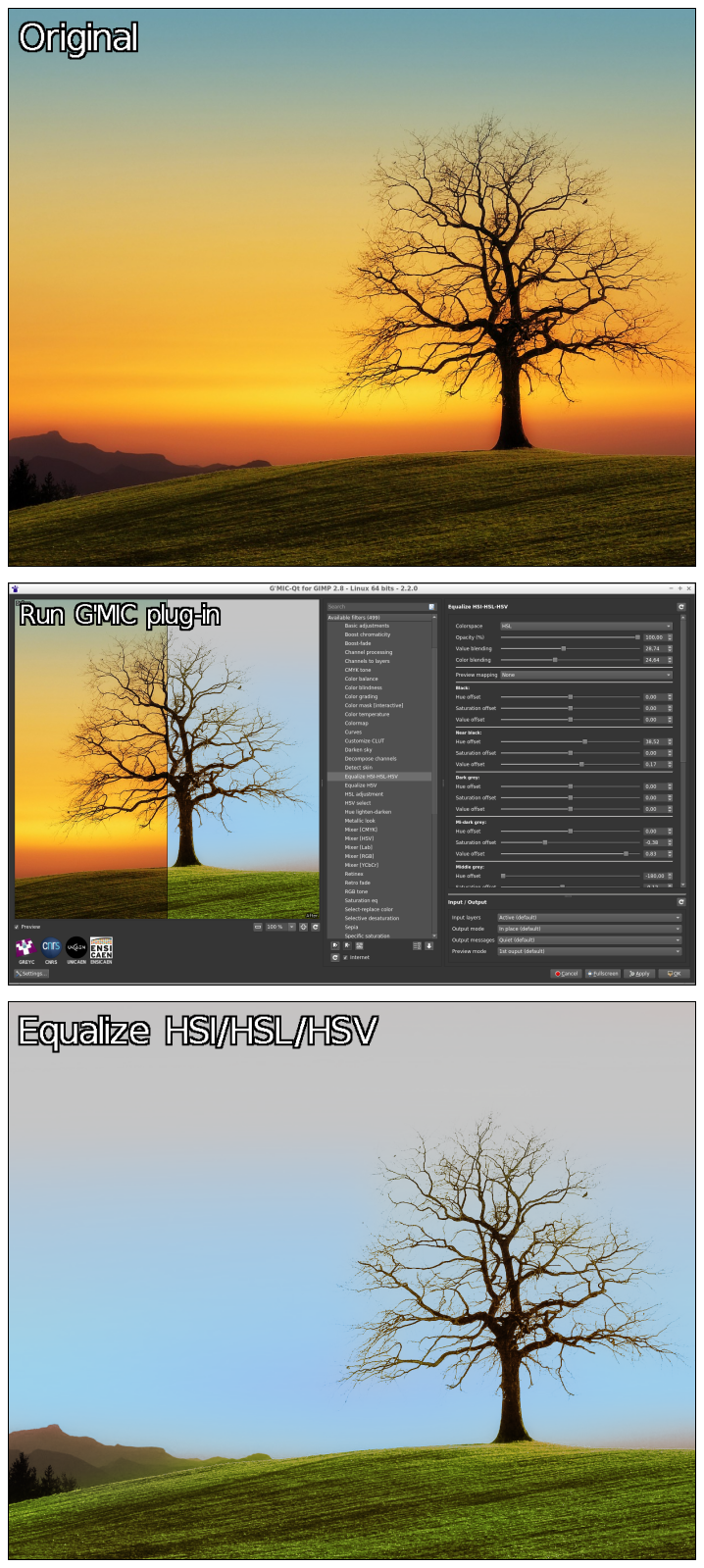
More recently, David suggested the idea of a filter to separately vary the hue and saturation of colors having certain levels of luminosity. The underlying idea is to give the artist the ability to draw or paint digitally using only grayscale, then colorize his masterpiece afterwards by re-assigning specific colors to the different gray values of the image. The obtained result has of course a limited color range, but the overall color mood is already in place. The artist only has to retouch the colors locally rather than having to colorize the entire painting by hand. The figure below illustrates the use of this new filter Colors/Equalize HSI/HSL/HSV available in the G’MIC plugin : each category of values can be finely adjusted, resulting in preliminary colorizations of black and white paintings.
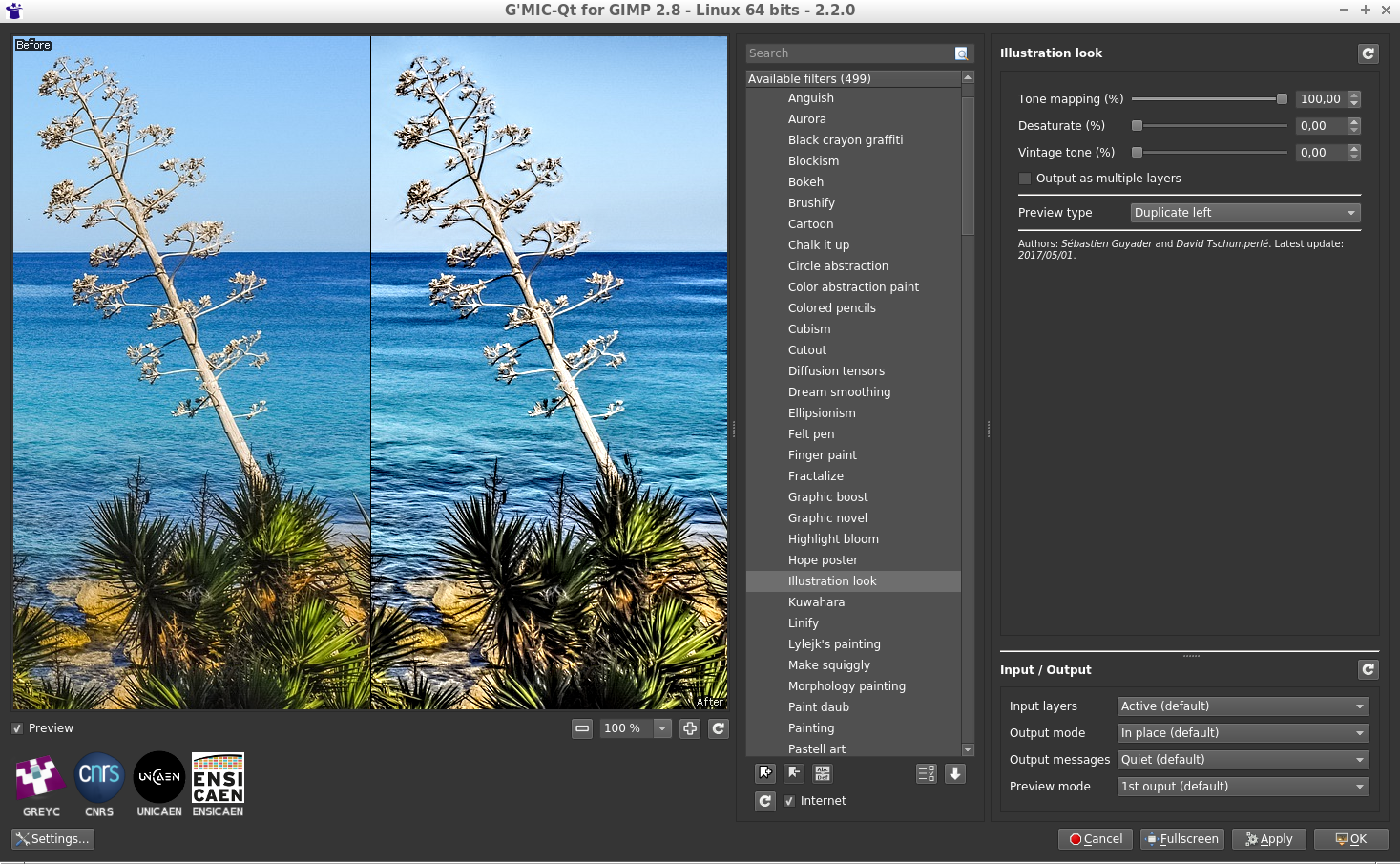
Note that the effect is equivalent to applying a color gradient to the different gray values of the image. This is something that could already be done quite easily in GIMP. But the main interest here is we can ensure that the pixel brightness remains unchanged during the color transformation, which is not an obvious property to preserve when using a gradient map. What is nice about this filter is that it can apply to color photographs as well. You can change the hue and saturation of colors with a certain brightness, with an effect that can sometimes be surprising, like with the landscape photography shown below.
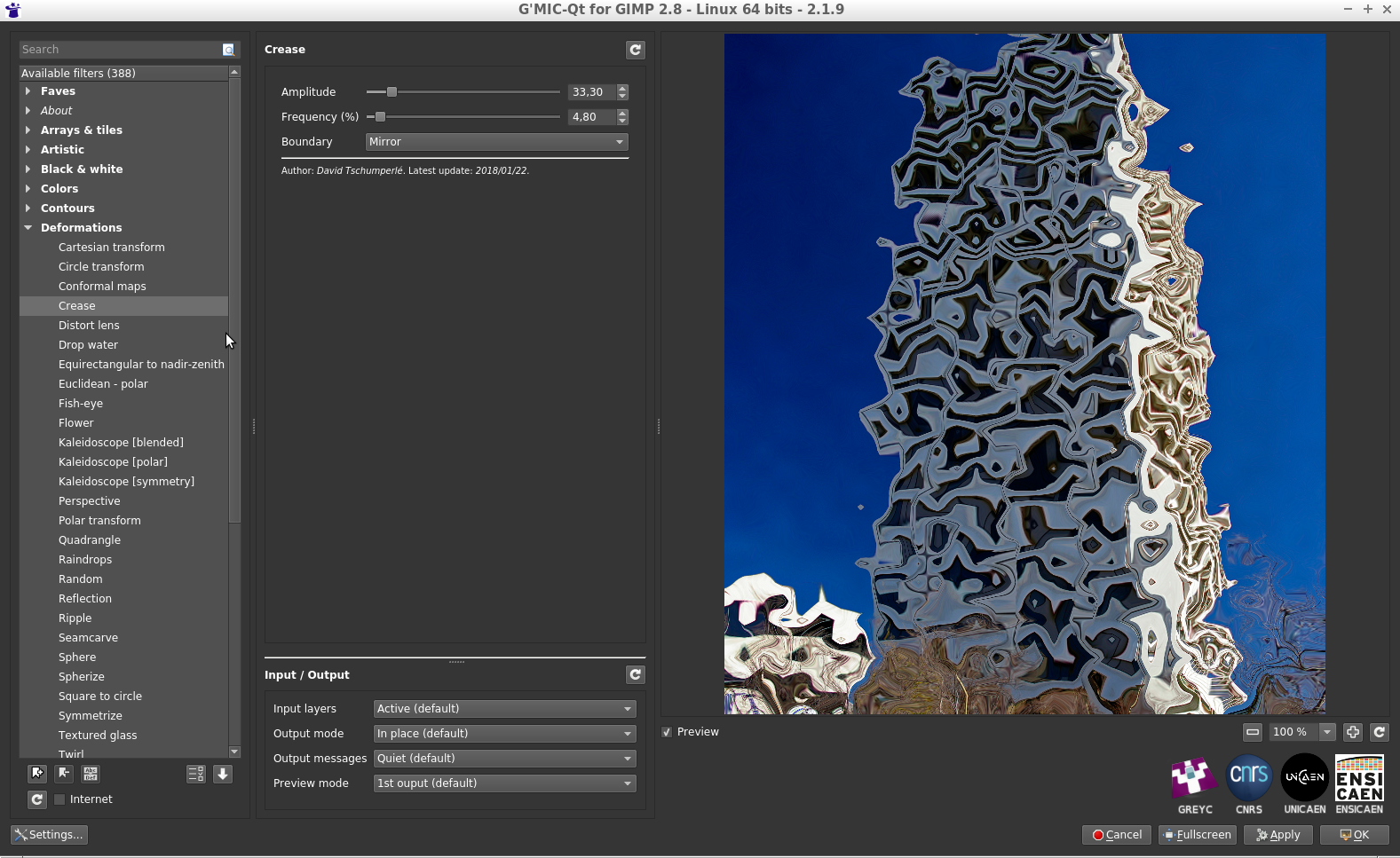
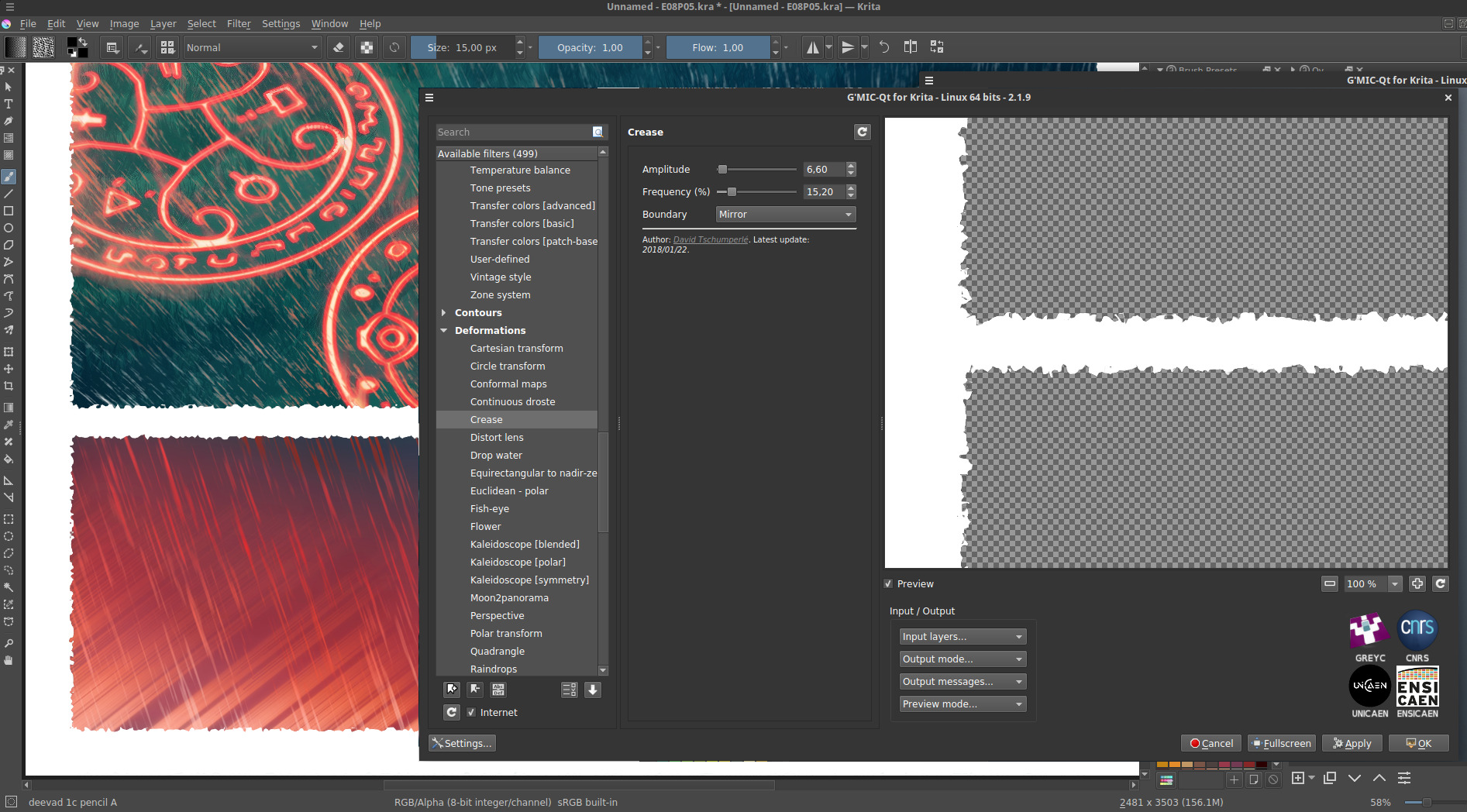
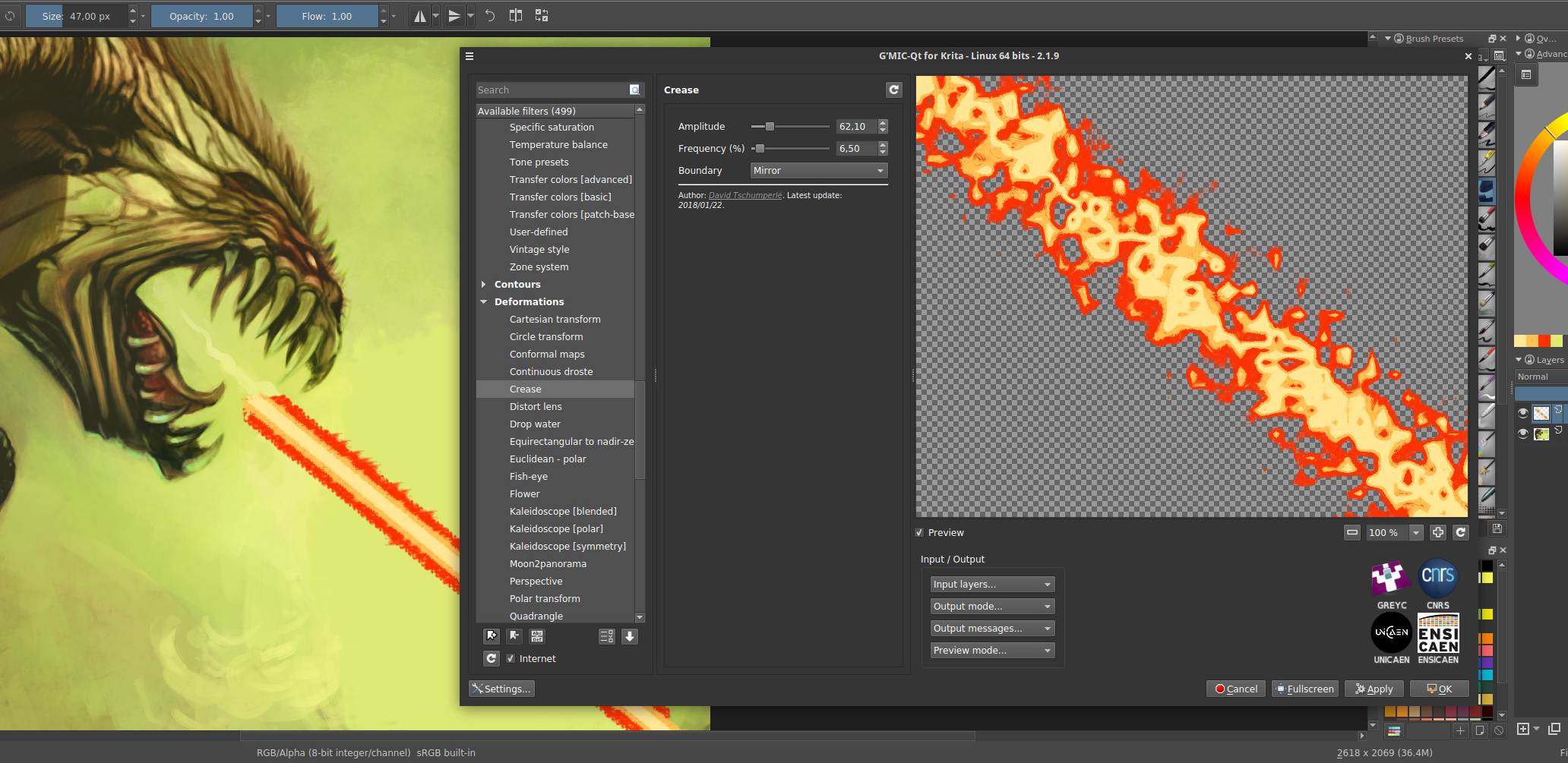
Another one of the David‘s ideas concerned the development of a random local deformation filter, having the ability to generate angular deformations. From an algorithmic point of view, it seemed relatively simple to achieve. Note that once the implementation has been done (in concise style: 12 lines!) and pushed into the official filter updates, David just had to press the “Update Filters“ button of his G’MIC-Qt plug-in, and the new effect Deformations/Crease was there immediately for testing. This is one of the practical side of developing new filters using the G’MIC script language!
However, I must admit I didn’t really have an idea on what this could be useful for in practice. But the good thing about cooperating with David is that HE knows exactly what he’s going to do with it! For instance, to give a crispy look to the edges of his comics, or for improving the render of his alien death ray.
David Revoy is not the only user of G’MIC: we sometimes count up to 900 daily downloads from the main project website. So it happens, of course, that other enthusiastic users inspire us new effects, especially during those lovely discussions that take place on our forum, kindly made available by the PIXLS.US community.
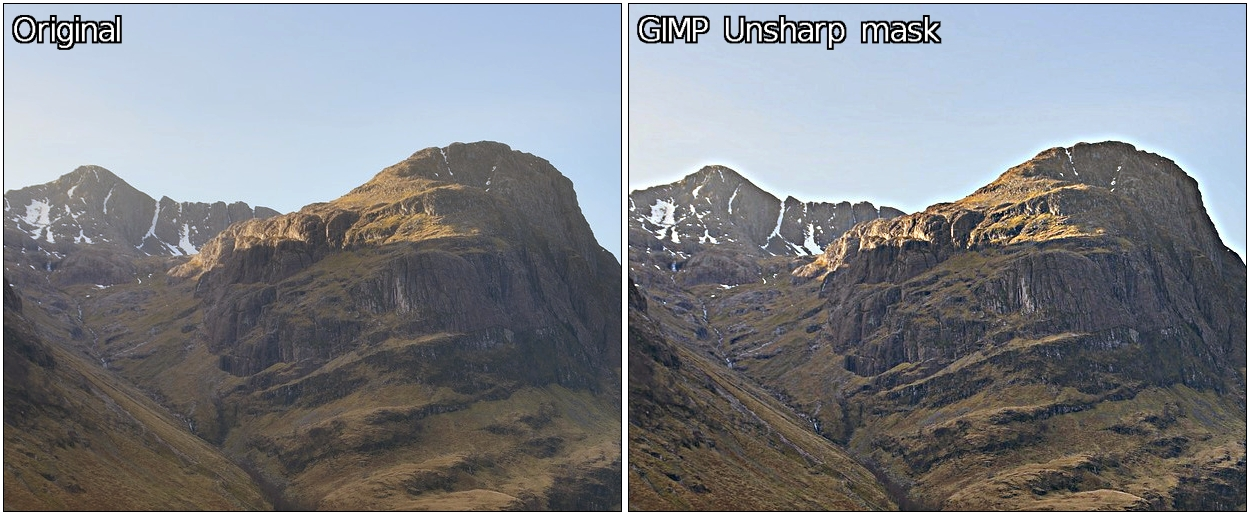
Many photographers will tell you that it is not always easy to enhance the details in digital photographs without creating naughty artifacts that often have to be masked manually afterwards. Conventional contrast enhancement algorithms are most often based on increasing the local variance of pixel lightness, or on the equalization of their local histograms. Unfortunately, these operations are generally done by considering neighborhoods with a fixed size and geometry, where each pixel of a neighborhood is always considered with the same weight in the statistical calculations related to these algorithms. It is simpler and faster, but from a qualitative point of view it is not an excellent idea: we often get “halos” around contours that were already very contrasted in the image. This classic phenomenon is illustrated below with the application of the Unsharp mask filter (the one present by default in GIMP) on a part of a landscape image. This generates an undesirable “halo” effect at the frontier between the mountain and the sky (this is particularly visible in full resolution images).
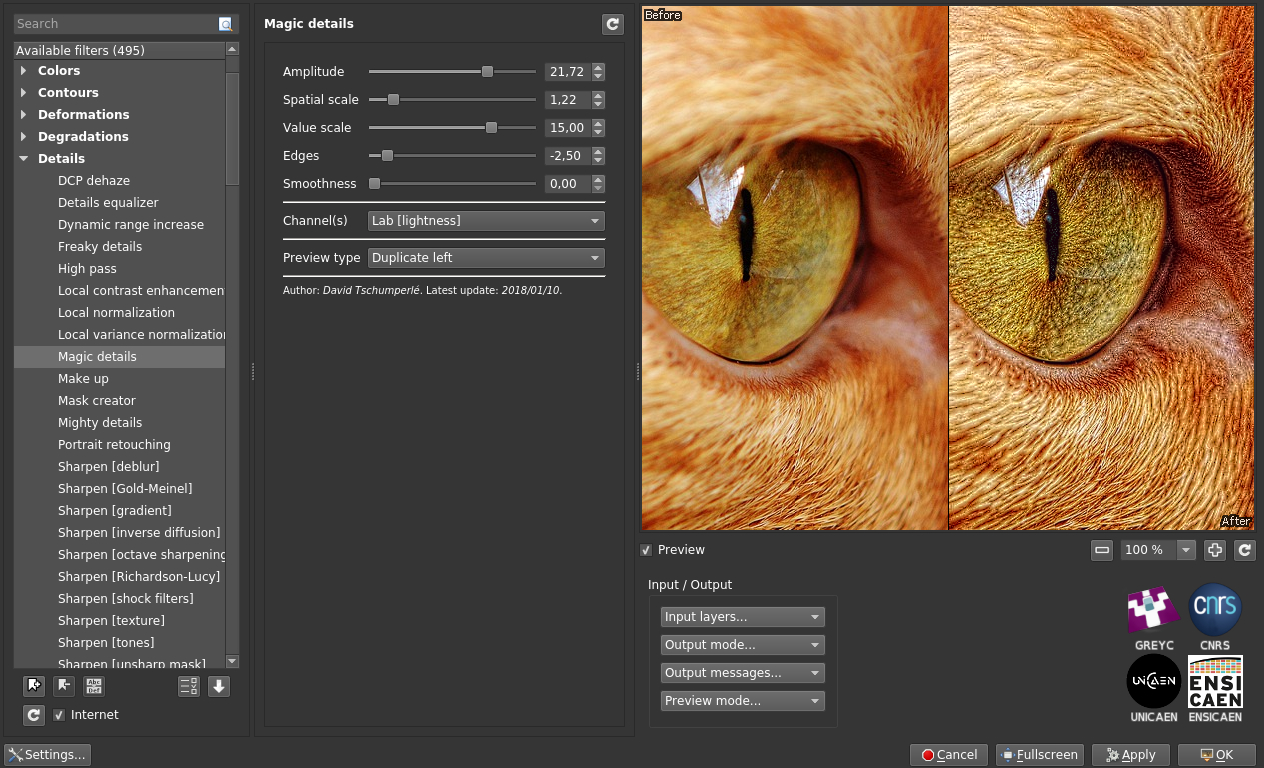
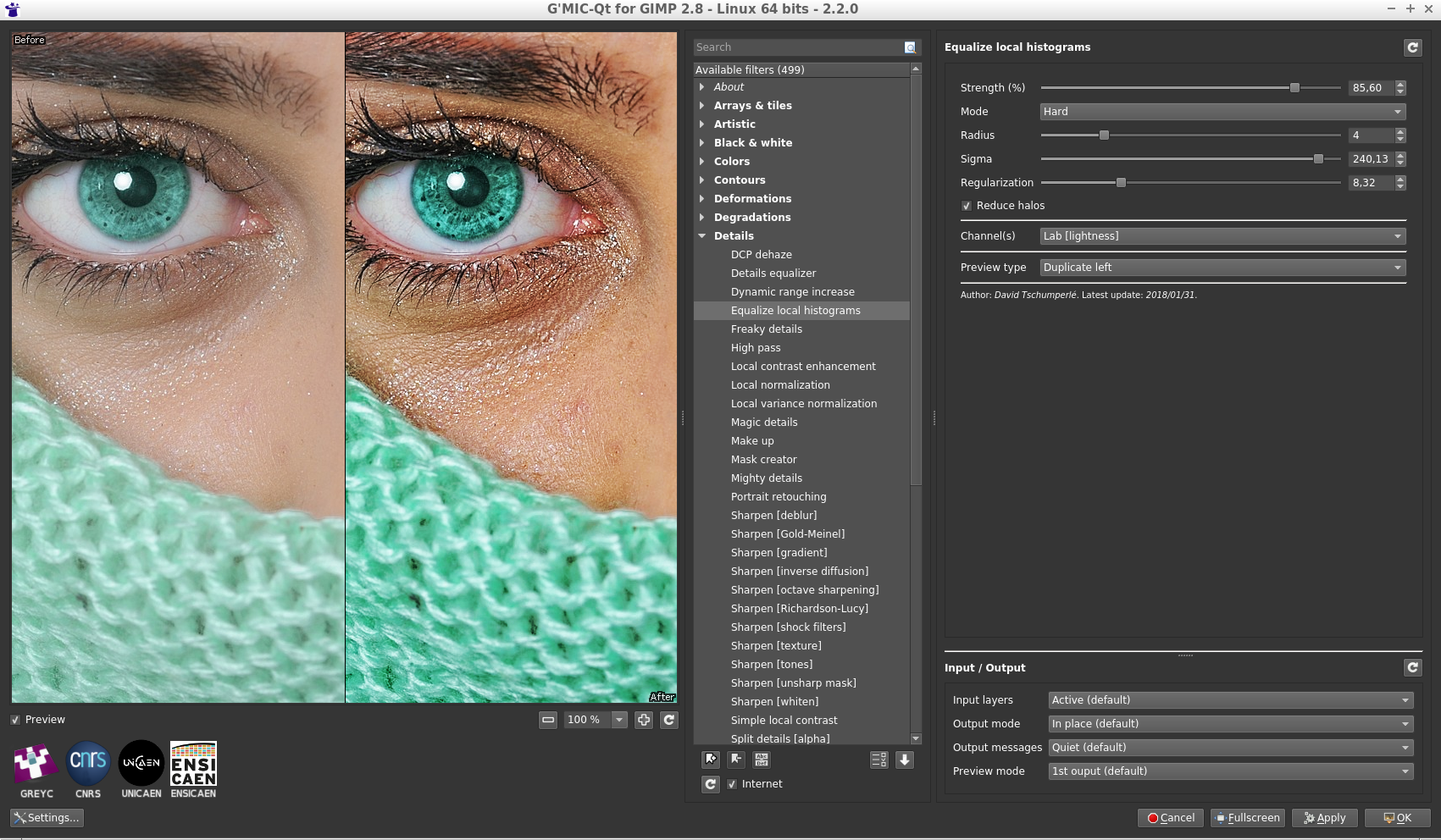
The challenge of the detail enhancement algorithms is to be able to analyze the geometry of the local image structures in a more fine way, to take into account geometry-adaptive local weights for each pixel of a given neighborhood. To make it simple, we want to create anisotropic versions of the usual enhancement methods, orienting them by the edges detected in the images. Following this logic, we have added two new G’MIC filters recently, namely Details/Magic details and Details/Equalize local histograms, which try to better take the geometric content of the image into account for local detail enhancement (e.g. using the bilateral filter).
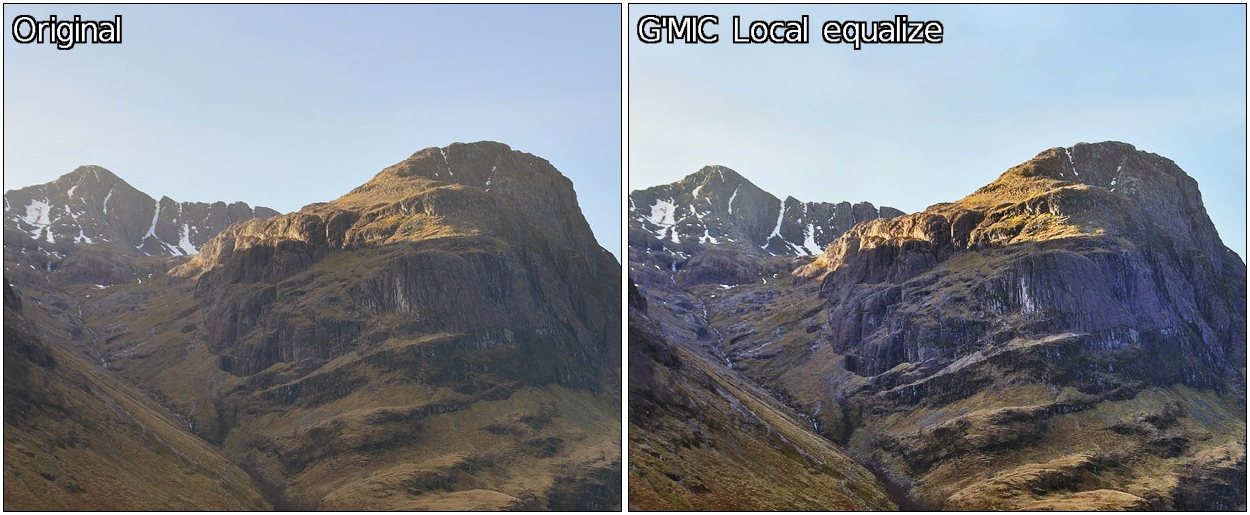
Thus, the application of the new G’MIC local histogram equalization on the landscape image shown before gives something slightly different : a more contrasted result both in geometric details and colors, and reduced halos.
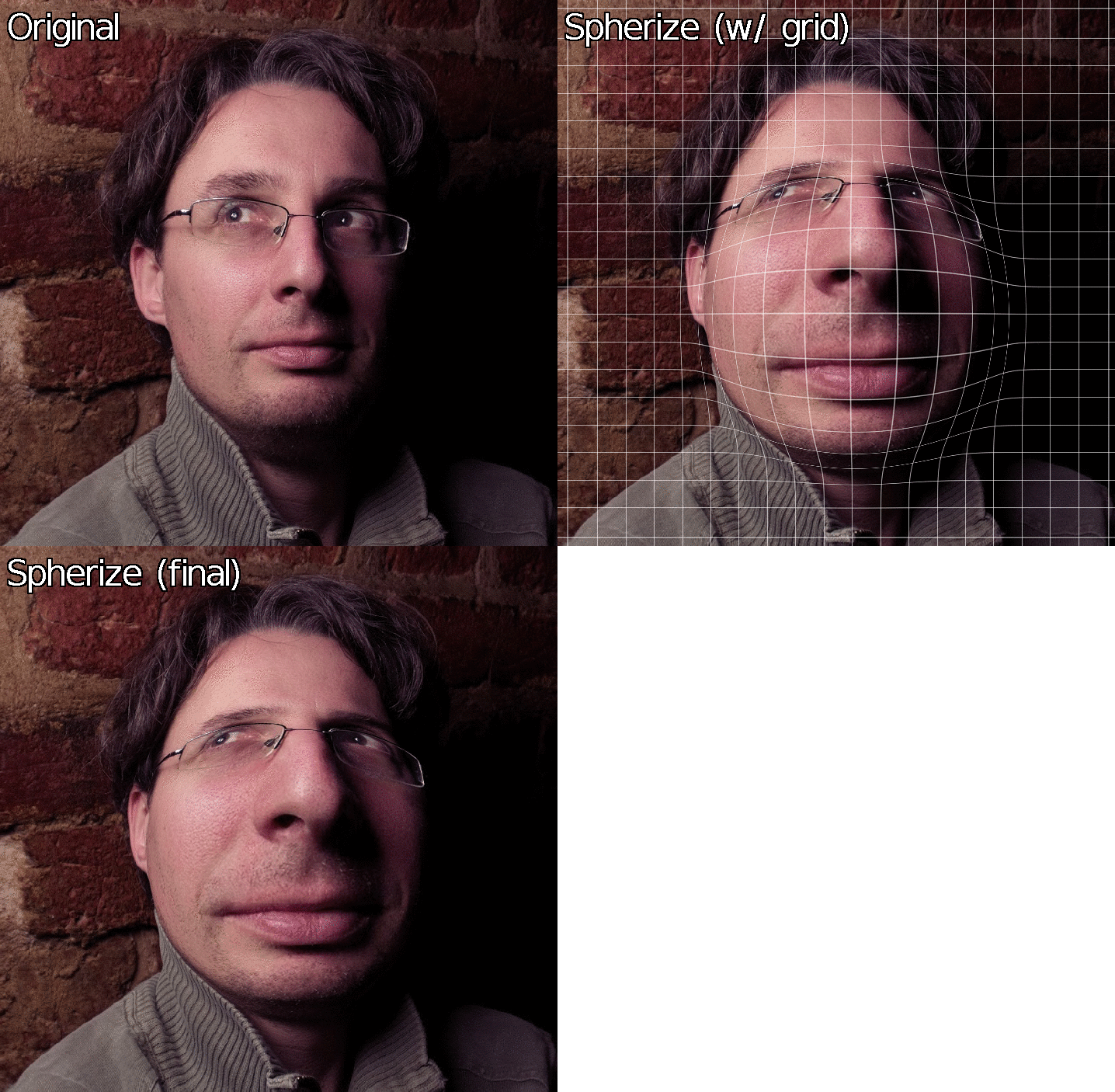
New filters to apply geometric deformations on images are added to G’MIC on a regular basis, and this new major version 2.2 offers therefore a bunch of new deformation filters. So let’s start with Deformations/Spherize, a filter which allows to locally distort an image to give the impression that it is projected on a 3D sphere or ellipsoid. This is the perfect filter to turn your obnoxious office colleague into a Mr. Potato Head!
On the other hand, the filter Deformations/Square to circle implements the direct and inverse transformations from a square domain (or rectangle) to a disk (as mathematically described on this page), which makes it possible to generate this type of deformations.
The effect Degradations/Streak replaces an image area masked by the user (filled with a constant color) with one or more copies of a neighboring area. It works mainly as the GIMP clone tool but prevents the user to fill the entire mask manually.
You might say that image deformations are nice, but sometimes you want to transform an image in a more radical way. Let’s introduce now the new effects that turn an image into a more abstract version (simplification and re-rendering). These filters have in common the analysis of the local image geometry, followed by a step of image synthesis.
For example, G’MIC filter Contours/Super-pixels locally gathers the image pixels with the same color to form a partitioned image, like a puzzle, with geometric shapes that stick to the contours. This partition is obtained using the SLIC method (Simple Linear Iterative Clustering), a classic image partitioning algorithm, which has the advantage of being relatively fast to compute.
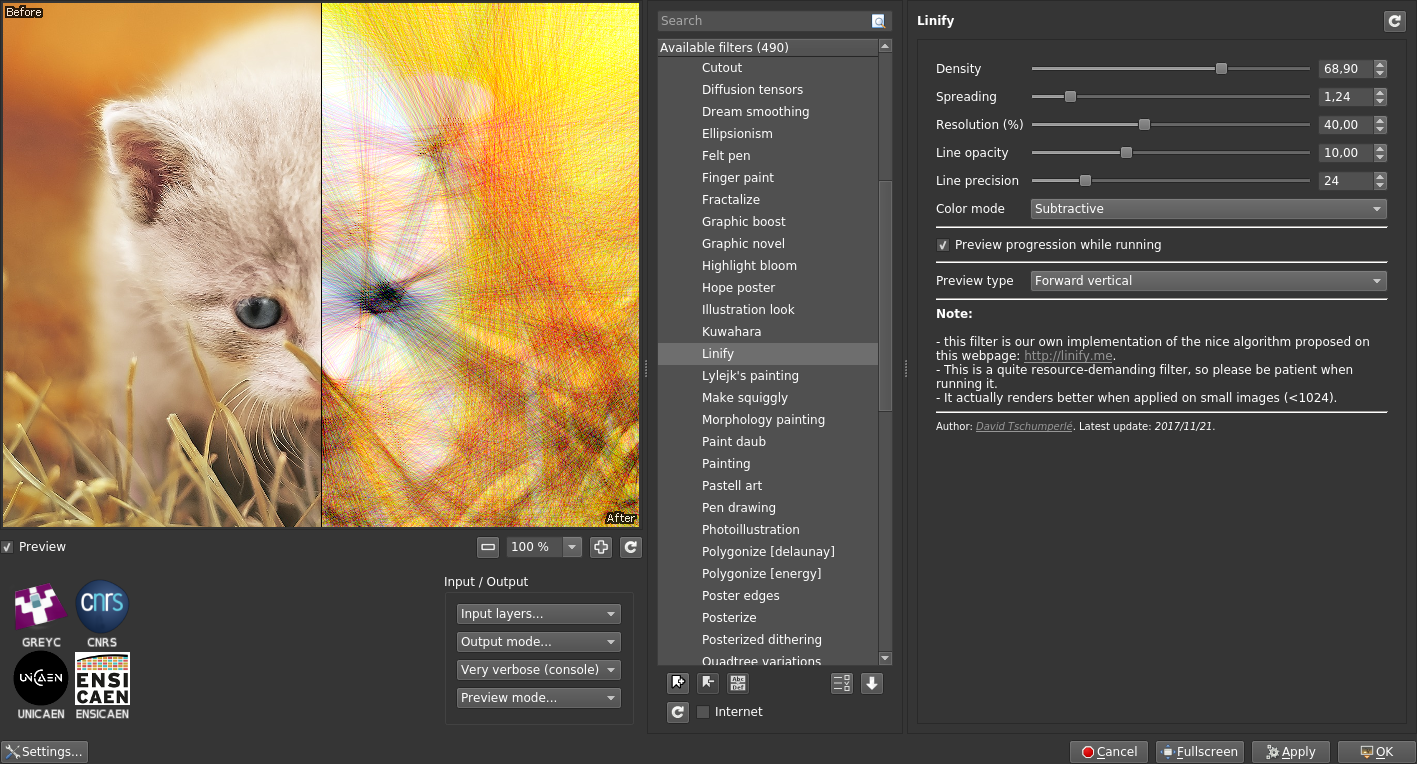
The filter Artistic/Linify tries to redraw an input image by superimposing semi-transparent colored lines on an initially white canvas, as shown in the figure below. This effect is the re-implementation of the smart algorithm initially proposed on the site http://linify.me (initially implemented in JavaScript).
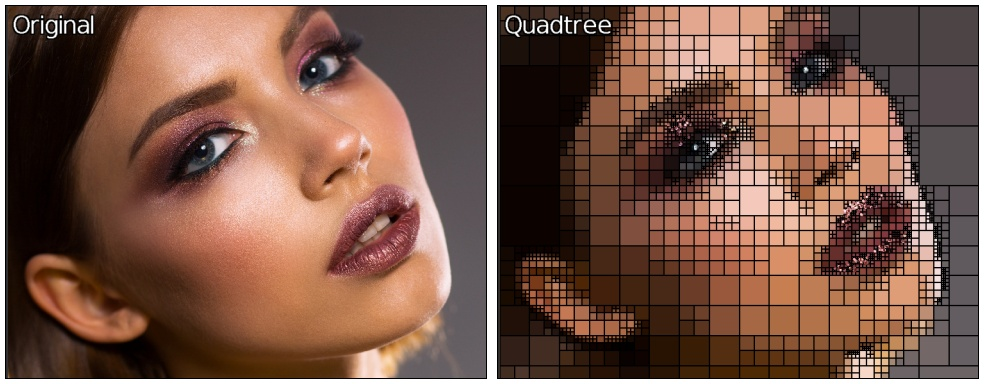
The effect Artistic/Quadtree variations first decomposes an image as a quadtree, then re-synthesize it by drawing oriented and plain ellipses on a canvas, one ellipse for each quadtree leaf. This renders a rather interesting “painting” effect. It is likely that with more complex shapes, even more attractive renderings could be synthesized. Surely an idea to keep in mind for the next filters update :)
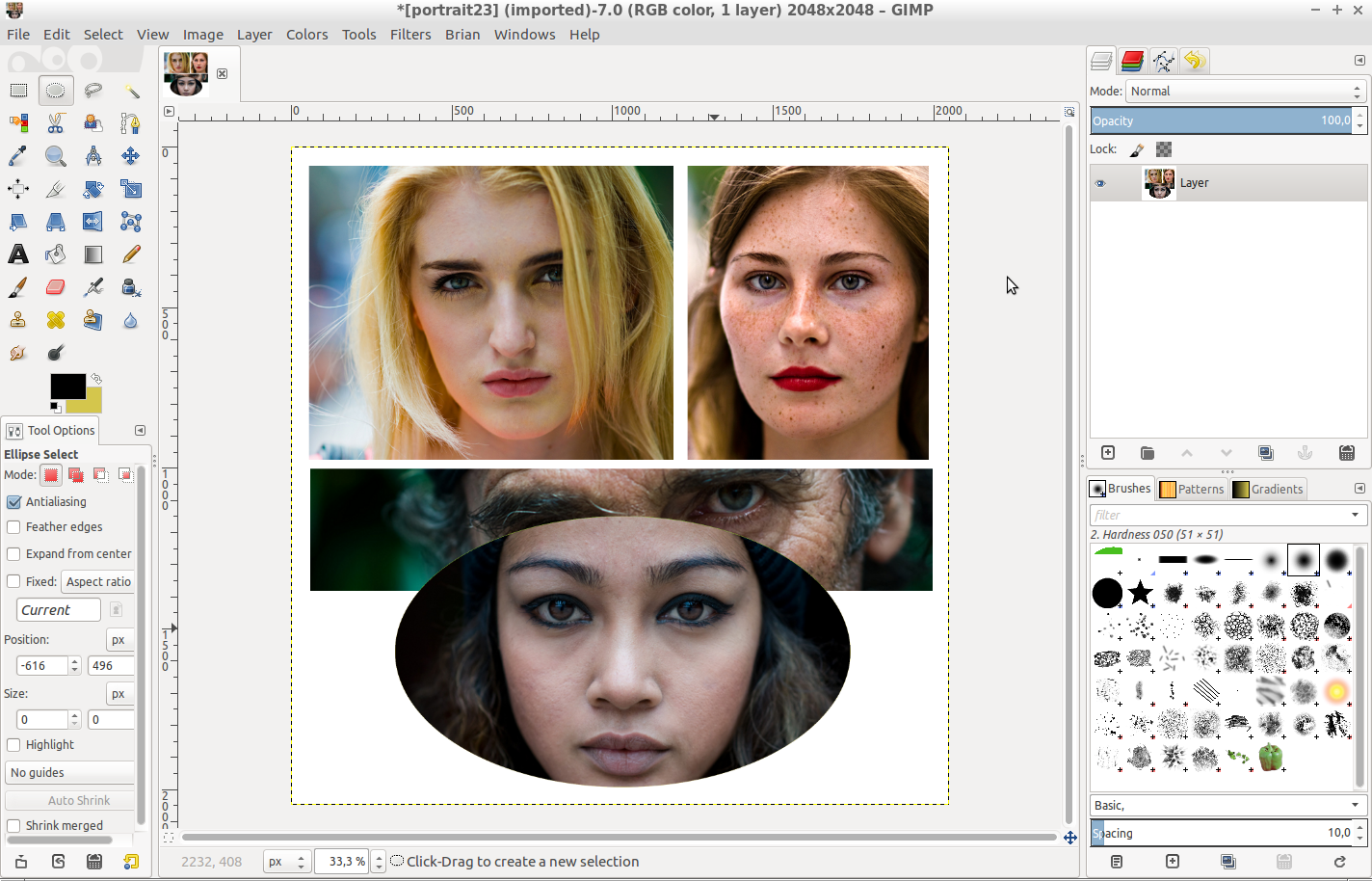
And now that you have processed so many beautiful pictures, why not arrange them in the form of a superb photo montage? This is precisely the role of the filter Arrays & tiles/Drawn montage, which allows to create a juxtaposition of photographs very quickly, for any kind of shapes. The idea is to provide the filter with a colored template in addition to the serie of photographs (Fig.3.10a), and then to associate each photograph with a different color of the template (Fig.3.10b). Next, the arrangement is done automatically by G’MIC, by resizing the images so that they appear best framed within the shapes defined in the given montage template (Fig.3.10c). We made a video tutorial illustrating the use of this specific filter.
But let’s go back to more essential questions: have you ever needed to draw gears? No?! It’s quite normal, that’s not something we do everyday! But just in case, the new G’MIC filter Rendering/Gear will be glad to help, with different settings to adjust gear size, colors and number of teeth. Perfectly useless, so totally indispensable!
Need a satin texture right now? No?! Too bad, the filter Patterns / Satin could have been of a great help!
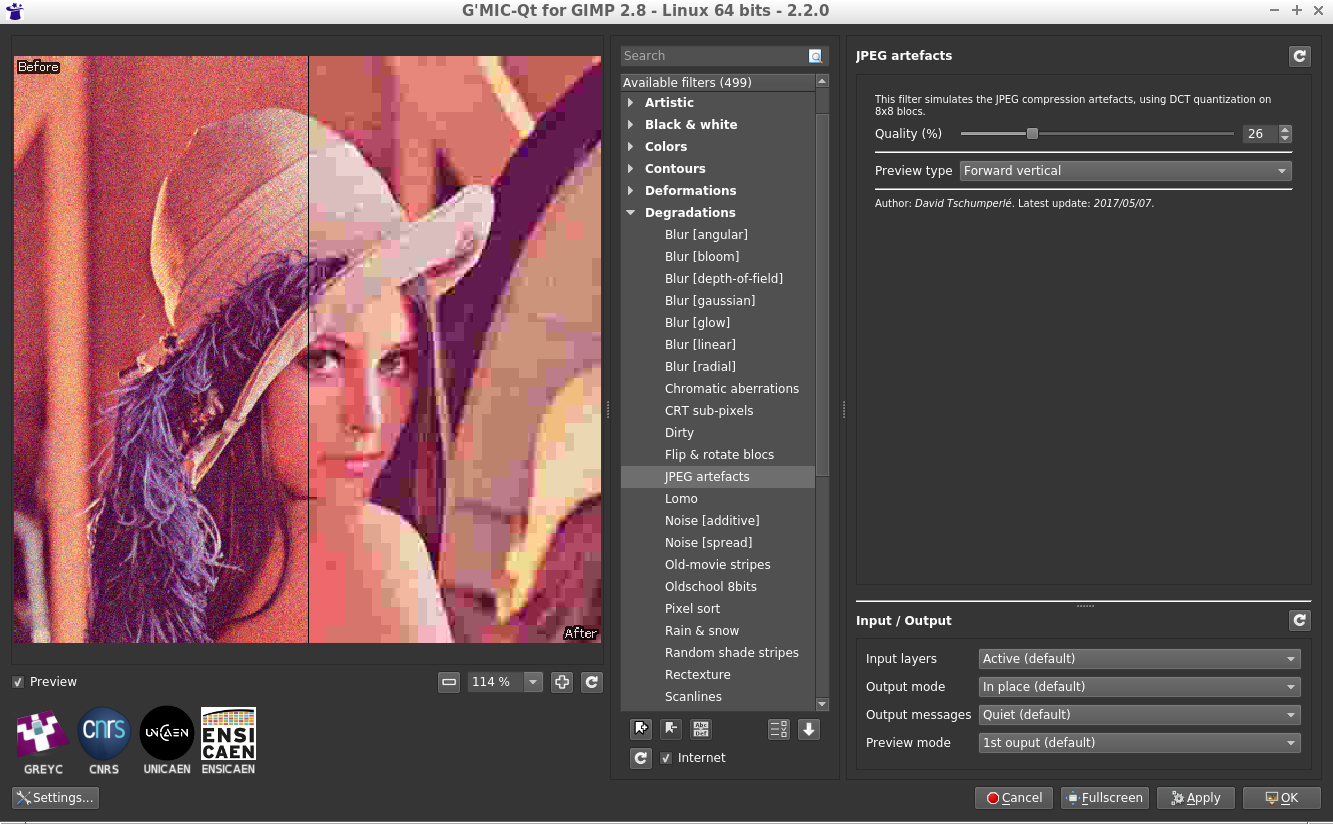
And finally, to end up with the series of these “effects that are useless until we need them”, note the apparition of the new filter Degradations/JPEG artifacts which simulates the appearance of JPEG compression artifacts due to the quantization of the DCT coefficients encoding 8×8 image blocks (yes, you will get almost the same result saving your image as a JPEG file with the desired quality).
This review of these new available G’MIC filters should not overshadow the various improvements that have been made “under the hood” and that are equally important, even if they are less visible in practice for the user.
A big effort of cleaning and restructuring the G’MIC-Qt plugin code has been realized, with a lot of little inconsistencies fixed in the GUI. Let’s also mention in bulk order some new interesting features that have appeared in the plugin:
All these little things gathered together globally improves the user experience.
Even less visible, but just as important, many improvements have appeared in the G’MIC computational core and its associated G’MIC script language interpreter. You have to know that all of the available filters are actually written in the form of scripts in the G’MIC language, and each small improvement brought to the interpreter may have a beneficial consequence for all filters at once. Without going too much into the technical details of these internal improvements, we can highlight those points:
The G’MIC built-in mathematical expression evaluator is also experiencing various optimizations and new features, to consider even more possibilities for performing non-trivial operations at the pixel level.
A better support of raw video input/outputs (.yuv format) with support for4:2:2 and 4:4:4 formats, in addition to4:2:0 which was the only mode supported before.
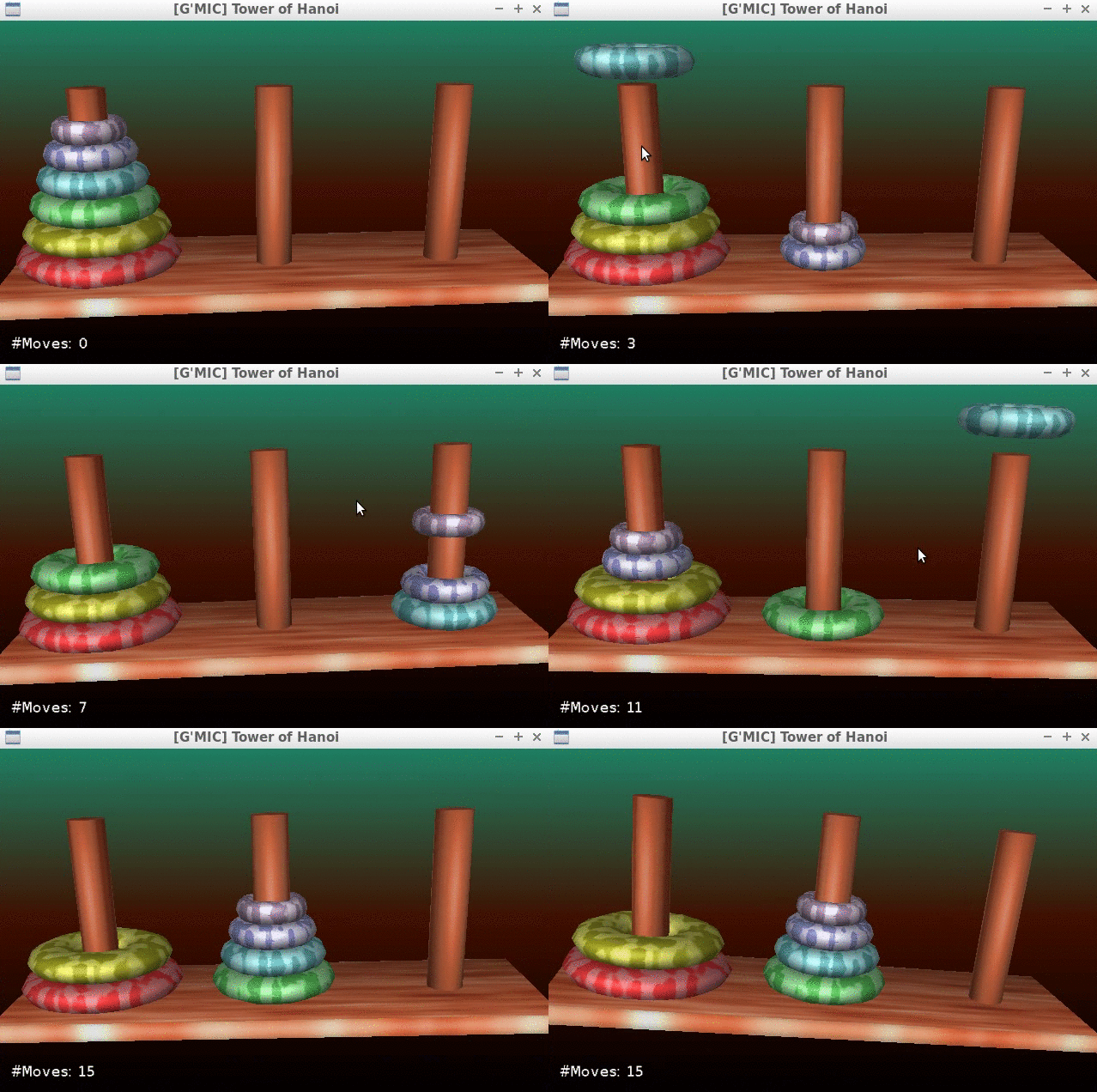
Finally, two new animations have been added to the G’MIC demos menu (which is displayed e.g. when invoking gmic without arguments from the command-line):
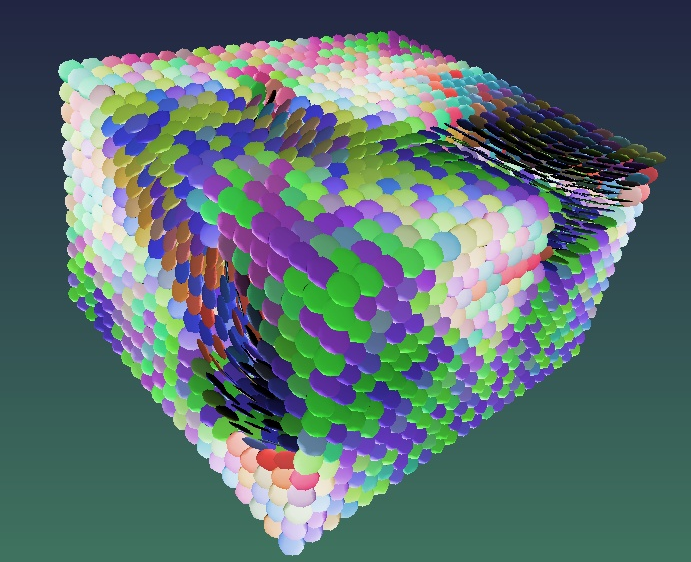
Finally, let us mention the introduction of the command tensors3d dedicated to the 3D representation of second order tensor fields. In practice, it does not only serve to make you want to eat Smarties®! It can be used for example to visualize certain regions of MRI volumes of diffusion tensors:
tensors3d.
To finish this tour, let us also mention the complete redesign of G’MIC Online during the year 2017, done by Christophe Couronne and Véronique Robert from the development departement of the GREYC laboratory. G’MIC Online is a web service allowing you to apply a subset of G’MIC filters on your images, directly inside a web browser. These web pages now have a responsive design, which makes them more enjoyable than before on mobile devices (smartphones and tablets). Shown below is a screenshot of this service running in Chrome/Android, on a 10’’ tablet.
The overview of this new version 2.2 of G’MIC is now over. One possible conclusion could be: “There are plenty of perspectives!“.
G’MIC is a free project that can be considered as mature: the first lines of code were composed almost ten years ago, and today we have a good idea of the possibilities (and limits) of the beast. We hope to see more and more interest from FOSS users and developers, for example for integrating the G’MIC-Qt generic plugin in various software focused on image or video processing.
The possibility of using the G’MIC core under a more permissive CeCILL-C license can also be a source of interesting collaborations in the future (some companies have already approached us about this). While waiting for potential collaborations, we will do our best to continue developping G’MIC and feed it with new filters and effects, according to the suggestions of our enthusiastic users. A big thanks to them for their help and constant encouragement (the motivation to write code or articles, past 11pm, would not be the same without them!).
“Long live open-source image processing and artistic creation!”

Hosted on Acast. See acast.com/privacy for more information.

Hosted on Acast. See acast.com/privacy for more information.


Hosted on Acast. See acast.com/privacy for more information.
A betting man’s reflections on money[1]
Keith Hart
Abstract
Part 1 describes my life as a betting man, starting out as a teenager in Manchester and achieving some success as a student at Cambridge. When asked in 2007 why I took up economic anthropology, I replied that I want to save my family from the financial holocaust to come. In Ghana I assumed the role of a criminal entrepreneur. Later I moonlighted for The Economist and worked as a development consultant. Spells of betting were intermittent – speculation on housing prices, cocoa futures, exchange-rate futures and FX trading. In all this my interest was to learn more about money at a practical level; I had no desire to get rich.
Part 2 offers some anthropological reflections on money. Popular and semi-scholarly literature on money illuminates the tragic human division between the few who make it and the many who take it (if they can). Three stories have long circulated side-by-side in money-making circles: the economists’ belief that you cannot beat the markets; another that you can with inside knowledge (which is illegal); and a third that scientific methods can guarantee steady profits from gambling on asset prices. My childish experiment in scientific betting was saved by deep empirical knowledge of horse-racing. Money shares some of the features of religion and this constitutes an obstacle to introducing democracy to its organization. The essay concludes with some observations about money in a human economy.
Part one A life of betting
My apprenticeship
In 1955, when I was 12 years old, I realised that I did not want a job like my Dad’s when I grew up. Most evenings he would come home and express his frustration to our mother. He knew his job better than anyone, but his bosses often made him do it their way, usually for the worse. Moreover, promotion was unfair. The surest route to advancement was to tell the bosses what they wanted to hear. My father told it how it was and this did him no favours. As the oldest of four children and with a father disabled by a war injury, he had left school when he was 14 to work in a factory. By attending night school until he was 21, he acquired the equivalent of a degree in electrical engineering from Manchester “Tech” (now UMIST) and joined the telephones branch of the General Post Office. But he remained stuck in the manual grades twenty years later. As it happened, he later won promotion to the managerial grades and retired from a relatively senior post in British Telecom during the early 1970s. But none of that seemed likely when I decided to take up betting.
I formed a fear of being owned by a single employer that has stayed with me since. I suppose I would now call it fear of being a proletarian. I was already embarked on a career of passing examinations into what I naively imagined were the free professions, a world of self-organized work, with the obvious choice being the academy, since I was already in school. I had been the first boy from our inner city district to win a place at Manchester Grammar School. I made it onto the front page of the local newspaper. But it was a lonely and competitive life and I had no precedents or home advice to draw upon. When I was eight, we visited an aunt in Bedfordshire and took a day trip to Cambridge. I asked why they had so many churches and was told that these were schools, not churches. Apparently I said, “When I grow up, I want to go to a school that looks like a church”. This became enshrined in family myth as “Keith wants to go to Cambridge”.
The trouble was I didn’t know how much I had to do to get there. As a teenager, I ended up doing 40 hours of homework a week, while travelling to and from a day school. I became obsessed with mastering the forms of being examined. I hated the impersonal procedure of being assessed in that way. There’s a scene in the film Billy Elliot where a miner’s kid is waiting to know if he has been accepted by the Royal Ballet School. Eventually, a buff envelope arrives with his name on it and his father tells him to open it. He refuses. That binary moment, when remote anonymous examiners say yes or no, is unbearable when measured against a child’s life and hopes. I too could not stand having no relationship with my potential executioners. I set about trying to influence them. I imagined an examiner in his 50s, on his fourth whiskey. It is 1 am and he is very tired. I knew I would do well enough to succeed, but what happens if he just passes over my paper for the sake of getting done and gives it a B? I needed to get his attention. I had already studied calligraphy and developed a handwriting style that was pleasant to read and avoided forward-sloping (extravert), backward-sloping (introvert) and big loops (psychotic). But I needed something else. I decided to insert a joke in the first paragraph. He might not like it, but at least he was now reading; and, if he liked it, I was even further ahead. This impulse to bridge the gap between impersonal society and me is what led me eventually to anthropology and much later to the study of money. But I get ahead of myself.
As a 12-year-old I was already committed to passing exams, but what if I failed the exams? The last thing I wanted was a job like my Dad’s, indeed any job in a bureaucracy. I had to find enough money to live on through something other than normal work. How do you make money without working? The only method I could think of was betting on the horses. Of course I had no money to bet with, but I set out to learn about horse-racing. My father’s Manchester Guardian was no good, but my grandma, who lived across the street, got the Daily Express which devoted several pages to the topic and had the best tipsters (The Scout and Peter O’Sullevan), so I borrowed it from her every day. I made notional bets and kept a record of the returns in a notebook. After three years I was making a regular profit on paper. I also now had some money, from a paper round and from fiddling my daily expenses for food and travel. So I started making small cash bets. In the next couple of years, I sometimes worked for wages in the holidays and my betting habit expanded accordingly. All the time I accumulated knowledge of the horses. My notebook still showed a small profit.
All this changed when I won a scholarship to Cambridge at the age of 18. The big shock was to get my grant cheque and scholarship in three instalments in advance. This came to £420 a year in 1961 (£8,700 today). I now had capital for the first time in my life and six years of grubbing around the bottom end of the market for betting on the horses now paid off. I realised that I had acquired substantive knowledge of the British “form” over a continuous and extended period. I hardly wanted to get thrown out of Cambridge for bad debts. But I knew that occasional bets made on a hunch would sooner or later have that result. I would have to make a science of betting. I knew that three variables mattered most in an extended betting sequence: the total fund available, the risk of losing it all and the size and speed of making bets. Most punters have only a little money and they try to win a lot occasionally. So they lose. The winning recipe is to have a lot of money in reserve and to bet to win a small amount often. This is in fact the recipe for capital accumulation across the board and it now drives stock markets in a computerised form.
“Scientific” betting at Cambridge
I devised a method from scratch that has some well-known features, but they were not well-known to me then. They also have well-known flaws (not to me at first) and I found my way past those through trial and error. My basic method was something called a martingale, an 18th-century French system of doubling up on bets with a 50 per cent probability of winning, such as the toss of a coin. The binomial theorem tells us that the chance of losing such a bet 10 times in a row is 1 in 512 (2 to the powers 0–9). If I placed bets to the value of a 500th of my stake on horses starting at around evens, I had a 0.2 per cent chance of losing the lot. I figured that I could reduce this risk by drawing on my knowledge of horse racing (six years’ worth by now). This meant that, with a fund in the bank of £100 (over £2,000 today), my initial stake on a bet should be no more than 4 shillings (£4 today).
The next problem was to make these bets fast enough. I chose to bet on all favourites starting between evens and 2 to 1 against. This allowed for the payment of betting tax on winnings. Odds-on bets made doubling up on losses impossibly risky. Favourites in Britain win one in three races on average. I could not afford the time to select bets based on studying form, so I made them mechanically until I reached four consecutive losses. The fifth bet in a losing sequence meant placing a bet around 16 times the original stake to win it back (over £3, now £64). At this point I slowed down and picked my bets, using my knowledge and best guesses. In four years as an undergraduate, the longest losing sequence I had was seven bets, meaning that the seventh bet cost over 60 times the original stake in order to recoup my losses (£12 or an eighth of my total fund, £250 now). It wasn’t a pleasant experience – my hands were shaking and I was sweating — but I only had to endure these extended losing runs two or three times.
Operating this system wasn’t even the main problem. In Britain the gatekeepers (bookmakers, casinos) have the legal right to refuse anyone a bet. They are especially likely to do so if they believe he is operating a scientific system like card counting at blackjack or using a martingale on red or black at roulette. When my system settled down, I made an average 8 per cent on turnover. I disguised the regularity of this return by spreading my custom between three betting shops and varying how much I won or lost at each, so that I came across as a high-volume punter who didn’t cost them much. I stopped keeping a record after a while since I knew by then that I couldn’t lose.
I made occasional bets outside my system. I had an ally in the college kitchen manager whom the students condescended to (he had a fake posh London accent that didn’t conceal its working class origins) by addressing him with his surname. I called him “mister”. We shared a consuming interest in betting on the horses. He would give me tips he got from Newmarket, racing headquarters only a few miles from Cambridge. Once he told me that three horses from the Jarvis stable were going to win at Yarmouth that day. They would start at short odds, so it was worth betting on them as an accumulator treble. I put £5 on the treble (which was a lot then, £100 now). The first horse won at evens, the second at 6-4 on. The third drifted out in the betting to 8-1…and won! The treble paid off at 30-1: £150 (a term’s stipend or £3,000 today).
My friend liked me enough to introduce me to the Cambridge underworld which met in a large mobile home that doubled as a strip club on the Newmarket Road. The main currency of Cambridge crime then was food, supplied by college kitchen managers to Cypriot restaurateurs. Students paid for their meals in advance, but they were so bad that they sometimes paid to eat at the Cypriot restaurants instead. There was an incipient Italian mafia based on cement, construction and pizza. Otherwise the denizens of the strip club included the usual bent policemen and former jockeys from Newmarket. One of my side lines was playing cards for money: three-card brag with Northern working class students and bridge for high stakes with the rich boys. My first decade, when I learned to play cards really well for my age, paid off at this time.
Overall, I roughly doubled my grant each year. In all my time as an undergraduate, I never worked for wages, took no money from my parents (although I used their home for free board and lodging) and had enough money to pay for my drinking bills, buy a lot of books and cinema tickets and take two-month holidays in the Aegean every summer. My social anthropology supervisor, Jack Goody, suggested Newmarket horse-racing as a suitable topic for my doctoral research; but I didn’t fancy ending up under a truck on the Newmarket Road and went to Ghana instead, which I laughably thought would be safer.
Spending two years on fieldwork in Ghana for a PhD in social anthropology ruined my betting career. I lost track of the British horse-racing form and no longer received a regular grant cheque when I returned to write up. I kept betting on the horses at first, but unsystematically and without a capital reserve. Eventually, I was forced to acknowledge that my net returns were under a few shillings an hour. I was also married to someone else without an income. It made more sense to write my thesis and get an academic job. A PhD required more work than my undergraduate degree in any case.
This put an end to me betting in the formal sense, although I milked the 1970s housing boom while buying and selling four houses in short order. I learned quicker than most that moving often and being indebted over your head as a property-owner was a path to riches in times of high inflation. In the United States during the early 1980s I kept a gambling stake of $25,000 which deployed for short periods in New York betting on cocoa futures and in Chicago I bet on exchange-rate derivatives for a while. Money market futures were invented at the Chicago Mercantile Exchange in 1972, a year after the dollar was unpegged from gold. Agricultural markets are the most volatile of all and the farmers who sold pork bellies to German supermarkets could not predict what they would receive some months down the line. I dabbled in dollar-deutschmark exchange rate futures, using my gambling fund. I had a front seat at what became known as ‘financialization’, the process whereby finance replaced production and marketing as the main preoccupation of industrial corporations, which I called ‘virtual capitalism’ in my book on money (Hart 2000:157-165)
Economic anthropology
In 2007 I was asked at a conference why I chose to study economic anthropology. I replied that I wanted to save my family from the coming financial holocaust. This was partly true. I have always considered anthropology to be a way of improving my own practical understanding of the world. When I switched from the classics, my first passion was the anthropology of religion, but for my doctoral research I opted to study migrant politics in the new West African nation of Ghana. When I got there, I discovered that it was a police state and nobody wanted to talk about politics. So I turned to the street economy of the slum I lived in. It turned out that my Manchester upbringing had prepared me more effectively to investigate the economy than I had imagined. In any case, my own economic relations gave me plenty to think about. I never set out to study an economic culture (“Tell me how you do that”), but rather entered a dialogue with individuals as an actor myself. Thus a woman approached me for a loan to start selling sugar lumps outside her front door. I asked how much she was selling them for. The answer was four lumps for a penny. I told her that she could still make a profit if she sold them five for a penny. Yes, she said, but the other women would beat me up. That is how I learned.
I lived in a criminal bad lands and my landlord was a small-time gangster. Betting in Cambridge – not to mention growing up in Old Trafford, Manchester — had already exposed me to the seamy side of economy. As a teenager, my hero in fiction was Raskolnikov, the deracinated student in Dostoevsky’s Crime and Punishment who believed that you have to be a criminal to do something new. So I wasn’t a virgin when I decided to cross the line and join the criminal element in Nima, the Accra slum I lived in. I went into partnership with my landlord. The deal was: I put up the cash, he supplied the knowhow, I got the field notes and we split the profits 50/50. Try putting that to a research ethics committee. Our main business was receiving stolen goods. I went out with the pickpockets, became a usurer, forged receipts for stolen goods, fenced drugs seized by the police and foreign currency from the soldiers. I was one of the few people, apart from Lebanese shopkeepers, who knew the difference between hard and soft currencies.
We tried ‘legitimate’ speculation, such as hoarding bags of maize against seasonal price fluctuations. My partner hadn’t done this before, but every year the price doubled between harvest-time and the following spring. We soon found hidden expenses and worse. First, a porters’ ring took a cut just for lifting each bag from the truck onto the ground. The bags needed to be turned out periodically to avoid rot and we had to buy insecticide against the weevils. Then, just when the price had doubled, American PL480 aid flooded the country with maize and it went back to what we paid originally. To recover our costs, we had to sell the bags on credit with all the hassle that involved. There is more to trade than the headline rate of profit. Moneylending was a failure too. I learned the hard way that it isn’t the rate of interest, but the default rate that counts (and a propensity for violence, which we lacked). Our core fencing business was profitable, however.
The money I made became an embarrassment. I tried to give it away. At one point I employed seven research assistants; hosted sheep, rice and beer parties; made gifts of blankets and sandals to old people. But this redistribution only boosted my renown as a big man and the flow of stolen goods increased. There were two social categories in the migrant community I studied – a floating sea of single young men and married elders whose houses were islands of stability in the tide. Without being aware of it, I moved from one class into the other. I did manage to get rid of the money before I left. It just took extra effort.
You can imagine that this hands-on approach to field research posed problems for writing up a thesis. I ended up representing my own experience in the third person. When I finished writing it, I felt that I understood Accra’s street economy as well as the inmates, if not better. But, like them, I had no explanation for the great events that had shaken Ghana’s political economy a decade after independence: the collapse of the world cocoa price, the ensuing scarcity of goods, the army coup which overthrew President Nkrumah. I had been surprised by how easy it was for me to make money and how difficult to get rid of it. I was ignorant of the history which might help me to account for this situation. Ghanaians wore cloth from Manchester, but I had little idea how it came about or what it meant.
So I set out to learn more about the history of colonialism and its successor, ‘development’. More than anything, I wanted to enter the world of states and international agencies. So I joined an academic consultancy organisation at the University of East Anglia. Before long my conversations with development economists paid off and I was able to transform my Accra ethnography into a means of entering the debates of the day about urban unemployment in the Third World. I was helped in this by moonlighting for The Economist, producing regular reports on West Africa. This taught me to write in what I call ‘Economese’ (how to sound like an economist without any formal training in the discipline). In the process I spawned the idea of an ‘informal economy’ (Hart 1973) a concept whose inter-disciplinary success is still a source of wonder to me. Over the next decade I worked as a consultant on development policy in the Cayman Islands, Papua New Guinea, Hong Kong (Hart 2002) and West Africa (Hart 1982), while retaining steady employment as a university lecturer in anthropology.
When I was asked by LSE to give a Malinowski lecture, I chose the topic of money (Hart 1986). I later became a small publishing and internet entrepreneur as the digital revolution in communications took off in the 90s (Hart 2009). I agreed to write a text book, Anthropology and the Modern Economy, but withdrew it because its objective style left no room for my personal engagement with the economy. In choosing another project, I asked myself what future generations would find interesting about us. The answer seemed obvious enough: the rise of the internet. I recalled the minor success I had had with my Malinowski lecture and started writing about how the digital revolution was transforming money (Hart 2000). There was plenty of me in that book. At the same time, I relocated to France and South Africa, which gave me an incentive to explore the betting possibilities in FX markets. When asset markets were highly volatile and interest rates on savings near zero, I tried to take advantage of medium-term shifts in relationships between sterling, euro, US dollar, Swiss francs, yen, Norwegian krone and South African rand, all (with the exception of Japan), countries in which I had a direct interest and firsthand knowledge. On balance I did quite well.
When I retired from British universities in September 2008, my pension immediately lost 30% of its value in France. Hence my reply when I was asked why I am an economic anthropologist. I am a teacher for sure, but I learn best when I try to figure out things that directly impact on my own family’s wellbeing. A youth spent passing exams and betting on the horses was the matrix for this life trajectory. In old age, I fancy myself as a prophet. Betting is fine training for that job. I also have a science fiction murder mystery on the backburner, Futures or who killed Don Quick?
Part Two Some anthropological reflections on money
Making and taking money
Oswald Spengler’s The Decline of the West (1918) had a major impact on American cultural anthropology between the wars, particularly on Ruth Benedict. He argued that the power of number and money to separate and depersonalize was fundamental to our understanding of the history of civilization. For the Greeks, number was magnitude, the essence of all things perceptible to the senses. Mathematics for them was thus concerned with measurement in the here and now. All this changed with Descartes whose new number-idea was function — a world of relations between points in abstract space. Now a passionate Faustian tendency towards the infinite took hold, married to abstract mathematical forms that freed themselves from concrete reality the better to control it. In economic life, a parallel shift took place from thinking in terms of goods to thinking in terms of money. When a businessman signs a piece of paper to mobilize remote forces, this gesture stands in an abstract relationship to the power of labour and machinery, only taking the form of money numbers in a retrospective accountancy process. Thinking in money generates money. It turns the world into subjects and objects– a few executives and those who follow their orders. Each person either joins the money force or is shaped by it as part of the mass.
According to this line of thinking, the difference between how the “masters of the universe” approach money and the cultural habits of people who have very little of it is crucial. The latter still count it carefully as a measure (when they know how to count in the first place), while the former understand that its potential is less tangible. We might make a distinction, therefore, between those who participate in what Spengler called “the money force” and their victims who don’t. We could label them the ‘makers’ and the ‘takers’ of money. There is some truth in this crude bipolar model, but a focus on gambling breaks it down. For a large number of people without much money, in making bets, open up the chance to participate actively in the money force, not just as a passive bystander.
The money-makers, at least since Frank Knight’s Risk, Uncertainty and Profit (1921), have been able to distinguish between future threats that are calculable (risk) and those that are not (uncertainty). Whereas to you or me a barn burning down is an unpredictable disaster, insurance companies can assess quite closely the probability of such an event in a given area and share the risk between those willing to pay a premium. This elementary principle was forgotten in the decades of the credit boom, so that the insurance giant AIG undertook liabilities that its assets were unable to cover in the event of a crash. The computer programs of some banks issuing mortgages could not even simulate a downturn in housing prices.
Yet we were told that capitalism had entered a new and eternally progressive stage, where rational calculation of financial outcomes was rapidly making a unified world market. ‘Quants’, often with physics degrees, created formulas to take advantage of minor discrepancies in markets (arbitrage). Thus insurance against bad weather for Caribbean hotels and against injury to major league baseball stars are two separate things. But a quant might find a mathematical connection between them. A derivative would then be constructed on that basis and the corporation issuing it would make a lot of money until others noticed and joined in. Soon where two markets had existed, there would be one. And this process was multiplied on a massive scale.
Alexandra Ouroussoff (2010) identified the rating agencies as the principal source for a belief that the risk of future losses could be known in advance and factored into share prices, whereas corporate executives tend to be empiricists who know that all futures are uncertain. They prefer to float a number of lines and hope that one of them scores big. But their need for investment capital led them to cook their books in conformity with the agencies’ expectations. In this climate, the investment banks came to think of themselves as invincible and Western capitalism took an unsustainable form. Well-established truths, such as what goes up always comes down in real estate markets, were forgotten in the rush for fat salaries and bonuses. Belief in the efficiency of the ‘free market’, as propagated by an army of economists, journalists and politicians, took hold in the money-maker class especially. Gillian Tett (2009) tells how she was denounced as unpatriotic by leading figures in the City of London, as well as by her employers at the Financial Times, for expressing doubts about the soundness of the market for credit derivatives.
Sometimes books written for the popular market are more revealing than most academic texts. One of them was Nassim Nicholas Taleb’s The Black Swan (2007). Taleb is a homespun philosopher and successful trader in financial instruments. He holds that unexpected events of large magnitude and consequence play a dominant part in history, especially in the history of markets. Such events, considered to be extreme outliers in terms of probability, play much larger roles than regular occurrences. High-impact, hard-to-predict events with disproportionate consequences go beyond the realm of normal expectations in history, science, finance and technology. The probability of such rare events is not computable using scientific methods; but it is possible to hedge against them. The psychological biases that make people blind to uncertainty and unaware of the massive role of rare events in history have already been discussed systematically in books like this that span popular and academic markets.
Elie Ayache (2010) seeks to refute Taleb in The Blank Swan: the end of probability. According to him, there is no point in seeking to calculate trends in market prices or even to hedge against rare events. The swan is neither black nor white, but a blank sheet on which the proactive trader writes his derivative. Ayache follows Quentin Meillassoux (2008) in arguing for the reinstatement of contingency over probability, a position I have some sympathy for.[2] The book is undeniably difficult. Some reviewers have suggested that it is a philosophical joke (but then French intellectuals do like to entertain). A short article, “I am a creator” (the reference is to the movie, Barton Fink), is more accessible (Ayache 2008). Most traders use the Black-Scholes-Merton model when pricing options, a practice that Taleb thinks is simply wrong. But Ayache has a more dialectical approach. What matters is to make the market while being in it, to be a “dynamic trader”. Such a person “both makes the market and is dictated (sic) the market. He can both be an original author and yet be-in-the-market.” (Ibid: 37). “Market-makers are thinkers and creators … (They) need both the model and the market. Because they make markets, they need to produce prices as outputs of pricing models. However, because the market is the outside (and cannot be their fabrication) that they should as market-makers-thinkers always be reaching for, they also need prices to be the inputs of their models…A market-maker makes a price only in so far as the market makes it.” (Ayache 2008:46). I will return to this paradox at the end.
William Poundstone is another popular writer whose theme is close to our own. His book, Fortune’s Formula: The untold story of the scientific betting system that beat the casinos and Wall Street (2006), appeals to me because its central message is congenial. His impressive canvas covers the last half of the twentieth century, taking in the inventor of information theory, the Chicago mob’s racing scams, Paul Samuelson, Rudy Guiliani’s crusade against insider trading, junk bonds and, of course, Black-Scholes-Merton. He reminds us that three stories have long circulated side-by-side in money-making circles: the economists’ belief that you cannot beat the markets; another that you can with inside knowledge (which is illegal); and a third that scientific methods can guarantee steady profits from gambling on asset prices. There is plentiful material here for a novel on betting. Poundstone may not meet Ayache’s philosophical standards, but he offers much support for the thesis that the rich rely heavily on personal relations for knowledge and contacts, even if the intellectual disciplines that dominate public education represent society as being governed by impersonal forces.
There is almost no public education about money in Western schools; and middle-class parents do their best to shield their children from direct experience of it for as long as possible. Paul Samuelson used to say in the introduction to his best-selling textbook Economics (Samuelson 1989) that 10 million New Yorkers go to sleep every night confident that the economy will still be there the next morning; but how do they know? In Money: Whence it Came, Where it Went (1975), J.K. Galbraith tells a story from the 1960s about a member of Kennedy’s administration being paid off with a directorship of a bank. After his first meeting, he was seen walking down Wall Street in a daze, muttering “I never knew. I never knew.” What had he not known? Galbraith surmises that he may have learned the first principle of modern banking: take money from one party and lend it to another, then persuade both that they still have it.
Perhaps money truly is a phantom conjured up by unscrupulous wizards (Baum 1900). In which case, most of us would rather not know. We prefer to believe that we are standing on solid ground, that the money we live by is real and will not go away. Failing that, we pay experts to look after the problem and are reassured by the sound of their technical jargon. In either case, understanding is unnecessary. That is why inflation is so upsetting: when the value of money refuses to stand still, what else is there to rely on? Fear of the unknown leads us into a crippling search for certainty in monetary affairs; and this is as much an obstacle to effective understanding as was the old-time religion it so closely resembles.
Perhaps for this reason most people are extremely tenacious of their ill-formed views of the money system they have grown used to. I know from personal experience that they refuse to be told that there are viable alternatives to working for wages and pensions, such as scientific gambling or do-it-yourself trading circuits such as LETS (Hart 2000). Successful capitalists draw on large reserves and make small bets often; but most punters lose in the long run by trying to win a lot with a little occasionally. This is the source for the dogma that the bookie or the casino must always win. Perhaps believing that makes it more tolerable to sacrifice our lives to an economic system stacked against us. It is the same with resistance to community and complementary currencies (Blanc 2010). When told that we can produce our own money with its own trading circuit, without earning wages in order to spend it, most people would rather turn away.[3]
The religious obstacles to democratizing money
To understand the social force of religion, one has to enter the minds of believers. Searching for the source of money’s power is like asking how God gets us to believe in Him. Of course we made him up, just as we made and make money up. Since all we can ever know is the past, why would anyone accept a claim to guarantee an unknowable future? But we do, because we have to–and faith is the glue sticking past and future together in the present. Simmel (1900) made a good case for why money is able to make this spurious claim. Since all the ephemeral transactions we wish to calculate are made in terms of it, money seems to be more stable than the rest, even though we know it is not really. The river bank seems to be solid and yet in reality it is just slower-moving deposits thrown up by the fast-moving water. But, if we are drowning, we settle for its presumptive stability. The physicist may have worked out what is going on at an abstract level, but for practical purposes we do not need to know what he knows about the movement of particles.
Given the cultural longevity of money in its present form and the powers of indoctrination held by ruling institutions, it is not surprising that most people are initially reluctant to embrace new approaches to finance; but the situation is psychologically complex. Conventional money flatters our sense of self-determination: with some money, we can exert power over the world at will, moving from infinite potentiality to finite determination, back and forth. Yet there is another kind of comfort in the notion that money, as presently constituted, is not in our control at all. The fact that it embodies an exogenous force of necessity serves, in a manner analogous to number, to generate clarity of judgment and action where otherwise things might be frighteningly wide open. Similarly, if they issued their own currencies, people would not only be freer, but would have greater responsibilities also.
There is a strong parallel with slavery. People feel that the monopoly claimed by national money must be inevitable, since no-one would freely choose it. To be told that there is an alternative we could choose makes nonsense of a lifetime’s enslavement to an unrewarding system. So we cling to what we know as the only possibility. We often talk about wanting to be free, but we choose the illusion of freedom without its real responsibility. This is perhaps why we prefer money not to be of our own making. We spend it, but we never have enough of it because ‘they’ keep it scarce. This is perhaps the underlying reason why eminently sensible schemes for do-it-yourself money get such a poor reception. It is not enough to develop a superb design for exchange circuits employing community currencies. People have to be sold the idea; and this involves engaging with their most cherished beliefs.
The word ‘belief’ originally meant ‘something held dear’, which is to say that exchanges involving money entail at some level a vision of humanity bound by mutual love (Hart 1988). This is how the young Marx ends his remarkable essay on “The power of money” in the 1844 manuscripts: “If you love without evoking love in return, i.e. if you are not able, by the manifestation of yourself as a loving person, to make yourself a beloved person, then your love is impotent and a misfortune” (Marx 1844).
In sum, I have long held that rationality works best backwards, as rationalization. We are surrounded by uncertainty because the future is unknowable and, to an unprecedented degree, modern societies train their members to expect to nail down future time. Precise calculation of future financial outcomes is a chimera, one of the principal causes of the recent collapse. What we can do is to apply reason to explaining past events and this is scientific method. Extrapolation from the past to the future is where it all breaks down. Knowledge and experience can play a more subtle role when we seek to manage uncertain futures on a looser empirical basis. Betting is one way that such experience may be acquired.
Looking back at my childish experiment in scientific betting, it seems barely credible that I survived, even less that I prospered a little. What saved me from the martingale was my empiricism. I knew a lot about the horses. I would probably have made more money without my system, but we all need props to judgment. I have learned, however, never to bet on something I don’t know very well. More important, those early forays into gambling gave me a different attitude to money. I did not accept that I was inevitably a victim of the market economy and I took that attitude to my excursions into economic anthropology. It has been central to a lifetime of learning by doing. I would now emphasize how betting teaches us about money; and that leads me finally to money practices as a form of religious life (Hart 2011).
Religion belongs to a set of terms that also includes art and science. It is a measure of the declining intellectual credibility of the established religions that science, which began as a form of knowledge opposed to religious mysticism, is now more often opposed to the arts. If science may crudely be said to be the drive to know the world objectively and art is mainly a means of subjective self-expression, religion typically addresses both sides of the subject-object relationship by connecting what is inside each of us to something outside. Religion binds us to an external force while empowering us to act as a subject; it stabilizes our meaningful interactions with the world, providing an anchor for our volatility.
Durkheim’s last book, The Elementary Forms of the Religious Life (1912), is his most neo-Kantian work. Compared with his reductionist sociological approach of the 1890s, this study of religion conforms quite closely to my definition above. He divided experience into the known and the unknown. What we know well is everyday life, the mundane features of our routines, and we know it as individuals trapped in a sort of private busy-ness. But this life is subject to larger forces whose origin we do not know, to natural disasters, social revolutions and, above all, death. We desperately wish to influence these unknown causes of our fate which we recognize as being both individual and collective in their impact. At the very least we would like to feel they were less uncertain and to establish a connection with them. For Durkheim, religion was the organized attempt to bridge the gap between the known and the unknown in our lives, between a profane world of ordinary experience and a sacred, extraordinary world located outside that experience. What is ultimately unknown to us is our collective being in society. Through ritual we worship our unrealized powers of shared existence, society, and call it God. Society lies within each of us as well as outside. The chaos of everyday life attains some stability to the degree that it is informed by beliefs representing the social facts of a shared collective existence. Ritual instils these collective representations in each of us.
Assisting with the publication of Roy Rappaport’s Ritual and Religion in the Making of Humanity (1999) sharpened my appreciation of Durkheim’s perspective, since it is an extended reflection on ritual as the ground where religion is made. Rappaport’s own definition starts from an emphasis on formality, invariance and tradition to build an analysis of ritual which, for comprehensiveness and consistency, has no parallel in the literature. He did not believe that a Durkheimian approach to religions must rest on a sharp division between the spheres of the sacred and the profane; nor do I. The project of achieving our potential to be collectively human is, in a sense, barely begun. It is entailed, however, in our origin as a species, according to Rappaport in the discovery of language and with it religion. Religion, which is constantly being made and remade through ritual, is how we get in touch with the wholeness of things (‘holiness’). Human society has a precarious unity defined by our common occupation of this planet. Rappaport considered money to be a false religion, preferring ecology to economics as cosmological grounds for a new world religion that is compatible with scientific law.
Money in a human economy
In contrast, I have come to recognize some of money’s redemptive qualities (Hart 2000) and to link them to the idea of a “human economy” (Hart 2017).[4] Ethnographic particularism lies at the heart of the idea of a human economy. The basic assumption is that we have to start with people where they live and what they do, think and want; but somehow also take into account that all human beings share a common predicament, as humanity.
Lindiwe is a woman of late middle age from Durban, South Africa. She once worked in a factory and is now a domestic worker; rents accommodation from the municipality; travels to and from work in informal minibuses; looks after her mother who receives a state pension and her brother’s young daughters since he has AIDS; her teenage sons are unemployed and drifting into crime; her husband disappeared over ten years ago; she sells cosmetics to neighbours in her spare time; attends a prosperity church and has joined a savings club (stokvel) there; she owes money to loan sharks, but doesn’t have a bank account; she shops once a week in a supermarket and at local stores the rest of the time. Note the complexity of her economic arrangements and the variety of sources she draws on, few of them directly linked to South African capitalism. Lindiwe understands her own life better than anyone else. But there are questions she doesn’t know the answers to: Why are there no longer mining jobs for the men? Why are the schools failing? Why has a Black government done so little to alleviate poverty and inequality?
The human economy approach does not assume that people know best, although they usually know their own interests better than those who presume to speak for them. An economy must be based on principles to be discovered and articulated. In origin the word focused on budgeting for domestic self-sufficiency; political economy promoted capitalist markets over military landlordism; national economy sought to equalize the chances of a citizen body (Hann and Hart 2011: chapter 2). The idea of a human economy is a way of envisaging the next stage linking unique human beings to humanity as a whole, synthesizing the historical sequence, house-market-nation-world, in an on-going process of extending society through the economy. Lindiwe could not juggle all the institutional facets of her life without money. Money and markets are intrinsic to our human potential, not anti-human as they are often depicted. Of course they can and should take forms that are more conducive to economic democracy. Her unanswered questions require a new kind of political education for answers, but one grounded in the circumstances she knows well.
I am still struggling with these issues. But I do know that an economy, to be useful, should be based on principles that guide what people do. It is not just an ideology or a description. The social and technical conditions of our era — urbanization, fast transport and universal media — should be at the heart of an inquiry into how the principles of human economy might be realized now. I suggest that gambling may often be a ritualized form of engagement with society through money. The difference between a gambler and Elie Ayache’s dynamic trader may just be one of degree, not kind. Betting inserts a person into money and markets as an agent who takes and makes them at the same time. There is some satisfaction in that, regardless of profit and loss. Most card games, whether played for money or not, offer a similar experience which, with repetition, may become a source of knowledge and skill with applications well beyond the card table.
I cannot resist ending reflexively with the source of this essay itself – writing. If you recall, writing lies at the heart of Ayache’s account of pricing an option. If I once inserted myself as an agent into the world of money through betting, no practice of mine now conforms more closely to Durkheim’s social model of religion than writing. This is first a struggle to get something out that was previously an undifferentiated part of our internalized experience. It then becomes a sort of two-way traffic between inside and outside, as we read and correct the object that our subjectivity has made, add new elements and revise some more. Later, we circulate it privately to readers and eventually to the anonymous world of a print or online text. It is a lonely occupation. Nothing ever comes back that remotely matches our effort in excavating a text. Writing is at once a deeply personal introspective act and a ritual that joins us to society as a meaningful actor. I often think of money practices this way and it was betting that taught me that.
As the man said, we make history, but not under circumstances of our own choosing.[5] I am a creator. So are we all creators. I said that.
References
Ayache, E. 2008. I am a creator, Wilmott magazine (June): 36-46 (available online at http://www.ito33.com/sites/default/files/articles/0807_nail.pdf).
—–. 2010. The Blank Swan: The end of probability. New York: Wiley.
Baum, F. 1900. The Wonderful Wizard of Oz. Chicago: George Hill. Available online at: http://www.gutenberg.org/ebooks/55
Blanc, J. 2010. Community and complementary currencies. In The Human Economy: A Citizen’s Guide, ed. K. Hart, J-L. Laville and A.D. Cattani. Cambridge: Polity, 303-312.
Durkheim, E. 1965 [1912]. The Elementary Forms of the Religious Life. Glencoe IL: Free Press.
Galbraith, J. K. 1995 [1975] Money: Whence it came, where it went. Harmondsworth: Penguin.
Hann, C and Hart, K. 2011. Economic Anthropology: History, ethnography, critique. Cambridge: Polity.
Hart, K. 1973. Informal income opportunities and urban employment in Ghana, Journal of Modern African Studies 11. 3: 61-89.
—- 1982. The Political Economy of West African Agriculture. Cambridge: Cambridge University Press.
—- 1986. Heads or Tails? Two Sides of the Coin, Man 21(3): 637-656.
—- 1988. Kinship, Contract and Trust: The Economic Organization of Migrants in an African City Slum’, in Gambetta, Diego (ed.) Trust: Making and Breaking Cooperative Relations, electronic edition, Department of Sociology, University of Oxford, 176-193.
—- 2000. The Memory Bank: Money in an unequal world. London: Profile.
—- 2002. World society as an old regime, In C. Shore and S. Nugent (eds) Elite Cultures: Anthropological perspectives. Routledge, London: 22-36.
—- 2008. The human economy, ASA Online 1. Available online at: http://www.theasa.org/publications/asaonline/articles/asaonline_0101.htm
—- 2009. An anthropologist in the world revolution, Anthropology Today 25.6: 24-25.
—- 2011. Money as a form of religious life, Religion and Society: Advances in Research 1: 156–63.
—- 2017. (editor). Money in a Human Economy. New York and Oxford: Berghahn.
Hart, K., Laville, J-L. and Cattani, A. editors. The Human Economy: A citizen’s guide. Cambridge: Polity
Knight, F. 1921. Risk, Uncertainty and Profit. New York: Houghton Mifflin.
Marx, K. 1844. The Power of Money. In The Economic and Philosophical Manuscripts of 1844. http://www.marxists.org/works/1844/manuscripts/power.htm
—- 1852. The 18th Brumaire of Louis Bonaparte. Available online at: http://www.marxists.org/archive/marx/works/1852/18th-brumaire/
Meillassoux, Q. 2010. After Finitude: An essay on the necessity of contingency. London: Continuum.
Ouroussoff, A. 2010. Wall Street At War. Cambridge: Polity.
Poundstone, W. 2006. Fortune’s Formula: The untold story of the scientific betting system that beat the casinos and Wall Street. New York: Hill and Wang.
Rappaport, R. 1999. Ritual and Religion in he Making of Humanity. Cambridge: Cambridge University Press.
Samuelson, P. 1989. Economics (13th edition). New York: McGraw-Hill.
Simmel, G. 1978 [1900]. The Philosophy of Money. London: Routledge.
Spengler, O. 1962 [1918]. The Decline of the West (Abridged Edition). New York: Alfred Knopf.
Taleb, N. 2007. The Black Swan: The impact of the highly improbable. New York: Random House.
Tett, G. 2009. Fool’s Gold: How the bold dream of a small tribe at J.P. Morgan was corrupted by Wall Street greed and unleashed a catastrophe. New York: Free Press.
[1] A revised version of “Making money with money: reflections of a betting man”, in R. Cassidy, A. Pisac and C. Loussouarn (eds) Qualitative Research in Gambling: Exploring the production and consumption of risk, Routledge, London,15-27 (2013).
[2] Having lost my grandfather, mother and sister to statistically remote probabilities in NHS hospitals, I need no reminding about the power of contingency. I was offered a prostate operation and declined on the grounds that I could end up dead. On being told that the chance was small, I replied yes, but I would be dead.
[3] I once saw a documentary about millenarian movements in the Backlands of Brazil. A communist agitator from Sao Paulo meets a peasant who expects Saint Sebastian to lead an army out of the sea that will overthrow the landlords. He asks him “How can there be God when he makes you suffer so much?” The peasant replies “How can there not be God, for without him our suffering is meaningless?”
[4] See Hart (2008), Hart, Laville and Cattani (2010), Hann and Hart (2011), http://web.upa.c.za/humaneconomy.
[5] “Men make their own history, but they do not make it just as they please; they do not make it under circumstances chosen by themselves, but under circumstances directly encountered given and transmitted by the past” (Marx 1852).
The real economy? The challenge of dialectical method[1]
Keith Hart[2]
Abstract
This blatantly introspective essay seeks to trace a path from the postulation of an informal economy as a device of ethnographic realism to participation in virtual reality through the social media. The Human Economy Programme at the University of Pretoria is the dialectical outcome of this process, but it is invisible here.[3] The argument is organized as two parts which are concerned with the dialectics of ethnographic realism conceived of as a historical movement. The first considers the origins of the formal/informal pair in urban ethnography; the second examines virtual reality and the scope for anthropology online.
Ethnography is grounded in the fieldworker’s lived experience, not objective records. The dialectic of imagined and real took shape in my Accra research; the real economy of the slum was analysed through the formal/informal pair. Hegel showed that an idea lends ‘form’ to experience, using the ‘house’ as an example. Because of neoliberal deregulation, the informal economy has become universal. Anthropologists must reflect reality and reach out for imagined possibilities.
Virtual reality involves extension from the real to the imagined. The digital revolution replicates face-to-face encounters at distance. The offline/online dialectic is illuminated by Kant’s and Heidegger’s metaphysics. Anthropologists must engage directly with the world revolution. The Open Anthropology Cooperative offers important lessons. Anthropology online has far to go. The idea of a ‘real economy’ must adapt to movement and distance communications, not just to local forms of society.
The realism of ethnography
Raymond Williams (1961) defined ‘realism’ as a modern literary genre. 1. It revealed a new class to the reading public. 2. It was contemporary rather than backward-looking. 3. It dismantled the sacred myths of old society. Soon after the devastation of the First World War, Malinowski (1922) fulfilled all three criteria in Argonauts of the Western Pacific. The Trobriand Islanders organized international trade without markets, money, states or an ethos of buy cheap, sell dear. Like the hit movie of the same year, Robert Flaherty’s Nanook of the North, they offered a dignified alternative to a western civilization demoralized by mass killing. By insisting on encountering them as they currently were, Malinowski rejected an evolutionism that saw them only as precursors of civilization. And the main sacred myth of the day, homo economicus, was consigned to the dustbin of history (perhaps). Fieldwork-based ethnography was a winning recipe and it has served anthropologists well ever since.
Ethnography has not only taken over anthropology, but it has been adopted by many other disciplines. Anthropologists know that their version is different and superior, but they have been inhibited in arguing the point by Malinowski’s other legacy – his claim that ethnography was a science. Ethnography for non-anthropologists usually means recording qualitative observations made in limited time and space. These then become public documents to be cited in analysis. Anthropologists collect field notes too, but they don’t grant public access to them, except sometimes after death. Why this reticence? The relationship between ethnographic analysis and field notes is speculative, not positivist. Long-term fieldwork allows anthropologists to build understanding based on their own practical experience and a people’s own concepts, learned in their language.
Durkheim (1912) taught us that we internalize ideas by living in society. This is one consequence of extended fieldwork. We absorb much from the places we live in, but this knowledge often lacks the concrete objectivity of a documentary record. We may start from notes, but we put them within a broader understanding of that society. It is this reaching out for more general intuitions that distinguishes anthropology from other disciplines. We may well discover more profound truths this way, but we often can’t demonstrate their source, as a science should. That might be less embarrassing if the discipline had not sold itself to the academy as a science when positivism ruled. So anthropologists cannot celebrate their method, since their speculative humanism is caught between an older sense of ‘science’ as organized knowledge and the objectivism of a social version of natural science.
Since 1990 my main excursions into ethnography have been online. This has led me to explore the dialectics of virtual reality. The idea of an objectively real economy is less plausible when relations are mediated by the internet. Dialectical reason is intended to capture the movement of thought in society and history. Rather than merely reproduce the status quo, we must imagine future possibilities whose initial conditions are actual. The movement of thought and practice is thus from the actual to the possible. Rather than being restricted to a positivist version of reality, we can envisage change, grounded in what already is.
This paper highlights a persistent thread in my work that might be called ‘the dialectics of realism’ with particular reference to the economy. In a 2011 interview with Federico Neiburg and Fernando Rabossi,[4] I recalled how as a teenager I wanted desperately to bridge the gap between myself and impersonal society. I felt oppressed by anonymous examiners and sought to influence them through a variety of techniques of self-presentation. Later this became an idée fixe of my anthropology, connecting the everyday to the wider reaches of a society whose principal mechanisms were impersonal – state bureaucracies, capitalist markets and science.
This took shape in my Accra research on the informal economy in 1965-68. Around 1970 the state was considered universally to be the main actor in development. Economists were either Marxist or Keynesian, with liberals extremely scarce. I knew that no idea, however big and strong, could ever capture what people really do. So I set out to document the real economy of the slum, with Hegel as my guide. Here ‘real’ meant the actual stuff of experience, rather than an analytical concept.
Hegelian dialectics
G.W.F. Hegel pioneered a historical version of dialectical method in The Science of Logic (1812-16). The object of philosophy for him was not individuals, but societies. These move because they are in history. So how can thought move systematically along with its object? The answer is dialectic. Dialectical method is often considered to be difficult, especially in the Anglophone tradition of empirical reasoning. But it is part of human thinking in general, where it is known as conversation. The other method of thinking in movement is story and this has not yet become a branch of philosophy.
Hegel begins with experience, a disorganized muddle. An idea gives part of it ‘form’. Form is an idea whose origin lies in the mind. It is the rule, the invariant in the variable, predictable and easily recognized. In a birdwatcher’s guide, it would not do to illustrate each species with a photograph of a particular bird. It might be looking the wrong way or missing a leg… So a caricature shows the distinctive beak, the wing markings and so on. Idealist philosophers from Plato onwards thought the general idea of something was more real than the thing itself. Words are forms, of course.
Hegel shows the error of taking the idea for reality. We all know the word ‘house’ and might think there is nothing more to owning one than saying ‘my house’. But before long the roof leaks, the paint peels and we are forced to acknowledge that the house is a material process requiring attention. It is legitimate to oppose the real to ideal abstraction. But Hegel wanted a more inclusive historical method.
An idea gives form to experience. If it is a powerful idea, like the state or family or economy, it may come to be seen as being synonymous with society itself. But the idea is not reality and a complementary category may eventually organize what this one is not. The movement of this paired negation may come to stand for society. This is positive dialectic. We need to know society as it is, but we also aspire to do better than that. Dialectic allows us to consider possibility in relation to the actual. When a people aim to realise a powerful idea, they may be disappointed for a time, but they can try again, sometimes replacing the status quo by revolution.
Eventually the dialectical pair loses its power. Each side leaks into the other and the division between them becomes blurred until the negation appears to be spurious. This is negative dialectic. Perhaps a new idea will organize reality and the process of positive dialectic starts all over. Despite Hegel’s reputation as an idealist philosopher, his main preoccupation was with the mutual determination of ideas and reality. To return to the house example, what do we do when our words are not enough? Redecorate? Read poetry while the place falls apart? Are a leaky roof and cracks in the walls the only reality? Or do we reclaim our ownership and learn how to fix the house?
The formal/informal pair
The formal/informal pair first saw light during the world crisis of the early 70s – a sequence of events that took in America’s losing war in Vietnam, the dollar’s detachment from gold in 1971, the invention of money market futures the following year and the dismantling of the Bretton Woods regime of fixed parity exchange rates. This was soon followed by a world depression induced by the oil price hike of 1973 and by a glut of petrodollar loans that ended up as the Third World debt crisis of the 1980s. ‘Stagflation’ in the West (high unemployment and inflation) prepared the ground for Reagan and Thatcher from 1979-80 onwards. After the ‘modernization’ boom of the 60s, the idea that poor countries could become rich by emulating ‘us’ gave way to gloomier scenarios, fed by zero-sum theories of ‘underdevelopment’, ‘dependency’ and ‘the world system’. In development policy-making circles, this trend was manifested as fear of ‘Third World urban unemployment’. Cities were growing rapidly, but without comparable growth in ‘jobs’, conceived of as regular public and private sector employment. The question was how were ‘we’ (the bureaucracy and its academic advisors) going to provide the people with the jobs, health, housing etc. that they need? And what will happen if we don’t? The spectre of urban riots and revolution raised their head. Some advocated forcibly returning the urban mob to peasant agriculture where they could do less damage. ‘Unemployment’ evoked images of the Great Depression, of broken men huddling on street corners.
This story didn’t square with my fieldwork experience in the slums of Accra (1965-68). In trying to work out why, I did not consult my field notes, but my store of intuitive knowledge gained from living there for over two years. The people I knew were working, often for small and erratic returns, but they were not ‘unemployed’. The result was a paper for a 1971 IDS, Sussex conference (Hart 1973). It eventually appeared after an ILO (1972) report, led by the organizers of the Sussex conference and influenced by my paper, had launched the idea of an ‘informal sector’ in Kenya without attribution. I had hoped to persuade development economists, from my ethnographic perspective, to abandon the ‘unemployment’ model and accept that there was more going on at the grassroots than their bureaucratic imagination allowed for. My first section was a vivid Malinowskian description; the second engaged with development theory, using ‘economese’ (how to sound like an economist without formal training in the discipline) which I had learned by moonlighting for The Economist. I had no ambition to coin a concept, just to insert a particular vision of irregular economic activity into the ongoing debates of development professionals. It was a classic move in the genre of ‘realism’. The ILO Kenya report did want to coin a concept, which is what it subsequently became, a keyword that organized a segment of the academic and policy-making bureaucracy. So the ‘informal economy’ has a double provenance, between bureaucracy (the ILO) and the people (ethnography).
Much later, I published a critique (Hart 1992) which endorsed drawing attention to activities that had been invisible to the bureaucratic gaze, but I was struck by how static my analysis had been. I held that no single idea (‘the state’) can ever capture the complexity of life as lived by people, including ethnographers, leaving the residue as potential material for another idea, its negation. But I first conceived of informal income opportunities as a minor appendage of the state-made economy, going nowhere. I never thought of the ‘informal sector’ as a new means of bootstrap development.
I could not anticipate what happened next: under a neoliberal imperative to reduce the state’s grip on ‘the free market’, manifested in Africa as ‘structural adjustment’, national economies and the world economy itself became radically informal (Hart 2015). Not only did the management of money go offshore, but corporations outsourced, downsized and casualized their labour forces, public functions were privatized, often corruptly, the drugs and illicit arms trades took off, the global war over ‘intellectual property’ assumed central place in capitalism’s contradictions, and whole countries, such as Mobutu’s Zaire, abandoned any pretence of formality in their economic affairs. Here was no ‘hole-in-the-wall’ operation living in the cracks of the law. The market frenzy led to the ‘commanding heights’ of the informal economy taking over the bureaucracy. The Cold War ended in a ‘negative dialectic’ of confusion – ‘state capitalism’, ‘market socialism’ and so on. The poles of the formal/informal opposition, inspired by the state/market pair, were now often indistinguishable. What is the difference between a Wall Street bank laundering gangsters’ money through the Cayman Islands and the mafias running opium out of Afghanistan with the support of several national governments (Hart 2005)?
So the informal economy concept was insufficiently dynamic. My next criticism was that ‘informal’ says what these activities are not, but not what they are. The next phase of negative dialectic (‘postmodernism’ and ‘deconstruction’ in the 1970s and 80s) was succeeded by a new positive idea (‘globalization’). Now we needed to know what was going on under the rubric of ‘informal’, rather than lump everything together in a catchall phrase that allowed bureaucrats to think they knew the unknowable. It remains to expose the principles organizing the informal economy in a historical context. But there are still limited political uses for the idea as well as empirical applications.
The dialectics of form
“General Forms have their vitality in Particulars, and every Particular is a Man”. William Blake.
Most academics live largely inside the formal economy. This is a world of salaries paid on time, regular mortgage payments, clean credit ratings, fear of the tax authorities, regular meals, moderate use of stimulants, good health cover, pension contributions, school fees, driving to the commuter station, summer holidays by the sea. Of course some households suffer economic crises from time to time and many feel permanently vulnerable, especially students. But what makes this lifestyle ‘formal’ is the regularity of its order, a predictable rhythm and sense of control that the middle classes used to take for granted.
When I first went to live in Accra, I would ask questions like how much do you spend on food in a week? Households were often unbounded and transient. If someone had a regular wage (which many didn’t), it was pitifully small; the wage-earner might live it up for a while and then was broke, relying on credit and help from family and friends or not eating at all. A married man might use his wage to buy a sack of rice, pay the rent and meet his children’s school costs, knowing that he would have to hustle outside work until the next pay check. In the street economy people sold everything from marijuana to refrigerators in an economy of flux more than stable income. I later worked in a development studies institute, where I tried to convey my ethnographic experience to development economists. The formal/informal pair came out of those conversations.
These two aspects of society were already linked of course, since an ‘informal economy’ is entailed in the institutional effort to organize society along formal lines. ‘Form’ is an idea that ought to be universal in social life; and in the twentieth century the dominant forms were those of national bureaucracy, since society had become identified with nation-states. This identity has been weakened by neoliberal world economy and the digital revolution in communications. This is the historical context for the mutual imbrication of public bureaucracy and informal popular practices.
The term ‘informal sector’ implies that the formal and informal are located in different places, like agriculture and manufacturing, whereas they are always found together. Their relationship is sometimes represented as a class war between the bureaucracy and the people. It was not supposed to be like this. Modern bureaucracy was part of a democratic political project to give citizens equal access to what was theirs as a right. It still has the ability to co-ordinate public services on a scale beyond the reach of individuals and most groups. Bureaucracy (‘the power of public office’) should be seen not as the negation of democracy (‘the power of the people’), but as its natural ally.
Forms are necessarily abstract and a lot of social life is left out as a result. The ‘informal sector’ is a device that seeks to reduce the gap by incorporating informal practices into abstract models. The forms of informality are largely invisible to the bureaucratic gaze. Equally, the formal sphere of society also consists of the people who staff bureaucracies and their informal practices. What makes something ‘formal’ is its conformity with an idea or rule. Formality endows a class of people with universal qualities, with being the same and equal. The world’s ruling elite is known as ‘the men in suits’ because they wear what was once an informal alternative to formal evening dress and now represents a modified formality. The dialectic is infinitely recursive. There is a hierarchy of forms and this is not fixed for ever. The dominant economic forms of the twentieth century were closely linked to the state as the source of law. The uneasy alliance of governments and corporations (‘public’ and ‘private’ sectors) was classified as ‘the formal sector’. How do non-conformist activities relate to this formal order? In any of four ways: as division, content, negation and residue.
The moral economy of capitalist societies seeks to keep separate impersonal and personal spheres of social life. The formal public sphere entailed another based on domestic privacy. The two constitute complementary halves of a single whole. Most people, traditionally men more than women, divide themselves every day between production and consumption, paid and unpaid work, submission to impersonal rules in the office and the free play of personality at home. Their interaction is an endless process of separation and integration that I call ‘division’. The division of sexual labour is the master metaphor for this dialectic of complementary unity and it is now unravelling before our eyes.
For a rule to be translated into human action, something else must be brought into play, such as personal judgment. So informality is built into bureaucratic forms as unspecified ‘content’. Workable solutions to problems of administration are always partly invisible to the formal order. For example, workers sometimes ‘work-to-rule’. They follow their job descriptions to the letter (the formal abstraction of what they actually do) without any of the informal practices that allow these abstractions to function. Everything grinds to a halt. Or take a commodity chain from production by a transnational corporation to final consumption in an African city. Invisible actors fill the gaps that the bureaucracy cannot handle directly, from the factories to the docks to the supermarkets and street traders. Informality is indispensable to the trade, as variable ‘content’ to the general form. Some of these activities break the law — a breach of health and safety regulations, tax evasion, smuggling, the use of child labour, selling without a licence. Informal activities here relate to formal organization as its ‘negation’. The informal is often illegal; and rule-breaking takes place both within bureaucracy and outside it. It is hard to distinguish between colourful women selling oranges on the street and the gangsters who supply them. When the law is weak, criminal forms of society usually fill the vacuum. The public image of bureaucracy must somehow be protected from a corrupt and criminal reality. We understand the realism of movies about cops and robbers who are often indistinguishable, but somehow we retain a belief in the separation of the legal and illegal.
Some ‘informal’ activities exist in parallel, as ‘residue’, untouched by the bureaucracy. It stretches the logic of the formal/informal pair to include domesticity, peasant economy and traditional institutions under the rubric of ‘informal’. Yet their typical social forms often shape informal economic practices and vice versa. Is society one thing – one state with its rule of law – or many? For practical purposes, society’s constituent communities use implicit rules (culture) rather than state-made laws and regulate their members informally, relying on the sanction of exclusion rather than punishment. European empires, faced with a shortage of administrators, turned to ‘indirect rule’ as a way of incorporating semi-autonomous subject peoples into their systems of government. Legal pluralism delegated supervision of indigenous customary forms to appointed chiefs and headmen, reserving the levers of power for the colonial regime.
How the informal economy took over the world
The informal economy was born when the post-war era of developmental states was drawing to a close. The 1970s were a watershed between three decades of state management of the economy and the ‘free market’ decades of one-world capitalism. It seems now that the economy has escaped from all attempts to make it publicly accountable. What forms of state can regulate a world of money that is now lawless? The formal/informal pair started off as a way of talking about the Third World urban poor living in the cracks of a rule system that could not reach down to their level. Now the rule system itself is in question. Everyone ignores the rules, especially the people at the top — the politicians and bureaucrats, the corporations, the banks — and they routinely escape being held responsible for their illegal actions. Privatization of public interests is probably universal, but the alliance between money and power used to be covert, whereas now it is celebrated as a virtue. The informal economy has taken over the world, while cloaking itself in liberal rhetoric (Hart 2015).
We are witnessing the world-historic collapse of the twentieth-century’s attempt to impose national controls on the economy. Inevitably, we dream of restoring the post-war era of social democracy, developmental states and even Stalinism. The rules operated then with some success. This nostalgia for the heyday of “national capitalism” will not serve us well today (Hart 2009a). Above all, we should acknowledge that the core problem is not narrowly economic, but one of political failure, both national and international. Money and markets have escaped from public control and cannot be put back in that straitjacket. To talk of the world economy being informal suggests that there is a global rule-system, whereas effective rules are now marginal for the rich, if not the poor and increasingly the middle classes. The crisis is not merely financial, a moment in the historical cycle of credit and debt. It is a formative episode in the history of money. Central banks and the states who claim to represent society as a single actor no longer control money. Offshore banking deals in sums that vastly exceed national budgets (Shaxson 2011) and money is created in myriad ways by a distributed network of corporations, not just banks licenced by governments. Politics is still mainly national, but the money circuit is global and lawless. The system that the world lived by in the last century has been unravelling since the U.S. dollar went off gold and its chief symbol today is the euro crisis, a single currency meant to protect European countries from global markets. The disconnection between economic and political institutions makes effective solutions unattainable at present.
The informal economy’s improbable rise to prominence is one result of the current mania for deregulation, linked to the wholesale privatization of public goods and services and to the capture of politics by finance. Deregulation provides a fig leaf for corruption, rentier accumulation, tax evasion and public irresponsibility. The removal of official restraints on finance generated a banking culture of personal excess from the trading floor to boardroom politics; moral responsibility towards clients was replaced by an ethos of predation. Yet, while the credit boom lasted, criticism was drowned by celebrations of unending prosperity. Even after the bust, the political ascendancy of finance has hardly been challenged. The shadow banking system — hedge funds, money market funds and structured investment vehicles that are unregulated — is literally out of control. Tax evasion is an international industry that dwarfs national budgets (Shaxson 2011). The Cambridge economist, Sir James Mirlees, won a Nobel Prize for proving that you cannot force the rich to pay more than they want. The criminal behaviour of transnational corporations, who now outnumber countries by two to one in the top 100 economic entities, goes largely unnoticed (Perkins 2004). The story goes on: the drug cartels from Mexico and Colombia to Russia, the illegal armaments industry, the global war over intellectual property (“piracy”), fake luxury goods, the invasion and looting of Iraq, four million dead in the Congo scramble for minerals. In 2006, the Japanese electronics firm NEC discovered a criminal counterpart of itself, operating on a similar scale under the same name and more profitably because it was outside the law (Johns 2009). The scale of it all passes belief.
We tend to talk about this disaster in economic rather than political terms. Even neoliberalism’s detractors reproduce the free market ideology that they claim to oppose. Clearly, we are at the end of something. This is the synthesis of nation-states and industrial capitalism whose main symbol has been national monopoly currency (legal tender). ‘National capitalism’ was the institutional attempt to manage money, markets and accumulation through central bureaucracy within a presumptive community of national citizens (Hart 2009). It was never the only active principle of political economy: regional federations, empires and globalization are as old or older.
I once studied identifiable persons scratching a living in a West African slum. They did not add up to much; but I considered these activities to be ‘real’. What are we to make of a world economy where corporations and governments run amok in blatant defiance of the law? Global finance is often portrayed as unreal and abstract. Our task is to show that it is the real economy.
The real and the virtual
The digital revolution seeks to replicate face-to-face encounters at distance. All communication, whether the exchange of words or money, has a virtual aspect in that symbols and their media of circulation stand for what people really do for each other. This involves the exercise of imagination, an ability to construct meanings across the gap between symbol and reality. For millennia the book sustained that leap of faith in human communication. Karl Marx (1867) showed how the power of money was mystified through its appearance as things (coins, products, machinery) rather than relations between living men. Both he and Max Weber (1922) emphasized how capitalists sought to detach their money-making activities from real conditions that could obstruct their purposes. Money-lending — charging interest on loans without production or exchange — is one of capitalism’s oldest forms. The apparent separation of the money circuit from reality is not new.
The ‘virtual’ is abstract (Carrier and Miller 1998), a function of the shift to ever more inclusive levels of exchange, to the world market as principal point of reference for economic activity. But more abstract forms of communication have the potential for real persons to be involved with each other at distance in very concrete ways. ‘Virtual reality’ expresses this double movement: it refers to a computer-generated environment explored by a person who becomes immersed in it while performing a series of actions in real time. It involves interaction between machines whose complexity their users cannot possibly understand and live experiences ‘as good as’ real. It is the same with money. Capitalism has become virtual in two main senses: the shift from material production (agriculture and manufacturing) to information services; and the corresponding detachment of the circulation of money from production and trade, partly as a result of the digital revolution in communications (Hart 2004)
If we would make a better world, rather than just contemplate it, we must learn to think creatively in terms that both reflect reality and reach out for imagined possibilities. Imagination then becomes central to ‘realization’. ‘Reality’ is present, in terms of both time and space; and its opposite was once imagined connection at distance, something as old as story-telling – hence the traditional contrast between fact and fiction that is now collapsing in the era of the internet. Already the experience of near synchrony at distance, the compression of time and space, is altering our conceptions of social relations, of place and movement.
Martin Heidegger (1930) says that ‘world’ is an abstract metaphysical category for each of us and its dialectical counterpart is ‘solitude’, the idea of an isolated individual. Every human subject makes a world of their own whose centre is the self. The world opens up, however, only when we recognize ourselves as finite individuals, and this leads us to ‘finitude’, the concrete specifics of time and place in which we necessarily live. So ‘world’ is relative both to an abstract version of subjectivity and to our particularity in the world (seen as position and movement in time and space).
The internet is often represented as a self-sufficient universe with its own distinctive characteristics, as when Castells (1996) writes of the rise of a new ideal type, ‘network society’. The idea that each of us lives alone in a world largely of our own making seems to be more real when we go online. But both terms are imagined, reciprocal and transcendental, therefore untenable as an object of inquiry, according to Heidegger. We approach them from where we actually live. It is thus unsatisfactory to study the social forms of the internet independently of what people bring to them from their lives. This social life of people off-line is an invisible presence when they are on-line. We must, however, grant some autonomy to ‘virtual reality’. Would we dream of reducing literature to the circumstances of readers? And this is Heidegger’s point. ‘World’ and ‘solitude’ may be artificial abstractions, but they do affect how we behave in ‘finitude’.
Copernicus solved the problem of the movement of the heavenly bodies by having the spectator revolve while they were at rest, instead of them revolve around the spectator. Immanuel Kant extended this principle to metaphysics. In The Critique of Pure Reason, he writes, “Hitherto it has been assumed that all our knowledge must conform to objects…. but what if we suppose that objects must conform to our knowledge? (2008:22)” That is, the world is inside each of us as much as it is out there. Our task is to bring the two poles together as subjective individuals who share the object world along with the rest of humanity (2003).
In the 19th and 20th centuries, society was identified with the state, entailing a separation of the personal from the impersonal, the subject from the object, humanism from science. The decline of national capitalism in the face of the digital revolution is undermining these divisions. National monopoly currencies are giving way to competition between multiple currencies, many of them specifically adapted to the internet; and informality on a world scale is driven in part by the illegal opportunities it affords. In The Memory Bank (Hart 2000), I argued that cheapening of the cost of information transfers thanks to the digital revolution allows much more information about persons to enter into what were largely impersonal commercial transactions before. This development is reproduced in many aspects of contemporary social life. It involves a new idea of the person based on digital abstractions as much as on more concrete forms of individuality. Customized interactions with Amazon, at once personal and remote, reflect this trend.
The use of new technologies in teaching means that learning can now be much more individual and ecumenical at the same time; this juxtaposition of self and the world poses a threat to the academic guild. It adds up to a radical revision of attitudes to subject-object relations, including the positivist dogmas that once underpinned scientific ethnography. Learning anthropology would be impossible if we were not, each of us, human beings in the first place. Anthropologists, who once could rely on public ignorance as support for their exotic tales, must now cope with mass movement and communications. What can our expertise offer that is not delivered more effectively through novels and films, journalism or tourism?[5] The rhetoric and reality of markets now encourage individuals to choose the means of their own enlightenment. We may be on the verge of a new paradigm for anthropology, reflecting the social and technological changes of the internet era.
Anthropology in the world revolution
The new communications technologies are blurring the boundaries of our disciplines, transforming the content of education, spawning new genres and sites of research, demanding fresh intellectual strategies. Anthropologists have not yet grasped the potential of this new world. We need to think again about its scope, reach and impact, about the audiences we wish to address and how.
We are living through the first stages of a world revolution as far-reaching as the invention of agriculture. Plants don’t move and building society around their cultivation engenders static conceptions of reality. Our world is built on movement and communication at distance. It is a machine revolution: the convergence of telephones, television and computers in a digital system; a social revolution, the formation of a world society with means of communication adequate at last to expressing universal ideas; a financial revolution, the detachment of the money circuit from production, linked to the West’s loss of control over the world economy; an existential revolution, transforming what it means to be human and how each of us relates to the rest of humanity.
Oswald Spengler (1918) observed that the world historical moment you are born into does not need you; it will carry on with or without you. But still he offers a challenge to his readers “Do you have the courage to embrace it?” So too with this revolution: you can engage with it or you can hide from it. And every person’s trajectory is particular to them, even if the revolution has some general outlines. The point is to embrace the new technologies and discover at first hand the opportunities they offer. The World Wide Web made the internet more visual, personal and interactive. But the digital revolution is linear. Everyone enters it with their own bundle of assets and liabilities at a particular moment. The technology evolves, so that early users may be over-adapted to older techniques, while latecomers can make more creative use of less demanding software. The society made by the machine revolution is a river; you never step into the same river twice.
We are like the primitive digging-stick operators who inaugurated the agricultural revolution. They hadn’t a clue that it would end up as Chinese civilization. Nor do we know where this thing is going. But our stumbling steps into this new world have implications for those who follow; future generations will be interested in us for what we do with this revolution. To take one example from many, social bookmarking is particularly important (Weinberger 2008). Classification of knowledge was hitherto done by experts and every piece of information had its unique place somewhere in a folder. Now tagging makes it possible for anyone to leave a mark on something they like or consider useful and you can find their guidance with sophisticated software. The people are generating the categories; and even Google’s search engine is becoming obsolete because its millions of hits are less attuned to the user’s profile.
When the Latins invented ‘society’ to describe their aspirations for collective order, the word they used had as its root the word meaning to follow (Hart 2003). The new social networks are personal and unequal; they often have a commercial feel (Barone and Hart 2015). Participation in them can be an alienating experience. But anthropologists do need to engage with them. I have long studied alternative approaches to money, especially community and complementary currencies (Hart 2006); they have not yet found the social and technical principles to would help them take off. Maybe Twitter would be an ideal platform for them.
Between social networks and academia: anthropology online
The Open Anthropology Cooperative (OAC) was launched in 2009 (Barone and Hart 2015). It now has over 20,000 members from an amazing diversity of backgrounds, divided between two social media sites. They include faculty, postgraduate students, undergraduates and outsiders. The OAC at one time had over a hundred discussion groups, including some in Spanish, Portuguese, German, Italian, Russian, Georgian and Norwegian, blogs, a forum, a wiki repository, its own Press (still going strong), a seminar series and personal pages in all their variety.
How do we transform anthropology into a more publicly engaged discipline? The OAC’s founders proposed to do this through new media, open technology, cooperation, public outreach and a passion for anthropology. We hoped to establish a universal medium capable of expressing anthropology’s unlimited potential. Yet we soon reverted to the anthropologists’ safe zone: observing, participating, collecting more data, but always failing to catch up with the world.
Participation in the machine revolution is both passive and active. We are all affected by the Internet’s impact, whether we choose to join in every day, occasionally as needed, or to ignore it. The Internet and social media are powerful tools because anyone can participate with little effort. Blogging, social media and open access publishing online are still downgraded by universities. Anthropologists have been slow to take up the new media because they do not fit traditional academic models. The struggle to break through established prejudices about online publication and interaction continues. The OAC’s popular online seminar series recreates the values of an academic mode of production. Its network is an anomaly in an otherwise tidy classification system, a reminder that anthropology has become an exclusive practice, treating online and academic conversation as mostly incompatible. The OAC is a compromised public island seeking to avoid academic bureaucracy, yet largely populated by its victims. Being an active OAC member takes more time commitment than Facebook or Twitter — at least some critical thought and the expectation of pointed exchange.
Academics change slowly, even if new modes of communication make a difference to how we live and work. We already know that fieldwork will never be the same again as a result of the digital revolution. But what can anthropologists, with our supposed expertise in social relations, do to help shape the future of our institutions? Our students, readers and the people we study will expect to be engaged through these new media. For some this will be an uphill struggle. We must move from monologue to dialogue, from guild disciplines to the kind of lifetime self-learning that the internet makes possible. The universities now lag behind their students in media literacy. The ‘edupunk’ movement, armed with user-friendly digital technologies, rejects the imposition of outdated software systems that universities have spent millions on. Anthropology has always been an anti-discipline, sitting uneasily with academic bureaucracy. We have a lot to gain, professionally and as human beings, from embracing this revolution.
From ethnography to social movement
The ethnographic model still dominates social and cultural anthropology; but that model was never intended to inform a movement to change the world. Contemporary anthropology reflects our world, but is not designed to change it. Anthropologists are conservative. After all, we spent the last century – a time of massive urbanization, total war and the break-up of empires – seeking out isolated places to study as if they were outside modern history. Now, having realized that we are part of a world unified by transnational capitalism, we spend our time bemoaning the fate of the universities and our own irrelevance to public discourse. The internet’s growth has generated a strong counter-movement that few anthropologists take seriously (Coleman 2012). Yet the new media have generated some dramatic political responses to the world economic crisis. Perhaps anthropology could still be affected by this development.
We have hardly used anthropology or social theory — old and new — to address the problems we now face as a discipline. The idea of society as a bounded hierarchy synonymous with a state was a medieval French invention. If we are now living in the “network society” (Castells 1996), it seems to be one where “followers” and “friends” play a major part. These relations are often ephemeral. We should think more about the implications of all this for anthropology and the academy.
Anthropologists suffer from an inability to catch up with a changing world while we meticulously document it. We are losing control of our master-concepts like culture to other disciplines and even to web moguls who are not afraid to engage with the popular media (Breidenbach and Nyiri 2010). We do have something to offer the general public. It is just that we are terrible at communicating it. We all know this. Anthropologists are often confounded when interacting with the world outside academia. Fear of marketing our expertise, of ‘branding’ anthropology or seeking out media attention fatally undermines an innovative project that once promised so much. Our web-based activities closely resemble office-based politics in this respect. The OAC began as a public-facing anthropological experiment and ended up being by and for academics, with similar prejudices and hierarchical constraints to those in the universities.
Tom Boellstorff (2012) has written a penetrating assessment of digital anthropology’s potential.[6] Unusually, he gives definition to its object, theory and method. All contemporary anthropology is digital, he says; but digital anthropology is a technique and thus only indirectly an object of study. In order to distinguish it from ‘online’ anthropology, he develops the volume editors’ dialectical concept of ‘digital’ as the gap between the virtual and the actual (similar to online and offline). The two are mutually constituted as indexical relations by the virtual and the actual. Boellstorff makes ‘indexicality’ his big theoretical idea, drawing on Peirce. He denies that the lines between virtual and actual are becoming blurred (as in Hegel’s negative dialectic above). His chief method is participant observation, the universal technique of ethnographic fieldwork; but he argues that digital anthropology can take this further since it involves self-conscious construction of identities to a greater degree that in normal fieldwork.
I have traced my thinking on the dialectics of realism from the informal economy to the world of social media today. Entering fully into that world provides a way of taking engagement with informal sociality further than I could fifty years ago. The idea of a real economy seems quite close in some ways to my original use of the formal/informal pair. Whatever dialectic it is part of, however, remains hidden by objectivist logic. A comparable pair, fact and fiction, lies at the heart of a doomed attempt to construe ethnography as science in the positivist sense. In pursuit of such a goal, early twentieth century ethnographers, while the world was being turned upside down, sought out remote agricultural societies conceived of as being outside world history. This allowed them to maintain their preoccupation with stable unconnected societies with economies and cultures to match, a preoccupation sustained, consciously or unconsciously, by identification of society with the nation-state. In the second half of the last century, anthropologists embraced the world’s movement and interconnectedness more openly, but still often retreat into a static methodology based on narrow ethnographic localism. The internet era has set in train revolutionary developments that have destabilised the ideas we have grown accustomed to work with. The only way we can catch up with this runaway world (Leach 1968) is to abandon static binaries of the yes/no type and fully embrace engaged movement. The concept of a ‘real economy’ could help anthropologists to understand and shape a world in revolutionary turmoil: but to do so a method grounded in dialectical history is urgently needed.
References
Barone, F. and K. Hart, The Open Anthropology Cooperative: Towards an online public anthropology, in S. Pink and S. Abram (eds) Media, Anthropology and Public Engagement, Berghahn, Oxford (2015).
Boellstorff, T. 2012 Rethinking digital anthropology, in Heather Horst and Daniel Miller (eds) Digital Anthropology. New York: Berg.
———. 2016 For whom the ontology turns: Theorizing the digital real, Current Anthropology 57.4: 387-407.
Breidenbach, J. and P Nyiri 2010 Seeing Culture Everywhere: From genocide to consumer habits. Seattle: University of Washington Press, Seattle (2010).
Carrier, J. and D. Miller 1998 Virtualism: A new political economy. Oxford: Berg.
Castells, M. 1996 The Information Age: Economy, Society and Culture. Vol. 1: The rise of network society. Oxford: Blackwell.
Coleman, G. 2012 Codes of Freedom: The ethics and aesthetics of hacking. Princeton: Princeton University Press.
Durkheim, E. 2014 (1912) The Elementary Forms of the Religious Life. Amazon: CreateSpace Independent Publishing Platform.
Hart, K. 1973 Informal income opportunities and urban employment in Ghana, Journal of Modern African Studies 11.3: 61-89.
———. 1992 Market and state after the Cold War: the informal economy reconsidered, in R. Dilley (ed) Contesting Markets. Edinburgh: Edinburgh University Press, 214-227.
———. 2000 The Memory Bank: Money in an unequal world. London: Profile. Also available at: https://thememorybank.co.uk/book/.
———. 2003 Studying World Society as a Vocation, Goldsmiths Anthropology Research Papers No.9. London: Anthropology Department, Goldsmiths.
———. 2004 Notes towards an anthropology of the internet, Horizontes Antropologicos 10.2: 15-40.
———. 2005 The Hit Man’s Dilemma: Or business, personal and impersonal, Chicago: Prickly Paradigm.
———. 2006 Richesse commune: construire une démocratie économique à l’aide des monnaies communautaires, in Jérôme Blanc (ed) Exclusion et liens financiers – “Monnaies sociales”. Paris: Economica, 135-152.
———. 2009a Money in the making of world society in C. Hann and K. Hart eds Market and Society, Cambridge University Press, Cambridge, 91-105.
———. 2009b An anthropologist in the world revolution, Anthropology Today 25.6: 24-25.
———-. 2015 How the informal economy took over the world, in P.Moertenboeck, H. Mooshammer, T. Cruz and F. Forman (eds) Informal Market Worlds Reader: The architecture of economic pressure. NAI010 Publishers, 33-44.
Hegel, G.W.F. 2015 [1812-16] The Science of Logic. Cambridge: Cambridge University Press.
International Labour Office 1972 Incomes, Employment and Equality in Kenya, Geneva: ILO.
Johns, A. 2009 Piracy: The intellectual property wars from Gutenberg to Gates. Chicago: University of Chicago Press.
Leach, E.1968 A Runaway World? The 1967 Reith Lectures. London: BBC Publications.
Malinowski, B. 2010 [1922]). Argonauts of the Western Pacific: An Account of Native Enterprise and Adventure in the Archipelagoes of Melanesian New Guinea. Berlin: Benediction Classics.
Marx, K. 1970 [1867] Capital: The critique of political economy Vol.1. London: Lawrence and Wishart.
Perkins, J. 2004 Confessions of an Economic Hit Man. New York: Plume.
Shaxson, N. 2011 Treasure Islands: Tax havens and the men who stole the world, London: Bodley Head.
Spengler, O. 1991 [1918]) The Decline of the West (abridged edition). Oxford: Oxford University Press.
Weber, M. 2013 [1922] General Economic History. Eastford CT: Martino Fine Books.
Weinberger, D. 2008 Everything is Miscellaneous: The power of the new digital disorder. New York: Holt.
Williams, R. 1961 Realism and the contemporary novel, in The Long Revolution. Swansea: Parthian Books.
[1] Paper presented to a conference, “Real Economy: Ethnographic Inquiries into the Reality and the Realization of Economic Life”, Rio de Janeiro, June 16-18, 2016
[2] International Director, Human Economy Programme, Centre for the Advancement of Scholarship, University of Pretoria.
[3] http://www.up.ac.za/human-economy-programme; http://www.berghahnbooks.com/series/?pg=huma_econ
[4] https://thememorybank.co.uk/2016/05/15/trying-to-make-a-meaningful-connection-keith-harts-anthropology/
[5] Jane Guyer (2016) suggests that anthropologists’ originality could now lie in patient tracking of ‘realizations’, understood over time in local terms in one place, social category or domain of action. We now bring our expertise to the process of ‘emergence’, in economy as elsewhere.
[6] Tom Boellstorff’s (2016) essay on ‘the digital real’ appeared too late for me to take full account of it here.