Elaine Showalter on the “avid, ardent, driven, generous, narcissistic, Olympian, obtuse, maddening, sometimes loveable but not very likeable” Susan Sontag; Patrice Higonnet goes in search of the real Robespierre; A. N. Wilson cuts through class, aristocracy, family and fantasy in Downton Abbey
Sontag: Her life, by Benjamin Moser
Robespierre: L’homme qui nous divise le plus, by Marcel Gauchet
Downton Abbey (Various cinemas)
Almanach de Gotha 2019, two volumes, edited by John James
O crítico de cinema Sérgio Augusto e o ator e escritor Gregorio Duvivier abrem o programa com uma conversa sobre o livro de memórias de Fernanda Montenegro. Em seguida, a poeta Mel Duarte fala da cena brasileira de spoken word (poesia falada), com participação especial da crítica literária Mariana Mendes. O episódio fecha com uma bonus track em que Duvivier e Sérgio Augusto falam de Bacurau e outros filmes e livros.
"When future historians study these troubled times, they will marvel at the relentless rise of sea levels, strongman politics and Kardashians." So says Irina Dumitrescu, who joins us to discuss the phenomenon of celebrity, from Sarah Bernhardt to the Kardashian-Jenners; Rafia Zakaria on the murder of the Pakistani social media star Qandeel Baloch, aka "How I'm looking?" girl; Lamorna Ash on 'Bait', a new film about a timeless clash between them and us, set in a small Cornish fishing village
The Drama of Celebrity by Sharon Marcus
Kardashian Kulture: How celebrities changed life in the 21st century by Ellis Cashmore
Tweenhood: Femininity and celebrity in tween popular culture by Melanie Kennedy
A Woman Like Her: The short life of Qandeel Baloch by Sanam Maher
No dia 25 de janeiro, a Barragem do Córrego do Feijão, da mineradora Vale, se rompeu criando uma avalanche de 12,7 milhões de metros cúbicos de lama e rejeito de minério de ferro.
Em instantes, a lama matou mais de duzentas pessoas, exterminou animais, destruiu casas, arrastou máquinas, veículos, e deixou a cidade de Brumadinho em estado de calamidade.
A apresentadora e repórter da Band News FM Gabriela Mayer esteve duas vezes no local da tragédia. Uma, logo após o rompimento. Outra, seis meses depois.
Neste episódio, ela conta como foi a cobertura dessa catástrofe e compartilha trechos de entrevistas e conversas com os moradores locais.
Assine Escafandro no seu aplicativo de podcast predileto e ouça de graça!
*****
– Colabore com a Rádio Escafandro e receba recompensas.
The future of the planet is in question this week, or at least, humanity's place on it, as Gabrielle Walker discusses possible solutions to climate change and why we don't need to panic - yet - but we do need to act, together. The TLS's fiction editor, Toby Lichtig, talks us through the hype and hoopla around Margaret Atwood's sequel to The Handmaid's Tale - and what the book itself is like. And are you Team Scott or Team Zelda? Joanna Scutts looks at 'the messy intertextuality of a marriage', and the question of influence within the Fitzgerald ménage.
Falter: Has the Human Game Begun to Play Itself Out? by Bill McKibben
Losing Earth: The Decade We Could Have Stopped Climate Change byNathaniel Rich
Down to Earth: Politics in the New Climatic Regime by Bruno Latour
Quarto episódio do podcast de livros da revista Quatro Cinco Um. Uma conversa com Luiz Felipe de Alencastro sobre política e história do Brasil abre o programa. Em seguida, Heloísa Buarque de Holanda fala sobre pensamento feminista com Branca Vianna, do podcast Maria Vai Com as Outras. E Ricardo Abramovay discute os riscos da vida digital para a democracia, a economia e os direitos humanos.
The IMAGE team at the GREYC research laboratory is pleased to announce the release of version 2.7 of G’MIC (GREYC’s Magic for Image Computing), its free, generic, extensible, and probably a little magical, framework for digital image processing.
The previous PIXLS.US article on this open-source framework was published a year ago, in August 2018. This new release is therefore a good opportunity to summarize the main features and milestones of the project’s life over the past twelve months.
Fasten your seat belts, the road is long and full of surprises!
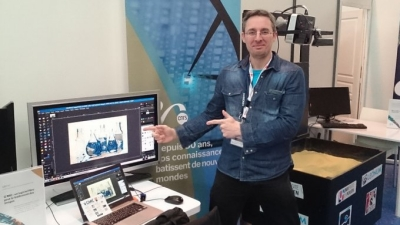
G’MIC is a piece of software that has been developed for more than 10 years now, mainly in C++, by two members of the IMAGE team of the GREYC lab: Sébastien Fourey and David Tschumperlé. It is distributed under the terms of the CeCILL free-software license. GREYC is a French public research laboratory located in Caen, specialized in digital sciences, under the head of three academic institutions: CNRS, University of Caen, and ENSICAEN.
The IMAGE team, one of the seven teams in the laboratory, is composed of researchers, professors, Ph.D. students and engineers, all specialized in the fields of algorithmics and mathematics of image processing.
Fig.1.1: G’MIC project logo, and its mascot “Gmicky” (designed by David Revoy).
G’MIC is cross-platform (GNU/Linux, MacOS, Windows, …). It provides various user interfaces for manipulating generic image data, i.e. 2D or 3D hyperspectral images or sequences of images with floating-point values (which indeed includes “usual” color images). Around a thousand different processing functions are already available. However, arbitrarily many features can be added thanks to an integrated scripting language.
The most commonly used G’MIC interfaces are: the gmic command, that can be accessed from the command line (which is an essential complement to ImageMagick or GraphicsMagick), the G’MIC Online Web service, but above all, the plug-in G’MIC-Qt, available for the well-known image editing software GIMP, Krita, and Paint.net. It provides more than 500 different filters to apply on images.
Fig.1.2: The G’MIC-Qt plug-in, here in version 2.7, is at the moment the most downloaded user interface of the G’MIC project.
Thanks to its extensible architecture, G’MIC is regularly enhanced with new image processing algorithms, and it is these latest additions that will be discussed in the following sections.
2. Add style to your images!
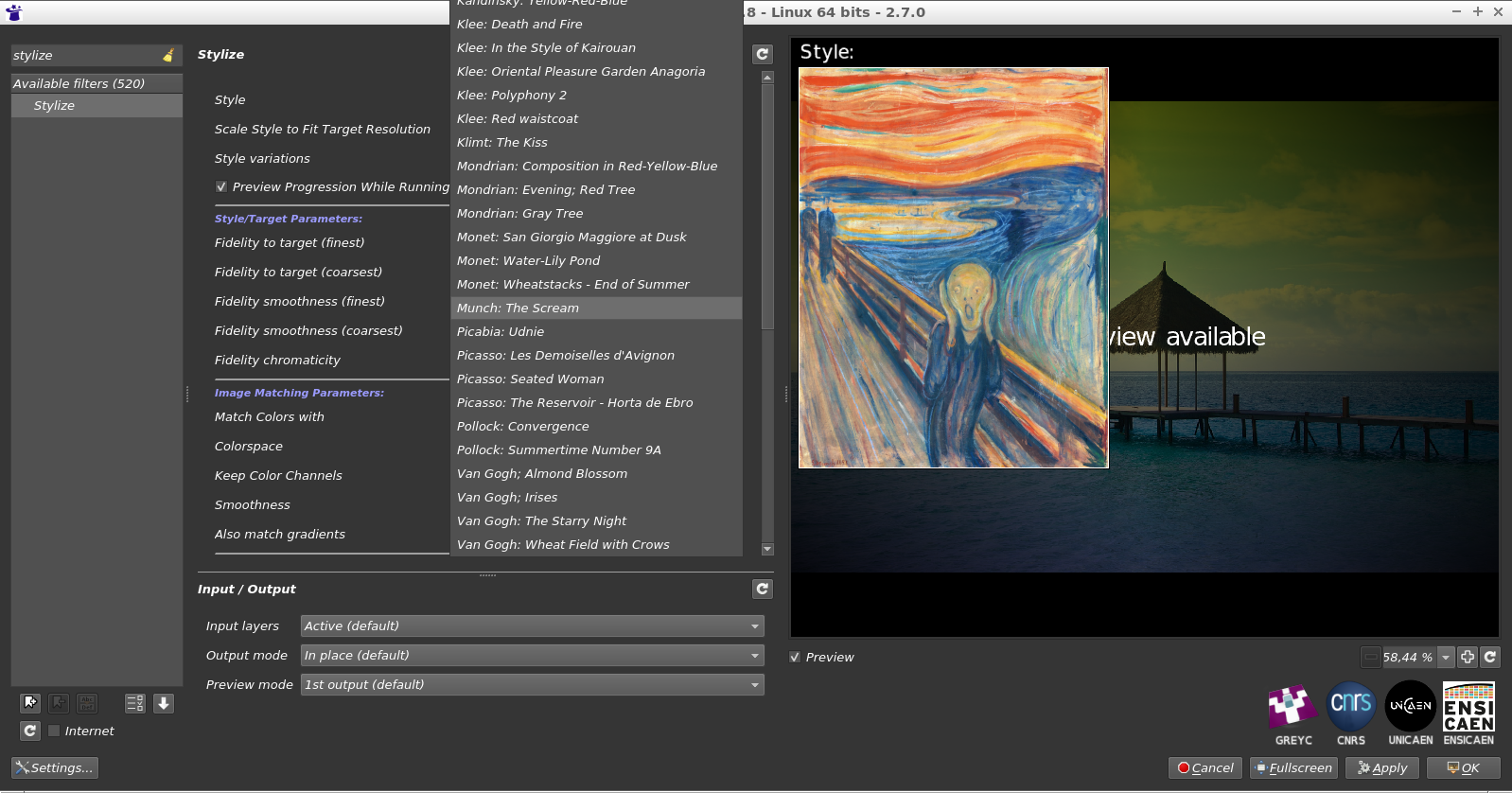
G’MIC has recently implemented a neat filter for style transfer between two images, available from the G’MIC-Qt plug-in under the “Artistic / Stylize“ entry.
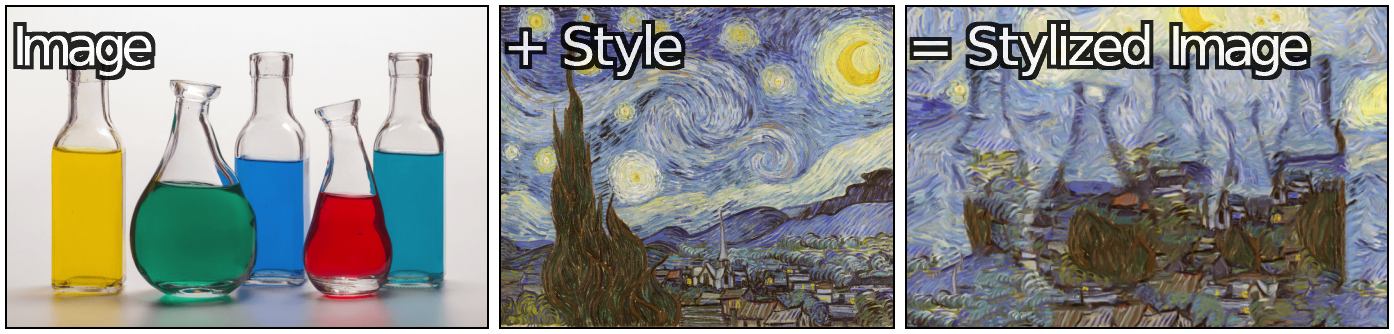
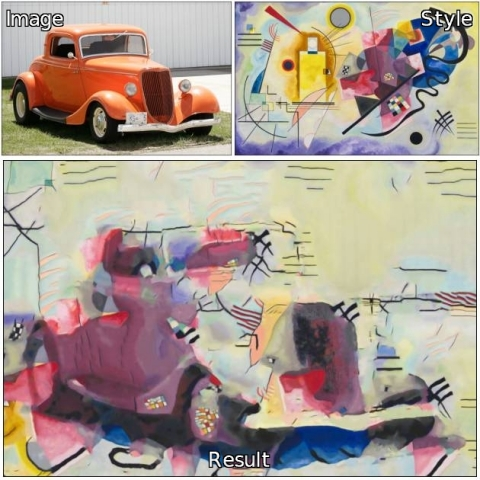
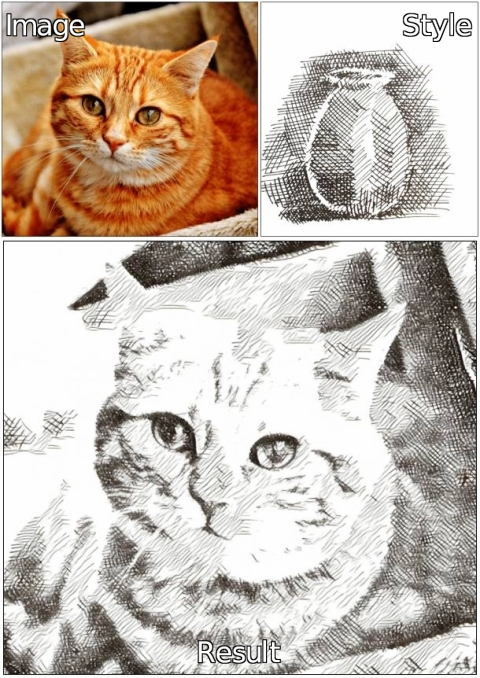
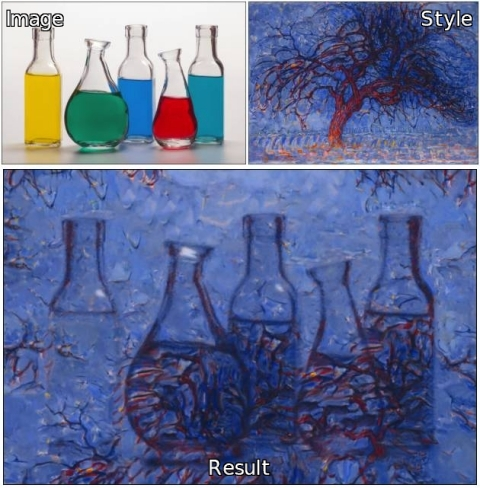
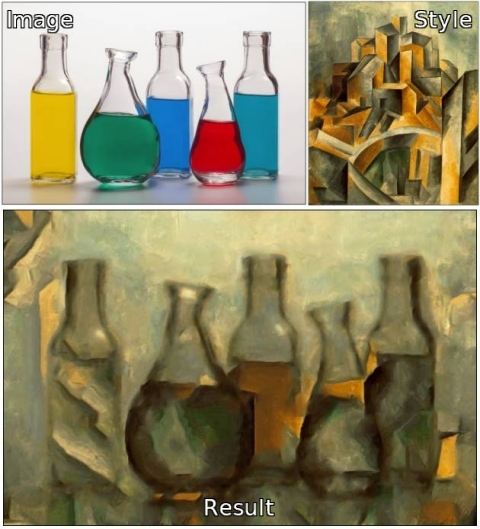
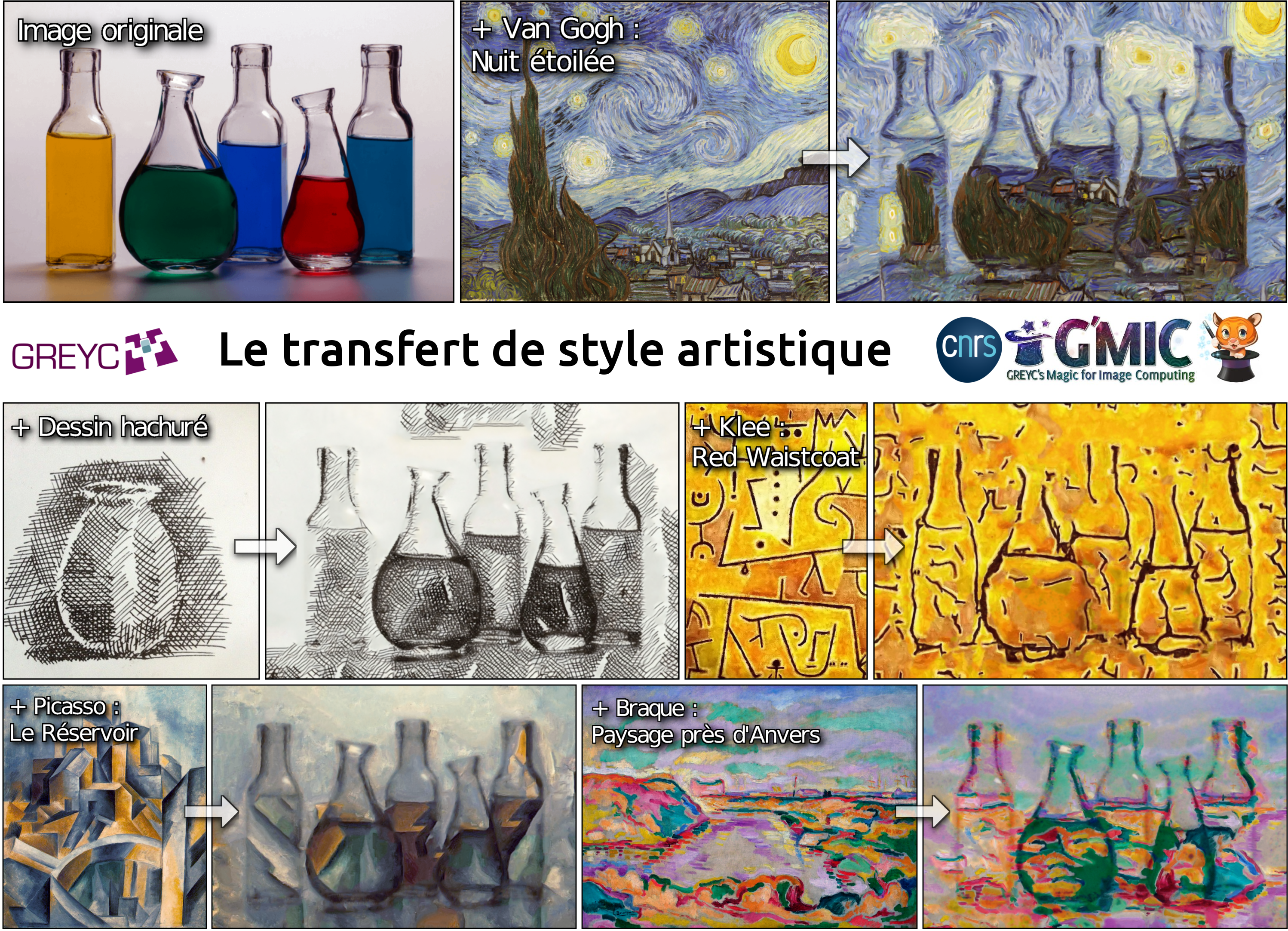
The concept of style transfer is quite simple: we try to transform an image (typically a photograph) by transferring the style of another image to it (for example a painting).
Fig.2.1: Principle of style transfer between two images.
The implementation of such a style transfer method is relatively complex: The algorithm must be able to recompose the original photograph by “borrowing” pixels from the style image and intelligently combining them, like a puzzle to be reconstructed, to best match the content of the data to be reproduced, in terms of contours, colors and textures. How easily this is done depends of course on the compatibility between the input image and the chosen style. In computer graphics, most existing implementations of style transfer methods are based on convolutional neural networks, more particularly generative adversarial networks (GANs).
G’MIC implements style transfer in a different way (without relying on neural networks, the scientific article detailing the algorithm is currently being written!). This method is parallelizable and can therefore benefit from all the processing units (cores) available on the user’s computer. The computation time naturally depends on the input image resolution, and the accuracy of the desired reconstruction. On a standard 4-cores PC, it could take tens of seconds for low resolution images (e. g. 800x800), up to several minutes for larger pictures.
As one can imagine, it is a very versatile filter, since we can apply any style to any input image without hard constraints. Some famous paintings are available by default in the filter, in order to propose predefined styles to the user.
Fig.2.2: “Artistic / Stylize“ filter, as it appears in the G’MIC-Qt plug-in, with its many parameters that can be tuned !
Let us be honest, it is not always easy to obtain satisfactory results from the first draft. It is generally necessary to choose your starting images carefully, and to play with the many parameters available to refine the type of rendering generated by the algorithm. Nevertheless, the filter is sometimes able to generate quite interesting outcomes, such as those shown below (the original photo is visible at the top left, the style chosen at the top right, and the result of the style transfer at the bottom). Imagine how long it would take for a graphic designer to make these transformations “by hand”!
Other examples of image stylization can be found on the image gallery, dedicated to this filter. To our knowledge, G’MIC is the only “mainstream” image processing software currently offering a generic style transfer filter, where any style image can be chosen.
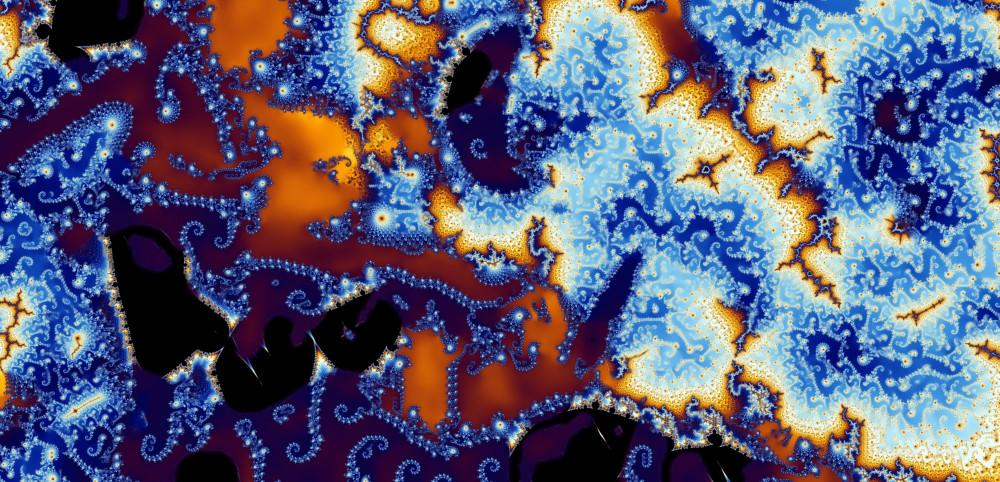
A last funny experiment: get a picture of an Alien’s head, like Roswell, and then select a crop of the Mandelbrot fractal set as your style image. Use the transfer filter to generate a “fractal” rendering of your alien head. Then, make the whole world believe that the Mandelbrot set contains the mathematical proof of the existence of aliens… ☺
Fig.2.9: Breaking News! An Alien head was found in the Mandelbrot fractal set ! (if you don’t see it at first sight, tilt your head to the left…)
In short, this filter has a clear creative potential for all kind of artists!
3. Interactive deformation and morphing
This year, G’MIC got an implementation of the RBFs interpolation method (Radial Basis Functions), which is able to estimate a dense interpolated function in any dimension, from a known set of scattered samples (not necessarily located on a regular grid). Thus, it gave us the idea to add distortion filters where the user interaction is focused in adding and moving keypoints over the image. In a second stage, G’MIC interpolates the data represented by these keypoints in order to perform the distortion on the entire image.
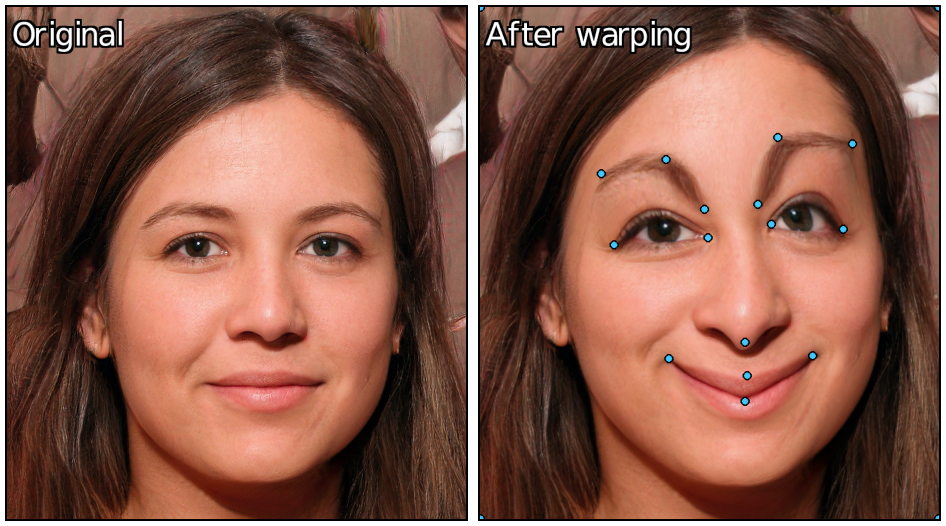
Let us start with the “Deformations / Warp [interactive]” filter which, as its name suggests, allows the user to distort an image locally by creating/moving keypoints.
Fig.3.1: The new “Deformations / Warp [interactive]” filter allows images to be distorted interactively, for example to quickly create caricatures from portrait photographs.
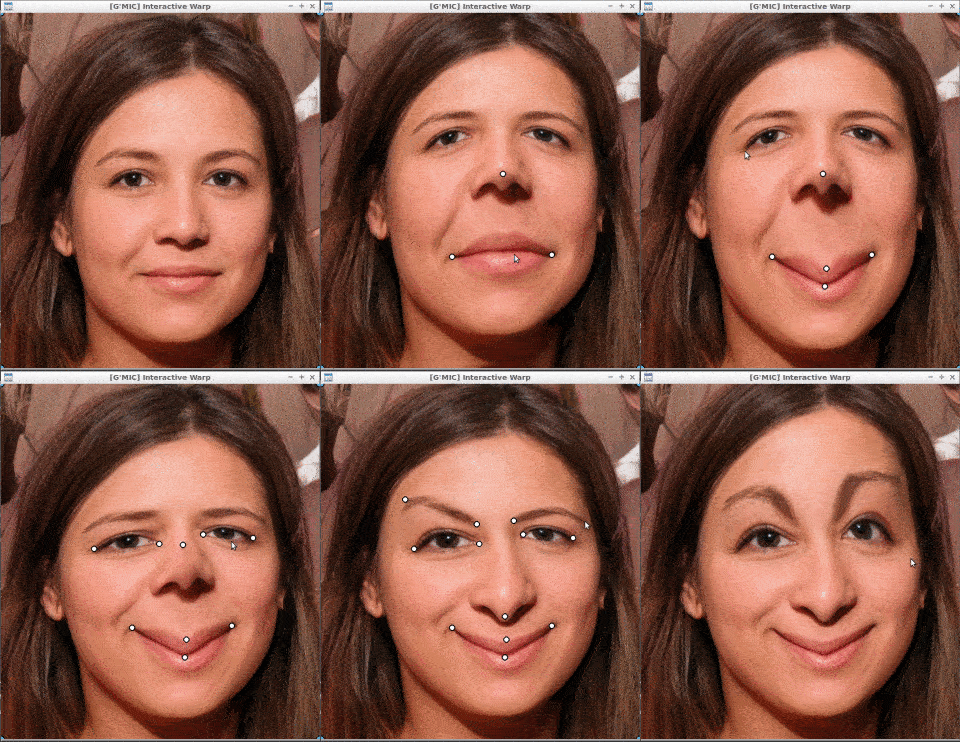
The animation below shows this interactive filter in use, and illustrates the fact that these keypoints can be considered as anchors to the image, when they are moved.
Fig.3.2: Illustration of the user interaction in the G’MIC deformation filter, based on the creation and motion of keypoints.
(For those who might be concerned about the portraits photos used in the figures above and below: all these portraits are totally artificial, randomly generated by GANs via the website This Person Does Not Not Exist. No moral prejudices to dread!).
The great advantage of using RBFs-based interpolation is that we do not have to explicitly manage a spatial structure between the keypoints, for instance by defining a mesh (i.e. a “deformation grid”). This gives a greater degree of freedom in the obtained distortion (see Fig.3.3. below). And at the same time, we keep a rather fine control on the local amplitude of the applied distortion, since adding more “identity” keypoints around a region naturally limits the distortion amplitude inside this region.
Fig.3.3: RBFs interpolation is able to create complex continuous distortions, with very few keypoints (here, by inverting the positions of the right/left eyes, and only 4 keypoints used).
A short demonstration of this distortion filter is also visible in this Youtube video.
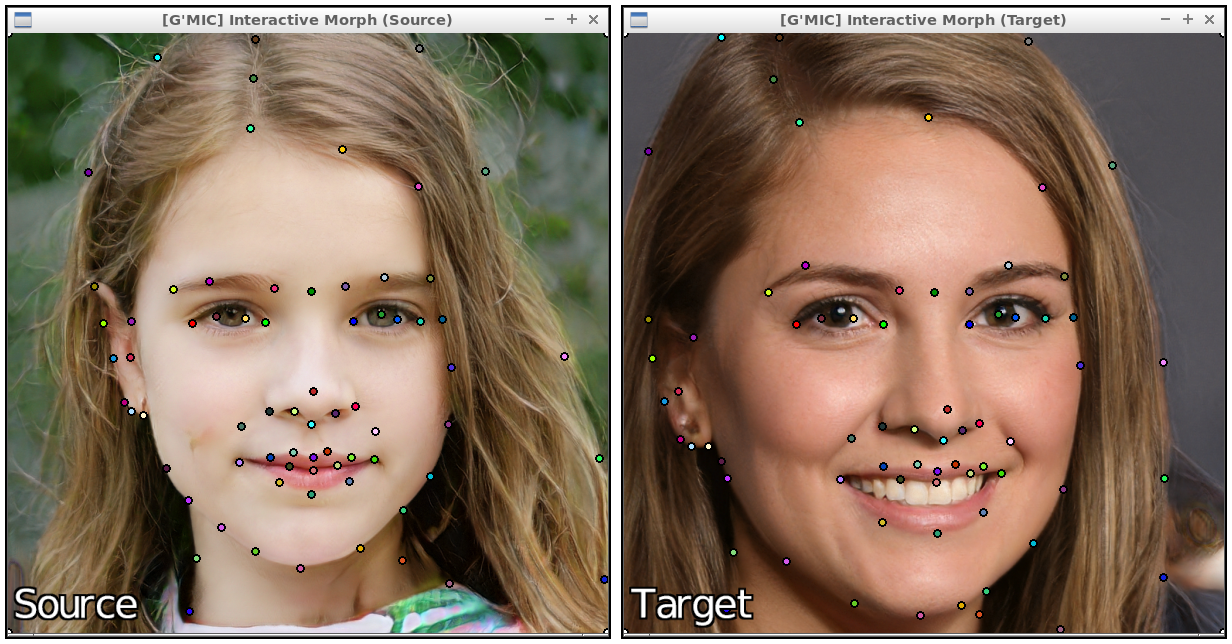
And why not extending this kind of distortion for two images, instead of a single one? This is precisely what the new filter “Deformations / Morph [interactive]” does. It is able to render a morphing sequence between two images (put on two separate layers), using the same interpolation technique that only asks for the user to set colored keypoints which match on both images.
Fig.3.4: “Deformations / Morph [interactive]” filter asks the user to position keypoints indicating correspondences between two images.
In the example above, keypoints are placed on characteristic areas of both faces (tip of nose, lips, eyebrows, etc.). In practice, this takes no more than 5 minutes. Thanks to these keypoints, the algorithm is able to estimate a global deformation map from one image to another, and can generate temporally “mixed” frames where the elements of the face remain relatively well aligned during the whole morphing sequence.
Fig.3.5: One of the intermediate images generated by the morphing filter, between the two input faces.
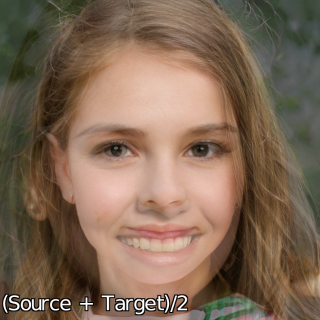
By comparison, here is what we would obtain by simply averaging the two input images together, i.e. without correcting the displacement of the facial features between both images. Not a pretty sight indeed!
Fig.3.6: A simple averaging of the “Source” and “Target” images reveals the differences in the locations of the facial features.
Thus, the morphing filter is able to quickly generate a set of intermediate frames, ranging from the “Source” to the “Target” faces, a sequence that can then be saved as an animation.
Fig.3.7: Animation resulting from the generation of all intermediate frames by the G’MIC morphing filter.
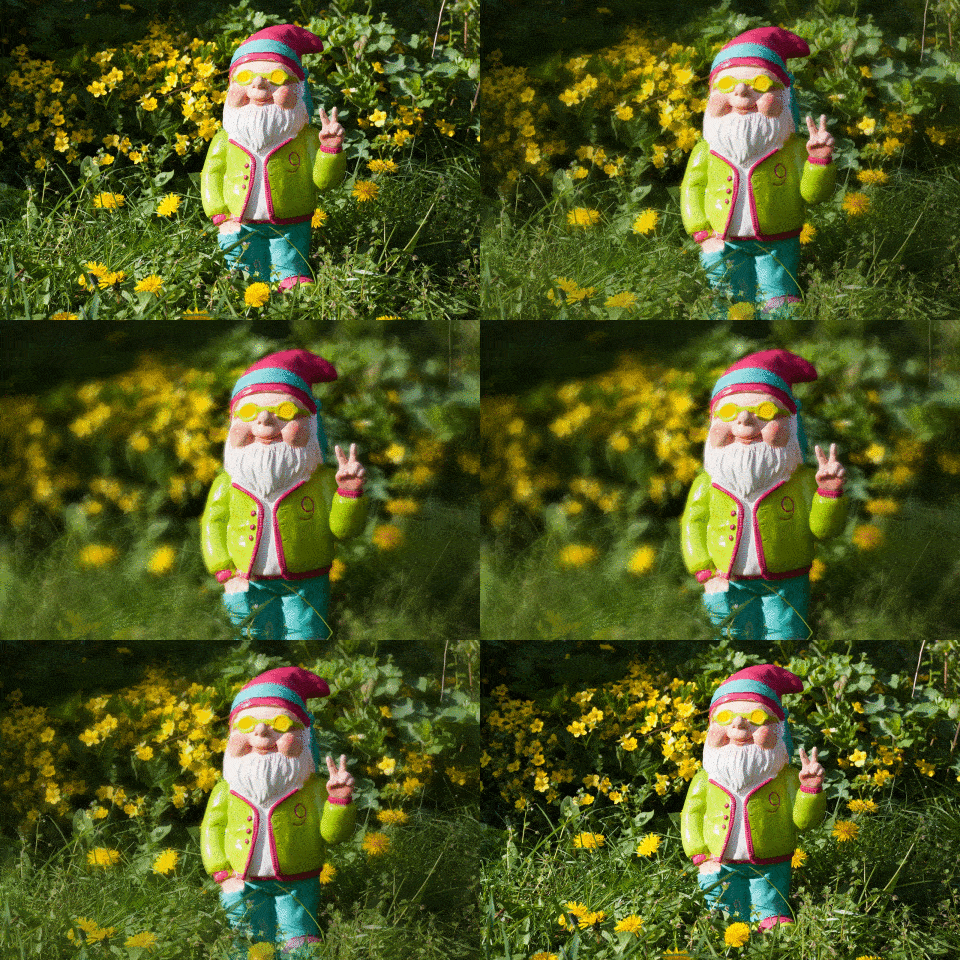
Many other use cases of this morphing filter can be considered. The following example illustrates its application to render an animation from two photographs of the same object (a garden gnome), but shot with different DOFs (Depth of Field).
Fig.3.8: Two photographs with different depths of field, and the location of the correspondence keypoints put by the user.Fig.3.9: Animation resulting from the generation of all intermediate frames by the G’MIC morphing filter.
Command line users will be pleased to know that these two filters can be tested very quickly from a shell, as follows:
For several years, G’MIC has contained colorimetric transformation filters able to simulate the film development process, or to give particular colorimetric moods to images (sunlight, rain, fog, morning, afternoon, evening, night, etc.). In a previous report, we already mentioned these filters, which are essentially based on the use of 3D CLUTs (Color Lookup Tables) for modeling the color transformation.
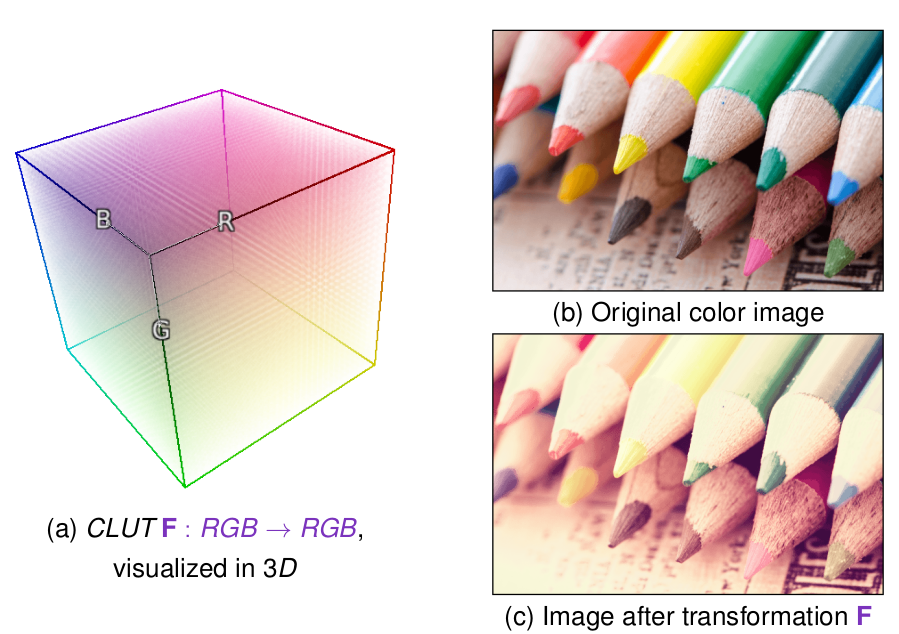
A 3D CLUT is technically a three-dimensional array that provides for each possible RGB color, a replacement color to apply to the image.
Fig.4.1: Modeling a colorimetric transformation by a “3D Color LUT”.
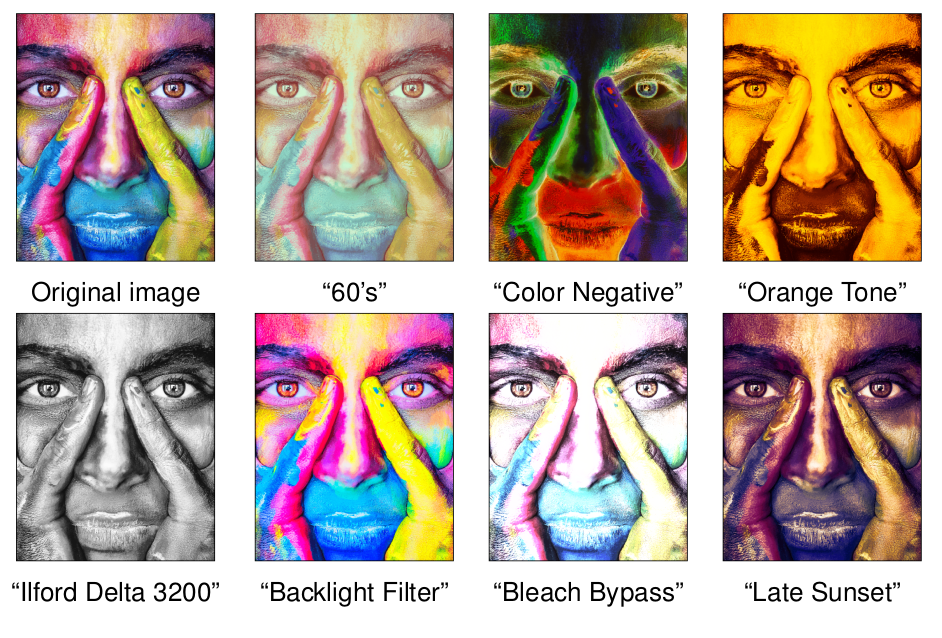
The main interest of these 3D CLUTs is the great variety of transformations they can represent: They can indeed define RGB-to-RGB functions with almost any kind of variations. The only “constraint” of these methods is that all image pixels having the same color will be transformed into pixels that also have an identical color.
Fig.4.2: Illustration of the variety of colorimetric transformations that can be modeled by 3D CLUTs.
The disadvantage, however, is that these 3D CLUTs are relatively data intensive. When you want to embed several hundred different ones in the same piece of software (which is the case in G’MIC), you quickly find yourself with a large volume of data to install and manage. For instance, our friends at RawTherapee offer on their website an additional pack of 294CLUTs functions to download. All these CLUTs are stored as .png files in a .zip archive with a total size of 402 MB. Even if downloading and storing a few hundred _MB_ is no longer limiting nowadays, it is still quite large for things as simple as color changing filters.
This year, we have therefore carried out important research and development work at the GREYC lab on this topic. The result: a new lossy compression algorithm (with visually imperceptible compression losses) that can generate binary representations of CLUTs with an average compression rate of more than 99%, relative to the data already loslessy compressed. The general idea is to determine an optimal set of color keypoints from which the CLUT can be reconstructed (decompression), and this, with a minimal reconstruction error.
Fig.4.3: Principle of our CLUT compression technique, based on determining and storing a set of well-chosen keypoints.
As a result, this original compression method allowed us to offer no less than 763 CLUTs in G’MIC, all stored in a binary file that weights less than 3 MB !
All these color variation filters have been grouped into two separate entries in the G’MIC-Qt plug-in, namely “Colors / Simulate Film” (for analog film simulations), and “Colors / Color Presets” (for other color transformations). Each of these filters provides sub-categories for a structured access to the hundreds of CLUTs available. To our knowledge, this makes G’MIC one of the image processing software with the most colorimetric transformations, while keeping a reasonable size.
Readers interested in the mathematical details of these CLUT compression/decompression algorithms may refer to the scientific paper we wrote about it, as well as the presentation slides that have been presented at the conferences GRETSI’2019 (French conference, in Lille) and CAIP’2019 (International conference, in Salerno).
Fig.4.4: Presentation slides explaining the details of the CLUT compression/decompression algorithm.
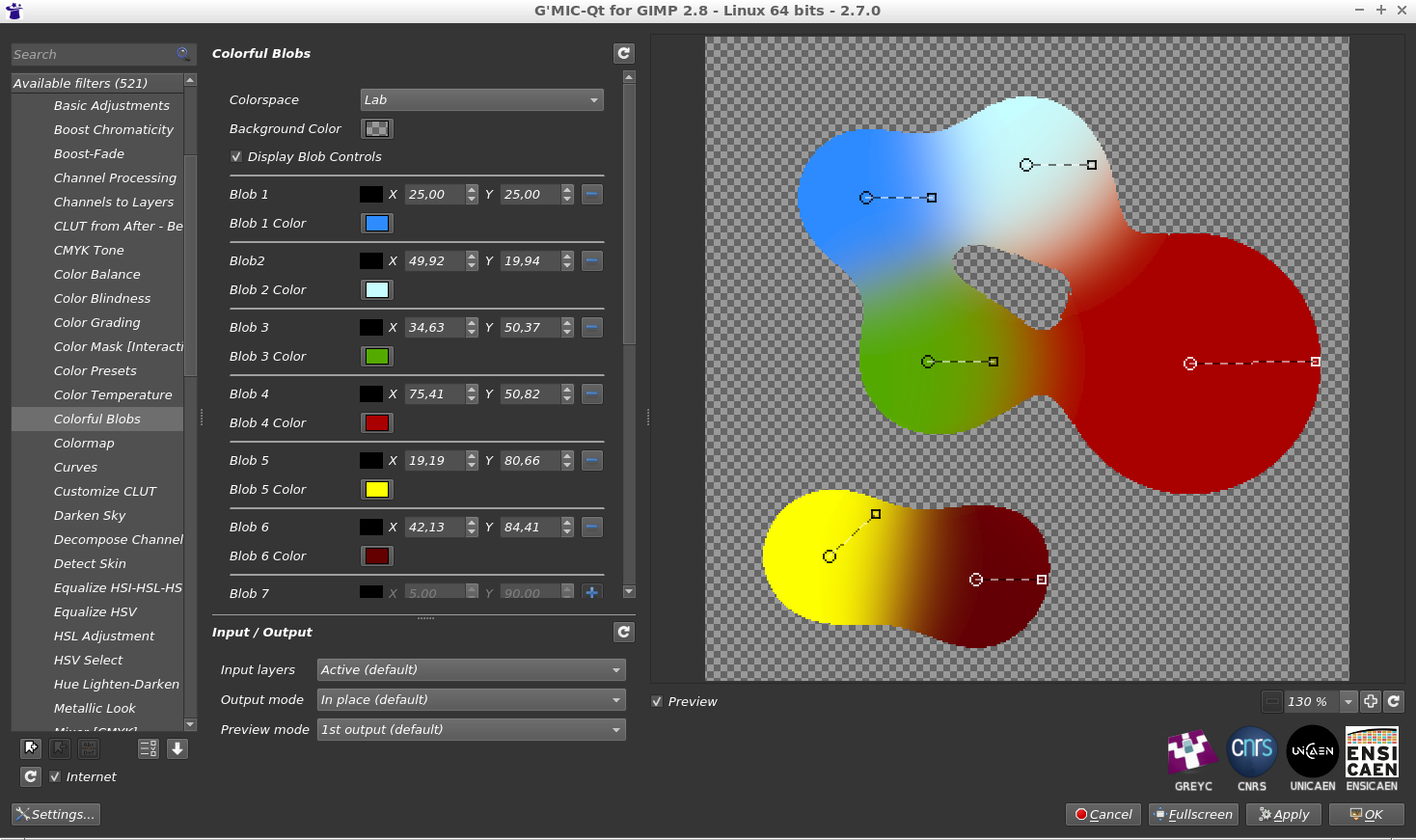
Let us now talk about the recent “Colors / Colorful Blobs” filter which is directly inspired by the original concept of Playful Palette created by the Adobe Research team in 2017. This filter is intended for illustrators (designers and digital painters). The goal: Create color palettes which contain only a few main colors (the ones you want to use in an illustration), but also a few sets of intermediate shades between these colors, in the form of color gradients. An artist is theoretically able to better preserve the color coherence of its artwork, by picking colors only from this palette.
Fig.5.1: “Colors / Colorful Blobs” filter allows you to create custom color palettes, by spatially mixing several colors together.
As shown on the figure above, the filter allows the artist to create and move colored “blobs” that, when merged together, create the desired color gradients. The result of the filter is thus an image that the artist can use afterward as a custom 2D color palette.
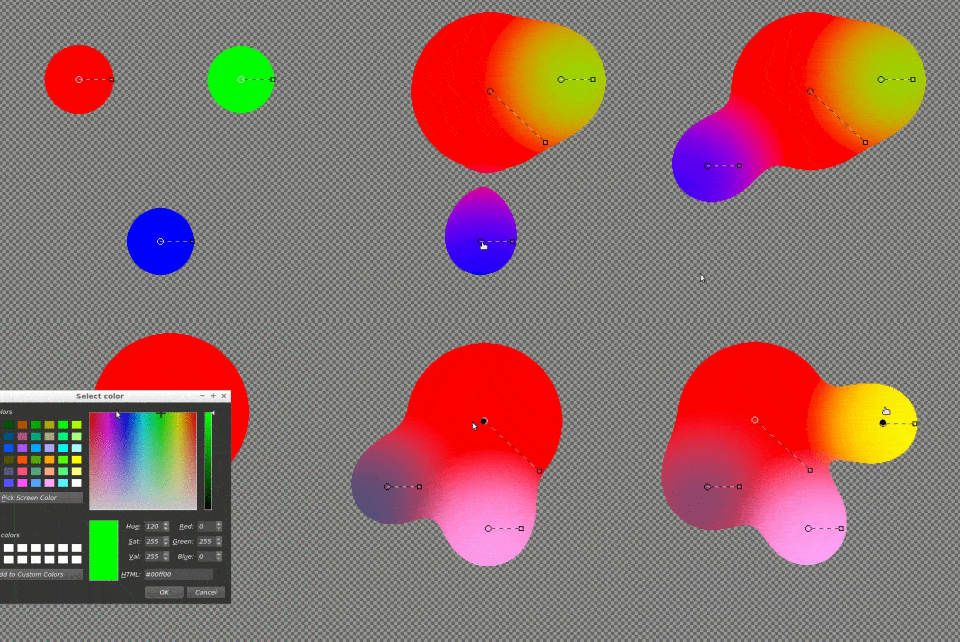
From a technical point of view, this filter is based on 2Dmetaballs to model the color blobs. Up to twelve separate blobs can be added and different color spaces can be chosen for the calculation of the color gradient (sRGB, Linear RGB or Lab). The filter also benefits from the recent development of the G’MIC-Qt plug-in that enhances the user interactivity inside the preview widget (a feature we mentioned in a previous report), as seen in the animation below (see also this longer video).
Fig.5.2: Illustration of the user interaction with the G’MIC palette creation filter, based on the creation and movement of colored “blobs”.
This filter may not be useful for most G’MIC users. But you have to admit, it’s pretty fun, isn’t it?
6. Some more filters
Let us now describe a selection of a few other filters and effects added during the year, perhaps less original than the previous ones (but not completely useless anyway!).
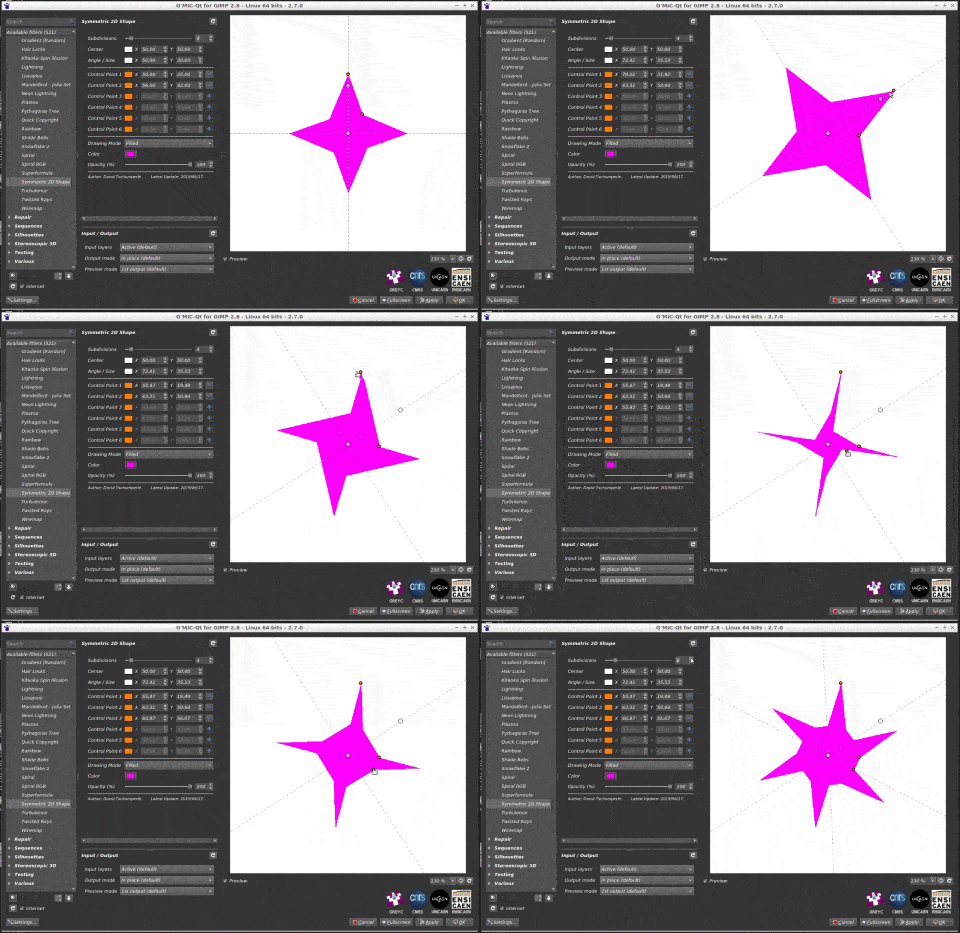
First of all, the “Rendering / Symmetric 2D Shape” filter is a great help when you want to draw geometric shapes having angular symmetries.
Fig.6.1: “Rendering / Symmetric 2D Shape” filter in action, in the G’MIC-Qt plug-in.
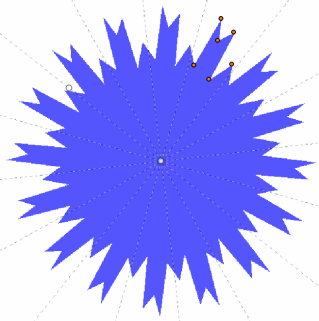
The plane can be subdivided into up to 32 angular pieces, each of which can contain a maximum of six keypoints to define a shape profile, allowing potentially complex and varied shapes to be rendered (such as the super-shuriken below!).
Fig.6.2: Example of a complex symmetrical shape obtained with the “Rendering / Symmetric 2D Shape” filter.
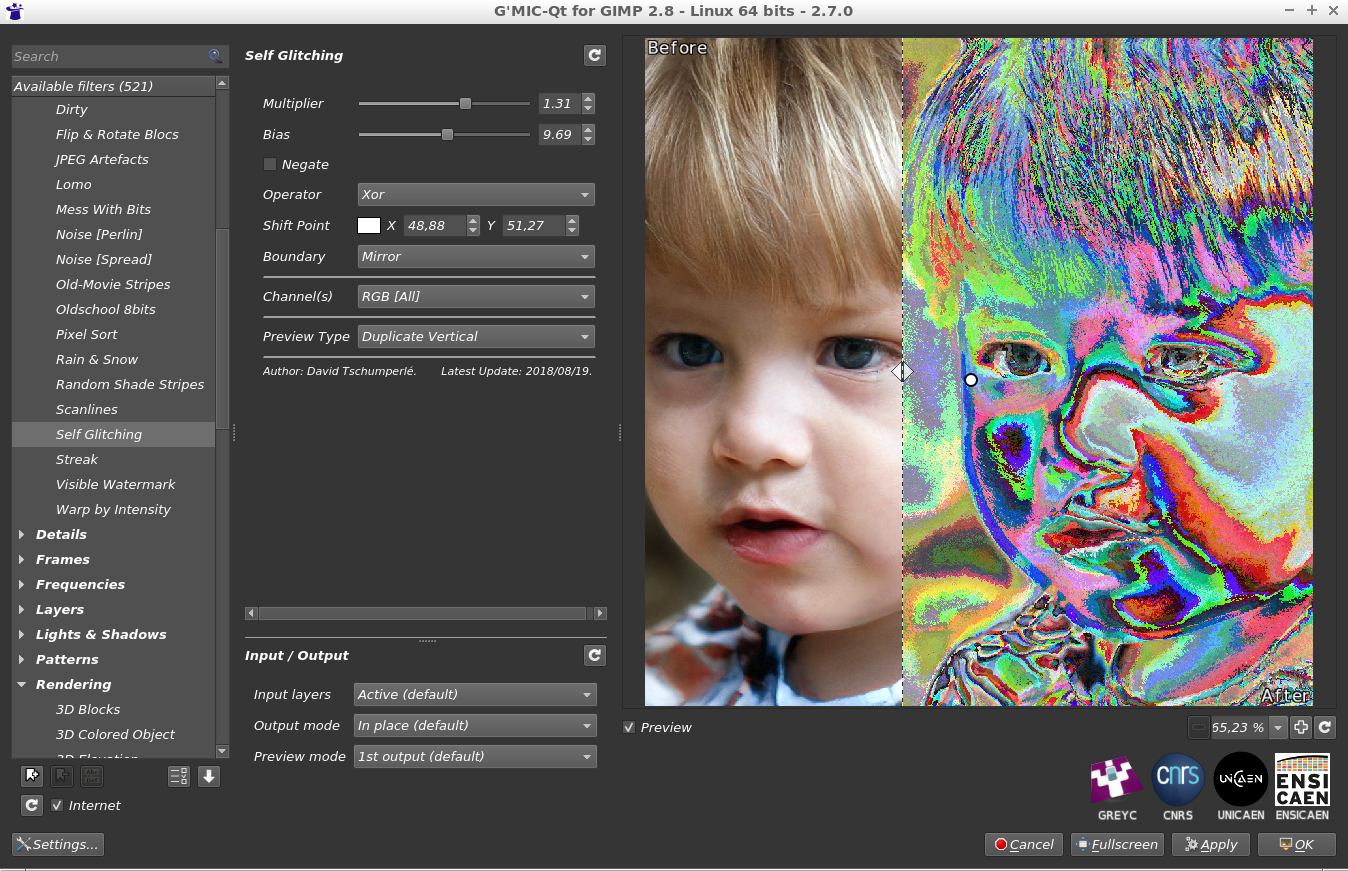
The “Degradations / Self Glitching” filter combines an image with a shifted version of itself, to create a Glitch-art type image. Several bitwise operations (Add, Mul, And, _Or_, Xor,…) can be chosen and you can adjust the shift direction and amplitude, as well as various other controls.
Fig.6.3: “Degradations / Self Glitching” filter helps to ruin your photos easily!
Again, this is not a filter that will necessarily be used every day! But it may be helpful for some people. It was actually added in response to a user request.
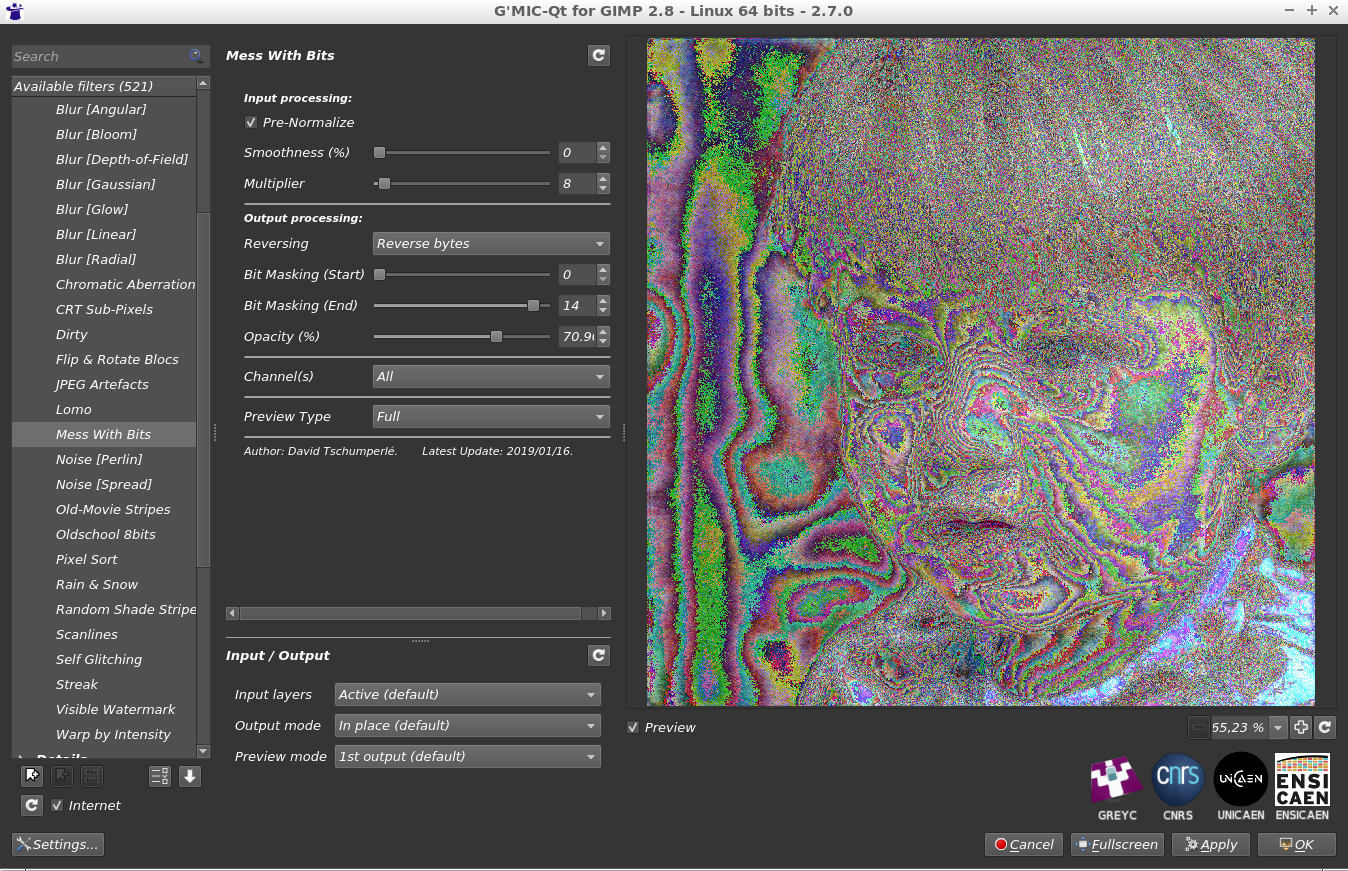
In the same style, the “Degradations / Mess With Bits” filter applies some arithmetic operations to the pixel values, seen as binary numbers (for instance, bit shift and bit inversion). Always with the idea of rendering Glitch art, of course!
Fig.6.4: “Degradations / Mess With Bits” filter, or how to transform an adorable toddler into a pustulating alien…
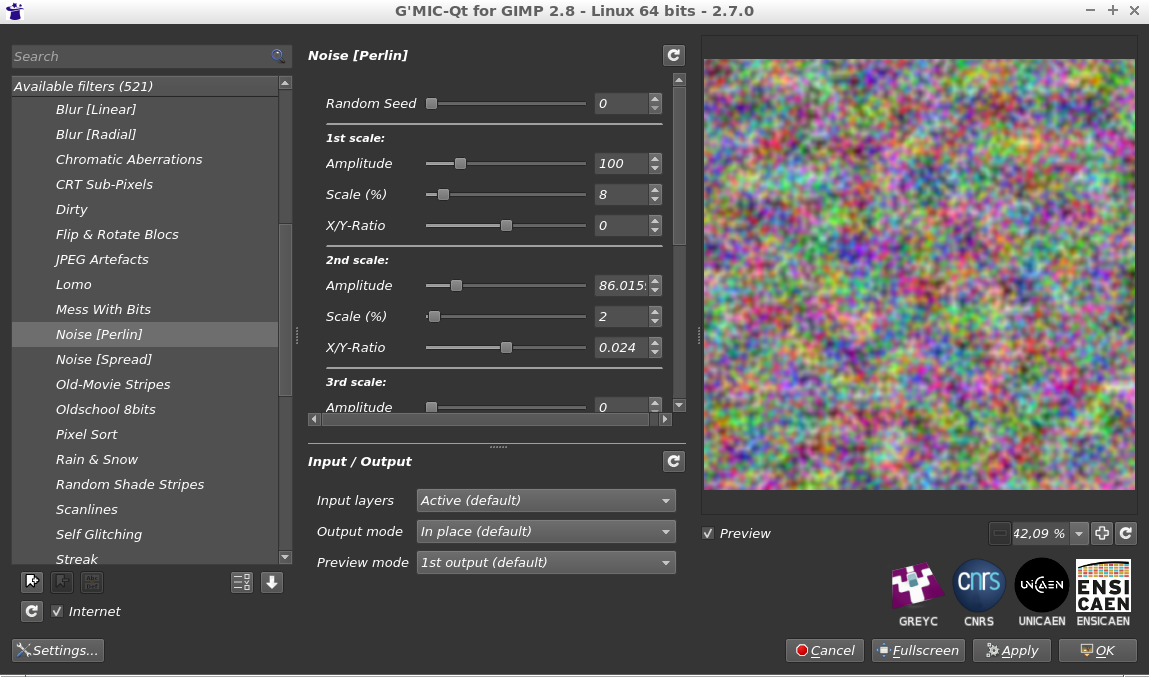
The “Degradations / Noise [Perlin]” filter implements the generation of the Perlin noise, a very classical noise model in image synthesis, used for the generation of elevation maps for virtual terrains. Here we propose a multi-scale version of the original algorithm, with up to four simultaneous variation scales.
Fig.6.5: “Degradations / Noise [Perlin]” filter proposes a multi-scale implementation of the Perlin noise (illustrated here with two variation scales).
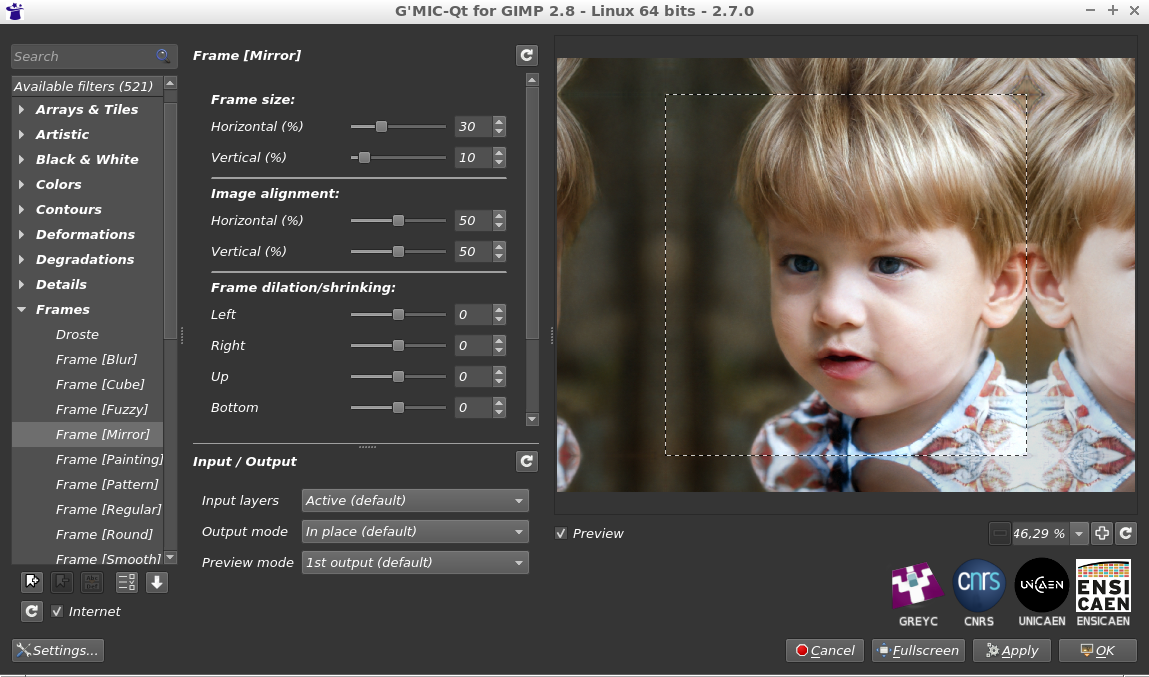
The “Frames / Frame [Mirror]” filter is also a “tailor-made” effect, to meet the needs of a G’MIC-Qt plug-in user. This photographer wanted to resize his photos to obtain a precise width/height ratio, but without having to crop his images. The solution was instead to add image information at the edges of the picture, by symmetry, in order to obtain the desired ratio. So that’s what this filter does.
Fig.6.6: The “Frames / Frame [Mirror]” filter extends the image borders by symmetry.
Finally, let us mention the upcoming advanced image noise reduction filter, by Iain Fergusson, whose development is still in progress. Iain has been contributing to G’MIC for several years now by implementing and experimenting original denoising filters, and his latest project seems really interesting, with promising results. This video shows this filter in action, a good place to learn a little more about how it works.
Now that we’ve looked at these new filters, it seems important for us to remind that, as in many IT projects, this visible part of the iceberg hides a set of lower-level developments done to improve the interactive possibilities of the G’MIC-Qt plug-in, as well as the performance of the internal scripting language interpreter (the G’MIC language), which is how all these filters and effects are actually implemented. These improvements and incremental slight optimizations of the code base benefit to all filters (even those already available for several years) and it actually represents most of the development time we spend on G’MIC. So, dear users, do not be surprised if no new filters appear for a while. It is probably just because we are doing serious work on the G’MIC framework core!
7. Other notable points in the project life
Here are listed some other important news that have punctuated the life of the project since August 2018.
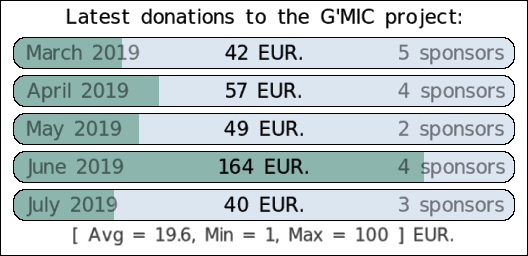
This is essential news for us: since March 2019, the G’MIC project has been granted permission to collect donations (via Paypal), to help in its maintenance and development!
This is a good thing, because until now, there was no simple way for a public research laboratory as the GREYC, to accept donations for supporting the development of a free software application such as G’MIC, an application used daily by several thousand people around the world. And we have currently no other ways to finance this piece of software in the long term.
Thus, we have partnered with LILA (Libre comme l’Art), a French non-profit organization promoting Arts, Artists and Free Software, who accepted to collect donations for us.
Fig.7.1: Logo of the LILA association, which collects donations for the G’MIC project.
In practice, this is something that has been a little long to set up, but now that the donation system is operational, we hope to benefit from it in the future to make the project development even faster (the possible use of the raised funds is detailed on the donations page, this being of course very dependent on the amount of money collected).
For the sake of transparency, we will post the monthly amount of collected donations on the project website. At this point, we don’t really know what to expect in practice. We will see how these donations evolve. Of course, we would like to thank all those who have already participated (or plan to do so) in supporting our open-source framework for image processing. Our ultimate dream would be, one day, to say that the illustration below is only a distant memory!
Let us also mention the work of Jehan, known to PIXLS.US readers as a regular GIMP developer. Jehan has been hired by the GREYC laboratory in September 2018, to work on G’MIC (for a 12-month fixed-term contract), thanks to a grant funded by the INS2I Institute of the CNRS (for which we are grateful).
One of its first missions was to re-implement the G’MIC “Smart Coloring” algorithm (that we had already talked about previously) as a new interactive mode integrated into the existing GIMP “Bucket Fill“ tool.
Fig.7.3: G’MIC’s “Smart Coloring” algorithm, now available in GIMP, helps illustrators color their drawings more quickly.
Jehan described all his work in a blog post, which is strongly recommended for reading. Of course, we don’t want to copy his post here, but we want to mention this activity, and to consider it as another original contribution of the G’MIC project to free software for graphic creation: at the GREYC laboratory, we are really happy and proud to have imagined and developed an image colorization algorithm, which artists can use through a well integrated tool into such a popular piece of software as GIMP!
This intelligent colorization algorithm has been the subject of scientific publications, presentations at the conferences GRETSI’2017, EuroGraphics VMV’2018, as well as at the Libre Graphics Meeting’2019. And it is with a great pleasure we see this algorithm is used in real life, for various realizations (as in this great video of GDQuest, for colorizing sprites for video games, for instance).
Scientific research carried out in a public laboratory, which becomes available for the general public, that is what we want to see!
Recently, a major improvement in the performances of G’MIC under Windows has been achieved, by recoding the random number generator (now reentrant)) and removing some slow mutex which were responsible of performance drops for all filters requiring sequences of random numbers (and there were many!). As a result, some filters are accelerated by a factor of four to six under Windows!
Since December 2018, our G’MIC-Qt plug-in is available for Paint.net, a free graphic editing software application under Windows (not open-source though). This has been possible thanks to the work of Nicholas Hayes who wrote the glue code allowing the interaction between our G’MIC-Qt plug-in and the host software. Users of Paint.net are now able to benefit from the 500+ filters offered by G’MIC. This plug-in, available here, has already been voted “Best Plug-in of the Year 2018“ by the members of the Paint.net forum ☺ !
Since October 2018, the G’MIC-Qt plug-in for GIMP has been compiled and proposed for MacOS by a new maintainer, Andrea Ferrero, who is also the main developer of the free software application Photoflow, a non-destructive image editor (more information here). Many thanks Andrea, for this wonderful contribution!
Since the announced shutdown of the Google+ social network, we have opened two new accounts, on Framasphere and Reddit, to share news about the project’s life (but the Twitter feed is still our most active account).
Let us also thank Santa Claus, who kindly brang us a materialized version of our mascot “Gmicky” last year. That looks almost perfect!
Fig.7.4: The mascot “Gmicky”, brought by Santa Claus, in December 2018.
Another video tutorial, showing how to use the G’MIC“Artistic / Rodilius” filter to create stylized animal photos.
8. The future
As you see, G’MIC is still an active open-source project, and with its 11 years of existence, it can be considered as mature enough to be used “in production” (whether artistic or scientific).
We have never defined and followed a precise roadmap for the project development: the functionalities come according to the needs of the developers and users (and the limited time we can devote to it!). At the moment, there is a lot of interest in image processing methods based on neural networks, and deep learning techniques. It is therefore possible that one day, some of these methods will be integrated into the software (for instance, we already have a prototyped code running in G’MIC that actually learns from image data with convolutional neural networks, but we are still at the prototyping stage…).
After 11 years of development (make it 20 years, if we include the development of the CImg library on which G’MIC is based), we have reached a point where the core of the project is, technically speaking, sufficiently well designed and stable, so as not to have to rewrite it completely in the next years. In addition, the number of features available in G’MIC already covers a large part of the traditional image processing needs.
The evolution of this project may therefore take several paths, depending on the human and material resources that we will be able to devote to it in the future (for the development, but also in project management, communication, etc.). Achieving an increase in these resources will undoubtedly be one of the major challenges of the coming years, if we want G’MIC to continue its progress (and we already have plenty of ideas for it!). Otherwise, this image processing framework might end up being just maintained in its current (and functional) state. It is of course with a hope for progression that we have recently set up the donation page. We also hope that other opportunities will soon arise to enable us to make this project more visible (you are invited to share this post if you like it!)
That’s it for now, this long post is now over, thank you for holding on until the end, you can resume normal activity! I’ll be happy to answer any questions in the comments.
Post-scriptum: Note that the 3D animation displayed as the teaser image for this post has been actually generated by G’MIC, via the command $ gmic x_starfield3d. An opportunity to remind that G’MIC also has its own _3D_ rendering engine capable of displaying simple objects, which is very practical for scientific visualization! We may have the occasion to talk about it again in a future post…
A special thank you for reviewing and helping to translate this article to: Patrick David, Sébastien Fourey, Christine Porquet, Ryan Webster.
We turn to children's and YA literature in this week's episode, with Rozalind Dineen and Toby Lichtig presenting new releases (as reviewed by a selection of young readers), as well as discussing some of the pros and cons of age-specific reading; Robert Douglas-Fairhurst reintroduces J. M. Barrie's classic work Peter Pan, where a wild imagination masks tragic, sometimes disturbing, realities
Gravamos 17 horas de rotina de uma casa coletiva. São dez adultos, seis crianças e seis gatos morando juntos e dividindo os espaços comuns de um casarão em São Paulo. Contas e tarefas domésticas também são compartilhadas, num esquema orgânico em que há apenas uma regra: cada dia um dos adultos prepara o jantar para todo mundo.
Mergulhe nessa história escutando o Episódio 12 de Escafandro. Assine no seu aplicativo de podcast predileto e ouça de graça.
What kind of son was Philip Larkin? The TLS's poetry editor Alan Jenkins finds insight in some of the 4,000-odd letters and postcards the poet sent home to his "Mop" and "Pop"; Helen Macdonald, the author of H is for Hawk, tells us more than we could ever hope to know about pigeons and pigeon fanciers; Norma Clarke considers the internet artist Cold War Steve, whose ‘furious absurdism’ has won him some 192.8K Twitter followers, and ponders connections with the eighteenth-century satires of Hogarth and Gillray
Letters Home, 1936–1977, by Philip Larkin, edited by James Booth
Homing: On pigeons, dwellings, and why we return, by Jon Day
Cold War Steve Presents...The Festival of Brexit, by Cold War Steve
No final da década de 1990, uma pequena cidade da grande São Paulo viveu um escândalo que abalou a politica nacional. Todos os vereadores da câmara municipal foram subitamente afastados de seus mandatos. Menos um.
No primeiro episódio de Escafandro, partimos dessa história para mostrar um pouco de como são os homens públicos mais próximos da população: os vereadores.
E de como as câmaras municipais replicam a política de outras esferas, criando heróis e vilões que mudam de lado com o tempo, ou apenas conforme o ponto de vista de quem observa.
Confira no Episódio 11 de Escafandro. Assine no seu aplicativo de podcast predileto e ouça de graça
*****
– Colabore com a Rádio Escafandro e receba recompensas.
Terceiro episódio do podcast de livros da revista Quatro Cinco Um. No primeiro bloco, uma conversa com o escritor Daniel Galera sobre Máquinas como eu, romance sobre inteligência artificial de Ian McEwan. Em seguida, as curadoras de uma exposição no MASP sobre arte feita por mulheres, Lilia Schwarcz e Mariana Leme, comentam o apagamento das artistas femininas na história da arte e a redescoberta de seu legado. E no terceiro bloco os antropólogos Luiz Eduardo Soares e Gabriel Feltran, autores de Desmilitarizar e de Irmãos: uma história do PCC, discutem a crise de segurança e as propostas de desmilitarização das polícias e de legalização das drogas.
The whereabouts of the "Salvator Mundi", the most costly artwork in the world, are still uncertain, as is its attribution to Leonardo da Vinci. Federico Varese, best known for his studies of the mafia, follows the trail; the TLS's history editor David Horspool considers the inner and outer worlds of Anne Frank’s diary, the actual anniversary of the Peterloo massacre, and a selection of other contributions to this week's special issue; Ladee Hubbard reflects on the late Toni Morrison, who died last week, and considers 'The Pieces I Am', a documentary that highlights Morrison's multifaceted life, work and legacy
The Collected Works, by Anne Frank, translated by Nancy Forest-Flier, Susan Massotty, Mirjam Pressler and Kirsten Warner and edited by Mirjam Pressler
Peterloo: The English uprising by Robert Poole
Legacy: One family, a cup of tea and the company that took on the world, by Thomas Harding
Jill Lepore traces the history of conspiracy theories and the conditions that allow them to thrive; Tim Crane talks us through whether we have free will or not, and why it is still a problem; Michael Caines looks at non-traditional approaches to criticism
Books
CONSPIRACY THEORIES AND THE PEOPLE WHO BELIEVE THEM, edited by Joseph E. Uscinski
CONSPIRACIES OF CONSPIRACIES: How delusions have overrun America, by Thomas Milan Konda
THE STIGMATIZATION OF CONSPIRACY THEORY SINCE THE 1950s: ‘A plot to make us look foolish’, by Katharina Thalmann
THE AMERICAN CONSPIRACIES AND COVER-UPS: JFK, 9/11, the Fed, rigged elections, suppressed cancer cures, and the greatest conspiracies of our time, by Douglas Cirignano
REPUBLIC OF LIES: American conspiracy theorists and their surprising rise to power, by Anna Merlan
A LOT OF PEOPLE ARE SAYING:The new conspiracism and the assault on democracy, by Russell Muirhead and Nancy L. Rosenblum
HARVESTER OF HEARTS: Motherhood under the sign of Frankenstein, by Rachel Feder
THE HUNDREDS, by Lauren Berlant and Kathleen Stewart
TUNNEL VISION, by Kevin Breathnach
ON THE LITERARY MEANS OF REPRESENTING THE POWERFUL AS POWERLESS, by Steven Zultanski
The Limits of Free Will: Selected essays by Paul Russell
Aspects of Agency: Decisions, abilities, explanations, and free will by Alfred R. Mele
Self-Determination: The ethics of action – Volume One by Thomas Pink
No segundo episódio do podcast de livros da revista Quatro Cinco Um, uma conversa sobre educação com Sérgio Haddad, autor da biografia O educador: um perfil de Paulo Freire. Em entrevista, a historiadora Silvana Jeha fala de seu livro sobre a história da tatuagem no Brasil. E os livreiros Maristela Calil e Ricardo Lombardi conversam com o apresentador Paulo Werneck sobre os sebos que administram em São Paulo, Livraria Calil e Desculpe a Poeira, e sobre o mercado de livros usados no país.
Following the discovery of a strange book, Sarah Green revises the story of the late nineteenth-century poet Lionel Johnson, whose legacy was distorted in the 1950s by a criminal with a taste for fancy bedding; in the US, of 70,000 cases that went to disposition in 2016, more than 99 per cent resulted in conviction. What does this tell us? Clive Stafford Smith explains why American justice is a mirage; since 2015, Refugee Tales – part walking pilgrimage, part protest, part collection of narratives about those unjustly treated by Britain’s immigration system – has become an annual event. David Herd tells us what ground remains to be covered
Doing Justice: A prosecutor’s thoughts on crime, punishment, and the rule of law, by Preet Bharara
Nick Groom ponders the fate of the beleaguered British countryside and shares new theories about the economics of the natural world; En Liang Khong takes us through the increasingly global phenomenon of Japanese manga (which translates as “pictures run riot”); Damian Flanagan on Mishima, a writer who yearned to transcend time and identity
Green and Prosperous Land: A blueprint for rescuing the British countryside by Dieter Helm
Who Owns England?: How we lost our green and pleasant land and how to take it back, by Guy Shrubsole
Manga, and exhibition at the British Museum in London
Star, by Yukio Mishima; translated by Sam Bett
The Frolics of the Beasts, by Yukio Mishima; translated by Andrew Clare
"The sociable side of nineteenth-century musical life is not acknowledged as often as it should be..." – Laura Tunbridge discusses the interconnected, complicated and often contradictory myths and realities that link Chopin, Schumann and Brahms; the TLS's music editor Lucy Dallas takes us through a selection of other pieces on music in this week's issue, including new histories of the blues and the poetic pop of Kate Bush and the Pet Shop Boys; when Irving Sandler wrote his seminal history of abstract expressionism, he neglected to mention Lee Krasner, Joan Mitchell, Helen Frankenthaler, Grace Hartigan and Elaine de Kooning – Jenni Quilter joins us to put these artists back in the frame
Ninth Street Women: Lee Krasner, Elaine de Kooning, Grace Hartigan, Joan Mitchell and Helen Frankenthaler: Five painters and the movement that changed modern art, by Mary Gabriel
Fryderyk Chopin: A life and times by Alan Walker
Schumann: The faces and masks by Judith Chernaik
Brahms in Context, edited by Natasha Loges and Katy Hamilton
(with Liebeslieder Walzer, Opus 52, performed by the London Philharmonic Orchestra)
Up Jumped the Devil: The real life of Robert Johnson by Bruce Conforth and Gayle Dean Wardlow
The Original Blues: The emergence of the Blues in African American vaudeville, by Lynn Abbott and Doug Seroff
It’s the centenary of the birth of Iris Murdoch, the novelist-philosopher who dominated the literary pages for much of the twentieth century. Where do we stand on her now? Michael Caines and Frances Wilson discuss; This was the week that the US women’s football team won the World Cup. Devoney Looser, the roller derby queen of academia, enjoys “a brief opportunity to revel in America’s better strengths”.
A weekly email from our star chefs featuring the latest recipes and seasonal eating ideas
Each week we’ll send you an exclusive newsletter from our star food writers. We’ll also send you the latest recipes from our star chefs, stand-out food features and seasonal eating inspiration, plus restaurant reviews from Grace Dent.
Sign up below to start receiving the best of our culinary journalism in one mouth-watering weekly email.

 Login
Login