Login
LoginHow to survive abandonment by America
Allies are planning for a lonelier, harsher world: a report from South Korea



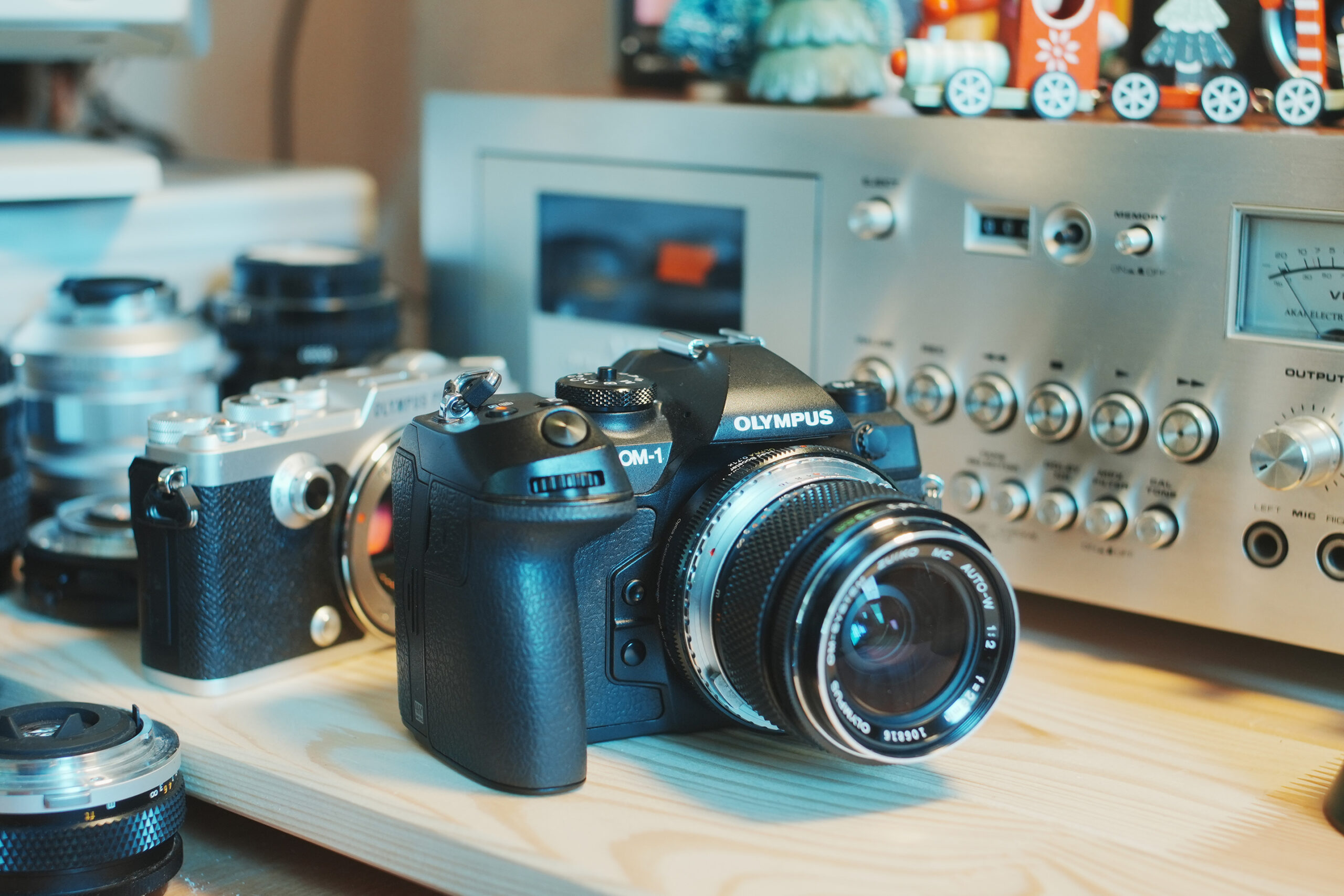
Olympus never gave us a digital full frame camera. It’s one of the biggest regrets of the camera industry. However they did leave us with this… the final Olympus Micro Four Thirds camera.
I have just fitted a Metabones Speed Booster with Olympus OM SLR lenses to my OM-1, be it video or stills, this camera is not just underrated but a powerhouse of good design and good images.
Here is my tribute to the final camera to bear the Olympus badge.
I have two Metabones Speed Boosters with Canon EF mount.
Turns out EF is a good choice. All of Olympus OM SLR lenses, M42, Nikon F and Contax Yashica adapt to EOS although I do miss my Minolta MD and Canon FD lenses on this adapter, the look of the OM lenses on this is fantastic. Caldwell Optics + some of the best vintage Japanese glass ever made.
The Metabones adapters are a tight fit on the OM-1. Be sure to apply protective tape below the EVF on the lens mount side as the thick barrel of the adapter scrapes flush with the camera housing when attaching. Once it’s on though, you get to keep it there – and have your pick of a range of vintage lenses that knock the sterile modern stuff for six.
The OM-1 appears to automatically detect the focal length of adapted manual focus vintage lenses. It doesn’t have the usual entry in the menus to add a focal length for a non-CPU lens like on Panasonic, Sony or Nikon cameras. At least I haven’t found it.
Either way, it works extremely well.
Let me make this clear… the OM-1 still in 2025 has the best IBIS on the market.
It has a much better EVF than the previous Olympus flagship, the E-M1X – although the latter handles like a mini pro DSLR or Canon 1D, which in itself is rather nice. You’ll also notice a design nod to the first Pentax full frame prototype DSLR of 2000, which was never released – just like the Olympus digital full frame camera.
The ergonomics of the OM-1 are truly exceptional. Although it’s an incredibly small camera it doesn’t handle like one somehow.
Do you know that feeling when using a camera, of a workspace? The camera is your office. You sit at the work desk of the Canon EOS R5 for example and it is smooth, slick and professional, it feels optimised and refined, but lacks that extra bit of interest or charm. The workspace of the OM-1 is tactile, smooth, deeply immersive, responsive and actually rather charming too.
This compares better than any other Micro Four Thirds camera ever made. The Olympus PEN-F digital for example although it looks pretty, has a workspace which is stiffer, slower, cheaper and more consumer. The E-M1 II and E-M1X feel more dated, especially the menus. The Panasonic GH6 has a workspace that is direct, utilitarian, but too computer-like and not really quite ‘camera’ enough whereas the OM-1 nails every aspect of what it’s like to shoot with.
The OM lenses are a perfect match for it too.
In the analogue OM days, the Zuiko OM System glass was all very well regarded for small size and superb optics. Maybe not the last word in sharpness but all had character and a nice look wide open, with very good colour and contrast. The mounting system is excellent and the OM to EOS adapters feel better made than, say, Contax Yashica mount to EOS. The locking pins are on the side of the OM lens barrel so the thin adapter doesn’t need to do much. No fiddly latch or locking lever required.
There is however a rather nice little lever on the back of the OM-1 can be configured to switch instantly between stills and video mode.
The 10bit footage in OM-LOG is a bit sharper than the 8bit material, but you can only use the Olympus colour styles in 8bit H.264. For 10bit H.265 the options are only OM-LOG and Hybrid LOG Gamma. DCI 4K up to 60fps with no crop from a stacked sensor rounds out a very capable filmmaking spec.
For stills the Olympus colour is superb and really satisfying to shoot with, it nails white balance every time as well.
So to the 0.71x Speed Booster, and my OM 28mm F2.0 becomes a 20mm F1.4, and the sensor is a 2x crop – so you end up with a 40mm field of view 35mm equivalent. This is pretty versatile and you have less distortion and sharper corners than with this same lens on full frame. My OM 24mm F2.0 becomes a 35mm equivalent wide angle (math is 24*0.71 = 17mm * 2 = 34 mm).
You can also get an 0.64x Speed Booster from Metabones but I don’t recommend using it with the OM-1. It fits my Panasonic GH5S but the optics go very far into the lens mount, the risk of hitting the shutter casing is pretty much 100% with the OM-1, so the 0.71x adapter is the sweet spot.
Speaking of the GH5S…
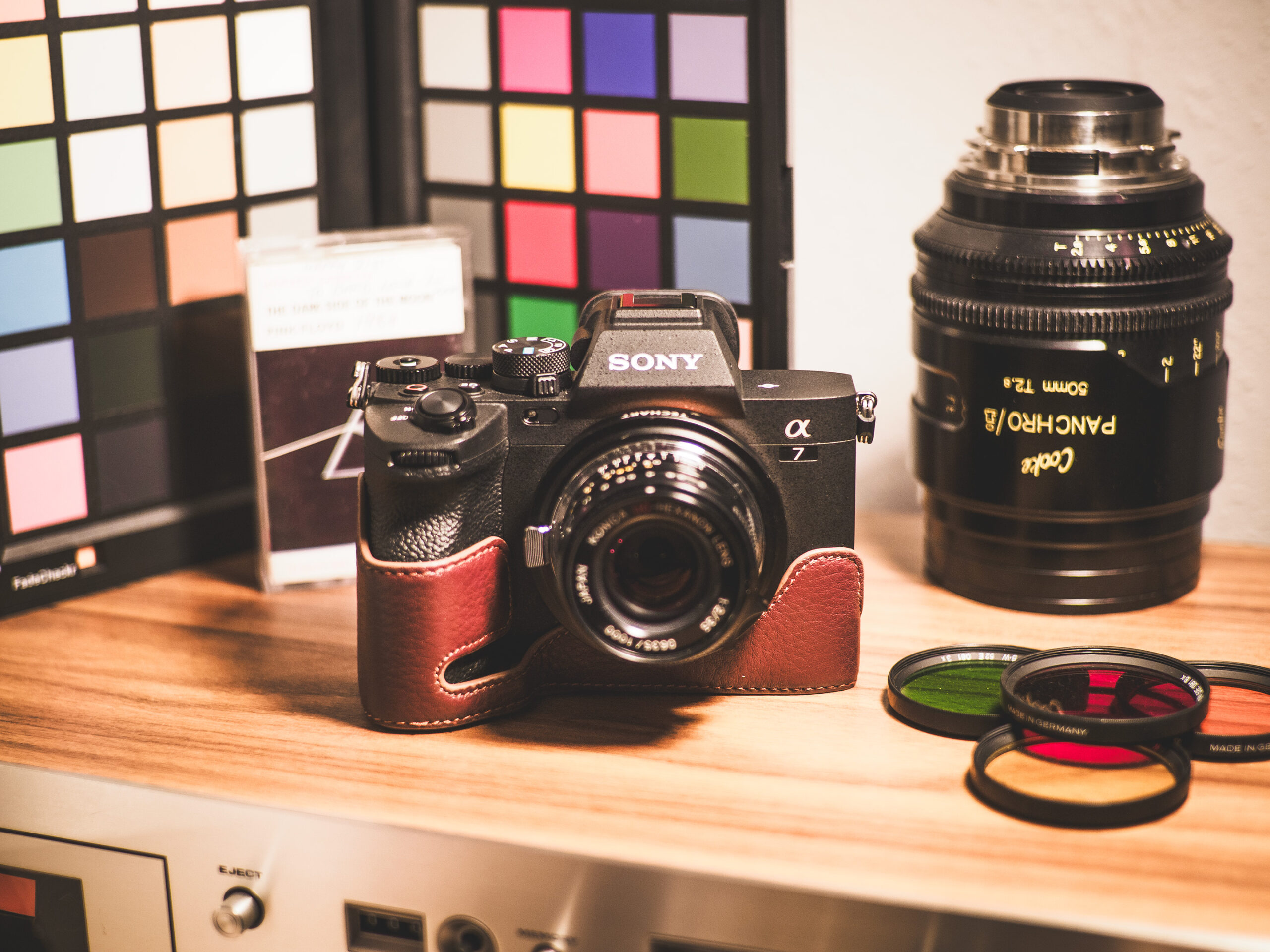
This has a larger than Micro Four Thirds sensor, it’s wider. The crop factor is 1.86x. So combined with the even wider 0.64x Speed Booster XL adapter, you’re getting very close to full frame on this, and the low light performance is just incredible with it.
24mm * 0.64 = 15.36 mm
Multiply that by the 1.86x crop factor and you get a 28mm equivalent. Therefore the GH5S can be made to perform like an APS-H 1.3x crop sensor camera!
The gain in aperture is significant too, an F1.2 lens turns into an F0.76.
If this doesn’t give you a sign that there’s still a future for the Micro Four Thirds format, I don’t know what will. There are times when I do find myself shooting more creatively with a camera like the OM-1 or GH5S than something like the usual Sony a7 series, or Canon EOS R mount camera.
And there is definitely a size and weight difference, with Micro Four Thirds telephoto lenses that difference is even more.
So hats off to Olympus. It’s a beautiful camera. Your engineers didn’t deserve the P45 you so cruelly handed out to cut a few 0.1% costs off your annual expenses.
This is what happens when an accountant turns gatekeeper of the arts and of engineering.
Sad isn’t it?
The post The Olympus OM-1 goes full frame OM appeared first on EOSHD.com - Filmmaking Gear and Camera Reviews.
Aren’t you sick and tired of nerds? They have done so much damage to life on earth. Men and women used to make love, they used to raise families and build amazing industries, now all people can do is bicker about how many stops dynamic range a Canon and Sony has.
Sony say it is 15 stops. Is the 15 stops in the room with us right now? Is the shadow realm noisy?
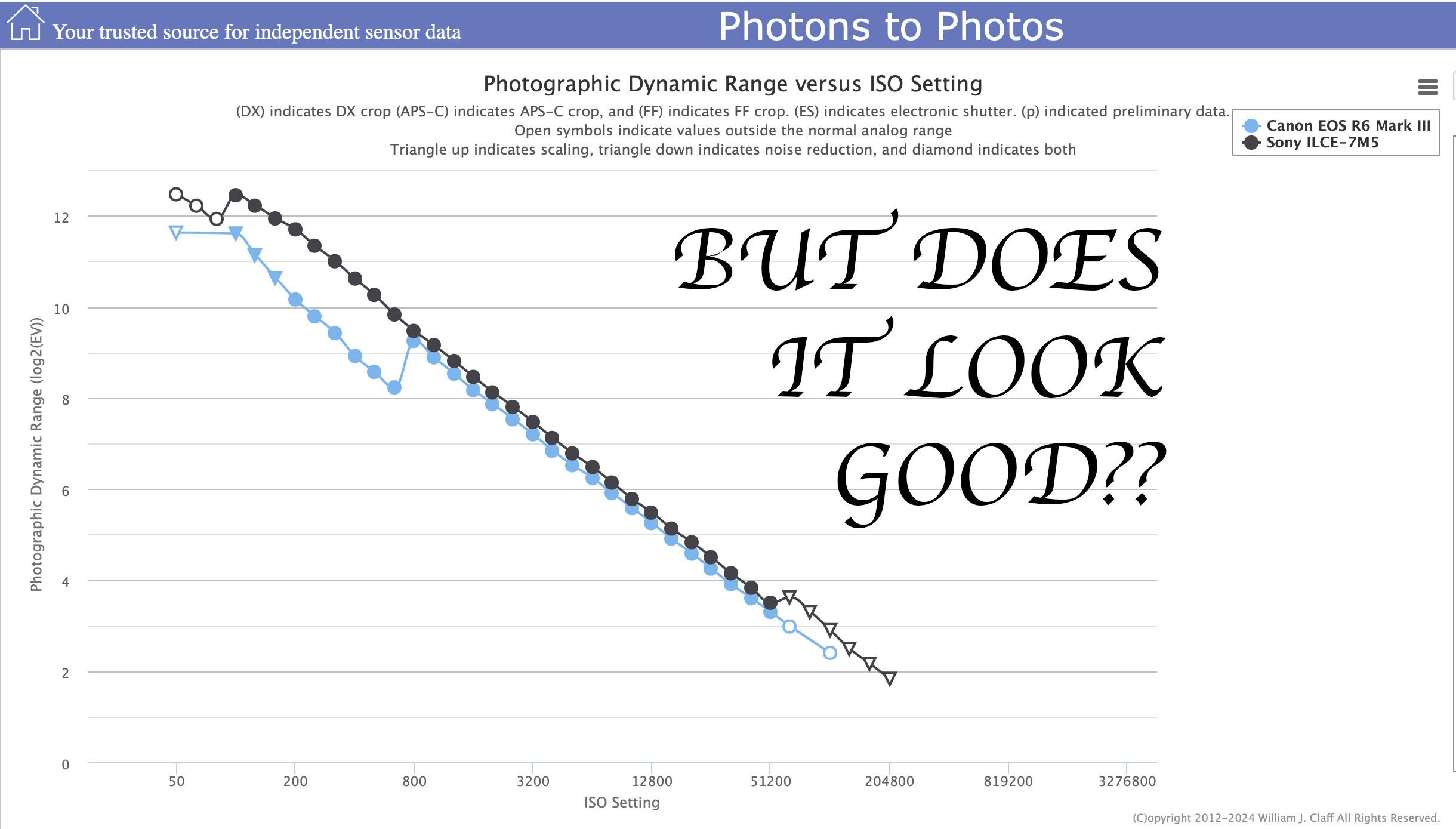
If you’re also a nerd, you may have seen the Sony a7v vs EOS R6 III dynamic range charts at PhotonstoPhotos.
These charts are excellent at photons, but we never seem to see the photos.
I want to issue a challenge to the camera community and that bloke who posts AI slop…
I want YOU to SHOW me, with IMAGES, moving or still, what 15 stops dynamic range looks like on the Sony a7 V, and then compare the same maximum HDR grading on the Canon EOS R6 Mark III, because apparently this 15 stops is very important.
Film (if you remember that) was measured at 13 stops.
I want to see a comparison at 13 stops too, digital to film.
With film, despite quite an impressive number of stops in-between the black and white parts in the same frame, colours come out rather well. The result also has something known as contrast, and a strange x-factor called tonality which means you can see the difference between colours of the same hue.
So come on camera reviewers and the equally as stupid audience… Let’s get the shadows slider and put it all the way to 11, and get the highlight slider and bring it all the way down the other way. Don’t forget to under-expose 6 stops to protect a pointless little light bulb, and have some dodgy looking human subject lurking in the shadows with noise all over his face.
Let’s see what these MAXIMUM dynamic range shots look like and then we can judge whether we actually like it or not… Then we can finally but the debate to bed – is Sony’s 15 stops of dynamic range A) real and B) a beautiful photographic tool?
For until now, all the shots I’ve seen that uses the maximum dynamic range of a sensor have been those weird over-processed HDR-sick photos you used to get all over Flickr.
I await however to be impressed. Get those images, count the stops and send them in for me to see on the EOSHD Forum.
Because the debate and clamour out there on the dweebweb is reaching a fever pitch and I can’t stand it any more. All those headlines must mean that the ultimate last couple of stops must be REALLY important, right?
12? loser territory, 13 is all the difference. Boom you have an ARRI ALEXA 35.
Alas, like Gerald Undone’s shots, the evidence is still missing after all these years!
The post The Canon EOS R6 Mark III trails the Sony a7 V dynamic range by 2 stops but nobody can find the images appeared first on EOSHD.com - Filmmaking Gear and Camera Reviews.
Depois de uma geração 'morna' com as RX 7000, em 2025, a AMD lançou as novas RX 9000 com arquitetura RDNA4, diminuindo o gap tecnológico em relação a NVIDIA, na arquitetura e principalmente nos recursos de software como o upscaler. Tudo isso parece muito bom, mas e para os overclockers, será que tem alguma novidade? É o que vamos ver nesse artigo!
O post Como deixar a RX 9070 mais rápida que a RX 9070 XT – Passo a passo com testes e resultados! apareceu primeiro em The Overclock Page.
When Sora 2 was released (invite only), results were impressive. Investors were happy, users excited. Then, a strange thing happened.
Sora began to buckle under load despite being invite only. In order to roll out Sora to all users, the technology looks to have been massively scaled back. Not only are users alleging OpenAI did this, the criticism is that they did so silently behind closed doors without elaborating. The results were clear. Overnight the quality of material generated by Sora 2 fell into the gutter like slop from a sausage machine.
EOSHD takes a look at what has been going on…
Sora 1 and the new model 2 are some of the most hyped AI tools of all time, driving enormous investor interest and at their best are capable of amazing visuals with very few imperfections.
Prompts could be incredibly complex in Sora 2 at launch, involving several sections to inform the look. In OpenAI’s own example of the otherworldly dragon, you had a “First Read” Primary Target & Visuals to lay out the general scene, followed by a Format & Look using cinematography terms like 180 degrees shutter, large format sensor, crisp micro contrast and no gate weave.
You could then go as far as to specify lenses, filters, grading and lighting. Sound is generated too. To round out the shot, the prompt can provide camera notes, location details and framing, as well as an optimised shot list to sequence it all.
The result was a few seconds, admittedly spectacular, of a dragon flying above a coastline with thunder and lighting in the background. Big whoop.
Now the thunder is very much in the foreground, for OpenAI is getting a roasting. Sora 2 at this kind of level needs a vast amounts of NVidia compute to work.
On Reddit discussions in the OpenAI sub, you can hear directly from disgruntled OpenAI paying customers about the dramatic shifts in quality they’ve been experiencing.
The launch version has effectively been shelved and now isn’t even available in most countries.
In one topic “It’s insane how badly they’ve ruined Sora 2 already“, the consensus is that OpenAI does not even have a sustainable business model to support it long term and that the “real Sora 2” can’t be rolled out for mainstream demand.
Sora 2 simply doesn’t scale.
Users even allege the technology was launched in loss-making form to show its full potential to investors and at the crucial moment when everyone was watching. As the losses came rolling in during subsequent weeks, the system was dialled back to use a fraction of the compute power it did at first.
Given the option to sign up to OpenAI Plus today for 23 euros per month where I am (Europe), the option for Sora 2 isn’t even available – only a limited use of Sora 1 is allowed.
Is this kind of technology simply too expensive to roll out at scale to paid users, at least for the ChatGPT Plus tier of $20 per month?
Could it be that in future, only professional creative studios will be able to use the best generative AI video tools – likely paying upwards of tens of thousands of dollars per month?
Could it be a bit like the DSLR revolution one day? Imagine the first affordable high-end Sora models reach the mainstream for a one off purchase with hardware controller enabling a virtual film studio on your desktop? That would be nice.
Might the compute to run it all fit on a single, professional GPU card on your desk?
The truth is, we have no clue.
Right now that future looks incredibly uncertain.
And yet the investors are piling on like OpenAI have discovered an alien technology.
We don’t know how the business model of generative AI will play out at all, especially not for the most advanced models. Video generation, world simulation, and video game development are all potential targets for AI – but they’re hard, and if it all DOES work as promised, the factors outside the industry’s control might topple them anyway, more on that in a moment…
Nvidia’s stock price today reflects the massive demand for AI data-centre GPUs.
But there’s a problem.
There’s simply not enough NVidia chips to scale demand according to AI investor expectations.
Production capacity at TSMC is not enough.
And what’s more, consumer expectations have to keep increasing with the wow factor going up with every release too – which means more and more demand for hardware (not just NVidia chips but everything else too like DDR5 memory and PSUs, rare earths, auxiliary components, and so on) a demand that simply isn’t realistic.
For not only can this level of compute be manufactured fast enough, it is not available at an economical enough price and has a shelf life of only a couple of years before it all needs to be replaced again.
Even the latest Blackwell NVidia chips are using too much energy, too much water for cooling and generate too much heat. Add to that, the needs of gamers and cryptocurrency on top – with just ONE company able to supply the required hardware, monopolising 90% of the market. And the chips are fabricated by just ONE supplier, in Taiwan.
Sounds bad? It gets worse…
I am certainly not a total pessimist when it comes to AI though – I really do think it can be a big future industry, I think it can benefit science and even creative work. The problem is, it has not been shown to benefit any of these things as much as it has benefited the pockets of tech industry oligarchs.
When is it going to show its real value to this world, a Magnum opus or an improvement in life and work quality for normal people? So far, ChatGPT is a useful data processor and a way to cheat at homework. The image and video generators, they feel like fancy toys at the moment.
But if I were an investor I’d be selling all my shares in January 2026 and getting out of the bubble.
The post Users are complaining OpenAI wreaked Sora 2. EOSHD takes a look at what happened… appeared first on EOSHD.com - Filmmaking Gear and Camera Reviews.
Today’s episode explores the trials of Nelson Mandela, variously charged by South Africa’s apartheid state with treason, incitement, illegal foreign travel, sabotage and conspiracy across a decade that saw him more often in court than out. How did Mandela defend himself? What changed from his first trial to his last? Could any justice be found in a system of blatant oppression? And what happens when the line between lawyer, defendant and prisoner becomes impossibly blurred?
The final film in our season at the Regent Street Cinema in London is coming up on Friday 19th December: a screening of David Cronenberg’s A Dangerous Method followed by a live recording of PPF with writer, psychoanalyst and feminist Susie Orbach. Do join us – tickets are still available https://bit.ly/3KHBp3g
Next time we start our season of Films of Ideas: Hitchcock’s Rope w/Nicci Gerrard and Sean French
Learn more about your ad choices. Visit podcastchoices.com/adchoices
With the Sony a7s IV nowhere to be seen, and a Sony FX2 with disappointing specs and an old sensor, Sony’s failure to go fully-in on video features have left users in the lurch. Now, with rival cameras like the Nikon Zr and Canon EOS R6 III offering so much more than an a7 V, for less money, Sony is building the perception that hybrid users and video shooters shouldn’t choose a Sony mirrorless camera.
From my personal point of view the Sony a7v is a very capable camera, but it in recent days the new model has become somewhat infamous and the target for a lot of disappointment from video users.
The competition has not just overtaken, it’s undercut on price.
Sony will hate this, the hybrid video/stills market is very important and Sony pioneered it, overtaking the previous leaders Canon (in the DSLR era) and Panasonic. Now the others (especially Nikon) are fighting back.
Now I’m not suggesting Sony is afraid of Panasonic grabbing all their video users, but they should be worried about what Canon and Nikon are doing.
Canon lost the crown back in the DSLR days and then decided to get those users back, starting with the EOS R5 which blew other cameras away for video specs only to prove itself to be completely defective in the field. Canon decided to un-cripple it with subsequent firmware updates for longer operation times. Ever since then Canon have been full-on chasing hybrid shooters, at all price ranges starting with the cheap EOS R50V, all the way to the Cinema EOS C50. Inbetween there is the R6 Mark III which shoots 7K Canon RAW internally with an Open Gate mode, for $2799. An aggressive move, that Sony didn’t seem to see coming.
Then there’s the Nikon Z6 Mark III for $2096 and the Nikon Zr, just $2196. These are the current best-bang-for-buck cameras, taking the limelight away from Panasonic. Sony is trying to get $2899 for something which is comprehensively worse for video than these cameras. The a7v counts on people being photography-first, and locked into the mount. Both of Nikon’s cameras shoot 6K RAW, and the Zr benefits from the purchase of RED being the first mirrorless camera to shoot REDcode raw.
And it is not just the headline resolution and raw capabilities lacking at Sony, the other missing video features are really starting to add up.
So Sony find themselves in a bit of an odd place and that’s before I mention the Sony FX2 sales disaster.
This is a camera that has already put back some of the missing features from the list above. It has the extra shooting aids, the best LUT support of the Sony cameras, many of the features found in the FX3, including anamorphic de-squeeze, Cine EI, and a form factor closer to the Nikon Zr.
The Sony FX2 however has not sold very well, to say the least and that’s because Sony put the old sensor from the a7 IV in it. It can’t even do full frame 4K/60p without a crop and yet is marketed as a modern hybrid camera. It has no anamorphic aspect ratio mode like 3:2 or 4:3, despite having a 2x anamorphic de-squeeze mode for monitoring! It has no Open Gate mode and the maximum resolution is 4K. It has the same middle-of-the-road rolling shutter performance as the 3 year old a7 IV and there is still no internal RAW codec, not even on the Sony a9 III with the global shutter sensor, or the $7000 Sony a1 II – only uncompressed raw via HDMI. To top it off the FX2 has no 120fps in 4K at all, not even a crop – only 1080p (what year is it, 2018?)
The FX2 then, is one of those rare failures from Sony in terms of sales despite the fact I personally actually really like it for my own needs. It’s laudable for being the only mirrorless camera with a cine body that features both a mechanical shutter and articulated EVF (does it think it’s a Panasonic GX9?) whereas the Zr has neither.
So there’s trouble brewing for Sony.
Their direct Nikon Zr competitor the FX2 is in many ways already outdated, more expensive and basically dead on arrival. The lack of sales back that up.
Their Cinema EOS C50 competitor the FX3 has a 6 year old 12 megapixel sensor, no raw codec, no open gate, no 6K, no 7K, no 8K and owes most of its popularity to a feature film.
Their high resolution a7r V is a stills camera with a video mode that has so many asterisk points not even Richard Butler can remember what crop goes where and the rolling shutter in 8K causes even cat videos to wobble.
The eyewateringly expensive a9 III and a1 II have two of the best sensors in the world but neither can be bothered with anything more than 4K, let alone open gate!
And the a7v has disappointed all of Sony’s loyal userbase who wanted better video specs, many of whom will be tempted to get a Nikon Zr or Canon EOS R6 Mark III instead.
There is still no a7s III successor. Much like the Panasonic S1H line, it seems to have vanished off the planet.
Meanwhile they have allowed Nikon to get their hands on the RED raw recording patents, which might explain why there is STILL no Sony internal raw codec to call their own. Sony face paying hefty royalties or doing something like BRAW which is partially debayered in-camera… that is, if they don’t also end up falling foul of Blackmagic’s patent on that!
Then there is Fuji who is making inroads into cinema with the medium format GFX 100 II (my dream camera) and the Eterna cinema camera. With their much less expensive APS-C X-mount bodies, video specs have been a priority for a long time – they have ticked nearly all the boxes including 6K, open gate and currently have the best LOG editing codec – with all flavours of ProRes in the X-H2 and X-H2s even LT for smaller file sizes. Indeed the X-H2 is the best value for money 8K mirrorless camera currently on the market.
So if I were Sony now I’d be a bit worried, despite the fact the a7v still appeals to me, for a few reasons. I set them out here but the summary is that I think Sony E-mount has the best range of third party lenses and adapters, the Leica M autofocus adapter by Techart fulfils my wildest dreams when it comes to vintage lenses, although it’s available for Nikon Z mount as well. I also think that aside from 6K, 7K or 8K, some of the extended video features Sony are missing do appeal to only a niche audience. Does everyone need open gate, more than 4K, internal RAW codecs and a vectorscope? For shooting social media content? Really?
And yet at the same time the perception won’t go away…
That for the first time in many years, Sony are now BEHIND on video.
The post Why Sony is falling behind in video appeared first on EOSHD.com - Filmmaking Gear and Camera Reviews.

Por que tantas pessoas se encantam por líderes autoritários? O psicanalista e tradutor Paulo Schiller, autor do ensaio A Paixão Pela Mentira: a Família e as Tiranias (Todavia), discute neste episódio as origens do fascínio por tiranos. A partir do seu trabalho na psicanálise, Schiller diz que a ascensão do totalitarismo no século passado e seus ecos do mundo de hoje têm raízes nas relações familiares e nos silêncios a que nos acostumamos desde a infância. Na conversa, ele ainda fala sobre a experiência de traduzir o escritor húngaro László Krasznahorkai, vencedor do Prêmio Nobel de Literatura de 2025, que também explora o poder da mentira no seu romance Sátántangó (Companhia das Letras).
Apoio: Lei Rouanet - Incentivo a Projetos Culturais.
Assine a Quatro Cinco Um por R$ 10/mês: https://bit.ly/Assine451
Seja um Ouvinte Entusiasta e apoie o 451 MHz: https://bit.ly/Assine451
Having hoovered up the entire internet including even EOSHD (which it cites as a source for many camera related queries), ChatGPT has built a business based on the theft of copyrighted information, especially for Sora which is the company’s very capable video generation tool. As a world-generator it has to get the understanding of that world from our footage and immense libraries of copyright material. Today marks a landmark deal however and a huge precedent because instead of being sued by Disney the two Goliaths have got together and made friends with a payment FROM Disney to invest $1bn in OpenAI for an equity share, including the use of AI tools by Disney staff and creatives at Disney’s studios, in return for Sora users being able (within tight guardrails) to generate content based on Disney’s IP.
So this sounds like an unbelievably good deal for OpenAI (press release here). Not least the financial aspects but the fact it sets an amazing precedent for the licensing of major works and big-brand content. Instead of paying out of their own pocket to license Mickey Mouse so that Sora users can make “fan content” of it, Disney is paying OpenAI.
Now OpenAI can go to other major studios and content providers, like Netflix, Warner, Paramount and HBO, point to the Disney deal and say how great it is and by the way would you like to do the same?
I can only assume that the legal situation around generative AI was pointing to the annulment of any claim Disney might have had over the company in terms of copyright infringement.
I suppose it’s going to be that way for the rest of us too, except we won’t have an equity stake!
Say for example that if an OpenAI tool cites from an EOSHD article and puts a link to it, that’s only what Google has being doing for years, and much to my benefit as a business. Say on the other hand ChatGPT only understands certain topics because of the information on this site or on the forum, then you could arguably say I should have some equity in the company or other form of compensation. A very very small amount (in percentage terms) but this is what the Disney precedent suggests is legally the case for the rest of us whose knowledge has gone into the training models.
Say on the other hand ChatGPT synthesising and remixing copyrighted works like books, camera guides, LUTs or blog posts and passing it off as original content, I think that’s where it gets even murkier – and that in effect is what their whole business model is based on, be it chat bots or Sora the video generator.
Yet for the rest of us there might be a chance to gain from the biggest theft of content in history.
As a tool Sora is going to be able to bring to the screen in perfect cinematographic realism pretty much whatever we can write down and imagine, which places a premium on a good script, and a good imagination, and the human touch.
And the big money long term is not actually in the generative AI algorithms themselves.
It is in the human-AI interface design.
I have long believed that generative AI should move away from the simple text prompt interface we’ve come to know from OpenAI and all these early days applications of AI.
If someone would offer Sora in a hardware box resembling an editing console with lots of dials and levers, and out the back of the HDMI comes a finished film, with a polished on-screen editing interface to manage the virtual stage of characters, scenes, lights, cameras, sets and virtual storylines you could generate first rate episodic TV this way in the future and even cinema.
What would be missing however would be the real chemistry of real people on set, as all this would have to be simulated by the AI and this by definition could only really be computational, whereas the human experience and consciousness is not and is something deeper.
Anyway, interesting times and if you’re reading Sam I am waiting for my first cheque in the post for all those blog posts you’ve nicked.
The post OpenAI decides content is worth paying for – but only if it’s Disney’s appeared first on EOSHD.com - Filmmaking Gear and Camera Reviews.