Nvidia’s place at the center of the US economy may have outweighed concerns about its CEO’s ties to a suspected Chinese intelligence asset, national security and foreign policy experts say.
The newly reinstated CEO discussed his daily therapy sessions, his reputation as a “tech bro,” his disdain for succession planning, and his relationship with President Trump.
For die-hard Amazon shoppers, the retailer’s “Black Friday Week” sale is now live. Grab these deals on our favorite (and tested) products through November 30.
Google has filed for a patent that would use the information it knows about you to create an AI-generated TV channel full of personalized “shows” starring you and featuring customized advertisements. The patent is the latest signal of the AI video endgame: endless highly specific, customized content that is automatically generated based on the wealth of data companies and advertisers collect about you.
Tech companies regularly file for patents that they don’t end up actually putting into real products, but this one, called “creating a channel of video experiences tailored to a user,” describes a system that many AI companies have been clearly trying to build. It imagines something called “My Channel,” which would be filled with AI content generated based on demographic data, their video watch history (presumably from YouTube), and other information it knows about the user. It would then make “the user as the protagonist for the whole video.” The patent was first noticed by Patentlyze, a news site that tracks tech company patents, who shared it with 404 Media.
“You are a customized video generating model. Generate a customized video for a user where the user will play the protagonist,” a hypothetical LLM prompt in the patent reads. “The generated customized video includes characteristics based on the <user_profile>. The generated customized video follows the style and format of the <top_ watches> of the user. The generated customized video sticks to the <preferred_genres> of the user but the narrative for the generated customized video is customized. The <top watches> and <preferred _genres> parameters are ordered from more preferred to less preferred.”
It suggests that the channel would be connected to an “advertising server,” and that advertisements would be inserted into the customized AI content: “an advertising stitcher included in the advertising server generates an updated customized media content item by inserting at least one advertisement into the customized media content item,” it says.
The patent imagines, for example, “a crime/comedy caper,” “a fun romantic comedy,” “a sci-fi adventure,” and “an action/thriller experience” with a viewer named “John” as the protagonist. Another prompt included in the patent suggests that someone who had recently watched cricket highlights of a “Player 1” might then be served a similar video “that incorporates elements of the Cricket World Cup and Player 1’s recent performance. Perhaps [user_name] could be cheering for India in the stands or interacting with Player 1 in some way.”
The notable thing about this patent is that it is barely an evolution of what is already happening on social media and what is beginning to happen on streaming free TV channels on services like Samsung TV Plus and TCLtv+.
The people generating AI slop on social media are making incredibly specific content because they know that social media algorithms will be highly effective at filtering people there. Meta is already allowing advertisers to use AI to generate many slightly different versions of an advertisement; its targeting AI then automatically shows them to users who are most likely to react to a specific version of an ad. As I’ve previously reported, TCL has been experimenting with AI-generated content on its streaming free TV channels, and, even without AI-generated content, free streaming TV channels have gotten incredibly specific. It is now possible, for example, to watch reruns of individual shows 24/7/365.
AI boosters have long been saying the future of entertainment is allowing anyone to generate their own TV shows, or to generate “new” episodes of existing properties. An always-on, autogenerating, customized AI TV channel isn’t far off from that idea.
As I’ve previously argued, the future that tech companies envision is one in which we are somehow even more siloed than we are now. They imagine a world in which everyone lives in their own reality and watches their own, customized content, which is a world in which big, unifying pieces of media are harder to make and are few and far between. The Google patent comes on the heels of a Microsoft patent that describes a system that alters spoken words (and the person’s lips) in live video, thereby distorting reality.
More from 404
University Approves Nuclear Weapons Data Center, Township Vows to Fight On: Last week, the University of Michigan’s board of regents approved the construction of a $1.25 billion data center that will power American nuclear weapons research. The regents voted 7 - 1 in a public meeting on November 19 to move forward with the project despite widespread opposition from faculty, staff, and the residents of Ypsilanti Township, Michigan where the data center will operate. A few hours after the vote, the leaders and citizens of the Township gathered to discuss how to stop it.
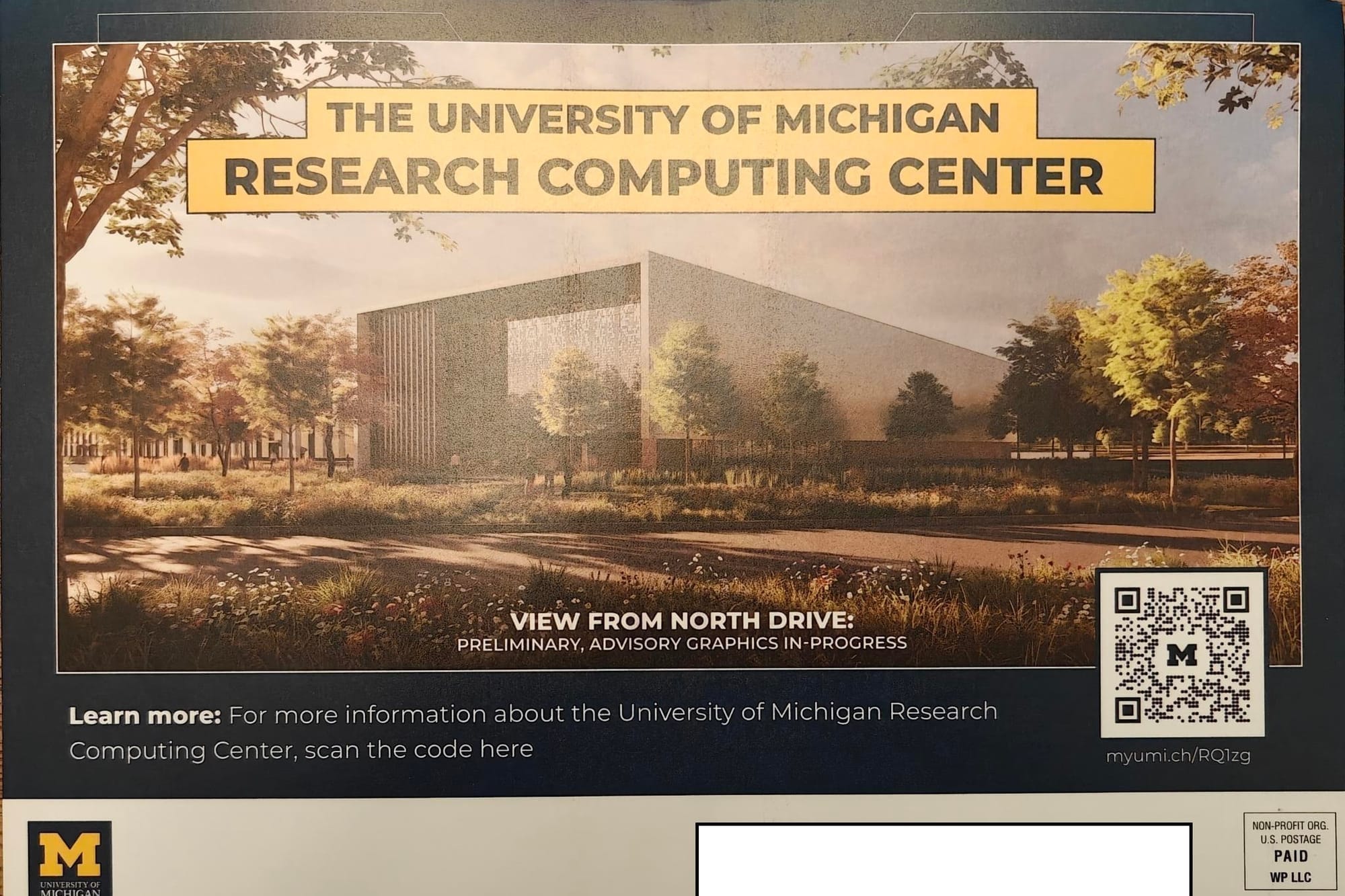
University of Michigan Mailer Promises Its Data Center Isn’t Really a Data Center:And, related, over the past month, the University of Michigan sent postcards and pamphlets to people in Michigan telling them its new data center is “NOT a commercial data center” and is, instead, a “research computing center.” According to one of the postcards viewed by 404 Media, the University’s data center will “advance breakthrough research in medicine, clean energy, cybersecurity, and engineering,” and "accelerate discoveries like new drug therapies and cancer treatments that improve people’s lives.” The University's postcard also promised to create 300 “high-quality union jobs during development” and “preserve approximately 80% of the 124-acre property as green space.”
From around the web
The biggest story in the tech world is, once again, Nvidia and the Jensen Huang scandal. Outside of mentioning it in this newsletter, we haven’t really been covering this. The main reason is that these are one of the few types of stories that we’re not really set up to do. Nvidia is technically the most valuable company on the planet, and so other bigger news outlets have a bunch of reporters who are dedicated to covering just Nvidia. When a scandal like this breaks, they throw entire news teams at it. It just doesn’t really make sense for us to try to compete with our smaller team. The New York Times, Bloomberg, The Information, and the Wall Street Journal (and lots of other outlets) are all over this. It does feel bad to more or less sit out such a big news story, and it’s not that we don’t think this scandal is important. It’s just that we are usually trying to break new ground, and it’s hard to do that when hundreds of other reporters are laser focused on the same scandal. We reserve the right to jump in at any time, especially with a reported take or something like this. I do think it’s depressing that this has become a culture war thing, and an opportunity for Silicon Valley VCs and billionaires to do class solidarity and try to show that there should be no consequences whatsoever for bad behaving CEOs. I think the Trump and essentially stock market by blackmail aspect of it all is quite worrisome, too. Huang’s return raises all sorts of national security concerns, corruption concerns, and questions about how (much more) subservient Huang will be to Trump now that he’s done him a massive favor. I also found this exchange to be upsetting on many levels. Also, this post from Balaji, one of the worst to ever do it, is wildly deranged and will probably make your blood boil. Anyways, that’s enough of that for the moment. Here’s what else is going on.
Over the past month, the University of Michigan sent postcards and pamphlets to people in Michigan telling them its new data center is “NOT a commercial data center” and is, instead, a “research computing center.”
According to one of the postcards viewed by 404 Media, the University’s data center will “advance breakthrough research in medicine, clean energy, cybersecurity, and engineering,” and "accelerate discoveries like new drug therapies and cancer treatments that improve people’s lives.” The University's postcard also promised to create 300 “high-quality union jobs during development” and “preserve approximately 80% of the 124-acre property as green space.”
One of U of M’s mailers said the building will not operate as a commercial data center. “This facility will not support streaming, entertainment, social media, or e-commerce,” it said. It also said the facility will not “burden the local community with the cost of its energy or water use, drain resources from the local community or raise utility rates,” or “create smoke, odors, or significant noise.”
The University has said it’s not sure how much water the data center will use but that it could be as much as 650,000 gallons a day. It also said it’s “evaluating several cooling techniques to identify the most efficient approach,” a process that “includes continued evaluation of reclaimed wastewater for cooling, which would significantly reduce demand on municipal potable water supply systems.”
University of Michigan mailer.
Los Alamos National Labs (LANL), America’s nuclear weapons scientists, have partnered with the U of M to construct a massive $1.2 billion 290,000 square-foot data center in Ypsilanti, Township, Michigan. Residents of the Township are angry about the “research computing center” and worry about how much water it’ll use, what it’ll do to electricity bills, and its connection to nuclear weapons.
In April, the Township’s utilities authority approved a moratorium on delivering water to data center projects while it studied how they might impact the community’s water supply. In response, U of M sent a letter to the Township utility board threatening legal action.
Concerned Township residents have spent the past year strategizing with community leaders about how to delay or stop construction. The Township’s anger caught U of M off guard and it attempted to address community concerns in several public meetings. It hasn’t gone well.
The pamphlet attempted to contextualize the data center’s place in America’s nuclear weapons research. “It would not involve nuclear weapons manufacturing, physical weapons testing, or the storage of hazardous nuclear materials,” the pamphlet said. But it would help “improve cybersecurity practices to safely manage existing nuclear material out of state.” In January, LANL confirmed its portion of the data center would be used for nuclear weapons research.
U of M did not return 404 Media’s request for comment.
On November 19, the board of regents approved the next phase of development for the data center in a vote of 7-1. The same night, Ypsilanti Township hosted a panel discussion about the data center where its leaders promised to continue to fight. “We have a number of strategies right now that we’re going to be pursuing,” Township attorney Douglas Winters said at the panel. “We believe that U of M has gone far afield when it comes to the constitutional autonomy which they have enjoyed by virtue of being a university.”
 Login