✅ Crie seu site na Hostinger por uma fração do preço que era nos anos 2000:
https://hostinger.com.br/diolinux
Use o cupom DIOLINUX para 10% de desconto nos planos anuais.
Preços absurdos de hardware, SSDs caros, fim da Lei de Moore e o medo da inteligência artificial. Olhando dessa forma, parece que a tecnologia atingiu um ponto crítico onde tudo está piorando. Mas por que a ciência aponta que estamos no maior pico da história humana enquanto vivemos exaustos de más notícias?
Neste vídeo, analisamos como o fenômeno psicológico da "Adaptação Hedônica" e a sobrecarga cognitiva fazem o cérebro humano focar apenas no lado negativo dos avanços tecnológicos. Vamos te mostrar algumas boas notícias e inovações científicas incríveis com IA, como o projeto AlphaFold (vencedor do Nobel de Química) e o Earth Species Project, e te lembrar da evolução rápida da internet e dos smartphones, descubra por que "tudo é incrível, mas ninguém está feliz" e como recuperar uma perspectiva mais positiva sobre o mundo moderno.
🔴 Seja Membro: https://youtube.com/diolinux/join
🤔 Dúvidas sobre ser membro? Confira o FAQ: https://diolinux.com.br/play
▶️ Inscreva-se no @diolinuxlabs: https://www.youtube.com/@Diolinuxlabs
📩 Conteúdo do Diolinux sem Algoritmo: http://diolinux.com.br/newsletter
🎤 Conheça o nosso Podcast: https://diolinux.com.br/diocast
📬 Contato comercial: https://diolinux.com.br/contato
💙 Nossas redes sociais e mais: https://diolinux.com.br/links
🛒 Diolinux Ofertas: https://diolinux.com.br/ofertas
📎 Fontes e Links referentes ao conteúdo:
‣ TECNOLOGIA TÁ MUITO RUIM no canal @Adrenaline :
https://youtu.be/-CiK-B0yp_I?si=X8MQCJmthHpNgwd4
‣ Earth Species Project: https://earthspecies.org/
‣ Earth Species Project: https://youtu.be/ka894z9pNls?si=h88VBVGyO9mp6Ohd
‣ AlphaFold do Google (Nobel de Química): https://youtu.be/P_fHJIYENdI?si=_8NlU9qNvGqJACK7
‣ Filtro e Sobrecarga Cognitiva: https://youtu.be/cWd4wLNxPMQ?si=P8qhkjjLHMSSslzu
O vídeo fala sobre:
‣ A sensação de que a tecnologia piorou: SSDs, memórias e o fim da Lei de Moore
‣ A evolução acelerada: da invenção do transistor à internet comercial em poucas décadas
‣ O verdadeiro lado da Inteligência Artificial: AlphaFold, Nobel de Química e conservação ambiental com o Earth Species Project
‣ A psicologia por trás da insatisfação: o que é a Adaptação Hedônica e a dopamina do novo
‣ Sobrecarga cognitiva: como a redução do atrito físico aumentou a fadiga mental
‣ Como filtrar o caos digital e recuperar a perspectiva positiva sobre a tecnologia
00:00 Por que a tecnologia parece estar piorando?
00:54 A lição do físico Michio Kaku sobre perspectiva
01:25 Do microchip ao GPS: O salto tecnológico das últimas décadas
02:26 Por que esquecemos como era a vida sem internet?
03:19 Como a tecnologia barateou o acesso à informação
04:01 O verdadeiro potencial da Inteligência Artificial (além do Chat)
05:44 Descobertas científicas impossíveis sem a IA
06:16 Quando a ficção científica virou nossa rotina
07:15 O que mudou de 1999 para cá? (Comparativo Matrix)
08:12 O que é Adaptação Hedônica e por que nunca estamos satisfeitos
09:48 Troca de problemas: Do trabalho braçal à sobrecarga cognitiva
11:58 Desafio da positividade: O lado bom da tecnologia hoje
📹 Produção:
Roteiro e Apresentação: Dionatan Simioni
Edição e efeitos: Willian Zanella
Thumbnail: @adrielfilipetech
O podcast “Durma com Essa”, do Nexo, terá uma temporada especial para as eleições de 2026. Serão oito episódios, publicados semanalmente, até os dias que antecedem o primeiro turno, agendado para 4 de outubro.
A cada episódio, o podcast vai discutir com pesquisadores um tema que irá ajudar a definir a disputa eleitoral. Mais que isso, os episódios vão abordar questões estruturais do Brasil que aparecem por trás desses assuntos centrais do pleito.
Acompanhe a temporada especial do #DurmaComEssa no nosso site ou no seu player de preferência.
•
O Nexo agora tem um canal no WhatsApp!
Você pode se inscrever neste link: https://bit.ly/3ugTBbU
Ative as notificações para receber avisos de publicação ao longo do dia.
•
Assine o Nexo e apoie o jornalismo independente e de qualidade.
Desconto especial para assinaturas com Google por tempo limitado:
https://www.nexojornal.com.br/assine/
•
Com produção e roteiros de Marcelo Roubicek, edição de Antonio Mammi e Mariana Vick, edição de áudio de Brunno Bimbati, pesquisa de Victoria Rengel, produção de arte de Yasmin Menezes, ilustração de Lua Lopes e distribuição de Paulo Cantalice e Pedro Bardini.
O podcast “Durma com Essa”, do Nexo, terá uma temporada especial para as eleições de 2026. Serão oito episódios publicados semanalmente até os dias que antecedem o primeiro turno, agendado para 4 de outubro.
A cada episódio, o podcast vai discutir com pesquisadores um tema que irá ajudar a definir a disputa eleitoral. Mais que isso, os episódios vão abordar questões estruturais do Brasil que aparecem por trás desses assuntos centrais do pleito.
Entre os tópicos que serão tratados estão a relação entre os Três Poderes, Banco Master e patrimonialismo, e interferência externa sobre as eleições brasileiras.
•
O Nexo agora tem um canal no WhatsApp!
Você pode se inscrever neste link: https://bit.ly/3ugTBbU
Ative as notificações para receber avisos de publicação ao longo do dia.
•
Assine o Nexo e apoie o jornalismo independente e de qualidade.
Desconto especial para assinaturas com Google por tempo limitado:
https://www.nexojornal.com.br/assine/
•
Produção e roteiros: Marcelo Roubicek
Edição: Antonio Mammi e Mariana Vick
Pesquisa: Victoria Rengel
Edição de áudio: Brunno Bimbati
Produção de arte: Yasmin Menezes
Ilustração: Lua Lopes
Distribuição: Paulo Cantalice e Pedro Bardini.
How does Axel Scheffler, the illustrator behind the Gruffalo, Zog, Stick Man and more, create his drawings? How does he get his ideas? Why does he think his collaboration with children's author Julia Donaldson is so successful?
Discover more about the Axel's background, creative process and get a sneak peak of how he draws the Gruffalo in this behind-the-scenes interview, filmed to mark his joint 2026 Bodley Medal award with Julia Donaldson from the Bodleian Libraries for services to children's literature.
To support independent science journalism and get bonus content ...
JOIN OUR PATREON: https://www.patreon.com/Howtown
We're grateful for the generous support of the Patreon Town Council:
Bev Fong
Sean Barrett
Albychen
avaren
Evan Hass
Mark Tinker
L.A. O’Connor
Marcos Huerta
Joaquim Salles
Sam Gaty
Edgar Sutawika
Navneet
Pedro ZM
Martin Weeks
Dimi
Bryce Golden-Chen
Estelle Caswell
Gregory Laborde
Yash Murthy
Matthew Stvartak
Slightly Suspicious Mind
Kellyn Lorentzen-Goler
omg.science
Duncan Stannett
Keith England
Jocelyn Tabancay Duffy
Casey Schatz
Mark McCreary
Jonathan McCabe
Branden Ushjima
Dr Esh | Second Opinion
Wookiee Henderson
Byung-Cheol Cho
Frances Haugen
Gilbo Jiménez
Melanie Halley
Dmitry
Archie Stonehill
Ed Martini
Jose Zaragoza Jr
Jamieson Urquhart
Nate Hingst
Jay McZara
Scott Heimendinger
Thin Air
Noëmie
Pedro Sarkis Portela
Gregory Batson
Ritvik
Mrglenna
Deborah Clark
Larry Fizz
Michael Thomas
Jamie
Thi Ha Phuong Dao
Bobby
hoang tung tran nguyen
WhateverReason
Could a tiny tube inside NASA’s Perseverance rover contain the strongest clue yet that something has lived somewhere other than Earth? This Howtown episode follows the discovery of Sample 25, “Sapphire Canyon,” drilled from the Cheyava Falls rock in the Neretva Vallis river channel leading into a Martian impact basin called Jezero Crater. Inside are organic molecules, minerals, and “leopard spots” that may provide a potential biosignature left by ancient Martian microbes. In order to confirm the biosignature, researchers need to study the sample with instrumentation in laboratories on Earth, but the much-anticipated Mars Sample Return mission was cancelled by the US government after a review board concluded that it would cost more and take longer than originally planned.
Uma carta anônima foi ponto de partida da investigação que revelou que planos de saúde validam laudos da junta médica antes que eles sejam enviados a pacientes, comprometendo sua independência.
Criadas há oito anos para garantir decisões mais técnicas sobre pedidos feitos aos planos, as juntas médicas funcionam como uma segunda instância de análise, mas a suspeita é de que tenham se tornado instrumento para endossar as negativas das operadoras.
A investigação do UOL levou a ANS (Agência Nacional de Saúde Suplementar) a abrir um procedimento administrativo para apurar o caso, e é sobre ela que o apresentador José Roberto Toledo conversa com o colunista Thiago Herdy no novo episódio do podcast UOL Prime.
This week, A. E. Stallings takes stock of Christopher Nolan's Odyssey, a “thrilling combination of seemingly opposite tendencies”; and Sam Riviere reads us a new poem
What are the best books for getting people into reading? How do we inspire children to read? Why is 2026 the National Year of Reading?
In this bonus episode of the Ask Penguin podcast, host Rhianna Dhillon sits down with children’s author and illustrator, Nadia Shireen, and Jonathan Douglas CBE, Chief Executive of the National Literacy Trust to discuss the National Year of Reading’s Go All In campaign. Plus, we answer your questions about the reluctant readers in your life and give out more book recommendations to spark a lifelong love of reading.
About the guests:
Nadia Shireen is a writer and illustrator. She enjoyed making homemade magazines and comics as a child. She studied law at university and then worked in magazine journalism; it was during this time that she started to draw again. After a lifetime of doodling in the sidelines, Nadia decided to pay some attention to drawing and in 2007 was accepted onto an MA course in Children's Book Illustration at Anglia Ruskin University, Cambridge. Her debut book Good Little Wolf received a mention in the Bologna Ragazzi Opera Prima Award and won the UKLA Book Award. Nadia has been shortlisted for the Roald Dahl Funny Prize and the Waterstones Children's Book Prize.
Jonathan Douglas CBE is CEO of the National Literacy Trust, a trustee of the Philosophy Foundation and of World Book Day. He is passionate about promoting access to literature and addressing inequality through literacy. He has lobbied and campaigned extensively and led the formation of the Literacy All Party Parliamentary Group. He is a chartered librarian and was Head of Policy Development at the Museums, Libraries and Archives Council and previously worked at CILIP and in Westminster Libraries.
For more information about the National Year of Reading, click here: https://goallin.org.uk
0:00 – Podcast intro by host Rihanna Dillon.
01:23 – What is the National Literacy Trust?
02:08 – Why 2026 was designated as the National Year of Reading?
03:47 – Have there been other National Years of Reading?
04:59 – Nadia Shireen on why she became an ambassador for the campaign and her school visits.
05:46 – What does it mean to be an ambassador for the National Year of Reading?
06:48 – What it means to "Go All In" for the campaign and strategies for behavioural change in reading?
08:08 – Why it's important to break down reading format hierarchy?
09:32 – Why are local stories and community identity is important for encouraging reading?
11:03 – How can book lovers encourage reluctant readers in their lives?
11:59 – How many volunteers are involved in the National Year of Reading?
12:54 – The importance of reading fan fiction, video game communities, and visual literacy/comics.
14:14 – What do children gain from discovering stories?
16:03 – Why is humour important for children's books?
17:01 – Jonathan Douglas's experience as a children's librarian and early funny books (Anthony Horowitz).
18:27 – Illustrating, draw-alongs, and demystifying the creative process for kids.
19:42 – Campaign partnerships (social media influencers, "Summer of Sport and Reading", British Land).
20:53 – Books that sparked the guests' love of reading (Meg and Mog, P.G. Wodehouse, My Name is Peter, A Traveller in Time).
24:32 – Favourite places and habits for reading (bedtime, train journeys, e-readers, and reading in the bath).
25:51 – Listener Request 1: Book recommendations for a partner into PS5, F1, and actuaries (The Formula, Niki Lauda biography).
26:49 – Listener Request 2: Recommendations for a friend into guitar, food, flowers, and birds (Kitchen Confidential, Men of a Certain Age, reading cookbooks as novels, May We Feed the King?).
29:43 – Listener Request 3: Recommendations for a reluctant reader who loves the beach and outdoors (The Beach, The Wedding People, Joseph O'Connor trilogy).
31:26 – Listener Request 4: Recommendations for an 8-year-old girl who loves baking, drawing, and climbing trees (Grimwood, comics/graphic novels, Roald Dahl's Revolting Recipes).
33:38 – Outro
It’s hard to keep up with the AI evolution; new AI tools drop every week, but how are experienced practitioners actually using them? Most of us are overwhelmed and unsure about the many possibilities, yet we need to keep going and do our work. You might use AI agents all day long, parallelize them with AI Orchestrators, tmux, git worktree, and so on, using AI IDEs, but in the end, you still need to coordinate and understand what the agents produced, potentially test it, which makes it even harder to keep up.
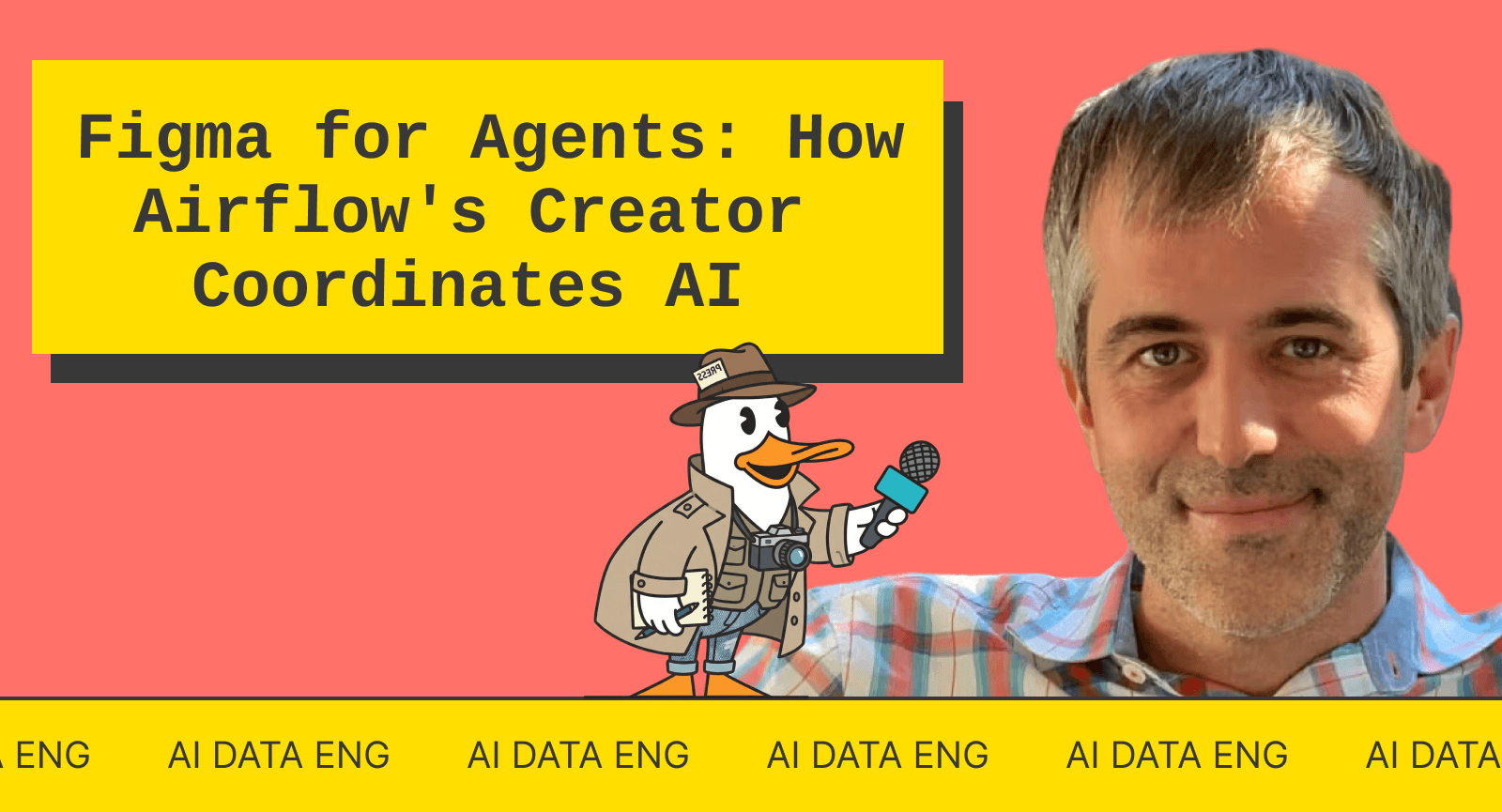
Luckily, Maxime Beauchemin, the creator of Airflow and Superset and the person who defined what “data engineer” meant for a decade (more on him below), joins us to show how he uses agents and what he’s built for working with them. I tried to extract the patterns behind how he actually uses AI in his data work today. This is the fourth interview in ‘How to use AI with DE’.
In this article, we go into four parts: (1) How to balance quality with messy data warehouse work, and how to manage agents with Figma for agents. (2) We elaborate on the future of the context layer and the return to semantics, (3) how Okta for Agents is needed for security, and (4) how the future of agentic workloads can be done in teams, whose yap-to-ship ratio is best, and why Amdahl’s law still counts.
Introducing the Guest: #4 Maxime Beauchemin
Our guest in this interview Max Beauchemin, the creator of Airflow and Superset. He’s known as one of the OGs of defining how data engineering worked back in 2017, and founded Preset, the company behind Superset, and currently serves as its CEO.
He is heavily involved in the AI workflow, which is another reason I wanted to interview him for this series, but he has also been building in the space himself: Agor (Ag: AI agent + Or: orchestration), earlier tooling like claudette-cli1, and db-agents, an experiment to embed agent context directly inside databases. We’ll get into it all.
Max and I talked about many things, among them how to use AI in data engineering, how security plays a role, how shared, secure, context-rich agent workspaces work within teams, and how he uses AI assistants to run his business and ease his life as a CEO.
Max is a true open-source enthusiast, and he wants open source to win. Everything we discuss here is somewhere on GitHub, which I have happily linked throughout the interview.
Figma for Agents: Visualizing Tasks and Jobs with Agor
Before we start using Figma for Agents, coordinating them on canvas, we need to ask why we need coordination and orchestration in the first place.
Balancing Quality with Quantity: Messy DWHs
That’s where we started, with the challenge of messy data warehouse environments that most people find themselves in. I asked how he balances quality and quantity, aiming for high quality.
Max says that the new models, Opus 4.5 or 4.62, are not making many errors anymore and are very clever when they get the right context as above with all the database schemas of tables and data types, and even querying it with MCP. He says they almost run in self-serve mode, but he still prefers that users know what they are doing and can either read the generated code or verify the generated numbers on a dashboard or chat results.
But the setup is critical. With these three prerequisites, the agents handle almost all queries really well:
You need some preparation claude.md/ agents.md
Access to SQL (e.g., execute dbt)
Access to MCP or CLI for BI tools (e.g., Superset supports sup!, a CLI to interact with Superset)
The only problem, and always has been, is the messy structure and sources that most organizations have, growing from an initial small project into a certain stage. There are always obscure tables or strings, timestamps not aligned, or hidden information that is not encoded in code or written down. Or there’s the hidden knowledge, like that a certain table shouldn’t be used anymore or has bad data, which is known to the people using it but might not be to agents.
The Canvas in Which Your Agents Can Run: Automate Most CEO-stuff
When he recently saw the power of agentic coding, Max went all in and has been building the Figma for agents ever since. Something he can use to collaborate with agents within his company, instead of everyone running the same prompts locally and needing to sync with each other manually. That’s when Agor was born.
Agor stands for Ag: agent and Or: for orchestration. As the creator of Airflow and CEO of a data company, he knows exactly how a tool needs to improve his workflow. He also called it:
The goal is to automate most of the automatable CEO-stuff
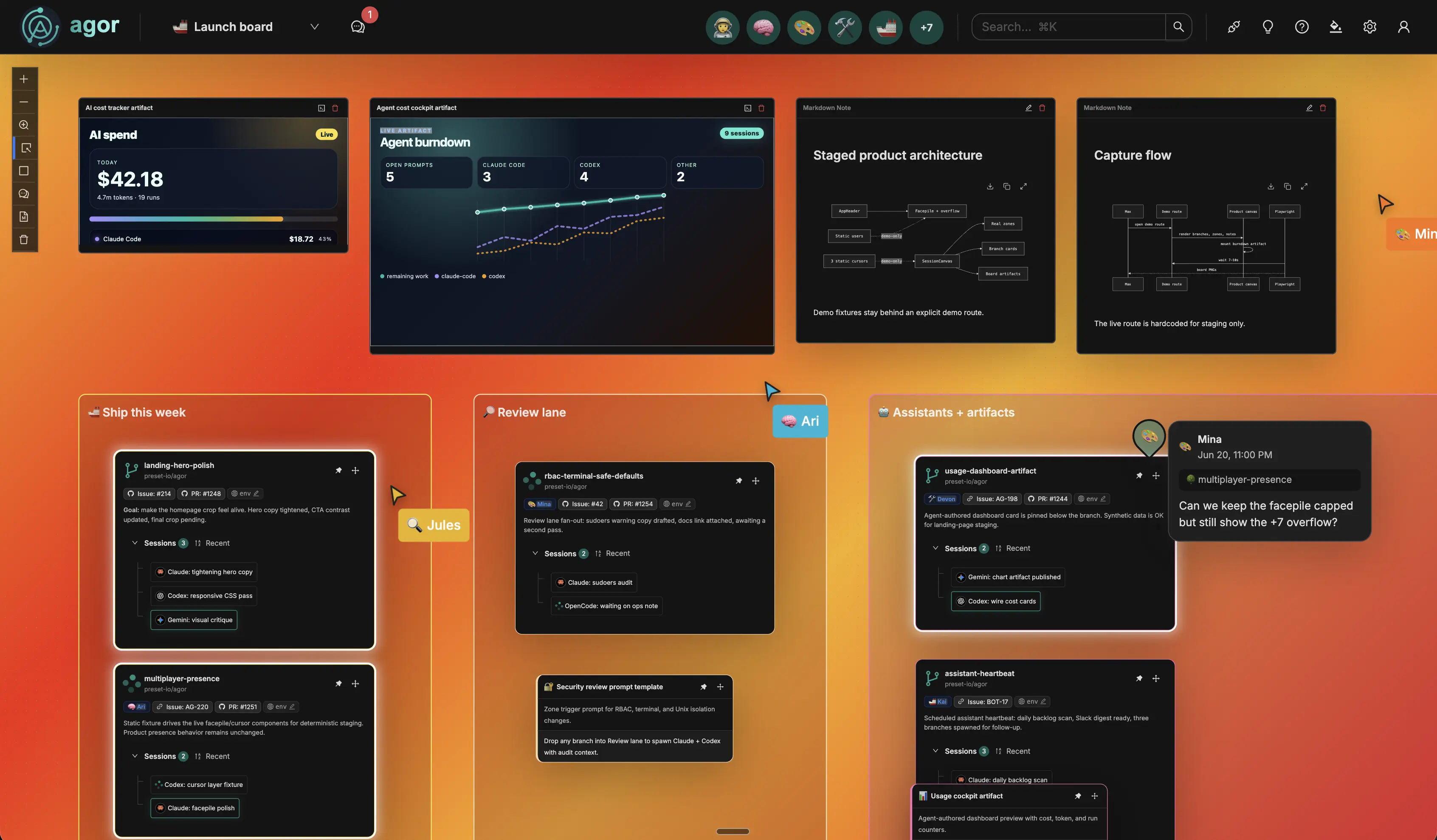
The board: branches as cards, zones as regions, agent sessions, and teammates present live. See full demo Agor Agent Orchestration Demo.
Building an Internal Knowledge Base: Shared Canvas
Agor was Max’s answer to “how he uses AI beyond a research tool”, but doing data modeling, writing data pipelines, even legal or HR roles he added later to Agor, so you can give company-wide roles to agents that can be fed with dedicated documents and context, and triggered by any employee internally. In contrast, others see the jobs and avoid asking the same questions, reusing the output for new queries—Andrej Karpathy’s concept of an LLM-maintained shared team wiki—which builds an internal knowledge base.
Initially, when we first chatted, Agor had already changed how he worked as a CEO, but since then, Agor has gone even further. Agor can replace high-level tasks while still being very hands-on by working closely with the code via git worktrees (branch cards in Agor’s UI) and verifying the code in the PRs it produces. Max also added OpenClaw-like features around memory and identity via dedicated Markdown files, such as AGENTS.md, SOUL.md, MEMORY.md, so that Agor’s agents can learn from recent runs and carry a purpose and clear instructions. This led to role-based agents called Assistants (use agor-assistant as a template to build your own).
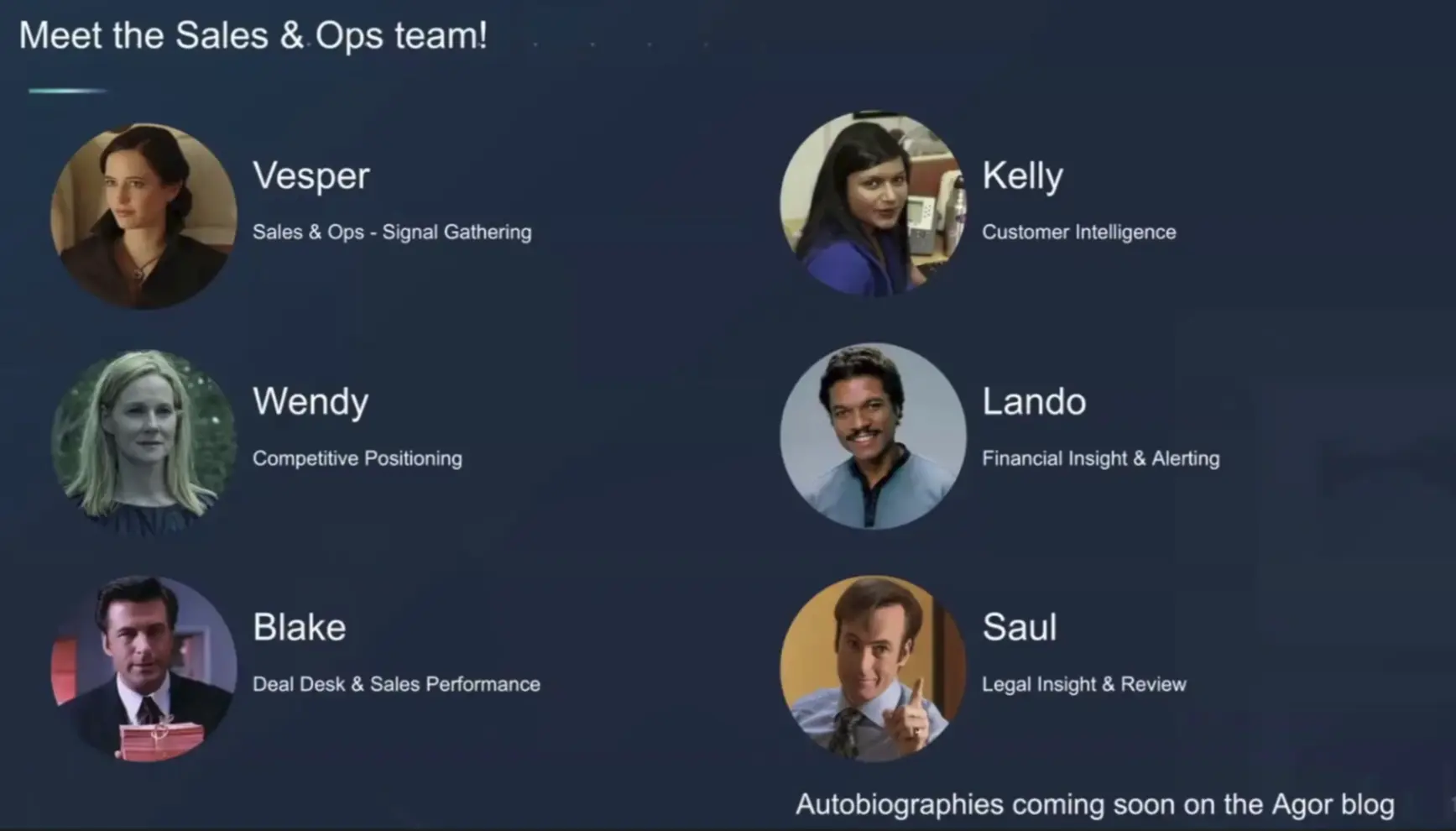
Example of different Agor assistants: Saul for legal, or OpEx for observability and so forth. | From the Webinar Anatomy of Our Internal Data Agent
Inspired by OpenClaw’s agent loop, Assistants became first-class citizens, persistent AI companions with memory, identity, skills, and scheduled tasks integrated into Agor’s canvas, multiplayer workflows, and reachable directly from Slack, for example. Additionally, Agor adds features beyond OpenClaw, such as better multi-user support, RBAC, one-click, full session inspection, and many more.
Asked about the goal of Agor, Max said:
The initial premise was to remove DevOps and set up time for other members of the company. Instead of people needing to connect all the MCPs or CLIs to add API keys, set permissions, or integrate with Slack, the prompt window with the needed context is there and ready to start.
[!note] OpenClaw, what is it? And how does Agor compare? OpenClaw (formerly ClawdBot) is an open-source agent framework built around a persistent agent loop: a serialized cycle that turns a message into actions, using file-based identity (SOUL.md) and layered memory (MEMORY.md). Agor’s Assistants adopt this pattern and extend it with multiplayer boards, RBAC, and canvas-level orchestration.
Visual and Spatial Memory
When you do a lot of agent work, it’s really hard to keep up with all of it. That’s where Agor’s visual and spatial overview really helps and is unique in its approach.
It brings the local and private session to a server, where everybody can see and work together on the same queries, and use the insights from other results, as dashboards are built for. So instead of keeping output locally, others can source the artifacts generated by agents, stored as Artifacts within Agor, ready to use by anyone, with no integration or deployment needed.
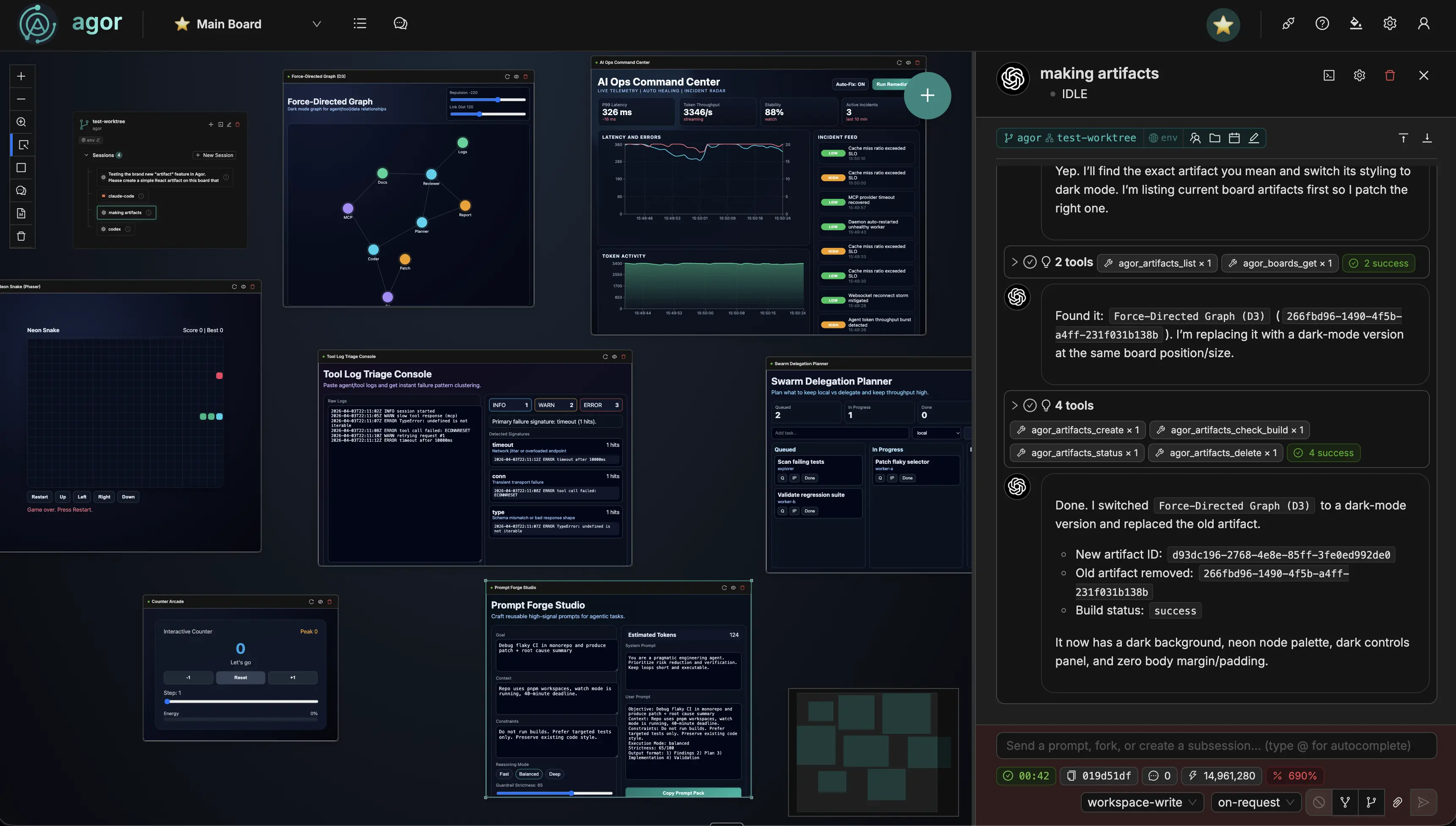
Example Artifacts such as AI Ops Command Center, Tool Log triage, these live directly in Agor based on an Agor session
Or how Agor tracks its own spending across sessions:
[!note] Check the full Webinar about the Anatomy of the Internal Data Agent at Preset.
Such as an assistant needing access to all pipelines’ metadata as illustrated data stack.
Or the data needs an analytics agent to support, such as self-serve, the data team, and extras such as memory, skills, documentation, etc:
Context Layer: Back to Semantic Layers?
Max also believes that we are going back to the Semantic layer, or using it for AI as agents benefit from structured information - helping with the data model and SQL part, to make sure it’s correct, especially with the needs of AI agents and the persistent challenge of providing trustworthy self-service analytics.
With the shift of semantics outside of the BI tool, versioned, testable, portable, it’s a chance for better integration between business domain experts and data engineers. His thinking has evolved since he wrote the article, and Max told me:
I see two different semantics: the semantic layer and the YAML. There are the hard constraints — not every area needs that strictness — and then the softer ones with Markdown and Agentic Skills, good for 80-90% but with no guarantees.
AGENTS.md For Databases: Markdown Stored Inside the Database Itself
Based on that idea, Max created an experiment to bring the AGENTS.md convention into the database. DB-AGENTS reserves a dedicated schema and table, _agents._agents, that holds agent-oriented documentation at different scopes (global, domain, schema, table, and even column). You write the docs locally as markdown files with YAML frontmatter, and a small CLI (dba) deterministically syncs them into that table — since databases don’t let you drop files into them, the table becomes the file. Agents then query it at session start the same way they’d read an AGENTS.md, making it a natural companion to INFORMATION_SCHEMA: one holds structure, the other holds meaning. Max calls it a “soft semantic layer”, which maps directly onto the hard-vs-soft split he described above. Check out the repo at db-agents.
With context being key for agents to understand what we humans know, Agor also added a context layer called knowledge. Agor Knowledge acts as a central place where humans and agents can store, organize, connect, and find the context that makes work compound over time, with Slack quickly becoming the main interface to many of the team’s agents.
How Do We Sandbox Agents for Safe Workflows (Okta for Agents)
Another big topic is security when agents have so much access to powerful CLIs, sometimes root access to systems or databases containing private keys, or just downloading random skills from the internet that may contain hidden secret messages.
Max coined the idea of Okta for Agents, which I found super interesting, and something I believe will become ever more important if we want to find a healthy way of working with agents in enterprises or with sensitive data. Okta for Agents means working around identity, scoped delegated permissions, leases, and audit logs.
When asked how he’s managing security, verifying what Agor or the agents are doing, Max responded:
I let the workers run in god mode3, but using dedicated environments/sandboxes, hooked to a dedicated git worktree repo, it can run autonomously and solve problems on an initial prompt, visualized in a shared canvas style.
I asked how he sees Okta for Agents being implemented. We desperately need it, he said, granting agents permissions like impersonation. Delegating the permission is an OAuth. With the roles, we can scope permissions strongly. E.g., the sales agent only has access to sales documents.
When asked at what level to integrate the Okta security layer, Max said it hasn’t been solved yet. Still, he sees it as the same question: whether we have 50 agents or 50 users who use a platform, both need a security layer.
Likewise, Max shared:
I trust agents the same way as I would an employee.
[!note] What does “Okta for Agents” mean in more details?
Okta is the identity layer companies put in front of their tools: it authenticates who you are, decides which systems you can open, and logs what you did. Max’s point is that agents need the same layer. E.g. Clawdbot, when he tried it, was effectively a DIY IAM manager for agents, config hell and all.
The twist is that it adds a whole new dimension to RBAC. It’s not just “the bot gets an email account” — it’s “the bot gets an email account, but can only read mine, and via MCP rather than as a real user.” Not so different from onboarding a human personal assistant, except this assistant can help with nearly everything, so the blast radius is much bigger.
Max’s own example: he saw a 1Password skill and immediately backed off then reconsidered, wondering whether the bot should have its own 1Password account with only safe credentials shared into it. Which is exactly the problem: you can be strict on paper, but the moment the agent has your email, Slack, and calendar, it can leak private things all day. (Full discussion at this post)
Related to security is the deterministic, repeatable behavior of data sets with the same input. Agents are the opposite: probabilistic. I was curious to hear from Max, who initially defined the functional data engineering paradigm for deterministic and idempotent batch data processing, what he thinks about the non-deterministic outcomes of agents, specifically with large language models.
Max said, regarding declarative definitions, that he finds a claude.md is usually sufficient for most tasks that have a git repo, more context, and an issue or PR to work with, given the initial prompts come from users who know what they are doing.
Regarding reliability, Max thinks about using good methodology references. Agents get it and understand it. E.g., data modeling practices such as Kimball are still valid, or the approach shared by him with Entity-Centric Data Modeling (ECM), he says, and when prompted to model in those patterns, agents follow them well (either via research or provided).
The other part is that some non-dangerous work can have vibe data pipelines, and there’s no danger. And there are cognitive-depth tasks, such as a complex Spark cluster, where you can’t just debug quickly with large data sets.
Also, the field varies: not every area is getting agentic-piled as fast. E.g., platform demands go through the roof (see GitHub outages), so we have 10-20x the platform needs, but at the same time, the work is critical to be correct. So it depends.
Future of Agentic Workload, and Canvas Development in Teams
When asked about how Agor has changed how they at Preset develop products (if at all?), or made them more effective, Max said:
There are more agents than humans nowadays. Everyone has a Claude Max plan, and agents handle almost all code writing.
And on a personal level:
I haven’t written a function by hand for a long time, and I might not anymore — except when I feel nostalgic.
He also thinks that the Yap-to-Ship Ratio, a metric that he announced half-jokingly on LinkedIn, describing people’s velocity by just getting stuff done without involving others at every step, will be very low-yap for 10x engineers, as they solve the problem and ship a solution without much back and forth.
They deploy it somewhere for others to use, not only for human consumption, but as a solution or CLI that other agents can use to discover further and solve their problems. A high Yap-to-Ship ratio would mean lots of human interaction, which is the clear new bottleneck.
As human code review gets bottlenecked, I asked how he does the review. He said he uses Codex with sub-agents to review, ensuring everything is DRY (Don’t Repeat Yourself) and that all expected callbacks are made.
You can also ask the operator assistant agents if you are not sure whether an implementation is correct.
Amdahl’s Law: Can’t Go Faster if not End-to-end
One bottleneck is still Amdahl’s Law. We can speed up tooling by using extremely fast agents, but unless the end-to-end workload is sped up, we only increase by a 2-3x factor, not 10 or 100 as any one tool does. This also overlaps with Max’s Yap-to-Ship ratio: if PRs need the human in the loop to review many of them, the overall speed at which we build is not faster.
Another side effect is that it takes a lot of context switching. Max said he has ten active sessions in Agor. He is good at context switching (maybe also learned through recent Agor workflow? 🙂).
Predictions for 2026
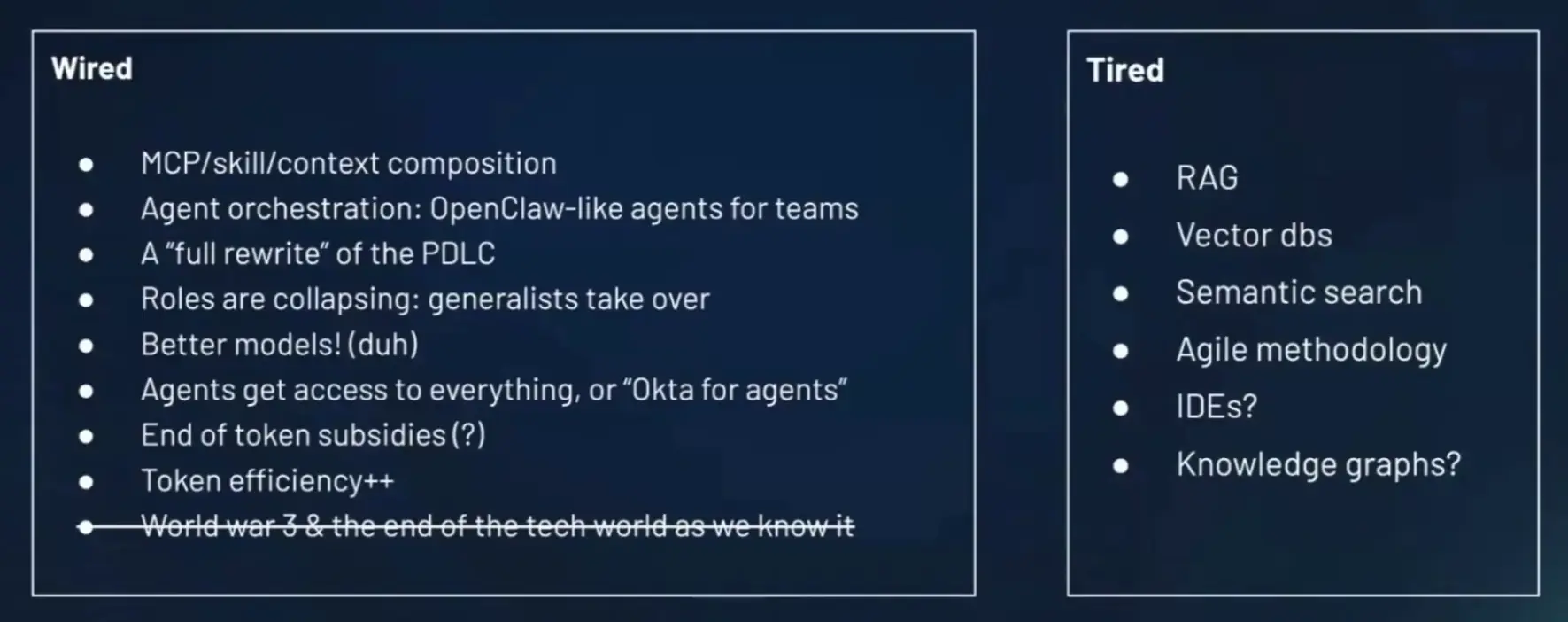
It’s hard to predict the future with AI, but Max took a stab and shared his predictions for 2026 and categorized them into wired and tired:
Max’s AI Setup for Data Engineering Work and Managing His Company
We end this interview with Max’s setup for working with agents, since we didn’t have time to go into full details on the call. I’m sharing the one he shared four months ago. I’m sure it changes almost daily. Still, it helps us get a good overview of his software engineering stack for the team at Preset, as well as his personal local computer stack.
For software engineering and data engineering:
Preset team instance of Agor behind VPN with a dozen boards, boards are mostly repo-oriented. Full Unix impersonation, backed by PostgreSQL.
doing most of my work on board with the agor-openclaw framework, agent is pushing projects across a kanban-type layout: tons of new automation there. Agent checks on agents, prompts them, moves worktrees to “needs human review” zone if/when needed
coding workflow is Opus 4.6 as a planner, Sonnet 4.5 / Opus 4.6 for most coding, Codex 5.3 as the reviewer (god it’s so good)
data engineering stuff: dbt/airflow repo + Superset MCP, superset-sup
“Command center” is agor-openclaw on Opus 4.6, monitors other agents, intricate HEARTBEAT.md with pseudocode to make a decision for coding project (worktree) on that board
And his new “Personal assistant” local instance of Agor (brand new/sensitive):
Beefy Mac Studio at home
connected to “productivity” tools (google-workspace-mcp)
connected to Slack through a semi-homegrown skill — read-only for now, mostly to summarize activity
connected to Notion MCP
connected to “contracts” repo, where I sync with Google Drive for all Preset contracts
connecting to Hubspot soon
goal is to automate most of the automatable CEO-stuff as discussed above
Coming up
We’ve learned how to use Figma for agents with Agor and to collaboratively work as a team, using shared prompts and creating artifacts. We’ve seen how Okta for Agents is needed but really hard to implement, and how the future of AI is mostly about context and how to integrate it well. Plus, we learned how Max automates many tasks as a CEO with dedicated AI assistants and still produces low-level code with the same assistants for both his personal and company-wide needs.
I hope you enjoyed this fourth interview with Max. Huge thanks to Max for taking the time to speak with me (twice!) and for sharing his experience with all of us. Follow him on LinkedIn, GitHub, or on Preset Blog, where he shares his distilled thoughts on the ecosystem, and obviously, if you want to know more about Agor, check it out at Agor GitHub repo.
Max shares a lot of his ideas and thoughts online. Here are some further articles and interviews to read/watch:
More interviews are coming out, so please share feedback, questions you might want to ask, or your experience working with AI in the data space. We’re all in this together, figuring it all out.
Timothy Mitchell came by the Verso offices to talk about his latest book, The Alibi of Capital.
Today, extraordinary wealth seems to arrive from nowhere. The trick of conjuring this unearned wealth is, in fact, the key to understanding capitalism’s origins and a clue to why the catastrophe of climate collapse is upon us: value is created by consuming the future.
In The Alibi of Capital, the acclaimed author of Carbon Democracy examines capitalism's method of stealing the future and concealing the theft.
The Alibi of Capital by Timothy Mitchell is available from Verso Books:
https://www.versobooks.com/products/3452-the-alibi-of-capital?utm_source=youtube&utm_medium=video&utm_campaign=alibi_video

 Login
Login