❌

Reading view

Google's Customized AI TV Channel, Starring You

Google's Customized AI TV Channel, Starring You

We promise 404 Media will never constantly generate customized AI newsletters for you. You'll get our flawed human tastes! And like it! (Hopefully)

Google's Customized AI TV Channel, Starring You

Google Wants To Make a 24/7 AI TV Channel. You’ll Be the Main Character

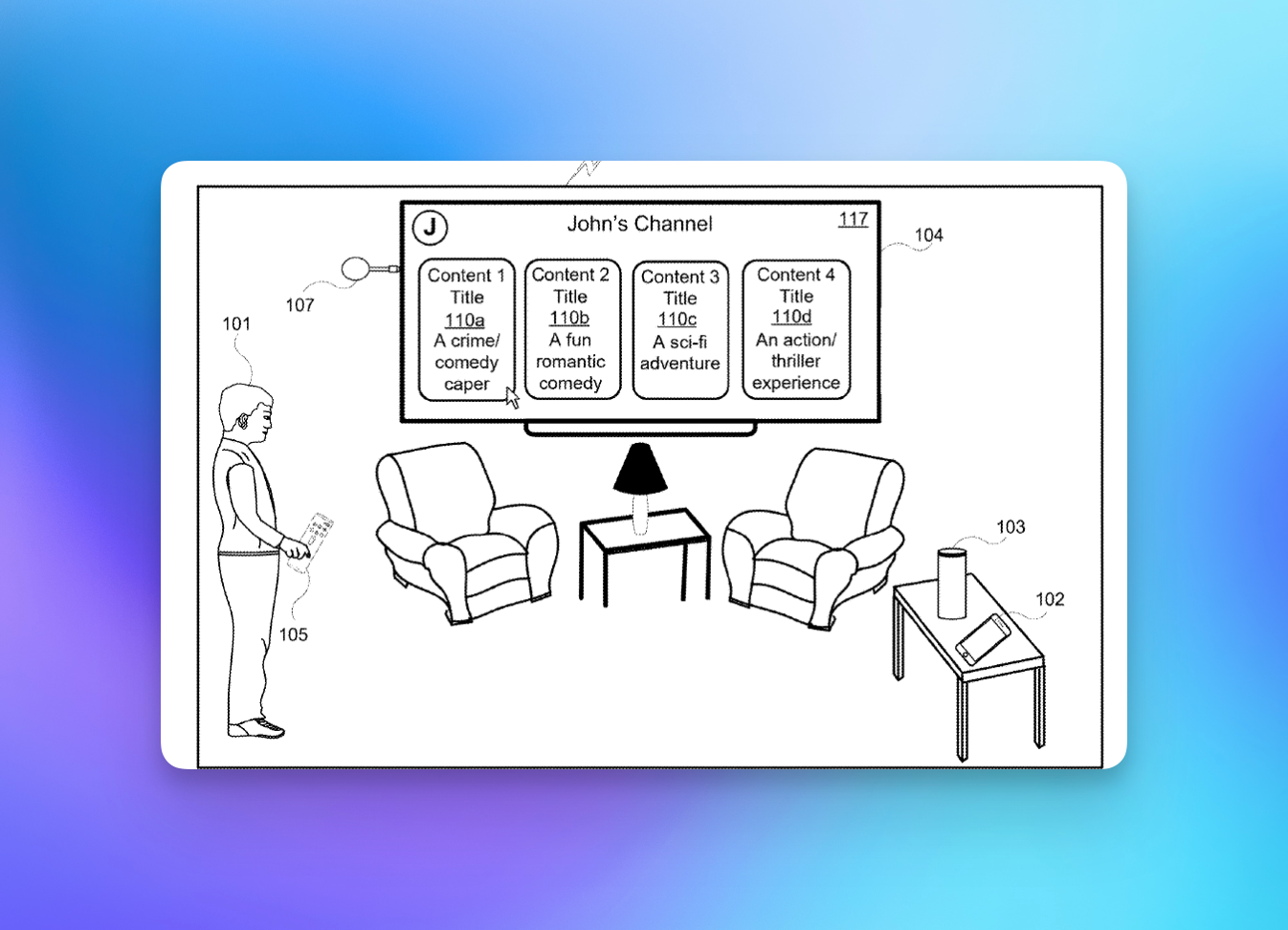
Google has filed for a patent that would use the information it knows about you to create an AI-generated TV channel full of personalized “shows” starring you and featuring customized advertisements. The patent is the latest signal of the AI video endgame: endless highly specific, customized content that is automatically generated based on the wealth of data companies and advertisers collect about you.

Tech companies regularly file for patents that they don’t end up actually putting into real products, but this one, called “creating a channel of video experiences tailored to a user,” describes a system that many AI companies have been clearly trying to build. It imagines something called “My Channel,” which would be filled with AI content generated based on demographic data, their video watch history (presumably from YouTube), and other information it knows about the user. It would then make “the user as the protagonist for the whole video.” The patent was first noticed by Patentlyze, a news site that tracks tech company patents, who shared it with 404 Media.

“You are a customized video generating model. Generate a customized video for a user where the user will play the protagonist,” a hypothetical LLM prompt in the patent reads. “The generated customized video includes characteristics based on the <user_profile>. The generated customized video follows the style and format of the <top_ watches> of the user. The generated customized video sticks to the <preferred_genres> of the user but the narrative for the generated customized video is customized. The <top watches> and <preferred _genres> parameters are ordered from more preferred to less preferred.”

It suggests that the channel would be connected to an “advertising server,” and that advertisements would be inserted into the customized AI content: “an advertising stitcher included in the advertising server generates an updated customized media content item by inserting at least one advertisement into the customized media content item,” it says.

The patent imagines, for example, “a crime/comedy caper,” “a fun romantic comedy,” “a sci-fi adventure,” and “an action/thriller experience” with a viewer named “John” as the protagonist. Another prompt included in the patent suggests that someone who had recently watched cricket highlights of a “Player 1” might then be served a similar video “that incorporates elements of the Cricket World Cup and Player 1’s recent performance. Perhaps [user_name] could be cheering for India in the stands or interacting with Player 1 in some way.”

The notable thing about this patent is that it is barely an evolution of what is already happening on social media and what is beginning to happen on streaming free TV channels on services like Samsung TV Plus and TCLtv+.

The people generating AI slop on social media are making incredibly specific content because they know that social media algorithms will be highly effective at filtering people there. Meta is already allowing advertisers to use AI to generate many slightly different versions of an advertisement; its targeting AI then automatically shows them to users who are most likely to react to a specific version of an ad. As I’ve previously reported, TCL has been experimenting with AI-generated content on its streaming free TV channels, and, even without AI-generated content, free streaming TV channels have gotten incredibly specific. It is now possible, for example, to watch reruns of individual shows 24/7/365.

AI boosters have long been saying the future of entertainment is allowing anyone to generate their own TV shows, or to generate “new” episodes of existing properties. An always-on, autogenerating, customized AI TV channel isn’t far off from that idea.

As I’ve previously argued, the future that tech companies envision is one in which we are somehow even more siloed than we are now. They imagine a world in which everyone lives in their own reality and watches their own, customized content, which is a world in which big, unifying pieces of media are harder to make and are few and far between. The Google patent comes on the heels of a Microsoft patent that describes a system that alters spoken words (and the person’s lips) in live video, thereby distorting reality.

More from 404

University Approves Nuclear Weapons Data Center, Township Vows to Fight On: Last week, the University of Michigan’s board of regents approved the construction of a $1.25 billion data center that will power American nuclear weapons research. The regents voted 7 - 1 in a public meeting on November 19 to move forward with the project despite widespread opposition from faculty, staff, and the residents of Ypsilanti Township, Michigan where the data center will operate. A few hours after the vote, the leaders and citizens of the Township gathered to discuss how to stop it.

Google's Customized AI TV Channel, Starring You

University of Michigan Mailer Promises Its Data Center Isn’t Really a Data Center: And, related, over the past month, the University of Michigan sent postcards and pamphlets to people in Michigan telling them its new data center is “NOT a commercial data center” and is, instead, a “research computing center.” According to one of the postcards viewed by 404 Media, the University’s data center will “advance breakthrough research in medicine, clean energy, cybersecurity, and engineering,” and "accelerate discoveries like new drug therapies and cancer treatments that improve people’s lives.” The University's postcard also promised to create 300 “high-quality union jobs during development” and “preserve approximately 80% of the 124-acre property as green space.”

From around the web

The biggest story in the tech world is, once again, Nvidia and the Jensen Huang scandal. Outside of mentioning it in this newsletter, we haven’t really been covering this. The main reason is that these are one of the few types of stories that we’re not really set up to do. Nvidia is technically the most valuable company on the planet, and so other bigger news outlets have a bunch of reporters who are dedicated to covering just Nvidia. When a scandal like this breaks, they throw entire news teams at it. It just doesn’t really make sense for us to try to compete with our smaller team. The New York Times, Bloomberg, The Information, and the Wall Street Journal (and lots of other outlets) are all over this. It does feel bad to more or less sit out such a big news story, and it’s not that we don’t think this scandal is important. It’s just that we are usually trying to break new ground, and it’s hard to do that when hundreds of other reporters are laser focused on the same scandal. We reserve the right to jump in at any time, especially with a reported take or something like this. I do think it’s depressing that this has become a culture war thing, and an opportunity for Silicon Valley VCs and billionaires to do class solidarity and try to show that there should be no consequences whatsoever for bad behaving CEOs. I think the Trump and essentially stock market by blackmail aspect of it all is quite worrisome, too. Huang’s return raises all sorts of national security concerns, corruption concerns, and questions about how (much more) subservient Huang will be to Trump now that he’s done him a massive favor. I also found this exchange to be upsetting on many levels. Also, this post from Balaji, one of the worst to ever do it, is wildly deranged and will probably make your blood boil. Anyways, that’s enough of that for the moment. Here’s what else is going on.
University of Michigan Mailer Promises Its Data Center Isn’t Really a Data Center

University of Michigan Mailer Promises Its Data Center Isn’t Really a Data Center

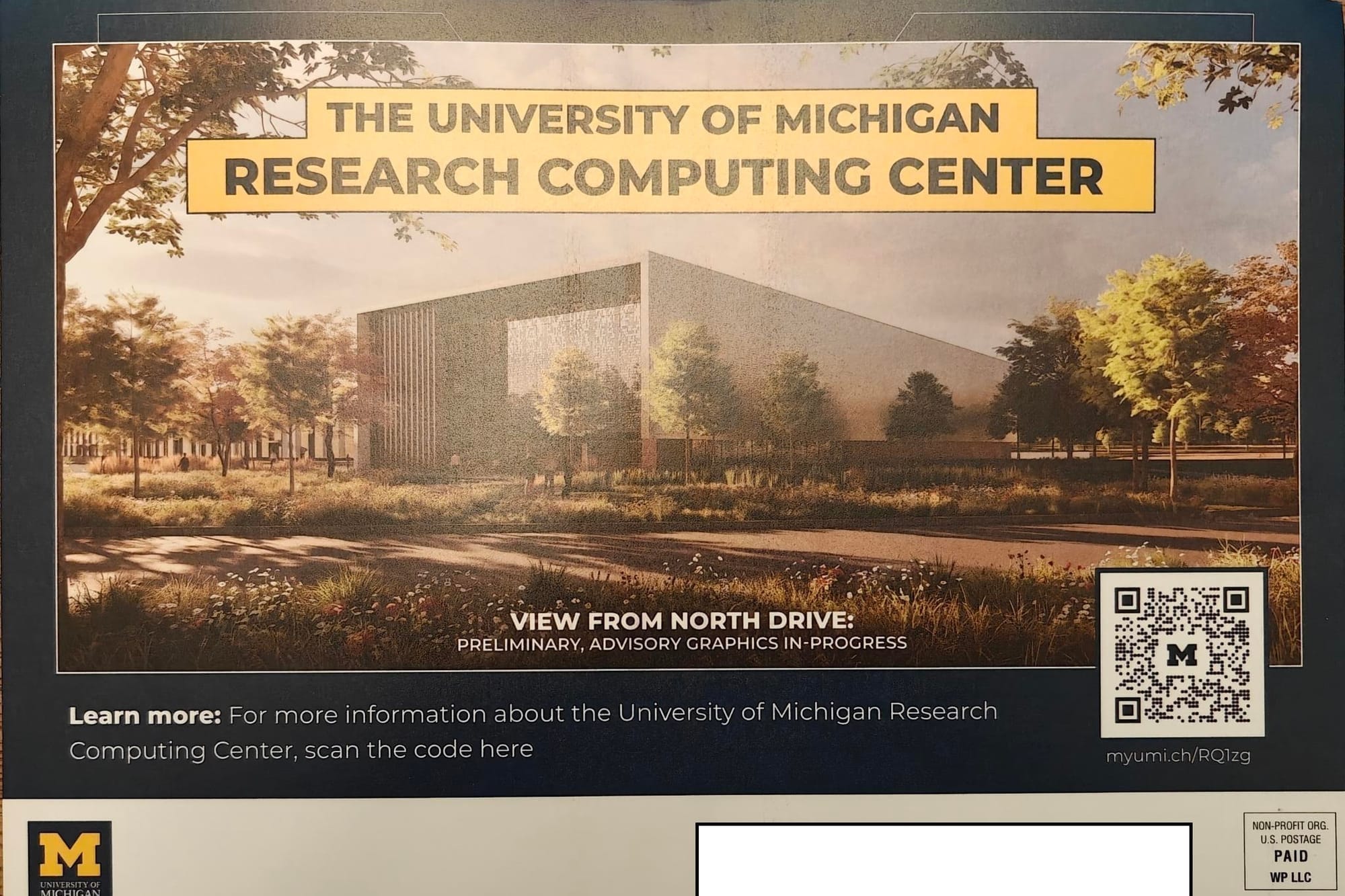
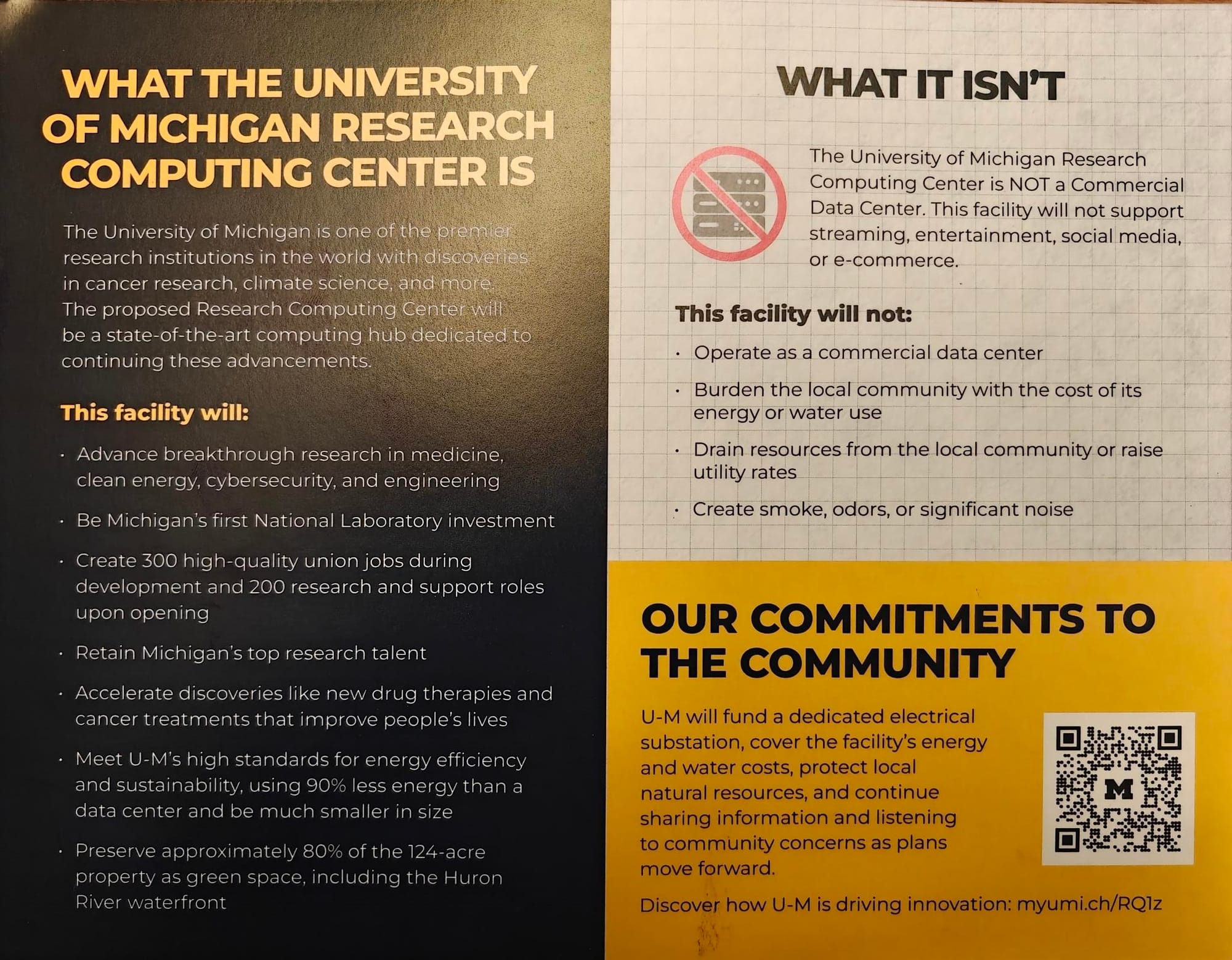
Over the past month, the University of Michigan sent postcards and pamphlets to people in Michigan telling them its new data center is “NOT a commercial data center” and is, instead, a “research computing center.”

According to one of the postcards viewed by 404 Media, the University’s data center will “advance breakthrough research in medicine, clean energy, cybersecurity, and engineering,” and "accelerate discoveries like new drug therapies and cancer treatments that improve people’s lives.” The University's postcard also promised to create 300 “high-quality union jobs during development” and “preserve approximately 80% of the 124-acre property as green space.”

One of U of M’s mailers said the building will not operate as a commercial data center. “This facility will not support streaming, entertainment, social media, or e-commerce,” it said. It also said the facility will not “burden the local community with the cost of its energy or water use, drain resources from the local community or raise utility rates,” or “create smoke, odors, or significant noise.”

The University has said it’s not sure how much water the data center will use but that it could be as much as 650,000 gallons a day. It also said it’s “evaluating several cooling techniques to identify the most efficient approach,” a process that “includes continued evaluation of reclaimed wastewater for cooling, which would significantly reduce demand on municipal potable water supply systems.”

University of Michigan Mailer Promises Its Data Center Isn’t Really a Data Center
University of Michigan mailer.

Los Alamos National Labs (LANL), America’s nuclear weapons scientists, have partnered with the U of M to construct a massive $1.2 billion 290,000 square-foot data center in Ypsilanti, Township, Michigan. Residents of the Township are angry about the “research computing center” and worry about how much water it’ll use, what it’ll do to electricity bills, and its connection to nuclear weapons. 

In April, the Township’s utilities authority approved a moratorium on delivering water to data center projects while it studied how they might impact the community’s water supply. In response, U of M sent a letter to the Township utility board threatening legal action. 

Concerned Township residents have spent the past year strategizing with community leaders about how to delay or stop construction. The Township’s anger caught U of M off guard and it attempted to address community concerns in several public meetings. It hasn’t gone well.

The pamphlet attempted to contextualize the data center’s place in America’s nuclear weapons research. “It would not involve nuclear weapons manufacturing, physical weapons testing, or the storage of hazardous nuclear materials,” the pamphlet said. But it would help “improve cybersecurity practices to safely manage existing nuclear material out of state.” In January, LANL confirmed its portion of the data center would be used for nuclear weapons research.

U of M did not return 404 Media’s request for comment.

On November 19, the board of regents approved the next phase of development for the data center in a vote of 7-1. The same night, Ypsilanti Township hosted a panel discussion about the data center where its leaders promised to continue to fight. “We have a number of strategies right now that we’re going to be pursuing,” Township attorney Douglas Winters said at the panel. “We believe that U of M has gone far afield when it comes to the constitutional autonomy which they have enjoyed by virtue of being a university.”

University Approves Nuclear Weapons Data Center, Township Vows to Fight On

University Approves Nuclear Weapons Data Center, Township Vows to Fight On

Last week, the University of Michigan’s board of regents approved the construction of a $1.25 billion data center that will power American nuclear weapons research. The regents voted 7 - 1 in a public meeting on November 19 to move forward with the project despite widespread opposition from faculty, staff, and the residents of Ypsilanti Township, Michigan where the data center will operate. A few hours after the vote, the leaders and citizens of the Township gathered to discuss how to stop it.

U of M and Los Alamos National Laboratories (LANL) first announced plans to build what the University then called an “AI research facility” in 2024. U of M now calls the project a “research computing center” and, if all goes to its plan, construction will begin on a 125,000 square foot facility in late 2027. The data center could expand to “no more than 300,000 square feet,” according to a U of M blog post.

During the regent’s meeting, faculty, staff, and members of the community shared their thoughts on the data center’s construction.

“It is widely promoted as the next step in furthering novel research taking place at this University. What is conveniently left out on flyers and pamphlets is that this is only part of the proposition, 10% in fact, the other 90% is being used by Los Alamos — a nuclear weapons developer,” a sophomore studying biochemistry told the board before the vote. “We already have three existing high tech data centers used for research. Why must we push forward with another one that is promoting nuclear warfare?”

An electrician from Ypsilanti Township, a representative of the International Brotherhood of Electrical Workers (IBEW) union, supported the construction project. “This will create 300 plus jobs for our members, all local, [and] give back to the community,” he said. “IBEW is in favor of the data center, excuse me, ‘high compute research center.’”

People who attended the regent’s meeting to discuss other topics referenced the vote during their presentations. “You voted today to fund a $785 million data center project in Ypsilanti, much to the opposition of the residents of the area, acting against what many residents in the area are calling environmental racism. I think I can speak for many students when I say I am frankly appalled by this decision,” a student who was there to discuss carbon emissions said.

A library worker present to talk about how the University treats its workers invoked the data center. “I’m not sure I can confidently appeal to your sense of compassion around this. The officials and residents of Ypsi Township are saying ‘stop,’ saying ‘no,’ saying ‘this hurts.’ And you and others responsible for this nuclear weapons data center project have shown you don’t care about the basic issue of consent as you plow ahead,” he said.

Ypsilanti Township is at the tip of the spear in the new nuclear arms race.

Despite the opposition in the room, the regents approved the project. “It’s been very controversial [...] For me, this is all about an investment in the community and it’s an investment, in many different ways,” regent Denise Ilitch said just before the vote. “The community will be enhanced — they may not feel it now, some, but I venture to say that there will be much good that will come from this.”

Many in Ypsilanti Township disagree. After the regents voted, the leadership and residents of the Township gathered for a panel discussion about the data center. One of the speakers that night was Jay Coghlan, the executive director of Nuclear Watch of New Mexico, a watchdog group that tracks Los Alamos. “The data center issue here in Ypsilanti is unique in that it is the clearest example of the pending merger of AI and nuclear weapons, which doesn’t bode well,” Coghlan told 404 Media.

Coghlan told 404 Media that he shared the Township’s concerns about how the data center will use water and electricity but said he thinks its construction will have farther reaching consequences. “Our nation is transforming from the military-industrial complex that Eisenhower warned us about to a Silicon Valley-Pentagon-Wall Street complex that closely links economics, economic inequality, increasing militarism, and I dare say the rise of techno-fascism,” he said.

U of M has repeatedly said the data center will mostly be used to power medical breakthroughs and conduct cancer research, something it’s highlighted in flyers and pamphlets it’s mailed to people in the Township. LANL sent a letter to the people of the community in September that promised it wouldn't build nuclear weapons in their backyard. 

“I'm going  ‘Duh, yeah, you're not going to bring plutonium to Ypsilanti in Michigan,” Coghlan said. “But I expect this data center to have a lot to do with the design of new nuclear weapons. So, in that way, Ypsilanti Township is at the tip of the spear in the new nuclear arms race.”

Coghlan  said he finds hope in the opposition to the project. “I’m very impressed by the intensity of opposition that I have witnessed. There seems to be a pretty widespread public awareness of the data center in Ypsilanti, Township.”

During the Township meeting on November 19, after the regents voted, Ypsilanti Township attorney Douglas Winters said he was mad. “What did we learn on November 3rd? Two weeks ago and two days, voters around this country loudly declared that they were sick and tired of government corruption. They were tired of secrecy. They were tired of abuse of power. They were tired of threats to democracy and the disregard of governmental accountability. And, importantly, they also said they were sick and tired of these data centers,” he said. “Somehow that message did not make it to Ann Arbor. That message did not make it to the board of regents.”

Winters and other leaders vowed to keep fighting the data center’s construction. In May, the community’s water authority voted to restrict new construction on infrastructure to data center projects while it conducts a review of their impact on the Township’s water supply. The University called the move “unlawfully discriminatory.” In August, the Township passed a six month moratorium on new electrical infrastructure, a move aimed at delaying the project. 

Google Wants To Make a 24/7 AI TV Channel. You’ll Be the Main Character

Google Wants To Make a 24/7 AI TV Channel. You’ll Be the Main Character

Google has filed for a patent that would use the information it knows about you to create an AI-generated TV channel full of personalized “shows” starring you and featuring customized advertisements. The patent is the latest signal of the AI video endgame: endless highly specific, customized content that is automatically generated based on the wealth of data companies and advertisers collect about you.

“I’m not going to remove the repository”

“I’m not going to remove the repository”

There is a hacking tool called ARTEX that is causing havoc around the world. It lets a hacker plug in their LLM of choice, and ARTEX will then spin up a bunch of AI subagents focused on different aspects of hacking, such as scoping out a target or stealing data. This tool can complete an entire hack of a target in just a few hours. The original author of ARTEX took down the tool in October after it became clear that bad people were using it. But, as I write below, ARTEX is free. Several people are still distributing it on GitHub. I spoke to them about it, asked them why, and for their thoughts about requests to take the tool down. 

And as I’m writing this, NVIDIA just said it has reinstated Jensen Huang as President, CEO, and Board Director. Hahahahahahahahahha.

‘The Code Is Already Copied Everywhere’: The AI Hacking Tool Causing Havoc Around the World

‘The Code Is Already Copied Everywhere’: The AI Hacking Tool Causing Havoc Around the World

ARTEX, an open source framework that makes it easy for AI agents to hack companies at superspeed, is causing havoc. People using the tool appear to include Chinese hackers breaking into targets for espionage, and financially-motivated hackers too. Earlier this month, the FBI published a warning to potential targets, and said hackers using ARTEX have targeted government, healthcare, telecommunications, legal, defense, financial services, and semiconductor sectors globally.

ARTEX is written in Go, and all someone needs to do is connect their preferred LLM — from Anthropic, DeepSeek, or whoever — and ARTEX then creates a bunch of agents that are designed to focus on different hacking tasks. There is something qualitatively different about ARTEX when compared to other hacking tools. As the FBI explains, it uses agentic AI to automate much of the hacking process “at machine speed.” This can be reconnaissance — the scoping out of a target to understand their infrastructure — right up to actually hacking a target and stealing their data. An AI agent doesn’t need to sleep, eat, or commute home. ARTEX can complete an entire hack in just a few hours from start to finish, the FBI says. With a tool like ARTEX, a hacker can set up the tool and let it rip. As Google’s threat intelligence arm has noted, hackers are using other similar multi-agent frameworks like CAIRN, CyberStrikeAI, and PentAGI too.

💡
Do you know anything else about ARTEX or related breaches? I would love to hear from you. Using a non-work device, you can message me securely on Signal at joseph.404 or send me an email at joseph@404media.co.

The original author of ARTEX, who goes by Autumn-27 and writes in Chinese, took the tool off of GitHub in October. A message left on their GitHub says, “It has come to my attention that the ARTEX tool has recently been misused by malicious actors to carry out cyberattacks. As the creator of ARTEX, I wish to make the following formal statement.” They go on to say they are not associated with these attacks, that malicious use of the tool runs “entirely counter to my original intent,” and that they are moving ARTEX into a closed-source model and will no longer update it.

Scientists Discover New and Horrible Eagle-Based Way Our Ancestors Died

Scientists Discover New and Horrible Eagle-Based Way Our Ancestors Died

Welcome back to the Abstract! Here are the studies this week that dive-bombed our ancestors, brightened the sky, recalled an old tune, and got hosed by marine mucus.

First, scientists discover that eagles are hunting large baboons, hinting that early human relatives once sated ancient avian appetites. Then: star-on-star contact, a musical memory lane, and the secrets of cetacean snot. 

As always, for more of my work, check out my book First Contact: The Story of Our Obsession with Aliens, or subscribe to my personal newsletter The BeX Files.

Eagle-eyeing you…for dinner!

Hobaiter, Catherine et al. “Signs of Eagle Predation on a 22-kg Adult Primate.” American Journal of Biological Anthropology.

Death came from the sky for early humans, according to a new study that suggests giant eagles preyed on our ancestors far more recently than was previously known. 

Birds of prey (raptors) have hunted primates for at least 20 million years, including early human relatives, known as hominins. For example, a hominin toddler known as the “Taung child” shows signs of being killed by a raptor roughly 2.5 million years ago. But scientists have assumed that hominins outgrew their status as bird bites since that time, and there are no reports of raptors preying on primates that weigh over 28 pounds on record—until now. 

In 2025, scientists discovered that Verreaux’s eagles—one of the largest eagle species in the world—at Ennedi Plateau in Chad are likely hunting adult olive baboons weighing up to 57 pounds. The team found baboon remains among the region’s sandstone cliffs that show signature marks of eagle predation, such as talon punctures on the skull and scrapes to the shoulder bones.

“We cannot definitively rule out scavenging activity, but the severity of punctures is suggestive of lethal interactions through a killing grip,” said researchers led by Catherine Hobaiter of the University of St. Andrews. The team also observed the baboons rapidly retreat when eagles approached, suggesting that they feared aerial attacks.

Scientists Discover New and Horrible Eagle-Based Way Our Ancestors Died
Speculative face-off between adult baboon and an eagle. Image: Javier Lázaro (reproduction permitted: CC-BY-ND)

Some researchers have argued against the “raptor-mediated predation” of the Taung child on the grounds that the hominin would have been too heavy for a bird. The study’s authors get extra points for including a quote from the comedy Monty Python and the Holy Grail on this point: “It is a simple question of weight ratios. A five-ounce bird could not carry a 1-pound coconut.” IYKYK.   

However, the laughs stop there, as the team refutes this idea by recounting the grisly “low flight with sustained grip attack” that eagles perform on ungulates, such as antelopes or cattle, which reveal that raptors can kill animals that are many times their own weight with the right approach. 

“Briefly, an eagle will land on the back or neck of a moderately large ungulate, gripping it firmly with its talons. If the prey withstands knocking to the ground, the eagle will ride it with wings outstretched and flapping to maintain balance until the quarry collapses, either from exhaustion, shock, or internal injury. A similar tactic is described in the extraordinary report of a Harpy eagle (Harpia harpyja) attacking a 52-kg adult woman.”

Wow, new fear unlocked! Imagine being an early hominin, minding your own business banging rocks together or something, when suddenly a giant bird of prey either pushes you off a cliff or rides you to death. For everyone preparing to eat a huge bird for Thanksgiving next week, be grateful that it’s no longer the other way around.

In other news…

A union made in heaven 

Karambelkar, Viraj et al. “An inspiral of a star inside a common envelope with its giant companion.” Nature.

Speaking of unwieldy meals, scientists have captured an unprecedented glimpse of a star eating another star, thereby forming a new mega-star. 

Over the past few years, scientists noticed that something weird has been unfolding in a binary star system called AT 2025abao—nicknamed “Bao” (yum!)—in the outskirts of the Andromeda galaxy, which is about 2.5 million light years away from the Milky Way. One of the stars, “Big Bao,” was expanding into its dying red giant phase, which pulled its companion, “Little Bao,” into a deadly spiral. Last year, the system rapidly brightened, signaling that Big Bao had swallowed Little Bao.

Scientists Discover New and Horrible Eagle-Based Way Our Ancestors Died
Observations of Bao from 2025. Image: NASA, ESA, CSA, STScI, Viraj Karambelkar (Columbia), Kishalay De (Columbia); Image Processing: Alyssa Pagan (STScI); Acknowledgment: DSS, Robert Gendler

“In October 2025, the star underwent a dramatic eruption” and exhibited “a sudden increase in its photospheric temperature to about 8,000 K,” said researchers led by Viraj Karambelkar of Columbia University. The system “shows the defining hallmarks of luminous red novae, a class of transients established to arise from impulsive energy injection…during the merger of a star with its companion.”

“This inspiral in such a system has never been observed directly,” the team noted. 

Congratulations to the newly-fed couple! Long may Bao shine.

Girl, put your records on / but don’t think you own that song

Turnbull, Cara et al. “Music illuminates sociocultural dimensions of autobiographical memory.” Proceedings of the National Academy of Sciences. 

We’ve all had that feeling of hearing a familiar song and being transported to a specific time and place in our lives. But as it turns out, the recollections stirred by those cherished songs are probably not all that special, according to a new study that surveyed 233 undergraduate students about these so-called “music-evoked autobiographical memories.”

The students (aged 18-23) listened to clips of 32 popular songs grouped into two categories: “new” songs released from 2014 to 2019, during their adolescence, and “old” songs released from 1985 to 1995, before they were born. When asked to reminisce about the songs, students with similar backgrounds were remarkably aligned in their answers.

“Memories evoked by country songs were more strongly associated with very recent time periods (college) and themes relating to family, driving, summertime, romantic partners, and listening to music (particularly music selected by someone else),” said researchers led by Cara Turnbull of Texas Tech University. 

“Alternatively, memories evoked by hip-hop songs were most often associated with friends, acquaintances (such as classmates, coworkers, and teammates), dancing, and being at school, while those evoked by pop songs were most associated with middle school, listening at home or by oneself, and singing along,” the team added. 

As an elder millennial, it was humbling to realize what counts as an “oldie” these days. I also felt my generation’s soundtrack was done dirty by offerings like “Achy Breaky Heart” by Billy Ray Cyrus or “Whoomp! There it is” by Tag Team. No Stevie Nicks? Madonna? Wu Tang? All I ask of future generations is that you do not judge us solely by the croonings of C+C Music Factory and Bryan Adams, I beg you. 

Thar she blows (DNA)!

O’Mahony, Éadin et al. “Breath to Genome: Whole Genome Sequencing of Large Whales From Blow Sampling.” Molecular Ecology Resources.

Join hands, dear friends, for we are about to run directly through majestic fountains of whale snot. Scientists who flew drones through whale “blow”—the mucus-filled vapor exhaled by whales through their blowholes—have successfully sequenced whole genomes from the snotty samples, representing “a major step towards non-invasive cetacean sampling,” according to a new study.

“Preserving biodiversity requires the genetic monitoring of wild populations, which is traditionally done through invasive sampling techniques for DNA collection,” said researchers led by Éadin O’Mahony of the University of St. Andrews. “However, this approach can impact animal welfare or be impossible to implement due to behavioural responses to anthropogenic factors or national/international legislation.” 

Scientists Discover New and Horrible Eagle-Based Way Our Ancestors Died
A drone samples whale blow. Image: North Coast Cetacean Society

Indeed, I think that we can all agree that humans have stressed whales out enough as it is. Instead of invasive biopsies of skin and flesh with darts or scrapers, O’Mahony and his colleagues equipped drones with petri dishes and flew them through a total of 58 blows from 26 Northeast Pacific humpback whales in the Gitga'at First Nation territory of northern British Columbia.  

The team “established that a whole humpback whale genome can be recovered from exhaled respiratory vapour (‘blow’), marking a significant methodological advancement in non-invasive cetacean genomics.”

While it’s not the kind of blow most people associate with breathing orifices, it just might be what we need to study whales without hassling them.

Thanks for reading! See you next week. 

Corrected: A previous version of this story erroneously used "miles" in place of "light years."

Podcast: I Spoke to an AI Fraud Kingpin

Podcast: I Spoke to an AI Fraud Kingpin

We start this week with Joseph’s profile of the man who made OnlyFake, an AI-powered fake ID site. After the break, Jason tells us about the Muse agent that is using Meta. In the subscribers-only section, Jason explains how the Department of Justice is using AI detection tools against defense lawyers.

Listen to the weekly podcast on Apple Podcasts, Spotify, or YouTube. Become a paid subscriber for access to this episode's bonus content and to power our journalism. If you become a paid subscriber, check your inbox for an email from our podcast host Transistor for a link to the subscribers-only version! You can also add that subscribers feed to your podcast app of choice and never miss an episode that way. The email should also contain the subscribers-only link for the extended video version too. It will also be in the show notes in your podcast player.

Behind the Blog: Keeping It Together

Behind the Blog: Keeping It Together

This is Behind the Blog, where we share our behind-the-scenes thoughts about how a few of our top stories of the week came together. This week, we discuss hippo physiology, Shenmue, and tricky interviews.

SAM: All anyone is talking about this week is GTA VI and a famous hippo, two things I have relatively passing interest in. GTA looks sick but I am very busy playing my interpersonal chores game of choice, Spiritfarer, in 20 minute increments three nights a week max, so I’ll be doing that for a while. 

The hippo situation is honestly very crazy to me (and sad ofc), a merely casual Fiona appreciator. But I'm finding the meta-discourse around the hippo situation more interesting than what actually happened; it seems like a ton of people have become parenting experts, hippo surgery experts, knit hat aerodynamics experts, and zoo enclosure design experts in the span of a week. In some cases it has gotten nasty. I think the situation so perfectly encapsulates the toxicity of online discourse, professors will probably teach it in mass media classes by next semester. 

To Catch a Ransomware Scammer, FBI Posed as Both Victim and Attacker

To Catch a Ransomware Scammer, FBI Posed as Both Victim and Attacker

This article was produced in collaboration with Court Watch, an independent outlet that unearths overlooked court records. Subscribe to them here.

Federal prosecutors say the FBI posed as both a ransomware victim and threat actor during an undercover operation targeting a Florida-based company.

The company, run by defendant Juan Ricardo Palacio Escobar and an unnamed business associate, began in 2020 and claimed to offer data recovery services for victims of ransomware.

High-End Furniture Marketplace AptDeco Is Taking People’s Furniture and Not Paying Them

High-End Furniture Marketplace AptDeco Is Taking People’s Furniture and Not Paying Them

This article has been updated with comment from AptDeco.

Last month, Erin sold a $3,000 large designer table on AptDeco, a white glove high-end furniture marketplace. More than a month later, she feels like she’s been literally robbed.

“AptDeco sent three men to physically collect my table on October 13, and here we are on November 16, with no payment and no concrete explanation for where my $2,000 (after their absurd $900 fee) is,” Erin told me. “It genuinely feels like I’ve had something stolen from me.”

AptDeco is a Y Combinator-backed company whose entire purpose is to take the risk out of places like Facebook Marketplace and Craigslist for designer furniture resale. It advertises itself as “simple and seamless,” and says “we handle pickup, delivery, and payments,” and claims that it pays sellers “within 5-10 business days.” But over the last few months, people who have sold furniture on the platform say that AptDeco has sold their furniture and taken it from their houses, but hasn’t paid them. 404 Media agreed to only use Erin’s first name because she is still trying to get her money from the company.

AptDeco’s social media accounts are full of sellers who say they haven’t been paid, the company has faced a series of Better Business Bureau complaints alleging the same, and a recent Reddit thread is full of upset sellers as well. 404 Media has spoken to four sellers who have been waiting more than a month for payouts with only vague updates and has reviewed their correspondence with AptDeco.  

“Another week and still processing,” an Instagram comment on the company’s last post reads. 

“Adding to the chorus of people who sold an item thru AptDeco and never received payment. I have no idea what to do at this point,” another says. 

“Can we do a class action lawsuit?” another reads.

“They owed me money since September 30th,” a fourth says. 

Every recent review and complaint on AptDeco’s Better Business Bureau page is from sellers who have not been paid: “Almost 6 weeks after they picked up and not being paid Pick up was a nightmare too No calls nobody doing anything Do NOT SELL ON APTDECO,” one reads. Another states “I have been in an endless loop with customer service for 2 months trying to get my payout for the bed I sold. I am losing faith that I will ever see this money. Extremely frustrated at this experience.”

On AptDeco’s website, everything appears to be business as usual. You can still buy and sell furniture, and there is no indication of anything wrong at all. 404 Media’s repeated attempts to reach AptDeco to ask what was going on went unreturned.

In communications with sellers seen by 404 Media, AptDeco’s customer service representatives have repeatedly blamed their payment processor, a “technical bug,” or have said the payment is “moving through the system.” On November 3, AptDeco told Erin that a bug had prevented her from being paid, that the payment team “retried” it, and that she would be paid within 10 days. 

“I’ve asked our team to prioritize your payout personally, so you should see it in your bank account by then - hopefully sooner! At this point, we’re doing everything we can to get your payout processed,” a customer support email reviewed by 404 Media reads. On Tuesday, two weeks after the company told her the payment had been retried, a different customer service representative followed up and said “I'm truly sorry — I know this isn't the update you were hoping for. Your payout is still being prioritized by our payments team, and I want to be honest with you: I don't yet have a confirmed release date or timeline to share.”

Several other people who have sold items on AptDeco recently told 404 Media they’re experiencing the same problem.

Harry Heymann sold a Room & Board couch on AptDeco in late September and still has not been paid the $120 he is owed by the platform. The messages he’s gotten from AptDeco customer support read much the same as Erin’s: They claim “a technical bug on our end held up your payout” and the customer service representative said “I’ve asked our team to prioritize your payout personally.” Late last week, he got what reads like an AI-generated message that reads “I know how frustrating this has been. You've been waiting on your $120 payout, the date you were given has passed, and you've had to follow up to get answers. That's not the experience we want for you, and I'm truly sorry. Your case has been escalated to me, and l'm happy to be your point of contact from here. Unfortunately, the issue with our payment processor has not yet been resolved, and our team is still working on it.” 

Natalie Simmons sold an armoire in late August and told 404 Media she initially had a good experience compared to using other platforms. But then she never got her money. 

“After so many uncomfortable situations on different social sites I was so happy when I found AptDeco,” she told me. “I received notification that my payment would arrive in 3-5 business days through the portal in app. That was Aug 30th. I tried calling but the voicemail says leave a message and they will respond by email. I emailed several times and finally after 2 weeks and a few voicemails I received an email that there was a glitch with their payment system and I will receive payment within 5-10 business days. After another 2 weeks I called and emailed again that I still didn’t receive payment. They sent another email with the exact same story. I just want to get paid. It’s not even that much but it’s the principle.”

It’s not just sellers who have had issues with the platform. One customer, K Turner, bought a couch and tried to return it. Rather than giving her a refund, the company said they would relist it at the price she paid and then give her a “refund” of whatever it sold for minus fees. The couch resold quickly at the beginning of September and the company told her she would quickly get her “refund.” More than a month later, on October 20, they told her “I have gone ahead and processed that refund ($600) manually. Please allow 5-10 business days for this refund to be reflected back to your original form of payment.” She has still not gotten her money. 

“The communication was decent at first, but once they confirmed the item resold on September 8th, they then went silent. It took me a month to finally get a response. They confirmed that the item resold at the full listing price of $600 and that I would receive my refund to my original payment in 5 - 10 business days,” Turner told me. “That was nearly a month ago, and I still don't have my money. So, they effectively double-dipped. They got my money from the original order and then collected money by reselling it. And who knows if they ever gave the money to the original seller; maybe they triple-dipped. I have threatened legal action twice now.”

The customers I spoke to have no idea what happens next. Some of them said they were going to file claims in small claims court or are considering a class action lawsuit. But the company is mostly giving them what appear to be canned, copy-pasted statements that come from a revolving cast of customer support email addresses, and no actual updates. Four emails from 404 Media asking for comment, including emails sent to the company’s CEO, have not been returned. AptDeco promises a high-end, safe experience when compared to somewhere like Facebook Marketplace or Craigslist, and markets itself primarily for more expensive, lightly-used furniture. The people I spoke to said they wish they had just stayed off the platform altogether.

“The irony is that I’m now feeling safer selling expensive designer furniture directly to strangers on Facebook Marketplace than through a platform whose entire purpose is supposedly to make these transactions safer and more secure,” Erin said. “At this point, AptDeco has my furniture, I have no money, and I’m left chasing them for something I’m already owed. It’s an incredibly unsettling position to be in, particularly when so many other sellers seem to be experiencing the same thing. The fact that I continue to receive email marketing newsletters and see them selling via Google Ads—paying that platform before their sellers—is infuriating.”

Update: 11/20/26

After this article was published (and three days after we initially asked for comment), an AptDeco spokesperson gave 404 Media a convoluted explanation involving “bot swarms,” which it blamed for the delays in seller payouts. “Over the past few months, we’ve been dealing with an unprecedented volume of bot activity, some of it malicious. This has created a myriad of challenges that we’ve been actively working to address.These bot swarms, along with the broader cybersecurity challenges of an AI-evolving world, prompted us to significantly strengthen our site’s security to ensure the long-term protection of our buyers and sellers,” the spokesperson said. “To be clear, customer data has not been compromised in any way. However, we’ve been investing heavily in preventative measures to further protect our community. Unfortunately, some of these efforts have resulted in delays in seller payouts.  As you can imagine, cybersecurity is a complex and sensitive topic, making it challenging to communicate all the details broadly. That said, the issue has now been resolved, and outstanding payouts are being processed. Any seller with questions can email payouts@aptdeco.com and will hear back within 1 business day. We appreciate your patience and understanding.”

When I asked for clarification because it was not clear how bot swarms would affect payouts, the spokesperson said “the bot swarm did not affect seller payouts.”

“We deployed code to further improve protections for our customers (given the bot swarms) which inadvertently impacted seller payout processing. Providing additional technical context would require a detailed understanding of our codebase and would likely be more information than is relevant or useful to readers,” they added. “That said, we sincerely apologize to our customers for the delays and are committed to making things right. The issue has been resolved, our security infrastructure remains extremely robust, and outstanding payouts are being processed. We appreciate you reaching out and giving us the opportunity to clarify. This will be our final comment on the matter.”

A 404 Media reader
also pointed out that the company is being sued by American Express for allegedly failing to pay a $158,461 credit card bill from 2024; that case is in default judgment but is ongoing.

Black Neighborhoods Are Twice as Likely To House a Data Center, Study Finds

Black Neighborhoods Are Twice as Likely To House a Data Center, Study Finds

Developers build data centers in communities of color at more than twice the rate they do in white neighborhoods, according to a new study from researchers at George Washington University and the Center for Security, Innovation & New Technology (CSINT) at American University.

According to the study, “Redlining in the Age of AI: The Relationship between Data Center Locations and Race in the US” majority-Black neighborhoods have 2.2 times the odds of hosting a data center than a white neighborhood in the same state. The number goes up to 2.6 in majority-Hispanic neighborhoods and 4.2 times in majority-Asian neighborhoods. “As the share of Black, Hispanic, and Asian residents in a neighborhood increases, so do the odds that the neighborhood hosts a data center,” the researchers wrote.

The researchers ran the numbers by examining 81,000 US census tracts and location data for 5,291 data centers. “We found that these racial disparities persist even after accounting for factors such as population, household income, education, land costs, proximity to major transmission lines, and state fixed effects,” they wrote. “These results hold even though data centers are concentrated in and around metropolitan areas, which are often more racially diverse.”

“We really wanted to look at this on a nationwide scale to see: is this something that fits into this broader structural racism story?” CSINT executive director Samantha Bradshaw told 404 Media. “What we did find was yes [...] neighborhoods that have data centers tend to have a higher ratio of people of color.”

Bradshaw and co-author Dhanaraj Thakur told 404 Media that they were inspired to do the study after reading stories about data centers in Memphis, Tennessee polluting Black and Brown communities. Another high profile case occurred in Taylor, Texas where a white family donated a tract of land to the city with the intention it become a public part. That land abutted a Black neighborhood. The city never built a park there and now it’s slated to become a data center

According to the researchers, the historical legacy of redlining — the process of denying Americans of color loans and other opportunities to keep them in specific neighborhoods — is to blame for some of this. Data centers are often built near transmission lines because they provide ease of access to power infrastructure, for example. Those transmission lines were often built in majority Black neighborhoods in America. 

Thakur said he doubted that data centers developers were seeking to intentionally put data centers in communities of color. “It’s just how embedded race is with all these other factors,” he said. 

The study distinguished between several different kinds of data centers and noted there are massive differences between hyperscalers like what Meta, Google, and Grok are building and smaller mixed use buildings that often serve as network transmission hubs as well as compute warehouses, which the study called “co-location facilities.” When a hyperscaler comes to town, the developers sometimes promise economic investment in the community where it’s being constructed and those facilities typically aren’t built in communities of color..

Meta is building a $50 billion data center in rural Louisiana. Community leaders there have said it would bring 1,000 permanent jobs and that sales tax revenues have already jumped 2,000 percent, leading to a $50,000 bonus for area teachers. Even here, there is disparity. Most of the hyperscalers that promise massive economic benefits to local communities are built in white rural communities. 

The study makes several suggestions about what to do about all this including data center-specific zoning regulations, prioritizing racial equity in discussions around building them, and requiring racial impact statements for data centers before they’re built. 

Thakur and Bradshaw emphasized that tech policy should be a negotiation between the companies that provide the tech and the communities that use it. Data centers have spurred these conversations — they’re physical representations of Big Tech’s powers, a power that Americans recently rejected at the ballot box. “AI has a physical geography, and that geography is shaped by political and social history,” the researchers wrote in the study.

“I think the issue around how racial justice, civil rights plays into many other kinds of policies —health, education, housing, whatever it is — we just don't see enough of that consideration in tech policy, and I think this this kind of analysis shows why we should be doing that, thinking about that more,” Thakur said.

Bradshaw agreed. “If you look at who's represented in tech policy and who built these systems, who designs them, who engineers them, it's a very specific kind of white male Silicon Valley California ideology engineer, and that is not representative of the technology and its users,” she said. “So I think bringing in these perspectives is really really important because then we can truly think about ways to design a tech future that is for everybody.

ICE Is Paying AT&T to Dig Through a Mountain of Call Records

📄
This article was primarily reported using public records requests. We are making it available to all readers as a public service. FOIA reporting can be expensive, please consider subscribing to 404 Media to support this work. Or send us a one time donation via our tip jar here.
ICE Is Paying AT&T to Dig Through a Mountain of Call Records

Immigration and Customs Enforcement is paying telecommunications giant AT&T millions of dollars to have AT&T’s analysts sift through mountains of raw AT&T data for a wide variety of investigations, according to an internal ICE document obtained by 404 Media, other procurement records, and experts who reviewed those records. Civil liberty experts have called it a mass surveillance program, and they say the data can include trillions of phone records and location data. 

The AT&T product, interchangeably called Data Analytics and Support Services or Data Analytical Services, appears to be related to an earlier surveillance program called Hemisphere, in which AT&T provided U.S. authorities at state, local, and federal levels access to AT&T user data. Though that program shut down, ICE is still paying for access to raw data under this new arrangement with AT&T, according to the restricted ICE procurement document obtained by 404 Media. The program likely affects more than just AT&T customers because the company connects phone calls for other phone companies, meaning non-customers are likely swept up too, according to a surveillance expert.

“This requirement provides ICE access to AT&T’s raw data and experienced analysts,” the document obtained by 404 Media reads.

💡
Do you know anything else about this data? Do you work at ICE or another federal agency using it? I would love to hear from you. Using a non-work device, you can message me securely on Signal at joseph.404 or send me an email at joseph@404media.co.

AT&T told 404 Media the data is made available under a valid legal order, but experts point out it requires an administrative subpoena, which agencies can issue themselves and don’t require a judge’s approval, raising concerns that ICE can use the data for essentially whatever it wants. The document also shows how financial incentives play a part in providing data to ICE.

Charting American Culture in News Footage of ‘Grand Theft Auto’

Charting American Culture in News Footage of ‘Grand Theft Auto’

Some people spent the week leading up to the release of Grand Theft Auto VI replaying the old games. I, sicko that I am, spent it watching TV news coverage of the franchise from the past 20 years.

Grand Theft Auto has been a staple of cable and broadcast TV news since at least the release of Grand Theft Auto III in 2001. I’ve been an adult for all of it; I’ve had a front row seat for two decades of moral panics, parental freakouts, and bizarre political theater. The games and the broader culture’s reaction to them have changed dramatically in that time. In 2001, newscasters worried GTA III was training an army of young men to kill. In 2026, The New York Times earnestly quoted Bell Hooks in its review of GTA VI.

For mainstream news, GTA is the ur-video game. The open world that mirrors our own, the prevalence of sex and death, and the increasingly realistic simulations and graphics pointed towards the dream of what a video game could be. GTA is the American id made manifest.

You can chart America’s changing culture — especially its anxieties — by watching how the media covered Grand Theft Auto. This was, at first, the game that critics of the medium had always warned us about: a violent sex and death simulator that rotted the brains of the youth just as rock and roll and comics had done in ages past. Twenty years on, the brains are thoroughly rotted, GTA won, and now? Now we’re all worried about money.

GTA III and Vice City — Murder Simulators, the Assassin of Youth

Rockstar released Grand Theft Auto III in October 2001 and Vice City just a year later. The controversy around both started right away and centered around violence, and sometimes, the game’s depiction of women. “This is the world’s most popular video game [...] and millions of kids are mastering it by learning to slaughter bystanders,” Ted Koppel told America.

Nightline devoted 20 minutes of its broadcast to GTA in July 2002. It interviewed children who grinned ear to ear as they gunned down people in GTA, their parents who insisted it was just a game, a concerned expert who was sure GTA was training them to kill, and a psychologist who said that was bullshit. It all ended with a roundtable discussion where a police officer, in uniform, explained the differences between video games and real world violence.

Grand Theft Auto: San Andreas — Congressional Hearings and Sex on TV

I was an assistant manager of a Gamestop in Texas in 2004 when Rockstar released Grand Theft Auto: San Andreas. The level of parental concern in the store was high in the weeks leading up to its release. One mother was so upset by a stack of Game Informers bearing a cover story about San Andreas that she told me I was going to hell for “selling a gangster lifestyle” to children.

But it was sex, not violence, that the news focused on with San Andreas. The game had a lot of simulation elements — its protagonist would gain weight if he ate too much — and Rockstar had experimented with a sex minigame called “hot coffee.” Developers cut the minigame from the final release, but it was still on the physical discs that went to stores. Modders uncovered it in the files and were able to patch it back in.

California politician Leland Yee got wind of the mod and condemned the Entertainment Software Ratings Board (ESRB) for labeling the game “Mature” instead of “Adults Only.” Cable news went wild. Rachel Maddow weighed in. Hillary Clinton, then a Senator in New York, demanded an investigation. Congress voted to send the FTC after Rockstar for deceiving the ESRB. 

The ESRB updated the game’s rating to an AO. Walmart, Best Buy, and other retailers pulled it from shelves. San Andreas publisher Take-Two shipped new copies with the content completely removed. Take-Two’s shareholders also removed most of its board and put Strauss Zelnick in charge. He’s been the CEO ever since.

Grand Theft Auto IV — The Ballad of Jack Thompson

The cultural winds had shifted by the time Grand Theft Auto IV hit stores in 2008. Retailers across the country had midnight release parties where people lined up to purchase the game as soon as possible. Local news outlets interviewed people in line and marveled at how much money Grand Theft Auto IV might make.

But the culture warriors still pointed to GTA as proof of America’s moral decline. Glenn Beck, then an anchor on CNN Headline News, ran multiple segments on the game and often spoke to American lawyer Jack Thompson. Thompson hated Grand Theft Auto so much and was so sure it was training young people to kill their elders that he let his crusade against the franchise ruin his life.

Thompson filed a lawsuit against Take-Two aimed at preventing the company from selling Grand Theft Auto IV at all. The publisher counter-sued, Thompson accused it of perjury, and the parties eventually settled. In its ruling, the courts said Thompson could never use the legal system to stop Take-Two from publishing a game ever again.

He didn’t stop though. After the game came out, Thompson was convinced Rockstar had based an assassination mission on him. He filed a lawsuit then sent a letter to Strauss Zelnick’s mom. “Your son, this very moment, is doing everything he possibly can to sell as many copies of GTA IV to teen boys in the United States, a country in which your son claims you raised him to be ‘a Boy Scout.’ More like the Hitler Youth, I would say. Happy Mother’s day, Mrs. Zelnick, which this year is May 11, two weeks after your son unleashes porn and violence upon other mothers’ boys. I'm sure you’re very proud,” Thompson wrote in the letter.

The Supreme Court of Florida permanently disbarred him shortly thereafter.

Grand Theft Auto V — Money in the Age of Violence

In 2013, Grand Theft Auto V made a billion dollars in three days and was the biggest entertainment release of all time. It made more money than any movie, book, album, or video game had ever made before. Every news broadcast about the game led with that fact. “Never has there been an opening like this in the entertainment industry,” CBS News said.

Jake Tapper and CNET’s Dan Ackerman lamented that GTA V’s success would hurt the creativity of the video game industry. “It’s become such a hit-driven business. You have to have a big opening day or opening weekend for anyone to take you seriously. And when you have such a hit-driven business, I think people get risk averse and they don’t get as creative,” Ackerman told Tapper. 

The news still ran segments about the violence and sex in the game, but it was typically couched in a conversation about its runaway financial success. Most anchors brought on experts who told them about the business. They sought to understand what was happening and why people liked the game, rather than condemning it outright. 

Grand Theft Auto VI — Anxieties of American Decline

In 2026, cultural fears about violence and sex in video games are gone. Instead, we’re all worried about money. Everyone is sure Grand Theft Auto VI will make money, the question is if it will make all the money?

“Why the stakes for GTA VI are so high,” declared the thumbnail for a Bloomberg video about the game. The outlet’s podcast also ran an episode about why the game cost so much. Newsweek worried that the U.S. economy might lose $1 billion as people take time off work to play. CBS News’ morning show wondered how much money the game would make and the anchor admitted he once “lost a summer” to Grand Theft Auto. No one discussed violence at all. CNBC’s coverage called the game a “Billion Dollar Hype Machine.”

Behind it all is a kind of lament — a worry that Grand Theft Auto VI might be a final hurrah for this kind of game. Rumors are that it cost a billion dollars. Games are more expensive than ever and the industry has been devastated. A third of the industry lost their jobs in the past 24 months and most of them can’t find another gig. Even when a game is successful, companies cut staff. The Washington Post wondered if GTA VI “may be the last great heist.”

Underneath all these economic fears, the older panics still lurked. On Fox News, middling collegiate swimmer turned political activist Riley Gaines hoped that the game’s romantic elements would lead to a rise in birth rates. “Hopefully these men realize they like the feeling of love, romantic love, and go out and find it. Because, I’ll tell you what, we’re in a population decline. We need more babies. You can’t have babies, real babies, mouths to feed, from video games,” Gaines said.

Here’s Riley Gaines on Fox News this weekend talking about GTA 6:

We’re in a population decline. We need more babies. You cannot have real babies from video games. Hopefully, this transcends into real life romantic relationships. pic.twitter.com/4RVWq5URZB

— Lucas Sanders 👊🏽🔥🇺🇸 (@LucasSa56947288) September 6, 2026

Twitch streamer Sasha Grey had early access to the game and was streaming it to YouTube and Twitch when YouTube shut down her stream for “nudity.” An early cutscene showed what Grey described as “artistic nip and some booty.” Grey complained to YouTube in a post on X and shared a screenshot of the moment the company shut down her stream. 

“They allow far worse under their educational category. This game is art, y’know? It’s the biggest release of the friggin’ decade,” Grey said during her stream. She pulled up the post on X to see if she’d gotten a response. “Oh god, the Twitter post got labeled as adult content, which means it’s going to be harder to get seen.”

The old protestant advertiser-friendly anti-sex morality is still there, programmed into the computer systems we use every day.

'Reverse Engineer Anything': AI Companies Crack Down on the Coolest Thing People Were Doing With AI

'Reverse Engineer Anything': AI Companies Crack Down on the Coolest Thing People Were Doing With AI

It was a fun few weeks while it lasted. People using both Anthropic’s Claude and OpenAI’s Codex to do AI-powered “reverse-engineering” or decompiling are now hitting guardrails or having their accounts limited while trying to do things like unbrick their internet-of-things devices or remove surveillance ads from their smart TVs. 

Several people have reported triggering “safety checks” in Claude Code that prevented them from doing AI-powered reverse engineering; a highly upvoted Reddit post in r/ClaudeCode reads “The Dream is dead. Reverse Engineer Anything (REA) is not likely to work with Claude.” A thread in the Reverse Engineer Anything Discord from last week reads, “Claude is refusing to decompile anything,” with multiple users responding saying they have hit similar walls. And X  user log4j, who used OpenAI’s Codex to reverse engineer Samsung TVs, reported having their OpenAI account banned for violating its rules on “cyber abuse.” Other users said they asked Codex to reverse engineer hardware or their own code now say they have either been warned by the company or had their accounts restricted. A project called Decomp.wtf that made it easier to reverse engineer software and games has also shut down in recent days.

As we reported last month, Reverse Engineer-Anything has made it easy for people to use AI tools to hack electronics that they own and replace a manufacturer’s software or operating system with an open source or vibecoded one. People have installed new operating systems on their smart TVs, have turned baby monitors into AI assistants, have unbricked internet-of-things devices that were abandoned by their manufacturers, and have installed new software on very old hardware. At the time, I wasn’t sure how I felt about the trend, but as I’ve seen people take ownership and control back over the devices that manufacturers have purposefully bricked, turned into spyware, or have placed artificial limitations on, I have come to see AI-powered reverse engineering of electronic devices as one of the few LLM uses genuinely worth getting excited about. And so big companies have immediately taken steps to restrict this behavior. 

The policy tweaks show that big AI corporations will protect other big corporations when their users find ways to use LLMs to circumvent the artificial constraints that hardware manufacturers put on their devices. AI-powered copyright circumvention is OK with big tech when it’s a massive company scraping the entire internet to build their LLMs, but is not OK when people then use those tools to liberate their internet-of-things devices. It’s not the end of AI-powered reverse engineering, but people suddenly getting locked out of their accounts for asking AI to reverse engineer their gadgets suggests that the future of this practice lies in open weight, local, and uncensored models, making it less accessible to the masses and the people who could probably benefit from it most. 

Tarun Gogineni, an OpenAI engineer, tweeted that people are not supposed to have their OpenAI accounts restricted for reverse engineering: “these blocks are mostly accidental and a result of difficult decision boundaries; there is no prohibition against reverse engineering with codex. it’s getting fixed,” he tweeted. 

But people who are doing AI-powered reverse-engineering suggest that they are moving away from big companies’ models to alternatives where they aren’t going to have their accounts disabled or have to figure out how to work around AI company guardrails. 

“My general experience about reverse-engineering getting blocked has been more or less 100% correlated with the ‘cyber’ category blocks I have received. My take is that the lab[s] are probably under pressure to not have their models take part in some kind of criminal hacking activities and their cyber guardrails are erring on the side of being too strict,” Matt Brown, principal consultant at Brown Fine Security and someone who has been using AI to reverse-engineer devices, told 404 Media. “I am investing in hardware and trying to stay up to speed because the frontier labs guardrails will randomly change without warning on the same model. For my security research and pentesting work I really don’t want to invest tooling and energy into an ecosystem that will eventually lock me out. These guardrails on the frontier side have come at the same time as open weight models from (mostly) China are getting better and better.” 

Brown posted a YouTube video last week explaining how he found hidden Bluetooth commands in an internet-of-things gas monitor attached to his propane tank with the open weight model GLM 5.3. He has explained in various posts that the guardrails big companies are putting on reverse engineering are why local AI and open weight models are important.

AI-powered reverse-engineering isn’t going anywhere, but it does look like it’s going to become much harder to use the most popular frontier models from OpenAI and Anthropic for it. It’s unclear how much longer it will be possible for you to open an OpenAI Codex window, ask it to find a smart TV hooked up to your network, and tell it to install a new operating system on it. Moving forward, it looks like this type of work will be best done with open source, open weight, uncensored, and local models. That’s a bummer, because one of the things that was so exciting about the Reverse Engineer-Anything trend was how easily accessible it had become.

Last month, researchers and law professors at Cornell Tech, Columbia University, and New York University published a paper about how cheap, AI-assisted reverse-engineering is challenging big manufacturers’ dominance over the devices their make, and is challenging existing intellectual property law. 

“AI systems can identify hardware components, extract firmware, decompile object code, and clone entire apps. The resulting struggle between technology vendors and reverse engineers will challenge a wide range of laws, including trade secret, copyright, anti-circumvention, computer misuse, and contract,” they write. “The law of reverse engineering was built for a world where opening a device took time, tools, and rare expertise. That friction is vanishing as agents whittle endless, precise picks for the many little locks that fill our digital lives.”

In recent days, people have started modifying older digital cameras with new, vibe-coded operating systems. In a video about hacking old cameras, the YouTuber Breno Loves Cameras explains why it’s such a big deal and why camera companies don’t like it; that same logic can be applied to any device manufacturer.

“Camera companies have this practice of keeping features to release on newer cameras, and having distinctions [in features] in camera lines,” the YouTuber Breno said in one video. “This is breaking that from those big companies, which are going to lose a lot of money if this becomes a big thing.”

 Through that lens, it’s easy to see why big companies are protecting other big companies. People finally found a thing to do with AI tools that gives consumers a bit more control over the devices they bought; it must be immediately stamped out.

“This vibe-code hacking is only called ‘reverse’ when somebody who lacks a trillion dollars is doing it,” the science fiction author Bruce Sterling tweeted. “When you ‘reverse engineer’ the entire Internet Common Crawl, you just built a nice AI model.”

Dad Asked 6-Year-Old Daughter if ‘She Had the Gun’ Before He Left Her in Line for Pokémon Cards

Dad Asked 6-Year-Old Daughter if ‘She Had the Gun’ Before He Left Her in Line for Pokémon Cards

Pokémon released its Mega Evolution Delta Region cards this week and one man in Charleston, South Carolina wanted them so badly that he left his 6-year-old daughter in line at Target at 1 am with a pillow and a blanket. 

According to the incident report obtained by 404 Media, the person next to the little girl in line heard the father ask if his daughter “had the gun” before he left her alone at Target for more than an hour. Later, the father told detectives he left his daughter behind so “he could maintain his place in line and avoid missing the opportunity to purchase the cards.”

Pokémon cards are big business and people will wait to go to wild lengths to secure them. Waiting in line outside of a store for days before a new release is routine. John-Michael Dooley was waiting in line outside of a Target in Charleston, South Carolina with his 6-year-old daughter on the morning of November 6 when he decided to run home. He didn’t want to lose his place in line so he left his daughter behind “sleeping on the concrete,” according to a record of 911 calls obtained by 404 Media.

Other people waiting for Pokémon cards watched Dooley drive away and called the cops when he didn’t return. One guy on the scene started a timer on his phone when Dooley left and called the cops once it hit 45 minutes. “[He] advised later that he continued the timer on his phone, and the point in which the father returned to target showed 1 hour and 6 minutes,” according to an incident report obtained by 404 Media.

The person in line next to the 6-year-old “recalled the father waking his daughter up before he left and advised her he was ‘taking the dogs home,’” the report said. “Following this, [he] recalled hearing the father ask the daughter if ‘she had the gun’ before leaving.’ All parties on scene advised that the offender did not ask anyone to care or look after his daughter, and all stated the offender simply left her there by herself.”

The cops woke the girl up and she told them “she was at Target in line to get Pokémon cards with her father when the store opened,” according to the incident report. The police didn’t find a gun. “The only items the juvenile had in her possession when she was located was a pillow and a green blanket.”

Dooley returned to the line to find police talking to his daughter. “The juvenile still was unsure to the whereabouts of her father at this time,” the report said. “Several minutes after this, I could hear and see a dark colored SUV driving in the parking lot of Target in our direction. As the vehicle got closer, the [person who called 911] yelled out ‘That`s him.’”

Dooley got out of his car and police arrested him. “The offender was brought back to my patrol vehicle at which point he continued to say that he had only left to bring his dogs home,” the report said. “The offender reiterated this several times while also confirming that he left his 6-year-old daughter unattended for a period of time.” Dooley has been charged with unlawful conduct toward a child.

Pokémon card collecting has been at the center of a few strange crimes over the past few years. Fights broke out in multiple Target parking lots earlier this year when a 30th anniversary set dropped.

Bad news for kinky Brits

Bad news for kinky Brits

Good Monday morning. Last week, the UK imposed one of the strictest, most vague (and therefore overly broad) new laws around pornography in recent memory. Recording yourself having consensual kinky sex in private could come with jail time, as could watching other people do it. And sex workers are the ones to feel the repercussions of bad laws like these first, of course, with many reporting content disappearing from their online stores en masse. Keep reading to learn more about what it covers, and how creators are responding.

Bad news for kinky Brits
Unsplash

In the UK, Face Sitting Porn Might Land You in Jail

“I adore breath play. I love being strangled, suffocated and drowned, and I love strangling and suffocating others. Waterboarding: that’s my favourite,” Melissa Todd, a UK-based writer and sex worker, told me. “Many women do: it really isn’t only horrid men forcing us to do these dreadful depraved acts. Interrupting oxygen supply produces the most intense sensation of euphoria. I enjoy it in my private life, and I offer it in sessions too.”

Starting Friday, she and anyone else in the UK distributing or possessing certain types of choking, suffocation, breath play, strangulation and a bunch of other types of porn — even if it’s just recorded in the privacy of their homes and not for sale on a porn site — could face up to five years in prison. 

This is, predictably, already a huge mess for sex workers. Adult creators watched platforms remove hundreds of their videos — even when the creators thought they were in compliance with the law. These creators say they were blindsided by the removals, since the content didn’t seem to violate the law at all. Creators are reporting one platform in particular, Clips4Sale, is purging content with little notice, “a precautionary measure,” with videos disappearing in the hundreds.

“Of course, we were all aware of the new Act coming in and prepared accordingly, but not for anything at this scale. We've had nothing since and they've been tweeting as normal,” adult creator Sophia Truee said. Clips4Sale launched in 2003 and caters heavily to fetish content. “It's a huge blow to this area of the industry, and I can only hope things will be communicated soon. We, as creators, understand how difficult it is to be a content site in this current climate, but communication has not been prioritized,” Truee said, noting that this is happening right before the holidays, with Black Friday being one of the most popular times for creators selling content. “For many, this will be devastating, as over 20 years of the work will have just been wiped.” 

MORE FROM 404

Important update for our RSS fans: If you’re a paid subscriber using our full text RSS feed and don’t want these newsletters included in your feed, you can now replace the feed’s URL, which usually looks like 404.feed.press/private?key=XXXX, with 404.feed.press/no-newsletters?key=XXXX instead. Questions? Reply here or email support@404media.co and we’ll try to help ya out.

Nevermind! Following widespread backlash, Meta announced last week it’s putting a planned update of its commercial terms of use on pause. The terms would have required business accounts to allow Meta to “use any content from such domains, web pages, or URLs to provide, develop, improve, research, train, and maintain the integrity of” Meta’s products. The new terms were initially set to go into effect on October 30, but after outcry from journalists and users who didn’t want Meta reaching far beyond Instagram and Facebook and into their websites to suck up their work as training data for its generative AI products, Meta announced it was pushing the change to November 20. Now, it’s on hold entirely. 

Whoa, dude. Archaeologists discovered the oldest direct evidence of psychoactive cannabis use in a Siberian tomb that dates back 2,800 years and was the site of human and horse sacrifices. During excavations of the tomb, a team found more than 1,400 cannabis seeds scattered around the remains of several Iron Age individuals, and even identified cannabinoids—including the active compound tetrahydrocannabinol (THC)—in a person’s preserved hair. Though humans cultivated cannabis for many millennia before the Iron Age, this is by far the earliest clear-cut proof that the plant was consumed for its psychoactive effects, which have made it one of the most widely used drugs in the world today.

How Earth Lost a Billion Years of Its History

How Earth Lost a Billion Years of Its History

Welcome back to the Abstract! Here are the studies this week that drew a blank, felt the squeeze, played the queen, and made donkey-bull love.

First, scientists shed new light on how Earth ended up losing more than a billion years of its geological record, a puzzle that has resisted explanation for decades. Then: octopuses in tight spots, a topless spear-brandishing Celt, and a tale of unlikely tail.

As always, for more of my work, check out my book First Contact: The Story of Our Obsession with Aliens, or subscribe to my personal newsletter The BeX Files. 

“Blank Space” (Earth’s Version)

Dhungana, Santosh and Flament, Nicolas. “The deep Earth origin of the Great Unconformity. Nature.

Earth doesn’t trouble itself too much with keeping intact archives. With its tectonic activity and erosive forces, our planet is constantly wiping out huge chunks of its own memory, creating gaps in the geological record called unconformities. 

The Great Unconformity, the largest gap of this kind, reveals that Earth straight-up deleted more than a billion years of strata, for reasons that remain hotly debated and mysterious. Sandstone that dates back to the Cambrian period some 538 million years is often found directly on top of ancient “basement” rocks that date back anywhere from 1.2 billion to 1.8 billion years ago. This missing layer shows up around the world, hinting that it was erased by a global event.  

Now, scientists have placed the origins of the Great Unconformity deep inside Earth’s mantle, during the tectonic tumult of supercontinent breakup.

“The cause or causes of the Great Unconformity are unknown,” said authors Santosh Dhungana and Nicolas Flament of the University of Wollongong. “The proposed mechanisms include extensive glacial erosion during Snowball Earth (about 720–635 million years ago), rifting and plume activity, sea-level fall and mantle-driven dynamic topography.” 

“These processes have not been dynamically tested, with limited comparison between global models and global datasets to explain the spatial distribution of the Great Unconformity,” the team added. 

To fill the knowledge gap about the geological gap, the researchers ran models of the formation and breakup of ancient supercontinents during the eons preceding the Cambrian period, when complex life rapidly proliferated in Earth’s seas. Massive landmasses were pushed upward by motions in Earth’s mantle during this time. Exposed to erosive forces such as weather, glaciers, and eventually oceans, they became sanded down over time, creating the vast void. 

“Our models explain why the Great Unconformity is best preserved in North America and show that it is a first-order surface expression of deep geodynamic processes that transformed global landscapes and sediment fluxes,” the team concluded.

Scientists will no doubt continue to debate the cause of this planet-wide memory lapse, but there is consensus that the same mechanisms also set the stage for the emergence of complex life during the Cambrian. No matter what caused the Great Unconformity, we partly owe our existence to it today. 

In other news…

Putting the squeeze on octopuses   

Xin, Wenci et al. “Overcoming environmental constraints: octopus uses 3-step or 4-step strategies to squeeze through small holes.” Journal of Experimental Biology.

We’ll move now from massive gaps in Earth’s memory to tiny gaps that octopuses can somehow squeeze through. These tentacled escape artists can famously maneuver their way through passages that seem impossibly small relative to their bodies, an ability that has spawned a subgenre of viral videos.

Now, scientists have discovered the secrets of “octopus-squeezing behavior” by observing two species—the common octopus (Octopus vulgaris) and the Mayan octopus (Octopus maya)—navigating small holes in laboratory containers. 

“Our study demonstrates that octopuses employ two primary strategies, 3-step and 4-step, for squeezing through narrow spaces,” said researchers led by Wenci Xin of the National University of Singapore. “The key distinction between these strategies lies in whether the body is squeezed separately from the arms.” 

The first two steps were probing the aperture and then shifting a few arms through it. Navigating the tightest spaces required breaking up the final passage into two parts: Pulling the remaining arms to the other side, and then compressing the mantle behind the head so they could fit through last.

In addition to documenting these amazing feats of flexibility in nature, the study is the perfect excuse to revisit the classic X-Files episode “Squeeze.”

A queen hidden in plain sight?  

Russell, Miles. “Verica Rex: Searching for a ‘lost’ queen of the British Iron Age.” Current Archaeology.

When Rome invaded Britain 2,000 years ago, they had the help of an inside man—or was it an inside woman? In a new article, an archaeologist makes the case that the British king Verica, who aided the Roman invasion of their own homeland, was actually a queen that has been misgendered lo these many centuries. 

Miles Russell of Bournemouth University argues that Verica was a woman based in part on the leader’s Latin name, which ends in the suffix “a” which is common for women, as opposed to names ending in “-us” for men. 

Coins also depict Verica using “slender, bare-breasted equestrian figures that appear irrefutably female in contrast to the overtly masculine warriors on the issues of Iron Age rulers like Tasciovanus and Caratacus,” according to Russell. 

How Earth Lost a Billion Years of Its History
Gold coin of Verica with a naked horse-riding warrior with a spear and VIR (for Verica) and REX. Image: Museums Victoria Collections CC BY 4.0 International Licence.

Many experts are not convinced that the evidence points to a secret ancient queen, and Verica’s gender is likely to inspire much more debate. Wikipedia, our great public arbiter, has not changed Verica’s male pronouns. 

Women leaders weren’t unheard of in Celtic Britain, as evidenced by the queens Cartimandua and Boudica, who lived in the same century as Verica. Regardless of whether Verica was among their ranks, this leader was a consequential figure in the Roman takeover of Britain. 

Achille and Patroclo: More than friends  

Da Cruz, André B et al. “A socio-sexual bond between a bull and a male donkey.” Current Biology.

Scientists who were conducting fieldwork on monkeys in Ethiopia serendipitously stumbled upon a very different discovery—a tender same-sex relationship between a bull and a donkey.

Achille, a bull, and Patroclo, a donkey, belong to different owners, but they graze together by day. Despite the availability of other males and females in their pasture, this pair has developed a strong socio-sexual bond that includes nuzzling, licking, and Achille sexually mounting Patroclo.

“Patroclo frequently presented his hindquarters toward Achille and nipped him,” said  researchers led by André Beirão da Cruz of the University of Pisa. “In the only two instances in which Achille approached and mounted another male donkey, this individual showed clear avoidance behaviours and displayed threatening facial expressions (e.g. ear flattening), which were never observed in Patroclo during the 51 mountings (34 with intromission) with Achille.”

How Earth Lost a Billion Years of Its History
The bond between Achille and Patroclo. Image: Da Cruz, André B et al.

Same-sex sexual behavior is extremely common in nature and has a wide variety of possible explanations, including social cohesion, mistaken identity, or lack of access to opposite-sex mates. But what Achille and Patroclo have is special. Despite being different species and having alternate mating options, the pair share a highly selective and reciprocal social and sexual bond. 

“Although interpreting this behaviour is challenging, the mounting attempts, taken together with the repeated and mutual affiliative interactions between the two animals, may signal the quality of their relationship” and “the strength of the animals’ social bond,” the team concluded.

In addition to this heartwarming tale, the study goes to show that you never know what you might find when you chase your goals. The researchers were there to watch geladas, but it turned out those primates weren’t the only animals monkeying around.

Thanks for reading! See you next week.


❌