Visit https://hensonshaving.com/howtown or use code 'howtown' to receive 100 free blades with the purchase of a razor. (Ensure both products are in the cart for the code to take effect.)
To support independent science journalism and get bonus content ...
JOIN OUR PATREON: https://www.patreon.com/Howtown
Instagram: https://www.instagram.com/howtown_videos
TikTok: https://www.tiktok.com/@howtown_
We are so thankful for the generous people who support this channel through our Patreon Town Council:
Bev Fong
Sean Barrett
Albychen
avaren
Evan Hass
Mark Tinker
L.A. O’Connor
Marcos Huerta
Joaquim Salles
Sam Gaty
Edgar Sutawika
Navneet
Pedro ZM
MW
Dimi
Bryce Golden-Chen
Estelle Caswell
Gregory Laborde
Yash Murthy
Christopher Asplund
Matthew Stvartak
Slightly Suspicious Mind
Kellyn Lorentzen-Goler
omg.science
Duncan Stannett
Keith England
Jocelyn Tabancay Duffy
Casey Schatz
Mark McCreary
Jonathan McCabe
Branden Ushjima
Dr Esh | Second Opinion
Wookiee Henderson
Byung-Cheol Cho
Frances Haugen
Gilbo Jiménez
Roy Lara
Melanie Halley
Dmitry
Archie Stonehill
Ed Martini
Jamieson Urquhart
Nate Hingst
Jay McZara
Scott Heimendinger
Thin Air
Noëmie
Gregory Batson
Ritvik
Mrglenna
Deborah Clark
Larry Fizz
Michael Thomas
Jamie
Thi Ha Phuong Dao
Bobby
hoang tung tran nguyen
WhateverReason
Mickey Snell
Michael
Hope Morton
Bryce Schuebert
Sarah Espedido
Ad-read music:
"Dover" by The Westerlies
Chapters:
00:00 cold sleep?
01:03 the best hibernator
02:17 the deepest hibernator
03:49 it's not sleep
05:26 medical applications
06:08 strokes/heart attacks
08:38 diabetes
09:02 cancer
09:18 longevity
09:58 dementia
10:21 space travel
11:13 radiation
13:36 razors for sale
14:33 space problems
17:12 ancient circuitry
18:36 the hidden switch
22:36 the pitt study
25:22 squirrelstronauts
Can humans hibernate? This episode investigates the science of human hibernation, induced torpor and suspended animation -- from the brain circuits that regulate metabolism and body temperature to experiments exploring how doctors might safely induce a hibernation-like state in humans.
Drawing on research into Arctic ground squirrels, edible dormice, bears, hamsters, mice and rats, we examine how natural hibernation suppresses metabolism, heart rate, breathing and body temperature; how neurons in the hypothalamus and preoptic area may act as a “torpor switch”; and how scientists induce synthetic torpor in animals. Researchers Nick Clark, Sinisa Hrvatin, Domenico Tupone, Ryan Sprenger and Kate Flickinger guide us through the evidence, including ultrasound-induced torpor, thermoregulatory inversion and University of Pittsburgh human experiments using dexmedetomidine and surface cooling.
Then we ask what human torpor might actually be good for: buying time after a heart attack or stroke, reducing ischemia-reperfusion injury, preserving donor organs, and informing research on diabetes, cancer, dementia, Alzheimer’s disease, aging and longevity. We also investigate human hibernation for deep-space travel: whether torpor could reduce food and oxygen needs on a Mars mission and protect astronauts from space radiation, muscle atrophy, bone loss, blood clots, microgravity and psychological strain. Finally, we look at NASA’s proposed STASH hibernation laboratory, which could send Arctic ground squirrels to the International Space Station ... and ask how close human hibernation really is.
To support independent science journalism and get bonus content ...
JOIN OUR PATREON: https://www.patreon.com/Howtown
We're grateful for the generous support of the Patreon Town Council:
Bev Fong
Sean Barrett
Albychen
avaren
Evan Hass
Mark Tinker
L.A. O’Connor
Marcos Huerta
Joaquim Salles
Sam Gaty
Edgar Sutawika
Navneet
Pedro ZM
Martin Weeks
Dimi
Bryce Golden-Chen
Estelle Caswell
Gregory Laborde
Yash Murthy
Matthew Stvartak
Slightly Suspicious Mind
Kellyn Lorentzen-Goler
omg.science
Duncan Stannett
Keith England
Jocelyn Tabancay Duffy
Casey Schatz
Mark McCreary
Jonathan McCabe
Branden Ushjima
Dr Esh | Second Opinion
Wookiee Henderson
Byung-Cheol Cho
Frances Haugen
Gilbo Jiménez
Melanie Halley
Dmitry
Archie Stonehill
Ed Martini
Jose Zaragoza Jr
Jamieson Urquhart
Nate Hingst
Jay McZara
Scott Heimendinger
Thin Air
Noëmie
Pedro Sarkis Portela
Gregory Batson
Ritvik
Mrglenna
Deborah Clark
Larry Fizz
Michael Thomas
Jamie
Thi Ha Phuong Dao
Bobby
hoang tung tran nguyen
WhateverReason
Could a tiny tube inside NASA’s Perseverance rover contain the strongest clue yet that something has lived somewhere other than Earth? This Howtown episode follows the discovery of Sample 25, “Sapphire Canyon,” drilled from the Cheyava Falls rock in the Neretva Vallis river channel leading into a Martian impact basin called Jezero Crater. Inside are organic molecules, minerals, and “leopard spots” that may provide a potential biosignature left by ancient Martian microbes. In order to confirm the biosignature, researchers need to study the sample with instrumentation in laboratories on Earth, but the much-anticipated Mars Sample Return mission was cancelled by the US government after a review board concluded that it would cost more and take longer than originally planned.
Visit https://hensonshaving.com/howtown or use code 'howtown' to receive 100 free blades with the purchase of a razor. (Ensure both products are in the cart for the code to take effect.)
To support independent science journalism and get bonus content ...
JOIN OUR PATREON: https://www.patreon.com/Howtown
Instagram: https://www.instagram.com/howtown_videos
TikTok: https://www.tiktok.com/@howtown_
We are so thankful for the generous people who support this channel through our Patreon Town Council:
Bev Fong
Sean Barrett
Jon Hewett
Albychen
avaren
Evan Hass
Mark Tinker
L.A. O’Connor
Marcos Huerta
Joaquim Salles
Sam Gaty
Edgar Sutawika
Tim Davey
Navneet
Pedro ZM
Martin Weeks
Dimi
Bryce Golden-Chen
Estelle Caswell
Gregory Laborde
Yash Murthy
Matthew Stvartak
Garret Wates
Slightly Suspicious Mind
Kellyn Lorentzen-Goler
omg.science
Duncan Stannett
Keith England
Jocelyn Tabancay Duffy
Casey Schatz
Mark McCreary
Jonathan McCabe
Branden Ushjima
Dr Esh | Second Opinion
Wookiee Henderson
Byung-Cheol Cho
Frances Haugen
Gilbo Jiménez
Roy Lara
Melanie Halley
Dmitry
Archie Stonehill
Ed Martini
Jose Zaragoza Jr
Jamieson Urquhart
Nate Hingst
Jay McZara
Scott Heimendinger
Thin Air
Noëmie
Pedro Sarkis Portela
Ilya
Gregory Batson
Ad-read music:
"Dover" by The Westerlies
Chapters:
00:00 how do they know?
01:42 🔥 behavior 101
03:41 clues!
05:00 troubling history
7:08 field experiments
9:54 the Palisades 🔥
11:29 possible ignition sources
12:25 a second 🔥
13:07 the LAFD response
15:44 was Lachman fireworks?
16:32 enter Rinderknecht
18:13 the Lachman 🔥 investigation
20:00 testing the hypothesis
21:55 "negative corpus"
23:08 razors for sale!
24:34 the trial
27:04 thanks local journos!
What started the Palisades Fire, and why did the LA arson trial fall apart? This Howtown episode investigates the deadly Pacific Palisades wildfire, the smaller New Year’s Eve Lachman Fire, and the federal arson case against Jonathan Rinderknecht. Prosecutors argued that the Lachman Fire became a hidden holdover fire, smoldering in roots and dense vegetation before reigniting during Santa Ana winds and becoming the catastrophic Palisades Fire. We examine how ATF fire investigators determine fire origin and cause using wildfire forensics, burn patterns, fire behavior, wind direction, topography, fuel, surveillance camera footage, ALERTCalifornia cameras, cell phone location data, ignition source testing, and lab experiments. The episode also looks at competing theories in the Palisades Fire investigation, including fireworks, cigarette ignition, open flame, accidental fire, intentional arson, smoldering roots, and reignition. At trial, prosecutors pointed to Rinderknecht’s location, behavior, searches, messages, 911 calls, and alleged motive, while the defense argued there was no direct evidence, no smoking gun, no recovered ignition source, and serious uncertainty in the wildfire investigation. The LA arson trial ended with a deadlocked jury, a mistrial, and a 10–2 split, raising questions about reasonable doubt, negative corpus, forensic science, ATF methods, LAFD response, the Skull Rock trailhead, the Lachman Fire origin, and why proving wildfire arson is so difficult after the evidence has burned away.
Get 1 month of super smart dictation with Wispr Flow Pro for free here: https://ref.wisprflow.ai/howtown
Sources for this episode: https://docs.google.com/document/d/1KUnfkVI_G7OzeR9WYWMu9v_TvheTB9PW7BDCmVRBIoQ/edit?tab=t.0
To support independent science journalism and get bonus content ...
JOIN OUR PATREON: https://www.patreon.com/Howtown
While most of the planet warms, a patch of ocean south of Greenland—often called the “cold blob” or “North Atlantic warming hole”—is not warming. In fact, depending on which years you look at, it has actually cooled since industrialization. In this video we investigate this odd phenomenon which has implications for the future of our climate and the stability of the Atlantic Meridional Overturning Circulation (AMOC). The AMOC is a system of currents that transports heat from the tropics to the North Atlantic, regulating weather patterns across Northwestern Europe and beyond. However, recent evidence suggests this vital system may be weakening. Could human-induced climate change, specifically the warming of the ocean and the influx of freshwater from melting ice, be pushing this circulation toward a tipping point? We take a journey through centuries of oceanographic discovery to understand the overturning circulation, the urgency of research on the AMOC, and what the potential collapse of this system could mean for the stable world we built our civilizations on.
We're grateful for the generous support of the Patreon Town Council:
Bev Fong
Sean Barrett
Jon Hewett
Albychen
avaren
Evan Hass
Mark Tinker
L.A. O’Connor
Marcos Huerta
Joaquim Salles
Sam Gaty
Edgar Sutawika
Tim Davey
Navneet
Pedro ZM
Martin Weeks
Dimi
Bryce Golden-Chen
Estelle Caswell
Gregory Laborde
Yash Murthy
Matthew Stvartak
Garret Wates
Slightly Suspicious Mind
Kellyn Lorentzen-Goler
omg.science
Duncan Stannett
Keith England
Jocelyn Tabancay Duffy
Casey Schatz
Mark McCreary
Jonathan McCabe
Branden Ushjima
Dr Esh | Second Opinion
Wookiee Henderson
Byung-Cheol Cho
Frances Haugen
Gilbo Jiménez
Roy Lara
Melanie Halley
Dmitry
Archie Stonehill
Ed Martini
Jose Zaragoza Jr
Jamieson Urquhart
Nate Hingst
Jay McZara
Scott Heimendinger
Thin Air
Noëmie
Pedro Sarkis Portela
Ilya
Gregory Batson
Chapters:
0:00 cold blob
1:01 side quest to turkey
3:00 a bucket meets the deep
5:10 deutsche atlantik expedition
6:31 the neutrally buoyant float
7:54 woa just look at it
9:24 what are we doing to it?
11:09 ghost of climates past
14:40 cells in shells
17:07 what if it collapses?
18:16 what the data shows so far
21:38 climate models are flawed
23:27 deep history
24:33 thanks!
To support independent science journalism and get bonus content ...
JOIN OUR PATREON: https://www.patreon.com/Howtown
Here are some of the wonderful people on who support this channel through our Patreon Town Council:
Bev Fong
Sean Barrett
Jon Hewett
Albychen
Aatish Bhatia
avaren
Evan Hass
Mark Tinker
L.A. O’Connor
Marcos Huerta
Joaquim Salles
Sam Gaty
Edgar Sutawika
Tim Davey
Navneet
Pedro ZM
Martin Weeks
Dimi
Bryce Golden-Chen
Estelle Caswell
Gregory Laborde
Yash Murthy
Matthew Stvartak
Garret Wates
Slightly Suspicious Mind
Kellyn Lorentzen-Goler
omg.science
Duncan Stannett
Keith England
Jocelyn Tabancay Duffy
Casey Schatz
Mark McCreary
Jonathan McCabe
Branden Ushjima
Esh Tatla
Wookiee Henderson
Byung-Cheol Cho
Frances Haugen
Gilbo Jiménez
Roy Lara
Kai Tze
Melanie Halley
Archie Stonehill
Ed Martini
Jose Zaragoza Jr
Jamieson Urquhart
Nate Hingst
Jay McZara
Scott Heimendinger
Thin Air
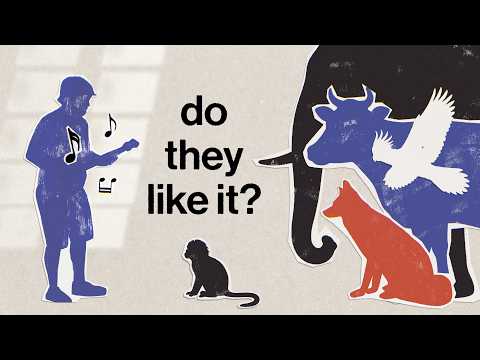
Do animals actually like music — or are humans just projecting? In this episode of Howtown, we investigate the science of animals and music through experiments with cotton-top tamarins, orangutans, rats, mice, parrots, dogs, cats, and a wild fox who seemed captivated by a banjo.
We look at what animal behavior research, neuroscience, and music cognition can tell us about rhythm, pitch, melody, consonance, dissonance, emotion, reward, pattern recognition, and why human brains find music so powerful. Along the way, we explore studies on cotton-top tamarins preferring silence to human music, orangutans choosing silence over different music genres, rats conditioned to prefer Miles Davis, mice exposed to Beethoven during development, dogs howling along to favorite songs, and Snowball the cockatoo dancing to the beat.
Featuring conversations with researchers and musicians including Aniruddh Patel, Pralle Kriengwatana, David Teie, Suzanne MacDonald, and Andy Thorn, this episode asks: can animals hear music the way we do? Can they recognize rhythm or melody? Do they feel emotion from music? And what does animal music research reveal about the evolution of music in humans?
00:00 the song
00:56 the fox
02:09 what’s music?
02:56 pitch = rhythm
05:57 incogni
07:00 tamarins & taste
08:35 orangutans & opera
10:22 other species
11:11 rats & reward
12:38 parrots & patterns
13:46 complex vocal learning
15:55 shallow howl
17:24 melody
18:41 consonance v dissonance
20:09 mice & memory
22:27 more than a feeling
23:39 the cellist
25:46 composing the song
28:41 the monkeys listen
30:26 good anthropomorphizing?
Visit https://hensonshaving.com/howtown or use code 'howtown' to receive 100 free blades with the purchase of a razor. (Ensure both products are in the cart for the code to take effect.)
To support independent science journalism and get bonus content ...
JOIN OUR PATREON: https://www.patreon.com/Howtown
Here are some of the wonderful people on who support this channel through our Patreon Town Council:
Bev Fong
Sean Barrett
Mike Purvis
Jon Hewett
Albychen
Aatish Bhatia
avaren
Evan Hass
Mark Tinker
L.A. O’Connor
Marcos Huerta
Joaquim Salles
Sam Gaty
Parag Mallick
Edgar Sutawika
Tim Davey
Navneet
Pedro ZM
Martin Weeks
Dimi
Bryce Golden-Chen
Estelle Caswell
Gregory Laborde
Yash Murthy
martin david
Matthew Stvartak
Garret Wates
Slightly Suspicious Mind
Kellyn Lorentzen-Goler
omg.science
Duncan Stannett
Keith England
Jocelyn Tabancay Duffy
Casey Schatz
Mark McCreary
Jonathan McCabe
Branden Ushjima
Esh Tatla
Wookiee Henderson
Frances Haugen
Gilbo Jiménez
Roy Lara
Kai Tze
Melanie Halley
Archie Stonehill
Ed Martini
Jose Zaragoza Jr
Jamieson Urquhart
Bogdan
How do we know where the moon came from? In this episode, Howtown dives into the giant impact hypothesis (the least bad theory of lunar origin) and the growing evidence that the story of Theia may be more complicated than the textbook version. We explore how scientists measure the Moon’s distance, mass, and angular momentum, why Earth’s Moon is so unusually large compared with other moons in the solar system, and how Apollo moon rocks transformed the debate over the origin of the Moon. Along the way, we unpack Robin Canup’s simulations, synestia and multiple-impact, evection resonance, and the “isotope crisis”: why Moon rocks are chemically almost identical to Earth despite models suggesting the Moon should be made mostly from an impactor. From lunar eclipses and amateur astronomy to Apollo samples, South Pole missions, Theia, Artemis, Chang’e, and the search for mantle rocks, this is a deep look at moon formation, planetary science, and how scientists reconstruct what happened more than 4 billion years ago.
Chapters:
00:00 intro
01:04 where is the moon
02:43 the moon is weird
04:20 4 hypotheses
06:08 razors for sale
07:29 the moon rocks
09:45 hartmann’s hawaii hypothesis
12:07 an inconvenient simulation
13:14 isotope crisis!
15:20 join patreon!!
15:30 messier solutions
18:20 back to venus
18:38 back to the moon
19:12 anthropic principle
20:27 love, howtown

 Login
Login