Login
LoginÉ hoje. SUMAÚMA Debate: Repovoar o Congresso
A liderança indígena Vanda Witoto e a cientista Luciana Gatti se encontram no programa de estreia às 8 da noite. A mediação é de Eliane Brum. Participe ao vivo no Instagram ou no YouTube

O Instituto de Matemática Pura e Aplicada (Impa) anunciou nesta terça-feira (25) os vencedores da 9ª edição do Prêmio Impa de Jornalismo, que reconhece reportagens sobre matemática e ciência publicadas no país. A revista Pesquisa FAPESP ficou em 3o lugar na categoria Divulgação Científica, com a matéria Brasil investe em pesquisa para dominar o ciclo produtivo das terras-raras e dos superímãs, escrita por Frances Jones e Yuri Vasconcelos.
A reportagem premiada mostra o esforço de pesquisadores, universidades e empresas para dominar o ciclo completo de exploração e processamento desses elementos, essenciais para a transição energética. O texto também destaca o potencial brasileiro, que tem uma das maiores reservas conhecidas do mundo.
Ainda na categoria Divulgação Científica, o primeiro lugar ficou com Maria Clara Rossini, da Superinteressante, por “A vida através do espelho”, sobre quiralidade — característica de objetos que não podem ser sobrepostos à sua imagem no espelho, e suas manifestações na física, na química e na biologia — e o que a assimetria da natureza pode revelar sobre as origens da vida. O segundo lugar ficou com Ed Wanderley, da Agência Pública, pela série documental em áudio “A Última Bolacha”.
Na categoria Matemática, a vencedora foi Catalina Leite, do jornal O Povo (CE), com “Além dos números: como a matemática constrói a gramática do Universo”.
Ao todo, nove mulheres inscritas como autoras foram premiadas nesta edição, incluindo a repórter Frances Jones, por Pesquisa FAPESP — pela primeira vez, elas foram maioria entre os vencedores. “A matemática só tem a ganhar quando as histórias são contadas por vozes diversas”, afirmou Marcelo Viana, diretor-geral do Impa e presidente da comissão julgadora.
A cerimônia de premiação acontece no sábado (29), às 17h30, durante o Festival Nacional da Matemática, na Marina da Glória, no Rio de Janeiro, e reunirá os jornalistas premiados em uma mesa-redonda sobre os desafios de transformar matemática e ciência em histórias acessíveis ao público.
Passados dez anos desde a sua inauguração, a usina hidrelétrica de Belo Monte, no norte do Pará, continua sendo um dos projetos de infraestrutura mais contestados da Amazônia. Comunidades tradicionais afetadas pelo empreendimento relatam impactos severos aos ecossistemas e à qualidade de vida na região da Volta Grande do rio Xingu, enquanto cientistas alertam que as mudanças climáticas deverão agravar ainda mais esse quadro nas próximas décadas.
Inaugurada em 2016, Belo Monte é a segunda maior usina hidrelétrica em operação no Brasil, responsável pela produção de 5 a 10% da energia elétrica consumida no país, dependendo da época do ano e das condições climáticas. Para fazer isso, ela desvia cerca de 80% da água do rio Xingu por meio de um sistema de barragens e canais artificiais na região de Altamira (PA), direcionando-a para a geração de eletricidade. A consequência disso é que um trecho de 100 quilômetros do rio teve sua vazão drasticamente reduzida nos últimos anos, com impactos diretos sobre os ecossistemas locais e as comunidades indígenas e ribeirinhas que dependem desses recursos para a sua sobrevivência.
“Essa redução da vazão gera uma infinidade de problemas”, diz o geólogo André Sawakuchi, professor do Instituto de Geociências (IGC), da Universidade de São Paulo (USP), e coordenador de um projeto de pesquisa sobre o tema, apoiado pela FAPESP e pelas Fundações de Amparo à Pesquisa dos Estados do Pará e do Amazonas (Fapespa e Fapeam). Segundo ele, os efeitos da usina sobre a Volta Grande do Xingu “são muito piores do que os previstos” no processo de licenciamento, tanto do ponto de vista social quanto ambiental.
A Norte Energia, empresa responsável pelo empreendimento, por outro lado, diz que os impactos estão dentro do esperado e que não há justificativa técnica para alterar os padrões de funcionamento da usina, que produz energia elétrica para milhões de famílias em todo o país. Belo Monte foi oficialmente inaugurada em 5 de maio de 2016, com duas de suas 24 turbinas em operação. A operação completa, com todas as turbinas em funcionamento, começou três anos e meio mais tarde, em novembro de 2019.
“Parece que é um debate de narrativas, mas não é. É um debate de dados”, argumenta Sawakuchi, que também é integrante do Monitoramento Ambiental Territorial Independente (Mati), uma iniciativa de pesquisadores indígenas, ribeirinhos e acadêmicos, que há anos monitora os impactos da usina na região (leia mais em Belo Monte e estiagem secam Volta Grande do Xingu).
A licença operacional de Belo Monte venceu em novembro de 2021, mas a usina permanece em funcionamento graças a um mecanismo de renovação automática. Desde então há uma batalha jurídica e administrativa em curso, associada à renovação definitiva da licença, em que o Ministério Público Federal (MPF) e o Instituto Brasileiro do Meio Ambiente e dos Recursos Naturais Renováveis (Ibama) tentam obrigar a Norte Energia a implementar um novo plano de repartição da água (hidrograma), que garanta mais recursos hídricos para as comunidades e os ecossistemas da Volta Grande.
Em dezembro de 2025, a Justiça Federal em Altamira condenou a Norte Energia e o Ibama a revisar o atual hidrograma e a estabelecer um novo regime de vazões para Belo Monte, mas o cumprimento da sentença só deve ser efetivado após o trânsito em julgado do processo — ou seja, quando não houver mais possibilidade de recurso.
Paralelamente, o Ibama já havia dado um prazo para que a empresa apresentasse um novo hidrograma até 12 de janeiro deste ano, mas a Norte Energia contestou a demanda em caráter administrativo. Em fevereiro, o prazo foi prorrogado até 13 de abril. A empresa, novamente, não apresentou um novo plano de partilha da água, argumentando que os impactos estão dentro do previsto e que a revisão do hidrograma precisaria partir de uma decisão colegiada, envolvendo o Ministério de Minas e Energia (MME), o Ministério do Meio Ambiente e Mudança do Clima (MMA), e a Empresa de Pesquisa Energética (EPE).
Desde então, o hidrograma já adotado pela usina permanece em vigor. O MME defende a manutenção desse regime em 2026, sob o argumento de que Belo Monte tem um papel estratégico para a segurança do sistema elétrico nacional, enquanto prossegue a discussão com os órgãos ambientais sobre uma eventual revisão das vazões.

Vazão reduzida, impactos ampliados
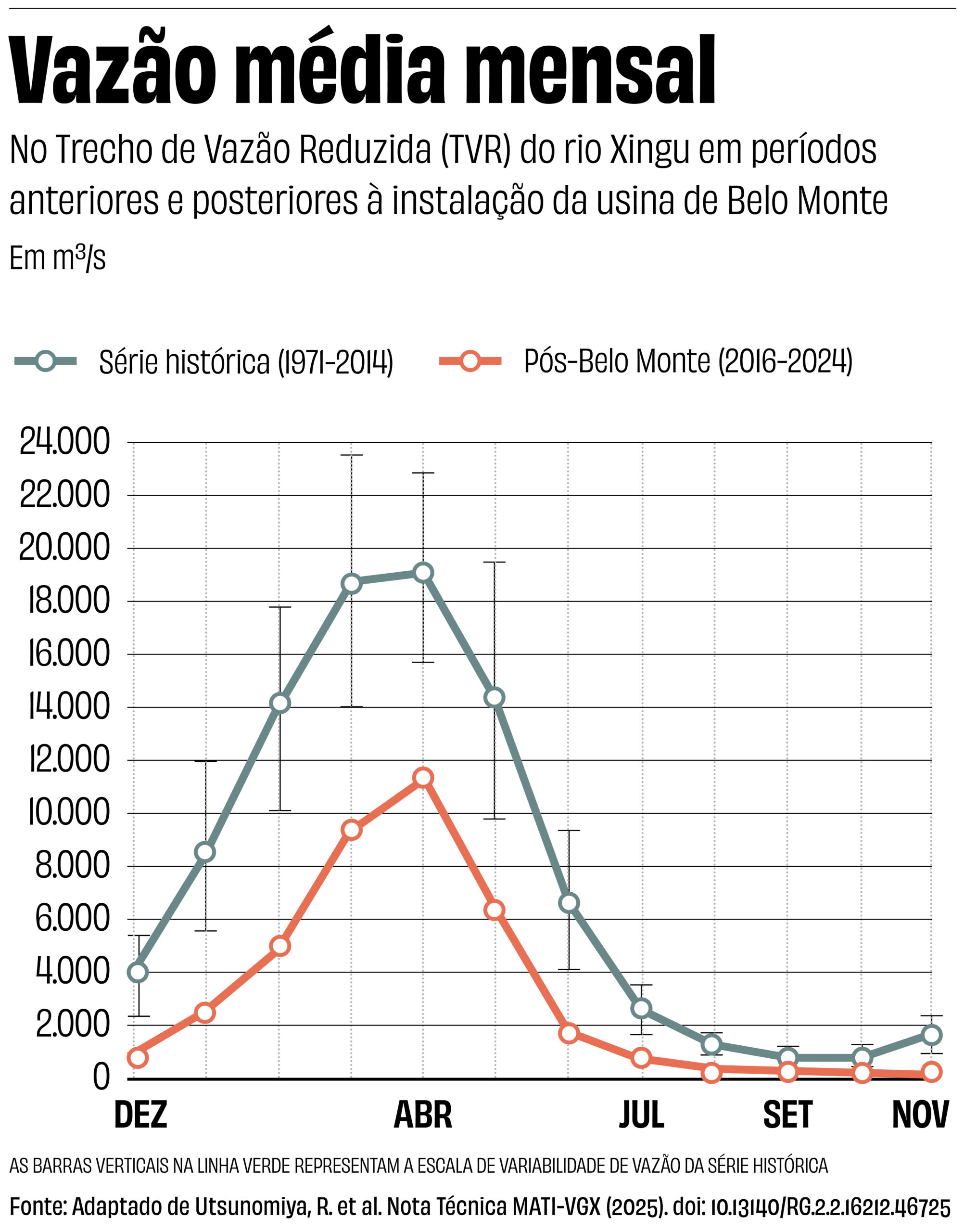
A nota técnica mais recente do Mati, divulgada em novembro de 2025, faz uma comparação mês a mês da quantidade de água que passou pelo chamado Trecho de Vazão Reduzida (TVR) do rio Xingu — trecho de 100 km em que o fluxo do rio é controlado pela usina — antes (de 1972 a 2014) e depois (de 2016 a 2024) da inauguração de Belo Monte, com base em dados oficiais de monitoramento da Agência Nacional de Águas e Saneamento Básico (ANA). As análises revelam alterações radicais nos padrões hidrológicos da região, não só em relação à quantidade de água disponível no rio, mas também ao momento de ocorrência (timing) e à duração das fases de enchente e vazante, que são fundamentais para o funcionamento dos ecossistemas locais.
Segundo o Mati, houve meses em que a vazão média do rio chegou a ser reduzida em quase 90%, em comparação com a série histórica do período pré-barragem. A duração média dos períodos de cheia, que era de aproximadamente 80 dias por ano, caiu para apenas nove dias, enquanto os períodos de seca extrema aumentaram, em média, de 45 para 104 dias. O ano mais crítico foi 2024, com seis meses seguidos de seca extrema, em função da ocorrência de um forte El Niño — fenômeno climático global que reduz a quantidade de chuvas na Amazônia.
“Com base nesses indicadores, é notável a diminuição do período da cheia e o prolongamento da seca, que tem causado efeitos deletérios e preocupantes, e que podem continuar e até se agravar sob as condições decorrentes das mudanças climáticas em curso no planeta”, diz o relatório do Mati. O documento é assinado por mais de 40 pesquisadores e monitores, vinculados a instituições públicas de pesquisa e comunidades tradicionais da Volta Grande do Xingu, incluindo Sawakuchi. Parte dos dados que subsidiam os relatórios do grupo foi publicada em 2025 nas revistas Conservation Biology e Perspectives in Ecology and Conservation.

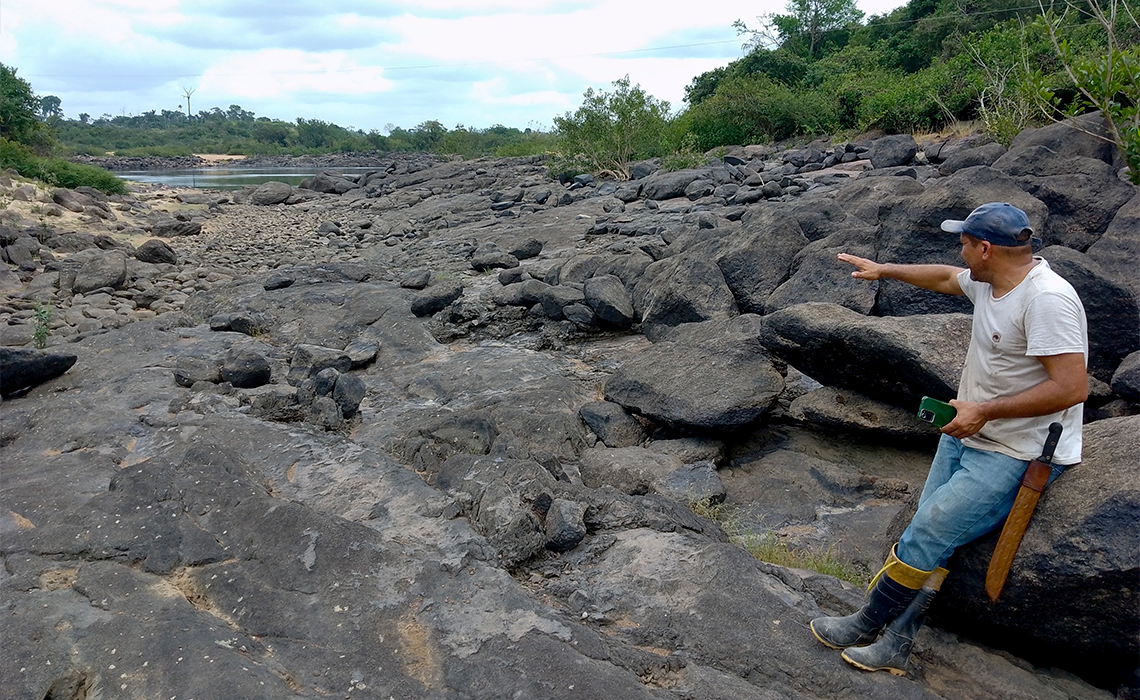
Carlos Mazoca/GeoHereditasLeito do rio Xingu fica naturalmente exposto durante os períodos de seca na Volta Grande. O problema é o prolongamento e o agravamento desses períodos de escassez hídrica nos trechos impactados pela usina de Belo MonteCarlos Mazoca/GeoHereditas
As projeções climáticas para as próximas décadas desenham um cenário ainda mais complicado. Estudos preveem reduções significativas de precipitação em diversas regiões da América do Sul, incluindo o sul e o leste da Amazônia, onde fica a bacia do rio Xingu, o que deverá reduzir ainda mais a quantidade de água disponível na região de Belo Monte, tanto para a produção de energia quanto para as comunidades e os ecossistemas da Volta Grande. As pesquisas levam em consideração tanto os efeitos da mudança climática quanto do desmatamento na Amazônia, que também contribui para o aumento da temperatura e a redução da precipitação nas áreas afetadas.
A redução da precipitação sobre a bacia do rio Xingu, especificamente, poderá chegar a 500 milímetros de chuva por ano até o final deste século, a depender do grau de aquecimento global, segundo projeções feitas pelo professor Nicolás Stríkis, do Instituto de Geociências da USP, com base em modelos acoplados de previsão climática. Isso reduziria a precipitação média da bacia dos atuais 1.800 mm/ano para algo entre 1.500 e 1.300 mm/ano em diversas áreas, incluindo anos de seca extrema, em que a precipitação cairia para a faixa de 800 a 900 mm/ano. “Isso é clima de Cerrado”, destaca Stríkis.
O rio Xingu nasce no leste de Mato Grosso e percorre cerca de 2 mil quilômetros até desaguar no rio Amazonas, no Pará. Sua bacia, abrangendo todos os seus afluentes, tem cerca de 530 mil quilômetros quadrados (uma área maior do que a da Espanha).
Desde a operação de Belo Monte, a duração média das cheias no rio Xingu caiu de 80 para apenas nove dias por ano, enquanto os períodos de seca extrema mais que dobraram, de 45 para 104 dias
Stríkis explica que o balanço hídrico de uma bacia hidrográfica depende essencialmente de dois fatores: precipitação e evapotranspiração — em outras palavras, a quantidade de água que entra no sistema por meio da chuva e a quantidade de água que sai do sistema por meio da evaporação e da transpiração das plantas. Se entra mais água do que sai, o balanço é positivo. Se sai mais água do que entra, é negativo. A temperatura é outro fator importante: quanto mais quente o clima, maior é a evapotranspiração.
Na bacia do rio Xingu, a tendência já é de queda há alguns anos. “O resumo da ópera é que a partir dos anos 2000 a gente começa a ter balanços hídricos negativos, e a tendência é que eles se tornem cada vez mais negativos daqui para a frente. Ou seja, o rio está secando”, afirma o professor da USP. Os dados dessa modelagem ainda não foram publicados em revista científica, mas são condizentes com os achados de diversos estudos publicados em periódicos de prestígio recentemente.
Um estudo publicado em março deste ano no International Journal of Climatology, por exemplo, projeta um aumento significativo na duração e na intensidade das estações secas da Amazônia nas próximas décadas, com impactos negativos sobre a disponibilidade hídrica e a capacidade da floresta de resistir a incêndios e estocar carbono. A pesquisa foi liderada por pesquisadores do Instituto Nacional de Pesquisas Espaciais (Inpe), em São José dos Campos (SP), com apoio da FAPESP (leia mais em notícia da Agência FAPESP).
André Sawakuchi/Mati-VGXRaimundo da Cruz e Silva, morador da Volta Grande do Xingu, mostra um canal do rio Xingu que leva água para áreas que funcionam como bercários naturais para peixes na comunidade Goianinho, cujos ciclos de inundação foram prejudicados desde a inauguração da usinaAndré Sawakuchi/Mati-VGX
Procurada pela reportagem, a empresa responsável pela usina contestou as análises do Mati. “A Norte Energia, após detida análise técnica dos estudos apresentados, identificou lacunas metodológicas, ausência de detalhamento do delineamento amostral e indisponibilidade do banco de dados bruto, fatores que fragilizam as inferências apresentadas no estudo [e], logo, suas conclusões”, afirma a empresa. Em resposta a uma solicitação do Ibama, em abril deste ano, a Norte Energia também afirmou que o relatório do Mati possui “limitações relevantes de natureza científica, metodológica e regulatória.
“Empreendimento de morte”
Os dados do Mati foram apresentados na trigésima Conferência das Partes (COP 30) da Convenção sobre Mudanças Climáticas da ONU, realizada em Belém do Pará, em novembro de 2025, no âmbito de uma série de seminários sobre Belo Monte, organizada pelo MPF.
Além da menor disponibilidade de água, a barragem alterou sobremaneira a duração e o timing do chamado pulso de inundação sazonal, que é quando as águas do rio transbordam mata adentro, formando os chamados igapós (trechos de floresta alagada), que são cruciais para a reprodução de diversas espécies de peixes. Normalmente, a água começaria a subir em novembro, até atingir um pico de cheia em abril. Depois começaria a descer de novo, até atingir um pico de seca em outubro. Agora, nem as populações locais e as plantas nem os animais sabem quando esses pulsos vão acontecer ou quanto tempo vão durar, porque a vazão do rio no trecho da Volta Grande passou a ser regulada pela operação da usina, e não mais pela natureza.
O resultado, segundo os pesquisadores do Mati, é um cenário de escassez hídrica extrema, que compromete a sobrevivência dos ecossistemas, da biodiversidade e dos milhares de famílias de populações indígenas e ribeirinhas da Volta Grande do Xingu. Não há um dado oficial sobre o número de pessoas atingidas por Belo Monte no Trecho de Vazão Reduzida, mas as estimativas variam de 3 a 6 mil.
A quantidade de peixes diminuiu radicalmente, comprometendo o sustento e a segurança alimentar das comunidades locais. A locomoção, a disponibilidade de água potável e o acesso a serviços de saúde também foram seriamente prejudicados, segundo os moradores, já que muitos trechos do rio se tornaram quase intransponíveis durante vários meses do ano, por causa do prolongamento das secas. Trechos de floresta inundada que eram usados pelos peixes como áreas de reprodução e berçários naturais (“piracemas”, como se diz localmente) hoje estão inacessíveis aos animais, ou porque não alagam mais ou porque não ficam mais inundados pelo tempo suficiente para que esses ciclos reprodutivos se completem.
“Onde a gente saía para pescar antigamente, hoje em dia não consegue mais, porque o nível do rio baixou”, disse o líder indígena Adalto Arara, da Terra Indígena Arara da Volta Grande do Xingu, em um dos seminários promovidos pelo MPF na COP 30. A construção da usina hidrelétrica, segundo ele, “mudou completamente o modo de vida” das populações locais. “Hoje em dia a gente tem que desmatar para fazer roça, para plantar cacau, para tirar nossa renda; por falta de opção. De pescadores, nós viramos agricultores”, completou a jovem indígena Kãyure Juruna, da Terra Indígena Paquiçamba. “(Belo Monte) destruiu toda a nossa vida. Não foi só uma coisa nem outra, foi tudo; porque a gente dependia do rio para tudo.”
“Belo Monte só nos trouxe desastre, em todos os aspectos; a gente não sabe mais como sobreviver naquela localidade”, reforçou Orcylene Reis, moradora de uma comunidade ribeirinha do rio Bacajá, que deságua no Xingu. “Antes do barramento, era uma coisa muito fácil: você ia para o rio e pescava caixas e caixas de peixe. Hoje em dia, o pescador da Volta Grande do Xingu morre de fome.”
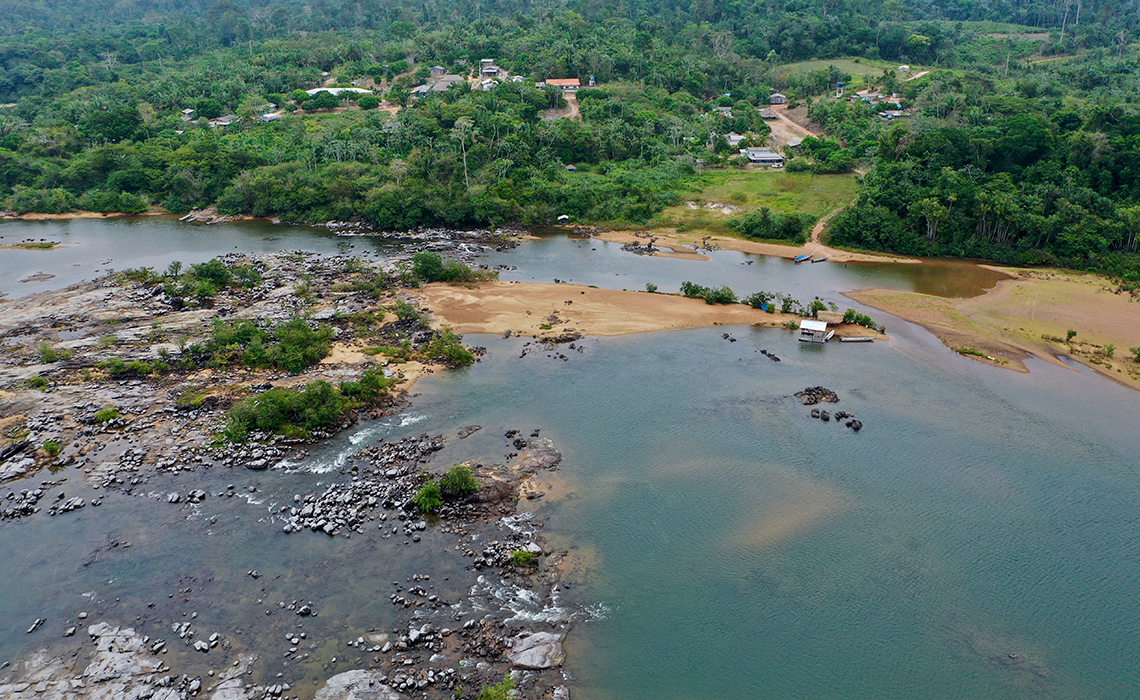
Carlos Mazoca/GeoHereditasRedução da vazão do rio Xingu causada pela usina de Belo Monte impactou a vida de diversas comunidades ribeirinhas da Volta GrandeCarlos Mazoca/GeoHereditas
A procuradora Thaís Santi, do MPF em Altamira, que conduziu os seminários sobre Belo Monte na COP 30, descreveu a usina como um “empreendimento de morte”. “A destruição dos meios de vida, a destruição dos ecossistemas, retira dessas populações as condições de existência. E não é (só) a condição econômica de existência, é a condição de existência enquanto povo”, disse a procuradora. “Portanto, não há como (…) separar os conceitos de ecocídio, genocídio, etnocídio. É morte.”
Josiel Juruna, coordenador do Mati e vice-liderança da aldeia Mïratu, na Terra Indígena Paquiçamba, disse que monitorar os impactos da usina equivale a “monitorar a morte de um rio”, e que a Volta Grande está se aproximando de um “ponto sem volta”. “Se a gente não tomar uma atitude […], a gente vai perder esse ecossistema. Se a gente perder esse ecossistema, a gente vai perder todo um povo que mora naquela região, toda uma tradição que tem naquela região, tanto indígena como ribeirinho, assim como algumas pessoas quilombolas, que dependem também do rio. Então, a gente vai perder tudo isso”, disse.
A Norte Energia rebate as críticas e questiona a credibilidade técnica dos dados do monitoramento local. “Ainda que os estudos do Mati possam oferecer percepções complementares, não possuem consistência metodológica e transparência para embasar, por si só, alterações no Hidrograma de Consenso”, argumenta a empresa, em uma nota técnica de dezembro de 2025.
A empresa nega que a usina esteja causando impactos significativos nos ecossistemas ou no modo de vida das comunidades locais, argumentando que os dados do monitoramento conduzido pela própria operadora mostram um cenário diferente. “Quando flora (plantas), ictiofauna (peixes), pesca e quelônios (cágados, tartarugas e jabutis) são avaliados de forma integrada […], os quatro componentes demonstram que não houve ruptura ecológica, perda irreversível de habitats, extinção local de espécies ou interrupção de ciclos reprodutivos”, diz a Norte Energia, em uma outra nota técnica, também elaborada em resposta aos questionamentos do Ibama. Segundo a empresa, o que se observa é “um sistema em reorganização, exatamente como previsto no EIA (Estudo de Impacto Ambiental) e coerente com o comportamento de grandes rios após regulação hidrológica.” Em nota enviada à reportagem, a Norte Energia disse que monitora as condições de vida das famílias do Trecho de Vazão Reduzida desde 2012 e desenvolve “um conjunto abrangente de programas e ações socioambientais” na região, com o objetivo de “prevenir, mitigar e compensar eventuais impactos decorrentes da operação do empreendimento”. (Leia a íntegra na nota da empresa aqui)
Hidrograma em xeque
A quantidade de água que Belo Monte pode desviar do rio Xingu para a produção de energia a cada mês é condicionada a um plano batizado de Hidrograma de Consenso, que estipula valores mínimos de vazão para o Trecho de Vazão Reduzida (TVR). Esse hidrograma tem duas versões (A e B), que deveriam ser alternadas anualmente para, supostamente, garantir a sobrevivência dos ecossistemas e das comunidades da Volta Grande.
Pelo Hidrograma A, a usina é obrigada a liberar uma média mínima de 4 mil metros cúbicos por segundo (m3/s) de água para o TVR no mês de abril, que representa o pico da cheia. Pelo Hidrograma B, essa média mínima obrigatória é de 8 mil m3/s. Os valores são diferentes para cada mês, chegando a 700 m3/s em outubro, no auge do período de seca.
Esses valores foram definidos no processo de licenciamento ambiental da usina, mas o volume previsto no Hidrograma A é tão baixo que nunca chegou a ser implementado, por determinação do Ibama. Desde novembro de 2019, quando todas as turbinas de Belo Monte entraram em operação, a usina trabalha apenas com o Hidrograma B, que permanece em vigor em 2026, enquanto prossegue a discussão sobre sua revisão. Ainda assim, estudos científicos e relatos de moradores indicam que as vazões previstas nesse hidrograma são insuficientes para manter vivos os ecossistemas da região.
Segundo o Mati, a média histórica da vazão natural do Xingu no TVR em abril, por exemplo, era de 19 mil m3/s — ou seja, mais que o dobro do mínimo previsto no Hidrograma B. A vazão média efetivamente liberada pela usina para aquele mês no período de 2016 a 2024, segundo o relatório do grupo, foi de 11.750 m3/s.

Além dos baixos volumes de água, segundo os pesquisadores, o hidrograma não respeita a temporalidade dos pulsos naturais de inundação do rio. “Fica evidente que a imposição de um regime hidrológico baseado em médias mensais, com enchente tardia e cheia limitada a 8.000 m³/s apenas durante o mês de abril, com vários meses de atraso em relação à enchente natural, que iniciava em novembro, compromete profundamente a reprodução dos peixes, as interações tróficas da fauna aquática e a integridade da floresta alagável”, aponta outra nota técnica do Mati, divulgada em junho de 2025, sobre os impactos ambientais da usina.
“Esses relatórios têm essa intenção, de contestar dados oficiais da Norte Energia, que tentam mascarar os impactos e dizer que está tudo bem”, diz a pesquisadora Renata Utsunomiya, integrante do Mati e doutora em ciência ambiental pelo Instituto de Energia e Ambiente (IEE), da USP.
“Além do nível de inundação da cheia, destaca-se a importância da temporalidade e da duração do pulso de inundação. Para que os ciclos ecológicos se completem é necessário que a cheia tenha início mais cedo e que o nível de cheia se mantenha elevado por pelo menos três meses consecutivos”, diz a nota do Mati. O documento propõe a adoção de um hidrograma alternativo, em que o volume de água liberado pela usina para o TVR aumentaria gradualmente a partir de novembro, chegando a 14 mil m³/s em abril, e caindo gradativamente para 850 m³/s em outubro.
Outra proposta, apresentada pelo grupo na nota de novembro, seria adotar um esquema de partilha da água baseado em porcentagens fixas, em vez de volumes específicos de água para cada mês. Nesse caso, segundo a proposta do Mati, 30% da água seria reservada para a produção de energia e 70%, para a Volta Grande do Xingu. Dessa forma, o volume de água efetivamente desviado para cada função variaria de acordo com a vazão natural do rio, e não com as necessidades da usina.
“Antes do barramento, você ia para o rio e pescava caixas e caixas de peixe. Hoje em dia, o pescador a Volta Grande morre de fome” – Orcylene Reis, moradora de uma comunidade ribeirinha do rio Bacajá
O problema, do ponto de vista energético, é que haveria menos água em determinados momentos para a geração de eletricidade, especialmente nos meses de seca. Isso poderia reduzir a produção da usina, que é uma peça fundamental do sistema elétrico nacional. Na virada do ano de 2025 para 2026, em meio a uma forte onda de calor no Sudeste, Belo Monte chegou a gerar mais de 9% da energia elétrica consumida no país, segundo a Norte Energia. E já houve momentos em que esse percentual passou de 10%.
O desafio, segundo Utsunomiya, é encontrar uma solução que contemple tanto a sobrevivência socioambiental da Volta Grande do Xingu quanto as necessidades energéticas do país. Uma discussão que, segundo ela, precisa contemplar outras fontes de energia limpa, como solar e eólica, além da hidreletricidade — que também pode gerar impactos sociais e ambientais expressivos, apesar de emitir menos carbono para a atmosfera, como mostra o caso de Belo Monte.
“Quando você coloca esses impactos socioambientais na balança, a hidrelétrica não vale a pena”, avalia Sawakuchi, do Instituto de Geociências da USP. “Esses efeitos negativos regionais são muito maiores do que qualquer ganho por redução de emissões de gases do efeito estufa para a atmosfera.” No caso de Belo Monte, segundo ele, até mesmo uma usina termoelétrica seria preferível ao que foi feito na Volta Grande. “Todas as grandes hidrelétricas do Brasil são dependentes da monção da América do Sul; e as projeções climáticas apontam para uma redução de vazão nas bacias de drenagem que abrigam essas grandes hidrelétricas. Então, não é só uma questão de conservar a biodiversidade aquática e as florestas alagáveis da Amazônia. É uma questão de segurança energética também.”
A Norte Energia disse que “acompanha com atenção os estudos científicos acerca do tema [das mudanças climáticas] e seus potenciais impactos sobre os regimes hidrológicos da Amazônia”, e que esses cenários são considerados no planejamento operacional de longo prazo e na gestão de riscos do empreendimento, “como ocorre em todo o setor elétrico”. O desafio de conciliar a geração de energia com a disponibilidade cada vez mais incerta de água no Xingu, portanto, deverá permanecer no centro das discussões sobre o futuro de Belo Monte.
Since the Chief Justice of the Indian Supreme Court, Surya Kant, described the country’s unemployed youth as ‘parasites’ and ‘cockroaches’, state forces have shot, beaten, tear-gassed, hospitalised, imprisoned, doxed and harassed the school-age students who took to the streets to denounce the broken education system.
Yet this movement, which quickly adopted the name ‘Cockroach Janta Party’, has nevertheless gained strength, mobilising tens of thousands and giving voice to millions more. As it channeled widespread anger at the corruption and cruelty of the ruling BJP, it sent shockwaves through the establishment, toppling the notoriously venal education minister, Dharmendra Pradhan, earlier this month.
Now, following this crucial victory, the Cockroach movement has reached a transition point. Its cadre who feel that the central government is no longer listening have called for a march in Delhi on 5 September, and some are travelling across the country to support local student protests that have continued to rage since the minister resigned.
One of the activists at the centre of the movement is Danish Ali, a student leader and organiser in Delhi who went on hunger strike at the height of the revolt. Threats from the government levelled at her and her family have not weakened her resolve. While traveling on a solidarity tour through the state of Bihar, she spoke to Tribune about the rising anger and desperation in Modi’s India, the evolving tactics and objectives of the Cockroach Movement, and where it goes from here.
Evan Robins
Why did you get involved in the Cockroach movement?
Danish Ali
As a young person in India, you just feel very disheartened. You feel like your life will never improve. The BJP has deliberately destroyed the education system, and here the leaking of exam papers — which gave rise to this movement — is one of the key issues. Leaks mean that students are required to re-take their exams, which naturally causes outrage. Earlier this year, the National Eligibility cum Entrance Test (NEET) paper, which one has to take for entry to medical college, was leaked. That same paper was also leaked two years prior. I myself had to sit for a re-examination after a different paper was leaked in 2024. It’s become a tradition in this country.
This is happening not only at the national level but also at the state level, where many state jobs require an entrance exam. There are serious issues around these jobs. One is that vacancies are becoming increasingly scarce. Another is that there is already a long delay to find out if you passed the exam. If a government exam happens in 2026, then the result will come out years later, maybe by 2028. Between the leaks and the delays, many people who’ve been continuously preparing and betting their whole future on the exams are disappointed. You simply cannot trust the examination system of this country anymore. You cannot believe that if you are meritorious enough, if you work hard enough, that you will have a better life.
Beyond that, the country’s educational spaces are physically crumbling, especially in government schools. There aren’t enough classrooms or enough teachers. There are no laboratories, no libraries and no playgrounds. The BJP government has deliberately created this situation and uses it as an excuse to close government schools around the country. A new study shows that more than 90,000 government schools have been closed over the last decade, an average of around twenty-five a day. The students who go to these schools come from very marginalised backgrounds and cannot afford private school.
Colleges and universities are also in a very bad shape. Jawaharlal Nehru University (JNU), for example, is one of the top universities in the country. But if you go to JNU, you find that the hostels and classrooms are in disrepair. Ceiling fans fall on the heads of students. In one case, the ceiling itself fell down. That’s a top university, so just imagine the condition of the state level universities.
Funding cuts are one of the main causes of decline. Student organisations have been demanding that the central budget expenditure on education be increased to at least 10 percent. Right now, it’s not even near 3 percent. But instead of increasing this figure, the government is trying to force institutions to generate their own funding, and that leads to fee hikes. As a result the students who can’t afford the higher fees don’t go to higher education institutions at all.
The government is trying to destroy the very idea of public education; they want to privatise the system and sell education as a commodity. They are comfortable, to say the least, with all the corruption in the system. When we started this movement, we wanted to snatch that comfort away. We wanted to tell corrupt ministers that someone has to take responsibility for the paper leaks, which are so devastating that they cause some students to commit suicide. As the person sitting at the top of the education system, we believed the education minister himself needed to resign.
Evan Robins
What has been your role in the movement?
Danish Ali
I’m a doctoral student at JNU, where I’m the joint secretary of the students’ union. I’m also connected to a student organisation, the All India Students’ Association (AISA), which has been continuously raising these issues for decades. Back when the previous paper leak happened in 2024, we went to Jantar Mantar, organised a sit-in for ten days and were detained by the Delhi police.
There was initially a lot of doubt and scepticism among students, and among many people in general about the Cockroach movement, especially because of the narratives peddled by Godi media and the BJP IT cell. Many people questioned Abhijee Dipke, the thirty-year old founder of the Cockroach Janta Party, who left Boston University to return to India and lead the protests. ‘Who is he?’ ‘What are his motives?’ I also had those doubts, as did my organisation. But we knew we had to come together and fight.
Evan Robins
How has the movement developed over the last several months?
Danish Ali
Because the movement started as a kind of an internet phenomenon, as a meme, many people said that it wouldn’t translate into a genuine mobilisation. There were real concerns that people wouldn’t show up for the first big protest on 6 June. But thousands of people from around the country arrived in Jantar Matar in Delhi that day, and it was a big success. After that, we started seeing student protests across India: Uttar Pradesh, Bihar, Bangalore and Pune.
Despite this, the government still refused to open any lines of dialogue with us. On 20 June, protests again started at Jantar Mantar, and we decided to shift to a sit-in protest. When the government remained unresponsive, the activist Sonam Wangchuk went on a hunger strike and I decided to join him, along with five others in my organisation.
This was the peak of summer in India. There was so much heat and humidity during the day. At night, the rain would destroy our tents. The police were a constant threat. They declared the protest illegal and tried to get us to move out. But somehow we continued. On the seventh day of my hunger strike I had to be hospitalised because my body stopped retaining water and my blood sugar was dangerously low. Some of the others continued for twenty-three days.
In the early morning hours of the twenty-first day of the hunger strike, the Delhi police used white sheets to hide the main stage area and brutally dragged Wangchuk away. The image was haunting. After seeing how the government treated the hunger strikers, the movement gained a lot of support from across the country and internationally, including from politicians, actors and singers. So we called the Parliament march for 20 July. On that day, even Jantar Mantar became small, because so many people turned up. In my own estimation, it was more than 100,000, even though many people were not allowed to get to the protest site.
Evan Robins
What kind of repression did you face that day?
Danish Ali
On the night of the 19th, the police started barricading the gates to our campus. Students were stopped at their places of residence and prevented from going to the protest site. Then, when the march started, the police brutally cracked down and there was a lot of lathi-charge.
The protests, it should be said, have been peaceful from day one. Dipke has always focused on the non-violent character of the movement. At Jantar Mantar, it was the police, not the people, who were violent. They used water cannons, tear gas, and for the very first time, pellet guns in the centre of Delhi, which they’ve used on protestors in Kashmir for about a decade.
The next day, I visited many hospitals in Delhi where I met victims of this police violence. I met at least two students who were injured by the pellet guns, even though the Delhi police initially claimed they didn’t use them. There was pressure from the government to prevent the real number of casualties from coming out. The medical staff and the police both refused to tell us anything. They didn’t want the media to report that thousands of students were hurt and admitted to the hospitals around the city.
The government and the police might have thought that that kind of violence would intimidate us, and perhaps that it would prevent more students from joining. The opposite happened. People got even angrier with the government because of how they dealt with us.
After 20 July, the crowd swelled. Thousands and thousands of students came to Jantar Mantar each day and stayed there from morning until night. From that point on, the protestors were not only demanding the resignation of the education minister, but started demanding the resignation of Amit Shah, the minister of home affairs, and even Prime Minister Narendra Modi. The government understood that if they didn’t let the education minister go, the anger of the protestors would be turned against the government itself. That’s why the resignation happened.
Evan Robins
What’s happened since the education minister resigned?
Danish Ali
Now the focus has shifted away from Delhi and Jantar Mantar to the student-led movements happening across India. I’m currently in Bihar, in the capital city of Patna, where a movement against paper leaks has been going on for at least twenty days and there are students on hunger strike. In Jharkhand, there was a twenty-five day sit-in and also a hunger strike before the government had to relent to the students’ demands.
Protests are happening everywhere because this was never just about the NEET exam. This is about the corruption of this government in general, and particularly in the education system. This frustration is still there, and students are still fighting.
I should also say that there has since been intense targeting of the students who participated in the Jantar Mantar protest. The police went to my very small ancestral village and threatened my relatives. My father got a call from the police in which he was instructed to control me and to tell me that I better focus on my studies and not take part in politics. Otherwise, there would be serious consequences for my actions. My education would be ruined, my career ruined, my life ruined, they said.
This happened to so many of us, especially the women. We’ve faced online harassment by the BJP IT cell pages. Every other day we receive rape threats and death threats from BJP supporters. Our personal information, like our contact numbers and our social media, has been made public and we’ve been doxed. Modi even made a video in which he said that he got culture shock seeing women openly abuse him, mock him and critique him.
One of the beautiful things about this protest was that so many young women turned up and became the face of the movement. That’s something that the patriarchal attitude of the BJP and the RSS simply cannot tolerate.
Evan Robins
What are you hoping to achieve on this solidarity tour to Bihar?
Danish Ali
The idea of the tour is that we should listen to each other as students and come together to decide how we are going to continue this fight. We’ve named it the Student Youth Parliament.
We started our tour on 11 July in Bihar, which is a very poor state. Here, people have to migrate out of the state in order to find work, because the state government cannot provide them employment. The students here were frustrated about the leaks and scams, but also with the way the government was treating the students who went out into the streets to protest. When these students themselves began protesting, the repression was very intense. The police even used AK-47 guns on them in a small town called Siwan. I personally met three students who had bullet injuries. From there, we’ve been visiting different villages and cities of the state, trying to coordinate with the students who have their own particular demands, like those on hunger strike here in Patna.
This government is increasingly dictatorial. I would call it a fascist regime. It has captured all the democratic institutions in this country — the electoral commission, the justice system, the media, the army and the police. If we want to resist this kind of government, we have to come together, forget our small differences and collectively struggle against their policies. My organisation, AISA, has been planning the future of this movement since the protest at Jantar Mantar concluded. Our president, Neha Bora, is also on tour visiting different places like Hyderabad, Bangalore, Kerala and Mumbai.
When students in Bihar are protesting, students in other states must be in solidarity with them. When we were sitting at Jantar Mantar, students joined us from Bihar, Kashmir, the northeast, Tamil Nadu, Kerala, and more. We understand that only by coming together can we be a strong force against this government, and through our efforts, actually push the government out of power.
Evan Robins
The BJP lost by-elections earlier this month in Bankipur, Bihar and Datia, Madhya Pradesh. These are places where the party usually wins, and opposition figures have credited the protests with these results. What’s your read on the movement’s ability to dislodge the BJP electorally?
Danish Ali
When the Modi government came to power twelve years ago it claimed an overwhelming mandate. But in the last two or three years, and especially since the recent protests, it is no longer confident about its popular base. When we were on hunger strike, so many people came to tell us that they used to be supporters of BJP but they’ve now come to the conclusion that this government is not doing the country any good. One man came to us and said that he had voted for BJP, but that his child — a NEET aspirant — had committed suicide, and he believed the government’s corruption was to blame.
The popular frustration is not just about education. As the government stokes hatred against Muslims, mob lynchings are happening and other forms of arbitrary violence have become more common. There are few protections, and there is no justice. It’s much the same for dalits and lower caste people who are being killed and mistreated, and for women who are facing all manner of attacks. This is a government that is constantly rewarding ministers who have rape charges against them. Every other day, you hear ministers making grotesque misogynistic statements. Crime against women has significantly increased; we constantly hear about a rape that has happened in this town or in that town, in that city or in this city. We don’t feel safe in this country anymore. The government also passed an anti-transgender bill earlier this year which removed the right to gender self-identification. Workers, too, have been hit by the government’s regressive policies. The new labour codes were pushed through without even the most basic consultation with the people they will affect. The farmers are suffering after the government has rowed back on promises after the major protests that erupted in 2020.
So the reality of Modi’s India is very different to the image he projects. It won’t be easy to change this when so many people are suffering. But if we don’t challenge the government, we’ll all be suffering for years to come.
At his final campaign rally before winning the 2015 Greek general election, Alexis Tsipras gave a warm welcome to the new leader of the Spanish left, Pablo Iglesias, who strode onstage to rapturous applause as Leonard Cohen’s ‘First We Take Manhattan’ blared in the background. Iglesias embraced his Greek counterpart and the two stood with their arms raised in defiance: the image of a confident, insurgent left, poised to take power from a discredited political class at the height of the eurozone crisis.
Iglesias’s party, Podemos, had topped opinion polls in Spain early that year and seemed on course to replicate Syriza’s rise. Combining his personal charisma with an innovative communications style and populist vituperation against Spanish elites, the party had channelled mass discontent at austerity into a new transformative project — all within twelve months of its founding. ‘First we take Athens’, Tsipras tweeted after the rally, ‘then we take Madrid’.
Now, a decade later, both parties are exhausted and increasingly marginal in their respective nations, lacking the strong leadership and political orientation that were once their defining features. What explains this reversal, and what comes in its aftermath?
While Syriza’s trajectory was defined by its failed confrontation with the Troika, Podemos’s story is more complex: not a single moment of truth, but a gradual process of retreat and fragmentation, as its hopes of surpassing the centre-left Spanish Socialist Workers’ Party (PSOE) receded and its poll numbers slid into irreversible decline. At the same time as its electoral ambitions came apart, though, another arc bent in the opposite direction, with Podemos continuing to exert a powerful ideological influence on Spanish politics, turning it into Europe’s progressive outlier.
We can only draw the right lessons from this experiment if we grasp these two distinct dimensions: the failure of Podemos’s radical mission, which flowed from its inability to resolve fundamental strategic and organisational problems, and its strange, lingering afterlife. Governing some of the country’s largest cities and eventually ascending to national office as the junior coalition partner to PSOE, Podemos and its allies made clearer policy gains than left-populist forces elsewhere on the continent. Spain’s recent positions on migration and the welfare state are a reflection of this legacy, which anchored PSOE to the left. Yet the regeneration of the old social-democratic establishment was a bitter pill for a party that had hoped to bury it.
The cracks within Podemos were apparent early on. Sergio Pascual, the party’s first Secretary of Organisation, remembers having ‘mixed feelings’ on the night of the 2015 elections. On the surface the results were impressive, with Podemos securing almost 21 percent of the vote to PSOE’s 22 percent. Yet Pascual knew that this one-point gap made all the difference. ‘We bet everything on the sorpasso of the Socialist Party’, he tells me, ‘sacrificing internal democracy and part of our programmatic identity to achieve it in an immediate electoral blitzkrieg. But once it failed to materialise, we faced a difficult institutional balance of power.’
Many of Podemos’s initial leading cadre, Pascual included, had previously worked as political advisors to leftist governments in Latin America. They saw a parallel between the Pink Tide backlash against neoliberalism and the crisis of representation in austerity-era Spain, arguing that the same conditions which had undermined traditional party systems in countries like Ecuador and Bolivia — allowing left-populist leaders to rapidly assemble new electoral majorities — had now arrived in Europe. The Indignados movement of 2011 was an unmistakable sign, bringing millions to the streets with the chant of ‘They Don’t Represent Us’.
By late 2013, Iglesias’s incendiary appearances on TV panel shows had turned the 35-year-old political scientist into a tribune for the disaffected. The pony-tailed professor eschewed the traditional language of the left and instead presented a series of populist binaries: el pueblo versus la casta, democracy versus oligarchy. After Spain’s existing left-wing party, Izquierda Unida, refused to join a united slate for the 2014 European elections, Podemos ran its own independent campaign with Iglesias’s face on the ballot papers instead of a party logo. It won 8 percent of the national vote. The leadership was convinced that a historic window of opportunity had opened. The task was to capture government within a single electoral cycle.
Podemos adopted a top-down organisational structure with a focus on media spectacle and message discipline, built for rapid advance at the ballot box. To ‘storm the heavens’, Iglesias declared, an ‘electoral war machine’ was needed for a twelve-month institutional assault.
One of the Podemos parliamentarians elected in 2015, Txema Guijarro, recalls the ‘epic character’ of that campaign: ‘Our Latin American experiences intoxicated us with the idea that winning was all-or-nothing. But maybe that was part of our miscalculation. In reality, the Spanish parliamentary system was never going to be as conducive to that kind of breakthrough, nor was the political system as fragile as it was in, say, Ecuador.’
The problem of translating the rapid insurgency into a more durable project became visible after the vote, which produced a deadlocked parliament and raised the prospect of a deal between Podemos and PSOE. There was no consensus among the leadership about how to move forward. For Iglesias the plan was simple: try to negotiate a coalition government of near equals, or, if that failed, force fresh elections. This threatened to deepen Spain’s crisis of governability and keep the right-wing government of the Partido Popular in power, but he reckoned it was worth the risk. ‘He knew our outsider appeal had a limited shelf-life’, says Pascual, ‘so he calculated that if PSOE would not share power with us, we should combine our vote with Izquierda Unida’s in a new electoral alliance that would allow us to beat PSOE in a second election’.
The party’s chief strategist, Iñigo Errejón, favoured a more conciliatory approach. He pushed for Podemos to allow PSOE to form a minority government so as to thwart the narrative that they were plunging the country into chaos. And he rejected the idea of forming a pact with Izquierda Unida, which, as he saw it, would mark a retreat from populism — with its below/above binary supplanting left/right — to a conventional strategy of ‘left unity’. Errejón began to organise within the party to challenge Iglesias’s dominance. As factional fighting spilled out into the open, amplified by a hostile media, Podemos lost momentum.
In the end Iglesias’s position won out; IU agreed to join a Unidas Podemos slate ahead of the June 2016 election, which was called to break the impasse in parliament. But much of the damage was already done. With more than a million left-wing voters deciding to stay home, the new alliance was unable to match the tally that Podemos had gotten just six months earlier. There now seemed to be no real possibility of eclipsing PSOE in the short term. The Iglesias and Errejón factions continued to clash: one calling for a line of open confrontation with PSOE, the other wanting to reduce antagonism and win support from wavering Socialists. The internal war accelerated the party’s downward spiral.
Iglesias again emerged victorious from this dispute. He built his strategy on the assumption that Spain was headed for a grand coalition of the centre. PSOE had recently launched an internal coup against its progressive leader, Pedro Sánchez, which seemed to suggest that the irreformable establishment was closing ranks. Podemos thus tried to stick to its intransigent position and consolidate its outsider status. But soon enough the political landscape shifted. In a surprise turn, Sánchez took on the old guard of his party, faced down his right-wing challenger and triumphed in the 2017 leadership contest, styling himself as the saviour of the Spanish left.
This closed off much of the political space Podemos had previously occupied. ‘We underestimated Sánchez,’ Guijarro concedes, ‘not least in his ability to push through a certain renovation in his own party. In making his comeback, he incorporated elements of our discourse and programme while minimising any openings available to us institutionally.’
The wider coordinates were also in flux thanks to a partial economic recovery and a reactionary tide of Spanish nationalism unleashed by the failed push for Catalan independence. The supposed threat to Spanish unity was now top of the agenda, and Podemos was struggling to respond. Miguel Urbán, a leading figure in the party’s radical Anticapitalista wing, and a member of the European Parliament until 2024, highlights its misreading of the conjuncture: ‘The electoral war machine model, with its hyperleadership structure, had marginalised early on any role for activists in the party, just when there had been a wave of popular enthusiasm around the project . . . By the time Podemos’s core leadership realised it had gone too far and attempted to reverse course, it had already undermined the conditions that would have made such a change of focus possible.’
The power struggle within Podemos’s leadership meanwhile led to a major split in 2019. Sidelined by Iglesias, Errejón struck a deal with Madrid’s left-wing mayor, Manuela Carmena, to set up a new regional platform called Más Madrid. He took most of his allies from the party with him, launching an unsuccessful bid for the capital’s regional presidency. Guijarro sees this as the result of a broader ‘failure of method’, in which Podemos’s inability to ‘create effective mechanisms for institutional dialogue and bargaining’ made it impossible to mediate internal disagreements.
At this point Iglesias changed tack. The same leader who had previously called for maximal antagonism with PSOE was now increasingly convinced that entering a Sánchez-led coalition was the sole means to stabilise the left, while renewing his own public image and that of the party leadership. By going all-in on this alliance, he argued, Unidas Podemos could block Sánchez’s preferred option: a more piecemeal coalition in which the centre and the right would wield real power, while the radical left would get only minor concessions.
The path to this agreement was long, running through two more general elections in 2019, during which Unidas Podemos’s vote share fell even further, to 14.3 percent in April and 12.9 percent in November. Finally, after four elections in four years, Sánchez found himself with no alternatives: he was forced to form Spain’s first left-wing coalition since the 1930s, including five Unidas Podemos ministers, with Iglesias as deputy PM.
When I interviewed Iglesias in his ministerial office in October 2020 he acknowledged it was hard to get an electoral payoff as a junior partner — that PSOE stood to reap the rewards from any progressive measures they pushed through — but he insisted the arrangement had nonetheless opened up new possibilities for his party. ‘This allows us to make up part of the leadership of the state, it allows us to form government cadres which we did not have, it allows us an understanding of and a praxis in the state that you don’t get from local or regional governments. And’, he reminded me, ‘we are young — a political force that reached government after existing for only six years.’
Seven months later, Iglesias had resigned. Governing turned out to be a gruelling process for him and his ministers. Their social agenda came up against fierce PSOE resistance and they swallowed some unpalatable policies in areas like defence and law and order. In the febrile atmosphere of the pandemic, Unidas Podemos engaged in a series of highly charged controversies around lawfare, media bias and free speech, but lacked the heft to force PSOE’s hand on any of these issues. The bitterness of the struggle diminished Iglesias’s public profile. ‘It’s clear’, he conceded on the night he stepped down, ‘that at this point I’m not contributing to the cause’.
Still, Unidas Podemos’s impact on government was real. Even with its limited leverage, it passed measures that were among the standout achievements of the coalition’s first term: a 46 percent rise in the minimum wage, a major new social welfare programme, a Guaranteed Minimum Income scheme, and a successful energy price cap during the Ukraine war which effectively contained inflation. With the far right on the rise, Unidas Podemos also played a key role in resisting its bigotry, calling for migrants to have their status regularised en masse.
As Iglesias exited the stage, much of Podemos’s political capital dissipated along with its dominance on the left. The most popular left leader to emerge during this period was Yolanda Díaz. A labour lawyer and member of the Communist Party, she took up the post of labour minister and was praised for her Covid furlough scheme as well as her major progressive reform of the country’s employment laws, which strengthened collective bargaining rights and massively reduced the use of temporary fixed-term contracts. Her political approach was distinct to the left populism of Podemos: rather than stoking binary antagonisms, she pursued a more cautious tripartism, striking deals between workers, business and the state. When Iglesias anointed her as his successor in the role of deputy PM and figurehead of Unidas Podemos, he passed the baton to someone outside his own party, in what appeared to be a tacit acknowledgement of its exhaustion.
It then fell to Díaz’s new electoral vehicle, Sumar, to reactivate the country’s radical forces, with Errejón brought back into the fold as her de facto second in command. She set about integrating various national and regional formations into an alliance which, like its predecessor, was top-heavy and leader-centred, promising to extend the progress made under the coalition. But unlike Podemos, Sumar’s origins did not lie in a movement wave beyond the established institutions; the fact that it was built exclusively from high office ended up reinforcing its subordination to Sánchez. Díaz’s main task became balancing the competing demands of Sumar’s internal actors and continuing to negotiate from a position of weakness with PSOE. Without a transformative offer, she failed to build out from her pandemic-era popularity and construct a sustainable electoral brand. Sexual misconduct allegations against Errejón further undermined Sumar’s credibility, and it unravelled at striking speed.
This implosion was yet another blow for an already demoralised Spanish left. In retrospect it seems obvious that many of the strategic decisions of left populism — not just in Spain, but elsewhere in the West — were based on a fundamental overconfidence about the pace and extent of the establishment’s decline. When it became clear that the existing order could stave off collapse, the left found itself disoriented, and struggled to develop a more durable approach to institutional politics. It was one thing to channel outrage at elites during a moment of crisis, but another to create mass identification with a political project while putting down the territorial roots and extra-parliamentary structures needed for sustained electoral engagement.
The result was that Unidas Podemos was already in retreat as it entered cabinet. Though it exercised significant influence in certain areas of government policy, the main political beneficiary was Sánchez — who made a show of standing above the tense negotiations between his ministers and acting as the final arbiter. This allowed him to tack left in response to public pressure without giving elites much cause to worry. He struck a delicate compromise between the different elements of the wider governing bloc, carving out greater autonomy from the right of his own party, while advancing or frustrating the left’s priorities as circumstances required. Sánchez broke with the continent-wide assault on migrants and implemented the Podemos policy to secure their status, welcoming 1.5 million new arrivals within three years. He courted major investments in renewables, greening the Spanish energy sector more rapidly than its European peers and lowering utility bills. And he vowed to ‘defend the welfare state tooth and nail’ against cuts and privatisation. On his watch, tax revenues and public spending have soared, while the economy has grown faster than any other major eurozone country.
Yet Sánchez has also thwarted every part of the Podemos programme that relied on confrontation with the Spanish power structure. Even as he and his family became the targets of a concerted lawfare campaign, the PM refused to rein in the reactionary judiciary or democratise the state, for instance by removing the Francoist Official Secrets Act or restrictions on public protest. He has repeatedly shied away from challenging the rentier interests who dominate the property market, allowing the country’s affordability crisis to deepen as young people continue to be priced out of decent housing. His government has been mired in corruption scandals, with senior figures accused of influence peddling and skimming money off state contracts. The limits of his reform agenda are, predictably, being exploited by the right bloc — which has won a series of regional victories, and is determined to dislodge PSOE in next year’s general elections.
Yet perhaps the most consequential change to have taken place under Sánchez is the direction of Spanish foreign policy. With much of Europe’s political class lying supine before Trump II, Sánchez is one of the few Western leaders to have openly challenged Washington: rejecting its calls to raise defence spending to 5 percent, pushing the EU to end its association agreement with Israel, refusing the use of Spanish bases for the war on Iran, and forging closer ties with China and nations of the Global South — with investment in electric vehicles, batteries and other green technologies aimed at unleashing a new phase of industrial development.
This is not an index of Sánchez’s radicalism so much as his wager that Spain has more to gain from adapting to the new geography of global economic power than it does from clinging to the old Atlantic order. There is a certain irony here. Although the left populism of the 2010s drew inspiration from Latin America, its main focus was the gulf between masses and elites within the Spanish nation-state. Sánchez’s social democracy, by contrast, has no Third Worldist influences — it is a simple outgrowth of the PSOE tradition that emerged after the dictatorship — yet it has been effective in grappling with the changing international balance of power. Its willingness to reimagine Spain’s role in the global order and reject the logic of the New Cold War is its most consequential feature, which may have major implications further down the line.
More than a decade after Tsipras and Iglesias electrified the crowds in Athens, we now see Sánchez embracing Lula da Silva at the first ever Spain–Brazil summit in Barcelona — the two leaders promising to build an anti-war, anti-Trump bloc that will unite progressive governments across the planet. This is not an image of rebels primed to storm the heavens, but of statesmen offering protection from the excesses of a dying empire. Instead of a war on the establishment, the new centre left offers a refuge from the brutalities of neofascism. Their ambition for the existing order is not destruction but revivification. In a world sliding towards chaos, it’s easy to see the appeal.

‘We got Gaza wrong’, said Andy Burnham just before becoming Prime Minister. The apology was necessary after Keir Starmer’s two-and-a-half years of supporting the destruction of the Strip and losing progressive voters as a result. But if Burnham’s stance made strategic sense, limiting the contrition to his predecessor’s original mistakes in 2023 was too clever by half. Anyone who cares will know that Labour continued to supply Israel with surveillance data from RAF flights and parts destined for its F-35s, while welcoming its leaders to Britain at the height of the genocide. Throughout this bloody saga, ministers have proudly proclaimed themselves ‘Zionists’, tarred pro-Palestine protests as ‘antisemitic’, introduced a law to prevent repeated marches and banned Palestine Action as a ‘terrorist group’.
Palestine activists are therefore sceptical about Burnham’s supposed reset. Some have cautiously welcomed Ed Miliband’s appointment as foreign secretary, as well as hints that the government may take a stronger line on Israeli settlements, sanction additional Israeli ministers and restrict more arms supplies. Still, few believe that Labour can deliver anything like the change that’s needed.
On Gaza, Burnham still talks only of the ‘disproportionate’ character of ‘what has happened’. This is the language of 2023. It fails to recognise that almost three years of deliberate Israeli destruction have inflicted appalling death, hunger and suffering. Gaza contains the world’s largest population of child amputees, and a new UNICEF study shows that the genocide has imprinted itself in children’s bodies, with one in eight showing signs of stunted growth.
Few apart from Israel’s apologists now doubt the genocide. According to polls, half the British public recognise it, despite media suppression of the term itself. Spain, the only other social-democratic government in Europe, has recognised that this is what is happening, as have Burnham’s cabinet ally, Louise Haigh, and Sadiq Khan, the mayor of London. The PM needs to catch up.
The terminology is important. It captures the defining features of Israel’s policy: that it has, in the language of the Genocide Convention, ‘deliberately inflicted’ on the Palestinian national group ‘conditions of life calculated to bring about its destruction’ in Gaza. The Convention binds the UK to ‘prevent and punish’ genocide when the risk is evident, not years later when a court finally delivers a ruling. This duty was triggered in January 2024, when the International Court of Justice (ICJ) ruled that there was a ‘plausible risk’ and deemed it necessary to order Israel not to commit genocide.
Now, for more than thirty months, Britain has not only failed in its duty but has remained actively complicit in the crime. The ministers, civil servants and commanders involved in negotiating the RAF’s aid to Israel could even be charged for it. Complicity has been fostered by the Labour Party’s longstanding support of Zionism, the Labour right’s reliance on pro-Israel donors, and its weaponisation of antisemitism to undermine Jeremy Corbyn’s leadership. The costs are now apparent in the rubble of Gaza, as well as in Britain’s changing electoral map.
The UK must belatedly fulfil its duty to prevent genocide and make reparation for the policies of the Rishi Sunak and Starmer governments. The genocide is ongoing and nothing has been done to aid the survivors. Meanwhile, Israel continues to expand its control of Gaza and disobey the nominal restrictions imposed by Donald Trump’s ‘peace deal’.
Recognising the genocide means that normal international relations can no longer apply to Israel; the situation demands nothing less than a repudiation of the UK’s alliance with it. The UK-Israel Military Cooperation Agreement, signed by Boris Johnson in 2020, under whose secretive terms Britain has aided the genocide, must be cancelled. Normal economic and cultural relations should be suspended. Members of the IDF who have taken part in the genocide should be denied entry to the UK, and visa-free access for Israelis should be ended to enable this.
A coherent anti-genocide policy would certainly require the mother of all U-turns from Burnham. He has retained several ministers in senior roles who bear direct responsibility for the worst policies under Starmer. The temptation will be strong to keep any shift within the bounds of the symbolic and performative.
But that approach has already been tried: Starmer criticised settler excess, banned some weapons sales and sanctioned individual ministers, with little to no impact in winning back former Labour voters. It is betting a lot on Burnham’s communication skills to believe that this will work a second time. The Palestine Action ban also continues to be a major embarrassment. Almost every Labour MP voted for it, with only nine against, even though seven in ten Labour members opposed it. Unless the Supreme Court rules the ban unlawful, Burnham will have to grasp this nettle and lift it.
Labour continues to focus on intensifying violence and displacement in the West Bank, yet its response there seems to be an escalation of Starmer’s token sanctions. Labour Friends of Israel is lobbying against even this, on the grounds that sanctions on settlements will become sanctions on Israel.
But this is precisely what the sanctions should be doing: targeting the occupying state, not just the settlements it has put in place or the individual extremist politicians at its head. The illegality of the occupation was confirmed in 2024 in a comprehensive judgment by the ICJ. The Labour government, despite the faux support for international law of Starmer and his attorney general Richard Hermer, has still to respond to this ruling. A key test of the reset is whether Burnham will rise to the judgment’s challenge.
At the beginning of 2026, Labour might have worried that an anti-Israel stance would seriously undermine Britain’s relationship with the USA. But the fallout of the Iran War means that all bets are off; Israel is increasingly criticised on all sides of US politics. Burnham might reflect that the war into which Israel bounced Trump — and which Starmer aided even while claiming not to (assistance Burnham has apparently decided to continue) — is a major contributor to Britain’s continuing cost of living crisis.
Israel is increasingly the weakest link in both far-right politics and the USA’s imperial network. Breaking with it is not only the right thing to do for Palestine; this could also be how Britain finally begins to move away from its decades-long dependence on the United States. If Burnham and Miliband cannot execute this shift, the Palestine movement, the Green Party, and the left must make it happen.
Se uma área natural perde parte de sua vegetação e fauna originais, a simples contagem de espécies sobreviventes não revela a história completa da devastação. Junto com o que se perdeu, se esvai também a diversidade de formas e características físicas que compõem e garantem o equilíbrio dos ecossistemas.
Foi buscando resgatar esse tipo de pistas morfológicas que uma equipe de biólogos se engajou para investigar o passado e o futuro de insetos popularmente reconhecidos como guardiões da biodiversidade no planeta: as abelhas
Para entender como as mudanças climáticas e a destruição de hábitats ameaçam a sobrevivência desses polinizadores, a ciência precisa olhar para trás e investigar a jornada evolutiva esculpida em seus esqueletos. Essa é uma das premissas da fenômica, campo que estuda o fenótipo (a totalidade das características visíveis) com a mesma sistemática com que a genômica mapeia o DNA.

Imagem extraída de Lepeco & Almeida. Bulletin of the American Museum of Natural History (2026). doi: 10.1206/0003-0090.478.1.1Preservada em âmbar, a fêmea da abelha Succinapis micheneri é um dos registros da tribo extinta Melikertini. O painel detalha a anatomia de partes específicas do fóssil (A, B e C) e a visão lateral completa do inseto (D). O estudo milimétrico do esqueleto dessas abelhas restritas ao Hemisfério Norte revela características ancestrais que o DNA não alcança, indicando seu parentesco evolutivo com as abelhas-sem-ferrão atuaisImagem extraída de Lepeco & Almeida. Bulletin of the American Museum of Natural History (2026). doi: 10.1206/0003-0090.478.1.1
Esse resgate da morfologia ancorou dois amplos estudos conduzidos no Programa de Pós-Graduação em Entomologia da Faculdade de Filosofia, Ciências e Letras (FFCLRP-USP), em Ribeirão Preto (SP). Com apoio da FAPESP, os pesquisadores mergulharam na intrincada árvore evolutiva desses insetos. As análises são resultado de cerca de 15 anos de pesquisas e expedições por mais de 30 países em diversos continentes, aliado a visitas e ao intercâmbio de material biológico com acervos de referência, como o do Museu de História Natural de Berlim, na Alemanha, e o do Museu Americano de História Natural, em Nova York.

Imagem extraída de Lepeco & Almeida. Bulletin of the American Museum of Natural History (2026). doi: 10.1206/0003-0090.478.1.1Detalhes anatômicos da abelha-sem-ferrão dominicana (Proplebeia dominicana), incrustada em resina fóssil há cerca de 18 milhões de anos. Mapear detalhes do aparelho bucal com as mandíbulas (esq.) e da vista anterior do pronoto, parte do tórax (dir.), forneceu evidências importantes sobre o lugar da espécie na árvore evolutiva das abelhas-sem-ferrão neotropicaisImagem extraída de Lepeco & Almeida. Bulletin of the American Museum of Natural History (2026). doi: 10.1206/0003-0090.478.1.1
O mapeamento avançou em duas frentes complementares. O biólogo Anderson Lepeco, atualmente doutorando na Universidade Federal do Rio de Janeiro (UFRJ), detalhou a morfologia de uma linhagem específica durante seu mestrado em Entomologia na FFCLRP-USP, dissecando 68 espécies viventes da tribo das abelhas-sem-ferrão (Meliponini), além de incluir na análise anatômica amostras extintas preservadas em âmbar. Os resultados foram publicados em fevereiro de 2026 no Bulletin of the American Museum of Natural History.
Em paralelo, o também biólogo Diego Sasso Porto, que hoje atua como pesquisador associado ao Museu de História Natural da Finlândia, em Helsinque, conduzia seu doutorado sobre a história evolutiva das abelhas catalogando 394 caracteres anatômicos de 116 espécies escolhidas para representar de forma equilibrada as ramificações das grandes famílias espalhadas pelo globo. O trabalho de Porto foi publicado em 19 de agosto, também no Bulletin.

Imagem extraída de Porto & Almeida. Bulletin of the American Museum of Natural History (2026). URI: https://hdl.handle.net/2246/7558A árvore genealógica dos polinizadores: o diagrama circular (cladograma) organiza o grau de parentesco entre as grandes famílias de abelhas do globo. Para interpretá-lo, a leitura é feita do centro para as bordas. O miolo representa o passado profundo e os ancestrais comuns; conforme as linhas se ramificam para fora, ilustram a separação das linhagens ao longo de milhões de anos até chegarem às espécies atuais, indicadas nas fotos das extremidadesImagem extraída de Porto & Almeida. Bulletin of the American Museum of Natural History (2026). URI: https://hdl.handle.net/2246/7558
Eduardo Almeida, coordenador do Laboratório de Biologia Comparada e Abelhas (LBCA) da FFCLRP-USP e orientador das duas pesquisas, comenta que “a genética e a morfologia caminham juntas, uma complementando as lacunas que a outra deixa. Quando olhamos apenas para o genoma, não enxergamos a beleza das formas e dos comportamentos. É a morfologia que nos abre a janela para entender o processo de formação da diversidade biológica.”
As evidências esqueléticas ajudaram a solucionar antigos impasses taxonômicos sobre linhagens extintas, tarefa que a análise de DNA não alcança. Almeida explica que, por muito tempo, houve forte suspeita de que a abelha dominicana (Proplebeia dominicana), incrustada em resina há cerca de 18 milhões de anos, fosse aparentada de abelhas-sem-ferrão viventes que habitam os Neotrópicos. Só faltava uma avaliação morfológica definitiva validando a hipótese – o que ocorreu graças aos estudos.
Outra dúvida pairava sobre a tribo extinta Melikertini, restrita ao Hemisfério Norte. O recorte de Lepeco interligou essas peças: comprovou a relação de proximidade entre a tribo Melikertini e as abelhas-sem-ferrão atuais e confirmou o lugar da abelha dominicana na árvore evolutiva neotropical. Juntos, esses fósseis revelam experimentos evolutivos de linhagens que pararam no tempo e não deixaram descendentes diretos, mas cujas formas físicas ajudam a interpretar o desenvolvimento das espécies viventes hoje. Esses exemplos demonstram morfologia e genética caminhando em paralelo.

Imagem extraída de Lepeco & Almeida. Bulletin of the American Museum of Natural History (2026). doi: 10.1206/0003-0090.478.1.1Detalhe da ponta do aparelho bucal da abelha Paratrigona lineata, espécie que integra o grupo das abelhas de língua longa da família Apidae. O alongamento de partes do aparelho bucal (estrutura equivalente à língua) com formação de flabelo na ponta foram inovações que permitiram a esses polinizadores alcançar o néctar em certos tipos de floresImagem extraída de Lepeco & Almeida. Bulletin of the American Museum of Natural History (2026). doi: 10.1206/0003-0090.478.1.1
A segunda pesquisa, focada na amplitude global das famílias, inovou metodologicamente ao utilizar técnicas estatísticas e computacionais criadas nos últimos anos para calcular a taxa da mudança anatômica. Os testes indicaram que diferentes partes do esqueleto de um inseto não evoluem na mesma marcha. O aparelho bucal das abelhas de língua longa, por exemplo, apresentou um ritmo acelerado de alterações durante o período Cretáceo (há mais de 100 milhões de anos), consolidando uma estabilização estrutural profunda logo em seguida.
Esse pico de adaptações se alinha ao surgimento de novidades evolutivas essenciais, como o alongamento de partes do aparelho bucal (uma estrutura complexa e equivalente à nossa língua) e a formação do flabelo na sua ponta, garantindo a capacidade mecânica desses insetos de sugar o néctar no fundo das flores tubulares. “A evolução produziu soluções diferentes, mas que foram altamente eficientes. A presença de ambos os grupos [de língua curta e de língua longa] há mais de 100 milhões de anos no planeta comprova esse sucesso”, ressalta Almeida.
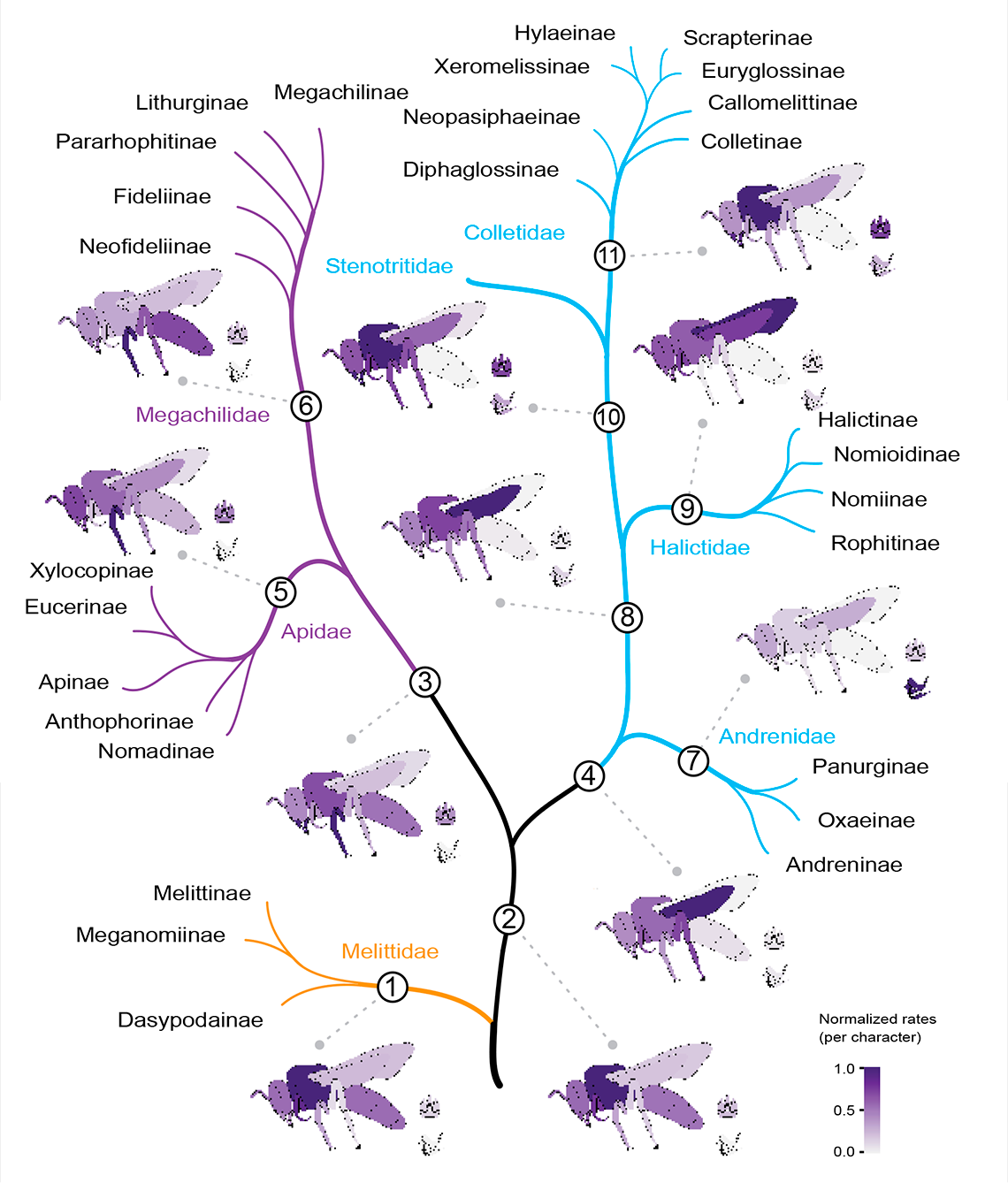
Imagem extraída de Porto & Almeida. Bulletin of the American Museum of Natural History (2026). URI: https://hdl.handle.net/2246/7558Mapeamento da história evolutiva da anatomia das abelhas indicando, em roxo, o ramo das abelhas de língua longa (famílias Apidae e Megachilidae). O alongamento de estrutura do aparelho bucal desses insetos possivelmente se associa à capacidade de extrair néctar em flores de corola profunda.Imagem extraída de Porto & Almeida. Bulletin of the American Museum of Natural History (2026). URI: https://hdl.handle.net/2246/7558
O futuro da investigação entomológica inclui a digitalização dessas grandes bases de dados anatômicos. Aliado a tecnologias avançadas, como a tomografia microcomputadorizada, esses dados permitirão reconstruções tridimensionais que revelam os insetos de dentro para fora. A partir daí, integrar informações fenotípicas de maneira contínua aos genótipos refinará a compreensão de como cada linhagem reage a estresses ambientais e distúrbios antropogênicos.
Desse modo, haverá mais ferramentas para investigar, por exemplo, as razões pelas quais algumas abelhas desenvolveram ferrões proeminentes e outras aprimoraram estratégias comportamentais distintas de defesa. Outra utilidade prática potencial das abordagens fenômicas é selecionar os polinizadores ideais para lavouras agrícolas e florestas em recuperação, fortalecendo a defesa e a conservação de ecossistemas, especialmente no contexto das mudanças climáticas.
Europeans born in the early 2000s have never not lived in times of crisis. The Great Recession, the hysteria over migration half-a-decade later, the recent shocks from the war in Ukraine: Europe has been in turmoil for so long that one forgets it could be otherwise. The political establishment has paid a high price, with ‘populists’ on both the left and right booting out incumbents everywhere from Lisbon to Lithuania.
Everywhere, that is, except the Federal Republic of Germany, the largest EU member-state, whose long-term macroeconomic strategy has been to gain an edge on the world market by repressing domestic wage growth and consumption, and using the savings to maximise exports of cars and heavy machinery to China. This model weathered the downturn of the 1980s relatively well. It soldiered on after the global financial crisis under the steady hand of Angela Merkel, who presided over sixteen years of sustained growth and low unemployment, effectively neutralising opposition from across the spectrum, and enjoying the support of two-thirds of the electorate by the time she stepped down in 2021.
For a while, it seemed that Germany’s outlier status could last forever, that it would remain stable and predictable even as its neighbours descended into chaos. But now, as Merkel’s memory fades, the foundations of the German social compromise are beginning to crack. Erstwhile customers in the Global South are becoming competitors, placing the German industrial heartland under growing strain. In June, Volkswagen announced plans to cut some 100,000 jobs. Energy prices are high and growth is slowing. According to a poll conducted late last year, less than half of Germans held positive expectations for themselves or their families for 2026, while only 22 percent described their outlook on the country’s future as optimistic.
The consequences are familiar. While the political centre, embodied by the government of the Christian Democrats and Social Democrats, has not yet collapsed, it appears to be well on its way, with the parties placing second and fourth in the polls respectively. The conservative chancellor, Friedrich Merz, has proven to be profoundly inept. Appointed last year, he is already the least popular chancellor in modern German history. Rather than forming at least a modicum of social consensus, as Merkel did so well, he is pushing a slew of aggressive cuts and ‘reforms’ to the welfare state. Some ten years after the initial populist wave crested, it would appear that Europe’s anchor of stability is now headed for its own. What is the likely outcome?
The forces harnessing this populist moment in Germany are not exactly new — the far-right Alternative für Deutschland (AfD) was founded in 2013, far-left Die Linke in 2007 — but they have been given a new lease on life after years on the margins of parliamentary politics. This is particularly the case for the AfD, which is still subject to the political ‘firewall’ that all other parliamentary parties including Die Linke have erected around it, but is currently polling in first place nationally and on the cusp of winning a majority in some eastern states, where protest parties of different persuasions have traditionally been most successful.
At least for now, the AfD seems to be the first address for German voters looking to express frustration with the country’s political and economic situation. For years, exit polls have shown the AfD topping the polls among workers and the unemployed, whose economic anxiety has been ignored by the political mainstream. Like far-right parties practically everywhere, it is particularly strong among lower-middle-class men in rural areas. Yet it is increasingly gaining support among industrial trade unionists, at least some of whom have responded to external economic threats by turning inwards, seeking to protect their jobs by excluding potential competitors from the job market. Although its organised presence within the labour movement remains meagre, at least in demographic terms, the AfD is now Germany’s leading workers’ party.
Ironically, the AfD began as something quite different: a Eurosceptic formation founded in opposition to bailouts for Germany’s Southern European neighbours. Populist, perhaps, but certainly not popular. Indeed, the early AfD was eminently middle class and its activist core remains overwhelmingly so to this day. Its stunning success, then, has less to do with a supposedly populist agenda (as critics are keen to point out, the AfD’s economic programme remains well within the neoliberal mainstream) than with a mixture of deft opportunism and blind luck. As xenophobia began to spread in the aftermath of the 2015 ‘summer of migration’, the AfD quickly positioned itself as the anti-migrant party. When protests against lockdowns broke out during the pandemic, it again pivoted in time to become the voice of Covid-scepticism. The anti-migrant and anti-lockdown waves have long since subsided, but the AfD — now shorn of its more moderate layers — has endured, and is now stronger than ever.
Precisely because of its exclusion from government and polite society, the AfD appears to millions as the only truly authentic voice of protest. The question is whether the party, on track to win a majority in the state of Saxony-Anhalt later this year, might become a victim of its own success: moving from an insurgent outsider to an established governing force. An AfD-led government is certainly an alarming prospect, particularly in a part of the country where its most reactionary elements dominate, but it would not mean the end of parliamentary democracy in Germany, as some alarmist voices tend to imply. The populist decade has already given us several examples of what the European far right in power actually looks like. The governments of Giorgia Meloni in Italy or (until recently) Viktor Orbán in Hungary succeeded in implementing regressive policies, but were — much like their counterparts on the populist left — domesticated by the institutions in which they operated. More importantly, they can, and almost certainly will, be voted out sooner or later, though it is less clear what will come next.
Could Germany’s belated populist turn therefore come to benefit the left? That is hard to say. Die Linke’s path to power has been rocky and winding. Teetering on the brink of political oblivion two years ago, the party has undergone a remarkable rejuvenation under the leadership of Ines Schwerdtner, once the editor of the German edition of Jacobin magazine. Today, it is gaining ground among disaffected centre-left voters and young people in urban areas, but has struggled to win back its traditional eastern electorate from the far right, and has made few inroads among working-class constituencies. As was the case for left populism in the rest of Europe, the resurgence in Germany remains largely restricted to downwardly mobile segments of the professional middle classes. Breaking out of this pattern will be key if Die Linke is to avoid the same fate as Corbynism or similar experiments that came to ruin.
It will also depend on whether the party can learn from the experiences of the last decade. In their book The Populist Moment (2023), Anton Jäger and Arthur Borriello describe this trend among left parties as an attempt to ‘rethink mobilisation for an age of demobilisation; to organise for an age of disorganisation’. But while populism has had distinct success in mobilising an electorate, at least sporadically, long-term organising has proven far more difficult. In countries like Spain and Greece, where the left rode the populist wave into government but lacked corresponding structures on the ground, this project is now for all intents and purposes dead.
Schwerdtner for her part prioritises ‘building a house of stone’, meaning a solid organisation rooted in workplaces and communities, as opposed to a short-term electoral focus. But come September, Die Linke stands a good chance of taking first place in the Berlin elections and coming under pressure to join a cross-party coalition to exclude the AfD in Saxony-Anhalt. There are strong arguments for doing so: Berlin is desperately in need of public investment after years of austerity, and it is hard to see any government without Die Linke making the necessary expenditures. As with Zohran Mamdani in New York, the party hopes to turn the city into a beacon of hope for the rest of the country, showing that democratic socialists can not only govern reliably, but improve the lives of their constituents in a meaningful, lasting way.
At the same time, assuming government responsibility — particularly in a poor state like Saxony-Anhalt, where there is little fiscal room for manoeuvre — risks tainting the party as part of the rotten establishment that sparked the populist wave in the first place. As was the case with Syriza in Greece, Die Linke’s foray in government could ultimately end up bolstering the far-right’s reputation as the only ‘real’ opposition and accelerating the country’s rightward drift. Schwerdtner surely had this dynamic in mind when she spoke of taking ‘difficult decisions’ at Die Linke’s party congress back in June.
Whether or not the AfD or Die Linke find themselves in government later this year, the structural crisis of the German economic model will not be resolved anytime soon. Bearing that in mind, we can expect the populist moment to stretch far into the future, with all the political unpredictability that entails. For Germany’s — and Europe’s — sake, left populism needs to succeed where it failed in the 2010s. That means combining immediate electoral priorities, to restore confidence in the left as a force that can wield effective power, with the slower work of cadre-building and coordinating among our base. These are the foundations on which a house of stone must rest. Without them, parties like Die Linke will, in their desire to halt the advance of the far right at any cost, repeat the same strategic missteps which have undermined their projects in years past.