 Login
LoginLow-tech Magazine: The Uncompressed Book Series

Kali Linux 2026.1 released with fresh 2026 theme and nostalgic BackTrack Mode. Kali Linux 2026.1 is now available. This first release of the year brings a stunning new visual theme, a fun nod to the project’s roots with BackTrack mode, eight exciting new tools, and the usual solid package updates. The Kali team always keeps...
The post Kali Linux 2026.1: Fresh 2026 Theme and Nostalgic BackTrack Mode appeared first on DebugPoint.com. Do not reproduce this post without permission.
SystemRescue 13.00 Released with Linux Kernel 6.18 LTS and Many Useful Improvements. SystemRescue 13.00 is now available. This is a significant update to the popular Arch-based live Linux distribution that many of us use for system repair and data rescue tasks. If you work with broken systems, need to recover data from damaged drives, or...
The post SystemRescue 13.00: Release Highlights appeared first on DebugPoint.com. Do not reproduce this post without permission.
AerynOS has dropped its latest project update. This February release brings a wave of refinements to the Linux distribution, sharpening its edges for smoother daily use. AerynOS is a modern, independent Linux operating system built from scratch – not based on Ubuntu, Fedora, or any other distro. It focuses on delivering blazing-fast performance, rock-solid reliability,...
The post AerynOS February 2026 Update Brings Fresh Features appeared first on DebugPoint.com. Do not reproduce this post without permission.
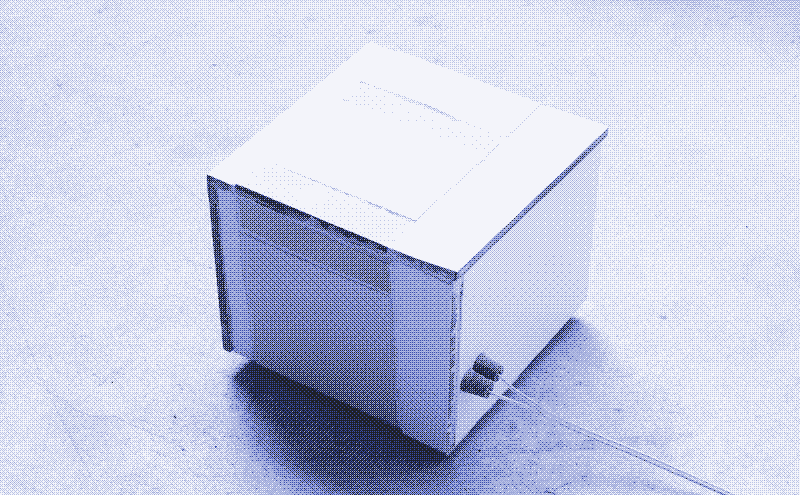
Over the last twenty years, smartphones gradually replaced many earlier digital tools such as PDAs, cameras and music players. Today these objects are regarded as obsolete: they may hold some esthetic or nostalgic appeal but they do not fit in a modern, zerofriction, cloud-first workflow. Yet these devices still have desirable qualities that smartphones lack: a singular focus on a specific use case; hardware buttons and physical connectors; multi-day battery life.
Even their lack of connectivity can be seen as an asset from a resilience, privacy and security standpoint. Actually using decades-old tech today is challenging, in spite of its apparent simplicity. The friction of physical media-based workflows now feels unacceptable. But much like classic cars can be fitted with an EV motor, it is possible to retrofit older devices in order to make them usable again in a connected world.
Read more: “Practical Retrofitting for Obsolete Devices“, Martin Lafréchoux, LIMITS2025, June 2025. Via Roel Roscam Abbing.
“Just like the arts-and-crafts movement was a reaction against industrialization, we’re now experiencing a reaction against the smart home. People are looking for more manual, less complicated places to live.”
Read more: Why the Ultrarich Are Unplugging From “Smart Homes”, The Hollywood Reporter, April 2025. Thanks to Manuel.
“Suppose Schopenhauer is right that life boils down to a flight from either boredom or pain. Insofar as the vast material abundance of wealthy, industrialised society has had an analgesic effect (there is simply less physical pain than in the past, before fluoride and anaesthesia and sedentary lives), it would seem to have solved one problem only to amplify the other. In place of pain, we have ennui, the quintessential modern condition. It follows directly from overabundance: an endless stream of video “content” or chocolate cake or edibles or any other indulgence cannot deliver lasting satisfaction. Everything gets old eventually, leaving one to grope around for the next fix.”
Read more: The West is Bored to Death, Stuart Whatley, The New Statesman, April 2025.
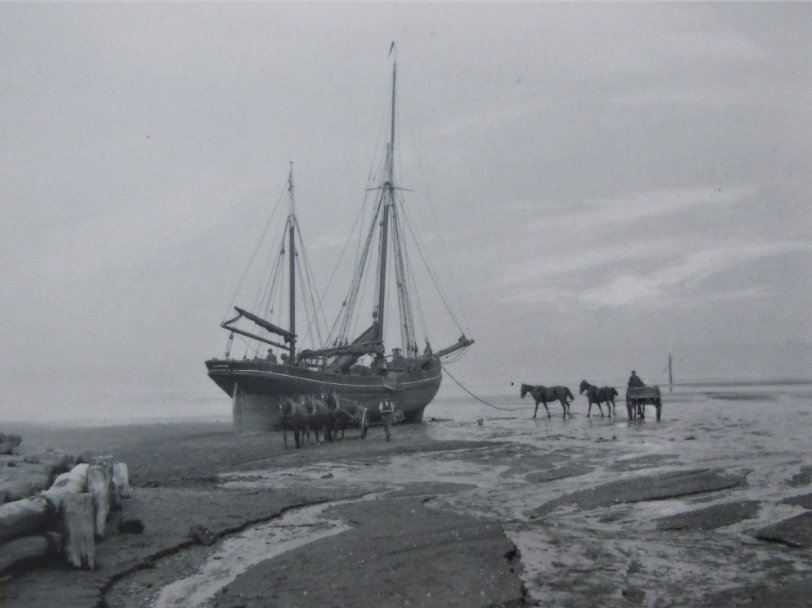
A Collier problem occurs whenever a new technology requires the technology it nominally replaces to function due to efficiency limits. Steam ships replaced sailing ships, but without windjammers the steamships could not function. This led to worldwide exports, paradoxically with large sailing vessels often transporting the coal needed by steamships, as they were more economical to operate on long oceanic sea routes.
Read more: Woods, Steven. “The Collier Problem: Toward a Definition and Application.” Image: Unloading coal from a collier on East Beach in the town of Cromer. Norfolk, England. Image taken on 8 March 1912. Public Domain.
From Places Journal:
“Building” is a powerful metaphor that has long structured how we think about progress and accomplishment. What might be the new metaphors, the new rubrics, for an epoch of repair? How might professions premised on growth and consumption — new buildings, new landscapes, new cities — adapt to the new urgencies of reuse, preservation, and degrowth?
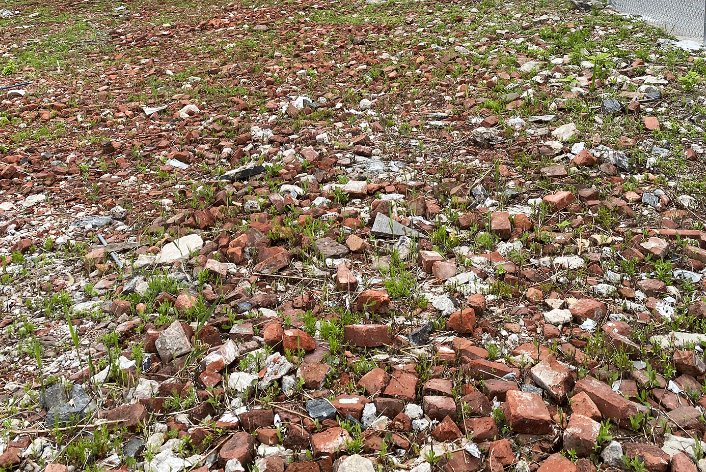 Image: Vacant lot, Second Avenue and Second Street, New York City, July 2024. [David Gissen], Places Journal.
Field Notes: Repair explores these questions and more through an ambitious eight-part narrative survey, featuring observations from nearly 100 scholars, designers, planners, activists, and artists. Contributing authors take us to locales around the world, from Belgrade to Chicago; Delhi to the Blue Pacific; Johannesburg to New York City, Malmö, and London, among many others.
In the installments, you’ll discover thoughtful, nuanced, and urgent calls for practices of repair, reuse, preservation, maintenance, and care. Some are hyper-practical, concerned with the lifespans of artifacts and structures. Others revise or propose philosophies of repair that might address the overlapping crises of climate change, economic inequality, and racial injustice. More than a few acknowledge that repair can only take us so far. “Field Notes: Repair” follows an earlier series in Places, Repair Manual.
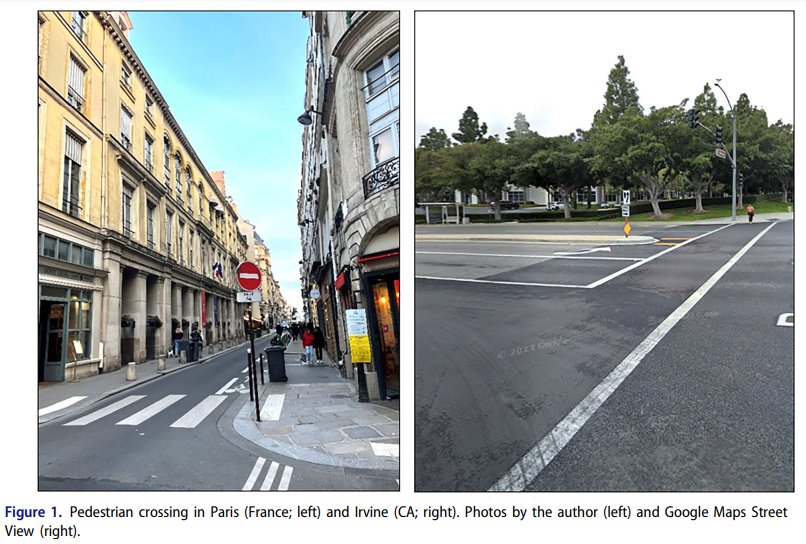
Pedestrians face the greatest risk of automobile collisions when crossing a street: the longer a crossing, the higher their exposure is to oncoming cars. Despite the relevance of crossing distance, few studies have considered its variance within or across entire cities. Given that, we probed pedestrian crossing distance at the municipal scale, leveraging both OpenStreetMap and satellite imagery to quantify crossing distances at roughly 49,000 formal crossings (those parts of the roadway designated for pedestrians to cross), both marked and unmarked, at intersections and at midblock.
We measured formal pedestrian crossings throughout a dense European city (Paris [France]), a dense American city (San Francisco [CA]), and a less-dense, more car-centric American city (Irvine [CA]). This granular approach—covering roughly 49,000 total crossings—identified inter- and intraurban spatial patterns in the distribution of pedestrian crossing distance, including clusters of long crossings that likely deter walking and increase its risk. By overlaying recent pedestrian–vehicle collisions on these novel data sets we found that longer crossing distance correlated with increased likelihood of collisions, raising the salience of traffic-calming interventions.
“Researchers have argued that wealthy nations rely on a large net appropriation of labour and resources from the rest of the world through unequal exchange in international trade and global commodity chains. Here we assess this empirically by measuring flows of embodied labour in the world economy from 1995–2021, accounting for skill levels, sectors and wages.
We find that, in 2021, the economies of the global North net-appropriated 826 billion hours of embodied labour from the global South, across all skill levels and sectors. The wage value of this net-appropriated labour was equivalent to €16.9 trillion in Northern prices, accounting for skill level. This appropriation roughly doubles the labour that is available for Northern consumption but drains the South of productive capacity that could be used instead for local human needs and development.
Unequal exchange is understood to be driven in part by systematic wage inequalities. We find Southern wages are 87–95% lower than Northern wages for work of equal skill. While Southern workers contribute 90% of the labour that powers the world economy, they receive only 21% of global income.”
Read more (open access): Hickel, J., Hanbury Lemos, M. & Barbour, F. Unequal exchange of labour in the world economy. Nat Commun 15, 6298 (2024). https://doi.org/10.1038/s41467-024-49687-y
Earlier this year Rachel Donald interviewed me for her podcast “Planet: critical”. Here’s the video. Also check out the other episodes, there’s lot of interesting stuff there. https://www.planetcritical.com.
One of Low-tech Magazine’s readers, Arie James Dallas, has started making audio versions of articles. Three articles are available at the moment. Find their playlist here.
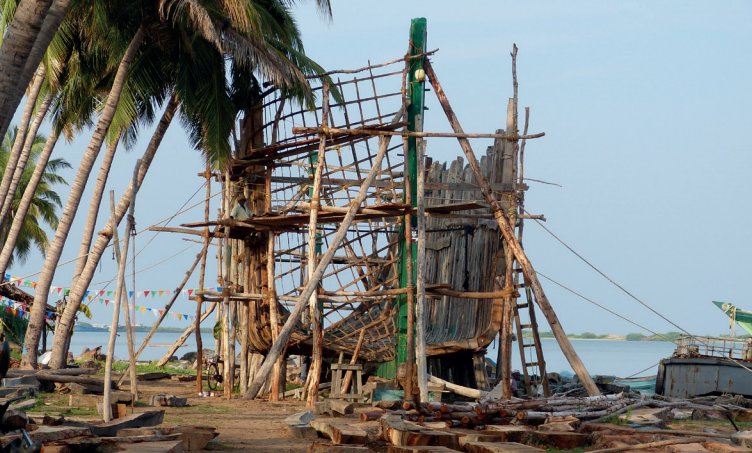
Giant wooden cargo ships that braved the oceans for thousands of years are still being made in the South Indian state of Tamil Nadu. Even as metal motorised ships became the norm, some shoreline communities in South India continue to craft this wooden cargo ship. In a blend of reason, creativity and hard work the communities engineered their past to forge a future. This book traces the transition of this tradition over time.
The authors have created a photo documentation using hundreds of images that capture the shipyard’s atmosphere to offer a narrative and the manufacture of these ships at each step of their construction. It analyzes the conditions of their economic viability and how it has evolved over time. Through visual anthropology this book offers a narrative of wooden cargo ship building and craftsmanship in south Asia.
The open access book can be downloaded from https://www.ifpindia.org/bookstore/wild-craft/.
There is also a video about the project: Of Wind and Wood. Sustainable cargo ships in France and in India.
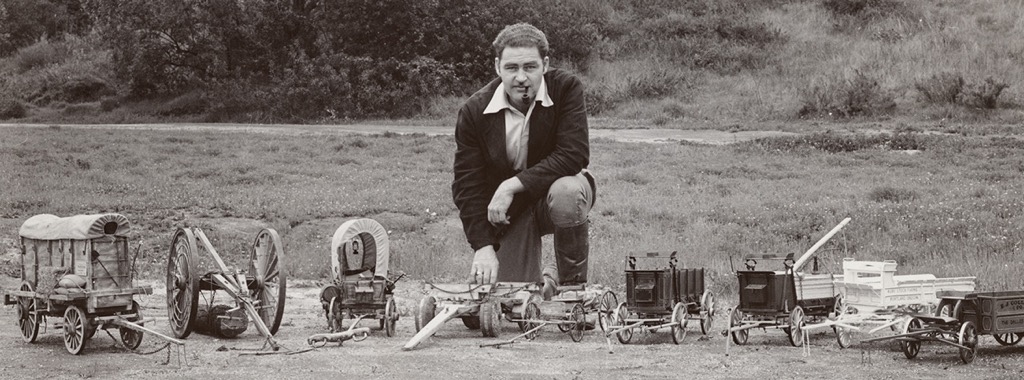
Ivan L. Collins created historically accurate models of horse-drawn vehicles using painstaking research to ensure that every detail was authentic. Built at one-eighth scale, these models represent transportation technology before the automobile. Collins saw this work as more than a hobby; his models were a way to preserve history for future generations.
See and read more:
https://www.ohs.org/museum/exhibits/models-in-motion-ivan-collins-miniature-vehicles.cfm
http://www.scalemodelhorsedrawnvehicle.co.uk/(Ivan%20Collins).htm
Thanks to David Barnes.
Image: Oregon Historical Society.
Earlier this year we organised an event in Barcelona, “Back To The Future Of The Internet”, in which we explored concepts from the Internet’s history that can help create a more sustainable future network. The video is now online:
“The SmolPhone project is an action research on the topic of low-tech in the domain of IT systems. Its practical aspects consist in designing a sort of low-tech smartphone offering some services of a classical smartphone with a one-week battery lifetime. The goal is not to optimize a typical smartphone but rather to reconsider the smartphone design space, exploring unusual architectures and evaluating the set of features that should be part of long-lasting smartphones.”
Quoted from: Rautureau, Aloïs, et al. “Quantifying the tiny-Small design of the SmolPhone.” ICT For Sustainability (ICT4S). 2024. Related articles.
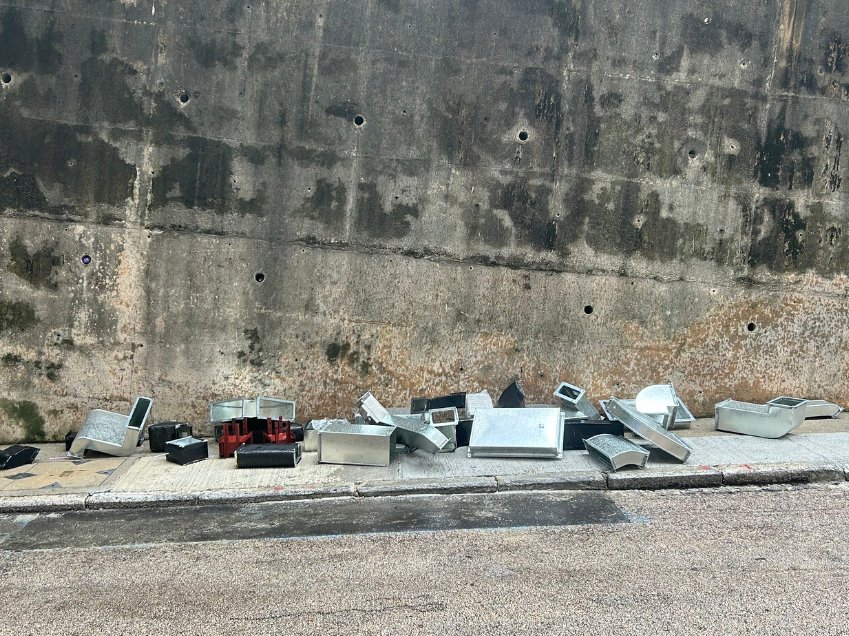
Image: Ducts in a row. Photo: Daniel A. Barber. Taken from: After Comfort: A User’s Guide.
Comfort is a construct. Many new commercial and institutional buildings built over the past few decades rely so heavily on fossil-fueled mechanical HVAC systems that they would be uninhabitable without them. Many of the stylistic and programmatic debates in architecture in these same decades similarly relied on HVAC for their explorations and innovations. In other cases, often at the residential scale, buildings have been produced with an expectation of cheap energy, which has meant that adequate insulation, cross ventilation, and other design-based passive thermal measures have not been considered. Our determinedly slow, casual move away from fossil fuels, with limited political or socio-economic support, is already resulting in “green inequity” and novel forms of thermal violence. Over the decades to come, enclaves where upper-class neighborhoods engage with expensive “green tech” such as electric vehicles and heat pumps will coexist alongside poorer areas that cannot afford to make any transition from the carbon-fueled lifestyles they need to get by.
After Comfort: A User’s Guide is a project by e-flux Architecture in collaboration with the University of Technology Sydney, the Technical University of Munich, the University of Liverpool, and Transsolar.

