 Login
LoginTECNOPOLÍTICA #276 - Matches, solidão e dependência


GNOME OS is getting a dedicated “Test Center” that finally makes testing experimental apps and system components safe, simple, and reversible on image-based distributions. GNOME OS has always been that cool, slightly wild playground for people who live and breathe GNOME. It’s image-based, atomically updated, super secure… and until now, a bit of a pain...
The post GNOME OS is Getting a ‘Test Center’ – Making Experimental Software Testing Actually Usable appeared first on DebugPoint.com. Do not reproduce this post without permission.

Debian released important point updates for both its current stable and previous stable versions on July 11, with Debian 12 officially entering its Long Term Support phase. The Debian project released updated point versions for both its current stable release and the previous one on July 11, 2026. Debian 13.6 delivers 124 stability fixes and...
The post Debian 12.15 and 13.6 Released: Bookworm Enters LTS with Support Until 2028 appeared first on DebugPoint.com. Do not reproduce this post without permission.

KDE Frameworks 6.28.0 Released with Android Calendar Plugin, New Barcode Support, and KIO Improvements. KDE has released Frameworks 6.28.0, the latest monthly update to its set of over 80 libraries that form the foundation of Plasma and most KDE applications. This release brings several useful new features along with the usual round of bug fixes...
The post KDE Frameworks 6.28.0 Released: Key Features appeared first on DebugPoint.com. Do not reproduce this post without permission.


Grammars for languages or any other field are a beautiful thing. They compress complex systems into a language with a couple of rules. For the spoken language example, we know when to capitalize a letter or how to start a sentence. There are clear rules. Grammars also help us remember, as we do not need to recall every little rule, but apply them in a structured way.
For text editing, we have Vim motions that help us navigate a text document with 1000s of shortcuts, but because there is a grammar, we do not need to remember them all, but learn the structure of the grammar and combine them. But what if you work in data? What if we could have the same for data, a grammar for data engineering, or a language that defines it?
Expressing our needs declaratively and decisively? Also, expressing it in a way that leads to reproducible outcomes, or works with multiple parts and execution engines already out there. This is what we will discuss in this article. How existing tooling, such as Ibis, provides some capabilities, and how xorq extends them by adding full lineage and transparency for humans, with included executable memory for useful tabular data, all manifested in a single git repository.
Having a grammar for data engineering means we can express the workloads in a declarative manner, and then be sure we can deterministically reproduce and apply that exact definition.
It’s similar to the concept of a Declarative Data Stack I introduced a while back, but it gives the stack not only configurations but also a language with in-built manifestation and execution engines.
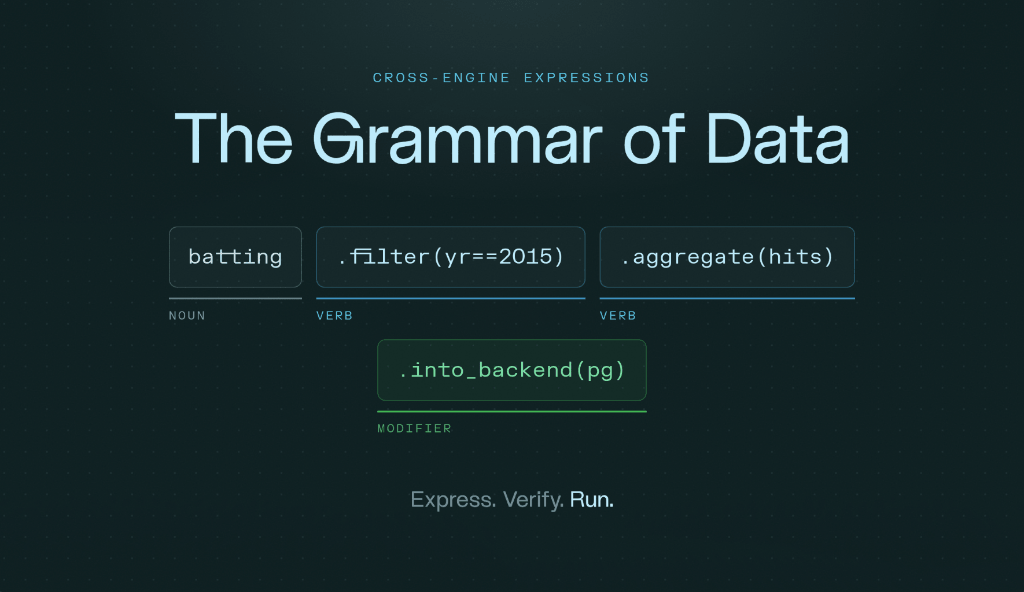
In the above image, we see:
expr.yaml you can diff and review in a PR.This is hugely powerful and separates the concerns of defining logic, verification in the manifest step, and execution as a composable data stack, as Wes McKinney called it, with multi-compute engine possibilities.
Every grammar starts with nouns, and here the noun is the source, a node that holds data but carries no transformation yet. It might be an in-memory table, a registered connection to a warehouse, or just a lazy pointer to a file on disk that hasn’t been read. They’re simply referenced, the way a noun refers to a thing before any verb acts on it.
The verbs in our language are transforms such as filter, select, mutate, aggregate, join, order, limit. Each one takes a source (or another transformed expression) and returns a new, immutable expression. You do not mutate anything before it, only describe what should happen next.
Looking at a definition such as .filter(...).aggregate(...).mutate(...), we can see this as a sentence. The moment a verb is applied, the expression stops being a plain noun and becomes a statement, a description of “data plus what should happen to it.” But the sentence isn’t spoken yet, it stays inert, fully composed but unexecuted, until something finally asks it to run. That’s the deferred part of the grammar: writing the sentence and saying it out loud are two different acts.
There’s a third part of speech worth naming: the template. Instead of writing a sentence about a specific noun, you can write one about a noun’s shape, a schema with no rows behind it. A template says “given something with a column of this type, here is what I’ll do to it,” and only later gets bound to an actual source, at which point the placeholder resolves and it becomes an ordinary statement again.
And we have modifiers that ride alongside a statement without changing what it computes. They’re small tags of metadata that say “this expression also represents a fitted model” or “this is a saved reference to something else.” It’s like a footnote with additional metadata that doesn’t change the surface meaning, but adds context for later use.
This analogy makes the grammar compose the same way regardless of which engine eventually executes it. There are more parts, but with just these four, noun, verb, template, modifier, you can read (and write) arbitrarily complex data pipelines the same way learning a handful of verb-and-object combinations in a text editor lets you compose arbitrarily complex edits.
[!tip] Avoids building “Inner-Platform Effect” with repeated tools
With this grammar, we can avoid repeatedly implementing the same logic we already have, but manifest and express our logic once, and reuse it with different execution engines, exactly what Ibis and xorq allow. Similar to what the inner-platform effect means for software best practices.
Having a grammar is really good for LLMs, too. It helps them first to declare data artifacts and second to execute them reproducibly.
On top, expressions can be LLM-agnostic, and we can interchange the LLMs we use just with an expression. Also, the chart is just an expression, or the data catalog and the metrics.
Like UDA (Unified Data Architecture) from Netflix, we define our expressions once and represent them everywhere. Netflix built UDA to solve duplicated models, inconsistent terminology, and siloed systems, where the same concept like ‘actor’ or ‘movie’ gets modeled differently across teams, with no shared foundation. Their answer was a full knowledge graph with a metamodel, making the conceptual model part of the actual control plane.
Not everyone needs Netflix-scale tooling, though. For a code-first approach, xorq gives you the same core principle: define once, execute anywhere by writing a declarative Ibis expression, serializing them as content-addressed YAML artifacts, and running against any supported engine, fully reproducible.
The difference worth noting: UDA is a semantic layer defining what data means across systems. Xorq is a computational layer defining what transformations do across engines. Both reject the same anti-pattern of re-implementing the same logic for every system.
Xorq is an executable memory system for tabular data that works horizontally across your data stack, supporting everything from discovery with a catalog to defining transformation logic to modeling.
It has declarative transformation (Pandas style), and you can build ML pipelines and prepare data with its semantics in a single stack that is not vertically integrated, but horizontally integrated, giving your agents a catalog of executable pipelines and turning short-lived agent work such as wrangling scripts, sklearn pipelines, ad-hoc tables into durable, composable, executable artifacts that any future agent or human can discover, reproduce, and reuse.
The horizontal data stack shows what Xorq brings to the table. Xorq’s origins started from a git-native semantic layer, for data analysts out of college, to build semantic models for a living, to make their lives easier.
From point-and-click tools, dragging tables and drawing joins manually, only to add more reporting tools on top to create pixel-perfect reports. Also performance-wise, it didn’t scale, meaning we needed cubes to make it faster, adding another layer of complexity.
And there was no lineage that shows from source to dashboard. The question asked was: “what if we could do this end-to-end data engineering workflow locally?”. This is what the horizontal data stack and xorq are providing.
To add semantic layer capabilities, Julien Hurault and Hussain built the Boring Semantic Layer + the Xorq catalog, providing a semantic model you define in Python, check into git, and query from the CLI.
Compression of a full data stack into a single executable is hard, but xorq tries exactly this with the help of Ibis, git, uv, and DataFusion.
The design choices of xorq showcase even better what it is, and what they enable:
requirements.txt.Another big advantage of expressions and having a grammar for data engineering is easily switching between backends, with no change to the transformation or business logic. It’s just defining the backend from Apache Arrow Flight to DuckDB or any other engine.
We write the definitions and express our tabular data and computations. The engine, in this case xorq, can build it into a manifest file that is deterministic and hashed.
Xorq uses Ibis as the expression layer for single-backend logic, then builds the cross-engine expression tree into a serialized YAML artifact. When moving data between backends, xorq transfers Apache Arrow RecordBatch streams between them—each backend acts as a RecordBatch transducer. No CSV serialization, no JSON encoding needed. This makes backend switching fast and memory-efficient. Write declarative Ibis expressions that run like a tool—xorq extends Ibis with caching, multi-engine execution, and UDFs.
Here’s an example of using DuckDB and Postgres in conjunction:
|
|
Move data between different engines within a single expression using into_backend(), here Postgres and DuckDB
You can see how easily you choose your most optimized execution engine, whether in the above example choosing DuckDB for filtering recent batting and using Postgres to filter NL (National League) awards, and joining the two with the Postgres engine.
Engines supported by xorq as of now, with the ability to move data between them, are (check Supported backends for the latest):
With different engines supported, we can use the compressed single executable logic across engines. We can build expression graphs before executing them, which works like this, with one expression, many engines:
|
|
The output of building a cross-engine expression is a directory containing your serialized pipeline with a unique hash identifying each build and its artifacts and expressions. When executed, the output is the resulting object or data.
And the expressions are tools, Arrow is the pipe. E.g., a Unix pipe streams text between small programs. Xorq pipes Arrow streams between expressions: unix : programs :: xorq : arrow-transforms
That executes like this:
|
|
This is quite short and potentially abstract to understand when never used, but we will go into more examples and details in another article.
This article introduces a new way of describing data transformations for machine learning or data engineering pipelines in a direct and simple way that works locally with any execution engine, without changing the code itself.
It’s a good place if you need a trusted harness for a data engineering persona. We can define once and use it with the engine that works best for your workload and data engineering environment.
We had a look at how we write -> manifest -> execute with xorq, its advantages, and why you might use it for modeling once and representing everywhere. By adding AI agents to the mix, which help us pull the right lever, instead of bigger, more expensive models or more tokens, we improve accuracy with more semantic understanding, with a grammar the model can learn and apply, even pre-manifest before execution, and run them deterministically every time. This is a huge addition to working just with agentic Skills files that are free-form Markdown and pull data all over, or are not defined precisely enough. It’s all about having high-quality context in the right format, with a clear definition where humans and AI agents can interchange and help each other.
There’s a lot more to come, with showcasing the horizontal data stack and the use cases it supports, how we build expressions versus running computations, and how data catalogs are integrated into the picture, too.
–
Check out xorq code and star it on GitHub, or read more behind the scenes at Xorq documentation.
They also have a macOS desktop app coming up that does it all in one unified app, geared towards non-technical users. Join the waitlist for that.
Full article published at xorq.dev - written as part of my services

With ever-changing models, new and better ones coming out every few months, it’s great if we don’t have to rely on them too heavily. The better your tooling, the less dependent you become on any single model. That’s also why the deterministic harness matters: a correctness layer that lets you reproduce outputs and trace lineage regardless of which model you’re running underneath. This is especially true during maintenance or extending the project, where verification is the real job.
The danger isn’t only a crash or an error message, but a wrong number that didn’t break. It might be a clean query, but it introduces duplicated rows.
In this article, we go through the three levels of AI agents in data engineering, how to structure projects so the AI delivers its best outcomes, and how dedicated agents with a deterministic core help us build higher-quality pipelines — ones we can actually trust. And we look at a practical example of how it works with a blast radius analysis.
Why should we use agents for data engineering? And at what levels can agents help us productively? As LLMs will always have some error tolerance, as humans do too, we need a way to be more confident in producing the code.
There are different levels of confidence and levels on which the agents can help us.
Ideally, we’d want to always use the dedicated tools, but there isn’t always one.
BI Dashboards vs. Plumbing the Data Pipelines, or Creating Source Ingestions, or Maintaining? For data engineering, the question is not only if there is dedicated agent tooling, but also on what part of the data engineering lifecycle AI agents can help data engineers and analysts the most, and potentially even domain experts?
The lifecycle contains the ingestion part, ETL, or understanding the business in great detail, or is it just to visualize the result? Or should it cover maintenance in case of overnight ETL errors, or the full data lifecycle?
In general, before we go into more details later, agents can help us on the full cycle, but it always depends on who you are and what role you play. Building from scratch with no knowledge or seniority is dangerous. Why? Because they can’t verify if the produced code is correct. Okay for a side project or a proof of concept, but not for actual production.
There’s also a part that is less technical, a way of guiding the agents in the right direction. Especially if we want to safely use it in large projects or organizations, we can’t just let it run without guidance.
For that we need:
uv init is best, because it will always be the same).With these steps, you can get the best out of the agents of today. I’d say the model matters less, but the structure does, and as Mario says, so does the workflow approach. For example, extensively plan (the process before writing a single line) and correct the model before any implementation that could lead down the wrong path is written.
Also, don’t overthink it. But this is only the workflow and learning the soft skills and discipline of working with agents. How does that look in a real-world project?
[!note] The key is to get use out of AI, not to get more work.
E.g., most developers used to think about the problem. Today, most drown in PRs. When the AI tooling gets better, AI can provide more quality code that is correct, that needs less review or fewer iterations, which means fewer PRs and less work for the developers to go through.
A key insight is that AI agents should support the “human in the loop” for correctness, or a correctness layer. And rather than making more work to verify more code, we should be confident in the process and know that the code it produces is verified and ultimately correct.
But how do we get more “correct” work and a layer in which we can verify it? The biggest argument is a deterministic-validation architecture in full. E.g., Altimate Code splits the agent into a probabilistic layer on top and a deterministic Rust/TS layer underneath that does the actual SQL ops such as parsing, validating, and equivalence checks, so that the agent itself never has to be trusted on those questions.
Altimate Code, for example, is built on a probabilistic agent, deterministic harness, and deterministic core. The probabilistic agent with the LLM does the creative work of reading intent, picking a strategy, drafting SQL, summarizing results, and recovering when something goes wrong.
Below the boundary sits the deterministic harness, a TypeScript layer that intercepts every tool call: a dispatcher checks hasNativeHandler before the call runs, and routes it either to a native, deterministic handler or back to the model. Those handlers don’t reimplement logic themselves, they call into the deterministic core, a Rust engine (altimate-core) that exposes SQL operations as pure functions over ASTs and schemas, wired in via napi-rs bindings. Parsing, validating, transpiling, checking query equivalence, diffing schemas, extracting column lineage, diffing rows across warehouses — all of it runs sub-millisecond, and all of it returns the same answer on the same input, every time.
Like a compiler, the agent never decides whether two queries are equivalent or a column exists upstream. Instead, it calls a function that proves it against the parsed AST and the schema, the same way a type-checker proves a program compiles rather than guessing.
That’s the distinction that makes the output easier to review, as factual checks have been run and the output is either correct, or there’s a bug that it can fix directly. The rest a human can re-verify. On the dilemma of having stopped to hand-write code and approving it faster than humanly possible to check, you can also read more at You Are the Trust Layer.
[!note] There’s another factor, being wrong
Bare agent use might be cheap, but only until they’re wrong, and then the cost is unbounded.
Altimate, or data engineering agents that have deterministic functions and integrated understanding of how to work, can help you save tokens and be token lean (the opposite of [[tokenmaxxing]], which is popular on Twitter/X, using as many tokens as possible and having an agent running at all times). Because in large enterprises, token costs are a real budget point.
To slow down the tokens, an easy trick is to instruct the model to use fewer tokens and words itself - caveman is a good example of that, but you can also add a singular prompt to your CLAUDE.md, Codex, or model of choice in combination with Altimate Code.
There’s a second, less obvious cost: the token itself isn’t a stable unit. When Anthropic shipped Opus 4.7, the same prompt that cost X tokens on 4.6 started costing roughly 1.4X (same input, same answer, more tokens, same price per token).
Altimate on The Great Token Heist of ‘26 makes the case that “cost-per-token is the wrong number to optimize”, since the meter itself can move with a vendor’s next model update, and what we should track instead is cost-per-task. I fully agree, and this is where deterministic function calls work around that volatility by not using a model/tokens for every task, making it less expensive.
In this chapter we go through typical AI agent use cases for data engineering.
There are many of them. You can use them to educate yourself or your team, build production data pipelines, build data apps, and visualize your data in new innovative ways (usually HTML web pages with React and other JavaScript frameworks). But in general, the use cases fit into these approaches:
Below we go through extending and changing an existing warehouse with a change of column, and using Altimate Code to give us a Blast-radius assessment.
A Blast-radius refers to the potential extent of damage. For example, before you knock down a wall in your house, you want to know if there’s plumbing behind it, electrical wiring within it, or if it’s holding up the floor above.
The same is true for a data warehouse or a data project with lots of ETL. For example, if a data engineer cleans up the table fct_orders by joining orders to order_items and summing order_total. It compiles, the dbt tests pass, nothing errors. But the join changes the grain, so any order with several line items now gets counted once per item, and revenue quietly inflates.
It’s best to know, before you rename a column or add a new join, the downstream (data that comes after the current task) dependencies to the dashboard — that’s what the blast-radius report does.
With Altimate Code we can achieve this. Before any change goes through, it maps out the full impact automatically and produces a detailed blast-radius report with what will break, what’s safe, what needs someone to sign off, and also performs the changes. Here is what this looks like:
As an example, in this prepared ecommerce repo with different DWH layers such as staging -> intermediate -> marts, I prompted this request to change unit from cent to dollars:
It recognized the dbt name and invoked dbt-analyze automatically:
It gave me a full Blast-radius report and the impact my changes would have on the project:
Including semantics only, to point out what’s safe and what’s not:
With a fixed order to address breaking changes, semantics and docs, and intentionally untouched:
Notice, I hadn’t said anything about blast analysis or using dbt-analyze — it did it on its own, ran dbt, and analyzed it deterministically.
This shows how Altimate Code looks behind the walls of data engineering, just like blast radius analysis.
If you want to see another example and a full blog post on Blast Radius, check out Blast Radius Analysis Using Altimate Code, and what Altimate Code did as in the video. Or Altimate provides many more examples and Showcase on their website such as Migrate SQL Server to Snowflake with dbt or showing how to resolve An Upstream Schema Changed.
[!example] Connect a model to Altimate
Make sure to connect to a model with/connectand choose an existing subscription with API credits, or any other subscription. I used opencode zen for my example, which includes e.g. Opus 4.8.
I hope you got a better understanding of why AI agents can be genuinely useful, especially when provided with the right tools and applied with the right discipline.
You’ve also seen how deterministic tooling, purpose-built for data engineering and analytics problems, gets you both better correctness and better token economics than general-purpose agents alone.
Coming back to where we started: not every task needs a level-three agent. A quick chat-phase agent is fine for exploring a dataset or drafting a query you’ll review yourself. But the moment that output touches production or serious work, a dashboard, a nightly job, a number someone makes a decision on, you want the deterministic core underneath it, not just a model that sounds confident.
That’s the gap Altimate Code is built to close. It runs on deterministic functions purpose-built for DE workloads, it’s open-source via the OpenCode TUI, and for teams wanting more, there’s Altimate Studio — a paid, multi-agent platform with extras like warehouse cost optimization, dbt development acceleration, and migration tooling.
Check out Altimate Code, it’s free and open-source. Give them a star if you like them, and find more information on their docs and new website.
Full article published at Altimate.ai - written as part of my services



System76 has officially released COSMIC 1.1.0, bringing a host of exciting improvements to their Rust-powered desktop environment. System76 has officially released COSMIC 1.1.0, the latest version of their exciting Rust-based desktop environment. This solid update brings many practical improvements across the board, making COSMIC even more polished and enjoyable to use. I have been following...
The post COSMIC 1.1.0 Desktop Environment Released: Big Update with Tons of New Features appeared first on DebugPoint.com. Do not reproduce this post without permission.
Shotcut 26.6 brings powerful High Dynamic Range preview, restored external monitor support, and several useful improvements. A new version of the popular free and open-source video editor Shotcut 26.6.25 is now available. This release brings excellent HDR (High Dynamic Range) preview and export capabilities, brings back the long-missing external monitor support using a system display,...
The post Shotcut 26.6: High Dynamic Range Preview, External Monitor & More appeared first on DebugPoint.com. Do not reproduce this post without permission.


