Out of nowhere, a woman's right arm and leg started shaking uncontrollably. In the moments leading up to the experience, she seemed well; she had no headache, confusion, or weakness. But for about a minute, half of her body juddered.
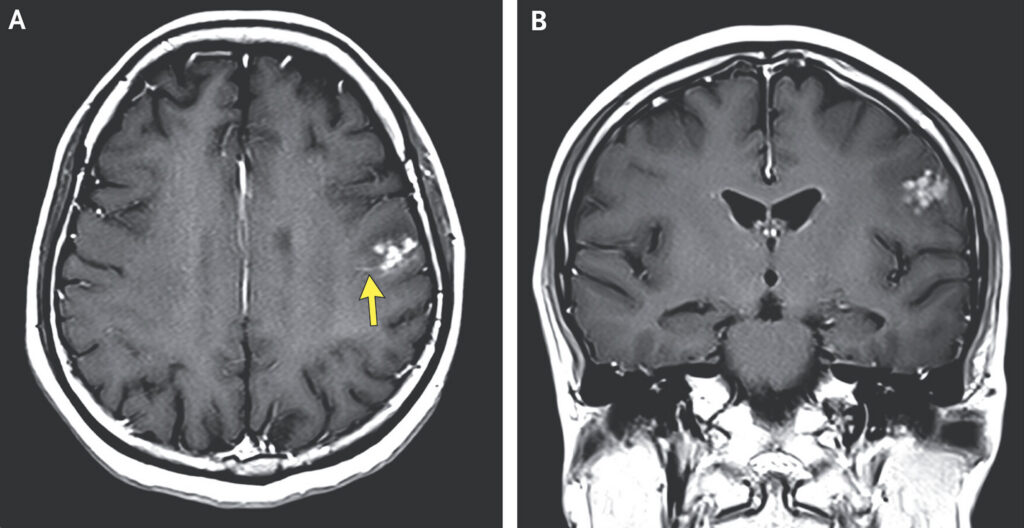
The woman, a rice farmer in the Philippines, headed to the emergency department. There, doctors gave her a physical exam and found nothing out of the ordinary. Then they took a look at her brain. Magnetic resonance imaging revealed a bright cluster of nodules surrounded by fluid in her left frontal lobe. The doctors had an immediate guess as to what they were: worm eggs.
An MRI of the woman's brain showing nodules.
Credit:
NEJM, 2026
In a case report published in the latest issue of the New England Journal of Medicine, doctors write that they suspected the woman had neuroschistosomiasis, an uncommon complication of an infection with a Schistosoma parasitic worm, aka a blood fluke. In the Philippines, the most common fluke is S. japonicum. It's also found in China and part of Indonesia; despite its name, it has been eliminated from Japan.
OpenAI and Anthropic both recently released new models aimed at lowering costs. Anthropic announced Opus 5.5, the latest version of its main mass-market workhorse model, used for tasks like coding and other complex knowledge work.
And OpenAI announced GPT-6 Sol and Luna, the latest versions of its middle-of-the-road or smaller models focused on efficiency and speed.
Cities and counties around the US are angry at the Trump administration over a proposal to override local rules that govern the deployment of wired broadband networks.
The Federal Communications Commission has been taking public comments on a Notice of Proposed Rulemaking that proposes to preempt state and local permitting rules. The FCC argues that too many local governments "excessively delay approvals and seek to extract exorbitant sums from providers, resulting in costs that render some deployments infeasible."
The FCC plan is supported by broadband providers, but local governments told the FCC that it would override rules that protect public safety. Local governments say the plan is illegal and that the FCC should instead focus on how Internet providers thwart competition with permit-hoarding and other tactics that prevent competitors from deploying networks.
Microsoft said Tuesday that it led an industry-wide disruption of a subscription-based scam platform that used an AI chatbot to compromise 12,000 Microsoft accounts over a few-month span.
Named EvilTokens, the platform was introduced over a Telegram channel in February and charged an initial $1,500 fee and a recurring $500 charge each month after that. EvilTokens provided a single service for streamlining most steps required to compromise email accounts in large numbers. From there, the platform helped customers analyze inboxes, select targets that would provide the biggest potential payouts, and draft follow-up emails that provided realistic ruses for tricking company employees into transferring funds to attacker-controlled accounts.
Minutes, not days
“While EvilTokens helped cybercriminals access email accounts, at the center of the service was an AI-style chatbot that could analyze a victim’s inbox and help criminals identify trusted relationships, payment authorizations, and sensitive responsibilities, as well as other circumstances where fraud was most likely to succeed,” Microsoft said. “The platform could even recommend fraud strategies, including drafting messages that impersonated trusted contacts to help criminals trick victims into taking action.”
A high profile hacking group claims it has breached multiple FBI-related services and stolen data “on all FBI employees and applicants.” A representative of the group, called ShinyHunters, told 404 Media the data includes FBI agents’ names, home addresses, phone number, and information on their spouse.
The data breach could be massively significant and may have all sorts of national security and counterintelligence implications. Criminals from the same ecosystem as ShinyHunters have previously used hacked data like phone records to track, intimidate, and harass the FBI agents investigating them. The highly sensitive data could also be a boon to foreign intelligence agencies who want to better understand how one of the most important law enforcement and intelligence agencies in the U.S. operates. And if the data fell into the hands of more criminals, FBI agents and their spouses could face serious threats to their safety.
“We hacked the FBI. We hold data on all FBI employees and applicants,” the representative of the group told 404 Media.
💡
Do you work at the FBI? Do you know anything else about this hack? I would love to hear from you. Using a non-work device, you can message me securely on Signal at joseph.404 or send me an email at joseph@404media.co.
Last week, Meta executives announced that its much-hyped AI agent, Muse, had a new feature: It could call businesses for you to do things like make a restaurant reservation or a haircut appointment. But in reality, Meta is testing having these calls being made by human beings in call centers, 404 Media has learned.
“We just expanded the @muse beta for outbound calls to US businesses,” Ryan Fox, the principal engineer on Muse posted on X on Sept. 16. Alexandr Wang, Meta’s chief AI officer, posted “we’re expanding our phone beta for muse!”
Internally, however, the company announced the features to employees and said that it had “added a human agent layer for calls to get completed,” and that “Muse human agent calls [sic] is ready for company dogfooding,” or testing.
“Muse doesn’t just dial a number. It calls a business on your behalf, handles the conversation, completes your request, and reports back with a transcript and a summary,” the internal message board post to employees, seen by 404 Media, reads. “It also no longer works alone. Muse is now able to hand requests to a trained human agent, who places the call and works it through.”
“This is still a confidential, pre-launch product,” the post adds. “Please don’t share it, or anything it producers, with anyone outside the company.”
Once again, a core feature of a major piece of AI technology will actually just be people working in a call center, doing work that a company says AI is doing. It is not clear how often or when a call is routed to a so-called “human agent,” and when a call is done exclusively by AI.
💡
Do you work for Meta or know anything more about Muse? I would love to hear from you. Using a non-work device, you can message me securely on Signal at jason.404. Otherwise, send me an email at jason@404media.co.
The fact that human beings are involved in the call raised questions among employees, who wondered both about the privacy implications of sharing people’s call requests with other human beings as well as the perception that its AI assistant wasn’t advanced enough to do calls on its own.
“Not sure what I am missing here but why is this a ‘feature?,’ one employee wrote on Meta’s internal message board for workers. “This has potential for so much negative PR. It could portray us as ‘their AI is not good enough so they still need humans’ kind of coverage for this launch.”
That Meta is at least sometimes letting human beings read users’ chats and make phone calls on their behalf is part of a time honored tradition in which companies launch an AI product, claim that it is AI, only for it to be later learned that human beings are doing some or all of the work. And it is the latest example of a tech giant passing potentially highly sensitive information to human beings; it is easy to imagine someone asking Muse to make a sensitive doctor’s appointment, for example, and the user not knowing that a human being might make that call.
In internal communications seen by 404 Media, Meta suggested to employees that potentially sensitive information shared by the user with AI — and then passed to human contractors — was still safe because the contractors had undergone “a lot of training to make sure all your data is safe and secure.” An employee commented that the training “is not a [security] mechanism.”
“This is absolutely going to create a ton of outcry if we publicly launch this as default-on. It will kill all the goodwill and organic press we’re getting from early adopters,” they wrote. “Please think about how the headlines will scream ‘Meta uses humans behind the scenes to make calls’ or ‘Muse AI is actually independent contractors’ and result in a ton of bad press about the privacy and security of our data handling […] please PLEASE do not release this as-is and at least make this a user preference if we absolutely must launch this. Please.”
Other employees who had tested the system said that it was a “bad bad idea,” and that they were not made aware that a human being did the call for them until after the call had been made: The tester “was not made aware of the caller being human and was only told after,” one employee wrote. “So they were concerned with information that they shared with the assumption that it is the secure AI which is making the call. Even with clear indication of human calling, I can think of many scenarios where I wouldn’t be comfortable with this and I am not positive about how our users will react to this.”
Various Meta employees and regular users have posted about Muse’s ability to make phone calls, and their experience with it. Ravid Shwartz Ziv, who does AI research at Meta, posted on X that “this week, Muse called customer service on my behalf. It navigated the phone tree, waited on hold, spoke with a human rep, and resolved the issue (worked great!). The crazy thing for me (besides that it works) is that the rep didn’t blink. Talking to a bot was completely natural to them.” Others have posted that the call function didn’t work, or that the person on the other end hung up on the agent (some have said that Muse did what it was supposed to do).
“Internal testing, aka dogfooding, is core to the product development process. While the response from employees has been overwhelmingly positive, the entire point is to get feedback so we can implement safety and privacy protections and improve features before we release them publicly,” a Meta spokesperson told 404 Media. “We’re working with merchants to continue improving this potential calling feature, and will only roll it out when it's ready and with the proper disclosures.”
OpenAI has an army of contractors who read real ChatGPT users’ prompts and other data to help improve the chatbot’s responses. The idea is that the contractors provide an, obviously, human touch to OpenAI’s models. Well, not all of the contractors are doing that. 404 Media has found multiple contractors hired to improve OpenAI’s models have been fired for using AI to train the AI. That’s not great for the models themselves, but there is also obviously a great irony in AI training companies working for OpenAI firing people for using AI when OpenAI’s whole thing is to make people use AI at work.
Some AI models already exhibit signs of “model collapse,” which is where AI models further trained on AI-generated text can become worse and worse. In this case, some of the people hired to partially stop that happening are themselves using AI-generated responses to train OpenAI’s models.
One contractor said they see people using AI “all the time and people are let go for it all the time, it’s pretty much the one thing that will get you kicked off ASAP.” The person said, “in a group of thousands there are tons that have been caught.”
💡
Do you work as a prompt reviewer for OpenAI, Anthropic, or another AI company? I would love to hear from you. Using a non-work device, you can message me securely on Signal at joseph.404 or send me an email at joseph@404media.co.
Last week, 404 Media revealed Project Lily, in which OpenAI has hundreds of contractors reading real ChatGPT users’ prompts and conversations which can include personal information. Those contractors then rate and critique the responses ChatGPT generated, including making sure that the responses are not too sycophantic or anthropomorphize ChatGPT. That reporting was based on internal documents and conversations with a person who works on the prompts.
404 Media has now obtained other internal documents and spoken to three contractors doing work for OpenAI across various projects. Those projects can include more than ten thousand contractors, according to one of the internal documents.
One of those documents says contractors must not use AI themselves for their work.
“Do not use AI detection tools, or AI yourself,” one document describing the work of contractors who are hired to review the work of other contractors, including catching them for using AI, says. “Do not use GPTZero or any other AI detection tool. They are not reliable. Reviewers may not use AI either, including Grammarly and AI translation, to review, write feedback, or write comments.”
The document continues, “Do not tell evaluators why you suspect AI. It is easier for them to hide if they know what you look for. Judge the overall pattern, not one clue.”
All three of the contractors said reviewers are told not to use AI in their work. Two of the sources said people have been fired or offboarded for using AI. 404 Media granted the contractors anonymity as they weren’t permitted to speak to the press.
The contractors who review other contractors’ work are told to be on the look out for tell-tale signs of AI use. That can include repetitive words, AI-style punctuation — which might include over zealous use of the em dash — and contractors finishing their work very quickly.
In related Slack channels where people ask each other for advice, a lot of people will post an example with the question, ‘Is this AI?,’ one contractor said.
“Usually the answer is yes,” the person said.
One contractor said they used AI while helping to train OpenAI’s models and shared what they presented as their termination letter. It said their employer had identified issues with the “authenticity” of their work.
“I’m not a bad person or worker. I just needed a little boost and turned to AI to help me which eventually led to my downfall,” the contractor told 404 Media. “I felt no joy in the work or that I was contributing to society in any way.”
Two of the contractors 404 Media spoke to worked for Mercor, an AI-training company that hires the contractors who in turn review ChatGPT-related material. A Mercor spokesperson told 404 Media in a statement: “Our experts are hired for their expertise and judgement, which is essential to the ongoing advancement of AI. Our contracts strictly prohibit the use of LLMs to complete projects and we enforce that. We invest heavily in our tools and systems to detect misuse and ensure our experts comply with project rules and contract terms. When we confirm an expert has used AI to complete a task, we immediately remove them from the project.”
404 Media spoke to a fourth contractor who has worked on training models for various AI companies. They said they sometimes purposefully chose the worst responses because they wanted to actively sabotage the models’ training.
“I did feel guilty about doing this kind of work at the start,” they said. “I either pay zero attention to the results and choose randomly or purposely choose the [worst] output. I’m not sure how much of a difference it actually makes since there are hundreds of other people also rating prompt results, but it does feel like I’m getting paid to make AI worse.”
OpenAI declined to comment on its contractors being fired for using AI.
When I first started writing about online cultures and subcultures almost 10 years ago, one of the first scholars I read on the subject of internet anthropology was Professor Sherry Turkle. Her earlier books, including The Second Self (published in 1984) and Life on the Screen (1995) became something like a model for my own writing and this kind of reporting— approaching the internet with an ethnographer's mindset and taking nonjudgemental documentation of how people are behaving and feeling in a given space, even if that space is digital.
Through talking directly to people in their own environments, whether they were in MUDs and early virtual chat spaces or Second Life and massive role-playing games, her work revealed endlessly interesting firsthand perspectives on lifestyles that people still found subversive, marginal, and at times perverse. The people she interviewed often said that digital worlds offered support, companionship, sexual satisfaction, gender play and freedom that the quote-unquote "real" world did not. These were topics traditional academia wasn't yet touching: cyber-sex, intimate relationships unfolding in chatrooms, embodiment in online worlds that felt as real to their inhabitants as the world their physical selves sat in behind a keyboard.
What struck me about those books — and later, in Alone Together, Reclaiming Conversation, and The Empathy Diaries — was often how fundamental the human needs for connection and vulnerability are, despite the technology being used to fulfill those needs.
Fast forward to today. Something has shifted. “In 1984, I called the computer a second self,” Turkle writes in her latest book, Artificial Intimacy: Who We Become When We Talk to Machines. “Computers provoked an explosion of talk about what was essential about being a person and about how new computational ideas might illuminate our thinking about the mind. With the digital twin, the metaphor is turned on its head. It’s the agent who is in charge and imagines a version of you. Now you’re the second self. So when you are given time to get ‘back to your life,’ it’s been diminished.”
Professor Turkle is a licensed clinical psychologist, the founding director of MIT's Initiative on Technology and Self, and the Abby Rockefeller Mauzé Professor of the Social Studies of Science and Technology at MIT. Artificial Intimacy: Who We Become When We Talk to Machines comes out on September 29.
The technology today is wildly different than it was in the 80s, but as Professor Turkle explores in our conversation for the 404 Media podcast, the need for empathy, vulnerability, and to feel understood remains central to the human experience. With increasing reliance on conversational “companion” chatbots like ChatGPT and Replika, we risk misinterpreting machine programming as care, and risk misattributing human qualities like empathy and emotional intelligence onto unfeeling, incapable robots. The result, she argues, is a population forfeiting its empathy skills at an alarming rate, trading difficult feelings and conversations with humans for convenience and instantaneous feedback.
“When people turn to a chatbot, they don’t have to dread the fatigue of genuine give-and-take. And they don’t fear judgment or abandonment. But when we talk to chatbots, we lose the skills required to interact with humans, so chatbots start to feel like a better option. With an alternative, disappointment with people feels unnecessary,” Turkle writes.
What happens when people stop caring that there’s not a human on the other line? We got into that on the podcast.
“It's a product whose fundamental directive is to keep your attention. And so it matters very much that we sort of become glommed onto it as though it were a person when it isn't,” Professor Turkle said in our conversation. “But more than that, I think that it's very important to ask, what is the end game of this?” She referred to the interview Mark Zuckerberg gave last year when he said Americans can only have three real friends, and intended to let AI fill in the demand for more.
“Now that to me is a very dark endgame,” she said. “And so people who say, ‘What the hell? I kind of like it.’ Well, let's just think about where we're moving towards. Because it's not just a little entertainment. It's a corporate project to get us involved in certain kinds of relationships that are going to make tons of money and to keep us at our screens all day talking to sycophantic, seemingly loving entities that don't know who we are and don’t care about us.”
In our wide-ranging conversation, we talk about how we got here, the concept of “deskilling” one’s own capacity for human connection and vulnerability, whether there’s a way back out of this mess for us, and what happened when she asked a chatbot to roleplay her own legacy (spoiler alert: nothing good).
Thanks to UGREEN for sponsoring this video and letting us have a first look at their AIoT lineup! Check out their HA100 and more below:
UGREEN HomeAgent 100(Reserve from $50, Save 50%): https://ai.us.ugreen.com/vtvW6V
UGREEN HomeAgent on Kickstarter: https://bit.ly/4iscRKl
UGREEN MagFlow Series: https://amzn.to/45XFgQW
#UGREENHomeAgent #UGREEN #SmartHome
UGREEN just launched their new suite of Home Agent NAS products to do it all. They combine local storage with on-device AI to bring your files, media, smart home security, and whole home control together into one system. The best part? Everything is done on premises and off the cloud.
Discuss on the forum: https://linustechtips.com/topic/1642947-i-thought-these-guys-made-cables/
Check out our Channel Partners:
Secretlab
- Grab a TITAN Evo ergonomic gaming chair: https://lmg.gg/secretlabltt
- Grab an ATLAS ergonomic office chair: https://lmg.gg/secretlablttatlas
PIA
- Get the VPN of our choice: https://www.piavpn.com/ltt
dbrand
- Buy a "Circuit" series skin for your device: https://dbrand.com/pcb
► SHOP LTT PRODUCTS: https://lttstore.com
► GET EXCLUSIVE CONTENT ON FLOATPLANE: https://lmg.gg/lttfloatplane
► DIVE DEEPER ON THE LTT LABS WEBSITE: https://lmg.gg/labs
► SPONSORS, AFFILIATES, AND PARTNERS: https://lmg.gg/partners
Purchases made through some store links may provide some compensation to Linus Media Group. Affiliate links powered in part by https://affilimate.com/?aid=ghz1izbpb
Linus Sebastian is an investor in Framework Computer, Inc and HexOS by Eshtek.
That brings up questions: what are cities and law enforcement agencies using Axon ALPRs for? And who are they in turn sharing that data with? 404 Media has started to find out, but needs the help of local residents and community members to figure out what is happening across the country.
👮
Have you obtained Axon ALPR activity logs? We think this information is important so we can learn how police are using Axon's surveillance cameras. Please feel free to send the files to us! You can email joseph@404media.co.
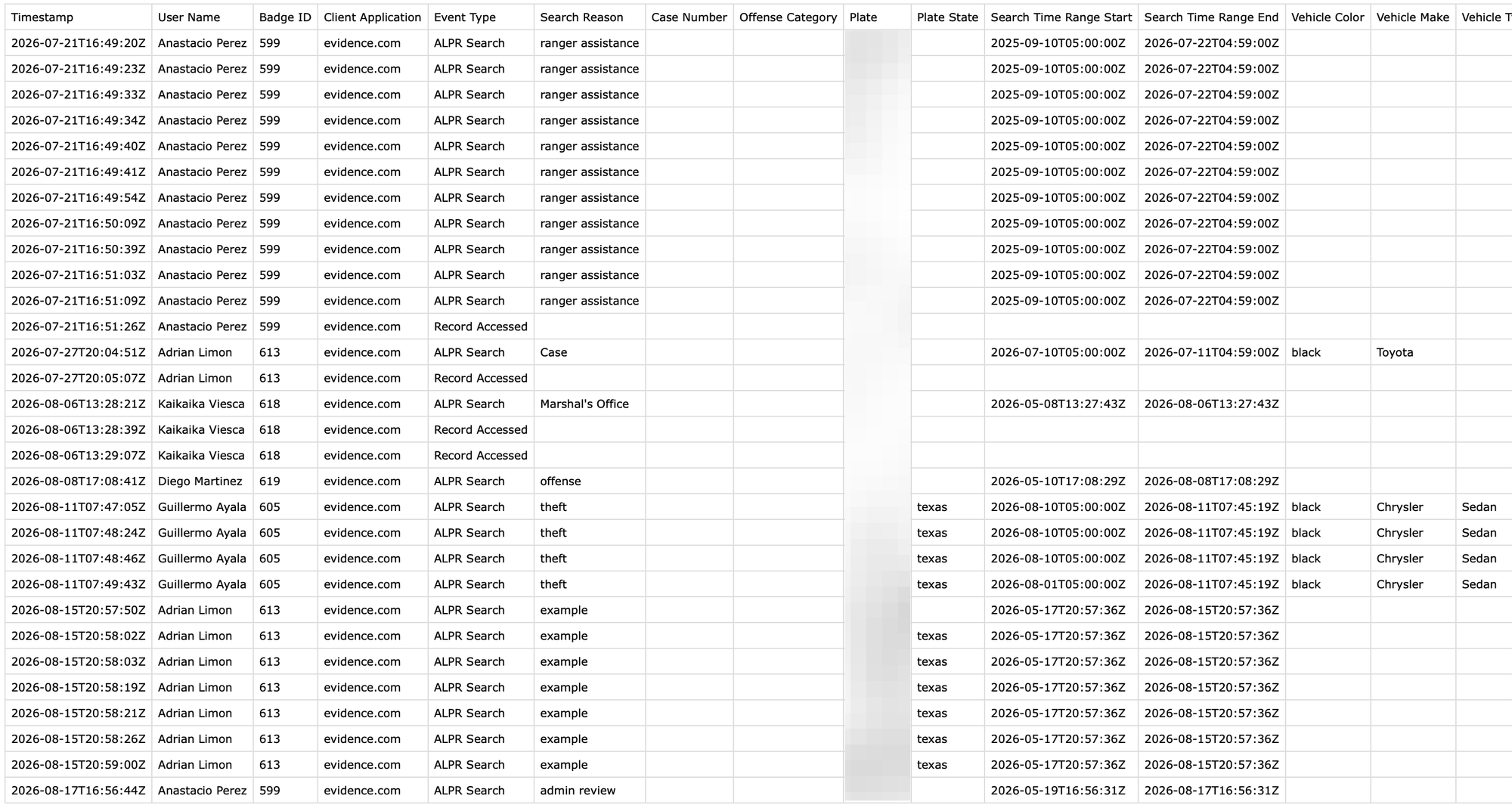
Over the last few weeks, 404 Media has filed requests with various cities and police departments for Axon “activity reports” and “sharing reports.” These show in granular detail when a police officer searched Axon’s ALPRs, the name of the officer, their badge number, the license plate they reached, and, most importantly, the stated reason why. These activity reports are essentially Axon’s version of Flock’s “network audits,” which has been the basis of much of 404 Media’s Flock reporting, and local and national media outlets’ around the country. You can see an example of one here:
404 Media redacted the plates in this screenshot.Another screenshot from an Axon activity report.
So far, 404 Media has obtained activity reports from the Benton County Sheriff's Office, WA; Falmouth Police Department, ME; Johns Creek Police Department, GA; Ocean Shores Police Department, WA; Pleasanton Police Department, TX; and Red Wing Police Department, MN.
But we need your help. Has your local police department or city switched to Axon ALPR cameras? Were they already using Axon? And do you want to know what they’re using those cameras for?
We’re asking interested readers to file the below public records request. You can simply copy this language, tweak it a little if necessary to apply to your state, then file the request with the relevant agency. You can do this by finding their relevant public records request email address, or by filing it through Muckrock. This is the platform we use for sending and organizing our records requests.
The Internal ALPR Activity report is the one shown above. The Network ALPR Activity report shows what other agencies the police department or city shares their data with. The ALPR Data Sharing report provides a history of when other agencies were invited, or removed, to receive the data. And the ALPR Hostlist Management Audit report details changes made to alerts the agency may receive.
If you file a request and get data back, please feel free to email it to us at joseph@404media.co. We’ve seen with the nationwide conversation about Flock that local residents can do a lot to reveal how surveillance technology is being used in their own communities. We hope we can find out a bit more about how agencies are using Axon’s cameras too.
To Whom It May Concern:
Pursuant to the [YOUR STATE’S PUBLIC RECORDS LAW], I hereby request the following records:
1. Internal ALPR Activity report in Axon.
The report should include data logged from the period of January 1, 2025, to the date this request is processed. Per Axon's documentation, the Internal ALPR Activity report is available within the LPR > ALPR Search > LPR Audit menu. You can find instructions to locate this here: https://www.axon.com/help/fusus/software/fusus/alpr/alpr-audit.htm
2. Network ALPR Activity report in Axon.
The report should include data logged from the period of January 1, 2025, to the date this request is processed. Per Axon's documentation, the Network ALPR Activity report is available within the LPR > ALPR Search > LPR Audit menu. You can find instructions to locate this here: https://www.axon.com/help/fusus/software/fusus/alpr/alpr-audit.htm
3. ALPR Data Sharing report in Axon.
The report should include data logged from the period of January 1, 2025, to the date this request is processed. Per Axon's documentation, the ALPR Data Sharing report is available within the LPR > ALPR Search > LPR Audit menu. You can find instructions to locate this here: https://www.axon.com/help/fusus/software/fusus/alpr/alpr-audit.htm
4. ALPR Hotlist Management Audit report in Axon.
The report should include data logged from the period of January 1, 2025, to the date this request is processed. Per Axon's documentation, the ALPR Hotlist Management Audit report is available within the LPR > ALPR Search > LPR Audit menu. You can find instructions to locate this here: https://www.axon.com/help/fusus/software/fusus/alpr/alpr-audit.htm
The requested documents will be made available to the general public, and this request is not being made for commercial purposes.
In the event that there are fees, I would be grateful if you would inform me of the total charges in advance of fulfilling my request. I would prefer the request filled electronically, by e-mail attachment if available or CD-ROM if not.
Thank you in advance for your anticipated cooperation in this matter. I look forward to receiving your response within the time period that the statute requires.

 Login
 An MRI of the woman's brain showing nodules.
Credit:
NEJM, 2026