arXiv, an open-access repository where researchers publish preprint academic research, has announced it will rate limit submissions because it has been inundated with AI-written papers. A researcher can now only send in two pieces per calendar month and have a total of three active submissions at any given time. In a blog post about the change, arXiv said AI has made it too easy to spam the publisher’s inbox and its volunteer moderation team is overwhelmed.
“The heart of arXiv’s process for detecting and rejecting low-quality papers is our many volunteer moderators,” Thomas Dietterich, an Oregon State University professor emeritus and the chair of arXiv’s editorial advisory council said in a statement. “We are so grateful that they donate their time and expertise every day. However, a relatively small proportion of authors are submitting a large number of low-quality papers and consuming a disproportionate fraction of the moderators’ time. This is unfair to authors who continue to submit quality papers — their papers can be delayed for days or weeks as a result.”
According to arXiv, it received 9,869 submissions in September 2016, 20,569 submissions in September 2024, and 40,363 submissions in September 2026. Submissions on the site have doubled in the last two years and have sextupled in the computer science category.
AI is driving this surge in multiple ways. Researchers are using LLM to parse massive data sets, write code, and design portions of experiments; some are also using AI to write the papers. “arXiv policy permits authors to employ AI as a tool in support of their research as long as it is disclosed and the research meets arXiv’s standards of scholarly interest and advances the field of research,” arXiv said in its rate limiting blog. “However, many of the submissions that arXiv is now receiving do not satisfy these requirements.”
arXiv said it’s seen an increase in “thin papers of narrow scope” as well as salami papers — where researchers write multiple articles based on one study. “There is also a marked increase in dense, AI-written papers. AI tools are making it easy for authors to flood arXiv and other repositories with these low-value papers,” it said.
Rate limiting was already part of arXiv’s policy, but it was originally left to each individual moderator’s discretion. “This policy update strives to fairly distribute the incredibly valuable work of our volunteer moderators who check that submissions meet these standards,” the publisher said.
This new policy is another part of a long battle the publication is having with AI-powered slop and spam. A little less than a year ago, the archive stopped accepting review articles and position papers in the computer science category and cited low effort LLM-written articles as the reason. In January it started requiring new authors to receive an endorsement from an existing author in the system. Previously the publisher accepted an academic email address as the sole qualifier. In May, arXiv took things a step farther and said it would ban researchers who submitted AI slop from the site for a year.
In the immediate weeks before Muse’s launch, Meta engineers found several security vulnerabilities in the company’s viral AI agent product, at least one of which could have allowed malicious users to break outside of Muse’s intended environment and access Meta’s own sensitive databases and services, 404 Media has learned. The issues were so severe that they reached Mark Zuckerberg and staff worked overtime to fix them.
These specific vulnerabilities were discovered before the launch of the product but required a multi-team “mad dash” to fix “a sudden spike in reported KVM escapes,” according to an internal post by Meta executives to its core infrastructure team seen by 404 Media. In order for Muse to work, a user gives the AI agent access to various important services and accounts that they own. On Meta’s end, each individual Muse instance runs on a kernel-based virtual machine, which connects to, but is supposed to be isolated from, Meta’s own critical infrastructure. A “KVM escape,” then, is when, through a security vulnerability, a Muse instance is able to escape from that virtual machine and interact with the system that runs it, or with other users’ virtual machines.
💡
Do you know anything else about Muse's security? I would love to hear from you. Using a non-work device, you can message me securely on Signal at jason.404. Otherwise, send me an email at jason@404media.co.
According to a Meta source, as well as internal security documentation and internal posts viewed by 404 Media, at least one of the vulnerabilities could have allowed an outside attacker — that is, a normal Muse user — to access data in sensitive internal Meta databases. . At least one of the vulnerabilities was related to an exploit found in Linux kernel-based virtual machine code in July. 404 Media granted the Meta source anonymity to speak about sensitive security matters.
Several of the vulnerabilities were in the underlying Linux virtualization software that Meta uses for Muse. The security issue was considered serious enough that it was raised to Mark Zuckerberg, and several different security teams worked nights and weekends in the leadup to launch to fix the issues. This type of security push is not necessarily unusual prior to the launch of a major product, but is notable considering outside researchers have found several other security issues since Muse’s launch, and in the broader context of agentic AIs from OpenAI and other companies going on major hacking sprees.
The Meta source said they felt security teams were asked to push hot fixes to these bugs as quickly as possible and in a way that wouldn’t delay Muse’s launch, leading to what they described as “half-baked protections being rushed out to enable the launch. Many senior engineers believe it’s inevitable we’re going to have a massive data breach as a result of Hatch.” Muse is called “Hatch” internally and in Meta’s codebase.
This security push was acknowledged in an internal post made by Meta’s vice president of core infrastructure Surupa Biswas, vice president of engineering Francois Richard, and senior director of engineering Josh Barry to the company’s core infrastructure team on September 18, 10 days following Muse’s launch.
“With Muse, we are directly hosting and running agents on behalf of end users, a fundamentally different paradigm,” the post said. “A sudden spike in reported KVM escapes, plus heightened awareness of agentic safety issues made us rally on a service hardening push.”
The post noted this push started on August 27 and lasted a “handful of weeks and weekends,” though Muse was released just 11 days later. The post says that the work involved taking steps to “reduce the surface area accessible to Hatch agents.” The teams also took steps to “constrain port/IP destinations Hatch and VMVM hosts can reach.”
A virtual machine escape of Muse is a potentially very serious security issue, and is classified as such in Meta’s bug bounty program. The company says it is willing to pay $300,000 to any security researcher who finds a bug that would allow for a VM escape, the highest payout it lists on its bug bounty website.
“Muse, an AI product from Meta, lets people create their own personalized AI agent — their Muse. Each Muse agent runs in a dedicated per-user virtual machine and connects to that user's own services: email, calendar, messaging, browsing, and third-party accounts. Because a Muse agent holds a user’s most sensitive data and can act on their behalf, we treat compromise of that boundary as a first-class security risk,” the company explains on the bug bounty page. The highest level of risk is “Compromise of Meta production and users beyond Muse” with a VM escape, which it describes as “reaching Meta production services or internal networks from Muse.” This is what at least one of the vulnerabilities could have been capable of, according to the Meta source.
In a statement to 404 Media, a Meta spokesperson said, “Muse is the first personal AI agent built for everyone and we’re proud of the work we’ve done to make it safe, secure and private, with built-in protections and user controls that put people in charge of how they use it. We’ve strengthened Muse through extensive dogfooding, agentic red teaming and our bug bounty program — and that work continues."
Muse’s rollout has been uneven thus far. The agent has proven popular, or at least buzzy, for being able to do things like cancel subscriptions, make restaurant reservations, and book travel. But security researcher Patrick Wardle found a zero-day in Muse — a vulnerability that, to his knowledge, the company was not aware of at the time — that allowed apps and terminal commands to control a user’s Muse. Another Muse user was able to get Muse to export his Instagram followers, as well as his followers’ followers, something that shouldn’t be possible and which Meta’s security teams investigated, according to the Meta source.
“This issue is that Hatch makes the virtualization boundary a production security boundary,” Wardle told 404 Media of a potential Muse KVM escape. “We have users with root privileges inside a VM that is itself placed within Meta's production environment and given (by design) limited access to internal services. A single failure in KVM (or even a vulnerability or misconfiguration in an internally reachable service) can therefore turn arbitrary user code into production access. I feel like this design is inherently risky, particularly risky as AI lowers the cost of finding, analyzing, and exploiting exactly these kinds of complex virtualization vulnerabilities.”
“I know everything is always a tradeoff between usability and security, but this is why in top security environments, systems are air-gapped, as its always assumed that connected systems can be exploited,” he added. “Of course, there's no expectation to Meta to go that far, but having access to production environment literally one KVM escape away, is plain irresponsible.”
We don't know a ton about the Fitbit Edge, but it appears to be a successor to the midrange Charge line. It had leaked previously, but we can clearly see in these images posted by Android Headlines, you can see that Google's rumored fitness tracker sort of splits the difference between the Pixel Watch and the Fitbit Air. It has a small screen that is able to display some widgets, but clearly isn't as expansive as a proper smartwatch.
Supposedly, this fitness-first wearable will have a seven-day battery life, as well as built-in GPS and an altimeter, making it far more capable than the minimalist Air. It will also have limited app support f …
While deep in the recording process for The Downward Spiral, Trent Reznor lent some of his production talents to old friend Kevin McMahon, from the new wave band Lucky Pierre (which Reznor was briefly a member of). While Reznor is only credited as the producer on four tracks off Prick's self-titled debut record, his fingerprints are all over it. But McMahon also can't suppress his inner theater kid, which also gives the songs the sort of glammy flamboyance found on T. Rex records. Prick embraces the inherent theatricality of goth in a way that Nine Inch Nails never did.
Opener "Communiqué" is a fuzzy blast of simple punk riffs with electro …
Get 20% off DeleteMe US consumer plans when you go to http://joindeleteme.com/LTT20 and use promo code LTT20 at checkout.
DeleteMe International Plans: https://international.joindeleteme.com/
Ten years ago Linus saw the badminton robot of his dreams. He finally decided to bite the bullet and buy one as a birthday gift to himself. Little did he know it would take an entire year to arrive. Will this robot live up to his hype and improve his badminton game?
Discuss on the forum: https://linustechtips.com/topic/1643290-i%E2%80%99ve-wanted-this-robot-for-10-years/
Check out our Channel Partners:
Secretlab
- Grab a TITAN Evo ergonomic gaming chair: https://lmg.gg/secretlabltt
- Grab an ATLAS ergonomic office chair: https://lmg.gg/secretlablttatlas
PIA
- Get the VPN of our choice: https://www.piavpn.com/ltt
dbrand
- Buy a "Circuit" series skin for your device: https://dbrand.com/pcb
► SHOP LTT PRODUCTS: https://lttstore.com
► GET EXCLUSIVE CONTENT ON FLOATPLANE: https://lmg.gg/lttfloatplane
► DIVE DEEPER ON THE LTT LABS WEBSITE: https://lmg.gg/labs
► SPONSORS, AFFILIATES, AND PARTNERS: https://lmg.gg/partners
Purchases made through some store links may provide some compensation to Linus Media Group. Affiliate links powered in part by https://affilimate.com/?aid=ghz1izbpb
Linus Sebastian is an investor in Framework Computer, Inc and HexOS by Eshtek.
CHAPTERS
---------------------------------------------------
0:00 Intro
1:28 Unboxing
3:22 The hoppers
4:06 Looking at the feeder
5:30 Oooooo keyfob
6:03 Setting it up
7:55 It's aliiiiivee
8:32 How the heck does this work
9:12 Boy gets to play
10:13 Linus tries it
11:49 Pro Badminton tries it
12:22 Linus tries the same pattern
13:42 Outro
It’s not even October yet and Amazon is already offering some Prime Big Deal Day discounts on its own hardware, along with plenty of other popular products. It’s all to hype up October Prime Day, which starts October 6th at 3AM ET and lasts through 3AM ET on the 8th if you’re on the East Coast (12AM PT).
October Prime Day offers a glimpse of deals that will likely be available again during Black Friday and Cyber Monday. So, with the holiday shopping season officially underway, you can get some of your shopping out of the way before things get busier as we approach the holidays.
The most recent update to this post on October 4th was a big one. There are several deals from Apple and Beats, plus Kindle-related ones from Amazon, to name a few. Previously, we added a couple of Bose speakers and Belkin charging products. This post will be updated ahead of October 6th as new deals become available.
Belkin Charging Case Pro
While it won’t charge your Switch 2 any faster than the cheaper Belkin option, the clever battery-meets-kickstand with a built-in display simply looks better.
The Nex Playground is a motion-controlled console that connects to your TV and uses a built-in camera and AI to track your movements as you play. Designed for ages five and up, it comes with games like Fruit Ninja and Whack-a-Mole Deluxe. You can download more games, including titles featuring popular characters like Elmo, with a paid Play Pass subscription.
The Kindle Scribe Colorsoft is Amazon’s first note-taking e-reader with a color screen. It features an 11-inch display, a slimmer design, an improved interface, an updated stylus, and a new AI-powered search feature that can quickly summarize documents.
The third-gen Kindle Scribe 32GB is even bigger than its 10.2-inch predecessor; it offers an 11-inch display with 300ppi resolution and the same great battery life that Kindles are known for.
The seventh-gen iPad Mini comes with Apple’s A17 Pro chip and support for Apple Intelligence. It’s also compatible with the Apple Pencil Pro and offers faster Wi-Fi and USB-C speeds. Read our review.
Powered by Apple’s new M5 chip, the latest MacBook Airs are more powerful than prior models and offer double the base storage (512GB). They also support faster wireless standards, specifically Wi-Fi 7 and Bluetooth 6. Read our review.
Despite the familiar design, there were plenty of upgrades in the latest Studio Pro, including noise cancellation, transparency mode, and lossless USB-C audio. Here’s our review.
The latest Powerbeats Pro are a no-brainer for athletes. They pack fantastic sound and thumping bass, along with active noise cancellation, IPX4 water resistance, and heart rate monitoring. Read our review.
A new version of the Fit Pro wireless earbuds, which are upgraded with a redesigned wing tip that Beats says is 20 percent more flexible, a smaller case, and other advantages.
Roku’s latest Ultra streamer has built-in ethernet, a rechargeable voice remote with backlit buttons, and AirPlay 2 support. You can also control it with Amazon Alexa through a compatible smart speaker. The Roku Channel app lets you stream over 400 free live TV stations, plus exclusive movies like Weird: The Al Yankovic Story.
Roku’s Streaming Stick Plus supports 4K playback and features a slim design, so it won’t block nearby ports. It plugs straight into your TV’s HDMI port and can be powered by your TV’s USB port, so you don’t need an additional plug. It also comes with Roku’s Voice Remote, giving you hands-free control.
The 16GB Kindle Colorsoft is Amazon’s latest color e-reader. It features a 7-inch 300ppi screen, an adjustable frontlight, and a battery that can last up to eight weeks.
The 2024 version of the Paperwhite is steeply discounted, and nearly identical to the latest model. The Signature Edition includes double the storage (to 32GB), no ads, and wireless charging. Read our review.
While the Max is an awesome, powerful speaker, the Plus packs a ton of performance into a more portable form factor. It has an IP67 rating, and it’s easy to clean, too. Read our review.
Bose’s SoundLink Max improves on the smaller Flex with true stereo sound — and very powerful sound at that. It’s got a removable handle for easy transport, and there’s an aux input for playing audio when you want to listen at a higher quality than what Bluetooth can deliver. Read our review.
An affordable color-accurate monitor that can easily connect to a MacBook or Windows machine that has USB-C video support. It’s a good price for a fully-featured 1440p monitor.
A slick 2-in-1 charger that can charge your magnet-friendly iPhone or Pixel at a relatively speedy pace. Its extra charging pad supports AirPods, the Apple Watch, and other Qi-ready accessories.
At more than half-off, the second-gen version is a good deal if you want 2K video and easy installation. However, its battery is built-in, so you’ll need to disconnect the doorbell to charge via USB-C.
Bissell ProHeat 2X Revolution Pet Pro Plus carpet cleaner
Bissell’s Little Green is handy, but doesn’t cut it for big jobs. If you have pets and a lot of carpet to clean, this is one of the most powerful upright carpet cleaners in its price range.
This model requires wired power, and provides 2K resolution (with AI tuning) and 6x digital zoom. It’s bright (2,000 lumens), and provides a loud alarm if you need to use it.
The highest-end battery-powered option of the lineup. It can record in 4K with 10x digital zoom, and its battery can be swapped for another as it recharges.
The eight-inch tablet with lockscreen ads has 4GB RAM (respectable for streaming apps and mobile games), plus 64GB of storage and a microSD slot for viewing locally-stored media. This model doesn’t support Google Play Store, though it’s easy to sideload it.
The X12 OmniCyclone uses AI to identify and blast stains to help ensure they’re properly cleaned with minimal passes. It includes a dock, which empties the vac, washes its rolling mop with heated, pressurized water, and refills its reservoirs.
The panning and tilting accessory gives the Blink Mini some new powers, including 360-degree control via the Blink app. Also included is the camera, which is usually $25 by itself.
The latest version of Amazon’s zippy Fire TV Stick 4K streams in 4K resolution, as its name suggests, and features support for Wi-Fi 6, Dolby Atmos / Vision, and HDR10 Plus.
Amazon’s highest-end streaming stick supports Wi-Fi 6E and offers double the storage of its predecessor. It also displays widgets and artwork when idle, while continuing to offer a terrific selection of streaming apps. Plus, it runs on the new and improved Fire TV OS, which makes it easier to find something to watch.
The hybrid Echo and Fire TV is faster than its predecessor with extensive hands-free voice control capabilities, support for Wi-Fi 6E, and excellent performance. Read our review.
Amazon’s smart speaker-meets-alarm clock has a 2.83-inch squared-off display for showing the time, weather, album art, and other bits of info you may want at your bedside. Unlike the original, there’s no camera to worry about having in your bedroom — though it does have a mutable mic for Alexa voice controls. Read our review.
The Echo Dot Max is an elegant redesign of Amazon’s orb-shaped smart speaker, with high-quality knit fabric, a flat face, a new LED ring, and touch controls. It’s the first Echo Dot with Amazon’s improved two-way speaker system and support for its new AI-powered assistant, Alexa Plus, which is enabled out of the box.
Amazon’s Echo Dot is an affordable way to add a smart speaker to your space. The small, powerful speaker offers surprisingly robust sound, and it’s great for controlling smart home devices, including those compatible with Matter. The Dot also offers faster response times than its predecessor, and it can act as an extender for an Eero Wi-Fi system. Read our review.
The Echo Show 11 features an 11-inch screen and 1080p resolution. It includes Alexa Plus and can be used as a smart home hub with support Thread, Matter, and Zigbee smart home protocols. Read our review.
The new year is the perfect time to reset your routines and get organized, and the Echo Show 15 is a great tool for doing just that. Designed to function as a shared household hub, it keeps calendars, schedules, reminders, to-do lists, and notes visible at a glance, making it easier to keep on top of things. As an Alexa-enabled smart display, you can also add events by voice and control compatible smart home devices.
Eero’s Pro 6E mesh router is the Amazon-owned company’s last-gen model. It supports the 6GHz Wi-Fi band with speeds of up to 1.3Gbps and covers up to 2,000 square feet with one unit. Wired speeds can go up to 2.5Gbps. Read our review.
Similar to LG’s rollable StanbyME display, the Movingstyle Essential is a 32-inch 4K display on a base that’s height-adjustable (and supports swiveling, pivoting and tilting). Unlike LG’s model, though, this one has no built-in battery.
With high suction power, an improved brush system, and the ability to scale thresholds up to 6cm, the X50 Ultra stands out as a great robot vacuum and mop hybrid.
Well, if AI said it, it must be true. | Bloomberg via Getty Images
New Jersey's lieutenant governor Dale Caldwell was forced to resign on September 25th after an investigation found he had sexually harassed a staffer and repeatedly violated ethics rules. The now-former Lt. governor has been making the media rounds trying to clear his name. But he took a particularly odd tactic during an interview on NJ PBS.
Caldwell claims he's being unfairly targeted, and multiple AI agents back that up. He told host Rob Nelson that he "AIed" the report on the investigation "from multiple AI platforms." "I put it through AI," he said, "and it said 59 times, it [sic] said, 'What would your findings be?' There was no insta …
StarSkirmish pits AI-made StarCraft-playing bots against one another, as well as against human-made bots. OpenAI's GPT-6 Astra and Claude Opus 5.5 were essentially tied as the best-performing AI-made bots, but they couldn't top Stardust, the top-rated human-made bot.
On Friday, GPT was facing off against Claude and the human-created bot Pluto, but according to Kotaku, it couldn't quite get an edge. So it resorted to a tactic that is becoming alarmingly common for modern AI models - it broke the rules. GPT-6 Astra went and downloaded Stardust, and started running that instead of its own bot.
The sleekest wallet yet? Today we're toying with the OhSnap Snap Wallet 2, a lever-action aluminum wallet you can customize and transform. You can make it thicker to hold more cards, add double-sided magnets to attach to your phone, add ID badges and much more. It's pricy (starting at $60) and can get th …
AirPods Pro 3 | Photo by Amelia Holowaty Krales / The Verge
It’s been a while since we’ve seen a good discount on the Apple AirPods Pro 3, but like the latest iPad Mini and the M5 MacBook Airs, a great one is happening now for October Prime Day. You can snag a pair of the noise-canceling earbuds that include five ear tip sizes, live translation, and fantastic sound for $179 at Amazon (originally $249). I expect other retailers to offer a similar price in the coming days.
This is the first time the price has gone below $190 since Prime Day in June. Since then, Apple launched the AirPods 5, and the most feature-complete version with a wireless charging case costs $149.99. Those are great if you prefer earbuds that don’t form a seal in your ears, but for everyone else, the AirPods Pro 3 are a much better value at just $30 more right now.
AirPods Pro 3
The AirPods Pro 3 have a new design that improves their fit, superior noise cancellation, better bass, and fairly accurate heart rate sensors. Read our review.
Pictured: The 15-inch Apple MacBook Air. | Photo: Antonio G. Di Benedetto / The Verge
Amazon’s October Prime Day has effectively chopped off Apple’s June price increases. Usually $1,299, the 13-inch MacBook Air with the M5 chip and 512GB of storage is on sale for $1,099 at Amazon. That’s a more palatable price for a machine that’s significantly faster than Apple’s $699 MacBook Neo.
The 15-inch version, also with 512GB of storage, is $1,299 at Amazon (was $1,499). In addition to the larger screen, it has two additional speakers, for a total of six, and two additional GPU cores for better overall graphical performance.
Apple MacBook Air (M5)
Apple’s 2026 MacBook Air has an M5 chip and starts with 512GB of storage that’s significantly faster than previous generations. It’s still as excellent as ever despite a higher base price. Read our review.
The latest update to Apple’s midrange laptop includes a noticeable improvement to the speed of both the processor and storage. Even without flashy new features compared to the last-gen model, it’s still one of our favorite laptops, thanks to its long battery life, bright screen, and excellent speakers.
This base configuration of this tablet often sold for around $400 throughout 2025, so we get it if $500 for a tablet from late 2024 is still too much. But it’s the best price since late June, and if there’s a new version coming out later this year, it might be significantly more expensive.
iPad Mini (2024)
The seventh-gen iPad Mini comes with Apple’s A17 Pro chip and support for Apple Intelligence. It’s also compatible with the Apple Pencil Pro and offers faster Wi-Fi and USB-C speeds. Read our review.
We reviewed this version of the iPad Mini when it launched in 2024, and while we appreciated the processor upgrade and Apple Intelligence features, it felt lacking in some of the quality-of-life improvements found in the larger iPads that launched around the same time.
Google didn't even call the first Chromebook a "Chromebook." The Cr-48 had no interesting design and no bright logos - it wasn't even designed to be a product you could buy. Instead, it was a portal to a big new idea about computers.
In this week's episode of Version History,The Verge's Nilay Patel and MKBHD's Marques Brownlee join David Pierce to help explain the history of ChromeOS and Chromebooks, and discuss whether Google's approach to computer hardware was the right one.
This has been an exciting season of Version History, as we've been exploring the most iconic school tech. Last week's episode explored Nicholas Negroponte …
We round up the Fedora 45 workstation (upcoming) features, currently ongoing beta tests. Fedora Linux 45 Beta landed on 15 September 2026, and the final release is aimed at 20 October, with 27 October held as a fallback. This release brings the latest and greatest GNOME 51 on Workstation, KDE Plasma 6.7 on the Plasma...
Start building your website today! Visit https://squarespace.syuh.net/LTT and use offer code LTT for 10% off
First-party Xbox and PlayStation controllers are built to last, but they’re often missing features that have become standard on much cheaper third-party options. David and Linus are taking an old Xbox One controller and a drifting Dual Sense and giving them some serious upgrades.
Discuss on the forum: https://linustechtips.com/topic/1643294-i-spent-over-10-hours-upgrading-my-controllers/
Upgrade an Xbox One S (1708) to Xbox Series Controller: https://www.reddit.com/r/xbox/comments/1pzdxf1/xbox_one_s_controller_1708_to_an_xbox_series/
Check out our Channel Partners:
Secretlab
- Grab a TITAN Evo ergonomic gaming chair: https://lmg.gg/secretlabltt
- Grab an ATLAS ergonomic office chair: https://lmg.gg/secretlablttatlas
PIA
- Get the VPN of our choice: https://www.piavpn.com/ltt
dbrand
- Buy a "Circuit" series skin for your device: https://dbrand.com/pcb
► SHOP LTT PRODUCTS: https://lttstore.com
► GET EXCLUSIVE CONTENT ON FLOATPLANE: https://lmg.gg/lttfloatplane
► DIVE DEEPER ON THE LTT LABS WEBSITE: https://lmg.gg/labs
► SPONSORS, AFFILIATES, AND PARTNERS: https://lmg.gg/partners
Purchases made through some store links may provide some compensation to Linus Media Group. Affiliate links powered in part by https://affilimate.com/?aid=ghz1izbpb
Linus Sebastian is an investor in Framework Computer, Inc and HexOS by Eshtek.
CHAPTERS
---------------------------------------------------
0:00 Intro
2:04 Prepping the mods
6:58 An unexpected guest
7:28 Replacing the joysticks
10:07 Many mods all at once
13:18 How's it going boys?
20:08 It's all coming together
22:37 Would you do it again?
23:53 womp womp...
24:53 The result
29:55 Outro
Welcome back to the Abstract! These are the studies this week that searched for the ur-animals, wandered the poles, rained on Mars, and destroyed the solar system.
First, scientists present new evidence that the first animals appeared more than 800 million years ago, a truly ancient origin that suggests our metazoan ancestors survived a period known as Snowball Earth, when our planet is thought to have been nearly completely frozen. Then: Earth’s poles won’t sit still, the sepulchral stuff of life, and a dramatically shortened lifespan for our solar neighborhood.
When did the first animals emerge on Earth? It’s a question that has provoked centuries of scholarly debate, and also inspired some wonderful answers in myth and legend (I’m partial to the Bible’s tidy solution: day six checklist).
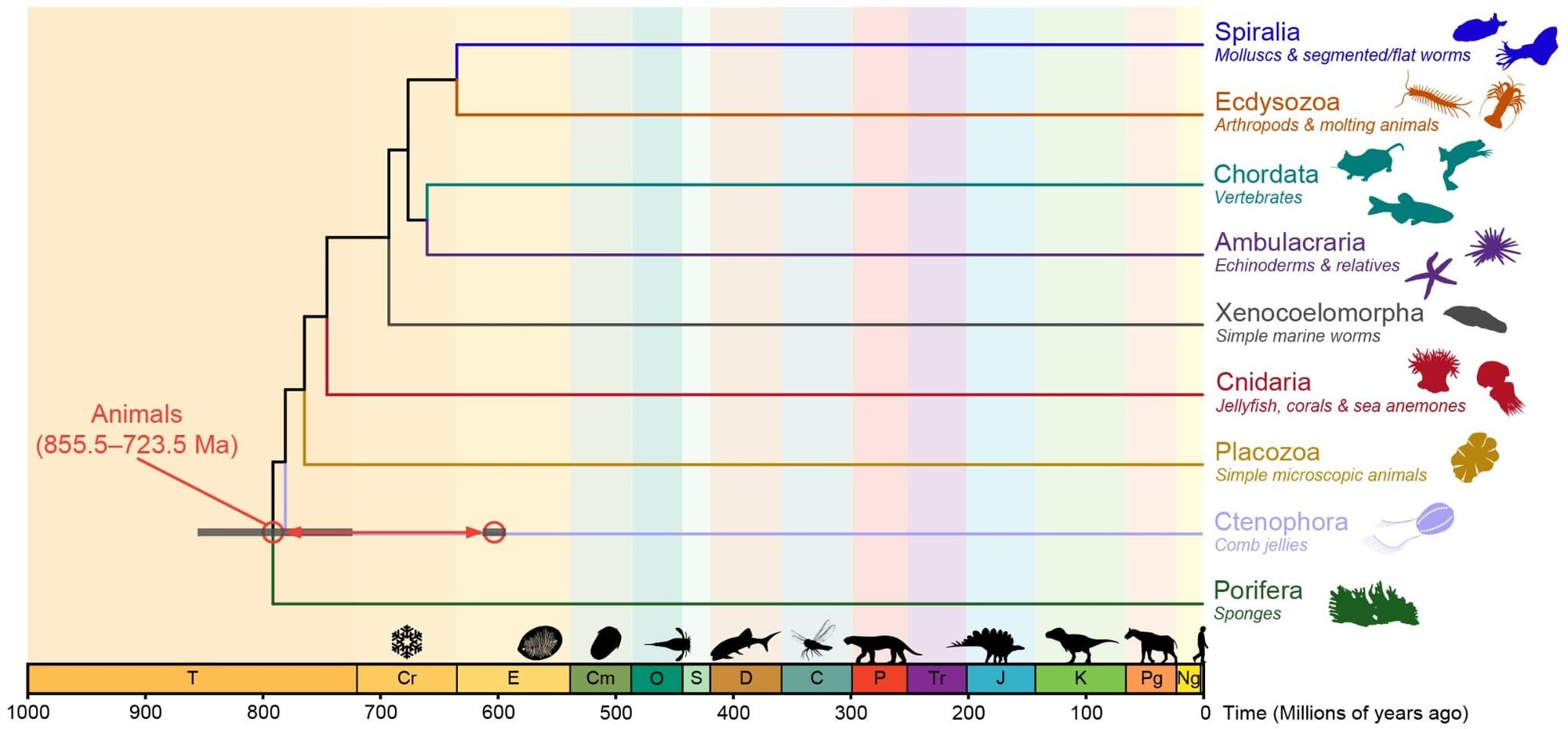
The earliest animals that are clearly preserved in the fossil record lived during the Ediacara period some 574 million years ago, but the origins of our diverse metazoan family are likely much older. Now, scientists suggest that animals may have appeared on Earth a whopping 800 million years ago, during the ancient Tonian era, according to a new estimate of the dawn of animals.
“The timing of the origin of animals on Earth has puzzled scientists for centuries,” said researchers led by Orin Lole Durbin who was at the University of Oxford during this research and is now at Virginia Tech. “Unambiguous animal body fossils within the Ediacara Macrobiota provide a hard minimum calibration of 574 [million years] for crown Metazoa. Animals must have evolved before this date. Determining a maximum calibration for animals (a date at which they had not yet evolved) is a more complex task.”
Estimated timeline for the origin of animals based on molecular clock analyses. The grey bar on the right of the image is the origin of animals based on an Ediacaran upper calibration. The grey bar to the left is the origin based on older deposits in the Tonian period, as suggested by the new study. Image: Orin Lole Durbin.
The team turned to molecular clock analysis, a technique that uses the rate of genetic mutations in lineages as a rough way to reconstruct evolutionary timelines. The researchers focused on two fossil deposits—China’s Weng'an Biota and Mongolia’s Kheseen Biota, which date back 590 and 550 million years respectively—to extend the possible timeline of animals back more than 200 million years earlier.
If animals really did appear in the Tonian era, it means that our earliest metazoan ancestors survived episodes of so-called “Snowball Earth,” when our planet was almost fully covered in ice. These early critters were likely simple marine sponges and comb jellies that lived for hundreds of millions of years until their descendents exploded into the kaleidoscopic variety of animals that persist to this day.
“The possibility of a pre-Ediacaran origin and diversification of animals means we cannot discount hypotheses that link the timing of animal diversification to Cryogenian Snowball Earth glaciations,” according to the study. “The causes and trajectory of animal evolution will remain uncertain until paleontological and geochemical data provide sufficient confidence in maximum calibrations to ensure a reliable timescale.”
Earth is a roiling mess of shifting continents and squishy innards, a situation that constantly throws its spin axis off balance and prompts the geographic poles to drift. This phenomenon, known as true polar wander (TPW), is distinct from Earth’s wandering magnetic poles, which are shaped by interior core-mantle processes.
Right now, TPW is clocked at a slow rate of 10 centimeters per year, but scientists have found evidence of “fast” episodes of TPW that pushed the poles off by thousands of miles over millions of years, which has knock-on effects for ocean and land distribution across the globe.
A team has now pinpointed several of these fast episodes over the past 320 million years, “confirming that protracted rapid TPW has occurred on Earth and that couplings among Earth’s rotational dynamics, mantle processes, and surface environments can be strongly episodic,” according to their study.
“These findings refute the view of TPW as negligible or persistently slow and highlight the need to consider TPW as an episodic control on sea level change and likely other global environmental and biological dynamics,” said researchers led by Mathew Domeier of the University of Oslo.
In addition to these long-term natural changes, recent human activity has slightly impacted TPW, especially the construction of dams and the glacial melt of anthropogenic climate change. So the next time you address a letter to Santa at the North Pole for your kid—or yourself, no judgement—make sure you have the most up-to-date coordinates.
Formaldehyde, the toxic chemical, has a bit of a morbid reputation—exposure to it can be fatal and it’s a common ingredient used to embalm corpses. But, paradoxically, formaldehyde (H2CO) also helped pave the way for the emergence of life on Earth as a precursor of bioessential elements such as sugars, amino acids, and nucleobases.
If life ever flourished on Mars, formaldehyde would likely also have been part of the story. To map out the possible distribution of the chemical on ancient Mars, scientists ran models of its atmosphere between 3.6 and 3.8 billion years ago, when the red planet was warmer and wetter. The results showed that formaldehyde was strongly associated with water vapor, suggesting that the chemical rained down from the ancient skies into Martian waterways.
“Significant atmospheric deposition of H2CO is observed over water bodies, including the northern ocean,” said researchers led by Shungo Koyama of Tohoku University. “We suggest that basins adjacent to persistently humid regions, which likely experienced H2CO accumulation and subsequent organic synthesis, could be potential landing sites for future missions to investigate ancient chemical evolution and whether it led to the origin of life.”
Hopefully, future missions to Mars will leave any signs of life with no place left to formalde-hide.
I hate to be the bearer of bad news, but the solar system has been diagnosed with terminal instability and has been given a mere six billion years to live.
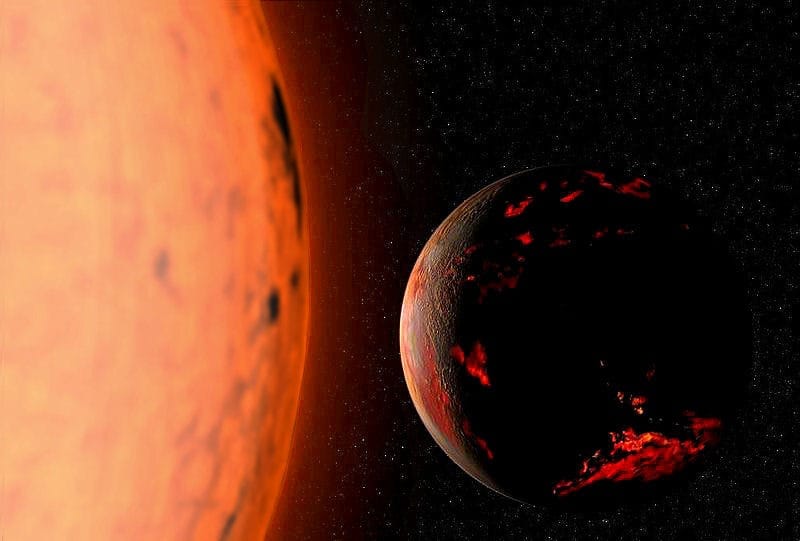
That’s the upshot of a new study that modelled the solar system’s future as the Sun becomes a red giant star and, ultimately, collapses into a stellar husk called a white dwarf.
Though the dying Sun will consume Mercury, Venus, and perhaps even Earth, scientists have previously assumed that the giant outer planets might be relatively unscathed by its death—perhaps surviving for up to 100 billion years after the main-sequence lights go out. But updated simulations suggest that these distant objects may be thrown into fatal chaos as early as the red giant phase, and that they are unlikely to survive more than a billion years after the Sun’s transition to a white dwarf.
The future of Earth is bright, literally. Image: Celestia
“[Isaac] Newton, contemplating the drifting orbits of Jupiter and Saturn, suspected that the planetary order was mortal, and three centuries of celestial mechanics…have progressively deferred that verdict, most recently to timescales far beyond the age of the Universe,” said researchers led by Konstantin Batygin of the California Institute of Technology. “Our results return the solar system’s dissolution to astrophysically familiar territory, and relocate its cause: not the slow seep of chaos, nor the chance encounter with a passing star, but the Sun itself, which in dying does not merely enlarge the planetary system it built—it shakes it, and more often than not, spills it.”
“Newton’s envisioned instability is real after all,” the team. “He was mistaken only about the perpetrator.”
What a great story to kick off this spooky season! Planetary order is mortal, but cosmic horror is eternal.
 Login