With a tactile dongle for on-the-fly customization and a metal chassis, the Wallhack M-001 is the most fun I've had reviewing a gaming mouse in a long time.
These elusive and reactive particles have been challenging to hold on to and even more challenging to study, but a new method paves the way for tests on the differences between matter and antimatter.
While oil is known to float, new research finds that over time it can permeate even extremely deep marine habitats, with animal populations declining by as much as 80 percent.
Paris Marx, author of Hyperscale, has been tracking global data center development for years. The US has a lot to learn from what’s happened everywhere from Ireland to New Zealand.
WIRED attempts what even the Swedish brand hasn’t: making a sonic monolith using scores of the cheapest Bluetooth speakers on the market. Can you have too much of a small thing?
Get your overpriced cases, screen protectors, and stickers at https://shortlinus.com
Initially we weren't going to review the Apple iPhone 18 Pro & Pro Max. But then dbrand came in with some "words of encouragement" so we had no choice. It also helps that LTT LABS tested this phone and found some VERY interesting discoveries. These new phones show great improvement thanks to the new Apple A20 Pro, and many more things that we'll tell you all about.
Discuss on the forum: https://linustechtips.com/topic/1643904-dbrand-forced-me-to-do-this-review/
Check out the LABS article: https://www.lttlabs.com/articles/2026/09/24/iphone-18-pro-series-test-results
Check out the sample photos: https://drive.google.com/drive/folders/1UkaqWIyF8sv81GsEOz-LMon0XlKxMMJO?usp=sharing
Apple iPhone 18 Pro (256GB): https://geni.us/tZz9S
Apple iPhone 18 Pro Max (256GB): https://geni.us/W5OW9
Check out our Channel Partners:
Secretlab
- Grab a TITAN Evo ergonomic gaming chair: https://lmg.gg/secretlabltt
- Grab an ATLAS ergonomic office chair: https://lmg.gg/secretlablttatlas
PIA
- Get the VPN of our choice: https://www.piavpn.com/ltt
dbrand
- Buy a "Circuit" series skin for your device: https://dbrand.com/pcb
► SHOP LTT PRODUCTS: https://lttstore.com
► GET EXCLUSIVE CONTENT ON FLOATPLANE: https://lmg.gg/lttfloatplane
► DIVE DEEPER ON THE LTT LABS WEBSITE: https://lmg.gg/labs
► SPONSORS, AFFILIATES, AND PARTNERS: https://lmg.gg/partners
Purchases made through some store links may provide some compensation to Linus Media Group. Affiliate links powered in part by https://affilimate.com/?aid=ghz1izbpb
Linus Sebastian is an investor in Framework Computer, Inc and HexOS by Eshtek.
CHAPTERS
---------------------------------------------------
0:00 Intro
1:58 Initial Impressions
2:50 New CPU Cores
3:49 Storage weirdness
4:40 Gaming
5:56 iOS27
6:30 Battery life
7:30 Screen
7:59 Camera
12:30 Siri AI & Shortcuts
15:44 Outro
Welcome back to the Abstract! Here are the studies this week that invaded our brains, thought fast, swapped coffins, and hit the art gallery.
First, an ancient viral pandemic that afflicted many of our primate relatives—but somehow missed humans—may help explain how we got so smart (relatively speaking). Then: mammal brains eat crow, an upcycled sarcophagus, and a trip to the starry Provençal summer of 1889.
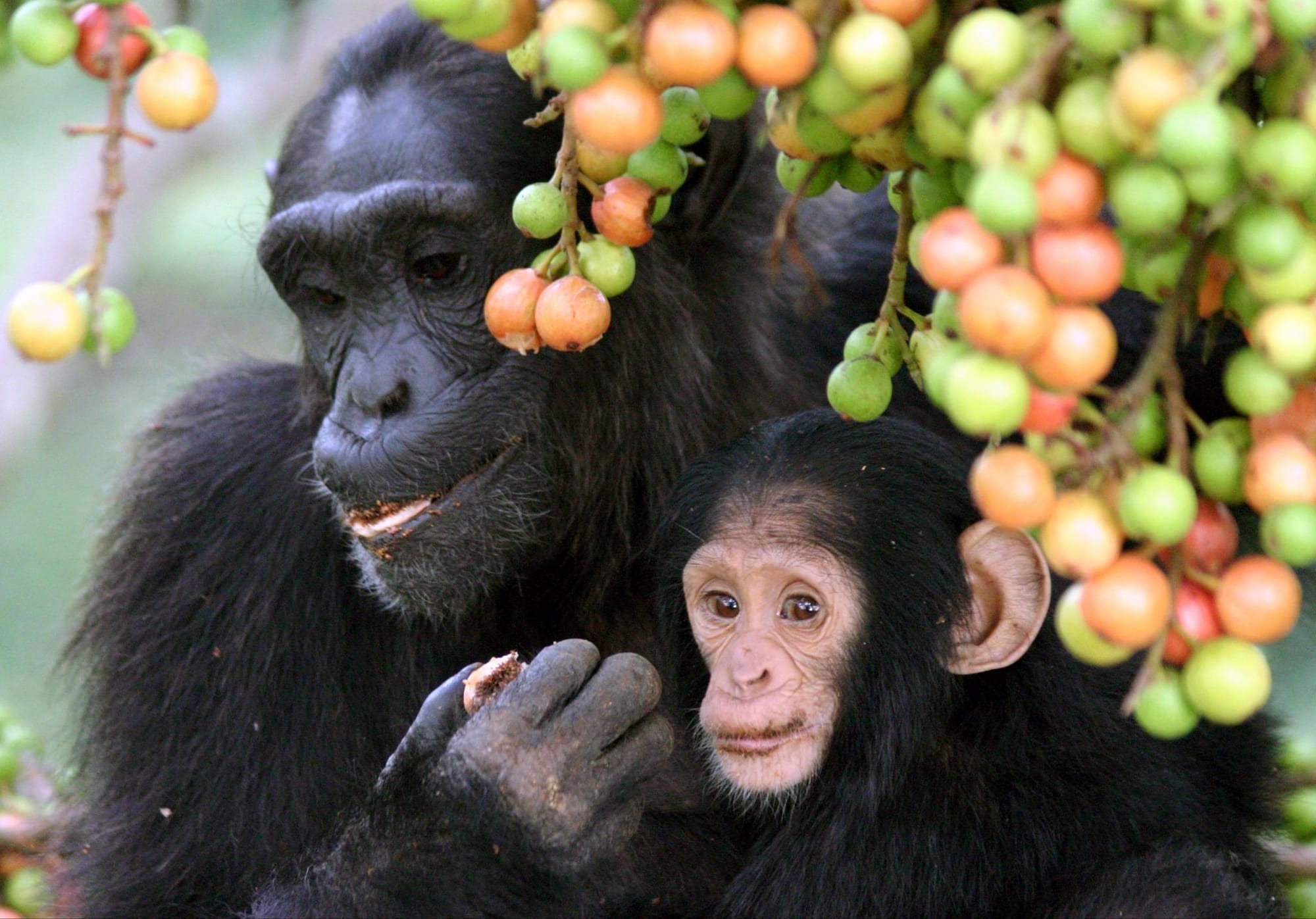
A virus that infected chimpanzees millions of years ago shaped the divergence of human and chimp brain development, shedding light on how our own species came to be more cognitively complex than our closest living relatives, according to a new study.
Retroviruses are infectious agents that can invade the genomes of their hosts and insert copies of their own genetic material, producing long-term evolutionary effects. Researchers have now discovered a family of these endogenous retroviruses called PTERV1—which are abundant in chimpanzees, but absent in humans—that influence brain development.
“Among primates, the human brain stands out as the largest and most complex due in part to an increase in cortical neurons and increase in synaptic connectivity,” said a team led by researchers from Lund University. “With a size roughly three times that of our closest living evolutionary relative, the chimpanzee, it has unique cognitive capabilities.”
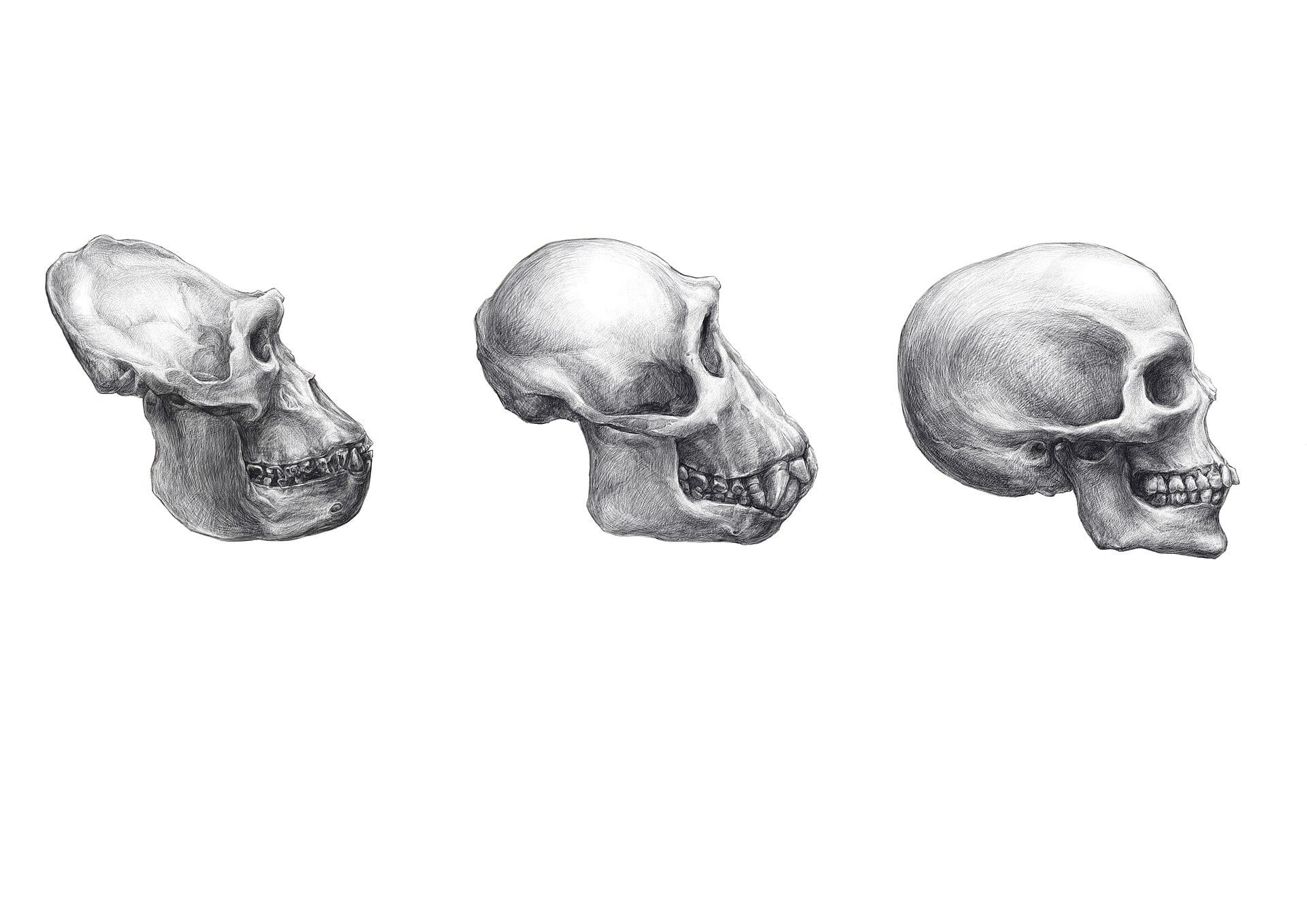
Sketches of gorilla, chimp, and human skulls. Image: kaiwei zhang
“The underlying genetic divergences responsible for these differences are still poorly understood,” the researchers continued, noting that their new findings “reveal a mechanism by which endogenous retroviral insertions contributed to human-chimpanzee brain divergence.”
The team discovered the mechanism using human and chimpanzee brain organoids, which are miniature clusters of neurons grown from stem cells that can model some aspects of brain development. The results revealed chimpanzee-specific PTERV1 insertions on chromosome 19 that silences a gene called LINC00662. In contrast, this gene is active during human brain development, and affects neuronal maturation, development, and outgrowth.
“These PTERV1 insertions are thought to have originated from infections that occurred in the ancestors of African apes about 5 to 7 million years ago,” said the team. “PTERV1 elements are found in chimpanzees, bonobos, and gorillas…Notably, the absence of PTERV1 insertions from the human genome suggests that either the human and chimpanzee lineages did not occupy the same habitat at the time or that germline-competent cells of the human ancestor were resistant to this infection.”
“In summary, this study describes how retroviral insertions contributed to the functional divergence of the human and chimpanzee brain, providing a mechanism by which retroviral infections influenced primate brain speciation,” they added.
In other words, early humans appear to have dodged consequential pandemics that widely infected our primate brethren simply because they had a random immunity to it, or roamed different ranges. While retroviruses are far from the only factor in our cognitive development, it’s still eerie to think that our human brain—that brilliant lump you are using to read these words—is shaped by dumb luck.
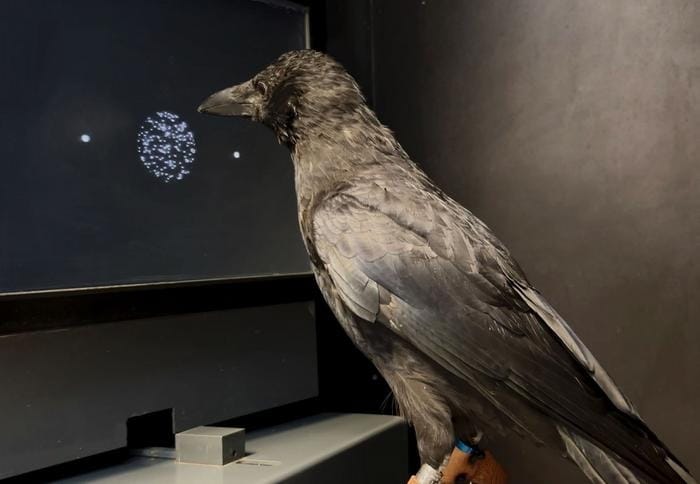
Speaking of interspecies brain-offs, it seems the birds have got us beat—at least when it comes to snap decisions. Scientists have discovered that carrion crows (Corvus corone) can make ultrafast choices in “approximately 235 milliseconds on average, which is roughly twice as fast as has been observed in monkeys or humans and without sacrificing accuracy,” according to a new study.
Crow acing the test. Image: Andreas Nieder
A pair of researchers observed two crows performing a common discrimination task in which dots on a screen move left, right, up, or down. The crows selected the predominant direction by pecking a target circle on a touchscreen, after which they were rewarded with promptly dispensed treats. The crows performed the task dozens of times at extremely high speeds, achieving an overall choice accuracy of 75 percent (crow 1) and 73 percent (crow 2).
“Having diverged from mammals more than 360 million years ago, birds evolved a distinct nuclear pallium”—a part of the vertebrate forebrain—”that lacks the layered neocortex yet retains key organizational and computational principles characteristic of mammalian brains,” said study authors Philipp Schmidbauer and Andreas Nieder of the University of Tübingen.
“These findings highlight the extraordinary efficiency of avian decisionmaking circuitry, possibly shaped by evolutionary pressures for rapid visuomotor control,” the team added.
So if anyone ever calls you a birdbrain, the correct response is “thanks.”
🌘
Subscribe to 404 Media to get The Abstract, our newsletter about the most exciting and mind-boggling science news and studies of the week.
Archaeologists may have finally discovered the mysterious identity of an ancient skeleton buried in a Roman-era sarcophagus that was first unearthed on the grounds of Westminster Abbey more than 200 years ago.
Despite an inscription on the sarcophagus identifying the occupant as Valerius Amandinus—a wealthy Londoner who lived between 300 to 400 AD—the bones likely belong to a medieval monk named Ælfwig, born centuries later in the year 993.
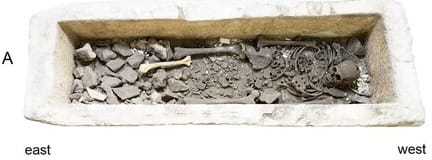
Interior of the sarcophagus, as found upon opening in 2016. Image: Rodwell, Warwick, 2026.
“The burial was of a male, probably in his late forties, and was radiocarbon dated to around the turn of the 11th century,” said study author Rodwell Warwick of Westminster Abbey. “The corpse had been laid in a timber coffin and covered with lime; it was then placed inside the sarcophagus. It is argued that this was the prestigious burial of Abbot Ælfwig.”
The sarcophagus was exhumed and moved to a northern courtyard during King Henry III’s reconstruction of the abbey in the mid-1200s, where it laid for about six centuries. On Easter Monday 1820, the coffin was “wantonly broke by workmen” according to a note from an unknown contemporary archivist. Any grave goods were likely plundered by this crew and the sarcophagus was hastily put back together and reburied with the bones all jumbled up inside. It was then re-discovered in 1869 with a note that the burial “‘had been subjected to violence by a previous examination.”
It turns out anything is recyclable—even sarcophagi. The discovery that this Roman coffin at some point took on another tenant now raises the new question of how the earthly remains of Valerius Amandinus got evicted and where they ultimately wound up.
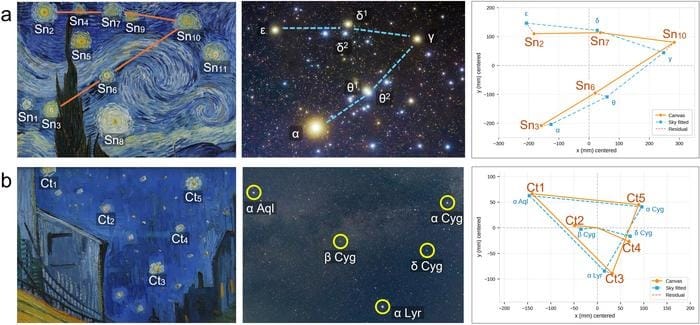
With its vibrant colors and psychedelic swirls, Vincent Van Gogh’s “The Starry Night” is one of the most beloved and recognizable paintings in art history. For years, experts and admirers have debated whether the mesmerizing skyscape, which van Gogh painted during an asylum stay in Provence, was a fantastical portrayal or if the artist included realistic renderings of astronomical phenomena.
Now, a team has proposed that the celestial elements of the painting match with a specific night—July 22, 1889—when “the waning-crescent Moon, Venus, and the Hyades cluster gather within that narrow frame,” according to a new study. This date conflicts with the conventional timeline of van Gogh painting “The Starry Night” weeks earlier in June.
“The question dividing fantasy from observation remained a matter of qualitative interpretation and was never treated in a physically decidable form,” said researchers led by Elijah Jeong-hyun Kim of Kyung Hee University. “The approach of this study shifts the burden of proof: if the celestial arrangement on the canvas matches a specific dawn sky, that match itself becomes what the imaginative reading must explain.”
The Pepe Silvia meme meets “The Starry Night.” Image: Kim et al., Scientific Reports (2026)
The team’s findings “suggest that the night sky in ‘The Starry Night’ originated from observation of a specific celestial arrangement, and call for reconsidering the June dating,” they continued. “This framework can extend to historical night paintings as a reproducible scientific art history.”
I love a hyper-niche new subfield—let’s call this one “forensic astroartistry.” Regardless of the painting’s exact date of origin, it has inspired wonder and fascination for more than a century—including these new stellaria of long-lost summer nights.
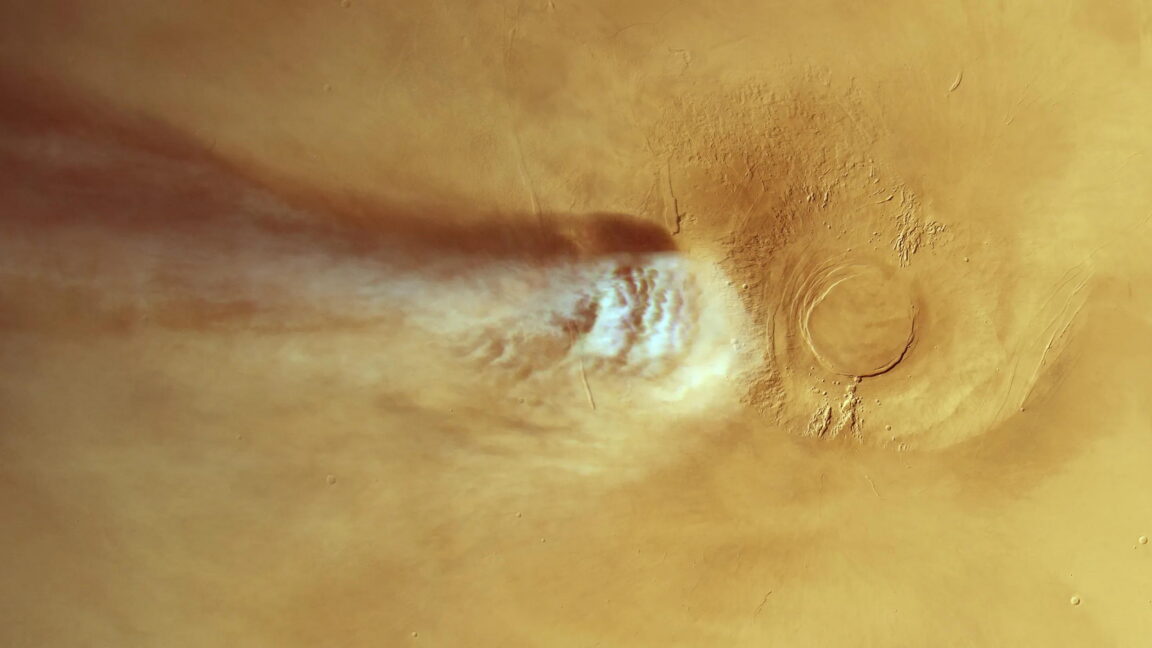
Every morning during the Martian spring and summer, a thin and extremely long cloud emerges, only to disappear again. The wispy formation appears near the volcano Arsia Mons and gradually elongates until it reaches over 1,000 miles—about the distance from New York to Kansas City as the crow flies—before dissipating. This cycle then repeats for several months.
Since it was first recorded by a probe in 2018, scientists have been unable to find a plausible explanation for the existence of this cloud, often referred to as the Arsia Mons Elongated Cloud (AMEC). Until now. Recently, researchers successfully modeled the cloud’s formation for the first time, their results suggesting that it may be driven by a physical process that has never been directly observed in any planet's atmosphere.
"We found that we needed to include some exotic physics… physics that, while included in textbooks, is treated as theoretical and usually thought not to happen in nature. It certainly hasn’t been seen in action before," Jorge Hernández-Bernal, a planetary scientist at Paris’ Sorbonne Université and lead author of the study, said in a press release. "Once we included this physics in our simulations, the AMEC emerged just as we hoped.”
The vaccine is personalized to a patient’s tumor, and results from the Phase 3 trial are yet another example of the promise of mRNA vaccines in treating cancer.
Barnes Ice Cap sits on the central plateau of Baffin Island, in the Canadian Arctic. It is the last surviving fragment of the Laurentide Ice Sheet, the largest of the Pleistocene ice sheets, which at its peak buried most of Canada under two miles of ice and locked away around 80 meters of sea level. That remnant has now yielded direct physical evidence that ice sheets might have reversed their retreat and started to grow again thousands of years ago.
In a recent Science study, researchers show that the Laurentide reached its smallest size about 3,600 years ago, then started re-expanding roughly 2,000 years ago, which the team interprets as the opening move of the next glaciation. Apparently, this brand-new ice age was on its way until about 1960, when human-caused climate warming reversed it.
Frozen to the bed
“Barnes is the last remaining piece of one of the domes of the Laurentide Ice Sheet,” says Nicolás Young, a geologist at Columbia University's Lamont-Doherty Earth Observatory and lead author of the study. As that enormous dome thinned through the Holocene, its margin withdrew up onto Baffin Island, and what's left today is the deflated core of something that was once two miles thick. The reason Barnes can testify about its own history, Young explains, comes down to the temperature at its base.
Apple’s first folding phone is inspiring indie developers to create fun, quirky apps that take advantage of the screen and the hinge. Here are a few to try as you explore the Duo.

 Login