This is Behind the Blog, where we share our behind-the-scenes thoughts about how a few of our top stories of the week came together. This week, we discuss election outcomes and code as a human endeavor.
JOSEPH: This week I got a real wave of ‘oh man this fucking sucks’ regarding AI. I won’t link to it because it’s just a rando person, but scrolling Reddit I saw someone who said they used Claude to build stuff with Max. Max, or Max/MSP, is a visual programming language that is heavily used in the world of music and visual art. It is the foundation of a lot of electronic music. You can build essentially anything in it, if you put in the work to understand how to put it together. And that can be a lot of work.
I’ve built various little things in Max. I made a tool that takes a drum break and generates new, random drum and bass style breaks from it. I am a big, big fan of generative music (both listening and making) where you create rules and parameters, press play, and let the rules decide what comes out. I made another that has various synthesizers, and from scratch manipulates the audio so they sound like Tibetan singing bowls, with their harmonies and individual melodies morphing over time. I also started working on the visual part of Max, called Jitter, to take audio output from Max and generate visuals.
Immediately after the UK banned a wide range of porn fantasies involving choking, breath-restriction, and relative roleplay, adult creators watched platforms remove hundreds of their videos — even when the creators thought they were in compliance with the law. These creators say they were blindsided by the removals, since the content didn’t seem to violate the law at all.
Creators are reporting one platform in particular, Clips4Sale, is purging content with little notice, “a precautionary measure.”
Some creators who’ve contacted Clips4Sale to appeal these removals have shared screenshots online of the reply the platform sends: “At this time, we have implemented a general restriction on content availability in the UK to ensure compliance with applicable regulatory requirements,” Clips4Sale support replies, according to these screenshots, viewed by 404 Media. “This is a precautionary measure and does not necessarily indicate that your clips contain prohibited content or violate our policies. We are continuing to review affected content, and additional clips will be made available to UK buyers as they are reviewed and cleared.”
Updates to the UK’s Crime and Policing Act went into force on Friday. The law criminalizes a list of sexual acts, including downloading or publishing choking and incest roleplay content. The law is vague and overbroad, criminalizing “strangulation or suffocation” and “certain types” of incest roleplay. There's a lot of confusion among sex workers and fans about what this encompasses, and seemingly could include various kinds of gagging, face sitting, and roleplay. Violating this law, either as someone in possession of noncompliant content or publishing it, carries a risk of up to five years in prison.
UK-based creator Sophia Truee told me that Clips4Sale removed more than 75 percent of her content — 392 out of 506 videos — with the platform flagging it as requiring edits without noting what needed to change. Truee makes POV content where she’s alone talking to the camera. Many more creators have shared on social media that content that shouldn’t be in violation of the law has been caught in the crossfire on Clips4Sale specifically.
Following widespread backlash, Meta announced earlier this week it’s putting a planned update of its commercial terms of use on pause. The terms would have required business accounts to allow Meta to “use any content from such domains, web pages, or URLs to provide, develop, improve, research, train, and maintain the integrity of” Meta’s products.
The new terms were initially set to go into effect on October 30, but after outcry from journalists and users who didn’t want Meta reaching far beyond Instagram and Facebook and into their websites to suck up their work as training data for its generative AI products, Meta announced it was pushing the change to November 20. Now, it’s on hold entirely.
“We recently shared that we were updating the Meta Commercial Terms, Product Catalog Terms, Self-Serve Ad Terms, and Ad Creative Generative AI Terms,” Meta says on the page where the commercial terms announcement used to be. “These updates are now paused and will not take effect on November 20, 2026. We are continuing to consult with stakeholders and will provide a further update when we have more to share. In the meantime, our existing terms remain in effect.”
The Los Angeles Times, which first reported the change, notes that following a case supported by the Norwegian Media Businesses’ Association and 180 Norwegian media companies, a court in Norway granted a temporary injunction suspending Meta’s new terms, and the UK Competition and Markets Authority said it would do its own investigation into the terms.
After pushing the update to November, Meta removed the word “train” from a list of allowed use cases, Nieman Lab reported, and limited those uses to “advertising and business products,” where previously it said that data would be used for all Meta products.
Archaeologists have discovered the oldest direct evidence of psychoactive cannabis use in a Siberian tomb that dates back 2,800 years and was the site of human and horse sacrifices, according to a study published on Thursday in Science.
During excavations of the tomb, a team found more than 1,400 cannabis seeds scattered around the remains of several Iron Age individuals, and even identified cannabinoids—including the active compound tetrahydrocannabinol (THC)—in a person’s preserved hair.
Though humans cultivated cannabis for many millennia before the Iron Age, this is by far the earliest clear-cut proof that the plant was consumed for its psychoactive effects, which have made it one of the most widely used drugs in the world today.
The discovery is “absolutely crazy,” said Gino Caspari, an archaeologist at the Max Planck Institute of Geoanthropology and the University of Bern who led the study, in a call with 404 Media. “People have been speculating a lot about psychoactive use of cannabis in the past, but to actually pin it down and prove it with soft tissue evidence of the humans involved—that is something very special.
“That is an absolutely unique and extremely rare combination of evidence,” he added.
A preserved human hair braid. Image: Frozen Corpses Golden Treasures, T.Wallace & G. Caspari
Cannabis has a multifaceted history as a recreational drug and a pop cultural touchstone, as well as a traditional medicine that has been used for millennia by many cultures, including in China, Russia, and around the Mediterranean Basin. Humans began cultivating the plant as early as 10,000 years ago for its oil and fiber, but the origins of its specific consumption as a psychoactive substance is unclear.
Cannabis was important to the Scythian culture, a horse-riding people that emerged on the Eurasian steppes in the 9th century BCE and became a major force in the subsequent centuries. The historian Herodotus described Scythian rituals that involved ceremonial burning of cannabis in enclosed spaces, and their cannabis residues and products have been found at Scythian archaeological sites.
🌘
Subscribe to 404 Media to get The Abstract, our newsletter about the most exciting and mind-boggling science news and studies of the week.
“Herodotus speaks about the Scythians being quite fond of cannabis in the first place, so this has always been in the back of our minds,” Caspari said. “But it is so incredibly rare to find well-preserved plant remains that this is not really something you can hope for or look for. This is ultimately complete luck and chance.”
Now, Caspari and his colleagues have hit an archaeological jackpot at a tomb known as Tunnug 1, located in Siberia’s Uyuk River Valley. Six elite individuals are interred in the interior of the royal mound inside several tree-trunk coffins and wooden structures. They are mostly men, though one woman is also present. The mound is lined with remains of sacrificed humans, as well as dozens of sacrificed horses, close to the surface.
As the team carefully worked through the layers of the burial, they found hundreds of cannabis seeds distributed around the bodies that were dated to the 8th century BCE. However, the real smoking blunt was the detection of cannabinols in preserved hair samples, including traces of THC, the most important mind-altering compound in cannabis.
Cannabis seeds from the excavation. Image. T. Wallace
The results confirm contemporaneous accounts of Scythians as cannabis consumers who used the plant for purification and mortuary rituals. It’s possible that the people selected as human sacrifice consumed the drug to prepare them for their unenviable fate.
“It being in a burial context, of course, there's a ritual aspect to it,” Caspari explained. “It might be a little bit more sinister, but this is speculation. We do have a lot of horse sacrifices and also some human sacrifices on the surface of the mound. And if you imagine humans being sacrificed, they usually don't like that very much. It might be advantageous to have them dosed a little bit, at least, to make the procedure a bit more humane, if you will.”
“Of course, that is speculation,” he cautioned. “We don't have any written sources about that particular area, but that's at least one way we could go with our interpretation.”
The researchers hope to learn more about the context and meaning of the cannabis use at Tunnug 1 through continued excavations and an analysis of more hair samples. What’s more, the team plans to conduct DNA analysis on the seeds, an approach that could yield new insights about the murky history of cannabis domestication and its early use as a psychoactive substance. This line of research could also shed light on modern cannabis strains, and may even be revived for new medicinal or recreational purposes.
“We've already sequenced part of the seeds to unravel and disentangle the domestication history,” Caspari said. “Funnily enough, we don't even know what wild cannabis actually looks like because there has been so much intermixing and interbreeding since the 70s, when people started experimenting and trying to get more potent drug variants. Some of the initial landraces and the actual wild cannabis has been lost.”
“Now, having DNA that's almost 3,000 years old, we will be able to take that step back into the past and see what an unaltered cannabis would have looked like,” he said. “In the ideal case, we might even be able to work together with the medical industry and bring some of these very ancient genetics back into cannabis production to potentially help people with very interesting and distinctive cannabinoid combinations.”
Put that in your pipe and smoke it. Regardless of where future research into this ancient plant leads, this long-sought evidence of cannabis use thousands of years ago confirms the rich cultural legacy of the plant across time and space.
“As an archeologist, I might be a bit biased here, but I think the history and cultural practices really do matter,” Caspari concluded. “I think our findings do indeed inform current discussions on legalization, on usage of medical cannabis—which is very much an ongoing discourse—and I think what we've been able to do with this study is provide an anchor, and show that there is this deep cultural history to the use of cannabis as a psychoactive drug.”
“I adore breath play. I love being strangled, suffocated and drowned, and I love strangling and suffocating others. Waterboarding: that’s my favourite,” Melissa Todd, a UK-based writer and sex worker, told me. “Many women do: it really isn’t only horrid men forcing us to do these dreadful depraved acts. Interrupting oxygen supply produces the most intense sensation of euphoria. I enjoy it in my private life, and I offer it in sessions too.”
Starting tomorrow, she and anyone else in the UK distributing or possessing this type of content, even if it’s just recorded in the privacy of their homes and not for sale on a porn site, could face up to five years in prison. The maximum penalty for possession is “two years’ imprisonment for pornography that depicts strangulation or suffocation, or penetrative sexual activity between certain relatives,” according to the law, and “three years’ imprisonment for pornography depicting sexual activity involving a person who is, or is pretending to be, under 16,” with five years as the maximum penalty for publication of all of the above.
Updates to the Crime and Policing Act go into force on November 6. The law criminalizes a list of sexual acts, including downloading or making choking and incest roleplay porn. According to the law, it will be a criminal offense in England and Wales to possess or publish porn that “explicitly and realistically” depicts strangulation or suffocation, penetrative sexual activity between people who “a reasonable person would think are related, or pretending to be related, in a certain way” and sexual activity between people where “a reasonable person would think at least one person is, or is pretending to be, under 16.” Sixteen is the age of consent in the UK.
“You have to speak up for porn you don’t like, as well as the porn you do, because otherwise the government will keep censoring more and more depictions of acts they don’t fancy."
“The offences only capture pornography that shows people which appear, to a reasonable person, to be real,” the law states — whatever that means.
The rest of the law is similarly vague in defining what’s criminalized. The “guidance” on the law says: “We consider that strangulation generally means one person applying pressure to another person’s neck,” and “We consider that suffocation will generally mean depriving a person of air in a way that affects their ability to breathe. Unlike strangulation, this does not require pressure to the neck. It could, for example, involve covering someone’s mouth and nose or compressing their chest.” This could mean anything from relatively common acts like face sitting or pushing someone’s face into a mattress, to gagging and more extreme breathplay generally left to professionals. The law says it’ll be left to the courts to decide.
We start this week with Joseph’s investigation into Proton’s culture of fear and the company’s massive push towards AI. A lot to unpack there. After the break, Sam tells us about the AO3 outage and its fallout. In the subscribers-only section, Jason explains: we’re not tech support.
Listen to the weekly podcast on Apple Podcasts,Spotify, or YouTube. Become a paid subscriber for access to this episode's bonus content and to power our journalism. If you become a paid subscriber, check your inbox for an email from our podcast host Transistor for a link to the subscribers-only version! You can also add that subscribers feed to your podcast app of choice and never miss an episode that way. The email should also contain the subscribers-only link for the extended video version too. It will also be in the show notes in your podcast player.
There's a BlazeTV YouTube video whose thumbnail shows the presenter with his arms around Anakin Skywalker and a gender-flipped Draco Malfoy called Malfoid. “Total Chud Victory?” It says. The video's title: “Young Right is Reclaiming Culture and Liberals Are Mad About it.”
BlazeTV posted the video on November 2, the day before Democrats swept the midterms and started a political realignment in America so overwhelming that Republicans lost control of all the most powerful state positions in Texas.
The video is a profound misreading of the political and cultural moment. It reminded me of stories of the Bolsheviks seizing the Winter Palace to discover tarot card playing courtiers who had no idea a revolution was happening in the streets.
The American version was watching defense contractor Palmer Lucky dress up like Harry Potter on Halloween while standing next to his Malfoid wife. And it was Elon Musk — who spent roughly half a billion on the election only to see his chosen candidates fail — posting an AI generated picture of Anakin Skywalker sitting at the head of a happy fascist Star Wars family two days before the midterms.
The online right has dominated American culture for a decade, or at least has dominated political narratives picked up by the mainstream media. Its memes and conspiracies drove news cycles. At first, the right’s memes filtered from random people on obscure Discord channels to Reddit’s r/the_donald or 4chan to Trump’s Twitter feed. More recently they’ve come from AI slop farms, from Musk, or from the administration itself. Powered by a well-funded media and podcast ecosystem, Fox News (and a propensity for shamelessness) its comedians, podcasters, and pundits became powerful celebrities and influencers, at least within Elon Musk’s X.
This insular, often inscrutable world has given us Ben Shapiro, Nick Fuentes, Gamergate influencers, the streamer Asmongold, and a revolving door of characters who have shuffled interchangeably between Twitterverse celebritydom and actual government; Kash Patel, DataRepublican, Laura Loomer, Pete Hegseth, RFK Jr., Dan Bongino, the list goes on.
It has been said many times that “Twitter is not real life,” and that posting too much anywhere will rot your brain. Never has that been more apparent than now: Much of Trumpworld spent the week before an election in which they would get utterly trounced using AI to generate barely legible Anakin and Malfoid memes for an inconsequential ingroup on the social media platform run by the biggest loser on the planet.
“It certainly seems like it has had its high water mark and that reality has FINALLY caught up with the Republican Party,” Michael Senters, a PhD candidate at Virginia Tech who studies online and gaming culture, told 404 Media.
In 2016, 4chan posters talked about “meme magic” — the pseudo-ironic belief that pictures on the internet could manifest great change in reality. According to legend, Trump strategist Steve Bannon was running a World of Warcraft gold farm when he realized the angry gamers could be harnessed into a powerful reactionary political force. Bannon and others would successfully parlay Gamergate into an endless culture war that’s dominated online life in the Trump era.
During the midterm livestream of Bannon’s War Room podcast, his guest read exit polls that suggested the right-wing had lost young men — a group long thought to be its strongest soldiers. The split between the parties was even, the guest explained. “That can’t be right,” Bannon whispered, signalling he’d lost touch with the constituency he’d harnessed on behalf of Trump ten years ago. As the election results began coming in, right-wing podcasters, livestreamers, and newscasters across the internet went through at least a few of the stages of grief. First they struggled to understand what was happening, suggesting the votes must be wrong. Eventually, many of them ragequit.
"Okay, I'm going to be honest. I'm absolutely rage quitting. I'm so frustrated. I am so unbelievably frustrated. I'm so mad. I think Trump didn't do 50 different things he should have done. I think he should have gone a thousand times harder. I think that he wasted his time selling trinkets and nonsense,” Asmongold said as the returns came in. He lives in Texas where Democrats swept in a shock victory.
“I wish that there were more people who thought like me that weren’t sorry about it. But you know what? There’s not. So it’s just me. And that’s fine. It’s fine. It’s OK,” he said, his voice catching in his throat.
Asmongold (@Asmongold) realizing in real time that he's a total fucking moron who got duped by the most cartoonishly obvious con-man of all time and ragequitting his election night coverage pic.twitter.com/XgtnqNjAaf
Many right-wing personalities went into Tuesday somehow expecting to win despite a disastrous war, a disastrous economy, disastrous polls, and a doddering president whose closing argument seemed to be more about his ballrooms, golf courses, and the Reflecting Pool than anything else. Since Trump was re-elected, these same people have called everyone else out of touch, convinced by their X algorithm and prediction markets that no blue wave would materialize. The media has similarly spent many thousands of words suggesting that Bluesky is an out-of-touchleftist echo chamber while mostly failing to suggest anything of the sort about the AI-pilled Silicon Valley executives, bots, and racists shitposting on X. Tuesday’s election wipeout highlights how detached from reality the Malfoid/Anakin-shipping, X-brained billionaires and their acolytes have actually become.
“Blueskywave. Those of us on here, across the board, were out of touch. I see no other conclusion,” Joe Weisenthal of Bloomberg's Odd Lots podcast (who is a serious, good journalist), said in a post on X after the election amidst a sea of Anakins tonguing Malfoids.
The meme game and general demeanor of Trump and his followers has grown wildly tiresome in his thus far-disastrous second term. Under the guidance of White House Communications Director Steven Cheung, official government accounts have posted racist Halo memes, used AI to put a studio Ghibli face on anti-immigrant propaganda, and fully embraced Malfoid and Darth Vader as cultural heroes. The base on X loved this stuff. No one else did.
As our friend Gita Jackson over at Aftermath wisely put it immediately before the election, "The idea that they can meme magic their way into a red sweep by posting about Anakin Skywalker a lot is pure desperation [...] Their values have been rejected by popular culture at large, and they are now resigned to exist in the margins.”
Senters said the midterms showed the hard limits of memes as a political tool. “The power that memes have has always been, in my opinion, the power to help define linguistic and community lines in the amorphous space of the Internet. You create a community when you ‘get the joke’ behind a meme but memes generally don't persuade,” he said. “I'll be curious to see if the government accounts will continue to post these far-right cultural memes in the wake of the defeat or if they'll change their tune at all. Like do they double down on the meme posting to try to rally their base? Because it very clearly had ZERO appeal to anyone outside their base.”
Yet the right-wing has spent the last ten years acting as if their memes had moved the country politically. “They deluded themselves into believing that memes carry persuasive power and that their bubble on X represented material reality in a meaningful way when that was no way close to the truth,” he said. “They saw how many ‘numbers’ the Malfoid and Anakin memes did on X and convinced themselves that this was a real cultural awakening moment and that the volk were on their side.”
It cannot be overstated how culturally significant Anakin poasting is. I dont think you could engineer a better anti-progressive memetic virus in lab if you tried.
Alyssa Mercante, an internet culture reporter who is writing a book about politics and video games called Rage Game, agreed. “I think what it's really showing is that when you start to get a little bit too deep in the weeds of this hyper online culture war stuff, it cannot escape the internet,” Mercante told 404 Media. “It is not working anymore. The material reality of America is just not good enough.” Gas prices are up. Everything is more expensive. And ICE has killed Americans in the streets.
“This conspiratorial mindset is wrecker mentality. It is just destructive for the sake of destruction. There is no goal beyond pulling away any sort of legitimacy from the media or from democracy,” Mercante said. “When you get so deep in the weeds of this anti-establishment conspiratorial thought process, you just can't make anything or do anything of value. You're just upending tables and pointing at them and laughing.”
Democrats crushed Republicans who leaned into the online culture war during the midterms. Bo French — an overt racist who ran for railroad commissioner in Texas — sent text messages to voters that depicted himself as Master Chief from Halo. His opponent beat him by more than a million votes.
In Nevada, Halo composer Martin O’Donnell ran as a Republican for a House seat and lost to incumbent Susie Lee. O’Donnell announced his campaign on Discord and leaned hard into an extremely online gamer identity. “He’s like, ‘I wrote the Halo music and I’m voting for Trump and you should too.’ He did a Halo LAN party campaign fundraiser. The imagery was him as Master Chief,” Mercante said. “This dude is like: ‘My personality is gamers, gamers are not woke and they're resisting this [...] and Trump is the person that is going to help us resist,’ and he's polling like absolute dog water.”
It’s been 12 years since Gamergate set the tempo for online culture wars and a decade since Trump won in 2016. In 2026, Star Wars, Halo, Harry Potter feel dated in a way they didn’t back then. “What 22-year-old kid is going to be like ‘they took Halo from me.’ They don’t know Halo to have it taken away from them,” Mercante said.
She stressed that so much right wing online culture is about distraction — she likened it to jingling keys to capture the attention of a baby. “If the economy is the number one issue for both Democrats and Republicans going into the midterms, no amount of Malfoid scissoring Anakin Skywalker is going to change that need for people to be in a better financial position,” Mercante said. “The tech oligarchs pushed this stuff straight into our eyes for two years straight unfettered [...] And I wake up and gas is this expensive? I don’t care if you take a Taylor Swift song and make JD Vance walk out to it.”
“[They] really thought that this would just last forever,” she added. “When you build up a meme presidency, eventually the cards just collapse underneath you, and there's just nothing to show for it.”
Though this midterm signals a move away from Gamergate-style culture war politics, both Senters and Mercante cautioned that this type of rhetoric is still dangerous, and can still be destructive. “They’re still very good at doing propaganda on the internet — they wrote the book in many cases,” Mercante said.
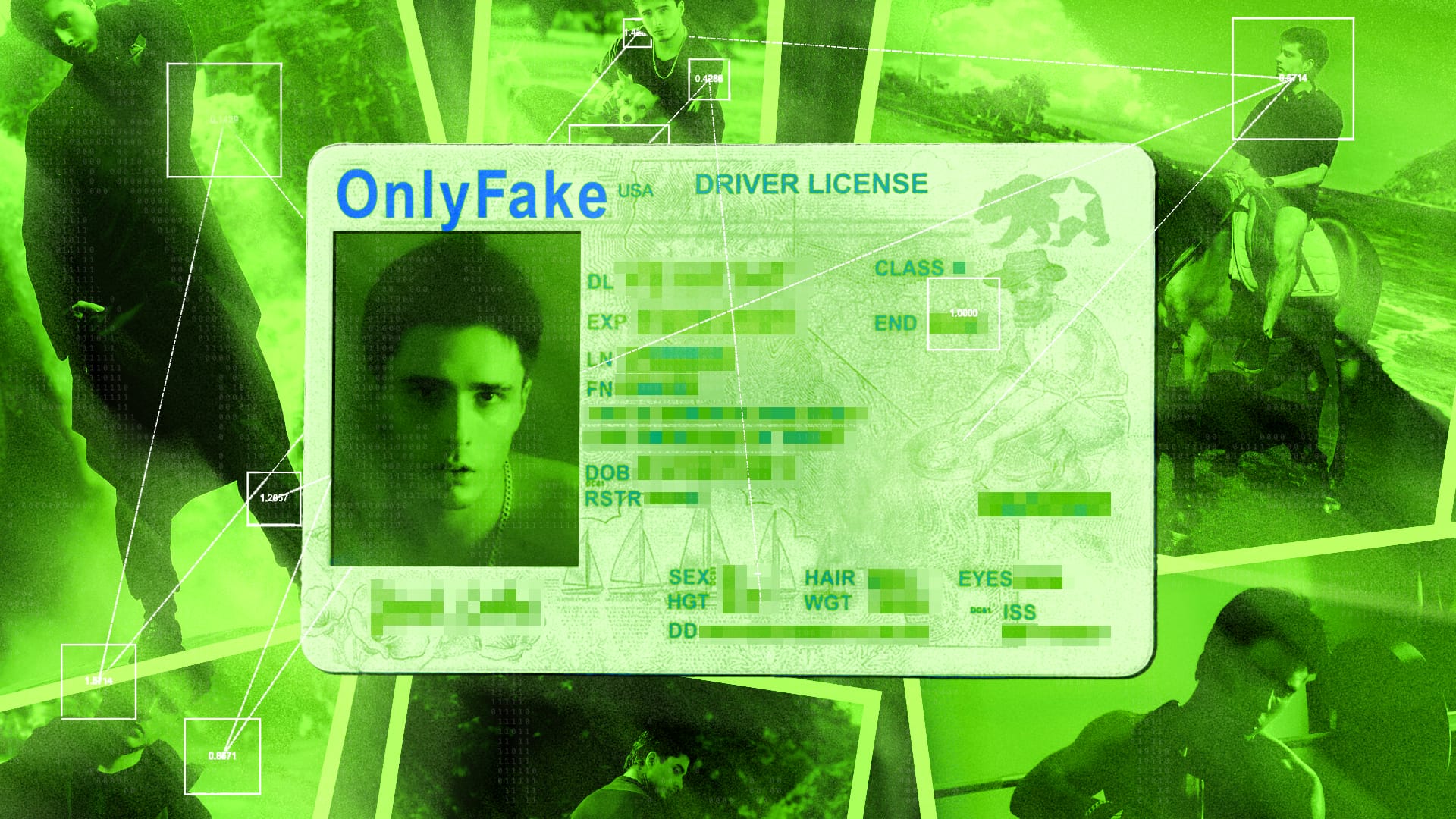
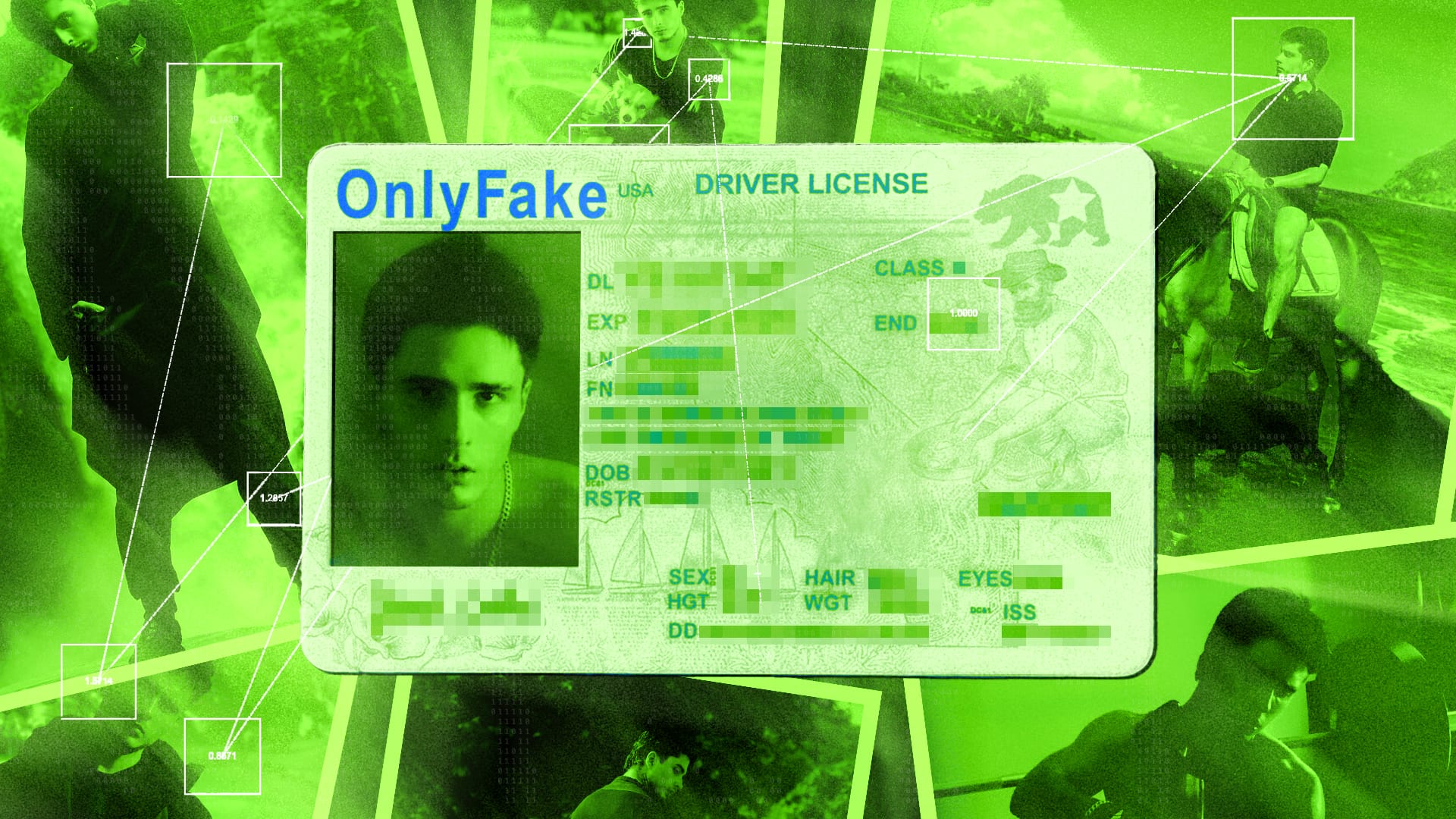
For months I’ve been speaking to an AI fraud kingpin. You might remember in 2024 we revealed the existence of OnlyFake, an underground site that let anyone generate realistic photos of fake IDs using ‘neural networks’. The creator of that site went by the handle John Wick. A while later, the creator was arrested.
Turns out there was a lot more to that story. Yuriy Nazarenko, the creator of OnlyFake, told me his side of it. How when I published my initial article he panicked, and destroyed his laptop and emails and got a new phone, paranoid that authorities were about to bust down his door. How the pressure of a growing fraud empire pushed him to drugs. And how North Korean fake IT workers used his site. Read below for his story.
A few years ago, Yuriy Nazarenko sat at a desk in his grandfather’s apartment in Ukraine and, on a diet of cigarettes, Lay’s chips, and beer, painstakingly made digital copies of fake identity documents. One of his four computer screens had the messaging app Telegram open. Another displayed a scan of a passport in Photoshop filling the entire monitor.
Pixel by pixel, with rap music blaring, Nazarenko edited each part of the passport. That included the MRZ codes, the block of text printed at the bottom of identity documents; the photographs to superimpose someone else’s face into the document; and the overall dimensions and quirks of each different type of passport. Nazarenko would sometimes sit for more than 12 hours at his computer, obsessively tinkering away, with a single, high-quality fake identity document taking up to a week of work.
When someone thinks of fake IDs, maybe they imagine a spotty underage teen buying a physical counterfeit drivers’ license so they can score some beer. But in the global criminal underworld, digital copies or scans of IDs are like a skeleton key. A convincing scan of an ID or utility bill, loaded with a bogus name or someone else’s identity, can unlock the ability to make bank accounts, bypass checks on cryptocurrency exchanges to buy or sell more Bitcoin, or rent a safehouse, all while keeping the criminal’s real identity hidden. The digitally altered IDs need to fool both human reviewers and automated systems that scan them for inconsistencies. Making fake IDs requires exquisite attention to detail.
All of that manual labor doesn’t really scale, Nazarenko thought to himself as he meticulously edited passport after passport. He went on to make templates of fake identity documents that sped up the process, but it was still slow.
After many of these quiet nights, he had an idea. He built a website to automate the process that autopopulated a fake ID with the personal data a customer wanted, rather than having him do it by hand. Then, when generative AI became mainstream a short while later, he incorporated that too.
“That gradually became OnlyFake,” Nazarenko told me.
OnlyFake, the underground website Nazarenko made, landed like a bomb in the fraud world. It allowed anyone to generate not only convincing scans of drivers’ licenses or passports, but also realistic looking photos of those fake identity documents laying on a sofa, carpet, or desk, as if someone had taken the ID out of their wallet and snapped a picture of it on their phone. Needed a convincing looking photo of a California drivers’ license to open a cryptocurrency account in someone else’s name? Or a British passport to incorporate a company overseas? Or a Social Security card? No problem. The results were photos of identity documents that didn’t really exist, of people who may not be real, but yet could trick the sorts of people and companies that verify documents.
With OnlyFake, you didn’t have to be a master forger like Nazarenko to make fake documents. Now, anyone could churn out fake IDs at scale, sometimes even hundreds or thousands at a time. OnlyFake threatened the entire idea of know-your-customer, or KYC, where financial institutions take steps to know who exactly are using its services. When anyone can make a photo of a fake ID for just a few dollars in Bitcoin, is anyone really who they say they are?
Nazarenko didn’t know it then, hunched over his desk, but OnlyFake would soon become so influential that it would spawn copy cats, and the FBI would eventually arrest Nazarenko and shut down some of its competitors. The Department of Justice said in an announcement about Nazarenko’s guilty plea that OnlyFake made more than a million dollars selling fake IDs for just $15 a pop.
Now for the first time, Nazarenko, 28, free after a year in prison and living in Asia, is telling his story: how North Korean fake IT workers used his creation, how he ended up in ICE detention for months after serving his sentence in the U.S., and how OnlyFake unleashed a new age of AI-powered fraud. Nazarenko said he wanted to talk to me because I was the first journalist to reveal that OnlyFake existed. This article is based on interviews with Nazarenko and his lawyer; court records; and my own reporting in the online world of fraud that OnlyFake inhabited.
“OnlyFake was the first time I saw how quickly a small internet project could turn into something global. Unfortunately, it also taught me, in a very painful way, what can happen when the scale of something grows faster than your understanding of its consequences,” Nazarenko told me.
Growing up, Nazarenko’s parents questioned whether Nazarenko would ever find a job. His father worked for the Security Service of Ukraine. Raised in a suburb outside of Odesa, Nazarenko jumped between a few different gigs. He worked as a cook, a waiter, at a supermarket, and as a cameraman at a local Ukrainian TV station.
We continued our election coverage with a piece from Matthew Gault on the data center angle. There were actually a ton of proposals related to data centers on the ballot in more than 40 races across 13 states. Well, people voted against data centers in at least 38 of them. People are sick of this stuff and they’re showing up to vote about it.
A few years ago, Yuriy Nazarenko sat at a desk in his grandfather’s apartment in Ukraine and, on a diet of cigarettes, Lay’s chips, and beer, painstakingly made digital copies of fake identity documents. One of his four computer screens had the messaging app Telegram open. Another displayed a scan of a passport in Photoshop filling the entire monitor.
Pixel by pixel, with rap music blaring, Nazarenko edited each part of the passport. That included the MRZ codes, the block of text printed at the bottom of identity documents; the portraits to superimpose someone else’s face into the document; and the overall dimensions and quirks of each different type of passport. Nazarenko would sometimes sit for more than 12 hours at his computer, obsessively tinkering away, with a single, high-quality fake identity document taking up to a week of work.
When someone thinks of fake IDs, maybe they imagine a spotty underage teen buying a physical counterfeit driver’s license so they can score some beer. But in the global criminal underworld, digital copies or scans of IDs are like a skeleton key. A convincing scan of an ID or utility bill, loaded with a bogus name or someone else’s identity, can unlock the ability to make bank accounts, bypass checks on cryptocurrency exchanges to buy or sell more Bitcoin, or rent a safehouse, all while keeping the criminal’s real identity hidden. The digitally altered IDs need to fool both human reviewers and automated systems that scan them for inconsistencies. Making fake IDs requires exquisite attention to detail.
All of that manual labor doesn’t really scale, Nazarenko thought to himself as he meticulously edited passport after passport. He went on to make templates of fake identity documents that sped up the process, but it was still slow.
After many of these nights, he had an idea. He built a website to automate the process that autopopulated a fake ID with the personal data a customer wanted, rather than having him do it by hand. Then, when generative AI became mainstream a short while later, he incorporated that too.
“That gradually became OnlyFake,” Nazarenko told me.
💡
Do you know anything else about OnlyFake or AI fraud? I would love to hear from you. Using a non-work device, you can message me securely on Signal at joseph.404 or send me an email at joseph@404media.co.
OnlyFake, the underground website Nazarenko made, landed like a bomb in the fraud world. It allowed anyone to generate not only convincing scans of driver’s licenses or passports, but also realistic looking photos of those fake identity documents laying on a sofa, carpet, or desk, as if someone had taken the ID out of their wallet and snapped a picture of it on their phone. Needed a convincing looking photo of a California driver’s license to open a cryptocurrency account in someone else’s name? Or a British passport to incorporate a company overseas? Or a Social Security card? No problem. The results were photos of identity documents that didn’t really exist, of people who may not be real, but yet could trick the sorts of people and companies that verify documents.
With OnlyFake, you didn’t have to be a master forger like Nazarenko to make fake documents. Now, anyone could churn out fake IDs at scale, sometimes even hundreds or thousands at a time. OnlyFake threatened the entire idea of know-your-customer, or KYC, where financial institutions take steps to know who exactly are using its services. When anyone can make a photo of a fake ID for just a few dollars in Bitcoin, is anyone really who they say they are?
Nazarenko didn’t know it then, hunched over his desk, but OnlyFake would soon become so influential that it would spawn copy cats, and the FBI would eventually hunt Nazarenko and shut down some of OnlyFake’s competitors. The Department of Justice said in an announcement about Nazarenko’s guilty plea that OnlyFake made more than a million dollars selling fake IDs which cost just $15 a pop.
Now for the first time, Nazarenko, 28, free after a year in prison and living in Asia, is telling his story: how North Korean fake IT workers used his creation, how he ended up in ICE detention after serving his sentence in the U.S., and how OnlyFake unleashed a new age of AI-powered fraud. Nazarenko said he wanted to talk to me because I was the first journalist to reveal that OnlyFake existed. This article is based on interviews with Nazarenko and his lawyer, court records, and my own reporting in the online world of fraud that OnlyFake inhabited.
“OnlyFake was the first time I saw how quickly a small internet project could turn into something global. Unfortunately, it also taught me, in a very painful way, what can happen when the scale of something grows faster than your understanding of its consequences,” Nazarenko told me.
Images Nazarenko provided.
Growing up, Nazarenko’s parents questioned whether Nazarenko would ever find a job. His father worked for the Security Service of Ukraine. Raised in a suburb outside of Odesa, Nazarenko jumped between a few different gigs. He worked as a cook, a waiter, at a supermarket, and as a cameraman at a local Ukrainian TV station.
People across America rejected data centers during last night’s midterm election. Proposals related to data centers were explicitly on the ballot in more than 40 races across 13 states. People voted against data centers in 38 of them and counting. Six cities voted to ban data centers outright and 12 put limits on the amount of megawatts such buildings could draw. In addition to specific ballot measures, candidates who supported data centers lost across the country.
One of the most striking repudiations of pro data center politicians was in Texas, where Gregg Abbott lost a bid for a fourth term as governor. Abbott had made Texas a data center friendly place. The state has more than 300 working data centers and there are plans to double that number. “Texas is the epicenter of AI development,” Abbott said in 2025 at a press conference with Google CEO Sundar Pichai. “We must ensure that America remains at the forefront of the AI revolution, and Texas is the place where that can happen.” He went on to accept more than $9 million from data center-related donors.
When public sentiment turned against data centers, Abbott attempted to ride shifting political winds by issuing a “pause” on new projects. The pause wasn’t real. Texas regulators continued to approve data center projects after Abbott’s announcement and only shut down the state’s permitting web portal when 404 Media reported it.
Gina Hinojosa, Texas’s Democratic governor-elect, made Abbott’s stance on data centers a central part of her campaign. Abbott’s words about making Texas a data center-friendly AI state played on TVs and the internet over and over again. He lost by more than 700,000 votes.
Anti-data center candidates overwhelmingly won statewide races across the country. In Burgin, Kentucky, mayoral candidate George Hensley lost his bid after voting to approve a hyperscale project—to a write-in candidate. Hensley was the only name on the ballot, and he lost to Joe MonroeTK, who ran an anti-data center write-in campaign. Emporia, Kansas — where police arrested a school teacher for clapping during a data center related city meeting — passed a ban on high impact data centers. In Yukon, Oklahoma the mayor lost a recall election after he supported a hyperscale data center project.
"These midterms sent a clear message — people don't want to see data centers in their backyards,” Michael Whitesides, the deputy communications director for Local Progress, told 404 Media. “Across the country, people do not see the promised benefit of these data centers, and the AI they power, playing out in their daily lives. They're seeing basic goods and services get more expensive while these billionaire backed monstrosities take up space in their community, poison their air, and drive up their utility bills.”
Local Progress is a network of local elected officials. Over the past year, its members have become increasingly focused on data centers as a top political issue. “Last night, we saw local, state, and federal officials who backed data center deals lose their seats,” Whitesides said. He noted that Kim Rooney in Asheville, North Carolina and Amanda Rodrigues in San Marcos, Texas (both members of Local Progress) were elected mayors in their cities after running anti-data center campaigns.
“Big Tech will continue its typical playbook of trying to buy and bully local officials into complying with their demands for more data center development, but our hope is that last night's results are a clear signal to local leaders that they can resist and their community will back them up,” Whitesides said.
American voters in the communities where they’re being built hate data centers. They run up power bills, burn through water, and power Silicon Valley’s AI apparatus. America rejected data centers last night as both symbols of the big tech oligarchy and a physical manifestation of the future it wants to build. It’s a future Americans seem willing to fight.
Elon Musk, one of the night’s big losers, took a break from a weeks-long posting spree on X as the election results rolled in. Musk spent half a billion dollars on the midterms, $224 million of it in Texas, the state where he lives and does a lot of business. The world’s richest man wanted to cover the state in data centers. Those plans aren’t looking good now that Abbott is out and Hinojoa is in.
Musk broke his election day posting silence a little after 1 am. “Data centers in space looking pretty appealing right now,” he said on X. Chased off the land by its people, the billionaire looks to the sky.
Analysts, analytics engineers, and even business users are writing less SQL and Python by hand. They prompt an agent instead, and with the right context (data models, docs, a data catalog), the agent writes a decent query. Think of a BI tool shifting left and democratizing new context from data models and sources. This helps the agents better understand the business problem and write a more accurate SQL query.
With more advanced tooling that automatically reviews or generates queries iteratively, the agents’ output gets higher in quality every time. The models get better, and we can add additional documentation from internal Confluence pages or data catalogs, and it will get even better.
When using Generative AI for BI tools, we need better ways to verify the underlying foundation for a dashboard. But how? What we need next are linters and a compiler-like style that AI-lints everything before running, and then integrated test suites that get better and better. Basically, back to Test-Driven Development: prompting the tests first, so we assert1 what we want to build.
As models get better, iterative test suites get better too, and with it, we get better verification. But still, in verification lies the liability today with agentic engineering work, and that’s what we talk about in this article: helping data analysts and domain experts develop more meaningful data work for the organization.
We need to move all logic into one place, to go from a stack of components to one optimized for human ergonomics. We need new ways to make this human-friendly, a new architecture even, a unified lineage tree. This article explores current challenges in BI from first principles, analyses what has worked so far, what no longer does, and how we could improve the architecture to better prevent errors.
[!note] People already feel this in a recent Survey
In a Metabase survey run during its AI analytics week (AI readiness quiz), 74% of teams were building with AI, and only 2% were scaling it. The bottleneck has moved from creating analysis to checking it. Take the quiz today to find out where your team stands.
Verification with Agents through Test Suites, and Human Intuition?
So the first question is, what do we need to verify? What’s an iterative test suite?
If it comes down to verifying metrics and KPIs, it’s all math. The retention KPI is built in code, defined in SQL. It’s math. Agents will eventually generate the right test suite to verify the retention KPI, based on 1000s of test cases, Sameer Al-Sakran, CEO of Metabase, said. It’s a standard equation: with evals run by a harness (the new Zeitgeist), agents can figure out edge cases.
But then again, you also need human verification. Sameer said:
Business people are the best data contracts, they know when something doesn’t make sense, they know the numbers. Plus they feel it in their subconscious.
It’s an intuition they gained with years of experience, knowing what the numbers should be in what case. So the test suite can be initiated at the beginning, iterated and improved, but the human adds their intuition to the mix.
Frameworks like Superpowers ask and question the human along the way, and Ponytail pushes the agent to write less code in the first place.
Five Hierarchy Levels for Testing System-wide Quality
For testing across the data stack, we need system-wide tests, and tests that run on different levels. Below are five different hierarchies for better quality testing:
Linting: Statically analyses our development code and our aggregations without running them, and gives real-time diagnostics of our metrics and configs with type checks and contract conformance.
Compiler: A whole-tree check that resolves and type-checks the full lineage tree before deploying and running on an environment, refusing to build what doesn’t fit together.
Unit Test: Tests small functions and components of the full system, each time we change something. Value assertions and calibration thresholds against known inputs live here.
Integration Tests: Similar to unit tests, but we test multiple parts of the system, modules or components as a group to verify interactions.
End-to-End Tests: Run the compiled system with dedicated seeds of data sets and check the outputs end-to-end.
All five hierarchies in one repo and where changes apply with one commit
If we add them all together, we could have thorough and well-tested KPIs for business analytics and the data stack, from start to end, with the power of the latest agentic engineering, but also a touch of human intervention and intuition.
[!info] Single Test Score to represent data quality?
The ultimate goal would be to have a single test score that gives you an indication of how good data quality, ETL, the aggregations and dashboards are, but that’s really hard to do. Again, this is where the test suite makes more sense. Also, agents are better at testing narrow fields in a broad test suite.
The Solution: Moving All Logic into One Place?
One git repository, one mono repository, one commit hash, one change across all metrics, dashboards and ETL load. Quite similar to what I was writing about a while back, the “Declarative Data Stack”, expressing the full data stack as a single function.
It’s precise, and a declarative config such as a function, e.g. run_stack(serve(transform(ingest))), can recreate the entire data stack.
For our purpose, we want to have better verification, which helps with that too. The logic (metrics, dashboard, ETL) is stored in a standardized way, agents can create test suites on top of it, and we can iterate fast. We can’t verify logic in four different databases and git repos. Bringing it together into one declarative place will avoid this.
In the end, metric definitions, segments, transformation, aggregation, all of it results in a dashboard. We go from source to visualization. It’s a full-stack data engineering platform, from transformation, semantic layer, actual computation to dashboard and data app.
Different Serialization Formats
Besides having the code and configuration in one place, having different formats or syntax is okay these days. dbt models are Jinja-templated SQL in each warehouse’s dialect, Metabase has native SQL and its own query language (MBQL), and Looker has LookML. Translating between them can increasingly be done by an agent, and verified with a compiler or inspection tools.
That means we have less lock-in to proprietary syntax than before, though formats like LookML and MBQL are still proprietary.
Stacking of Components to Optimize for Human Ergonomics
We need a system that focuses on human productivity by fitting into our workflow like macros in dbt or LookML functions. In programming, we also started with Assembly, then moved up to higher-level languages like FORTRAN and C, then to object-oriented languages like Smalltalk, and now we have all the programming languages. Now we have evolved even further, so we can just instruct in natural language.
We went up the stack, it’s a different optimization level when we don’t need to write Assembly anymore. Sure, sometimes it’s still beneficial to write in Assembly, if you need to have full control over everything, making it super performant, but sometimes we also just need a setup that helps us get the job done. For BI developers, that’s a reliable system that supports us with agentic work whenever possible, but still with the human ergonomics and productivity in mind—e.g. producing more is not better, but higher quality and correct metrics are.
We want the ability to verify. Some companies have rewritten their core as notebooks were unusable: state was not clearly managed, variables ran out of order or were reassigned, and it was hard to understand which code block created which datasets. That is where, in a BI tool, the connection between a metric and the compute engine becomes essential: the better integrated, the less drift we have from definition to data sets.
This idea is older than BI. Donald Knuth’s Literate Programming (1984) treats the computer program more like an essay explaining the reasoning, with the code as illustration. One tool produces the tangled version the machine runs, and another produces the woven version the human reads. Meaning and implementation can’t drift apart, because they’re the same document.
Apply that to a metric (and its contracts), and you get what this article is about, with humans writing less code: a definition that says what a metric means, and the code that computes it, kept in one place and checked against each other.
[!note] The P versus NP problem, in reverse
The P versus NP problem is a major unsolved problem in theoretical computer science. Informally, it asks whether every problem whose solution can be quickly verified can also be quickly solved. For NP problems, checking is the easy part and finding the answer may be hard. Agentic BI has the reverse asymmetry: an agent can produce a metric or dashboard cheaply, but checking that it’s correct is the hard, expensive part, which is why we invest so much in the verification layer.
A Unified, Hierarchical Lineage DAG
For bringing the test suite into an integrated place, I was tinkering with the idea of creating a unified computational graph that represents the full state from ingestion to dashboard.
When I discussed this with Sameer, he pointed out that it has no cycles and is hierarchical: a DAG that goes down level by level into its sub-DAGs. It isn’t a strict tree, since any join gives a model more than one parent, but it reads top-down like one. That’s what I mean by “lineage tree”, or “hierarchical lineage DAG”, in this article:
A hierarchical DAG of sub-DAGs with no cycles. Every node is parsed to its AST and linted at every layer.
For the linting part, we can use something called an Abstract Syntax Tree (AST). It’s a data structure that represents the structure of a program or code snippet. It is a tree representation of the abstract syntactic structure of text written in a formal language. There’s also a SQL AST specifically, and tools like SQLMesh and most parsers in BI tools make heavy use of them. E.g. the Virtual Data Environments feature, which detects modifications and automatically categorizes the impact of breaking or non-breaking changes, is heavily reliant on ASTs:
This is possible due to the platform’s ability to understand SQL semantically, at the AST level. By comparing the current model version with the previous one we’re able to compute a semantic diff, which SQLMesh further analyzes to understand the impacts it would have on downstream models.
So with such techniques, and advanced knowledge about the configuration of the full system, adding SQL transpilation and LSP (Language Server Protocol) linters to the mix, we have a pretty strong lineage tree that can help us make verification up-to-date for the new AI age, and allow faster iterations.
[!note] The Modern Data Graph?
Stephen Bailey, in The Modern Data Graph, reframes a16z’s “unified data infrastructure” from a stack into a graph:
While there is an overall left-to-right flow from data sources to output systems, there is a hub of interchange around the warehouse and storage. You could get rid of almost all other nodes and still have a platform that sustains the workloads (see his illustration).
Its role is “transferring knowledge so humans can use it”: the data graph supports the system graph, which supports the human graph. His distinction between systems that operate within the graph (defined edges, inside boxes) and those that work on it (unboxed) maps neatly onto the two things we need to verify: the state at rest in the warehouse hub, and the declarations, the edges of transformations, metrics, and joins that produce it.
State is the Enemy, Except Known Test Data
One element of the equation we can’t leave out is the state of a system, and even more the state itself, the customers or our data.
For the system state, Sameer says:
State is the enemy: the more mutable state there is in a system, the less you trust the output.
The problem is mutable state. Planning should happen against fixed, known state: a test data set, a seed of data where you know the expected outcome. Without that fixed reference, verification is just guessing. This is the idea behind Transform tests in Metabase (upcoming in v65): known input rows, expected output, and a rollback after each run.
Usually, state is especially relevant when we deploy the system’s data stack, e.g. visible in DevOps approaches with Kubernetes, where we need to deploy to different environments (dev, test, prod) and conserve state and relevant data for our data stack if we upgrade software or configurations.
Shift Assertions Left: Catching Drift at Build Time
The last question is, when do we actually do the verification? During development, like a compiler that checks at the end of the development cycle, once we have defined metrics, and blocks and refuses to run anything?
Or better, like a linter that constantly shows us warnings and errors while we develop? Both are possible, depending on how rigid we want it to be.
Timing-wise, as early as possible is best. During development, before production, as verification during runtime is already well covered by orchestrators and integrated data quality tools. Again, the more we shift left, the better.
Catch the Drift: Good Data
But how do we know if measures and KPIs are verified, or tested well? What’s important is a good data set and test suite that improves the data quality, the tests, and also the business quality. We need to measure the “Goodness of data”.
With an all-encompassing hierarchical lineage DAG that knows the business logic better than existing BI tools, we can use the declarative metrics, unit test them so they declare an outcome, build a compiler that does built-in assertions, and develop assertion programming. Today, most data checks — dbt data tests, Airflow checks, Snowflake data metric functions — run after the data is computed; they’re runtime checks. dbt has started moving left: since v1.8, unit tests check model logic on static inputs before materialization, and model contracts are enforced at build time. We need to take that further and shift assertions left across the whole stack, surfaced by a linter while the metric is being written, and enforced at build time before the pipeline runs.
Avoid a definition drifting from its original definition by unit testing configuration against a large test suite and human intuition. Most BI drift today comes from the opposite arrangement: the dashboard built ad-hoc once with manual tests, and not touched after—drifting away.
The outcome is a system of components optimized for tests and good data quality, allowing fast iteration with high confidence and control.
Inspect Element, but for a Dashboard Number (DevTool for Data)
Think of it like the Developer Tools in Chrome: one pane, full context, everything traceable from the rendered element back through the DOM, styles and network requests. That’s what we’re missing for data. A single interface where you can follow a number on a dashboard all the way back through metrics, semantic layer, transformations, and raw source—without switching tools or asking five people in the first place.
[!tip] Slow down
Mario Zechner, creator of Pi, calls for building “modular” systems in Building pi in a World of Slop. He also says: slow down, learn to say no.
What’s Next: And Where Are BI and Human-Written Code Heading
We covered a lot: why verification is the new liability in an agentic BI stack, why we need test suites at five hierarchy levels (linting, compiler, unit, integration, end-to-end), why moving all logic into one declarative place helps with verification compared to having spread-out components, and why a unified hierarchical lineage DAG, built on ASTs, semantic diffs, and LSP-style linters, solves part of the linting and verification. We also looked at why state is the enemy of trust, and why assertions need to shift left from runtime checks to build-time guarantees.
But there are still open questions. How do we run tests deterministically and reliably? How do we write a “verification rule engine”? How do we actually create the unified hierarchical lineage DAG, compute the full hierarchy before runtime, and potentially compile it into a binary that runs fast, even on the web? And do LLMs help us with verifying?
This is where the thinking behind Data Studio in Metabase is heading. Transforms, metrics and dashboards live in one place. Dependency tracking shows what depends on what, so you can see what a change will break before you ship it. Remote sync lets you version all of it in Git. It isn’t yet the full linter for data described here, but it’s the foundation with all the logic in one place, with a lineage dependency graph, transformations and reusable metrics.
Running out of space on your Nintendo Switch 2? Thankfully, Samsung’s P9 MicroSD Express card is discounted at multiple retailers, with the 256GB version going for $47.99 (Amazon, B&H Photo) and the 512GB version $99 (Amazon, B&H Photo). The smaller card typically sells for around $80, and the larger option usually sells between $150 and $200, though both are higher than their original launch prices, likely because of the ongoing memory shortage.
Samsung P9 microSD Express Card
The P9 is great if you need more storage for your Nintendo Switch 2. The microSD Express card offers sequential read speeds of up to 800MB/s, but only gadgets with a microSD Express card slot can take full advantage of the highest speeds. That includes certain cameras, tablets, and drones with a microSD USH-I slot.
First-party Switch 2 games generally run between 10 and 30 gigabytes each — the upcoming The Legend of Zelda: Ocarina of Time remake is 27GB, for example — while third-party games can take up even more space (Cyberpunk 2077 is 60GB). Until recently, the Switch 2 was one of the few devices that could take advantage of the faster MicroSD Express standard, but this year’s Asus ROG Ally X20 also added support for MicroSD Express. While expensive, the latter is an impressive gaming handheld that runs Windows 11, giving it a versatility that’s hard to find elsewhere.
"Competition for access to electrical supply and data center locations with adequate power availability is intense."
In documents filed with the US Securities and Exchange Commission Monday, Anthropic acknowledges that data centers are becoming increasingly reliant on "natural gas" - the fossil fuel industry's marketing term for what is primarily methane - leaving the company's AI data center buildout vulnerable to rising fuel costs and existing supply chain constraints. And in a possible catch-22, Anthropic admits that rising gl …
Anthropic’s S-1 filing is hundreds of pages long—and it leaves out quite a few financial details. “Anthropic owes investors more information,” one analyst tells WIRED.

 Login