❌

Reading view

Crime and fraud in the food industry

Who knew that food manufacturers would be up against these kinds of frauds?  Not me.  That’s why I was interested to run across these items.

CANDY: Confectionery fraud surges as manufacturers struggle to stay ahead:  Confectionery fraud is rising as volatile cocoa markets, premium ingredient demand and supply chain disruption create new opportunities for adulteration, substitution and counterfeiting.

WINE: National Food Crime Unit arrests man in £500K counterfeit wine bust:  An operation by the Food Standards Agency (FSA) and National Food Crime Unit (NFCU) has resulted in an arrest over alleged wine fraud…. Read more

SUPPLEMENTS: Botanical adulteration on the rise despite 15 years of industry action: Adulteration is one of the most significant and persistent issues facing the botanical industry, and the issue appears to be on the rise, exacerbated by supply chain pressures, trade wars and climate change…. Read more

COMMENT

Food fraud is so common the the FDA has a page on it.

Estimating how frequently food fraud occurs or its exact economic impact can be hard because food fraud is designed to avoid detection. Outside estimates by experts have found that food fraud affects 1% of the global food industry at a cost of about $10-$15 billion a year, although some more recent expert estimates put the cost as high as $40 billion a year.

Caveat emptor!


<

The post Crime and fraud in the food industry appeared first on Food Politics by Marion Nestle

California passes Non-Ultraprocessed Food Label!

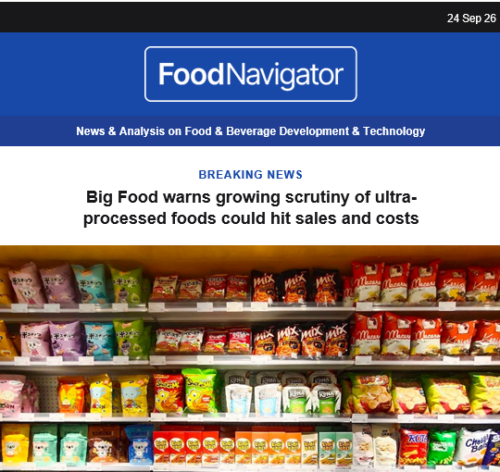
I first heard this big news from FoodNavigator:

California signs voluntary non-UPF label into law:  Gov. Gavin Newsom’s signing of AB 2244 into law creates the first state-backed, voluntary label for non-UPF qualifying products, amid a pending federal UPF definition. Read more.California is the first state with a government-backed label for qualifying foods that are not considered ultra-processed, following Gov. Gavin Newsom’s signing of Assembly Bill 2244, legislation introduced by Assembly member Jesse Gabriel, D-Encino.

The new law establishes a voluntary “Non-Ultraprocessed Certified” label intended to help consumers more easily identify foods that meet California’s non-UPF standard. The label is the latest step in California’s broader effort to address ultra-processed foods, with implications to set a blueprint for the rest of the country.   According to the governor’s office, the label will provide front-of-package information for shoppers while also improving visibility of qualifying products on shelves.

While the federal government is dithering about what it sees as a vexing problem—defining ultra-processed foods—California has just passed its own non-UPF standard.  Its definition:

Existing law defines, for certain school-related purposes, “ultraprocessed food” as any food or beverage that contains a specified substance and either high amounts of saturated fat, sodium, or added sugar or a nonnutritive sweetener or other substance, as specified.

The school food definition specifies amounts per serving of trans fats, salt, sugar, and calories, and artificial colors.  This definition adds artificial sweeteners.

Why is the federal government having so much trouble with this?  Well, the makers of ultra-processed foods don’t want it defined unless the definition focuses on nutrients.

The Institute of Food Technologist, for example, wants “policymakers to focus on the nutritional quality of foods rather than processing level alone and cautioned against relying on existing UPF classification systems as the basis for public policy (view IFT comments).”

 Many commonly used UPF classification systems focus primarily on processing intensity rather than nutritional value. As a result, foods such as whole-grain bread, yogurt, fortified cereals, infant formula, allergy-friendly foods, and medical nutrition products can be categorized as ultra-processed despite providing important nutritional benefits. That distinction matters. Policies based largely on processing criteria could unintentionally penalize foods that help consumers meet nutrient needs and support broader public health objectives.

Medical foods could easily be exempted from the definition.  So could those considered “healthy” by the FDA.

The arguments aren’t really about the science; they are about protecting sales of ultra-processed foods.

By this time, it’s pretty obvious that eating real food and reducing intake of ultra-processed foods is likely to promote health.

California’s new Non-UPF label is a good first step,

I can’t wait to see what it looks like.

The post California passes Non-Ultraprocessed Food Label! appeared first on Food Politics by Marion Nestle

Promoting a health food system: A manifesto from Stuart Gillespie and Julia Belluz

Stuart Gillespie, author of Food Fight, and Julia Belluz, co-author with Kevin Hall of Food Intelligence, asked me to co-post their jointly posted Substacks today, which I am happy to do.

Fighting our toxic food environment: what can I do?

Making the healthiest choice the easiest choice 

We are living in the era of diet and nutrition hype. Top up your protein!  Don’t spike your glucose!  Take these supplements! The advice is both omnipresent and inescapable. A Kaiser Family Foundation Poll of US adults found 72 percent reported seeing weight loss, diet, or nutrition content on social media over the last month, making it among the most popular content categories. Even people who didn’t seek out the diet advice and don’t have social media said they were exposed.

And yet, what we’ve learned spending decades researching nutrition and diet-related diseases is that this industry of wellness products and individual diet protocols amounts to a great big distraction. Eating well is not that complicated, and it’s not a problem of individual choices and will. It’s a collective action problem. If junk food inundates people everywhere, even the best nutrition advice is going to be impossible to follow. If healthy food is the most expensive and laborious to prepare, eating well becomes a privilege few can afford.

Instead of more individual diet advice, we need to use our power to tackle the systemic and structural drivers of the toxic food environments around us. We need to fight to make healthy food the default.

Since we published our books, one of the most common questions we’ve received is: ‘Ok, but what can I do to help?’

We’ve learned a lot from discussions and responses to that question, in different settings. Drawing on this and the literature on activism and action in the food and health space, here are six key things individuals can do. (We promise, they don’t involve protein or supplements.)

  1. Vote for a better food environment 

As citizens in democracies, we have the power to vote in the governments we believe will act in the public interest. Elected officials have a range of policy and regulatory tools they can use to make food environments healthier for all. We detail them in our books, but briefly they include:

  1. Using government budgets to procure healthy foods (and limit ultra-processed foods) for institutions such as schools, government agencies, hospitals and clinics.
  2. Regulating advertising, labelling, marketing and the commercial promotion of unhealthy ultra-processed foods — including infant foods — using enforceable mandatory standards.
  3. Deploying economic tools to push people away from unhealthy foods (e.g. taxing harmful products, reforming agricultural subsidies) and toward healthier options (e.g. earmarking tax dividends to subsidize healthy diets for low-income families, supporting businesses that offer convenient and healthy ready meals in marginalized communities).
  4. Ridding advisory bodies, food regulatory bodies and dietary guideline committees of conflicts of interest, and cleaning up industry lobbying practices (via public registers, disclosure and bans on the ‘revolving door’ from food industry into public office).

Look out for representatives or parliamentarians who make these issues part of their platform, and support or vote for them. But don’t stop there. Hold them accountable once they’re in power. Write to them to ask what they’re doing on regulating food environments, especially to protect young children from harmful products.

  1. Advocate for healthy food at work, school, and in our communities

At a more personal level, the food environments at the places we spend a lot of time outside the home — like our offices, schools, or community spaces — shape what and how much we eat every day, even below the level of conscious awareness. If you find you or your kids are being nudged in unhealthy directions by the lunches at school, or bottomless snacks at work, push for change. Form a coalition with other colleagues or parents who want to improve the food environment. Document the status quo, and how it’s harming collective health. Use that evidence to demand change. Convene a regular workplace committee meeting to discuss how your school or employer responds to your concerns. (For inspiration, Chefs in Schools is one group that’s organizing on the education front.)

There are other measures you can take to affect change locally. These include joining public campaigns, signing petitions to demand local governmental action, or using local media to get the word out.

You also have a right to protest. This can be digital (online, social media) or, physical (like marches, or protests outside industry HQs and government offices). ‘Democracy’ after all derives from the Greek for ‘people power’.  (For more inspiration, Stuart provides examples of ‘food fighters’ who’ve had success in his book.)

The media part is easier than ever. You can reach out to your local, national or global media outlet of choice, or develop your own newsletter or social media campaign.

  1. Build social movements or join civil society organizations

Savvy social movements can help raise awareness and affect change. One of our favorites is Bite Back, the UK’s leading youth-led activist movement on food and health. Their campaign started with a film about how marketing influences young people’s food choices below the level of conscious awareness. Eight adolescents were shown ads for unhealthy ‘triple dipped chicken’ and later asked to choose from a menu of 50 items. All picked the triple dipped chicken. (Julia and Kevin detail the group’s work in their book.)

In the last few years, the campaign has done more than just raise awareness. Its petitions and advocacy have helped expand the number of schools offering healthy free school meals, and restrict junk food advertising to kids in the UK.

There are other inspiring movements and campaigns working on improving food environments around the world. In America, you can check out the  Center for Science in the Public Interest, EWG, Food Tank, Food and Water Watch, and Plant Powered Meals in Schools. Leading organizations in the UK include Action on Sugar,  Children’s Food Campaign, Food Foundation, the Food, Farming and Countryside Commission, First Steps Nutrition Trust, the Right to Food Commission and Sustainable Food Places, and the Obesity Health Alliance. Globally, there’s the Slow Food movement, IPES-Food, the Milan Urban Food Policy Pact and the Global Health Advocacy Incubator.

You can join or support these or other civil society organizations. Many provide resources, expertise and platforms for citizen action. They also do a great job of raising public awareness about the way our food system operates, exposing problems, lobbying politicians and proposing alternative solutions, including drafting legislation, policies and standards.

Closer to home, you can start or join local food groups and volunteer on community schemes and social innovations, including local food partnerships that share ideas and resources across a national network.

  1. Invest for health 

Use your skills, energy, time and money to invest in a healthier world. Do you work for an organization that’s positive, negative (or neutral) with its impact on food and health?

What can you do, in your workplace, to push for change?  How can your employer help create a healthier food environment for all?

Ask about your pension fund: what’s it invested in? Speak to your colleagues or workplace committee and challenge investment decisions. If your funds are invested in a Black Rock, Vanguard, State Street ‘ESG fund,’ dig deeper and ask which companies sit within the fund  (recent research has shown that many such funds invest in harmful ultra-processed food corporations). Outside work, you have agency in where you invest your personal savings.

Shareholder activism and advocacy are gaining traction. NGOs purchase shares to acquire voting rights, which they use to challenge big food transnationals. These can shift their portfolios towards healthier products. ShareAction in the UK has been attending company AGMs and coordinating shareholders for several years, most notably with Nestlé. In 2023, it persuaded Tesco to report on the percentage of its profits that derive from healthy foods; Unilever soon followed suit.

Vote with your wallet by buying foods that reflect the kind of food system you want to live in. This can involve boycotting unhealthy and unsustainable or unethical foods, while ‘buycotting,’ or switching to, better products and brands.

  1. Sue Big Food 

Of everything on this list, we think the litigation lever is the one that has the potential to have the most impact on our food environment. Again and again in the history of public health, protections and regulations don’t arrive with just a damning pile of research evidence. They arrived following litigation.

More specifically, smart lawyers sue companies on behalf of individual plaintiffs who allege they’ve been harmed by products. Those lawsuits pile up, and often through legal discovery, even when the plaintiffs lose, secrets revealed change public opinion and embolden governments to act in the interest of public health. This happened with asbestos, cigarettes, and opioids. And as Julia recently detailed in the New York Times, such lawsuits have begun to pile up in the US against ultra-processed food companies. But we’ll need a lot more of them to really affect change and it’ll take time. We’ll also need cities and state governments to start to sue, too — something San Francisco took the lead on last December.  You can get involved in this legal effort by launching a suit, as a lawyer, a plaintiff, or a city or state.

The lawsuits could also gain strength from proposed regulatory actions. The former US Food and Drug Administration commissioner David Kessler — who was a leading anti-smoking crusader — proposed a way to regulate ultra-processed foods using existing agency rules.  Kessler filed a petition with the FDA to ask the agency to reconsider whether a broad category of refined carbohydrates used in many ultra-processed foods should still be considered safe according to FDA regulation. The petition has gained traction among US health leadership, but that hasn’t translated to any action yet.

  1. Run the research, support the science, and build awareness

As we’ve seen with public health menaces of the past, we need a solid body of evidence to make the case that inaction on food environments is no longer an option. It took decades to build that case when it came to smoking, as well as lots of litigation. Right now, we have an overwhelming body of evidence on the links between diet and health, but we need more on how various factors in a food environment exert different levels of influence on peoples’ food choices. Nutrition research now is dominated by studies that focus on the impact of individuals foods or diets, and much of that evidence is observational, not causal. We need more high-quality, randomized control trials on the impacts of food environments.

This research needs to be free from conflicts of interest. It’s not enough to disclose a conflict. Industry-funded research is likely to generate a significant and systematic bias so conflicts need to be avoided.

One group that’s trying to address these problems in nutrition research is UPF.RAN (Ultra-Processed Food Research Action Network), a global network of researchers committed to advancing knowledge and action on ultra-processed foods. They’re focused on sharing documents and resources, grounded in scientific evidence and translating that evidence for policymakers, advocates, journalists, and educators.

Beyond the science and evidence, we need to get the message about toxic food environments out, and support those who do. Investigative and independent media are key players here. These groups include Lighthouse Reports which, along with others, highlighted the shocking degree of corporate litigation against governments who had introduced pro-health regulation. BMJ Investigations, meanwhile, exposed the rampant conflicts of interest within the UK’s foremost nutrition advisory body (Scientific Advisory Committee on Nutrition). In the US,

US Right to Know and Open Secrets have been using Freedom of Information legislation in their pursuit of truth and transparency in public health.

We can strengthen our own awareness and knowledge by enrolling in online or physical courses, discussion groups, summer schools, and webinars, or just listening to podcasts and lectures. (Stuart was recently involved in the launch of a new series of short courses, run by the Brighton & Hove Food Partnership, for example). There’s no need to start from scratch. Many of the NGOs mentioned above provide technical support and training and they’ve developed adaptable toolkits.

In sum, these are the six actions we think go a long way towards tapping into the latent power we hold, as individuals and collectively.  But what do you think? Let us know what you find most compelling and if there’s anything — or group— we’ve missed.

The post Promoting a health food system: A manifesto from Stuart Gillespie and Julia Belluz appeared first on Food Politics by Marion Nestle

Industry funded study of the week: grapes

I learned about this one from an article in Science Daily that reads like a press release:

Eating grapes daily could unlock powerful skin protection

New research suggests grapes may help “rewire” your skin’s defenses against sun damage at the genetic level.

Scientists discovered that eating grapes can actually change how your skin behaves at the genetic level. After just two weeks of daily grape consumption, volunteers showed signs of improved skin protection and reduced oxidative stress from UV exposure. Researchers say the effects appear widespread, even though every person’s genes responded a little differently.

The Study: Asim Dave, Sumi Piya, Dana-Lynn T. Koomoa, Ingo Lange, Jaewoo Choi, Richard B. van Breemen, John M. Pezzuto. Inter- and Intraindividual Variation of Gene Expression in Human Skin Following Grape Consumption and/or Exposure to Ultraviolet Irradiation. ACS Nutrition Science, 2026; DOI: 10.1021/acsnutrsci.6c00003

The funder: “Funding for the study was provided by the California Table Grape Commission.”

Comment: Participants consumed three servings of grapes a day.  The investigators did not compare the effects of grapes to any other fruit but concluded grapes are a superfood.  I’m greatly in favor of eating grapes along with lots of other fruits and vegetables.  Are grapes a superfood?  Only if all other fruits and vegetables are too.  Each has its own useful combination of nutrients and nutritional factors.

The moral: Eat a wide variety of plant foods.

The post Industry funded study of the week: grapes appeared first on Food Politics by Marion Nestle

Weekend reading: Mushrooms

Every food is its own industry, and mushrooms are no exception.  Want to sell more mushrooms?  Let everyone know about their cognitive and medicinal benefits.

I love eating mushrooms, but not for medicinal reasons, and especially not for mushroom supplements.  Whatever.

The post Weekend reading: Mushrooms appeared first on Food Politics by Marion Nestle

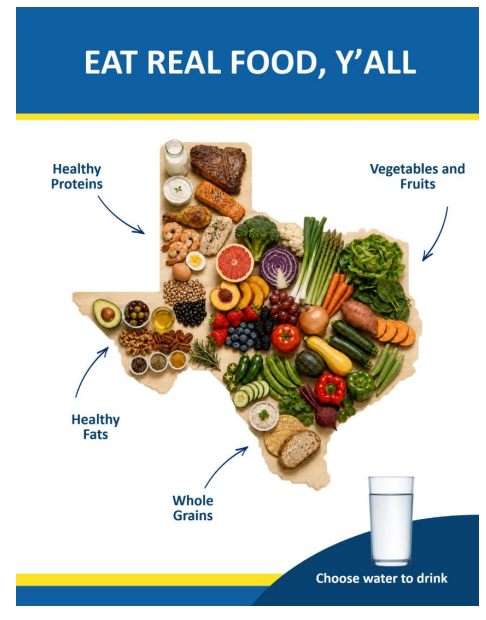
Texas’ dietary guidelines. “Eat real food, y’all!”

Jerry Mande of Nourish Science tipped me off on this one.  Texas wrote its own dietary guidelines.  He judges them as “pretty good and from Texas, y’all.”

Indeed they are.

The 2025-2030 dietary guidelines are a mess and pretty much unusable.  Perhaps coincidentally, the Texas legislature told nutritionists to write guidelines for Texans.

The result:

They set the guidelines on three pillars:

  • Foods without a lot of processing are best for your body.
  • How you prepare food matters.
  • There are many ways to eat healthy.

They were produced by the Texas Nutrition Advisory Committee.

The Texas Legislature added Health and Safety Code, Chapter 119B, to establish the Texas Nutrition Advisory Committee (TNAC) in 2025. Statute tasks TNAC with:

  • Examining the impact of nutrition on human health and the connection between ultra-processed foods and the prevalence of chronic diseases;
  • Providing an independent review of scientific studies analyzing the effects of ultra-processed foods on human health;
  • Providing education on the effects of ultra-processed foods on human health; and
  • Developing and maintaining dietary and nutritional guidelines.

I don’t know any of the members of the Advisory Committee but high marks to them.  They did all this in a thoughtful, systematic way and produced guidelines well substantiated by current scientific evidence.

Take a look at the link to the committee.  That page provides loads of useful information about the process as well as links to educational materials.

Go Texas!

The post Texas’ dietary guidelines. “Eat real food, y’all!” appeared first on Food Politics by Marion Nestle

Is the food industry really in trouble?


I keep repeating: the food industry is in trouble.

People are eating less.

Eating less is bad for business.

Why are food sales down?

  • RFK Jr says the food industry is poisoning America
  • Concerns about ultra-processed foods are reducing sales of the most profitable products.
  • GLP-1 drugs encourage users to eat less.
  • Inflation is raising the cost of food.

Here is one example of what’s happening to food companies:

Cuts to SNAP also affect the grocery industry.

But the biggest factor is the GLP-1 drugs.

GLP-1 drugs put $73B in global food value at risk, report finds: PepsiCo’s Lay’s is the most exposed food brand, with Doritos, Hershey’s, Cheetos, Kellogg’s and Reese’s also vulnerable, Brand Finance determined.

For Food Companies, Shifts From GLP-1 Use Are Hard to Digest: People on medications for weight loss are buying less food, shrinking their portion sizes and purchasing smaller clothes. Businesses are trying to adjust.

But the drugs slow digestion, leading people to eat fewer calories a day. They are often instructed by physicians to consume more protein to protect muscles and more fiber to offset gastrointestinal issues that can sometimes result.

So consumers aren’t just eating less when on the medications, they’re eating differently, moving away from breads and pastas and toward more meats and vegetables.

The food industry is scrambling to keep up:

Big Food’s Big Reset: Why the industry’s changing faster than ever:  From C-suite shake-ups to targeted acquisitions, Big Food is rethinking how to win in a rapidly changing market… Read more

Already, sales of alcohol, chips, ice cream and sodas have taken a hit from consumers on the medications…Analysts at J.P. Morgan predict that as GLP-1 treatments proliferate spending on food and beverage industry revenues could fall by as much as $55 billion by 2030. Food companies, facing declining sales, are racing to develop products they hope will appeal to those customers.

As researchers Luc L. Hagenaars and Laura A. Schmidt write in Science, (Un)intended consequences of mass-prescribing GLP-1s

The food industry has a long-demonstrated capacity to turn health concerns into market opportunities, while deflecting attention from its role in the obesity epidemic. The Ozempic era could therefore have the unintended consequence of consolidating the food industry’s market power, while perpetuating price inflation and unhealthy food environments.

Stay tuned on this one.

The post Is the food industry really in trouble? appeared first on Food Politics by Marion Nestle

RFK Jr letter to David Kessler’s citizen’s petition leaked

Remember former FDA commissioner David Kessler’s petition to the FDA to revoke GRAS status for refined carbohydrates as a way to immediately regulate ultra-processed foods?

I wrote about this here on August 14, 2025.

David Kessler, a physician, lawyer, and former FDA Commissioner, has done a great service for the Make America Healthy Again movement.  He has written a letter to RFK Jr presenting a Citizen’s Petition to the FDA: “Petition to Limit the Exposure of Refined Carbohydrates used in Industrial Processing in order to Prevent Obesity, Diabetes, and Cardiovascular Disease in Children and Adults.”

The FDA has 180 days to respond to citizens’ petitions.  It did not come close to meeting this deadline.

But now The Washington Post says that HHS Secretary Robert F. Kennedy, Jr tried to meet it.  He wrote a letter in response in March but he White House held it up and it has never been sent.  The Post based its account on a leaked copy of the letter.

I also acquired a leaked copy. Here it is.

The letter is undated, and I do not know whether this is the latest version or the one obtained by the Post.

Whatever it is, it’s impressive.  It’s thoughtful, well written, compelling, and referenced in detail.

The draft I received came with two highlighted statements.

The first contains RFK Jr’s statement of intention:

I will be calling on companies to provide any safety information they have to HHS on the health impacts of refined starches and sweeteners to allow FDA to evaluate the GRAS status of the refined starches and sweeteners listed in your petition.

The second states his endorsement of Kessler’s petition.

I believe your petition points toward an historic opportunity to significantly improve the quality of our food supply and thus the health of our citizens.

FDA’s statute and regulations require that GRAS status be based on the ingredient’s intended use. We want to see any information that proves these ingredients at the quantities they are being added to the food supply should still be generally considered safe. Today, HHS will begin seeking any detailed safety studies food companies may have conducted for proving the safety of the refined starches and refined sugars they are adding into the food supply.

The letter states Secretary Kennedy’s further intentions: “during my time as Secretary, I intend to work across the Administration to oversee a process that will include at least the following actions:”

  • Fully Implementing the new Dietary Guidelines for Americans.
  • Engaging Congress, the States, the Food Industry, and the Public in a Strategy to Address the Concerns Raised by Ultra-Processed Foods.
  • Ongoing and Systematic Reassessment of Ingredients and Additives of Concern.
  • Added Sugar Reduction Strategy.
  • Labeling to Better Inform Consumers.
  • Facilitate Research and Technical Assistance to Industry.

This signals that RFK Jr is serious about reducing ultra-processed foods and added sugars.  Of sugars, the letter says:

I have directed FDA to develop an added sugar reduction strategy that will encourage food manufacturers, retailers, and restaurants to reduce added sugars in their products and provide greater transparency to consumers on added sugar content. On January 23, 2026, FDA’s Human Foods Program released its 2026 priority deliverables, which include specifics on this strategy. I have directed FDA to develop an added sugar reduction strategy that will encourage food manufacturers, retailers, and restaurants to reduce added sugars in their products and provide greater transparency to consumers on added sugar content.

On January 23, 2026, FDA’s Human Foods Program released its 2026 priority deliverables, which includes this statement about sugar reduction.

The strategy will focus on encouraging the food industry to lower added sugar in processed and prepared foods, proposing a nutrient content claim for added sugars (defining “low added sugar”), exploring targeted consumer education initiatives in collaboration with other federal agencies, investigating ingredient labeling and menu labeling requirements, exploring potential strategies for labeling of sugar alternatives that do not increase blood glucose, and assessing the use of low or no-calorie and non-nutritive alternative sweeteners.

Comments

The letter does not sound like it was written by RFK, Jr.  I wonder who wrote it.

The letter is hard hitting; it threatens the food industry with major federal efforts to reduce consumption of ultra-processed foods and sugars.

I can understand why it’s been held up.  It means the government is taking on the food industry, as promised by RFK Jr (“the food industry is poisoning America”).

Will he take on the food industry?  Does he want to do that?  Will the White House let him?

So far, the MAHA agenda has been mostly talk and no action.  I don’t see this being any different, but let’s wait and see.

The post RFK Jr letter to David Kessler’s citizen’s petition leaked appeared first on Food Politics by Marion Nestle

Industry-funded study of the week: almonds and sleep

Charles Platkin of the Center for Food as Medicine & Longevity sent me this gem.

His summary: Eating almonds improved how people rated their sleep, but most objective sleep measures did not change…Almonds are nutritious, but this is not proof they treat insomnia.

The study: Desai SR, Pinto L, Halbe A, Vaidya RA, Udipi SA and Kalita S (2026) Effects of almond consumption on sleep quality in adults: a randomized controlled trial. Front. Nutr. 13:1892442. doi: 10.3389/fnut.2026.1892442

Method: 175 adults with sleep problems were randomized to eat almonds or another snack for 5 months.

Results: Those eating almonds reported improvements in sleep quality and melatonin levels were higher.  But no significant treatment effects were observed for most parameters and there were no significant differences observed for other biochemical or anthropometric outcomes.  The almond eaters felt that they slept better.

Conclusion: “Almond consumption was associated with improvements in subjective sleep efficiency and sleep continuity in adults with poor sleep quality. These findings suggest that almonds may enhance perceived sleep quality, with slight objective improvements among responders.”

Funding: The author(s) declared that financial support was received for this work and/or its publication. This clinical trial was supported by Almonds Board of California.

Comment: This study is a classic instance of industry-influenced interpretation bias.  It’s hard for me to understand why anyone would think 50 almonds a day (350 calories!) would help anyone sleep and they didn’t.  But the conclusions put a positive spin on the results.

As placebos go, I’ll take almonds any day.  I like them.  But sleep?

The post Industry-funded study of the week: almonds and sleep appeared first on Food Politics by Marion Nestle

Weekend viewing: food politics art on the High Line

When my children, Rebecca and Charles Nestle, visited last week, we took a walk on the High Line in Manhattan, spotted this water fountain at 23rd Street, and I took this picture.

Here’s what the sign says:

Ximena Garrido-Lecca
The Golden Crop, July 2026 – June 2027

The High Line press release explains:

Ximena Garrido-Lecca uses sculpture and installation to highlight the complex relationship between Indigenous knowledge, colonial history, and modern technological and industrial systems.

For the High Line, Garrido-Lecca presents The Golden Crop, a nine-foot corn cob water fountain, made of bronze. Corn holds a central position in pre-Columbian mythology and was considered the origin of humanity by the Aztecs and Maya.

It also is one of the most important crops in the global economy, and is often genetically modified to tolerate pesticides like glyphosate. Glyphosate has sparked debates for its effects on human health and the environment, such as river contamination.

Garrido-Lecca dyed the water that trickles down the corn and between the kernels to have a neon yellow hue, a reference to the toxic chemical and its effects on runoff water sources, particularly those that communities use for drinking, fishing, and recreation. The artist also highlights the way industrial farming and GMO corn have impacted the existence and strength of native varieties, risking the erosion of cultural heritage associated with these crops, ultimately, challenging the viewer to reconsider the social, health, and environmental costs of our interconnected modern world.

Indeed.  It seemed appropriate to post this at foodpolitics.com.

The post Weekend viewing: food politics art on the High Line appeared first on Food Politics by Marion Nestle

Where is country-of-origin labeling for beef when we need it?

Everyone should read Eric Schlosser’s op-ed, Why Did Trump Order Up 660 Million Pounds of Mystery Meat?  We have country-of-origin labeling for fresh produce.  But because of Big Meat lobbying,

Beef and pork are notable exceptions to these laws. And that may help to explain why President Trump signed a proclamation last month that will allow the duty-free importation of about 660 million pounds of inexpensive beef.

If American consumers knew where that beef was coming from, they might not want to eat it.

As he explains, this beef is  trimmings, possibly stored frozen for years, intended to be added to ground beef to adjust the fat content.

He lists the food safety scandals around such trimmings.

  • China rejected two shipping containers of beef from Uruguay after finding residue of an anti-parasitic drug in the meat.
  • China rejected beef from Argentina reportedly because it tested positive for a banned antibiotic that can cause serious blood disorders.
  • Brazilian federal police raided nearly 200 meatpacking plants after allegations that government inspectors and politicians were being bribed to allow the sale of contaminated beef.

As for why President Trump allowed this, against the wishes of the US beef industry:

“Regime Change,” the recent book by the Times reporters Maggie Haberman and Jonathan Swan, contains an interesting clue: a White House meeting last November between President Trump and Joesley Batista, whose family controls JBS…Mr. Batista gained the White House meeting last November, Ms. Haberman and Mr. Swan wrote, because of his friendship with Melania Trump. In addition, a JBS subsidiary had donated $5 million to Mr. Trump’s second inauguration, the largest gift from any individual or corporation.

Eric Schlosser discusses this and other such matters on Democracy Now.

Comment

We need country of origin labeling for beef, for sure.  We have it for produce.  Congress made beef exempt.  Bring it back.

Food safety lawyer Bill Marler wants more USDA inspection and more transparency, as he says in 660 Million Pounds of Trimmings — The Part of Eric Schlosser’s Op-Ed I Would Underline.  His advice to hamburger eaters:

The one thing that makes a hamburger safe is 160°F, measured with a thermometer. Buy from your butcher if you want to know where your beef came from. Then cook it to 160 anyway.

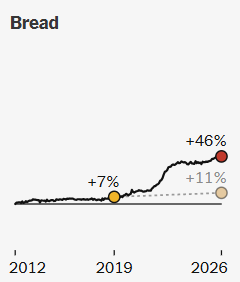
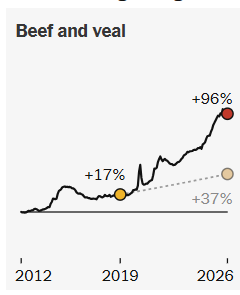
And then, of course, there’s what’s happening to beef prices.  You might feel better about this if you knew the beef was raised here and was safe.

The post Where is country-of-origin labeling for beef when we need it? appeared first on Food Politics by Marion Nestle

How is MAHA doing so far? Not so great.

A bunch of items got me thinking about the gap between what MAHA promised and what it is actually doing: mostly talk, but not much action.

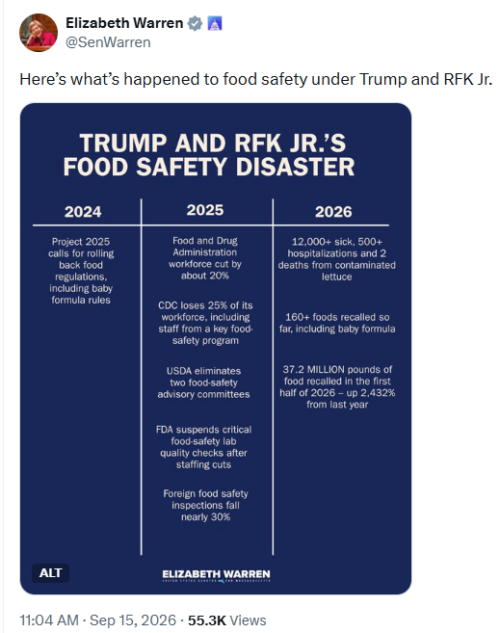
I.  This post from Senator Elizabeth Warren on X.

II.  The New York Times: How Kennedy did on children’s health reforms

Everything seems to be a mixed bag:

  • Dietary guidelines advising eat real food and restrict highly processed foods, but also advising more meat, fat, and saturated fat.
  • State restrictions of sodas and other sugary foods on SNAP, but other requirements that have dropped enrollments.
  • An FDA proposal to close the GRAS loophole, but cuts to personnel will make oversight impossible.
  • Removal of artificial dyes from food products, but this is voluntary.
  • Defining ultra-processed foods, but this is held up and its fate is uncertain.
  • Promises to put real food in schools, but no rules have as yet been issued nor is more money being appropriated.

III.  “MAHA Moms Built a Movement. MAGA Bros Have Taken It Over,”

With the midterm elections approaching and MAHA voters increasingly dissatisfied with Trump, it’s worth asking: How exactly did a cause powered by women turn into one run by men? And will the women who built the MAHA movement ever revolt?

IV.  KFF  Health News:  Trump and Kennedy’s Health Industry Deals Haven’t Been Enforced and Are at Risk of Vanishing

Like the focus on artificial dyes, however, many of the administration’s highest-profile health initiatives rely on voluntary agreements. The goals, such as lower drug prices and nutrition classes for doctors, have widespread appeal, cutting across party lines and economic divisions.  But the administration-industry deals lack the enforcement teeth of more traditional federal regulation. Their details are vague, and minimal oversight makes it hard to monitor progress. In some cases, the administration has claimed victories that have yet to materialize.

Comment

I had some cautious hope that this particular piece of this administration’s plans might actually get somewhere.  At the beginning, RFK Jr sounded like he really did want to improve American diets and Make America Healthy Again.  Apparently, he was unable to stand up to food industry pressures, as is most evident by his failure to get glyphosate out of the food supply.

His one resounding success?  Destroying confidence in the safety and efficacy of vaccinations, despite tons of evidence that their benefits hugely outweigh risks.

In a word, disappointing.

The post How is MAHA doing so far? Not so great. appeared first on Food Politics by Marion Nestle

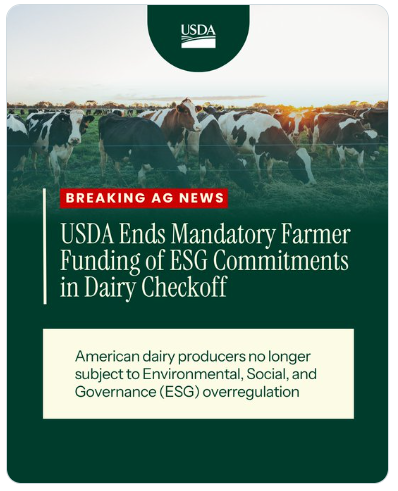
USDA tells dairy industry not to worry about environmental, social, and governance (ESG) overregulation

It’s Climate Week, so this seems ironically appropriate.  Never mind global warming, ruminant greenhouse gas emissions, or food safety.

You have to love the double-speak rhetoric:

This action aligns research and promotion activities with the Department’s priorities and the original mission of the checkoffs. USDA remains committed to ensuring that every dollar collected from American producers serves American agriculture for the better.

“Serving American agriculture for the better” is a red flag.  It usually translates as serving the interests of agribusiness or the peculiar politics of the current USDA.

The USDA’s target here is its Innovation Center for U.S. Dairy.  This, according to the announcement, was

established through the checkoff, has pursued extensive ESG initiatives, including greenhouse-gas and net-zero targets. USDA’s action ends checkoff support for those ESG-related projects…This action also directs the Agricultural Marketing Service to ensure no research and promotion funds in other commodity checkoffs advance ESG mandates…USDA is taking swift action to bar the Dairy Checkoff from spending farmer paid dollars on the radical ESG ideology [my emphasis].

I took a look at the Innovation Center website.  Its focus areas may explain why the USDA wants its funding stopped.  Radical ideology?  You decide.

  • Animal care: Align the industry on best practices for animal well-being and care.
  • Environmental Stewardship: Advance solutions that protect natural resources and nourish the planet for future generations.
  • Food Safety: Drive adoption of world-class food safety practices while exploring next generation technologies that progress safety and traceability.
  • Health & Well-being: Deliver dairy nutrition that meets emerging and personalized health while improving nutrition security in the U.S. and around the world.
  • People & Community: Support efforts to alleviate hunger, promote community vitality, and empower the dairy workforce.

The Center is funded by the checkoff program.  With no checkoff funding, it will no longer exist.

Chalk this up as another tragic casualty of the Trump administration’s radical ideology.

The post USDA tells dairy industry not to worry about environmental, social, and governance (ESG) overregulation appeared first on Food Politics by Marion Nestle

The National Confectioners Association is concerned about sugar restrictions

I subscribe to Jerry Hagstrom’s “The Hagstrom Report” for his tracking of food events in Washington DC I would not know about otherwise.  He occasionally hosts sponsored posts and I was especially interested to read this one on September 15: “Candy: An American Manufacturing Success Story 250 Years in the Making” by John Downs, the president and CEO of the National Confectioners Association.

I don’t write about candy much.  Yes it’s sugar, but most people don’t eat all that much of it.

The CDC lists these main sources of sugar in US diets:

  • 24% from sugary drinks, such as soft drinks, fruit drinks, sports drinks, and energy drinks.
  • 19% from desserts and sweet snacks.
  • 11% from coffee and tea that is sweetened before sale or added later.
  • 9% from candy and sugars.
  • 7% from breakfast cereals and bars.

According to Google’s AI, for candy:

  • Annual per capita intake: Estimates range from 8 pounds up to 22 or 25 pounds per person annually when including chocolate and seasonal treats. [1, 2, 3]

But the National Confectioners Association wants you to eat more candy, and not worry about it.  Therefore, it wants dietary guidelines to say nothing about sugar or ultra-processed foods.  Alas for the NCA, the 2025-2030 guidelines advise limits on both.

Mr, Downs notes that the NCA was in Washington DC that week to meet with congressional representatives.  The NCA wants them to know that

the confectionery industry supports nearly 700,000 jobs across manufacturing, agriculture, transportation, retail, and other sectors. Every confectionery manufacturing job supports another 11 American jobs. That is the Power of Sweet — and it shows what’s at stake in policy debates that impact American manufacturing.  In celebration of our nation’s 250th birthday, we created our Sweet Land of Liberty campaign…Chocolate and candy have always been about fun, celebration, and connection, and behind every treat stands a great American manufacturing success story.

And then he gets to the ask.  When he says “ingredients” he means sugars.  He’s particularly worried about ultra-processed food classifications.

The rapidly evolving conversation around food ingredients is one example. In recent years, states have enacted different restrictions, labeling requirements, and other rules governing food ingredients, often reaching different conclusions about how ingredients should be treated. This patchwork of conflicting state requirements creates uncertainty, complicates supply chains, and makes it harder for manufacturers to make long-term investments in American facilities and jobs…Our industry is engaging in conversations around ingredients, nutrition, and the future of the American food supply. We believe that public policy should be grounded in science, administered consistently at the federal level, informed by how food is manufactured, distributed, and consumed. It should also account for the real-world effects on supply chains, manufacturing costs, American jobs, and the prices families pay at the grocery store.

Sounds reasonable, no?

If you want to know why we still do not have a definition of ultra-processed foods, why we still support sugar with tariffs, why Congress won’t touch policies to limit marketing of sugar foods and drinks, chalk it up to effective lobbying.  The NCA is small in comparison to the American Beverage Association, but all that talk about jobs on the Sweet Land of Liberty site carries weight.

The MAHA dietary guidelines for sugar are pretty tough.

+ Avoid sugar-sweetened beverages, such as sodas, fruit drinks, and energy drinks.
+ While no amount of added sugars or non-nutritive sweeteners is recommended or considered part of a healthy or nutritious diet, one meal should contain no more than 10 grams of added sugars.
+ When selecting snack foods, added sugar limits should follow FDA “Healthy” claim limits. For example, grain snacks (e.g., crackers) should not exceed 5 grams of added sugar per ¾ ounce whole-grain equivalent, and dairy snacks (e.g., yogurt) should not exceed 2.5 grams of added sugar per ⅔ cup equivalent.

But without policy to implement them, they are just talk.

Policy requires opposing industries with vested interests.

This administration has no plans to regulate industry.  It is likely to listen hard to Mr. Down’s concerns.

That’s what is meant by “corporate capture.”

The post The National Confectioners Association is concerned about sugar restrictions appeared first on Food Politics by Marion Nestle

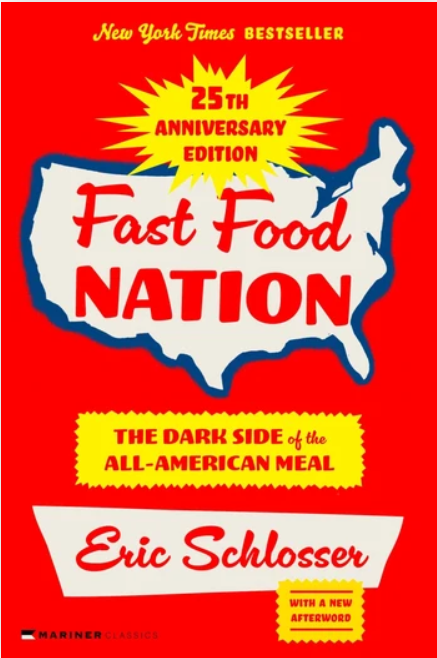
Weekend (Re-)reading: Eric Schlosser’s Fast Food Nation

Wish Fast Food Nation a happy 25th anniversary.

It’s hard for me to believe it’s been 25 years since this book first appeared, but 25th anniversary editions of my Food Politics and Michael Pollan’s Omnivore’s Dilemma are also in the works.

The book is about the beef industry and what it does to the animals, packing house workers, the environment, and human health.

Eric Schlosser wrote a new Afterword for this edition.

Here are two excerpts.

As of this writing…highly pathogenic avian influenza (H5N1) has not yet caused a deadly epidemic among human beings.  Pasteurization kills H5N1 in milk, and the virus hasn’t yet mutated to become for contagious or more lethal.  But H5N1 has become endemic among wild birds, chickens, turkeys, and dairy cattle in the United States, allowing a continual mixture of its genes.  A bird flu epidemic that kills millions of people may never emerge from America’s factory farms—or it may next week, next month, next year.  The industrialization of livestock, the transformation of sentient creatures into commodities, and the absence of government oversight have created an efficient system for creating dangerous new pathogens.  As this book argued twenty-five years ago, that’s the price we pay for cheap meat.  That price doesn’t appear on the menu. (p. 312)

Economists often use the four-firm concentration ratio as a measure of the competition in a market for goods and services.  When four companies gain a combined market share of 40 percent or higher, an oligopoly has formed.  The prices offered to suppliers, the prices charged to consumers, and the wages paid to workers are no longer determined mainly by market forces.  A handful of companies have gained control of the market.  Effective government regulation becomes more difficult, as state and federal agencies readily become “captive” to the corporations they’re supposed to oversee.  Today, four companies control about 60 percent of the worldwide market for seeds and 61 percent of the market for pesticides.  Four companies control about 70 to 90 percent of the worldwide trade in grain.  Four companies are responsible for processing about 70 percent of America’s hogs and 85 percent of its cattle.

This book kicked off the food movement 25 years ago.  If you haven’t read it, now is the time.  We need it more than ever.

The post Weekend (Re-)reading: Eric Schlosser’s Fast Food Nation appeared first on Food Politics by Marion Nestle

GLP-1 Drugs: A collection of items

More and more Americans are taking GLP-1 drugs; the current estimate is 11%.

This causes a big problem for the food industry.  Eating less is bad for business.

Here are some of the ways the food industry is responding.

Analyzing the GLP-1 consumer

Dealing with labeling issues

Developing new products

_________________________

Arriving Sept 8. For a 30% discount, pre-order here using code UCPSAVE30.

The post GLP-1 Drugs: A collection of items appeared first on Food Politics by Marion Nestle

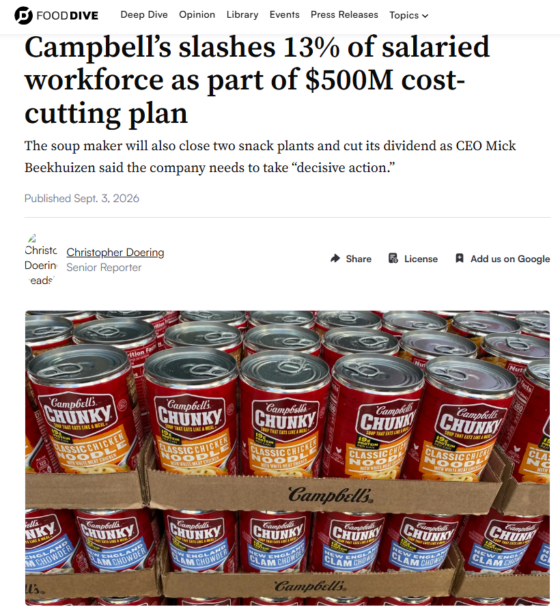
Layoffs: a sign of flagging food industry sales

I was struck by this announcement: 

Campbell’s is not the only one.  Also see:

What’s going on?  I see four reasons for declining food sales.

  • RFK Jr says the food industry is poisoning America
  • Health advocacy to reduce intake of ultra-processed foods
  • The effect of GLP-1 agonist drugs in reducing food intake
  • Inflation in food prices

These trends may do wonders for health.

But to the food industry, they are a worry: eating less is bad for business.

The post Layoffs: a sign of flagging food industry sales appeared first on Food Politics by Marion Nestle

Who is lobbying about the forthcoming school food rules?

If you want to know why school food is so controversial, and improving its nutrition quality is so difficult, follow the money.

A reader, Jennifer Windh, says she is a mom of a second grader in Texas (Tomball School District) and a member of “Make Texans Healthy Again.”  She tells me she asked ChatGPT to summarize information about food lobbying on the new school food rules:

I’ve been tracking USDA’s forthcoming proposed rule updating the Child Nutrition Programs to align with the 2025–2030 Dietary Guidelines for Americans (RIN 0584-AF17). USDA sent the proposed rule to the White House Office of Information and Regulatory Affairs (OIRA) for review on July 20, and USDA’s regulatory agenda currently targets publication in September.

While the proposed rule itself is not yet public, OIRA’s public meeting records give us some clues about what may be under consideration. Outside groups can request meetings with OIRA while a significant regulation is under review, and OIRA publishes the identity of the groups, attendees, and materials they submit.

Much applause to Jennifer for digging into who is pushing OIRA about food and nutrition standards for school meals.

Date Organization Key Participants / Interests Documents Submitted
Aug. 10 USA Rice Tracy Gensler; Cameron Jacobs USA Rice Proposed School Meal Nutrition Standards Final OMB
Aug. 11 American Bakers Association Campbell Genn; Eric Dell; Rasma Zvaners; others None listed
Aug. 13 American Frozen Food Institute AFFI; Schwan’s; Wyman’s; Wawona Frozen Foods; Conagra; J.M. Smucker 3 documents concerning smoothies/frozen foods
Aug. 14 National CACFP Association McKenzie Brunner; Alexia Thex CACFP Alignment and Reality of Implementing 2025–2030 DGAs
Sept. 1 Plant Powered School Meals Coalition Physicians Committee for Responsible Medicine; Alexandria City Public Schools; Plant Powered School Meals Coalition 5 documents concerning meat/MMA requirements, nondairy milk, processed meat, and related issues
Sept. 2 School Nutrition Association SNA; Caprock Strategies None confirmed
Sept. 3 The Grain Chain Campbell Genn None confirmed
Sept. 4 Urban School Food Alliance Urban School Food Alliance; OFW Law None confirmed
Sept. 8 TBD Meeting occurred/scheduled; full organization and participant information needs confirmation TBD
Sept. 11 – 2:00 p.m. ET TBD OIRA meeting on USDA school-food rule TBD
Sept. 11 – 2:30 p.m. ET Meat Institute appears to be requestor Susan Backus listed as requestor; final OIRA participant list pending TBD

The table does not say what these participants were asking for, but let’s speculate.  The new dietary guidelines call for more real food, less highly processed food, and less sugar, but more protein, healthy fats, and whole milk dairy.

The trade associations want the USDA to require meals to have more of their products: rice, bread (not too much whole wheat), frozen foods, grains (preferably not whole), and meat.

The National CACFP (Child and Adult Care Food Program) Association advocates for this desperately underfunded program and surely is asking for more funding to comply with new DGA standards.

The Plant Powered groups want more plant foods and less meat and dairy.

The Urban School Food Alliance works with school districts to provide healthy food to low-income kids.  I’ll bet it’s asking for more funding too.

Of special interest is the position of the School Nutrition Association, which supposedly represents school food service workers.

It is heavily sponsored by food companies.   Its position on forthcoming rules is that

Any new rules limiting UPFs in schools must ensure meal programs are permitted to serve nutrient-dense, pre-prepared foods. Schools are simply not equipped to scratch prepare all menu items – more than 93% cited the need for more staff, culinary training, equipment and infrastructure to reduce reliance on UPFs.

To see what attempts to improve the nutritional quality of school meals are up against, take a look at the SNA’s talking points defending highly processed snack foods as well as sugary foods.

As it happens, a new analysis shows that basically all snack foods sold in schools are ultra-processed.

And another analysis of 10,000 school lunches, Beyond the Nugget: The Hidden Health Risks of Industrially Produced Animal Proteins—and the Path Toward Better School Lunchesfrom Friends of the Earth and Chef Ann Foundation, finds that they are “dominated by industrially produced meat and cheese, raising concerns about children’s exposure to known carcinogens, ingredients of concern and potentially undisclosed contaminants, including veterinary drug, dioxin and pesticide residues.”

The big questions:

  • Will the calls for less ultra-processed food and sugar survive this kind of lobbying opposition?
  • Will school meals get enough funding to do what the guidelines call for?

I can’t wait to find out.

The post Who is lobbying about the forthcoming school food rules? appeared first on Food Politics by Marion Nestle

Industry-funded study of the week: dairy trans fats

I learned about this one from a press release: Natural trans fats in dairy do not raise heart disease risk.

Trans fats found naturally in dairy foods such as milk, butter and cheese do not increase the risk of heart disease or type 2 diabetes, a new study has found.

Who, I wondered, could possibly have paid for this study?

Bingo!

This research was funded by the National Dairy Council (USA). Several authors work for or receive funding from dairy interbranch or industry organisations.

I could see why the dairy industry would fund something like this.

Ruminants—cattle and dairy cows—naturally hydrogenate unsaturated fatty acids and convert them to trans fats, the bad kind that raise the risk of heart disease.

Meat and dairy producers would love to be able to show that naturally hydrogenated trans fats are healthier than those that are artificially hydrogenated.  Hence this study.

The study:  Gayet-Boyer, C., Tenenhaus-Aziza, F., Torres-Gonzalez, M., Givens, D.I., & Schweitzer, C. (2026). Trans fatty acids from dairy foods do not affect risk of cardiometabolic diseases: Systematic review and meta-analysis of evidence from randomized controlled trials and systematic review of prospective cohort studies. Nutrition Research, 150, 33–48. https://doi.org/10.1016/j.nutres.2026.03.009

Comment: Would independent scientists who demonstrated the harm of artificial trans fats find something different with ruminant trans fats?  I’d like to see those studies.

The post Industry-funded study of the week: dairy trans fats appeared first on Food Politics by Marion Nestle

What are the top food brands?

The industry newsletter, FoodNavigator, reports the top  international Big Food companies.

The full list is here.

Nestlé (no relation) is the clear winner.

Among the top 10, only Danone and Tyson report lower sales in 2026 than in 2025. I can only speculate about the reasons, but am guessing problems in the beef supply and reduced consumer demand as factors for Tyson, and maybe the infant formula recalls affected Danone?

It’s interesting that only four of these brands are in the U.S.  Actually, only three U.S. companies are involved since both Lay’s and Doritos are owned by PepsiCo.  Two companies are Swiss and two are Chinese.

Of special interest: Both Yili and Mengniu sell dairy products: milk, yogurt, ice cream, and cheese.  But almost all Chinese people have problems digesting lactose.

When I was in Beijing in 2019, I was told that the Chinese government wants its people to consume these foods in the belief that dairy products promote growth in children’s height.

If this list just looked at the U.S., Walmart would head the list.

The post What are the top food brands? appeared first on Food Politics by Marion Nestle

❌