 Login
It’s election day: Vote!

The post It’s election day: Vote! appeared first on Food Politics by Marion Nestle

The post It’s election day: Vote! appeared first on Food Politics by Marion Nestle
Thanks to Earlene Cruz, a doctoral student in my NYU department, for sending this contribution to my collection, a press release from the University of Reading.
Natural Trans Fats in Dairy Do Not Raise Heart Disease Risk:Researchers at the University of Reading found that naturally occurring trans fats in dairy foods are not linked to higher risk of heart disease or type 2 diabetes, distinguishing them from industrial trans fats. Read More
It links to the original paper: Trans fatty acids from dairy foods do not affect risk of cardiometabolic diseases: systematic review and meta-analysis of evidence from randomized controlled trials and systematic review of prospective cohort studies. Nutr Res. 2026;150:33–48.
Its highlights:
Sources of support: This research was funded by the National Dairy Council (NDC), USA, and Centre National Interprofessionnel de l’Economie Laitière (CNIEL).
Author declarations: C.S. received research funding from Dairy Management, Inc. C.G.-B. and F.T.-A. work for the French dairy organization, CNIEL. M.T.-G. works for the National Dairy Council. D.-I.G. has received funding from various international dairy organizations.
Comment: This is a literature review funded by the dairy industry and conducted by employees or recipients of research funding from dairy companies or trade associations. Industrially hydrogenated trans fats demonstrably raise the risk of heart disease. Ruminant animals naturally hydrogenate unsaturated fats and convert them to trans fats. These differ in some ways from industrial trans fats, but are still trans fats. Whether naturally occurring trans fats are as harmful as industrial trans fats is of great concern to the dairy industry, which would like to prove that dairy fats do not raise the risk of heart disease. Animal welfare groups such as the Physicians Committee for Responsible Medicine argue that dairy fats do raise such risks. Hence, this review. This question would be easier to resolve if the investigators doing the research were independent.
The post Industry funded study of the week: Trans fats appeared first on Food Politics by Marion Nestle
Halloween is about selling candy and lots of it. Here is a small collection of items about the Halloween business.
The post A food business opportunity: Happy Halloween! appeared first on Food Politics by Marion Nestle
I am seeing more and more notices of food factory closures. Here are some examples:
And their consequences:
Food and beverage layoffs accelerate: The sector has slashed close to 30,000 jobs as of September, up 76% from the same period last year.
What’s going on?
The standard explanation is efficiency, which translates to reducing production costs.
This, in turn, translates to reducing labor costs and avoiding local taxes.
Americans are spending less on food as a result of the effects of concerns about ultra-processed foods, GLP-1 drugs, and inflation.
This is another reason to invoke my mantra: Eating less is bad for business.
The post Food factory closures: anomaly or trend? appeared first on Food Politics by Marion Nestle
As the co-author of a new book on breakfast cereals, I’m tracking what’s happening with them with great interest.
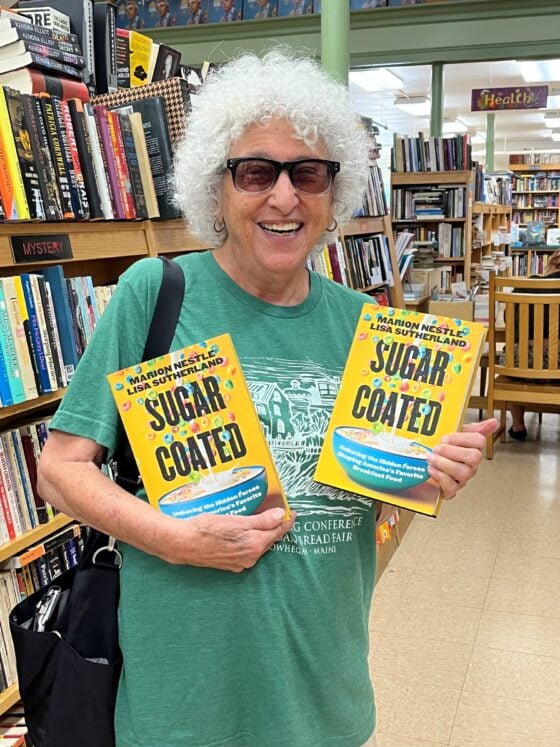
Three recent articles describe what’s currently happening with the cereal industry.
I. Christopher Doering in Food Dive: Can WK Kellogg save cereal? After years of sales declines amid a shift in eating habits, executives at the Froot Loops and Frosted Flakes manufacturer have a plan to give the category a wake-up call.

II. Kim Severson in the New York Times: Cereal Is in a Crunch. Can a Health Pitch Save It? As more Americans turn away from the snap, crackle and sugar, the industry is trying to capitalize on our current obsession with wellness.
Severson quotes us about our book.
III. Ted Kyle in ConscienHealth: Will Protein and Fiber Save the Ailing Cereal Business? The breakfast cereal business has a problem. After a brief reprieve during the pandemic, sales are hurting again. They’re down 13 percent from 2021.
Kyle produced this terrific AI illustration of my current favorite example of hilarious marketing.

And then there’s this item:
WK Kellogg bets on nutrition and schools to revitalize cereal: As cereal sales come under pressure, the company is reformulating iconic brands with more protein and fiber and less sugar while introducing school-focused products designed to win over the next generation of eaters… Read more
Comment: Sugar Coated explains the history of all this and why it is happening. Enjoy!
The post What’s happening with breakfast cereals? appeared first on Food Politics by Marion Nestle
Chris McCullum-Gomez sent this one.
Beef can fit into healthy diets, but what about its environmental cost?
This required a look at the actual study: Beef in nutritious and sustainable diets, by Julia Sekula, Shalene McNeill, Ruaraidh Petre, Zachary Gould. Animal Frontiers, Volume 16, Issue 5, October 2026, Pages 91–97, https://doi.org/10.1093/af/vfag028.
This is a research-based review and opinion study. It evaluates the contribution of beef to nutrition and health, and to meeting the United Nations’ Sustainable Development Goals.
Acknowledgments: This manuscript was invited for submission by the US Roundtable for Sustainable Beef. The views expressed in this publication are those of the author(s) and do not necessarily reflect the views or policies of the USRSB, the journal, or the publisher.
Comment: This is a study commissioned by the beef industry and conducted by researchers who work for the beef industry. It’s purpose was to demonstrate that beef intake is consistent with sustainable food systems. It makes “the case for moderate beef consumption.”
“Moderate,” of course, means different things to different people. The study does not define it.
The post Industry funded study of the week: Beef appeared first on Food Politics by Marion Nestle
Christopher Gardner. Food Sense: The Science and Practice of Eating Well. Simon Element, 2026 (287 pages).
Christopher Gardner and I were doing book events at the same time within a couple of miles of each other in Marin County, mine at Book Passage in Corte Madera, and his at Copperfields in Larkspur. We met for lunch after our talks (thanks to Will Rosenzweig).

I had done a blurb for his book:
Here is Christopher Gardner’s remarkably sensible and easy-to-read philosophy of how to eat healthfully and enjoyably, based on his extensive and deep scientific training, experience running clinical trials, and—delightful surprise–cooking skills (the book has recipes!). He uses all this to weigh in on your most perplexing questions about diet and health. Food for thought!
And here is a brief excerpt:
It makes sense that as a culture we’d be so interested in diet because we’ve been told for decades now that we as a society need to eat better, but the reality is that we’re up against a really powerful and entrenched food system that may have started with good intentions but hasn’t had our best interests at heart for some time. The competing priorities of taste, cost, and convenience can make even simple and straightforward nutrition guidance seem complicated. It’s a perfect environment for people to try to sell you miracle cures and quick fixes…So what do we do? Well, we need to empower ourselves with everything we’ve got to cut through the noise…[the approach you take] has to be louder than the messages you’re getting from, well, everywhere…most importantly, it needs to offer you a strong foundation based in science with lots of room for flexibility (pp. 6-7).
A few chapter titles:
It’s a great read. Take a look!
The post Weekend reading: Christopher Gardner’s Food Sense appeared first on Food Politics by Marion Nestle
I have a long-standing interest in pet food and subscribe to Pet Food Industry, a truly superb trade publication. It recently carried this item (don’t miss its AI illustration):
Pet food marketers’ guide to blame-free obesity communication: Respectful communication does not require avoiding the word obesity. The guide favors precise descriptions over euphemisms that can minimize a health concern. Read more
It seems that the Association for Pet Obesity Prevention (yes, this organization exists) has published 2026 Pet Obesity Communication Guidelines.
These advise the same kinds of things as ConscienHealth advises for health professionals dealing with humans with obesity.
- Describe pets as having a condition rather than defining them by weight—say “a dog with obesity” instead of “an obese dog”
- Connect messaging to health goals like mobility, quality of life, and comfort rather than weight loss guarantees
- Avoid shock-value images, before-and-after campaigns without context, and language that shames pet owners or ridicules animals
- Direct owners toward veterinary consultation with specific, actionable next steps rather than immediate diet changes
- Test messages with your target audience to ensure clarity and identify whether wording feels accusatory or prevents action
The Communication Guidelines have lots of useful suggestions. For example:

Obesity is rampant in dogs and cats. Veterinarians have a lot of work to do. This guide should help.
The post Guidelines for talking about pet obesity with respect appeared first on Food Politics by Marion Nestle
FoodNavigator.com ran this item a couple of weeks ago. I haven’t seen much about it in the US press.
Nestlé Russia falls under Kremlin control: Food and beverage giant vows to protect its rights after Russia transfers control of local business to state-appointed administrator. Read more
Apparently, Russia is transferring Nestlé’s assets to LEV Management based in Moscow. Not much is known about that company; it was created in 2025 and nobody knows what it does, according to the account in Le Monde,
Russian authorities have seized the businesses and assets of Swiss food giant Nestlé and three French groups, a move the Kremlin defended Friday, September 18, as a justified measure against firms representing “unfriendly countries” that back Ukraine.
Le Monde quotes Nestlé as saying the company is “assessing the situation and its options.” Nestlé is said to have 6 factories in Russia employing around 7,000 people, who produce coffee, pet care, infant nutrition and confectionary products. Russia accounts for about 1% of the group’s sales, down from around 2% before the Ukraine war.
Nestlé (no relation) is a huge company in 185 countries with 271,000 employees, sales of $89.5 billion and 30 brands generation a $billion or more annually.
The seizure won’t hurt Nestlé much (we can ask why Nestlé was in Putin’s Russia in the first place) but it’s a sure sign that US food companies need to get out of there.
As I keep saying, the food industry is in big trouble these days. Here is one more piece of evidence.
The post Russia seizes Nestlé’s assets over support for Ukraine appeared first on Food Politics by Marion Nestle
Jerry Mande of Nourish Science sent me this item from The Examination: Junk food researcher finds hidden hand in ultraprocessed foods debate.
This, in turn, referred to Nine in ten research papers disputing definition of ultraprocessed foods have industry ties, study finds.
This, in further turn, referred to a study in the American Journal of Public Health: Characterizing Food Industry Affiliations Among Critics of the Nova Food Classification System: A Systematic Review. Am J Public Health. 2026 Nov;116(11):1790-1799. doi: 10.2105/AJPH.2026.308691. Epub 2026 Sep 17.
Of 69 articles from 2009 to 2025 criticizing the Nova classification system for ultra-processed foods or defending ultra-processed foods:
Arguments defending or promoting ultraprocessed foods appeared in
Given the tobacco industry’s well-documented strategy of manufacturing academic doubt about its products’ harms, these findings raise concern that the food industry may be following a similar playbook as evidence for the health risks of ultraprocessed foods continues to grow.
These results certainly do raise concern. They confirm what I’ve long suspected. The food industry does not like the concept of ultra-processed food. Defining it makes research possible. This research shows diets high in ultra-processed foods to be bad for health. If people eat less of them, sales and profits will decline (and this is already happening). The main opposition to defining ultra-processed foods and advice to eat less of them comes from the food industry (other opposition comes from nutrition researchers who object to the focus on processing rather than nutrient content). This study provides further evidence for the bias introduced by industry funding of research.
The bottom line: not eating too much ultra-processed junk food is likely to improve health.
The post Most studies criticizing the Nova classification of ultra-processed foods are funded by food companies appeared first on Food Politics by Marion Nestle
Phil Baker sent me this one:
The Study: Effect of non-nutritive sweetened beverages v. water on body weight: long-term results of a randomised controlled trial. Joanne A. Harrold , Scott Hill, Cristina Radu, Paul Thomas, Paula Thorp, Charlotte A. Hardman, Paul Christiansen, Una Masic, Lauren McGale, Dan J. Cuthbertson and Jason C.G. Halford. . British Journal of Nutrition 136: 482–493. doi: 10.1017/ S0007114526108150
Purpose: The aim of this study was to provide robust evidence on the long-term use of non-nutritive sweetened (NNS) beverages on weight management.
Method: Compare NNS beverages to water during 1 year of assisted weight management followed by a voluntary, unassisted 1-year extension.
Results: Participants consuming water maintained a weight loss of 3·7 kg over 104weeks, compared with 4·8 kg with NNS beverages (not statistically significant).
Conclusion: Our findings suggest people can lose weight and maintain it for 2 years, when drinking either NNS beverages or water and taking part in weight-management programmes.
Financial support. This trial was funded by the American Beverage Association. The American Beverage Association was not involved in the design, conduct, analysis of data or interpretation of this trial; a representative from the American Beverage Association was provided with the opportunity to review the manuscript. Final decisions regarding the content were made by the authors. The manuscript was developed with the assistance of a medical writer, funded by the American Beverage Association, under the direction of the authors. A third-party organisation (Biofortis) audited data at the clinical site to check for the accuracy and integrity of the data.
Competing interests. Joanne A. Harrold reports funding (paid to the University of Liverpool) from the American Beverage Association for the present study. Outside of the submitted work, she reports a grant from the European Commission for the Horizon 2020 project SWEET. Scott Hill reports funding (paid to the University of Liverpool) from the American Beverage Association for the present study. Cristina Radu reports funding (paid to the University of Liverpool) from the American Beverage Association for the present study and funding from Coca Cola for a PhD studentship outside of the submitted work. Paul Thomas reports funding (paid to the University of Liverpool) from the American Beverage Association for the present study. Paula Thorp reports funding (paid to the University of Liverpool) from the American Beverage Association for the present study. Charlotte A. Hardman reports funding (paid to the University of Liverpool) from the American Beverage Association for the present study. Outside of the submitted work, she reports honoraria from the International Sweeteners Association, International Food Information Council and Mars Global Nutrition Advisory Council (paid to the University of Liverpool); grants from the European Commission for the Horizon 2020 project SWEET, the Biotechnology & Biological Sciences Research Council and the Natural Environment Research Council (paid to the University of Liverpool); primary supervisor on a PhD studentship funded by Coca Cola (awarded to CR); personal fees for her role on the Food Standards Agency Advisory Committee on Social Sciences and an unpaid role as a trustee of Feeding Liverpool. Paul Christiansen reports funding (paid to the University of Liverpool) from the American Beverage Association for the present study. Outside of the submitted work, he reports grants from the European Commission for the Horizon 2020 project SWEET, the National Institute for Health and Care Research, the Home Office UK and the Federal Bureau of Investigation and personal fees from Kaplan and Crohn’sandColitisUK. Una Masic reports funding (paid to the University of Liverpool) from the American Beverage Association for the present study. Lauren McGale reports funding (paid to the University of Liverpool) from the American Beverage Association for the present study. Outside of the submitted work, she reports funding (paid to the University ofLiverpool) fromtheWHO,andfunding(paid to the University of Wollongong) from the Australian Government’s Department of Health and Aged Care. Daniel J. Cuthbertson reports funding (paid to the University of Liverpool) from the American Beverage Association for the present study. Outside of the submitted work, he reports funding from Novo Nordisk and AstraZeneca for investigator-initiated research and consultancy (paid to the University of Liverpool) and educational grants from Perspectum. Jason C.G. Halford reports funding (paid to the University of Liverpool) from the American Beverage Association for the present study. Outside of the submitted work, he reports a grant from the European Commission for the Horizon 2020 project SWEET; consultancy fees from Boehringer Ingelheim, Dupont and Mars (all paid to the University of Leeds); honoraria from Novo Nordisk (paid to the University of Leeds); support for attending meetings from Novo Nordisk; financial support for participation in an advisory board for Dupont (paid to the University of Leeds); unpaid participation in an advisory board for the Sweet Tooth Project and unpaid board membership of the European Coalition of People Living with Obesity. He is treasurer of the World Obesity Federation.
Comment: This study was commissioned by, paid for, and reviewed by the American Beverage Association. The authors were paid by the ABA to do the study (the University of Leeds must be a hotbed of research funded by the soda industry). Why do this? People consuming artificially sweetened drinks sometimes are shown to gain weight on them. This study aimed to demonstrate—and did—that artificially sweetened drinks are as good as water during weight loss. The ABA got what it paid for.
The post Industry-funded study of the week: artificially sweetened drinks vs. water appeared first on Food Politics by Marion Nestle
In the most complete analysis yet, Protect Our Care has issued a devastating report card on the failure of the Trump administration to keep its MAHA promises.
The report: MAHA Betrayed: Trump, RFK Jr. Keep Selling Out Movement to Corporate Polluters and Poison Peddlers
For over a year, Donald Trump and his Health Secretary Robert F. Kennedy Jr. promised the Make America Healthy Again movement that this administration would finally take on Big Food, Big Ag, and Big Chemical. Instead, they have delivered a steady diet of broken promises, corporate quid pro quos, and foodborne illnesses….But a year into his [RFK Jr’s] tenure, the receipts tell a different story: cancer-linked chemicals back on the market, food safety agencies gutted, families paying more for groceries, and even the movement’s founders wondering whether they’ve been put out to political pasture.
The report details and documents broken promises about chemicals, pesticides, and corporate capture, especially to women.
Here is one item as an example:
Kennedy Stays Silent While EPA Betrays MAHA on Toxic Chemicals. While MAHA leaders have spoken out about air and water pollutants, Trump’s EPA has now shut down plans to release a MAHA agenda and the NIH has stopped accepting submissions for its flagship journal on environmental health and yanked research grants.. EPA scientists were pressured to alter safety reviews of chemicals in household cleaners and cosmetics to make risks appear less serious than the data shows — whitewashing health risks of the products MAHA’s core constituency was promised would be regulated. At a chemicals summit, Kennedy praised an Oregon State researcher’s microplastics study from the podium — unaware, or unbothered, that an hour earlier she’d learned EPA had just terminated the grant funding that research.
Kennedy has stayed similarly silent as EPA rolls back the very mercury rules he spent decades fighting for. As an environmental attorney, he sued over mercury pollution and personally developed “word retrieval and memory problems” from mercury-tainted fish. EPA announced its rollback of mercury emissions rules the day after the MAHA Commission, which Kennedy and Zeldin both sit on, held its first meeting. A recent report from Climate Power and Protect Our Care details how Trump has eliminated 31 pollution protections that, together, were set to deliver $275 billion in benefits per year and prevent 30,000 deaths annually.
Take a look at the report. The list is long, alas.
The post Weekend reading: MAHA betrayed appeared first on Food Politics by Marion Nestle
I was interested to see this chart from the USDA: Chart of Note: U.S. food system required greater share of national water use compared to employment or energy use: Water, labor, and energy are resources relied upon throughout the U.S. food system. The food system comprehensively required more than a quarter of total U.S. freshwater use each year from 2010 to 2023….In 2023, the U.S. food system relied on 27.7 trillion gallons of freshwater, or 29.3 percent of total freshwater withdrawals.

This, of course, explains the depletion of the Ogallala aquiver.
Sustainable agriculture anyone?
The post The food system uses a lot of water appeared first on Food Politics by Marion Nestle
While I’m thinking about food fraud (see last week’s post), I’ve always said that the fish counter is the wild west of the supermarket. The Food and Agriculture Organization of the UN would agree.
provides information on tools that can be used to fight food fraud for aquatic products, and international case studies illustrate the scope and impact of fraud. The report reviews regulatory frameworks as well as standards such as those set by Codex Alimentarius, FAO guidelines, and GFSI‑benchmarked schemes, advocating for harmonized labelling, mandatory scientific names, and improved traceability. It emphasizes the role of consumer awareness and industry transparency in combating fraud.
Well, good luck with that.
The report covers these kinds of fraud:

There is lots of it:

What can I say? Know your fish seller.
Caveat emptor!
The post A fishy story: Food fraud in the fisheries and aquaculture sector appeared first on Food Politics by Marion Nestle
A reader and doctoral student in my NYU department, Earlene Cruz, sent this classic example, a press release from the University of Leeds: Major trial examines no-sugar sweetened soft drinks
The major new study was published in the British Journal of Nutrition and provides long-term clinical evidence that NNS beverages – specifically those containing aspartame, acesulfame potassium (acesulfame K), and sucralose – are equivalent to water in supporting weight loss and long-term weight maintenance.
The press release explains the rationale for doing this: “Overall, the results do not support concerns that NNS beverages disrupt appetite regulation or have long term metabolic harm.”
Who would be most interested in debunking this idea?
High marks to the press release for disclosing the funder: The American Beverage Association.
And why would the American Beverage Association care so much?
Policy impact: Importantly, the findings directly address recent World Health Organization (WHO) guidance, which advised against using non-sugar sweeteners for weight control due to uncertainty in observational studies. The SWITCH trial provides long-duration, randomised controlled evidence which can be used to inform global guidelines.
Isn’t it handy that the results can be used to argue against the WHO’s advisory.
This is one reason why beverage companies and their trade associations invest in research.
I took a look at the study itself and was glad I did. Check this (my emphasis in red):
Financial support: This trial was funded by the American Beverage Association. The American Beverage Association was not involved in the design, conduct, analysis of data or interpretation of this trial; a representative from the American Beverage Association was provided with the opportunity to review the manuscript. Final decisions regarding the content were made by the authors. The manuscript was developed with the assistance of a medical writer, funded by the American Beverage Association, under the direction of the authors. A third-party organisation (Biofortis) audited data at the clinical site to check for the accuracy and integrity of the data.
Competing interests: Joanne A. Harrold reports funding (paid to the University of Liverpool) from the American Beverage Association for the present study. Outside of the submitted work, she reports a grant from the European Commission for the Horizon 2020 project SWEET. Scott Hill reports funding (paid to the University of Liverpool) from the American Beverage Association for the present study. Cristina Radu reports funding (paid to the University of Liverpool) from the American Beverage Association for the present study and funding from Coca Cola for a PhD studentship outside of the submitted work. Paul Thomas reports funding (paid to the University of Liverpool) from the American Beverage Association for the present study. Paula Thorp reports funding (paid to the University of Liverpool) from the American Beverage Association for the present study. Charlotte A. Hardman reports funding (paid to the University of Liverpool) from the American Beverage Association for the present study. Outside of the submitted work, she reports honoraria from the International Sweeteners Association, International Food Information Council and Mars Global Nutrition Advisory Council (paid to the University of Liverpool); grants from the European Commission for the Horizon 2020 project SWEET, the Biotechnology & Biological Sciences Research Council and the Natural Environment Research Council (paid to the University of Liverpool); primary supervisor on a PhD studentship funded by Coca Cola (awarded to CR); personal fees for her role on the Food Standards Agency Advisory Committee on Social Sciences and an unpaid role as a trustee of Feeding Liverpool. Paul Christiansen reports funding (paid to the University of Liverpool) from the American Beverage Association for the present study. Outside of the submitted work, he reports grants from the European Commission for the Horizon 2020 project SWEET, the National Institute for Health and Care Research, the Home Office UK and the Federal Bureau of Investigation and personal fees from Kaplan and Crohn’s and Colitis UK.
Una Masic reports funding (paid to the University of Liverpool) from the American Beverage Association for the present study. Lauren McGale reports funding (paid to the University of Liverpool) from the American Beverage Association for the present study. Outside of the submitted work, she reports funding (paid to the University of Liverpool) from the WHO, and funding (paid to the University of Wollongong) from the Australian Government’s Department of Health and Aged Care. Daniel J. Cuthbertson reports funding (paid to the University of Liverpool) from the American Beverage Association for the present study. Outside of the submitted work, he reports funding from Novo Nordisk and AstraZeneca for investigator-initiated research and consultancy (paid to the University of Liverpool) and educational grants from Perspectum. Jason C.G. Halford reports funding (paid to the University of Liverpool) from the American Beverage Association for the present study. Outside of the submitted work, he reports a grant from the European Commission for the Horizon 2020 project SWEET; consultancy fees from Boehringer Ingelheim, Dupont and Mars (all paid to the University of Leeds); honoraria from Novo Nordisk (paid to the University of Leeds); support for attending meetings from Novo Nordisk; financial support for participation in an advisory board for Dupont (paid to the University of Leeds); unpaid participation in an advisory board for the Sweet Tooth Project and unpaid board membership of the European Coalition of People Living with Obesity. He is treasurer of the World Obesity Federation.
Comment
This is an industry study through and through. I consider it marketing, not science.
The post Industry-funded study of the week: the American Beverage Association at work appeared first on Food Politics by Marion Nestle
I was asked to write the Foreword to a special issue of Georgetown University’s Science Politics titled “Food Forward.”
As its editor, Emily Medenhall, explains,
In these essays, the authors consider how food is produced, distributed, purchased, shared, consumed, and experienced.
But instead of thinking only about what’s wrong, they think about how to create a better, safer, and more nourishing world. By investing in food, we cultivate strong bonds that strengthen families, economies, and the planet.
Here’s my Foreword but do read the essays; they are at the link above.

The post Weekend reading: Science Politics appeared first on Food Politics by Marion Nestle
Who knew that food manufacturers would be up against these kinds of frauds? Not me. That’s why I was interested to run across these items.
CANDY: Confectionery fraud surges as manufacturers struggle to stay ahead: Confectionery fraud is rising as volatile cocoa markets, premium ingredient demand and supply chain disruption create new opportunities for adulteration, substitution and counterfeiting.

WINE: National Food Crime Unit arrests man in £500K counterfeit wine bust: An operation by the Food Standards Agency (FSA) and National Food Crime Unit (NFCU) has resulted in an arrest over alleged wine fraud…. Read more
SUPPLEMENTS: Botanical adulteration on the rise despite 15 years of industry action: Adulteration is one of the most significant and persistent issues facing the botanical industry, and the issue appears to be on the rise, exacerbated by supply chain pressures, trade wars and climate change…. Read more
COMMENT
Food fraud is so common the the FDA has a page on it.
Estimating how frequently food fraud occurs or its exact economic impact can be hard because food fraud is designed to avoid detection. Outside estimates by experts have found that food fraud affects 1% of the global food industry at a cost of about $10-$15 billion a year, although some more recent expert estimates put the cost as high as $40 billion a year.
Caveat emptor!
<
The post Crime and fraud in the food industry appeared first on Food Politics by Marion Nestle
I first heard this big news from FoodNavigator:
California signs voluntary non-UPF label into law: Gov. Gavin Newsom’s signing of AB 2244 into law creates the first state-backed, voluntary label for non-UPF qualifying products, amid a pending federal UPF definition. Read more.California is the first state with a government-backed label for qualifying foods that are not considered ultra-processed, following Gov. Gavin Newsom’s signing of Assembly Bill 2244, legislation introduced by Assembly member Jesse Gabriel, D-Encino.
The new law establishes a voluntary “Non-Ultraprocessed Certified” label intended to help consumers more easily identify foods that meet California’s non-UPF standard. The label is the latest step in California’s broader effort to address ultra-processed foods, with implications to set a blueprint for the rest of the country. According to the governor’s office, the label will provide front-of-package information for shoppers while also improving visibility of qualifying products on shelves.
While the federal government is dithering about what it sees as a vexing problem—defining ultra-processed foods—California has just passed its own non-UPF standard. Its definition:
Existing law defines, for certain school-related purposes, “ultraprocessed food” as any food or beverage that contains a specified substance and either high amounts of saturated fat, sodium, or added sugar or a nonnutritive sweetener or other substance, as specified.
The school food definition specifies amounts per serving of trans fats, salt, sugar, and calories, and artificial colors. This definition adds artificial sweeteners.
Why is the federal government having so much trouble with this? Well, the makers of ultra-processed foods don’t want it defined unless the definition focuses on nutrients.
The Institute of Food Technologist, for example, wants “policymakers to focus on the nutritional quality of foods rather than processing level alone and cautioned against relying on existing UPF classification systems as the basis for public policy (view IFT comments).”
Many commonly used UPF classification systems focus primarily on processing intensity rather than nutritional value. As a result, foods such as whole-grain bread, yogurt, fortified cereals, infant formula, allergy-friendly foods, and medical nutrition products can be categorized as ultra-processed despite providing important nutritional benefits. That distinction matters. Policies based largely on processing criteria could unintentionally penalize foods that help consumers meet nutrient needs and support broader public health objectives.
Medical foods could easily be exempted from the definition. So could those considered “healthy” by the FDA.
The arguments aren’t really about the science; they are about protecting sales of ultra-processed foods.
By this time, it’s pretty obvious that eating real food and reducing intake of ultra-processed foods is likely to promote health.
California’s new Non-UPF label is a good first step,
I can’t wait to see what it looks like.
The post California passes Non-Ultraprocessed Food Label! appeared first on Food Politics by Marion Nestle
Stuart Gillespie, author of Food Fight, and Julia Belluz, co-author with Kevin Hall of Food Intelligence, asked me to co-post their jointly posted Substacks today, which I am happy to do.
Fighting our toxic food environment: what can I do?
Making the healthiest choice the easiest choice
We are living in the era of diet and nutrition hype. Top up your protein! Don’t spike your glucose! Take these supplements! The advice is both omnipresent and inescapable. A Kaiser Family Foundation Poll of US adults found 72 percent reported seeing weight loss, diet, or nutrition content on social media over the last month, making it among the most popular content categories. Even people who didn’t seek out the diet advice and don’t have social media said they were exposed.
And yet, what we’ve learned spending decades researching nutrition and diet-related diseases is that this industry of wellness products and individual diet protocols amounts to a great big distraction. Eating well is not that complicated, and it’s not a problem of individual choices and will. It’s a collective action problem. If junk food inundates people everywhere, even the best nutrition advice is going to be impossible to follow. If healthy food is the most expensive and laborious to prepare, eating well becomes a privilege few can afford.
Instead of more individual diet advice, we need to use our power to tackle the systemic and structural drivers of the toxic food environments around us. We need to fight to make healthy food the default.
Since we published our books, one of the most common questions we’ve received is: ‘Ok, but what can I do to help?’
We’ve learned a lot from discussions and responses to that question, in different settings. Drawing on this and the literature on activism and action in the food and health space, here are six key things individuals can do. (We promise, they don’t involve protein or supplements.)
Vote for a better food environment
As citizens in democracies, we have the power to vote in the governments we believe will act in the public interest. Elected officials have a range of policy and regulatory tools they can use to make food environments healthier for all. We detail them in our books, but briefly they include:
- Using government budgets to procure healthy foods (and limit ultra-processed foods) for institutions such as schools, government agencies, hospitals and clinics.
- Regulating advertising, labelling, marketing and the commercial promotion of unhealthy ultra-processed foods — including infant foods — using enforceable mandatory standards.
- Deploying economic tools to push people away from unhealthy foods (e.g. taxing harmful products, reforming agricultural subsidies) and toward healthier options (e.g. earmarking tax dividends to subsidize healthy diets for low-income families, supporting businesses that offer convenient and healthy ready meals in marginalized communities).
- Ridding advisory bodies, food regulatory bodies and dietary guideline committees of conflicts of interest, and cleaning up industry lobbying practices (via public registers, disclosure and bans on the ‘revolving door’ from food industry into public office).
Look out for representatives or parliamentarians who make these issues part of their platform, and support or vote for them. But don’t stop there. Hold them accountable once they’re in power. Write to them to ask what they’re doing on regulating food environments, especially to protect young children from harmful products.
Advocate for healthy food at work, school, and in our communities
At a more personal level, the food environments at the places we spend a lot of time outside the home — like our offices, schools, or community spaces — shape what and how much we eat every day, even below the level of conscious awareness. If you find you or your kids are being nudged in unhealthy directions by the lunches at school, or bottomless snacks at work, push for change. Form a coalition with other colleagues or parents who want to improve the food environment. Document the status quo, and how it’s harming collective health. Use that evidence to demand change. Convene a regular workplace committee meeting to discuss how your school or employer responds to your concerns. (For inspiration, Chefs in Schools is one group that’s organizing on the education front.)
There are other measures you can take to affect change locally. These include joining public campaigns, signing petitions to demand local governmental action, or using local media to get the word out.
You also have a right to protest. This can be digital (online, social media) or, physical (like marches, or protests outside industry HQs and government offices). ‘Democracy’ after all derives from the Greek for ‘people power’. (For more inspiration, Stuart provides examples of ‘food fighters’ who’ve had success in his book.)
The media part is easier than ever. You can reach out to your local, national or global media outlet of choice, or develop your own newsletter or social media campaign.
Build social movements or join civil society organizations
Savvy social movements can help raise awareness and affect change. One of our favorites is Bite Back, the UK’s leading youth-led activist movement on food and health. Their campaign started with a film about how marketing influences young people’s food choices below the level of conscious awareness. Eight adolescents were shown ads for unhealthy ‘triple dipped chicken’ and later asked to choose from a menu of 50 items. All picked the triple dipped chicken. (Julia and Kevin detail the group’s work in their book.)
In the last few years, the campaign has done more than just raise awareness. Its petitions and advocacy have helped expand the number of schools offering healthy free school meals, and restrict junk food advertising to kids in the UK.
There are other inspiring movements and campaigns working on improving food environments around the world. In America, you can check out the Center for Science in the Public Interest, EWG, Food Tank, Food and Water Watch, and Plant Powered Meals in Schools. Leading organizations in the UK include Action on Sugar, Children’s Food Campaign, Food Foundation, the Food, Farming and Countryside Commission, First Steps Nutrition Trust, the Right to Food Commission and Sustainable Food Places, and the Obesity Health Alliance. Globally, there’s the Slow Food movement, IPES-Food, the Milan Urban Food Policy Pact and the Global Health Advocacy Incubator.
You can join or support these or other civil society organizations. Many provide resources, expertise and platforms for citizen action. They also do a great job of raising public awareness about the way our food system operates, exposing problems, lobbying politicians and proposing alternative solutions, including drafting legislation, policies and standards.
Closer to home, you can start or join local food groups and volunteer on community schemes and social innovations, including local food partnerships that share ideas and resources across a national network.
Invest for health
Use your skills, energy, time and money to invest in a healthier world. Do you work for an organization that’s positive, negative (or neutral) with its impact on food and health?
What can you do, in your workplace, to push for change? How can your employer help create a healthier food environment for all?
Ask about your pension fund: what’s it invested in? Speak to your colleagues or workplace committee and challenge investment decisions. If your funds are invested in a Black Rock, Vanguard, State Street ‘ESG fund,’ dig deeper and ask which companies sit within the fund (recent research has shown that many such funds invest in harmful ultra-processed food corporations). Outside work, you have agency in where you invest your personal savings.
Shareholder activism and advocacy are gaining traction. NGOs purchase shares to acquire voting rights, which they use to challenge big food transnationals. These can shift their portfolios towards healthier products. ShareAction in the UK has been attending company AGMs and coordinating shareholders for several years, most notably with Nestlé. In 2023, it persuaded Tesco to report on the percentage of its profits that derive from healthy foods; Unilever soon followed suit.
Vote with your wallet by buying foods that reflect the kind of food system you want to live in. This can involve boycotting unhealthy and unsustainable or unethical foods, while ‘buycotting,’ or switching to, better products and brands.
Sue Big Food
Of everything on this list, we think the litigation lever is the one that has the potential to have the most impact on our food environment. Again and again in the history of public health, protections and regulations don’t arrive with just a damning pile of research evidence. They arrived following litigation.
More specifically, smart lawyers sue companies on behalf of individual plaintiffs who allege they’ve been harmed by products. Those lawsuits pile up, and often through legal discovery, even when the plaintiffs lose, secrets revealed change public opinion and embolden governments to act in the interest of public health. This happened with asbestos, cigarettes, and opioids. And as Julia recently detailed in the New York Times, such lawsuits have begun to pile up in the US against ultra-processed food companies. But we’ll need a lot more of them to really affect change and it’ll take time. We’ll also need cities and state governments to start to sue, too — something San Francisco took the lead on last December. You can get involved in this legal effort by launching a suit, as a lawyer, a plaintiff, or a city or state.
The lawsuits could also gain strength from proposed regulatory actions. The former US Food and Drug Administration commissioner David Kessler — who was a leading anti-smoking crusader — proposed a way to regulate ultra-processed foods using existing agency rules. Kessler filed a petition with the FDA to ask the agency to reconsider whether a broad category of refined carbohydrates used in many ultra-processed foods should still be considered safe according to FDA regulation. The petition has gained traction among US health leadership, but that hasn’t translated to any action yet.
Run the research, support the science, and build awareness
As we’ve seen with public health menaces of the past, we need a solid body of evidence to make the case that inaction on food environments is no longer an option. It took decades to build that case when it came to smoking, as well as lots of litigation. Right now, we have an overwhelming body of evidence on the links between diet and health, but we need more on how various factors in a food environment exert different levels of influence on peoples’ food choices. Nutrition research now is dominated by studies that focus on the impact of individuals foods or diets, and much of that evidence is observational, not causal. We need more high-quality, randomized control trials on the impacts of food environments.
This research needs to be free from conflicts of interest. It’s not enough to disclose a conflict. Industry-funded research is likely to generate a significant and systematic bias so conflicts need to be avoided.
One group that’s trying to address these problems in nutrition research is UPF.RAN (Ultra-Processed Food Research Action Network), a global network of researchers committed to advancing knowledge and action on ultra-processed foods. They’re focused on sharing documents and resources, grounded in scientific evidence and translating that evidence for policymakers, advocates, journalists, and educators.
Beyond the science and evidence, we need to get the message about toxic food environments out, and support those who do. Investigative and independent media are key players here. These groups include Lighthouse Reports which, along with others, highlighted the shocking degree of corporate litigation against governments who had introduced pro-health regulation. BMJ Investigations, meanwhile, exposed the rampant conflicts of interest within the UK’s foremost nutrition advisory body (Scientific Advisory Committee on Nutrition). In the US,
US Right to Know and Open Secrets have been using Freedom of Information legislation in their pursuit of truth and transparency in public health.
We can strengthen our own awareness and knowledge by enrolling in online or physical courses, discussion groups, summer schools, and webinars, or just listening to podcasts and lectures. (Stuart was recently involved in the launch of a new series of short courses, run by the Brighton & Hove Food Partnership, for example). There’s no need to start from scratch. Many of the NGOs mentioned above provide technical support and training and they’ve developed adaptable toolkits.
In sum, these are the six actions we think go a long way towards tapping into the latent power we hold, as individuals and collectively. But what do you think? Let us know what you find most compelling and if there’s anything — or group— we’ve missed.
The post Promoting a health food system: A manifesto from Stuart Gillespie and Julia Belluz appeared first on Food Politics by Marion Nestle
I learned about this one from an article in Science Daily that reads like a press release:
Eating grapes daily could unlock powerful skin protection
New research suggests grapes may help “rewire” your skin’s defenses against sun damage at the genetic level.
Scientists discovered that eating grapes can actually change how your skin behaves at the genetic level. After just two weeks of daily grape consumption, volunteers showed signs of improved skin protection and reduced oxidative stress from UV exposure. Researchers say the effects appear widespread, even though every person’s genes responded a little differently.
The Study: Asim Dave, Sumi Piya, Dana-Lynn T. Koomoa, Ingo Lange, Jaewoo Choi, Richard B. van Breemen, John M. Pezzuto. Inter- and Intraindividual Variation of Gene Expression in Human Skin Following Grape Consumption and/or Exposure to Ultraviolet Irradiation. ACS Nutrition Science, 2026; DOI: 10.1021/acsnutrsci.6c00003
The funder: “Funding for the study was provided by the California Table Grape Commission.”
Comment: Participants consumed three servings of grapes a day. The investigators did not compare the effects of grapes to any other fruit but concluded grapes are a superfood. I’m greatly in favor of eating grapes along with lots of other fruits and vegetables. Are grapes a superfood? Only if all other fruits and vegetables are too. Each has its own useful combination of nutrients and nutritional factors.
The moral: Eat a wide variety of plant foods.
The post Industry funded study of the week: grapes appeared first on Food Politics by Marion Nestle
