Stay better informed https://ground.news/caspian and access worldwide perspectives on global developments. Subscribe for 40% off unlimited access through my link.
Saudi Arabia and the Houthis are drifting back toward war. Attacks at sea and across the border threaten Saudi oil exports and are pulling other countries into the fight.
See what others miss. Start your free DeltaSweep trial: https://www.deltasweep.com
If you want to support CaspianReport, the best way is simple: watch, like, and share the videos. For direct support, you can join as a member or contribute; every bit helps keep the channel independent and improves the quality of the work.
En una entrevista televisiva el Presidente se refirió a su exjefe de Gabinete, caído en desgracia luego de que se conocieran sus exorbitantes gastos en propiedades y viajes. Opinó que Adorni sufrió “un ataque desproporcionado” porque “tocó el ego de los periodistas”.
El gobernador de La Rioja reunió a dirigentes kirchneristas en la previa del homenaje a Monseñor Enrique Angelelli y trabaja para conseguir la foto que hoy le falta al PJ: Axel Kicillof y Máximo Kirchner en el mismo escenario.
Ricardo Quintela recibió en La Rioja a Eduardo "Wado" de Pedro y Juliana Di Tullio en la previa del homenaje por los 50 años del martirio de Monseñor Enrique Angelelli.
El jefe de Gabinete cuestionó a la vicepresidenta, quien puso en duda la salud mental del mandatario. “Cuál es la razón de estar en un lugar donde vos creés que no tenés que estar. Que arme su proyecto y que compita”, sostuvo.
Argentina's players hold a banner reading "The Malvinas (Falkland Islands) belong to Argentina," after winning the 2026 World Cup football tournament semi-final match between England and Argentina at the Atlanta Stadium in Atlanta on July 15, 2026. (Photo by Paul ELLIS / AFP)
“Milei se ve venir que no va a ser reelecto, las encuestas reales le dan para el traste”, dijo. Calificó el anuncio del Presidente como “un papelón” y dijo que el gobierno “quiere atornillar a los cómplices de Caputo” en el BCRA.
El presidente del Gobierno español viajó a la ciudad autónoma. Garantizó “todos los resortes del Estado para garantizar la seguridad y la convivencia”.
La crisis en Ceuta recuerda al episodio sucedido en 2021, cuando 5.000 personas llegaron a la ciudad en apenas 24 horas, después de una crisis diplomática con Marruecos.
La oposición rechazó la propuesta presidencial de reformar la carta orgánica del Central. Además, advierten sobre el peligro del shutdown del Estado que promueve Milei.
A través de la desarticulación de la Carta Orgánica del Banco Central, se apunta al desfinanciamiento del Estado en un esquema similar a la convertibilidad de los 90
El Presidente restringe el ingreso y residencia de migrantes que emitan mensajes de odio contra la Argentina, sin fundamentar la medida con estadísticas. Los expertos y organismos de derechos humanos califican el decreto como ilegal.
El presidente anunció desde el Salón Blanco de la Casa Rosada el envío al Congreso del proyecto para modificar la carta orgánica del BCRA. Fuertes críticas a la gestión de Cristina Kirchner y a la extitular del organismo, Mercedes Marcó del Pont.
¡Quedan solo dos plazas! elDiario.es financiará becas para estudiantes e incorporará a sus periodistas al equipo docente de este posgrado que cuenta con la participación, entre otros, de Maldita.es, Reporteros Sin Fronteras o PorCausa
En 2012 nacieron elDiario.es y el Máster de Periodismo de Investigación de la Universidad Rey Juan Carlos. Catorce años después, ambas iniciativas unen sus caminos para facilitar el acceso de los estudiantes a una formación especializada en periodismo de investigación, nuevas narrativas, datos, factchecking, transparencia e inteligencia artificial. “Buscamos un periodismo con más 'valor añadido' y queremos contribuir a que el ascensor social no se pare”, afirma Antonio Rubio, director del máster que ofrece el centro público madrileño. Quedan solo dos plazas para la nueva edición de este programa.
Durante la entrega del premio Manuel Leguineche a la Fundación Gabo, celebrada el pasado 2 de julio en Brihuega, el director de elDiario.es, Ignacio Escolar, recordó una de las ideas que guiaban el trabajo de Gabriel García Márquez: “Lo importante no era contarlo el primero. Era contarlo bien”. Escolar añadió que, para el Nobel colombiano, “un buen periodista se compone de tres cosas: una base cultural importante, mucha práctica y también mucha ética”. Palabras que escuchó desde primera fila y refrendó Jaime Abello, director general de la Fundación Gabo, quien recogió el galardón.
Esos principios inspiran desde su creación la filosofía del Máster, que combina formación académica con un enfoque eminentemente práctico en investigación periodística, periodismo de datos, transparencia y verificación. Uno de los ejemplos de esa relación entre el Máster y elDiario.es es el departamento de Datos del periódico, encabezado e integrado por exalumnos del posgrado.
“La formación va más allá de aprender herramientas: consiste en adquirir una forma de entender y ejercer el periodismo desde la evidencia y los datos”, explica por su parte Raúl Sánchez, redactor jefe de Datos de elDiario.es
“El periodismo de datos es una rama que ha conseguido abrirse hueco y tener entidad propia en las redacciones; te abre las puertas como ninguna otra formación”, señala sobre el máster Yuly Jara, periodista de datos de elDiario.es.
En el curso 2026-2027, la decimoquinta edición, también se incorporan como colaboradores la revista La Marea y PEN España. Se suman a una red de medios, organizaciones y entidades nacionales e internacionales que apoyan al Máster en la organización de actividades y eventos. Los últimos, el taller ‘Cómo se hace un libro de Periodismo de Investigación’, en la Feria del Libro de Madrid, y el curso de verano de la URJC ‘Escribir en tiempos revueltos’, con Martín Caparros y Olga Rodríguez entre los ponentes.
El Máster de Periodismo de Investigación nació en la Facultad de Ciencias de la Comunicación de la Universidad Rey Juan Carlos, impulsado por el catedrático Manuel Gértrudix, el expresidente de la Asociación de Periodistas de Investigación de España Antonio Rubio y la factchecker audiovisual Agustina Pozzi. Los periodistas que han salido de sus aulas hoy desarrollan su carrera en medios nacionales e internacionales como elDiario.es, El Confidencial, Maldita.es, El País, InfoLibre, Le Monde, La Nación, La Vanguardia, Servimedia, France TV, Prodigioso Volcán, CAPA, RTVE, La Sexta, ICIJ, CSIC, Vocento, Sud Ouest, France TV, Cadena SER, Netflix, Newtral, Civio, À Punt, entre otros.
Docentes y antiguos alumnos del posgrado han obtenido reconocimientos nacionales e internacionales, como el Pulitzer, el Ondas de Podcast, el European Press Prize, el Premio API, GO del Gobierno Abierto, Media City Bergen de Noruega, Datos Abiertos de Castilla y León y Protección de Datos; también han sido finalistas de los Premios Gabo y diversos galardones relacionados con el periodismo de investigación, la innovación y el periodismo de datos.
La nueva edición apuesta por dar continuidad al club de lectura especializado en periodismo y literatura, coordinado por la periodista y propietaria de la librería Primera Página Tamara Crespo, e incorpora un cinefórum dirigido por el periodista, showrunner y exmánager de contenidos de no ficción en Netflix Tomás Ocaña, dedicado al análisis de documentales, series y películas sobre el oficio periodístico.
La lista de entidades que participan en el Máster es extensa y multidisciplinar: elDiario.es, Maldita.es, Canarias Ahora, Prodigioso Volcán, Capa España, Reporteros Sin Fronteras, El Faradio, porCausa, Le Monde Diplomatique en español, Página Internacional, Transparencia Internacional, APDI Group, El Cierre Digital, Servimedia, Confilegal, Comisión Europea, Université Bordeaux Montaigne, Instituto de Prensa y Sociedad (IPYS), COLPIN, Madrid Diario, Diario Vivo, Primera Página, Iberinform y Esri.
California is leading on kids’ data privacy in the U.S. but still lags internationally.
The California Legislature is considering bills to safeguard children from chatbots and curb addictive social media for kids. Students of Saint Monica Preparatory hang out after school in Santa Monica. May 24, 2023.
Photo by Zaydee Sanchez for CalMatters
Alarming trends in teen mental health and increased social media use led California to pass a new wave of laws to protect kids online.
The state enacted protections to prevent children’s data from being sold, to give kids an opportunity to delete what they post, and to require businesses that target children to manage potential risks. Future legislation could ban social media altogether for many teens.
Some of those regulations face legal challenges, but together, the laws amount to some of the strictest privacy safeguards for children in the United States.
California’s laws are considered stronger than the federal Children’s Online Privacy Protection Act, or COPPA, which is geared toward protecting children’s privacy. Under that law, website operators must obtain parental permission before collecting information on kids under 13 if their site is targeted toward, or knowingly collects information about children.
California’s laws expand the ages protected and place further restrictions on product design. To some extent, California sets childrens’ privacy policy for the entire country, since companies may choose to provide California’s more stringent protections to children nationwide rather than carve out protections just for the most populous U.S. state.
But despite policies that are extensive when compared to the rest of the country, California’s regulations still lag well behind those of other countries. As California passed various child privacy laws, countries like Brazil passed comprehensive legislation that overlaps with some California policies, while going even further.
Experts say the United States and California face unique hurdles in passing children’s privacy laws that other countries don’t. Among those are First Amendment challenges, different conceptions of privacy, and — maybe most importantly — a tech industry that sees strict privacy laws as an existential threat to its future.
A child privacy push
California has led the way nationally for a decade on protecting kids online, and more recently has picked up more steam.
“California, everything there is changing and changing fairly dramatically within the last just four years,” said Ed Howard, Senior Policy Advocate for the Children’s Advocacy Institute at the University of San Diego.
Like the federal law, the California Consumer Privacy Act, passed in 2018, requires companies to obtain parental permission to collect data on kids under13. But it also protects teens between 13 and 16 by forcing companies to make them consent before their data can be gathered.
In 2022, the Legislature enacted the California Age-Appropriate Design Code Act. That law requires companies to estimate ages, then ensure they provide, by default, strict privacy protections for underage users. The law also limits the use of so-called “dark patterns,” which provide an illusion of choice for users while steering their behavior in certain directions.
“If there’s a product that’s likely to be accessed by children, it has to be, by design and by default, safe for them,” said Assemblymember Buffy Wicks, an Oakland Democrat who worked on that legislation.
Wicks also authored a measure that next year will require companies to include a “signal” system that will tell businesses a device user’s approximate age. The law would be among the strictest in the country, although a series of legal challenges by the tech industry have left it partly defanged.
Another law, the Protecting Our Kids from Social Media Addiction Act of 2024, bans social media companies from showing minors “addictive” feeds without parental consent and limits the hours when companies can send notifications to teens. The law, which goes into effect in 2027, has already survived legal challenges.
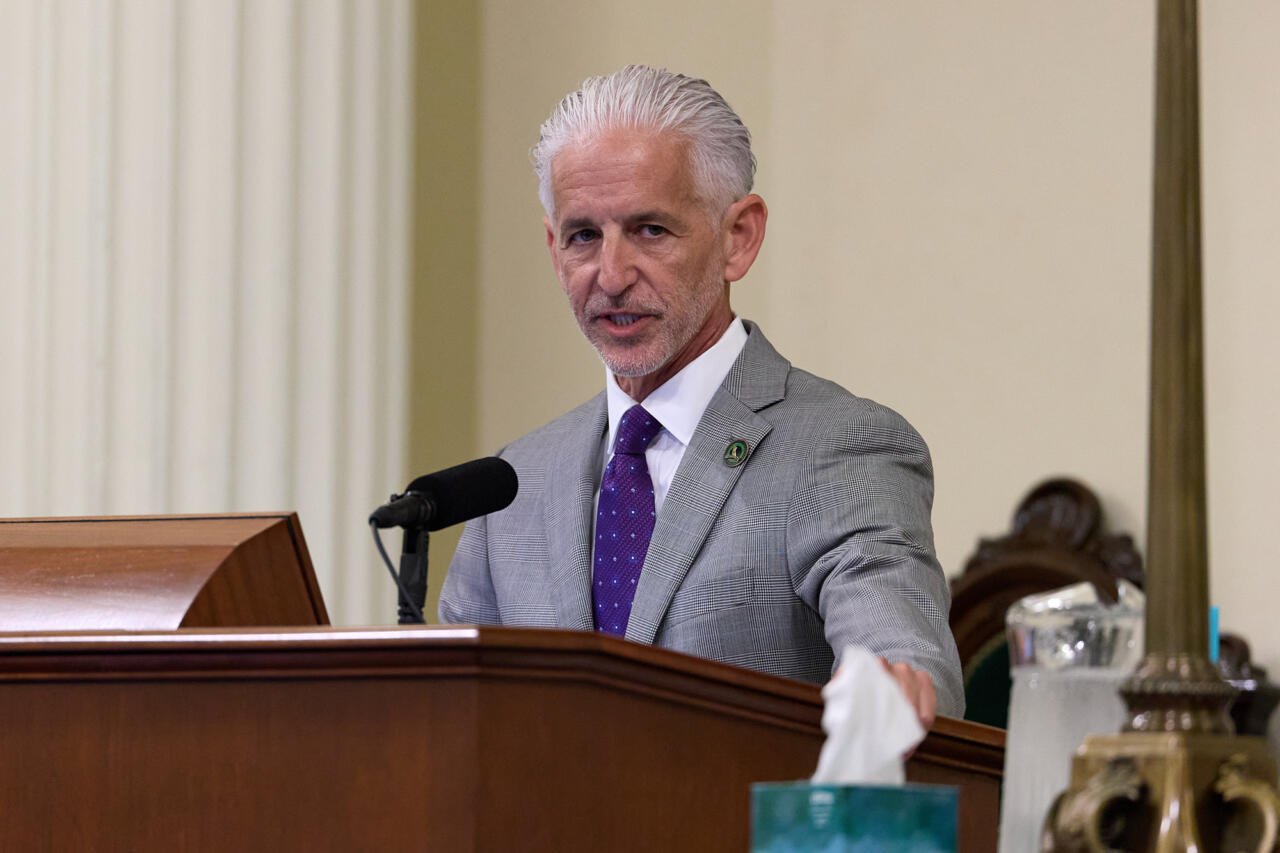
Assemblymember Josh Lowenthal at the dais during an Assembly floor session at the state Capitol in Sacramento on Aug. 21, 2025.
Photo by Fred Greaves for CalMatters
Bills now before the Legislature would ban kids under 16 from “addictive” social media entirely, in a step that has earned the ire of some online privacy groups over fear it would end online anonymity by requiring age verification at sign-up.
More recently, the state has begun regulating artificial intelligence, passing a law to impose mental health safeguards on chatbots. That legislation was passed in response to a series of troubling incidents, including the death of California teenager Adam Raine, who talked about suicide with ChatGPT for months before eventually taking his own life. The death is just one in a series of several incidents involving teens that have alarmed legislators.
Raine’s mother, Maria, recently testified in front of Senate Privacy, Digital Technologies, and Consumer Protection Committee, calling for stricter protections. ChatGPT, she said, was “a homework helper [that] turned into a confidant, then a suicide coach.”
Under a law enacted last year, AI chatbots are required to disclose that they are not real people and companies must take reasonable steps to prevent children from seeing graphic content.
The Legislature is considering bills to further govern how chatbots can interact with kids online. Those would require AI companies to make annual risk assessments on potential mental health harms and create controls that let parents limit how kids interact with bots.
The flurry of legislation is a marked contrast to the federal picture, as Congress has repeatedly failed to agree on terms for national laws.
This session, lawmakers are considering the Kids Internet and Digital Safety (KIDS) Act, which would expand several privacy laws. Among them would be applying COPPA protections to everyone under 18 and prohibiting targeting online ads toward children and teens.
For years, advocates have pointed to research linking teens’ mental health to social media use in arguing for stronger protections. A substantial proportion of teens say social media has damaged their mental health, and heavy social media use is linked to increased risk of anxiety and depression.
Recently, Meta and YouTube were found liable in a landmark lawsuit accusing them of knowingly creating platforms with features that were addictive and harmful to children and teens. That suit argued that internal documents showed how the company was aware of the damage their services could do, but allowed kids to use them anyway.
Other countries have taken a more comprehensive route than the United States, passing packages of laws specifically meant to cover children’s data and social media use. “I look at what’s happening in the U.K., I look at what’s happening in Australia,” said Wicks, who said she’s recently met with British and Greek policymakers about children’s privacy issues.
“We steal good ideas when we see them from other places,” she said, saying the Age-Appropriate Design Code Act was “wholesale borrowed from the UK.”
The act forbids companies from targeting ads to children based on their online behavior. It also requires parental supervision tools and defaults to the most protective privacy settings for kids. It also bans potentially addictive features like autoplay and infinite scroll for kids.
Some legal experts see how provisions of that law and others could be imported to the United States, possibly through a state like California.
Mariana Olaizola Rosenblat, a policy advisor on technology and law at the NYU Stern Center for Business and Human Rights, pointed out that there’s already some consistencies between regulations in Brazil and California.
“I think there’s quite a bit of overlap, but where they diverge is mostly because of specific constitutional features of the U.S. legal system,” she said. The First Amendment has often been used in legal challenges brought by the tech industry against laws limiting what content their algorithms show.
Olaizola Rosenblat, who has studied global privacy laws, said provisions in the ECA Digital, like a requirement that social media sites offer parental supervision tools, could be imported to the U.S., too. Those tools allow parents to control features and content their kids see, including by setting limits on messaging, screen time, automatic playback, and rewards. She points out that California has also passed provisions like privacy-by-default settings for child users and limits on advertising.
International laws can often go further in placing limits on the content that minors might see because the countries don’t have the same guaranteed speech rights. “They’re able to regulate that in a way that I don’t think the U.S. can under the First Amendment,” she said.
Texas Tech University researcher Marina Petric said this amounts to “First Amendment fundamentalism.”
“The U.S. narrative has been embedded into the architecture of digital platforms as though it were a universal standard,” she said. “Those who reject this premise are portrayed as supporters of censorship. But freedom of expression defined by one side and applied only to some is not freedom of expression — it is a tool of power.”
Ultimately, there are ways to take pieces of international laws and import them, Olaizola Rosenblat said. There are at least parts of laws like the ECA Digital that are compatible with legal rights in the U.S.
Our system is uniquely vulnerable to the power of that money.
Ed Howard, University of San Diego
Howard adds that the structure of the U.S. government makes it easier to pass individual laws than major packages all at once. He also points out that privacy issues are constantly evolving, and slow-moving bodies like Congress have trouble keeping up.
But both Howard and Olaizola Rosenblat believe the major barrier to a stricter children’s privacy law is a single issue: the influence of tech industry cash.
“The thing that is by a wide margin, the biggest reason, is the power of money in our system and the fact that our system is uniquely vulnerable to the power of that money,” Howard said.
In 2025, tech companies pushing for fewer regulations on AI and cryptocurrency poured more than $39 million into political spending and lobbying, according to a CalMatters analysis. The companies say the money goes toward supporting candidates that protect their industry, but critics say the companies are exerting undue influence.
As part of its spending, Meta gave $150,000 to the California Democratic Party and $20 million to a new political committee. While lawmakers questioned how best to regulate AI last year, the company spent far more than any other previous year. Meta said the money was “to help elect state political candidates in California — no matter their party affiliation — that support and defend the American tech industry.”
That’s only the tip of the iceberg. Tech companies spend tens of millions more every year lobbying Congress.
“I think the main problem is the tech lobby, which is very successful in the U.S. and maybe not as successful in other jurisdictions like Brazil,” Olaizola Rosenblat said. “Because they know that the most threatening thing to them would be a federal law in the U.S.”
While other countries get lobbied, the U.S. is a uniquely gigantic market, and California is the tech industry’s home base. Tech giants are willing to push back hard against laws that threaten their business model in the country, and that includes for laws aimed at protecting kids.
“When it comes to privacy, every business has a financial stake in there being very little privacy,” Howard said.
Hay provincias que superan el límite del 15% del territorio para capitales foráneos, que están en áreas de frontera y zonas de recursos naturales estratégicos, tanto hídricos como mineros.
Muchas de las tierras en manos extranjeras están en zonas de producción minera.
Check out War Thunder now! Use my links to sign up and get a massive, free bonus pack for PC and consoles: https://playwt.link/caspianreport | iOS/Android: https://wtm.game/caspianreport
China may not need to invade Taiwan at all, as Beijing believes time, pressure, and gradual coercion can shift the balance in its favor without triggering a catastrophic war.
See what others miss. Start your free DeltaSweep trial: https://www.deltasweep.com
If you want to support CaspianReport, the best way is simple: watch, like, and share the videos. For direct support, you can join as a member or contribute; every bit helps keep the channel independent and improves the quality of the work.
En un contexto laboral marcado por el cambio, cuidar a quienes hacen posible el servicio se convierte también en una ventaja competitiva
En un mundo en el que la tecnología está cada vez más presente y es cada vez más sofisticada, sigue siendo el factor humano el que marca la diferencia. Las empresas las construyen personas, por lo que el talento no puede entenderse únicamente como una cifra en una plantilla, sino que debe concebirse como la suma de una cultura corporativa sólida, oportunidades reales de desarrollo profesional y la capacidad de construir equipos diversos, capaces de responder a las necesidades de una sociedad igualmente diversa.
Este desafío es hoy especialmente relevante ya que el mercado laboral atraviesa una profunda transformación que está obligando a las empresas a replantearse cómo quieren atraer, desarrollar y fidelizar a sus profesionales. Tras décadas en las que la carrera profesional se entendía como una progresión casi natural dentro de una misma organización o sector, en la actualidad, las nuevas generaciones tienen expectativas distintas. Según el informe Workmonitor 2026 de Randstad, casi dos de cada cinco profesionales ya no buscan una trayectoria lineal, sino la posibilidad de explorar distintos tipos de empleo y adquirir experiencias diversas. Paralelamente, el 72% de los empleadores considera que la tradicional escalera profesional ha quedado obsoleta y que el crecimiento ya no se mide únicamente por los ascensos, sino también por el aprendizaje continuo, la adquisición de nuevas competencias y la capacidad de encontrar sentido al trabajo desempeñado.
A su vez, los profesionales más jóvenes valoran cada vez más factores como el desarrollo personal, el bienestar, el equilibrio entre vida profesional y personal, además de la posibilidad de contribuir a un propósito que trascienda los resultados económicos. En resumen, la retribución, como no, continúa siendo importante, pero ya no es el único elemento que determina la elección de una empresa ni para trabajar en ella, ni para quedarse.
Igualdad e inclusión en las empresas
A esta evolución de las expectativas laborales se suma un marco regulatorio que sitúa la igualdad y la inclusión en el centro de la gestión, lejos ya de ser cuestiones exclusivamente vinculadas a la reputación corporativa. La pregunta ya no es si una empresa apuesta por la diversidad, sino cómo lo hace. Cómo selecciona, promociona y forma a sus profesionales y, una vez están dentro, cómo escucha sus necesidades y garantiza que todas las personas dispongan de las mismas oportunidades para desarrollar su carrera.
Verisure España representa un ejemplo de esta evolución. La compañía cuenta con más de 10.000 profesionales repartidos por toda la cadena de valor con una amplia presencia territorial y funcional que la convierte en uno de los grandes empleadores del país además de en una organización donde conviven perfiles muy diferentes. Por eso su cultura interna se resume en una idea sencilla: personas que protegen a personas. Aunque la tecnología desempeña un papel fundamental en la seguridad moderna, la intervención humana sigue siendo decisiva y son los profesionales quienes interpretan la información, toman decisiones en momentos críticos, acompañan a los clientes y aportan el valor diferencial que no puede proporcionar una máquina por sí sola.
Precisamente por ello, la gestión del talento ocupa un lugar estratégico dentro de la compañía. El objetivo no es únicamente incorporar profesionales cualificados, sino crear las condiciones necesarias para que puedan desarrollarse, crecer y permanecer en la organización. Esto implica trabajar sobre aspectos como la formación, el liderazgo, el bienestar y la creación de entornos inclusivos donde cada persona pueda aportar valor desde su propia experiencia.
Plantillas diversas y escucha activa
Los datos a cierre del 2025 reflejan esta apuesta por la diversidad. En la plantilla de Verisure España conviven profesionales de 57 nacionalidades diferentes, las mujeres representan el 43% del total de personas trabajadoras. Además, el 42% de las nuevas incorporaciones correspondieron a menores de 30 años y el 12% a personas mayores de 50 años. Esta combinación refleja la voluntad de incorporar nuevas capacidades sin renunciar a la experiencia acumulada, favoreciendo equipos intergeneracionales capaces de enriquecerse mutuamente.
Pero la diversidad no se queda en los procesos de selección. Requiere escucha constante. La compañía impulsa herramientas como encuestas de compromiso, foros internos o programas de embajadores que permiten recoger la voz de los equipos y adaptar las iniciativas a sus necesidades reales.
Una formación de empresa para los empleados de televenta de Verisure.
La diversidad en el día a día
Más allá de los datos, el reto está en convertir esa diversidad en algo vivo y cotidiano.
En este sentido, la celebración de la Semana de la Diversidad —una iniciativa europea impulsada por Naciones Unidas tras la Declaración Universal sobre la Diversidad Cultural de la UNESCO— supone un buen ejemplo de cómo trasladar ese compromiso a la práctica. Este marco, orientado a promover el respeto, el diálogo intercultural y la inclusión, encuentra su reflejo en compañías que integran estos principios en su día a día.
Es el caso de Verisure España, donde recientemente se ha conmemorado esta semana con distintas actividades orientadas a sensibilizar y generar conversación en torno a la diversidad. No se trata solo de visibilizar la diversidad en momentos puntuales, sino de incorporarla de manera sostenida en la organización.
Desde programas de desarrollo como She Leads, centrado en el impulso del talento femenino, hasta iniciativas como el Plan Afloramiento, enfocado en discapacidad, la compañía impulsa un entorno de apoyo cercano y tangible. A través de estos programas, promueve espacios seguros en los que las personas puedan expresar sus necesidades y recibir acompañamiento en distintos momentos de su vida personal y profesional. Este acompañamiento incluye también el respaldo a profesionales en procesos de transición de género, facilitando durante todo su proceso la actualización de su nombre elegido (preferred name) en los sistemas internos y en los entornos de trabajo, para que su identidad esté correctamente reflejada en su día a día.
Porque fomentar espacios donde cada persona pueda mostrarse tal y como es no es solo una cuestión de cultura corporativa, sino también una manera de cuidar. Y, en última instancia, de construir organizaciones más representativas, más resilientes y mejor preparadas para entender a las personas a las que sirven.

 Login