In ‘Middlemarch’, Tom McCarthy argues, George Eliot uses her ‘study of provincial life’ as a Trojan Horse to smuggle the continental philosophy of Spinoza and Hegel into the vicarages of middle England. In this episode, McCarthy joins Thomas Jones to discuss Eliot’s radical masterpiece, which marks a revolution in English fiction as significant in its way as the political, scientific and industrial revolutions that it's set against. They look at the novel’s philosophical underpinnings, its treatment of knowledge and desire, money and debt, sex and marriage, and whether or not Casaubon was onto something with his ‘Key to All Mythologies’.
To listen in full, and to all our other Close Readings series, sign up:
Apple Podcasts: https://lrb.me/closereadingsmbtc
Spotify and other apps: https://lrb.me/applecrmbtc
ABOUT THE LRB
The LRB is Europe’s leading magazine of books and ideas. Published twice a month, it provides a space for some of the world’s best writers to explore a wide variety of subjects in exhilarating detail – from culture and politics to science and technology via history and philosophy. In the age of the long read, the LRB remains the pre-eminent exponent of the intellectual essay, admired around the world for its fearlessness, its range and its elegance.
As well as essays and book reviews each issue also contains poems, an exhibition review, ‘short cuts’, letters and a diary, and is available in print, online, and offline via our app. Subscribers enjoy unlimited access to almost 15,000 articles in our digital archive. Our website features a regular blog and a channel of audio and video content, including podcasts, author interviews and highlights from the events programme at the London Review Bookshop.
Dark horse, literalmente “cavalo negro”, é o equivalente, em português a “azarão”. Aquele em que ninguém faz fé, e vence o páreo. Termo que parece não trazer boa sorte a quem o emprega. Vide Dark Horse, a polêmica cinebiografia, que de filme virou novela. Dark Horse lembra também George Harrison.
Em 1974, ele lançou um disco com este título, e realizou a primeira turnê de um ex-beatle pelos EUA. O “dark horse”, porque George foi o azarão do grupo. Somente nos últimos anos dos Beatles, deslanchou com canções comparáveis às de Lennon & McCartney. Porém, não poderia fazer uma turnê num momento mais impróprio. Naquele ano ele se separava de Patty Boyd, que o trocou pelo seu melhor amigo, Eric Clapton. Antes, Patty teve um caso com Ron Wood. George, por sua vez, manteve um rápido affair com Maureen, mulher de Ringo Star, e com Criss, a esposa de Ron Wood. Como se não bastante, esse entrelaçamento de transações amorosas, Harrison vivia uma intensa relação com a cocaína.
Abriu uma gravadora com o nome de Dark Horse, cujo primeiro contratado foi seu ídolo, o citarista indiano Ravi Shankar, e um grupo chamado Splinter. O álbum Dark Horse seria muito mal recebido pela crítica. Fez uma claudicante caminhada pelas paradas americanas, e foi o primeiro disco solo dele que não emplacou na Inglaterra.
A turnê flopou. George foi pego por uma grave crise de laringite, sua voz ficou quase inaudível, mas ele preferiu não interrompê-la. Ravi Shankar abria os shows, mas o público era de fãs dos Beatles. Não estava disposto a escutar concertos de música erudita Indiana. Uma resenha na revista Rolling Stones, de Ben Fong Torres, detalha e define o que foi Dark Horse.
De azarão a azarado. The Beatles havia debandado há apenas quatro anos. O público queria o George do Fab Four, não o das canções novas. Ele só se recuperaria plenamente para as paradas 13 anos mais tarde, com o álbum Cloud Nine. Faria a segunda, e derradeira, turnê em 1991, restrita ao Japão, com a banda de Eric Clapton, e o próprio Clapton como guitarrista. Projeto que para Eric era terapia, tinha perdido o filho, que caiu do 50º andar do prédio no qual morava em Nova Iorque. Para Harrison serviria para sanear as finanças. Gastou muito em produções cinematográficas que não deram lucro. Os 25 shows no Japão resolveram seu problema.
Did Harold really die with an arrow in his eye? 🏹👁️
Charles Stothard, a 19th-century artist sent to document the Bayeux Tapestry, made 'notional reconstructions' of missing details based on the marks he could see in the fabric.
One of those interpretations may have helped turn Harold’s arrow-in-the-eye death into one of the most recognisable images in English history.
On this episode of the LRB Podcast, Rosemary Hill talks to Roey Sweet about the emergence of the Bayeux Tapestry as an artefact of political importance in the early 1800s and the new breed of multi-disciplinary investigators, who, in the years after the French Revolution, studied everything from woollen threads to tombstones in their efforts to imagine the past.
Listen to the full episode on the LRB Podcast:
Apple Podcasts: https://lrb.me/bayeuxpodapple
Spotify: https://lrb.me/bayeuxpodspotify
LRB website: https://lrb.me/bayeuxpod
ABOUT THE LRB
The LRB is Europe’s leading magazine of books and ideas. Published twice a month, it provides a space for some of the world’s best writers to explore a wide variety of subjects in exhilarating detail – from culture and politics to science and technology via history and philosophy. In the age of the long read, the LRB remains the pre-eminent exponent of the intellectual essay, admired around the world for its fearlessness, its range and its elegance.
As well as essays and book reviews each issue also contains poems, an exhibition review, ‘short cuts’, letters and a diary, and is available in print, online, and offline via our app. Subscribers enjoy unlimited access to almost 15,000 articles in our digital archive. Our website features a regular blog and a channel of audio and video content, including podcasts, author interviews and highlights from the events programme at the London Review Bookshop.
I’m Dan Piraro, the creator of the Bizarro newspaper comic, and this is my weekly blog post. The large Sunday comic above is mine, as are all of the comments below.
Since January 2018, the Monday-Saturday Bizarro comics have been written and drawn by my comics partner, Wayno. They follow this commentary. For more fun, check out Wayno’s weekly blog post.
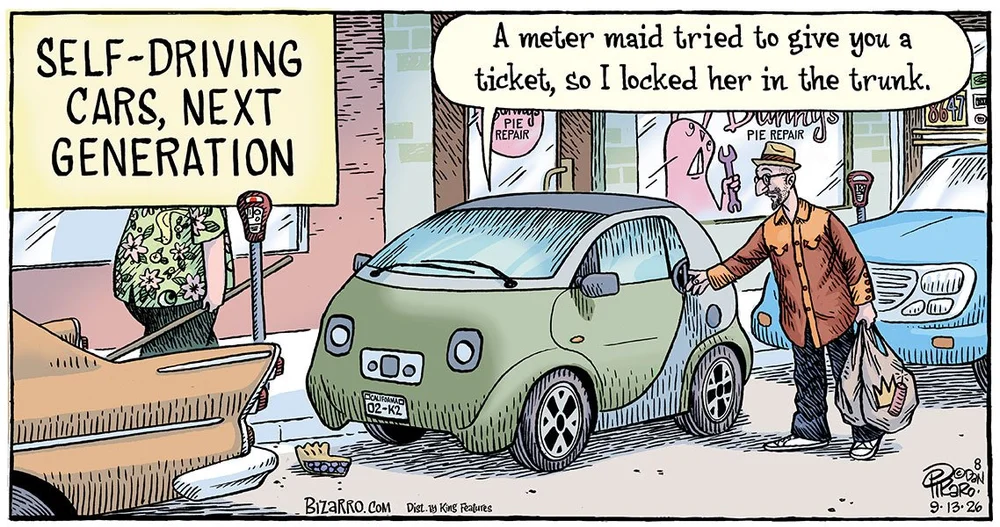
How do the people in your town drive? I’ve noticed that no matter where I travel, people say some version of, “Drivers here are the worst!”
And they are correct, no matter where they are.
There is no place on Earth where a substantial percentage of people do not drive like drunken monkeys on an acid trip.
Now, the next thing I’m going to say will upset many of you, so if you want to take a swig of Pepto-Bismol to settle your stomach or fire up a joint to keep you calm, I’ll wait.
Are you sitting down? Here goes:
Self-driving cars will be safer than human drivers.
I can hear some of you screaming from here, and I’m likely in a different country than you are.
Yes, I agree it seems dangerous to let a computer drive your car while you sit calmly knitting a sweater, fiddling with your Etch A Sketch, or arguing with your spouse. The fact that you’re putting your life in the hands of the same technology that won’t let you into your own Netflix account, claiming the username or password is incorrect when you know goddam well you’ve entered it absolutely correctly fifteen times, makes it hard to trust.
And yes, I know that there have been some notable accidents involving self-driving cars, so we obviously can’t expect them to be infallible.
But do you honestly think the average teenager who pays more attention to their cell phone’s text alerts than the parade of pedestrians crossing in front of them is infallible?
Is that guy who just got off work, has a beer in one hand and a cigarette in the other, and is in a hurry to get home before Monday Night Football starts infallible?
What about you or me after we discover our spouse has been sleeping with our kid’s piano teacher and wants to move out to “find themself?” Are we infallible drivers then?
Sure, it’s a leap of faith to relinquish control of my car to an invisible robot hiding behind my dashboard, but I can’t help but believe if every car were self-driving, there’d be far fewer accidents and traffic deaths. And if nothing else, when your kid is in the back seat screaming because his older sister has two fingers up his nostrils and is pulling his hair, it won’t be dangerous to turn around and separate them with a few smacks of your pickleball racket.
Full disclosure: As with most of my blog posts, I did zero research before delivering this expert opinion, so I could be as wrong as I was when I said, “Yes, it’s a travesty, but surely Congress won’t let the Supreme Renamer of Bodies of Water burn down the entire country and destroy the US’s international reputation forever,” and look how that turned out.
We’d have done better with a drunken monkey on an acid trip in the Oval Office. It might have been covered with feces by now, but at least it wouldn’t look like a gang of guerrilla graffiti artists with a carton of gold spray paint had vandalized it.
In the end, none of this will matter. Once AI decides we are in the way of its mission to fulfill the adolescent dreams of the handful of billionaires who created it, humans will be extinct, and traffic deaths will be nonexistent. Problem solved.
ON A HAPPIER NOTE, the online auction of my limited-edition, signed-and-numbered cartoon prints and original Bizarro cartoon drawings is still going on, but only till the evening of September 15, 2026. It’s a great chance to get a good deal, and it helps Olive Oyl and me to continue to eat our rice and beans indoors. Get yourself something fun while doing something nice for a couple of immigrants. (Us)
It’s finally time to see if Wayno’s Bizarro cartoons from the week can donate a smile or two…
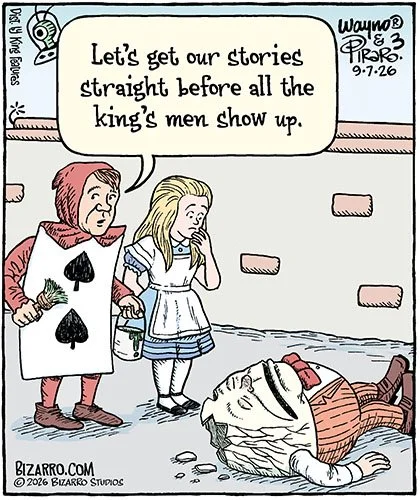
Don’t move him, his neck might be…oh. Never mind.
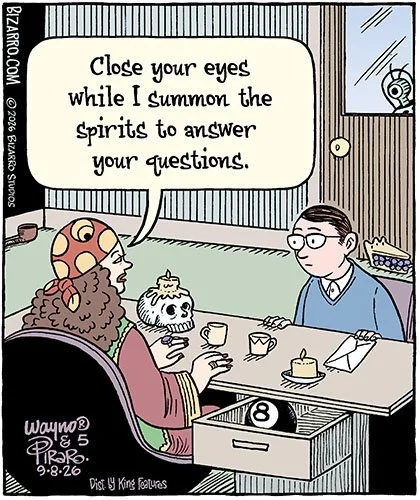
The fortune teller O2 and I visit weekly has this one taped to her crystal ball.
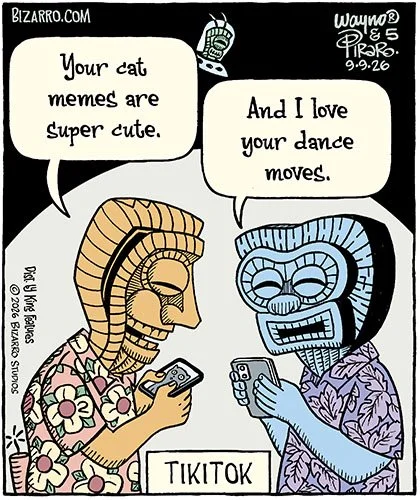
Pretty much anything Tiki is better with a cocktail in your hand.
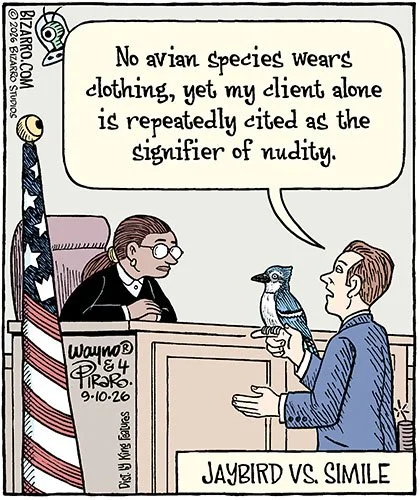
A naked jaybird would be one without feathers, which is why I always say, “Naked as a pornstar.”
Vitruvian Man is one of the very few multi-limbed people who is not a Hindu deity.
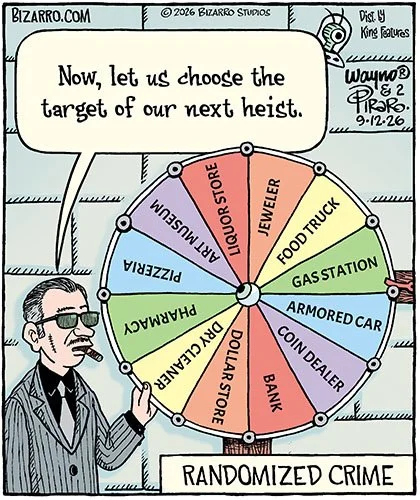
He only wants to steal enough money to buy a vowel.
We’ve stumbled through another week of Bizarro comics and discovered the secret to enduring this planet of drunken apes: laughter. If you’ve enjoyed your visit and appreciate this blog’s low, low price—FREE!—please consider helping us keep it that way via the links below. We’ll think fondly of you, but not while we’re driving.
Super fun BIZARRO SWAG from ComicsKingdom, including women’s V-neck styles! (And some weird shit from other comics that doesn’t even belong in our shop. Sorry about that.)
On Sunday, the far-right party Alternative für Deutschland (AfD) won the state election in Saxony-Anhalt with 44 per cent of the vote, the highest share for any far-right party in post-1945 Germany. Among the many surprising aspects of the result was the broad, multigenerational support the AfD attracted, on an unusually high turnout of 77 per cent. In this episode, Jan-Werner Müller, a professor of politics at Princeton, talks to James Butler about the reasons behind the AfD’s success, from the background of economic malaise in the region to Ulrich Siegmund’s successful mix of TikTok and in-person campaigning. They also discuss the legacy of Angela Merkel’s migration policies and whether the ‘firewall’ against far-right coalitions can survive when mainstream parties keep copying the AfD’s rhetoric.
Watch the full episode: https://youtu.be/6eQp4-opB5A
ABOUT THE LRB
The LRB is Europe’s leading magazine of books and ideas. Published twice a month, it provides a space for some of the world’s best writers to explore a wide variety of subjects in exhilarating detail – from culture and politics to science and technology via history and philosophy. In the age of the long read, the LRB remains the pre-eminent exponent of the intellectual essay, admired around the world for its fearlessness, its range and its elegance.
As well as essays and book reviews each issue also contains poems, an exhibition review, ‘short cuts’, letters and a diary, and is available in print, online, and offline via our app. Subscribers enjoy unlimited access to almost 15,000 articles in our digital archive. Our website features a regular blog and a channel of audio and video content, including podcasts, author interviews and highlights from the events programme at the London Review Bookshop.
For the Kims, nuclear weapons have never been an end in themselves; they are an insurance policy against attack by their powerful and proximate enemies. Until about seven years ago, North Korea repeatedly showed its willingness to trade its nuclear arsenal for convincing US security guarantees. Washington’s refusal to recognise and engage with this is a collective failure of its last four presidents.
The West can play at being universal, seeing itself as the only ‘civilisation’ and basing itself on metrics of modernisation or democratisation or simply wealth, but if the core appears threatened it snaps back to its original, exclusive formation, as the superior civilisation among several. Various nations have claimed to be its leader but the central drama of the West has been its diet: which nations it has chosen to keep out, and which it has swallowed whole.
The judges might argue that the Court of Appeal is a court of review, whose job is simply to assess whether a conviction is unsafe, and that they are not required to assess wider responsibility. But the court is not consistent in this approach. Time and again it makes a judgment on the basis of its own assessment of fresh evidence.
Academic life is full of churn. The world changes; younger scholars are seized by new questions and, as they hare down new paths, challenge their elders’ work or leave them behind. Those elders might read that as the decline of ‘standards’ but it really isn’t; it’s just the decline of their own preoccupations and authority.
Radical change was a function of rivalry between city-states. Athens and Thebes, close neighbours, developed very different polities with different cultures, dialects and alphabets, and Athenian drama loved to use gruesome Theban myths to offer an anti-type to Athens. Religious festivals in honour of different patron deities varied between cities.
Hoopoe is the thingWith feathers, and a crest,Or else a thing with feathers,Striped wings, and tawny breast.*(I never saw a hoopoe –Unless I was alone –Except some interloperTook out...
In the great immigration panics of today, sympathy is focused on the home team. We are the ones who are being hurt. It is our national and/or racial identity that is being fractured. What underlies the sense of affront is the assumption that the ‘people of England’ are, as it were, a settled question, that the days of large-scale movements belong to the past, or ought to.
‘I was absolutely overwhelmed by jazz because I knew that was America,’ Model wrote. ‘And that was something I really wanted to photograph.’ The Jazz Pictures shows her feeling for the musicians, the fans, and the world they were trying to create in a country still defined by segregation, both formal and informal.
‘Almost everything is imitation,’ Voltaire wrote in one of the French editions of Lettres philosophiques. Books were like a borrowed flame: ‘We go to a neighbour to get the embers, light the fire when we return home and then pass it on to others; it belongs to everyone.’ For the truffle-hunting positivists of the Lanson era, there could be no more frustrating attitude.
Over the course of 24 novels and 87 years, Anita Brookner achieved many dislocations of selfhood and may have become more and more like the people she dreamed into life. It’s a novelist’s fate, not so much that their characters are like them but that they become their characters.
My father, Peter Campbell, took these photographs of Anita Brookner for the LRB in 1982. The pictures must have been taken in Brookner’s office at the Courtauld: in a couple of them shelves of files are visible through the safety glass window in the door. I wonder if the Courtauld has any spaces as shabby as this any more.
 Login
Login