Vadico, caixa com três discos, divididos por temas, resgatando a música do compositor paulista Oswaldo Gogliano (1910/1962), ou simplesmente Vadico. Lançado pelo Selo Sesc, este é o mais importante projeto de memória realizado este ano no país. Pois não se limita ao que Vadico deixou gravado no Brasil.
O pesquisador e músico Franco Galvão valeu-se de 541 partituras de Vadico encontradas numa universidade do Illinois. 170 músicos foram envolvidos no projeto, que reúne nomes como Guinga, Ná Ozzeti, Zé Manoel, Zé Renato, Nailor Proveta, a orquestra de câmera da USP, entre outros. Literalmente, promoveu-se o resgate de Vadico.
Quem sabe um mínimo de música brasileira, sabe de Noel Rosa, e conhece, pelo menos, estes clássicos do Poeta da Vila, Conversa de Botequim, Feitio de Oração Feitiço da Vila e Pra Que Mentir? Poucos, porém, têm ideia de que o autor das melodias dessas canções é um pianista paulistano, filho de italianos, Oswaldo Gogliano, ou simplesmente Vadico.
Morto Noel, em 1938, Vadico, no ano seguinte, integrando a orquestra do maestro Romeu Silva, foi tocar nos Estados Unidos, e acabou ficando por lá durante 15 anos. Acompanhou Carmen Miranda, quando ela se mudou para Hollywood. Depois de Carmen, foi pianista de Katherine Durham, dona de uma companhia de dança moderna, uma das mais importantes artistas negras americanas do século 20 (O que não impediu que fosse barrada num hotel chique de São Paulo por causa da cor da sua pele). Também fez músicas para a Disney.
Vadico retornou ao Brasil em 1956. Atuou em várias frentes. Não topou criar a música de Orfeu do Carnaval, de Vinícius de Morars, e abriu caminho para a parceria do poeta com o então pouco conhecido Tom Jobim. Vadico faleceu, em 1962, no Rio, aos 52 anos, de um infarto fulminante, no estúdio da gravadora Columbia.
Arranging and rearranging a magazine’s layout before it goes to press is all done on computers now. But in the years before desktop publishing software, the work of cutting and pasting required a sharp scalpel, a parallel-motion board and plenty of glue.
We look back at what paste-up used to involve in the early years of the paper. Flashing her blade is Bryony Dalefield, who has been doing paste-up for the LRB, in both its gluey and digital forms, since the early 1980s.
ABOUT THE LRB
The LRB is Europe’s leading magazine of books and ideas. Published twice a month, it provides a space for some of the world’s best writers to explore a wide variety of subjects in exhilarating detail – from culture and politics to science and technology via history and philosophy. In the age of the long read, the LRB remains the pre-eminent exponent of the intellectual essay, admired around the world for its fearlessness, its range and its elegance.
As well as essays and book reviews each issue also contains poems, an exhibition review, ‘short cuts’, letters and a diary, and is available in print, online, and offline via our app. Subscribers enjoy unlimited access to almost 15,000 articles in our digital archive. Our website features a regular blog and a channel of audio and video content, including podcasts, author interviews and highlights from the events programme at the London Review Bookshop.
Like Christopher Marlowe, William Shakespeare made good use of his time off when the theatres were shut for plague in 1593. 'Venus and Adonis' appeared in quarto that year and become by far the most popular work Shakespeare published in his lifetime, running to ten editions before his death (compared to just four for 'Romeo and Juliet'). In this episode, Seamus and Mark consider the many ways in which Shakespeare’s poem displays its author's remarkable originality, from its peculiar reshaping of the Ovidian myth into a tale of comic mismatch, to its surprising diversion into the psychology of grief.
To listen to the full episode, and to all our other Close Readings series, subscribe:
Apple Podcasts: https://lrb.me/applecryt
Other podcast apps: https://lrb.me/closereadingsyt
Get in touch: podcasts@lrb.co.uk
ABOUT CLOSE READINGS
Close Readings is a multi-series podcast subscription from the London Review of Books which looks at different periods and themes in literature through selections of key texts, covering poetry, fiction, history and philosophy from Ancient Greece to the present day.
Subscribe: https://lrb.me/closereadingsyt
ABOUT THE LRB
The LRB is Europe’s leading magazine of books and ideas. Published twice a month, it provides a space for some of the world’s best writers to explore a wide variety of subjects in exhilarating detail – from culture and politics to science and technology via history and philosophy. In the age of the long read, the LRB remains the pre-eminent exponent of the intellectual essay, admired around the world for its fearlessness, its range and its elegance.
As well as essays and book reviews each issue also contains poems, an exhibition review, ‘short cuts’, letters and a diary, and is available in print, online, and offline via our app. Subscribers enjoy unlimited access to almost 15,000 articles in our digital archive. Our website features a regular blog and a channel of audio and video content, including podcasts, author interviews and highlights from the events programme at the London Review Bookshop.
O fluminense (de Nova Friburgo) Uday Veloso, melhor dizendo, Benito di Paula, cuja morte, aos 85 anos, foi anunciada nesse domingo, 18 de outubro, foi um dos maiores hitmakers dos anos 70. Mas teve um início claudicante. Seu LP de estreia, não foi sucesso de vendas, embora trouxesse Violão Não Se Empresta a Ninguém, samba muito cantado em todo o país no carnaval de 1970.
Benito cometeu bobeira, abriu o disco com Apesar de Você, o samba de Chico Buarque, que seria proscrito, proibido em todo território nacional. O álbum do cantor novato também foi recolhido. Mas a Copacabana acreditou nele, e investiu em mais um LP, Ela (1972) que também não aconteceu. Acertou no próximo, Um Novo Samba (1974). Este rendeu uma trinca de blockbusters radiofônicos: Se Não For Por Amor, Retalhos de Cetim e Que Beleza. Daí em diante foi só hits.
Nesse disco, Benito di Paula definiu seu estilo. 1974 é o marco zero de um novo tipo de samba, de letras românticas ou bem humoradas, menos sincopado, meio baladão, de apelo fácil. O avô do que chamam hoje de pagode. Atribuem ao crítico carioca Tárik de Souza o rótulo pejorativo de “samba jóia”, que englovava ainda, ente outros, Luiz Ayrão, Wando, Luiz Américo, Gilson de Souza, Agepê. O Originais do Samba também flertou com o estilo.
Mas nenhum dos praticantes emplacou tantos sucessos quanto Benito de Paulo, ruim de crítica e bom de público. O samba jóia, de certa forma, surgiu graças à censura. Exatamente no auge da prensa nos grandes nomes da geração dos festivais. Suas letras passavam por longe da política. Não se sabe onde encontraram o link da música de Benito di Paula com o jazz, do qual seu piano não trazia nada. Estava mais para o velho bolero.
Seu sucesso atravessou a década, e arrefeceu nos anos 80. Nessa década ele continuou gravando uma média de um disco por ano. Na década seguinte, houve uma mudança geral na música brasileira, com manguebeat, pagode romântica, axé, fuleiragem, sertanejo. Benito di Paula não se encaixava em nenhum desses nichos.
Ele passou a gravar em espaços cada vez longos, Em 1996, lançou Baileiro, pela Paradoxx, e só voltou a lançar disco em 2009, pela EMI, com CD e DVD ao vivo. Disco novo somente em 2017, Essa Felicidade É Nossa, pelo selo 74 Music, quase todo repertório é autoral, mas assinado como Uday Vellozo (tem participação de Fernanda Takai). Seu disco final, foi dividido com o filho, Rodrigo Vellozo, o independente O Infalível Zen, de 2001.
Embora seus discos não atraíssem mais compradores, nem tocassem no rádio ou TV (até porque esses o formato desses veículos sofreu mudanças radicais), Benito di Paula continuou nos palcos e na estrada, tanta a popularidade do seu repertório. Onde sua música pode ser ouvida com frequência. Seus clássicos são obrigatórios no repertório dos artistas e grupos que animam barzinhos país afora.
(Foto: Benito di Paula com Oswaldo Sargentell, reproduzida de O Cruzeiro)
São misteriosos os caminhos que levam uma canção a bater recordes de plays nas plataformas de streaming, assim como, em outros tempos, nas paradas de sucesso. Como acontece em desastres aéreos, nos quais há sempre alguém que deixou de embarcar e escapou, bandas e artistas desdenham grandes hits que lhes foram oferecidos.
O produtor Joe Boyd, americano, na Inglaterra desde 1966, foi 9 primeiro empresário do Pink Floyd (produziu os primeiros compactos da banda). Também sócio do UFO, casa noturna frequentada pela nata do rock inglês da época, que tinha como bandas residentes o Pink Floyd e a Soft Machine (às vezes até Jimi Hendrix).
Em 1967, trouxeram-lhe uma banda de nome estranho, que lhe apresentou uma canção na qual ele não viu potencial de sucesso. A banda até tocou no UFO, mas Boyd não se interessou em produzi-la. Perdeu de contratar o Procol Harum, e de produzir A Whiter Shade of Pale, um clássico, dos sucessos mais duradouros dos anos 60.
Tem um hit dos anos 80 que já atingiu a marca do bilhão de plays nas plataformas: Don’t You (Forget About Me), de Keith Forsey e Steve Schiff, composta para o filme The Breafast Club, de 1985 (aqui batizado de Clube das Cinco). Os autores pensaram em Billy Idol para interpretá-la. Na época ele estava nas paradas com Dance With Myself, e onipresente na MTV. Idol não se mostrou muito interessado na canção.
Keith Forsey optou pelo Simple Minds, uma das bandas tecnopop mais bem-sucedidas dos anos 80. Jim Kerr, vocalista do grupo, confessou que ele e os companheiros toparam gravar Don’t You (Forget About Me) por desencargo de consciência. Tinham recusado a música seis vezes. Mas não foi apenas eles que a menosprezaram. Chrissie Hynde e Brian Ferry também a recusaram.
O Simple Minds gravou, o filme bombou, e com ele a canção, que se tornou o maior hit da carreira do grupo, com milhões de singles físicos vendidos, e agora 1 bilhão de plays no formato digital.
‘Romans always seem to have seen Britons as outsiders living in a cold, damp, miserable corner of the empire.’
For decades after the Roman legions left Britain in the early fifth century, people expected them sooner or later to return. ‘During this bizarre interregnum,’ Pablo Scheffer wrote recently in the LRB, ‘a veneer of romanitas was everywhere.’ But unlike in other parts of the former Roman Empire, it didn’t endure, as Angles, Saxons and other Germanic peoples arrived in Britain – perhaps invited at first, later as invaders – bringing their new customs, religion and language with them, and displacing, killing or subjugating the people who were already here. On this episode, Pablo joins Tom to explore the transition from Roman to British to Anglo-Saxon England between the sixth and eighth centuries. They discuss why none of the changes that took place was inevitable and why so few British words survive in modern English, even if the man said to be the first English poet was a cowherd with a British name.
Listen on the LRB Podcast: https://lrb.me/schefferpod
ABOUT THE LRB
The LRB is Europe’s leading magazine of books and ideas. Published twice a month, it provides a space for some of the world’s best writers to explore a wide variety of subjects in exhilarating detail – from culture and politics to science and technology via history and philosophy. In the age of the long read, the LRB remains the pre-eminent exponent of the intellectual essay, admired around the world for its fearlessness, its range and its elegance.
As well as essays and book reviews each issue also contains poems, an exhibition review, ‘short cuts’, letters and a diary, and is available in print, online, and offline via our app. Subscribers enjoy unlimited access to almost 15,000 articles in our digital archive. Our website features a regular blog and a channel of audio and video content, including podcasts, author interviews and highlights from the events programme at the London Review Bookshop.
I’m Dan Piraro, the creator of the Bizarro newspaper comic, and this is my weekly blog post. The large Sunday comic above is mine, as are all of the comments below.
Since January 2018, the Monday-Saturday Bizarro comics have been written and drawn by my comics partner, Wayno. They follow this commentary. For more fun, check out Wayno’s weekly blog post.
Hail, Jazz Pickles. I’m happy you’ve chosen my weekly typed thoughts to distract yourself from the firehose of chaos that has become the ubiquitous backdrop of modern life.
The Oyl and I are visiting family in the US this weekend, and having a lovely and sinful time.
At home, we eat a healthy diet and refrain from the myriad things that would raise our blood sugar levels to unacceptable levels, fill our arteries with sludge, or expand our waists and butts beyond the limits of our current wardrobes. But when we are vacationing, all of that asceticism goes the way of our belief in Santa Claus, and we pig out.
Yesterday, I had biscuits and gravy with fried eggs for breakfast, pizza, root beer, and real beer for lunch, and an Old Fashioned and a big scoop of ice cream with caramel and chocolate chips in a waffle cone for dinner. (Not after dinner—that was dinner.) We’ll likely do that shit again today.
I’m reminded of when I’d stay at Grandma’s house for a week when I was a kid. As soon as my parents dropped me off, there was unlimited soda pop, candy, and television until they returned a week later to begin an intervention and detox. They’d typically find me slumped against a wall in the corner behind the sofa in a sugar and TV coma, with a goatee of chocolate smeared across my face and half a Butterfinger melting in my hand. It wasn’t pretty.
That’s more or less what I’ll look like on the plane on the way home Tuesday morning. I hope I don’t end up on a no-fly list.
QUICKLY: If you’re still considering improving (or starting) your Spanish skills, I recommend my good buddy, Ricardo. I’ve been working with him for years and really enjoying our conversations via Google video or whatever you call it. He’s well-educated, a published novelist (in Spanish), and is fluent in English. Here’s what one of our Jazz Pickles says about her first few lessons with him:
“I can’t say enough good things about Ricardo! He pushes me when I need it, and he gives me room when I need that too. My Spanish is much better because of him, and he is incredibly good about clarifying local idioms: That is Argentinian Spanish, that is Spain Spanish, THIS is Mexican Spanish.” —P.P.
And you can reach Wayno via his weekly (free!) Substack posts here. But first, bring your chuckle needs with you as we visit his Bizarro cartoons for the week...
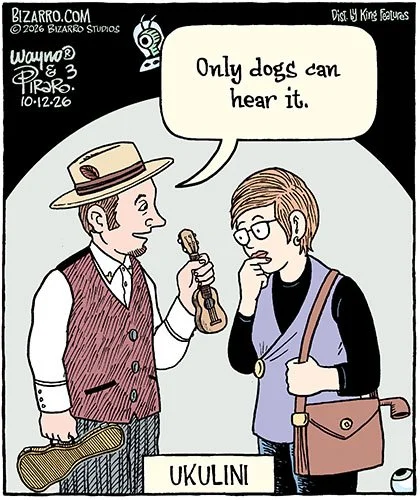
For the first time in my life, I’m thinking I’m lucky not to be a dog.
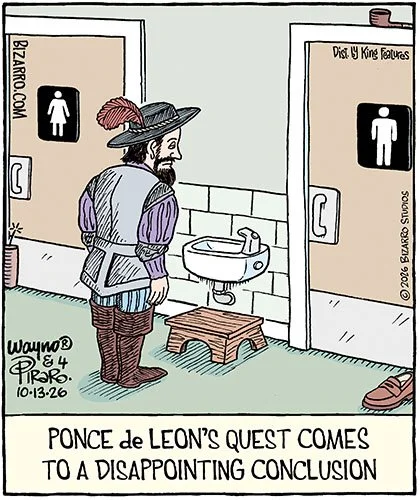
If this one befuddles you, think “fountain,” and “youth.” If you’re still being fuddled, look up Ponce de Leon. Our cartoons are occasionally as educational as they are occasionally funny.
My mind immediately goes to a cabinet full of such wolves that I wish were more emotionally healthy.
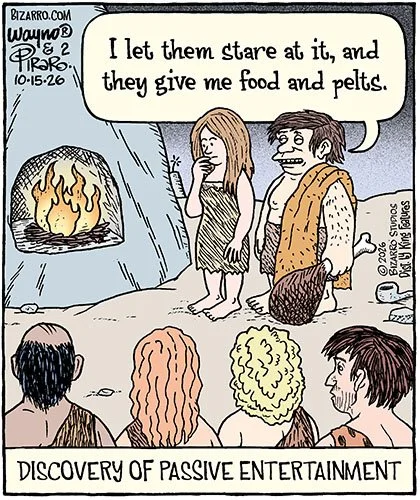
Carving out the fireplace and chimney were the hardest part about the first Pay Per View.
That’s good advice whether or not your ass is a piñata.
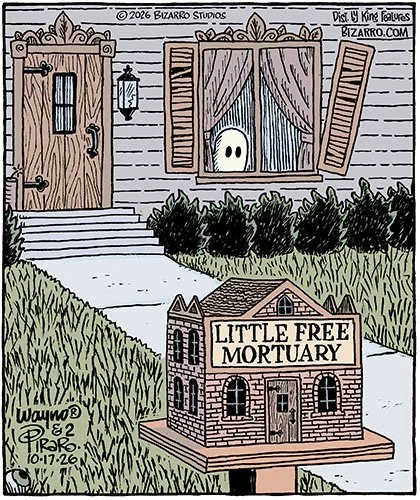
If you dont’ have “little free libraries” in your area, this one won’t make sense. Whoops.
This is where the comedy sidewalk ends this week, Jazz Pickles. Thanks for enduring our childish whims for another week. If you love us half as much as we love you, please consider helping us keep this site free of ads and paywalls via the opportunities below. Just the thought of your generosity makes us giddy!
Super fun BIZARRO SWAG from ComicsKingdom, including women’s V-neck styles! (IF ORDERING FROM CANADA or anywhere outside the US, CHECK SHIPPING COSTS CAREFULLY!)
Tom McCarthy and Thomas Jones on why George Eliot’s Middlemarch needs rescuing from middlebrow, middle England and BBC costume drama. Listen to the full episode of The Man Behind the Curtain, a Close Readings series from the London Review of Books.
Tech billionaires warn that the technologies they are developing could threaten humanity’s survival, yet continue to pursue them.
Astra Taylor examines the extraordinary risks Silicon Valley’s most powerful figures are willing to take with the future of humanity.
The Romans built the London Wall around a markedly bigger footprint than the city. Its function was symbolic and political, signalling London’s renewed importance, probably as capital of the new southern province of Britain. In hindsight, it was arguably the beginning of the end for Roman London.
In the second episode of ‘London Revisited’, a Close Readings podcast series, Rosemary Hill and Dominic Perring discuss the Romans’ final expansion and contraction of Londinium, and what remained when they finally abandoned the city.
Listen to the full series:
Apple Podcasts: https://lrb.me/lrappleyt
Spotify: https://lrb.me/lrspotifyyt
ABOUT CLOSE READINGS
Close Readings is a multi-series podcast from the London Review of Books which looks at different periods and themes in literature through selections of key texts, covering poetry, fiction, history and philosophy from Ancient Greece to the present day.
Subscribe to Close Readings:
Apple: https://lrb.me/lrapplesignupyt
Spotify and other apps: https://lrb.me/lrscsignupyt
ABOUT THE LRB
The LRB is Europe’s leading magazine of books and ideas. Published twice a month, it provides a space for some of the world’s best writers to explore a wide variety of subjects in exhilarating detail – from culture and politics to science and technology via history and philosophy. In the age of the long read, the LRB remains the pre-eminent exponent of the intellectual essay, admired around the world for its fearlessness, its range and its elegance.
As well as essays and book reviews each issue also contains poems, an exhibition review, ‘short cuts’, letters and a diary, and is available in print, online, and offline via our app. Subscribers enjoy unlimited access to almost 15,000 articles in our digital archive. Our website features a regular blog and a channel of audio and video content, including podcasts, author interviews and highlights from the events programme at the London Review Bookshop.
Dostoevsky’s 1864 novella doesn’t contain the descriptive detail, impersonal narration or many other features of 19th-century realism established by Flaubert. The book’s two-part structure, which starts with a 40-year-old’s furious rant against rationalism and moves on to present three humiliating episodes from his earlier life, offers no kind of conclusion. Instead, it is the unbearable moments of psychological truth that make ‘Notes from Underground’ a revolutionary development in the history of realism.
In this episode, James Wood is joined by the novelist and critic Adam Thirlwell to consider Dostoevsky’s mastery of the inner life and the experiences that shaped his hostility to rational egoism, from being subjected to a mock execution and four years in a Siberian prison camp to his reading of Hegel and a visit to London’s Crystal Palace.
James Wood is professor of the practice of criticism at Harvard and author of many books including 'How Fiction Works'.
Adam Thirlwell is a novelist and critic whose books include Politics, The Escape, Lurid & Cute, and The Future Future.
Find the full episode and series on the Close Readings podcast:
Apple Podcasts: https://lrb.me/realismseriesapple
Spotify: https://lrb.me/realismseriesspotify
Episode one on Flaubert: https://youtu.be/S7NTFAGuxb0
ABOUT CLOSE READINGS
Close Readings is a multi-series podcast subscription from the London Review of Books which looks at different periods and themes in literature through selections of key texts, covering poetry, fiction, history and philosophy from Ancient Greece to the present day.
Subscribe: https://lrb.me/closereadingsyt
ABOUT THE LRB
The LRB is Europe’s leading magazine of books and ideas. Published twice a month, it provides a space for some of the world’s best writers to explore a wide variety of subjects in exhilarating detail – from culture and politics to science and technology via history and philosophy. In the age of the long read, the LRB remains the pre-eminent exponent of the intellectual essay, admired around the world for its fearlessness, its range and its elegance.
As well as essays and book reviews each issue also contains poems, an exhibition review, ‘short cuts’, letters and a diary, and is available in print, online, and offline via our app. Subscribers enjoy unlimited access to almost 15,000 articles in our digital archive. Our website features a regular blog and a channel of audio and video content, including podcasts, author interviews and highlights from the events programme at the London Review Bookshop.
Em 1986, por acaso, com o objetivo de criar um single para o novo álbum de George Harrison, surgiu o mais bem sucedido dos supergrupos, o Traveling Wylburys. Sob este nome, George Harrison, Bob Dylan, Roy Orbinson, Tom Paty e Jeff Lynne, gravaram dois discos primorosos (o segundo sem Orbinson, que faleceu de um infarto antes). A banda não fez turnê.
O fenômeno repetiu-se aqui no Brasil com Os Tribalistas, em 2001. Arnaldo Antunes, Marisa Monte e Carlinhos Brown formaram um trio descaradamente pop, sem pretensões, puro entretenimento, Obteviveram sucesso comercial comparável ao dos Secos &. Molhados quase 30.anos antes. O mais vendido e tocado do ano, nas rádios, lojas e carrinhos de pirataria.
Com o álbum Vice-Versa, Arnaldo Antunes e Adriana Calcanhotto não devem repetir o o sucesso dos dois grupos citados. Isto porque a maneira de se escutar música mudou muito desde o advento das plataformas de streaming. Nem tem mais carrocinhas de pirataria pra, involuntariamente, divulgar o disco
.
O álbum tem em comum com Os Tribalistas o fato de ser uma coleção de canções assobiáveis, engenhosas, criadas por dois artistas também bons de letas. Além disso, os outros dois Tribalistas, Carlinhos Brown e Marisa Monte, participam como compositores em uma faixa cada, enquanto Marisa também toca. Na faixa em que é parceira (Na Minha Carne Viva). A despretensão dá o tom. E o melhor exemplo é As Bancas de Jornais, um inventário lúdico do que as bancas passaram a vender em lugar de revistas e jornais.
A produção de Pupilo enfatiza a simplicidade, Como um solo básico de sintetizador cerzindo a melodia de Também Capaz (tocado por Vitor Araújo, que desempenha importante papel no disco). Ele forma a banda base com Lucas Martins (baixo), Pedro Sá (guitarra), e Pupilo (bateria e percussão). E ainda, Sthe Araújo e Luiza Lian, vocais de apoio, mais a guitarra de Tomé Araújo, em quatro faixas.
Samba, rock, maracatu são alguns dos ritmos do disco, com várias faixas em outros tempos fadadas a hits radiofônicos. Uma dessas é Contemplando a Folia (em parceria com Pupilo) um dos melhores Maracatus canção que escutei em anos. Contraste com a guitarra surf em Sorriso Livro, dessas pérolas pop que Carlinhos vez por outra saca da cartola (parceria com Denny e Edmundo Cardoso).
Ao contrário do Traveling Wylbury, e Tribalistas a dupla Adriana e Arnaldo vai pra estrada com turnê de Vice-versa.

 Login