Silvia Zhang and Guojun Xuan presented themselves to surrogates as a couple desperate for a child. In reality, they were in the process of obtaining dozens of children. Who was this mysterious couple, and why had they collected so many kids? The Journey, a new five-part podcast series from In the Dark, investigates.
All five episodes are available now to New Yorker subscribers, ad-free, on the New Yorker app and Apple Podcasts.
In a new interview, Colin Kaepernick says the N.F.L. assumed that his act of protest during the national anthem would negatively impact the league because “they only looked at it from the perspective of white fans. The part that I think is under-covered is the massive support for the protests, and how that continued to grow.” He was not “bad for business,” he continues—in fact, his jersey went to No. 1.
The former N.F.L. quarterback Colin Kaepernick galvanized a national conversation when he began taking a knee during the national anthem. In a new interview with David Remnick, he discusses the response to his act of protest and his disappointment in the players who didn’t publicly support him.
The former N.F.L. quarterback talks with David Remnick about why he took a knee, the culture of the league, and the consequences of political activism.
Subscribe to the New Yorker channel on YouTube so that you never miss an episode:
bit.ly/newyorkeryoutubesub
Listen to every episode of The New Yorker Radio Hour wherever you get your podcasts: swap.fm/l/tny-radiohour-eBFv3Y
On September 11, 2001, Françoise Mouly, the art editor at The New Yorker since 1993, was walking to vote in the mayoral primaries with her husband, the cartoonist Art Spiegelman, when a plane flew low overhead and struck the north tower, visible at the end of their street. They rushed to their daughter’s high school in the towers’ shadow, spending 90 harrowing minutes in the school before they located her. Stepping out, they watched the second tower disintegrate.
Shortly thereafter, Mouly was told that The New Yorker needed a new cover for the issue they were assembling, but none of the proposed images felt adequate to the enormity of what had happened. Then, she thought of a black cover, and Spiegelman suggested the towers’ silhouette, black on black.
For the 25th anniversary of 9/11, Mouly shares the story behind one of The New Yorker’s most memorable covers—one that conveyed the unbearable loss of life, the sudden absence in our skyline, the tear in the fabric of reality.
The comedians Harris Alterman and Dave Ross have gone viral for putting up posters for fake tech products across the city. The campaign germinated about a year ago, when Alterman began noticing subway ads for A.I. companies that annoyed him with their promises to make existence easier, even frictionless. “It’s the same voice, which I’ve called slop voice,” he said. For the Talk of the Town, the reporter Bruce Handy visited a newsstand at West Fourth Street Station that the comedians took over with advertisements for nonexistent tech companies. “The ads conveyed just enough Silicon Valley messianism to be believable, and just enough absurdity to be funny,” Handy writes. “Or maybe it was the other way around?”
Is starting your day with a couple cups of coffee bad for you? Coffee is the most widely consumed commercial beverage in the U.S.: two thirds of American adults drink coffee every day, which means that more Americans drink coffee than tea, soda, or even bottled water. But is all that caffeine good for us? Dhruv Khullar, a practicing physician, discusses whether you should start your day with a cup of brew.
Susan Te Kahurangi King has a riotous œuvre. In counterpoint stands the 75-year-old artist herself, who does not read, write, or speak. King, who was diagnosed with autism-spectrum disorder at the age of 64, stopped speaking in her early childhood. But give her a pencil, and pliant and playful interpretations of the world spill forth. The writer Laura Preston travelled to New Zealand to profile King, who may be the country’s greatest living artist.
Ten years ago, Frank Lowenstein, then the United States special envoy for Israeli-Palestinian negotiations, presented President Barack Obama with maps of settlements by Israeli Jews in the occupied West Bank. The maps showed that the expansion of settlements crisscrossing the West Bank threatened the hope of establishing a contiguous Palestinian state there. Lowenstein’s maps helped persuade Obama, who was in the final weeks of his Presidency, to let the United Nations Security Council pass a resolution condemning the settlements, which most of the world had long considered violations of international law.
Ten years later, Lowenstein, now a policy fellow at the liberal Zionist advocacy group J Street, is still updating those maps, which show the breakneck expansion of officially authorized settlements and unauthorized (or not yet authorized) settler “outposts.” Lowenstein told David D. Kirkpatrick that the evolving maps have drained the meaning from those Obama-era debates about the viability of a Palestinian state, forcing a revision of the vocabulary that American politicians use to talk about the conflict.
Heading to the playa like Paris Hilton and Mark Zuckerberg once did? Need a faux-fur coat or a secret-stash pouch? The Burning Man Bazaar has you covered. For the Talk of the Town, the writer and humorist Henry Alford visits a pop-up market in SoHo to find the perfect outfit for the Burn.
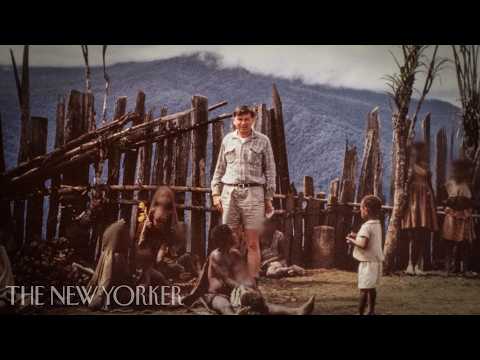
D. Carleton Gajdusek won the Nobel Prize for his research on kuru, a fatal brain disease in Papua New Guinea. Over three decades, he brought dozens of boys from the South Pacific to live with him in the United States—an arrangement he framed in philanthropic and anthropological terms.
Years later, Gajdusek pleaded guilty to child abuse. Rachel Aviv follows the complicated afterlives of the boys he brought home, whose stories have never before been fully reported.
Read “The Children a Scientist Took Home” by Rachel Aviv: https://www.newyorker.com/magazine/2026/08/24/the-scientist-who-lived-with-dozens-of-children-from-the-south-pacific
Tarlov occupies the hot seat on a Fox News panel of diehard conservatives, arguing for liberal values and rousing the ire of the President, who has encouraged Fox to fire her.
This interview is drawn from The New Yorker Radio Hour, a weekly radio show and podcast hosted by David Remnick. For more, follow The New Yorker Radio Hour wherever you get your podcasts. http://swap.fm/l/tny-radiohour-eBFv3Y
Subscribe to the New Yorker channel on YouTube so that you never miss an episode:
http://bit.ly/newyorkeryoutubesub
D. Carleton Gajdusek won the Nobel Prize for his work on a disease in Papua New Guinea. In the course of three decades, he brought dozens of boys from the Pacific Islands to live with him in the United States. Gajdusek cast the arrangement in philanthropic as well as anthropological terms, but the reality was darker. What became of the boys he brought to America has never been fully reported—until now.
The environmental activist has launched a project to document community concerns about the boom in data-center construction across the U.S.
This interview is drawn from The New Yorker Radio Hour, a weekly radio show and podcast hosted by David Remnick. For more, follow The New Yorker Radio Hour wherever you get your podcasts. http://swap.fm/l/tny-radiohour-eBFv3Y
Subscribe to the New Yorker channel on YouTube so that you never miss an episode:
http://bit.ly/newyorkeryoutubesub
The virologist D. Carleton Gajdusek wrote sexually about his adopted children in journals that were printed by the National Institutes of Health. “I carried my lifelong pederasty into my medical career and succeeded in both with very few failures,” he wrote, two months before he died. “Without protectors I would never have succeeded.” In this week’s issue, Rachel Aviv reports on how institutions enabled the Nobel Prize-winning scientist—and the complicated afterlives of the boys who were in his care.
Maybe you know Alia Shawkat from her acclaimed roles in “Arrested Development” and “Search Party”—or, maybe, you went to high school together? The “Wrong Girls” actress reveals that she doesn’t really think she’s famous. “I get a lot of, like, ‘How do I know you?’ ”
 Login
Login