To listen to more of Gerald Fischbach’s stories, go to the playlist: https://youtube.com/playlist?list=PLVV0r6CmEsFx3DRAuU3bpy3bxgC3OzmB6
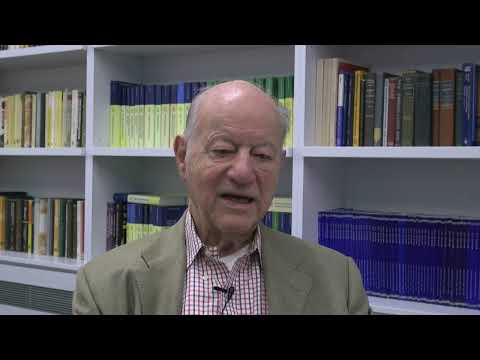
Gerald Fischbach (b. 1938) is an American neuroscientist and pioneering researcher. He pioneered the use of nerve cell cultures to study the electrophysiology, morphology and biochemistry of developing nerve-muscle and inter-neuronal synapses. [Listener: Christopher Sykes; date recorded: 2023]
TRANSCRIPT: Harvard was a different story. I loved teaching. One reason I moved, left the NIH, was I missed interacting with students and I loved teaching in classes and seminars. I gave a course at Harvard at one of the houses [Leverett House], which was terrific, the students loved me. There was not a lot of credit for that, but I'd go over to the college once a week and teach, and it was such a joy to see the enthusiasm of students. I miss that.
I joined the pharmacology department at Harvard, which had been in the past chaired by Otto Krayer. That name is not prominent today, but it was in the '30s, '40s and '50s and the '60s. Krayer was brilliant. He married a Jewish woman and, hence, could not get a job in Germany anymore, so he moved. Had a couple of stops before Harvard but ended up chairing the department of pharmacology at Harvard. When I went there it was chaired by Irving Goldberg, who was a biochemist.
One reason I went there to Harvard, I was offered a job at Caltech, MIT and a couple of other places, was that it was near Steve Kuffler and the neurobiology department. That department was the first neurobiology department in the country. Neurosciences were usually tucked into physiology departments or anatomy. This was the first recognition of neurobiology as a separate discipline. They became very aloof, the neurobiologists, and arrogant, so I was happy to be a safe distance away from them, across the quadrangle. But I liked them very much, especially Steve Kuffler and Dave Potter and Story Landis, who I'll say more about in a minute, and Paul Patterson, who also passed away at a very young age with a lung disorder. Shocking when this happens to someone, one of your colleagues. But I was accepted by the neurobiologists; many other people were not.
To listen to more of Gerald Fischbach’s stories, go to the playlist: https://youtube.com/playlist?list=PLVV0r6CmEsFx3DRAuU3bpy3bxgC3OzmB6
Gerald Fischbach (b. 1938) is an American neuroscientist and pioneering researcher. He pioneered the use of nerve cell cultures to study the electrophysiology, morphology and biochemistry of developing nerve-muscle and inter-neuronal synapses. [Listener: Christopher Sykes; date recorded: 2023]
TRANSCRIPT: While I was chairman of the department we recruited nine people, each one a long search, so that took a lot of time and effort and consensus. Eight of those nine were promoted to tenure, which was unheard of for any department, let alone the stodgy neurobiology group. But they've all worked out well and I think people there are extremely happy. In fact, I have the urge now to go back to Boston. Not to live, but to spend time, take a train up and spend a couple of days just trying to learn more about neural circuits and molecular science going on there. We'll see if that works. I could take a train up and hang out at the local hotel. I think I'd be welcome. And I feel badly about all the friends who I miss. One of them, Rod MacKinnon, left Harvard and went to Rockefeller, where he had a cryo-EM and won a Nobel Prize studying potassium channel structure. We had dinner at Rod's house with Bruce [Bean] two years ago, I think it was two years, on Long Island. And pledged that we would get together more frequently than every 20 years, and it's up to me to get us together. But I think my interests in individuals and in the department actually grew beyond that, to issues of the school and the university.
To listen to more of Gerald Fischbach’s stories, go to the playlist: https://youtube.com/playlist?list=PLVV0r6CmEsFx3DRAuU3bpy3bxgC3OzmB6
Gerald Fischbach (b. 1938) is an American neuroscientist and pioneering researcher. He pioneered the use of nerve cell cultures to study the electrophysiology, morphology and biochemistry of developing nerve-muscle and inter-neuronal synapses. [Listener: Christopher Sykes; date recorded: 2023]
TRANSCRIPT: The trip to St. Louis was terrific. The time in St. Louis, the drive out there was a long way and en route my daughter, who had been accepted at Amherst College and who was encouraging me and Ruth to take the job in St. Louis, because it's exciting and you need to do something different. On the drive out, she said – as we were passing corn fields in Idaho – she said this is so far from any place I'd ever want to be. She was so keen to get into college and break free, which she did do. But, despite that, we got out there and we had lunch with the then-chairman of biochemistry. It was about a 100 degrees and moist, but we got through that and bought a lovely home which backed onto the university campus, across a beautiful park which I had to traverse to get to the medical school every day. This was in a small town called Clayton. Forest Park was the name of the park. It had beautiful museums and sports fields and a number of other things, so it was fun to walk across the park or ride my bike across the park.
The community felt like I was back in high school in the '50s. It was not a bustling New York or Boston community, but it was wonderful. Our kids, our sons loved it. They went to high school there, played sports, and have friends even today, now that they're in their 50s, have friends from that era.
St. Louis' suburbs are beautiful. And Washington University, to the effort of Bill Danforth, who was then president. He was an MD. He raised tremendous amounts of money and interests in the university, and I got involved with that. We created a neuroscience center. I was the chairman of the Department of Anatomy and Neurobiology. Subsequently, it changed to the Department of Neuroscience after I left.
I tried to do both; I took part in teaching gross anatomy. Until one day, I was in the lab and one of the students who happened to be the son of a high school friend of mine, came up to me and said, 'Dr Fischbach, the rumor in the class is you don't know what you're talking about.' I said, 'Bob, anatomy is straightforward,' but he wouldn't believe it. But I helped organize that, make it a vital course. More and more my time and my interests diverged from laboratory science to university-wide affairs, both at the medical school and the college.
Our neighbor [Bob McDowell] in Clayton was Chairman of the Math Department. He and his wife [Attie] became very close friends, and his kids. So, I enjoyed St. Louis enormously and recommended… I'd get very annoyed when the snooty, arrogant kids from New England say, 'How could you ever go to St. Louis if you had a job in Boston?' They just don't know what the world is like. We loved St. Louis and were there for about 10 years, when I was recruited to come back to Harvard as chairman of neurobiology.
To listen to more of Gerald Fischbach’s stories, go to the playlist: https://youtube.com/playlist?list=PLVV0r6CmEsFx3DRAuU3bpy3bxgC3OzmB6
Gerald Fischbach (b. 1938) is an American neuroscientist and pioneering researcher. He pioneered the use of nerve cell cultures to study the electrophysiology, morphology and biochemistry of developing nerve-muscle and inter-neuronal synapses. [Listener: Christopher Sykes; date recorded: 2023]
TRANSCRIPT: We moved back, lived in the campus for a year, then moved into a brand-new apartment building on the 15th floor. It was beautiful, walking distance from the NIH. The whole city had changed dramatically from the time we were there before. Bethesda was now a thriving metropolis. The NIH, because of the Vietnam War, was an armed camp. You couldn't get into the NIH without a pass and without being identified at one of the several entrance points. Disappointing, in a way, with no more baseball games, but it was secure. The first time I was there in the '60s, we would demonstrate against the war on the steps of the administration building, and no one bothered us, crowds gathered around. Today, if you did that, you'd be arrested in 10 minutes and dragged off the campus. What a change in the place.
Ruth, in the earlier years, had become the president of the Maryland Mothers of Twins Association, we had twin boys. She was articulate and outspoken. They finally fired her because she was so outspoken. But she wanted to have her say and one of her clear memories is taking this group to the Capitol to demonstrate. Where they would hold hands and circle the building. My daughter, Elissa, who went with her, remembers being stretched so much that she could hardly raise her arms after that. But that was Ruth, her passion and skill was organizing in community events. She had another job at the NIH, she worked at the director's office in Varmus and another woman, who was the assistant director, who she helped organize many projects. We were both very happy there.
And then I got fired. It was not my choice. I had been nominated by Donna Shalala, who was then the Secretary of Health and Human Services, to succeed Harold Varmus as director of the NIH. But this occurred near the end of the president's term, who is a Democrat. And the Republicans in the House Committees didn't want to make another appointment for a Democrat at the end of his term. This was Bill Clinton.
To listen to more of Gerald Fischbach’s stories, go to the playlist: https://youtube.com/playlist?list=PLVV0r6CmEsFx3DRAuU3bpy3bxgC3OzmB6
Gerald Fischbach (b. 1938) is an American neuroscientist and pioneering researcher. He pioneered the use of nerve cell cultures to study the electrophysiology, morphology and biochemistry of developing nerve-muscle and inter-neuronal synapses. [Listener: Christopher Sykes; date recorded: 2023]
TRANSCRIPT: My time at Columbia was interesting and challenging, being concerned with national matters of healthcare and survival of schools and the profession of medicine. The students were wonderful at Columbia. Very smart, very committed, and full of interesting ideas. And the staff was great. The professors and the administrators were very good and thrilling and challenging. The staff was terrific. I met and worked closely with Kevin Kirby and Marian Jakubiak, who remained good friends during my next step. But there were many people like that on the faculty who I'd known throughout my career from the early days at the NIH to then. So, regardless of the agony of the financial world, there were rewards that I appreciated.
But after a period of time, I think I was then 65 or older, I decided it was time to step down as dean, as Executive Vice President. At that time, I was at a loss of what to do, and then I met Jim and Marilyn Simons. Helped them with making a decision about a particular request they had from a faculty member at Columbia, and I advised against doing it because I didn't think the faculty member was up to the job. But we became associates, Marilyn and Jim and I, and then friends.
To listen to more of Gerald Fischbach’s stories, go to the playlist: https://youtube.com/playlist?list=PLVV0r6CmEsFx3DRAuU3bpy3bxgC3OzmB6
Gerald Fischbach (b. 1938) is an American neuroscientist and pioneering researcher. He pioneered the use of nerve cell cultures to study the electrophysiology, morphology and biochemistry of developing nerve-muscle and inter-neuronal synapses. [Listener: Christopher Sykes; date recorded: 2023]
TRANSCRIPT: I, and also Steve Hyman [director of NIMH], felt that it was time to bring disciplines together, rather than have neuroscience in the Institute of Mental Health in neurological disorders and stroke, in aging, in infectious disease. Wouldn't it be good if all the neuroscience was closer together? We proposed to Harold Varmus, who was director at the time, that a new structure be put up, a new building, and they did. It took years to get it passed and built, and now it's named the John Porter Centre for Neuroscience.
John Porter was probably one of the most successful congressmen who championed science and the NIH, so I was very happy when I was invited back to give a talk at the opening of the center. And it's thriving today. I don't know where John Porter is now, but I hope he's still very involved. It's way up on the Old Georgetown Road side of the campus with beautiful grounds around it, right across from the Cancer Center. There's no place like it in the country, I think, or in the world.
That's how I moved, not away from, but beyond my own lab. Very rewarding times. So when, after 10 years at Harvard, and very satisfying years, I had a very tearful departure from the department. Me crying, them crying, why was I doing that? After all, I just recruited them, didn't I want to see them succeed? I said, 'Yes, I did, but I had been offered the directorship of the National Institute of Neurological Disorders and Stroke.' And I figured why not? Washington was one of our, certainly Ruth's, favorite place to live. Boston is my favorite place. I had great friends, and I miss Boston today. But she had put up with so much for so long, and I was very interested in the NIH and in directing an institute, that we decided to do it.
To listen to more of Gerald Fischbach’s stories, go to the playlist: https://youtube.com/playlist?list=PLVV0r6CmEsFx3DRAuU3bpy3bxgC3OzmB6
Gerald Fischbach (b. 1938) is an American neuroscientist and pioneering researcher. He pioneered the use of nerve cell cultures to study the electrophysiology, morphology and biochemistry of developing nerve-muscle and inter-neuronal synapses. [Listener: Christopher Sykes; date recorded: 2023]
TRANSCRIPT: So they, even though I had been approved enthusiastically by the FBI and all other people that reviewed me for the position, and Harold Varmus was very enthusiastic, they wouldn't approve it. For no reason at all, they just said no. I was prepared to stick it out, to wait until there was a new president, perhaps be nominated again, but I was enjoying revolutionizing the NINDS. Which itself had become a little stuck in the mud, but which everybody agreed, and in our years together there, rejuvenated the science.
But then a lawyer came to see me who was working with Shalala. And he said, 'Gerry, if I were you, I would leave because this is never going to stop. The Republican congressman will always fight you in whatever you want to do.' So, I listened to that and thought for a while, should I go back to Harvard? But I didn't want to disrupt the department and the new chairperson there. So, this offer at Columbia came up and I took it. Ruth had a job also in the bioethics group. She had her PhD, had got a good job. Our kids were all grown and out, so we went up to New York again.
To listen to more of Gerald Fischbach’s stories, go to the playlist: https://youtube.com/playlist?list=PLVV0r6CmEsFx3DRAuU3bpy3bxgC3OzmB6
Gerald Fischbach (b. 1938) is an American neuroscientist and pioneering researcher. He pioneered the use of nerve cell cultures to study the electrophysiology, morphology and biochemistry of developing nerve-muscle and inter-neuronal synapses. [Listener: Christopher Sykes; date recorded: 2023]
TRANSCRIPT: When I took the job over from Herb Pardes, I was told there was a $20 million deficit in the annual budget. The university told me I have to fix that. It wasn't as though they gave me $20 million for new programs, I had to make it myself. They described many new programs, but they said, 'Gerry, of course you have to raise money for that'. Most of the fundraising at this medical school and every other medical school, is from grateful patients. And they're equally grateful to the hospital as they are to the medical school. In fact, they didn't have much of a sense of what the medical school did.
Indeed, the trustees of the university didn't either. It's not a big board of trustees, it's about 20 people, and none of them had ever been to the medical school, which was at 168th Street, as opposed to 116th. I asked them, gave them the privilege of having a board meeting at the medical school. And the trustees were shocked at the resources and the research going on, they did not understand what was being done at the medical school. That seemed to shift and two or three of the trustees became close advisors and friends.
To listen to more of Gerald Fischbach’s stories, go to the playlist: https://youtube.com/playlist?list=PLVV0r6CmEsFx3DRAuU3bpy3bxgC3OzmB6
Gerald Fischbach (b. 1938) is an American neuroscientist and pioneering researcher. He pioneered the use of nerve cell cultures to study the electrophysiology, morphology and biochemistry of developing nerve-muscle and inter-neuronal synapses. [Listener: Christopher Sykes; date recorded: 2023]
TRANSCRIPT: We initiated a program, which has spread across the country, called 'Mind, Brain and Behavior'. Which was meant to be focused on the college and to include people from all disciplines, not just neurobiology and biology. But there were people who signed up for the program from the business school, from other disciplines. And our meetings were just exciting because everyone wanted to learn about the brain, especially the students. It became the second-most popular concentration at Harvard within a year or two. The students wanted to know why their grandfather was drinking so much or why their mother or grandparents couldn't remember their names. They really became deeply involved in brain science, so that was a joy for me. And it still exists today. They've forgotten about me, but it still exists.
To listen to more of Gerald Fischbach’s stories, go to the playlist: https://youtube.com/playlist?list=PLVV0r6CmEsFx3DRAuU3bpy3bxgC3OzmB6
Gerald Fischbach (b. 1938) is an American neuroscientist and pioneering researcher. He pioneered the use of nerve cell cultures to study the electrophysiology, morphology and biochemistry of developing nerve-muscle and inter-neuronal synapses. [Listener: Christopher Sykes; date recorded: 2023]
TRANSCRIPT: I felt this was a chance that we shouldn't turn down, that I felt the department was sluggish, it had not made a promotion to tenure in 26 years. They had great students that came through, but the postdocs never got faculty tenure. That was just understood before they came, so I wanted to change that. And when I came back my lab and the department was not ready, they were renovating.
So, I moved initially to the MGH, to a new research building across the river in Charlestown, in a beautiful research building. My lab was next to Steve Hyman, who's a friend and a good student when I was teaching pharmacology, and there were several other people. I was there for almost two years before the labs were complete and then moved up to the medical school. But what that experience did, was it gave me a much better understanding and respect for the science going on in the hospitals. There's no place in the world whose science community matches Boston, I think. Between the MGH and the college, the Brigham, Beth Israel Children's Hospital, the Cancer Center, there's no place like it.
There are some areas that are excellent, but the aggregate of science and scientists is unprecedented. There's also a wonderful psychiatric hospital, Mass Mental Health, which I interacted with quite a bit.
To listen to more of Gerald Fischbach’s stories, go to the playlist: https://youtube.com/playlist?list=PLVV0r6CmEsFx3DRAuU3bpy3bxgC3OzmB6
Gerald Fischbach (b. 1938) is an American neuroscientist and pioneering researcher. He pioneered the use of nerve cell cultures to study the electrophysiology, morphology and biochemistry of developing nerve-muscle and inter-neuronal synapses. [Listener: Christopher Sykes; date recorded: 2023]
TRANSCRIPT: Being the dean... actually, my title was Executive Vice President for Health and Biomedical Sciences, it was a long title, was a very difficult job. Because it meant dealing with a very aggressive hospital who was fighting with the medical school at every turn over money, over prestige. The president of the hospital, Herb Pardes, was a former dean. He was a tough guy. Effective, but tough.
I learned a lot about biomedical science and medical politics, dealing on a very different level from the department. It was more on a very political and financial level. If you've ever been to Columbia, P&S, now called the Vagelos School. To give you an idea of how unrealistic I was, I proposed building on top of a sports center or on top of a parking garage, a hotel for patients. It could be done, and I think the individuals were willing, but the city was not, and I didn't have any skill in dealing with politics at that level. Take an elevator up above the sports center to two floors. It was a huge center, the whole block, to make that a hotel for parents of patients, children would have been ideal, but didn't get much of a hearing.
But there were many other things that we did at Columbia. But, again, there was recruitment, there was dealing with the college when the new president was appointed back there, there was an effort to consolidate resources from the medical school to the college. I don't know if that makes sense to you, but things like royalties on inventions, the college wanted more control over, so we lost money that way.
To listen to more of Gerald Fischbach’s stories, go to the playlist: https://youtube.com/playlist?list=PLVV0r6CmEsFx3DRAuU3bpy3bxgC3OzmB6
Gerald Fischbach (b. 1938) is an American neuroscientist and pioneering researcher. He pioneered the use of nerve cell cultures to study the electrophysiology, morphology and biochemistry of developing nerve-muscle and inter-neuronal synapses. [Listener: Christopher Sykes; date recorded: 2023]
TRANSCRIPT: So, it was really a throwback, this early science. Even to my undergrads over many years. I had majored in mathematics at Colgate and had a very good course in partial differential equations. One of the key questions, which was commented on by ignorant reviewers, was these cells are not real, they're all artifact, they're tissue culture artifacts. I felt it was important to study the membrane properly of muscle and nerve.
It was about the time when Wilfred Rall at the NIH and Phil Nelson [and three other authors] had published a series of papers in the 'Journal of Neurophysiology' on motor neurons, showing that these highly branched neurons could be reduced mathematically to the single cylinders, and they could estimate the membrane properties. I decided to do a similar but different project with the branched myotubes. And we analyzed the input resistance, the membrane capacitance, as well as the membrane potential of myotubes at different stages of development, whether they were single cylinders or branched cylinders.
That analysis showed that the membrane resistivity, which was derived from these differential equations, was very comparable to adult mature muscle, so this was not tissue culture artifact, but it was real muscle with intact membranes. That gave me a great deal of satisfaction because it combined the partial differential equation with a very important and relevant developmental issue. I think that settled, in my mind at least, the notion that we were not dealing with leaky cells, artifacts.
To listen to more of Gerald Fischbach’s stories, go to the playlist: https://youtube.com/playlist?list=PLVV0r6CmEsFx3DRAuU3bpy3bxgC3OzmB6
Gerald Fischbach (b. 1938) is an American neuroscientist and pioneering researcher. He pioneered the use of nerve cell cultures to study the electrophysiology, morphology and biochemistry of developing nerve-muscle and inter-neuronal synapses. [Listener: Christopher Sykes; date recorded: 2023]
TRANSCRIPT: The other important result at that time was we demonstrated the transmitted release was quantized, it was not high, it was mean quant of about 3 or 4, which gradually increased with time and culture, but that was just like the mature neuromuscular junction. I focused more and more on the accumulation of acetylcholine receptors. Why did that occur and was it really focused on?
We published two papers in 1979, which shaped my career, my reputation, and set the direction for future research. One was a biochemical paper with Tom Jessell, who had joined the lab two years earlier from England. He was in pharmacology and was comfortable with biochemical procedures. He was using fairly standard approaches of gel filtration and ion exchange chromatography. We purified a factor from the chick brain and spinal cord, which could increase the number of acetylcholine receptors on cultured muscle somewhere between 4- and 10-fold, very exciting to me.
The other paper was with Eric Frank, who was a wizard. He was the son of Karl Frank, who was the chairman of the lab of neurophysiology [at the NIH] and a brilliant physiologist, very involved in spinal cord analysis. Eric had been at Reed College and then came to the NIH, and was a gifted, I really mean gifted, experimentalist. He had set up a system so that he can precisely, within a couple of microns, place the electrode filled with acetylcholine next to a recording electrode, eject the ACh and know exactly what the sensitivity was within a 5- to 10-micron span. He had so much electronics set up and he would step on a pedal and that would eject the ACh, turn the oscilloscope on and get the cameras moving. I told him that that pedal was so magic that I could hear the toilets in the hallway flush whenever he stepped on that pedal, he controlled so many different things. It was really quite amazing.
To listen to more of Gerald Fischbach’s stories, go to the playlist: https://youtube.com/playlist?list=PLVV0r6CmEsFx3DRAuU3bpy3bxgC3OzmB6
Gerald Fischbach (b. 1938) is an American neuroscientist and pioneering researcher. He pioneered the use of nerve cell cultures to study the electrophysiology, morphology and biochemistry of developing nerve-muscle and inter-neuronal synapses. [Listener: Christopher Sykes; date recorded: 2023]
TRANSCRIPT: And my own ambitions had grown beyond individual things, and I was interested in running a department. Washington University has a great history of neuroscience. The most recent chair had been Max Cowen, but they had a great history before that. So, when they asked me to be the chairman, I struggled with that decision for a while, but Ruth and I decided let's move and see what it's like.
So we left Harvard; few people do that. I had tenure at the time. I had tenure at the NIH, and I had tenure at Harvard. When I go back and calculate, I think I passed tenure review six times in my career, twice at Harvard, once at WashU, twice at the NIH [and once at Columbia]. Anyhow, it goes on and on.
To listen to more of Gerald Fischbach’s stories, go to the playlist: https://youtube.com/playlist?list=PLVV0r6CmEsFx3DRAuU3bpy3bxgC3OzmB6
Gerald Fischbach (b. 1938) is an American neuroscientist and pioneering researcher. He pioneered the use of nerve cell cultures to study the electrophysiology, morphology and biochemistry of developing nerve-muscle and inter-neuronal synapses. [Listener: Christopher Sykes; date recorded: 2023]
TRANSCRIPT: These two papers, again, shaped my life for the next 15 to 20 years. They were both published in excellent journals, the Journal of Cell Biology, etc. And they established the problem of regulation of acetylcholine receptors [in cultured myotubes]. Because we always believed what was true of acetylcholine at the neuromuscular junction must be true of GABA and glutamate on neurons and other transmitters and modulators.
And that has turned out to be the case, where receptors, excitatory amino acid receptors on neurons, are concentrated on the spines of the dendrites. They're not uniformly distributed. GABA, the inhibitory transmitter, is a little more broadly distributed, but it also is concentrated at synapses. I think our work on tissue culture neurons because we can visualize it and place electrodes precisely, was a bit ahead of its time and created a great deal of attention.
Tom Jessell had a very successful career after that but ended up in tragedy when he died at a very young age of supranuclear palsy. He was really quite a remarkable, joyful, outgoing person. Winner of many, many awards. In line, I felt, for the Nobel Prize, to follow Richard Axel and Eric Kandel at Columbia.

 Login
Login