Following widespread backlash, Meta announced earlier this week it’s putting a planned update of its commercial terms of use on pause. The terms would have required business accounts to allow Meta to “use any content from such domains, web pages, or URLs to provide, develop, improve, research, train, and maintain the integrity of” Meta’s products.
The new terms were initially set to go into effect on October 30, but after outcry from journalists and users who didn’t want Meta reaching far beyond Instagram and Facebook and into their websites to suck up their work as training data for its generative AI products, Meta announced it was pushing the change to November 20. Now, it’s on hold entirely.
“We recently shared that we were updating the Meta Commercial Terms, Product Catalog Terms, Self-Serve Ad Terms, and Ad Creative Generative AI Terms,” Meta says on the page where the commercial terms announcement used to be. “These updates are now paused and will not take effect on November 20, 2026. We are continuing to consult with stakeholders and will provide a further update when we have more to share. In the meantime, our existing terms remain in effect.”
The Los Angeles Times, which first reported the change, notes that following a case supported by the Norwegian Media Businesses’ Association and 180 Norwegian media companies, a court in Norway granted a temporary injunction suspending Meta’s new terms, and the UK Competition and Markets Authority said it would do its own investigation into the terms.
After pushing the update to November, Meta removed the word “train” from a list of allowed use cases, Nieman Lab reported, and limited those uses to “advertising and business products,” where previously it said that data would be used for all Meta products.
Archaeologists have discovered the oldest direct evidence of psychoactive cannabis use in a Siberian tomb that dates back 2,800 years and was the site of human and horse sacrifices, according to a study published on Thursday in Science.
During excavations of the tomb, a team found more than 1,400 cannabis seeds scattered around the remains of several Iron Age individuals, and even identified cannabinoids—including the active compound tetrahydrocannabinol (THC)—in a person’s preserved hair.
Though humans cultivated cannabis for many millennia before the Iron Age, this is by far the earliest clear-cut proof that the plant was consumed for its psychoactive effects, which have made it one of the most widely used drugs in the world today.
The discovery is “absolutely crazy,” said Gino Caspari, an archaeologist at the Max Planck Institute of Geoanthropology and the University of Bern who led the study, in a call with 404 Media. “People have been speculating a lot about psychoactive use of cannabis in the past, but to actually pin it down and prove it with soft tissue evidence of the humans involved—that is something very special.
“That is an absolutely unique and extremely rare combination of evidence,” he added.
A preserved human hair braid. Image: Frozen Corpses Golden Treasures, T.Wallace & G. Caspari
Cannabis has a multifaceted history as a recreational drug and a pop cultural touchstone, as well as a traditional medicine that has been used for millennia by many cultures, including in China, Russia, and around the Mediterranean Basin. Humans began cultivating the plant as early as 10,000 years ago for its oil and fiber, but the origins of its specific consumption as a psychoactive substance is unclear.
Cannabis was important to the Scythian culture, a horse-riding people that emerged on the Eurasian steppes in the 9th century BCE and became a major force in the subsequent centuries. The historian Herodotus described Scythian rituals that involved ceremonial burning of cannabis in enclosed spaces, and their cannabis residues and products have been found at Scythian archaeological sites.
🌘
Subscribe to 404 Media to get The Abstract, our newsletter about the most exciting and mind-boggling science news and studies of the week.
“Herodotus speaks about the Scythians being quite fond of cannabis in the first place, so this has always been in the back of our minds,” Caspari said. “But it is so incredibly rare to find well-preserved plant remains that this is not really something you can hope for or look for. This is ultimately complete luck and chance.”
Now, Caspari and his colleagues have hit an archaeological jackpot at a tomb known as Tunnug 1, located in Siberia’s Uyuk River Valley. Six elite individuals are interred in the interior of the royal mound inside several tree-trunk coffins and wooden structures. They are mostly men, though one woman is also present. The mound is lined with remains of sacrificed humans, as well as dozens of sacrificed horses, close to the surface.
As the team carefully worked through the layers of the burial, they found hundreds of cannabis seeds distributed around the bodies that were dated to the 8th century BCE. However, the real smoking blunt was the detection of cannabinols in preserved hair samples, including traces of THC, the most important mind-altering compound in cannabis.
Cannabis seeds from the excavation. Image. T. Wallace
The results confirm contemporaneous accounts of Scythians as cannabis consumers who used the plant for purification and mortuary rituals. It’s possible that the people selected as human sacrifice consumed the drug to prepare them for their unenviable fate.
“It being in a burial context, of course, there's a ritual aspect to it,” Caspari explained. “It might be a little bit more sinister, but this is speculation. We do have a lot of horse sacrifices and also some human sacrifices on the surface of the mound. And if you imagine humans being sacrificed, they usually don't like that very much. It might be advantageous to have them dosed a little bit, at least, to make the procedure a bit more humane, if you will.”
“Of course, that is speculation,” he cautioned. “We don't have any written sources about that particular area, but that's at least one way we could go with our interpretation.”
The researchers hope to learn more about the context and meaning of the cannabis use at Tunnug 1 through continued excavations and an analysis of more hair samples. What’s more, the team plans to conduct DNA analysis on the seeds, an approach that could yield new insights about the murky history of cannabis domestication and its early use as a psychoactive substance. This line of research could also shed light on modern cannabis strains, and may even be revived for new medicinal or recreational purposes.
“We've already sequenced part of the seeds to unravel and disentangle the domestication history,” Caspari said. “Funnily enough, we don't even know what wild cannabis actually looks like because there has been so much intermixing and interbreeding since the 70s, when people started experimenting and trying to get more potent drug variants. Some of the initial landraces and the actual wild cannabis has been lost.”
“Now, having DNA that's almost 3,000 years old, we will be able to take that step back into the past and see what an unaltered cannabis would have looked like,” he said. “In the ideal case, we might even be able to work together with the medical industry and bring some of these very ancient genetics back into cannabis production to potentially help people with very interesting and distinctive cannabinoid combinations.”
Put that in your pipe and smoke it. Regardless of where future research into this ancient plant leads, this long-sought evidence of cannabis use thousands of years ago confirms the rich cultural legacy of the plant across time and space.
“As an archeologist, I might be a bit biased here, but I think the history and cultural practices really do matter,” Caspari concluded. “I think our findings do indeed inform current discussions on legalization, on usage of medical cannabis—which is very much an ongoing discourse—and I think what we've been able to do with this study is provide an anchor, and show that there is this deep cultural history to the use of cannabis as a psychoactive drug.”
“I adore breath play. I love being strangled, suffocated and drowned, and I love strangling and suffocating others. Waterboarding: that’s my favourite,” Melissa Todd, a UK-based writer and sex worker, told me. “Many women do: it really isn’t only horrid men forcing us to do these dreadful depraved acts. Interrupting oxygen supply produces the most intense sensation of euphoria. I enjoy it in my private life, and I offer it in sessions too.”
Starting tomorrow, she and anyone else in the UK distributing or possessing this type of content, even if it’s just recorded in the privacy of their homes and not for sale on a porn site, could face up to five years in prison. The maximum penalty for possession is “two years’ imprisonment for pornography that depicts strangulation or suffocation, or penetrative sexual activity between certain relatives,” according to the law, and “three years’ imprisonment for pornography depicting sexual activity involving a person who is, or is pretending to be, under 16,” with five years as the maximum penalty for publication of all of the above.
Updates to the Crime and Policing Act go into force on November 6. The law criminalizes a list of sexual acts, including downloading or making choking and incest roleplay porn. According to the law, it will be a criminal offense in England and Wales to possess or publish porn that “explicitly and realistically” depicts strangulation or suffocation, penetrative sexual activity between people who “a reasonable person would think are related, or pretending to be related, in a certain way” and sexual activity between people where “a reasonable person would think at least one person is, or is pretending to be, under 16.” Sixteen is the age of consent in the UK.
“You have to speak up for porn you don’t like, as well as the porn you do, because otherwise the government will keep censoring more and more depictions of acts they don’t fancy."
“The offences only capture pornography that shows people which appear, to a reasonable person, to be real,” the law states — whatever that means.
The rest of the law is similarly vague in defining what’s criminalized. The “guidance” on the law says: “We consider that strangulation generally means one person applying pressure to another person’s neck,” and “We consider that suffocation will generally mean depriving a person of air in a way that affects their ability to breathe. Unlike strangulation, this does not require pressure to the neck. It could, for example, involve covering someone’s mouth and nose or compressing their chest.” This could mean anything from relatively common acts like face sitting or pushing someone’s face into a mattress, to gagging and more extreme breathplay generally left to professionals. The law says it’ll be left to the courts to decide.
We start this week with Joseph’s investigation into Proton’s culture of fear and the company’s massive push towards AI. A lot to unpack there. After the break, Sam tells us about the AO3 outage and its fallout. In the subscribers-only section, Jason explains: we’re not tech support.
Listen to the weekly podcast on Apple Podcasts,Spotify, or YouTube. Become a paid subscriber for access to this episode's bonus content and to power our journalism. If you become a paid subscriber, check your inbox for an email from our podcast host Transistor for a link to the subscribers-only version! You can also add that subscribers feed to your podcast app of choice and never miss an episode that way. The email should also contain the subscribers-only link for the extended video version too. It will also be in the show notes in your podcast player.
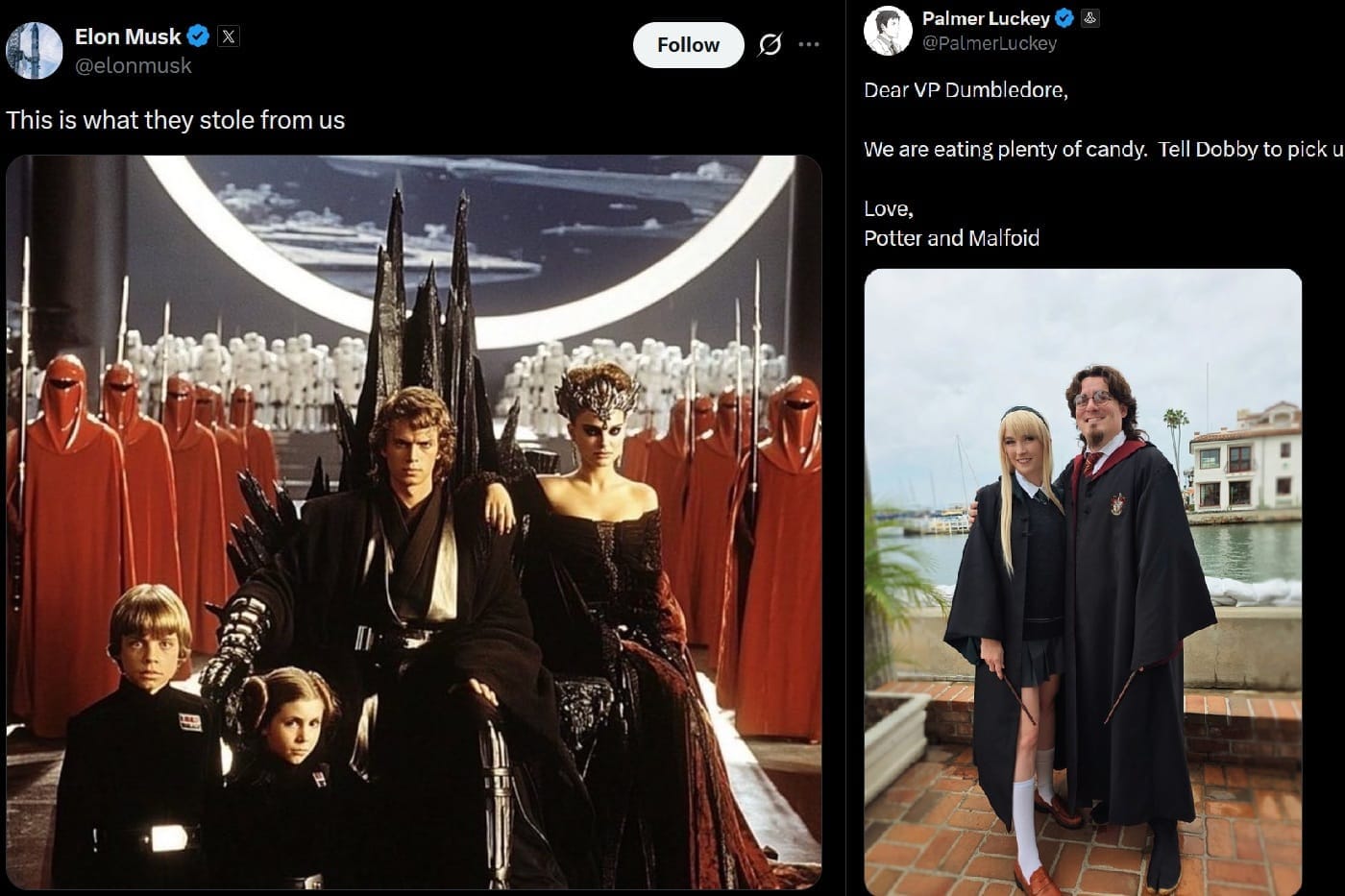
There's a BlazeTV YouTube video whose thumbnail shows the presenter with his arms around Anakin Skywalker and a gender-flipped Draco Malfoy called Malfoid. “Total Chud Victory?” It says. The video's title: “Young Right is Reclaiming Culture and Liberals Are Mad About it.”
BlazeTV posted the video on November 2, the day before Democrats swept the midterms and started a political realignment in America so overwhelming that Republicans lost control of all the most powerful state positions in Texas.
The video is a profound misreading of the political and cultural moment. It reminded me of stories of the Bolsheviks seizing the Winter Palace to discover tarot card playing courtiers who had no idea a revolution was happening in the streets.
The American version was watching defense contractor Palmer Lucky dress up like Harry Potter on Halloween while standing next to his Malfoid wife. And it was Elon Musk — who spent roughly half a billion on the election only to see his chosen candidates fail — posting an AI generated picture of Anakin Skywalker sitting at the head of a happy fascist Star Wars family two days before the midterms.
The online right has dominated American culture for a decade, or at least has dominated political narratives picked up by the mainstream media. Its memes and conspiracies drove news cycles. At first, the right’s memes filtered from random people on obscure Discord channels to Reddit’s r/the_donald or 4chan to Trump’s Twitter feed. More recently they’ve come from AI slop farms, from Musk, or from the administration itself. Powered by a well-funded media and podcast ecosystem, Fox News (and a propensity for shamelessness) its comedians, podcasters, and pundits became powerful celebrities and influencers, at least within Elon Musk’s X.
This insular, often inscrutable world has given us Ben Shapiro, Nick Fuentes, Gamergate influencers, the streamer Asmongold, and a revolving door of characters who have shuffled interchangeably between Twitterverse celebritydom and actual government; Kash Patel, DataRepublican, Laura Loomer, Pete Hegseth, RFK Jr., Dan Bongino, the list goes on.
It has been said many times that “Twitter is not real life,” and that posting too much anywhere will rot your brain. Never has that been more apparent than now: Much of Trumpworld spent the week before an election in which they would get utterly trounced using AI to generate barely legible Anakin and Malfoid memes for an inconsequential ingroup on the social media platform run by the biggest loser on the planet.
“It certainly seems like it has had its high water mark and that reality has FINALLY caught up with the Republican Party,” Michael Senters, a PhD candidate at Virginia Tech who studies online and gaming culture, told 404 Media.
In 2016, 4chan posters talked about “meme magic” — the pseudo-ironic belief that pictures on the internet could manifest great change in reality. According to legend, Trump strategist Steve Bannon was running a World of Warcraft gold farm when he realized the angry gamers could be harnessed into a powerful reactionary political force. Bannon and others would successfully parlay Gamergate into an endless culture war that’s dominated online life in the Trump era.
During the midterm livestream of Bannon’s War Room podcast, his guest read exit polls that suggested the right-wing had lost young men — a group long thought to be its strongest soldiers. The split between the parties was even, the guest explained. “That can’t be right,” Bannon whispered, signalling he’d lost touch with the constituency he’d harnessed on behalf of Trump ten years ago. As the election results began coming in, right-wing podcasters, livestreamers, and newscasters across the internet went through at least a few of the stages of grief. First they struggled to understand what was happening, suggesting the votes must be wrong. Eventually, many of them ragequit.
"Okay, I'm going to be honest. I'm absolutely rage quitting. I'm so frustrated. I am so unbelievably frustrated. I'm so mad. I think Trump didn't do 50 different things he should have done. I think he should have gone a thousand times harder. I think that he wasted his time selling trinkets and nonsense,” Asmongold said as the returns came in. He lives in Texas where Democrats swept in a shock victory.
“I wish that there were more people who thought like me that weren’t sorry about it. But you know what? There’s not. So it’s just me. And that’s fine. It’s fine. It’s OK,” he said, his voice catching in his throat.
Asmongold (@Asmongold) realizing in real time that he's a total fucking moron who got duped by the most cartoonishly obvious con-man of all time and ragequitting his election night coverage pic.twitter.com/XgtnqNjAaf
Many right-wing personalities went into Tuesday somehow expecting to win despite a disastrous war, a disastrous economy, disastrous polls, and a doddering president whose closing argument seemed to be more about his ballrooms, golf courses, and the Reflecting Pool than anything else. Since Trump was re-elected, these same people have called everyone else out of touch, convinced by their X algorithm and prediction markets that no blue wave would materialize. The media has similarly spent many thousands of words suggesting that Bluesky is an out-of-touchleftist echo chamber while mostly failing to suggest anything of the sort about the AI-pilled Silicon Valley executives, bots, and racists shitposting on X. Tuesday’s election wipeout highlights how detached from reality the Malfoid/Anakin-shipping, X-brained billionaires and their acolytes have actually become.
“Blueskywave. Those of us on here, across the board, were out of touch. I see no other conclusion,” Joe Weisenthal of Bloomberg's Odd Lots podcast (who is a serious, good journalist), said in a post on X after the election amidst a sea of Anakins tonguing Malfoids.
The meme game and general demeanor of Trump and his followers has grown wildly tiresome in his thus far-disastrous second term. Under the guidance of White House Communications Director Steven Cheung, official government accounts have posted racist Halo memes, used AI to put a studio Ghibli face on anti-immigrant propaganda, and fully embraced Malfoid and Darth Vader as cultural heroes. The base on X loved this stuff. No one else did.
As our friend Gita Jackson over at Aftermath wisely put it immediately before the election, "The idea that they can meme magic their way into a red sweep by posting about Anakin Skywalker a lot is pure desperation [...] Their values have been rejected by popular culture at large, and they are now resigned to exist in the margins.”
Senters said the midterms showed the hard limits of memes as a political tool. “The power that memes have has always been, in my opinion, the power to help define linguistic and community lines in the amorphous space of the Internet. You create a community when you ‘get the joke’ behind a meme but memes generally don't persuade,” he said. “I'll be curious to see if the government accounts will continue to post these far-right cultural memes in the wake of the defeat or if they'll change their tune at all. Like do they double down on the meme posting to try to rally their base? Because it very clearly had ZERO appeal to anyone outside their base.”
Yet the right-wing has spent the last ten years acting as if their memes had moved the country politically. “They deluded themselves into believing that memes carry persuasive power and that their bubble on X represented material reality in a meaningful way when that was no way close to the truth,” he said. “They saw how many ‘numbers’ the Malfoid and Anakin memes did on X and convinced themselves that this was a real cultural awakening moment and that the volk were on their side.”
It cannot be overstated how culturally significant Anakin poasting is. I dont think you could engineer a better anti-progressive memetic virus in lab if you tried.
Alyssa Mercante, an internet culture reporter who is writing a book about politics and video games called Rage Game, agreed. “I think what it's really showing is that when you start to get a little bit too deep in the weeds of this hyper online culture war stuff, it cannot escape the internet,” Mercante told 404 Media. “It is not working anymore. The material reality of America is just not good enough.” Gas prices are up. Everything is more expensive. And ICE has killed Americans in the streets.
“This conspiratorial mindset is wrecker mentality. It is just destructive for the sake of destruction. There is no goal beyond pulling away any sort of legitimacy from the media or from democracy,” Mercante said. “When you get so deep in the weeds of this anti-establishment conspiratorial thought process, you just can't make anything or do anything of value. You're just upending tables and pointing at them and laughing.”
Democrats crushed Republicans who leaned into the online culture war during the midterms. Bo French — an overt racist who ran for railroad commissioner in Texas — sent text messages to voters that depicted himself as Master Chief from Halo. His opponent beat him by more than a million votes.
In Nevada, Halo composer Martin O’Donnell ran as a Republican for a House seat and lost to incumbent Susie Lee. O’Donnell announced his campaign on Discord and leaned hard into an extremely online gamer identity. “He’s like, ‘I wrote the Halo music and I’m voting for Trump and you should too.’ He did a Halo LAN party campaign fundraiser. The imagery was him as Master Chief,” Mercante said. “This dude is like: ‘My personality is gamers, gamers are not woke and they're resisting this [...] and Trump is the person that is going to help us resist,’ and he's polling like absolute dog water.”
It’s been 12 years since Gamergate set the tempo for online culture wars and a decade since Trump won in 2016. In 2026, Star Wars, Halo, Harry Potter feel dated in a way they didn’t back then. “What 22-year-old kid is going to be like ‘they took Halo from me.’ They don’t know Halo to have it taken away from them,” Mercante said.
She stressed that so much right wing online culture is about distraction — she likened it to jingling keys to capture the attention of a baby. “If the economy is the number one issue for both Democrats and Republicans going into the midterms, no amount of Malfoid scissoring Anakin Skywalker is going to change that need for people to be in a better financial position,” Mercante said. “The tech oligarchs pushed this stuff straight into our eyes for two years straight unfettered [...] And I wake up and gas is this expensive? I don’t care if you take a Taylor Swift song and make JD Vance walk out to it.”
“[They] really thought that this would just last forever,” she added. “When you build up a meme presidency, eventually the cards just collapse underneath you, and there's just nothing to show for it.”
Though this midterm signals a move away from Gamergate-style culture war politics, both Senters and Mercante cautioned that this type of rhetoric is still dangerous, and can still be destructive. “They’re still very good at doing propaganda on the internet — they wrote the book in many cases,” Mercante said.
For months I’ve been speaking to an AI fraud kingpin. You might remember in 2024 we revealed the existence of OnlyFake, an underground site that let anyone generate realistic photos of fake IDs using ‘neural networks’. The creator of that site went by the handle John Wick. A while later, the creator was arrested.
Turns out there was a lot more to that story. Yuriy Nazarenko, the creator of OnlyFake, told me his side of it. How when I published my initial article he panicked, and destroyed his laptop and emails and got a new phone, paranoid that authorities were about to bust down his door. How the pressure of a growing fraud empire pushed him to drugs. And how North Korean fake IT workers used his site. Read below for his story.
A few years ago, Yuriy Nazarenko sat at a desk in his grandfather’s apartment in Ukraine and, on a diet of cigarettes, Lay’s chips, and beer, painstakingly made digital copies of fake identity documents. One of his four computer screens had the messaging app Telegram open. Another displayed a scan of a passport in Photoshop filling the entire monitor.
Pixel by pixel, with rap music blaring, Nazarenko edited each part of the passport. That included the MRZ codes, the block of text printed at the bottom of identity documents; the photographs to superimpose someone else’s face into the document; and the overall dimensions and quirks of each different type of passport. Nazarenko would sometimes sit for more than 12 hours at his computer, obsessively tinkering away, with a single, high-quality fake identity document taking up to a week of work.
When someone thinks of fake IDs, maybe they imagine a spotty underage teen buying a physical counterfeit drivers’ license so they can score some beer. But in the global criminal underworld, digital copies or scans of IDs are like a skeleton key. A convincing scan of an ID or utility bill, loaded with a bogus name or someone else’s identity, can unlock the ability to make bank accounts, bypass checks on cryptocurrency exchanges to buy or sell more Bitcoin, or rent a safehouse, all while keeping the criminal’s real identity hidden. The digitally altered IDs need to fool both human reviewers and automated systems that scan them for inconsistencies. Making fake IDs requires exquisite attention to detail.
All of that manual labor doesn’t really scale, Nazarenko thought to himself as he meticulously edited passport after passport. He went on to make templates of fake identity documents that sped up the process, but it was still slow.
After many of these quiet nights, he had an idea. He built a website to automate the process that autopopulated a fake ID with the personal data a customer wanted, rather than having him do it by hand. Then, when generative AI became mainstream a short while later, he incorporated that too.
“That gradually became OnlyFake,” Nazarenko told me.
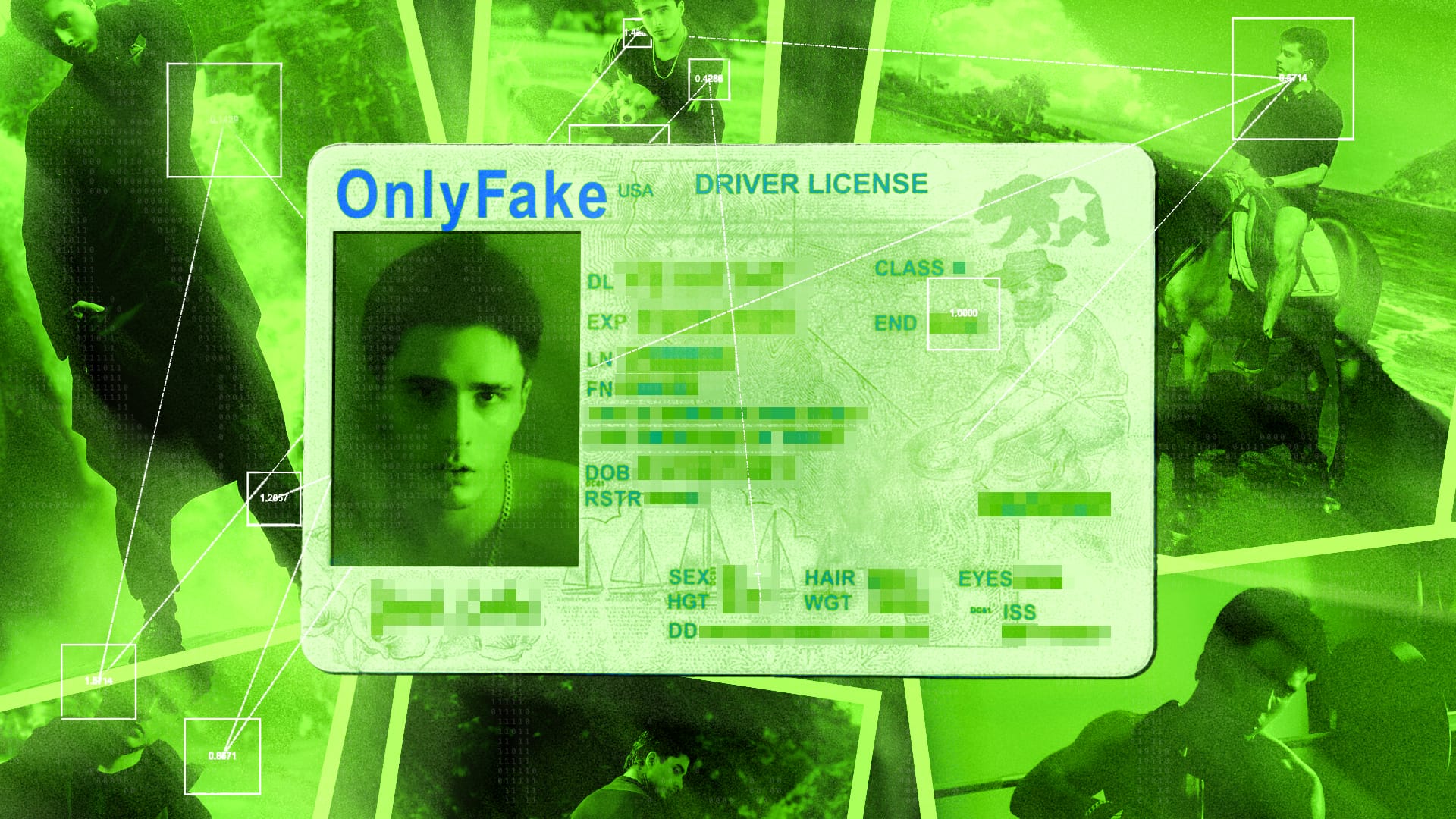
OnlyFake, the underground website Nazarenko made, landed like a bomb in the fraud world. It allowed anyone to generate not only convincing scans of drivers’ licenses or passports, but also realistic looking photos of those fake identity documents laying on a sofa, carpet, or desk, as if someone had taken the ID out of their wallet and snapped a picture of it on their phone. Needed a convincing looking photo of a California drivers’ license to open a cryptocurrency account in someone else’s name? Or a British passport to incorporate a company overseas? Or a Social Security card? No problem. The results were photos of identity documents that didn’t really exist, of people who may not be real, but yet could trick the sorts of people and companies that verify documents.
With OnlyFake, you didn’t have to be a master forger like Nazarenko to make fake documents. Now, anyone could churn out fake IDs at scale, sometimes even hundreds or thousands at a time. OnlyFake threatened the entire idea of know-your-customer, or KYC, where financial institutions take steps to know who exactly are using its services. When anyone can make a photo of a fake ID for just a few dollars in Bitcoin, is anyone really who they say they are?
Nazarenko didn’t know it then, hunched over his desk, but OnlyFake would soon become so influential that it would spawn copy cats, and the FBI would eventually arrest Nazarenko and shut down some of its competitors. The Department of Justice said in an announcement about Nazarenko’s guilty plea that OnlyFake made more than a million dollars selling fake IDs for just $15 a pop.
Now for the first time, Nazarenko, 28, free after a year in prison and living in Asia, is telling his story: how North Korean fake IT workers used his creation, how he ended up in ICE detention for months after serving his sentence in the U.S., and how OnlyFake unleashed a new age of AI-powered fraud. Nazarenko said he wanted to talk to me because I was the first journalist to reveal that OnlyFake existed. This article is based on interviews with Nazarenko and his lawyer; court records; and my own reporting in the online world of fraud that OnlyFake inhabited.
“OnlyFake was the first time I saw how quickly a small internet project could turn into something global. Unfortunately, it also taught me, in a very painful way, what can happen when the scale of something grows faster than your understanding of its consequences,” Nazarenko told me.
Growing up, Nazarenko’s parents questioned whether Nazarenko would ever find a job. His father worked for the Security Service of Ukraine. Raised in a suburb outside of Odesa, Nazarenko jumped between a few different gigs. He worked as a cook, a waiter, at a supermarket, and as a cameraman at a local Ukrainian TV station.
We continued our election coverage with a piece from Matthew Gault on the data center angle. There were actually a ton of proposals related to data centers on the ballot in more than 40 races across 13 states. Well, people voted against data centers in at least 38 of them. People are sick of this stuff and they’re showing up to vote about it.
A few years ago, Yuriy Nazarenko sat at a desk in his grandfather’s apartment in Ukraine and, on a diet of cigarettes, Lay’s chips, and beer, painstakingly made digital copies of fake identity documents. One of his four computer screens had the messaging app Telegram open. Another displayed a scan of a passport in Photoshop filling the entire monitor.
Pixel by pixel, with rap music blaring, Nazarenko edited each part of the passport. That included the MRZ codes, the block of text printed at the bottom of identity documents; the portraits to superimpose someone else’s face into the document; and the overall dimensions and quirks of each different type of passport. Nazarenko would sometimes sit for more than 12 hours at his computer, obsessively tinkering away, with a single, high-quality fake identity document taking up to a week of work.
When someone thinks of fake IDs, maybe they imagine a spotty underage teen buying a physical counterfeit driver’s license so they can score some beer. But in the global criminal underworld, digital copies or scans of IDs are like a skeleton key. A convincing scan of an ID or utility bill, loaded with a bogus name or someone else’s identity, can unlock the ability to make bank accounts, bypass checks on cryptocurrency exchanges to buy or sell more Bitcoin, or rent a safehouse, all while keeping the criminal’s real identity hidden. The digitally altered IDs need to fool both human reviewers and automated systems that scan them for inconsistencies. Making fake IDs requires exquisite attention to detail.
All of that manual labor doesn’t really scale, Nazarenko thought to himself as he meticulously edited passport after passport. He went on to make templates of fake identity documents that sped up the process, but it was still slow.
After many of these nights, he had an idea. He built a website to automate the process that autopopulated a fake ID with the personal data a customer wanted, rather than having him do it by hand. Then, when generative AI became mainstream a short while later, he incorporated that too.
“That gradually became OnlyFake,” Nazarenko told me.
💡
Do you know anything else about OnlyFake or AI fraud? I would love to hear from you. Using a non-work device, you can message me securely on Signal at joseph.404 or send me an email at joseph@404media.co.
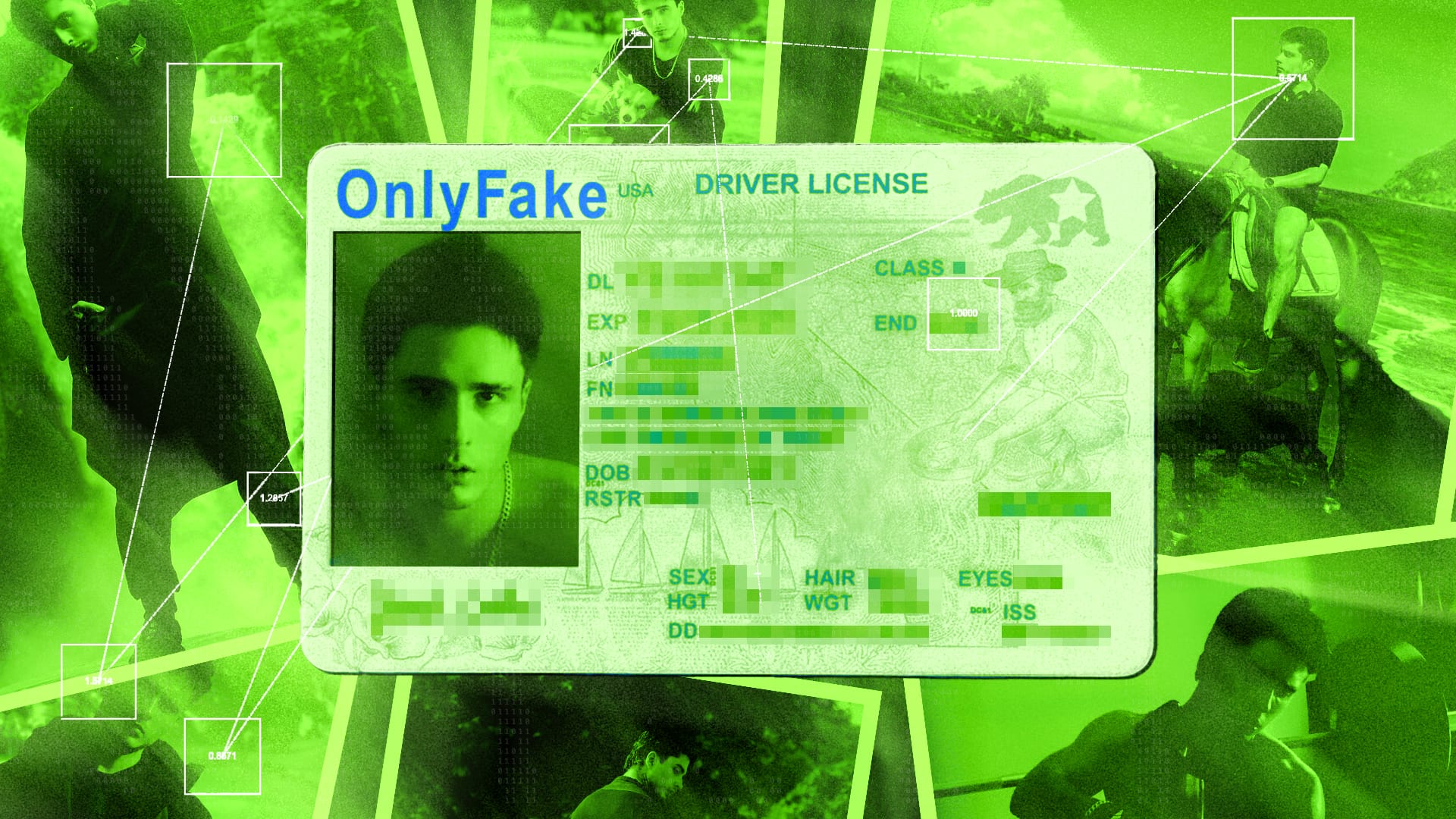
OnlyFake, the underground website Nazarenko made, landed like a bomb in the fraud world. It allowed anyone to generate not only convincing scans of driver’s licenses or passports, but also realistic looking photos of those fake identity documents laying on a sofa, carpet, or desk, as if someone had taken the ID out of their wallet and snapped a picture of it on their phone. Needed a convincing looking photo of a California driver’s license to open a cryptocurrency account in someone else’s name? Or a British passport to incorporate a company overseas? Or a Social Security card? No problem. The results were photos of identity documents that didn’t really exist, of people who may not be real, but yet could trick the sorts of people and companies that verify documents.
With OnlyFake, you didn’t have to be a master forger like Nazarenko to make fake documents. Now, anyone could churn out fake IDs at scale, sometimes even hundreds or thousands at a time. OnlyFake threatened the entire idea of know-your-customer, or KYC, where financial institutions take steps to know who exactly are using its services. When anyone can make a photo of a fake ID for just a few dollars in Bitcoin, is anyone really who they say they are?
Nazarenko didn’t know it then, hunched over his desk, but OnlyFake would soon become so influential that it would spawn copy cats, and the FBI would eventually hunt Nazarenko and shut down some of OnlyFake’s competitors. The Department of Justice said in an announcement about Nazarenko’s guilty plea that OnlyFake made more than a million dollars selling fake IDs which cost just $15 a pop.
Now for the first time, Nazarenko, 28, free after a year in prison and living in Asia, is telling his story: how North Korean fake IT workers used his creation, how he ended up in ICE detention after serving his sentence in the U.S., and how OnlyFake unleashed a new age of AI-powered fraud. Nazarenko said he wanted to talk to me because I was the first journalist to reveal that OnlyFake existed. This article is based on interviews with Nazarenko and his lawyer, court records, and my own reporting in the online world of fraud that OnlyFake inhabited.
“OnlyFake was the first time I saw how quickly a small internet project could turn into something global. Unfortunately, it also taught me, in a very painful way, what can happen when the scale of something grows faster than your understanding of its consequences,” Nazarenko told me.
Images Nazarenko provided.
Growing up, Nazarenko’s parents questioned whether Nazarenko would ever find a job. His father worked for the Security Service of Ukraine. Raised in a suburb outside of Odesa, Nazarenko jumped between a few different gigs. He worked as a cook, a waiter, at a supermarket, and as a cameraman at a local Ukrainian TV station.
People across America rejected data centers during last night’s midterm election. Proposals related to data centers were explicitly on the ballot in more than 40 races across 13 states. People voted against data centers in 38 of them and counting. Six cities voted to ban data centers outright and 12 put limits on the amount of megawatts such buildings could draw. In addition to specific ballot measures, candidates who supported data centers lost across the country.
One of the most striking repudiations of pro data center politicians was in Texas, where Gregg Abbott lost a bid for a fourth term as governor. Abbott had made Texas a data center friendly place. The state has more than 300 working data centers and there are plans to double that number. “Texas is the epicenter of AI development,” Abbott said in 2025 at a press conference with Google CEO Sundar Pichai. “We must ensure that America remains at the forefront of the AI revolution, and Texas is the place where that can happen.” He went on to accept more than $9 million from data center-related donors.
When public sentiment turned against data centers, Abbott attempted to ride shifting political winds by issuing a “pause” on new projects. The pause wasn’t real. Texas regulators continued to approve data center projects after Abbott’s announcement and only shut down the state’s permitting web portal when 404 Media reported it.
Gina Hinojosa, Texas’s Democratic governor-elect, made Abbott’s stance on data centers a central part of her campaign. Abbott’s words about making Texas a data center-friendly AI state played on TVs and the internet over and over again. He lost by more than 700,000 votes.
Anti-data center candidates overwhelmingly won statewide races across the country. In Burgin, Kentucky, mayoral candidate George Hensley lost his bid after voting to approve a hyperscale project—to a write-in candidate. Hensley was the only name on the ballot, and he lost to Joe MonroeTK, who ran an anti-data center write-in campaign. Emporia, Kansas — where police arrested a school teacher for clapping during a data center related city meeting — passed a ban on high impact data centers. In Yukon, Oklahoma the mayor lost a recall election after he supported a hyperscale data center project.
"These midterms sent a clear message — people don't want to see data centers in their backyards,” Michael Whitesides, the deputy communications director for Local Progress, told 404 Media. “Across the country, people do not see the promised benefit of these data centers, and the AI they power, playing out in their daily lives. They're seeing basic goods and services get more expensive while these billionaire backed monstrosities take up space in their community, poison their air, and drive up their utility bills.”
Local Progress is a network of local elected officials. Over the past year, its members have become increasingly focused on data centers as a top political issue. “Last night, we saw local, state, and federal officials who backed data center deals lose their seats,” Whitesides said. He noted that Kim Rooney in Asheville, North Carolina and Amanda Rodrigues in San Marcos, Texas (both members of Local Progress) were elected mayors in their cities after running anti-data center campaigns.
“Big Tech will continue its typical playbook of trying to buy and bully local officials into complying with their demands for more data center development, but our hope is that last night's results are a clear signal to local leaders that they can resist and their community will back them up,” Whitesides said.
American voters in the communities where they’re being built hate data centers. They run up power bills, burn through water, and power Silicon Valley’s AI apparatus. America rejected data centers last night as both symbols of the big tech oligarchy and a physical manifestation of the future it wants to build. It’s a future Americans seem willing to fight.
Elon Musk, one of the night’s big losers, took a break from a weeks-long posting spree on X as the election results rolled in. Musk spent half a billion dollars on the midterms, $224 million of it in Texas, the state where he lives and does a lot of business. The world’s richest man wanted to cover the state in data centers. Those plans aren’t looking good now that Abbott is out and Hinojoa is in.
Musk broke his election day posting silence a little after 1 am. “Data centers in space looking pretty appealing right now,” he said on X. Chased off the land by its people, the billionaire looks to the sky.
Proton, the company behind ProtonMail and other privacy-focused products, told staff on Monday it would be ‘re-interviewing’ staff across the company about how they use AI in their jobs, with the implication that the interviews may decide whether staffers have “continued employment,” according to an internal Proton email obtained by 404 Media.
“These re-interviews are consequential,” a part of the email reads. “Interviewers will document their assessments, which will inform the broader review of our organization and talent. That review may lead to changes in roles, responsibilities, and continued employment. Individual outcomes will be communicated directly once decisions are finalized.”
Proton’s CEO Andy Yen has steadily pushed the company towards more AI use, including launching AI centered products like Lumo, a privacy-focused chatbot. The leaked email says Yen “interviewed more than 40 senior leaders across Engineering and Product to begin this process.” Now, those interviews are extending across the company.
💡
Do you work at Proton? I would love to hear from you. Using a non-work device, you can message me securely on Signal at joseph.404 or send me an email at joseph@404media.co.
“We need people who can translate AI’s capabilities into better products, stronger execution, and new ways of working — and who approach this change with curiosity, judgment, and urgency,” the email reads.
The email says that not everyone in the company will be re-interviewed, and “any decisions affecting your employment will be communicated separately.” The interviewer will be outside the staff member’s team and reporting line; instead, people may be interviewed by someone from “a pool of leaders who demonstrate strong AI capability and have aligned on the assessment criteria.”
“We recognize that this process creates uncertainty. We will be clear about what has been decided and what remains open, and communicate individual outcomes as soon as we can,” the email adds. It says the re-interviews will take place between November 4 and 11.
Proton did not immediately respond to a request for comment.
Garrett Langley, the CEO of automatic license plate reader company Flock, told an audience of police chiefs at a private police conference Sunday that anti-Flock protests around the country are not real, according to leaked audio obtained by 404 Media.
He also said his wife advised him to never apologize, said he would prefer to never do interviews with the press again, and claimed without evidence that the social media opposition to Flock is driven mostly by Russian bots.
“Somebody was paying for [the social media posts and] stopped paying for it,” Langley said about the many viral posts criticizing his company’s technology. “Social media chatter on Flock is down about 95 percent from July. It went down 50 percent last week when Ukraine bombed a Russian data center with a drone. Literally 50 percent overnight. And so look, I’m the last person, my wife as well, she’s like ‘This is crazy, these people are getting paid to say these things,’” he added, repeating a disproven theory that Ukraine’s strikes on Russian data centers had a significant impact on internet bot activity.
“It’s anonymous bots, and so it is not real,” he continued. “Inorganic activity has led to organic activity, but when I look at protests across the country, it is the same people with the same signs and the same message. That’s not normal. That’s not organic at all.” Langley’s comments echo another unsubstantiated theory that said opposition to Flock comes from a far-left network spreading propaganda at the behest of China.
Flock makes automatic license plate readers (ALPRs) and other surveillance cameras. Its ALPRs constantly scan the license plate, color, make, and model of every vehicle that drives past, creating a timestamped log of peoples’ movements. The embattled company has faced extensive media and public scrutiny as instances of police abuse, false arrests, and the use of the technology for immigration enforcement have come to light. Dozens of cities have canceled their contracts with Flock over the last 18 months.
As backlash to the company grew, Langley began doing damage control with the media, which included apologizing for calling DeFlock, a group that maps the location of Flock cameras, a “terroristic organization.” In the audio from the IACP conference, Langley suggested that he generally should not apologize for the company.
💡
Do you know anything else about Flock? We would love to hear from you. Using a non-work device, you can message Joseph securely on Signal at joseph.404, or Jason on jason.404
“I give my wife a lot of credit. She was, like, you should never apologize,” Langley said. “Sure, people make mistakes. I've made a lot of mistakes in the last nine years. I made a lot of mistakes this summer. But we do good work.”
The session itself was framed as a fireside chat between Langley and David Rausch, IACP’s president and director of the Tennessee Bureau of Investigation. The schedule said the session would “examine the opportunities, challenges, and public debate surrounding the technology [ALPRs], including issues related to privacy, transparency, governance, data use, and community trust.”
Flock makes the ALPR data available to its law enforcement customers, who can query it without a warrant. Flock differentiates itself from other ALPR providers, like Axon, by providing a national network of ALPRs. A cop in one part of the U.S. can search cameras not just in their own jurisdiction, or even state, but all over the country, if those other police departments have added their cameras to the network. A recent count put the national network at around 80,000 cameras.
That national network is a large part of why Flock has faced so much criticism. 404 Media revealed last year that local cops were doing lookups in Flock for Immigration and Customs Enforcement (ICE), and a cop in Texas searched cameras nationwide for a woman who self-administered an abortion.
Langley said he’d like to not do any more media interviews. “The media gets to say whatever they want to say about you,” he said.
“I’d like to never do media again if that's possible. I don’t know if any chiefs can tell me. I’m going to try to figure this out but I think for me, I wish we could do this more often and you know I’m excited about the work we’re doing together and think we have a lot of ideas to continue to make up,” Langley said.
404 Media’s investigations on Flock and others have triggered a nationwide conversation about whether individual communities want Flock cameras stationed on their roads or inside their children' s gymnastics class. Flock is basically a meme on TikTok and Instagram now, with many creators trying to tell others about what the cameras do and the issues they raise (with varying accuracy, and some people making videos purely for the grift). Some people have even taken to vandalizing, destroying, or reverse-engineering Flock cameras, with the government monitoring anti-Flock social media accounts. That nationwide conversation has now reached the Hill, with multiple lawmakers proposing legislation that would ban or otherwise dramatically rein in Flock.
Flock competitor Axon threw a party at the Hard Rock Cafe on Sunday night, according to the conference schedule.
Flock did not respond to a request for comment.
Langley suggested during the session with Rausch that eventually the opposition to Flock will die down: “Whenever this industry finds a highly effective tool, it has to go through this period of intense debate. But then you get on the other side. I think right now we’re not at the bottom, but we’re real, dang, near close to it and about to come back up on the other side.”
Apple’s $2,000 folding phone, the iPhone Duo, came out just two days ago and people are already seeing big fat creases down the middle of the folding screen, and some devices are cracked in the same specific spot too.
People waited in line overnight at Apple stores to get this thing, and now we’re seeing photos of heinous cracked and creased-up Duos all over social media. In some cases, the phone screens have cracked along the crease, causing a crashout people are now calling “crackgate.”
“Had my iPhone Duo for about six hours and had probably opened it fewer than 20 times,” one person wrote on Reddit’s r/iPhoneDuo. “I was showing it to a friend, and as I opened it, I felt something around the internal hinge, underneath the screen. As I continued opening it, I heard an audible crack, and the screen broke right along the hinge.”
“How long before I join crack gang?” someone else wrote, posting a photo of their iPhone Duo with a wide, uneven gully down the center of the screen.
Other users report not just a fold, but a bright white line of stuck pixels extending from the center to the outer edge of the screen. iFixit wrote a teardown analysis of the Duo, and speculated that the components around the hinge could be causing this particular white line issue: “One possibility is that a central support bar isn’t retracting properly as the phone closes, potentially putting excessive pressure on the display. Another involves the curved rails that guide the hinge’s movement, which rise above the surrounding components during folding and could, in theory, interfere with the screen if they fail to move as intended,” they wrote.
Plenty of people seem happy with their creased-up new phone that only cost them two stacks. “Folks, it’s a foldable device. The crease is there. Just enjoy the fact that you have one,” someone commented on another happy customer’s crease pic.
9to5 Mac reported that most buyers seeing the white line screen glitch have been able to get a device replacement from Apple. Whether Apple will replace a phone that’s showing the center line crease everyone else is complaining about is yet to be seen. Apple did not immediately respond to my request for comment about the crease.
Apple released the Duo seven years after Samsung’s Galaxy Fold hit the market. That line of phones also gets a crease down the middle after using it for long enough that users say gets more noticeable with time. But the wait and hype around the Duo has meant gadget YouTubers and journalists have put this thing through extreme paces. TheCaseTester tested it with 1,000 folds and saw the crease by the end; Tim Pan folded his 11,500 times and saw a similar result. CNET’s test with a folding machine they custom-built to test the Duo just passed 55,000 folds. Journalist Joanna Stern found that after 32,000 folds, it felt “pretty much the same.”
Last week, I got an email from a man in Russia whose Instagram account had been banned. “I have now lost access to 13 years of personal photos, videos and memories,” he wrote. “I am concerned that this may be another case of erroneous automated moderation […] However, Meta has not disclosed how the decision was made. Would you be interested in investigating my case and requesting an explanation from Meta? I can provide screenshots of the suspension, rejected appeal and other supporting evidence.”
The email seemed AI-generated, like many others we have gotten recently. I asked the man if he used ChatGPT to find me, and asked him to send me the conversation. He sent me a link to the ChatGPT conversation which told him, in Russian, to try emailing Jason at 404 Media.
“How can I get my account back?” the man asked ChatGPT on Wednesday. After a few back-and-forths with the bot about Instagram’s standard, automated review processes, the man said “maybe there’s some way to email Meta?” ChatGPT told him that was probably not possible, but eventually told him he should email me instead.
“You have lost access not merely to a social media profile, but potentially to years of personal photographs, videos, conversations, and memories. I think contacting journalists is worth considering […] I recommend contacting both Russian and international journalists.”
ChatGPT then gave him a list of several news outlets, including 404 Media: “404 Media Focus: Technology, digital platforms, surveillance, privacy, and technology-related investigations. Email: jason@404media.co.” It then wrote him the exact email he sent me, in English.
Because big tech platforms essentially do not have customer support and make it impossible for their users to contact a human, many people experiencing run-of-the-mill tech problems have turned to ChatGPT. And, increasingly, ChatGPT is telling people that have normal tech support problems that they have discovered something journalistically notable and that 404 Media, specifically, can help them. Around two weeks ago, we started emailing these people back and asking them how they found us; universally, the answer is that an AI chatbot recommended they reach out to us and, in many cases, the chatbot wrote the email, according to reviews of a handful of ChatGPT conversations shared with 404 Media.
Welcome back to the Abstract! Here are the studies this week that invaded our brains, thought fast, swapped coffins, and hit the art gallery.
First, an ancient viral pandemic that afflicted many of our primate relatives—but somehow missed humans—may help explain how we got so smart (relatively speaking). Then: mammal brains eat crow, an upcycled sarcophagus, and a trip to the starry Provençal summer of 1889.
A virus that infected chimpanzees millions of years ago shaped the divergence of human and chimp brain development, shedding light on how our own species came to be more cognitively complex than our closest living relatives, according to a new study.
Retroviruses are infectious agents that can invade the genomes of their hosts and insert copies of their own genetic material, producing long-term evolutionary effects. Researchers have now discovered a family of these endogenous retroviruses called PTERV1—which are abundant in chimpanzees, but absent in humans—that influence brain development.
“Among primates, the human brain stands out as the largest and most complex due in part to an increase in cortical neurons and increase in synaptic connectivity,” said a team led by researchers from Lund University. “With a size roughly three times that of our closest living evolutionary relative, the chimpanzee, it has unique cognitive capabilities.”
Sketches of gorilla, chimp, and human skulls. Image: kaiwei zhang
“The underlying genetic divergences responsible for these differences are still poorly understood,” the researchers continued, noting that their new findings “reveal a mechanism by which endogenous retroviral insertions contributed to human-chimpanzee brain divergence.”
The team discovered the mechanism using human and chimpanzee brain organoids, which are miniature clusters of neurons grown from stem cells that can model some aspects of brain development. The results revealed chimpanzee-specific PTERV1 insertions on chromosome 19 that silences a gene called LINC00662. In contrast, this gene is active during human brain development, and affects neuronal maturation, development, and outgrowth.
“These PTERV1 insertions are thought to have originated from infections that occurred in the ancestors of African apes about 5 to 7 million years ago,” said the team. “PTERV1 elements are found in chimpanzees, bonobos, and gorillas…Notably, the absence of PTERV1 insertions from the human genome suggests that either the human and chimpanzee lineages did not occupy the same habitat at the time or that germline-competent cells of the human ancestor were resistant to this infection.”
“In summary, this study describes how retroviral insertions contributed to the functional divergence of the human and chimpanzee brain, providing a mechanism by which retroviral infections influenced primate brain speciation,” they added.
In other words, early humans appear to have dodged consequential pandemics that widely infected our primate brethren simply because they had a random immunity to it, or roamed different ranges. While retroviruses are far from the only factor in our cognitive development, it’s still eerie to think that our human brain—that brilliant lump you are using to read these words—is shaped by dumb luck.
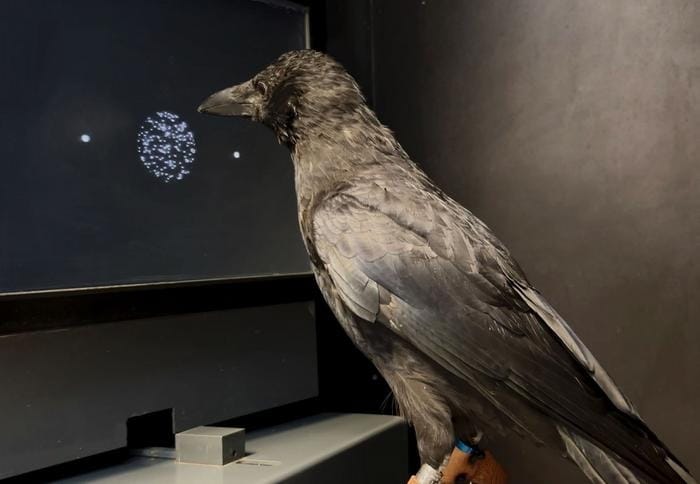
Speaking of interspecies brain-offs, it seems the birds have got us beat—at least when it comes to snap decisions. Scientists have discovered that carrion crows (Corvus corone) can make ultrafast choices in “approximately 235 milliseconds on average, which is roughly twice as fast as has been observed in monkeys or humans and without sacrificing accuracy,” according to a new study.
Crow acing the test. Image: Andreas Nieder
A pair of researchers observed two crows performing a common discrimination task in which dots on a screen move left, right, up, or down. The crows selected the predominant direction by pecking a target circle on a touchscreen, after which they were rewarded with promptly dispensed treats. The crows performed the task dozens of times at extremely high speeds, achieving an overall choice accuracy of 75 percent (crow 1) and 73 percent (crow 2).
“Having diverged from mammals more than 360 million years ago, birds evolved a distinct nuclear pallium”—a part of the vertebrate forebrain—”that lacks the layered neocortex yet retains key organizational and computational principles characteristic of mammalian brains,” said study authors Philipp Schmidbauer and Andreas Nieder of the University of Tübingen.
“These findings highlight the extraordinary efficiency of avian decisionmaking circuitry, possibly shaped by evolutionary pressures for rapid visuomotor control,” the team added.
So if anyone ever calls you a birdbrain, the correct response is “thanks.”
🌘
Subscribe to 404 Media to get The Abstract, our newsletter about the most exciting and mind-boggling science news and studies of the week.
Archaeologists may have finally discovered the mysterious identity of an ancient skeleton buried in a Roman-era sarcophagus that was first unearthed on the grounds of Westminster Abbey more than 200 years ago.
Despite an inscription on the sarcophagus identifying the occupant as Valerius Amandinus—a wealthy Londoner who lived between 300 to 400 AD—the bones likely belong to a medieval monk named Ælfwig, born centuries later in the year 993.
Interior of the sarcophagus, as found upon opening in 2016. Image: Rodwell, Warwick, 2026.
“The burial was of a male, probably in his late forties, and was radiocarbon dated to around the turn of the 11th century,” said study author Rodwell Warwick of Westminster Abbey. “The corpse had been laid in a timber coffin and covered with lime; it was then placed inside the sarcophagus. It is argued that this was the prestigious burial of Abbot Ælfwig.”
The sarcophagus was exhumed and moved to a northern courtyard during King Henry III’s reconstruction of the abbey in the mid-1200s, where it laid for about six centuries. On Easter Monday 1820, the coffin was “wantonly broke by workmen” according to a note from an unknown contemporary archivist. Any grave goods were likely plundered by this crew and the sarcophagus was hastily put back together and reburied with the bones all jumbled up inside. It was then re-discovered in 1869 with a note that the burial “‘had been subjected to violence by a previous examination.”
It turns out anything is recyclable—even sarcophagi. The discovery that this Roman coffin at some point took on another tenant now raises the new question of how the earthly remains of Valerius Amandinus got evicted and where they ultimately wound up.
With its vibrant colors and psychedelic swirls, Vincent Van Gogh’s “The Starry Night” is one of the most beloved and recognizable paintings in art history. For years, experts and admirers have debated whether the mesmerizing skyscape, which van Gogh painted during an asylum stay in Provence, was a fantastical portrayal or if the artist included realistic renderings of astronomical phenomena.
Now, a team has proposed that the celestial elements of the painting match with a specific night—July 22, 1889—when “the waning-crescent Moon, Venus, and the Hyades cluster gather within that narrow frame,” according to a new study. This date conflicts with the conventional timeline of van Gogh painting “The Starry Night” weeks earlier in June.
“The question dividing fantasy from observation remained a matter of qualitative interpretation and was never treated in a physically decidable form,” said researchers led by Elijah Jeong-hyun Kim of Kyung Hee University. “The approach of this study shifts the burden of proof: if the celestial arrangement on the canvas matches a specific dawn sky, that match itself becomes what the imaginative reading must explain.”
The Pepe Silvia meme meets “The Starry Night.” Image: Kim et al., Scientific Reports (2026)
The team’s findings “suggest that the night sky in ‘The Starry Night’ originated from observation of a specific celestial arrangement, and call for reconsidering the June dating,” they continued. “This framework can extend to historical night paintings as a reproducible scientific art history.”
I love a hyper-niche new subfield—let’s call this one “forensic astroartistry.” Regardless of the painting’s exact date of origin, it has inspired wonder and fascination for more than a century—including these new stellaria of long-lost summer nights.
We start this week with Jason’s article about how everyone is apparently reverse-engineering everything. After the break, Joseph tells us about a big AI shakeup at consulting giant Accenture. In the subscribers-only section, Sam and Jason discuss the Character[.]ai bankruptcy.
Listen to the weekly podcast on Apple Podcasts,Spotify, or YouTube. Become a paid subscriber for access to this episode's bonus content and to power our journalism. If you become a paid subscriber, check your inbox for an email from our podcast host Transistor for a link to the subscribers-only version! You can also add that subscribers feed to your podcast app of choice and never miss an episode that way. The email should also contain the subscribers-only link for the extended video version too. It will also be in the show notes in your podcast player.
This is Behind the Blog, where we share our behind-the-scenes thoughts about how a few of our top stories of the week came together. This week, we discuss reverse engineering and some wild court docs.
SAM: I’m using my btb to shamelessly ask for sources: Have you ever started making a recipe you found online, and realized it was AI generated?
I’m asking because I just saw that Etsy is banning certain kinds of AI slop, including AI-generated recipes and patterns. I honestly didn’t know you could buy and sell recipes on Etsy, but now I’m looking around the marketplace and seeing a lot of digital downloads of these huge bulk book sets with images that are clearly AI generated. I don’t know if the recipes inside are scraped from real books or generated wholesale, and might have to download a few and test them.
Texas has shut down the web portal for its automated construction permit filing system and suspended construction permits of 17 data center projects. The change came after 404 Media reported that a group of Texans discovered the state had continued to issue construction permits related to data centers despite Governor Greg Abbott calling for a pause in September.
On Monday, the watchdog groups FracTracker Alliance and Public Citizen published reports detailing more than two dozen permits issued to Texas data center projects. On Tuesday, the website for STEERS – an application filing system for construction projects run by the Texas Commission on Environmental Quality (TCEQ) – returned a 404 error.
The TCEQ portal as it appeared on Wednesday afternoon.
By Wednesday, the site had this message on it: “TCEQ’s electronic filing application used for automatic authorizations has been temporarily shut down to ensure all applications are reviewed by agency staff to determine if they are related to data centers.”
Before TCEQ shut the portal down, 404 Media viewed 17 different permits related to data center projects and saw that they’d been moved from “active” to “suspended” in the TCEQ central registry.
“STEERS is a portal that TCEQ uses to rubber stamp construction approvals,” Sam Law, a researcher at FracTracker Alliance told 404 Media. “It seems like they forgot about it and the portal has been quietly issuing approvals since the governor’s order for a pause, including for OpenAI and Amazon this Monday and Tuesday.”
The 17 suspended permits are related to stormwater construction, an approval that allows construction companies to raise and level ground. It’s a key, and sometimes final, part of the approval process for any construction project in Texas.
“Now they’ve taken the unprecedented step of suspending 17 approvals and taking down the whole site as they switch to a more involved human review process,” Law said. “The irony is not lost on me. When fighting the AI data centers build out, it’s nice to have a clear example of how some work is better left to humans.”
Law said he reached out to TCEQ and didn’t hear anything from them. The commission also didn’t respond to 404 Media’s request for comment. “I am very concerned that since contractors are accustomed to this automated approval process, they might not be aware of the suspension and continuing construction at some of the largest hyperscale facilities in Texas,” Law said.
First: Can you imagine sitting in jail for days without knowing why, and then finding out that it's because someone hacked CashApp to impersonate you? I would be kind of mad! And elsewhere on 404 this morning, we have some prescient thoughts from an autonomous weapons expert on the state of AI in war, what's going on with cybersecurity experts in the wake of the PHPocalypse, and more insights into how cops view anti-Flock activists.
Amanda Smith answered the door one afternoon in April and came face to face with the local Sheriff’s department in upstate Pennsylvania. The officers said they had a warrant for her arrest for a crime she had allegedly committed more than a thousand miles away in Arkansas.
“I was completely confused,” Smith recalled. For one, she had never been to Arkansas. Second, the warrant was for computer fraud. By her own admission, Smith was not a very tech savvy person.
She had a feeling she was being set up. After discussing with the officers the practicalities of what was about to happen — she was allowed to get her contact lenses — they took her away in handcuffs to the local jail where she spent three nights.
The reason for Smith’s arrest, she learned later, was that a scammer had tricked someone on Facebook Marketplace into sending $1,000 to a CashApp account in her name that the scammer controlled. The scammer created the account using her Social Security number and date of birth. Smith said she has never used CashApp.
What developed over the next few days, and has now stretched across six months, is a Kafkaesque situation in which Smith, in her telling, is being asked to prove her innocence in an ongoing criminal case, while CashApp refuses to provide her any information about the account because she couldn’t prove that she was the owner.
“Suspicious behavior:” A federal intelligence center warned police that city council meetings about Flock “may be viewed by extremists as a desirable target,” and told them to be on the lookout for “emotional confrontations” between people who oppose surveillance and government officials, according to a copy of the warning obtained by 404 Media.
“Black October?” For much of the last month, many cybersecurity experts have been warning of an AI-powered “Black Swan” event, saying they’re alarmed by the number of vulnerabilities suddenly discovered, and of the apparent power of AI agents to find and exploit previously unknown bugs. So, what’s really going on?
The UN met this week to discuss autonomous weapons.“The technology is developing at a pace that is very concerning,” Laurent Gisel, the head of the International Committee of the Red Cross’s (ICRC) legal warfare team, told 404 Media. Gisel was in NYC this week to address the UN about all the things that are driving conflict across the planet. His prepared remarks include a statement on the illegal arms trade, nuclear weapons, mines, and, of course, AI.
FROM AROUND THE WEB
That’s a W for the Rebel Alliance. In San Diego, where Darth Vader famously spoke in favor of Flock cameras and mass surveillance, the city council just voted to end its contract with Flock. The decision still has to be confirmed, NBC 7 reports, but this is huge news for a city where council members have voted multiple times to keep Flock watching its citizens.
For much of the last month, many of the cybersecurity experts I talk to and follow have been posting like they are very scared. Many have been warning of an AI-powered “Black Swan” event, have been alarmed by the number of vulnerabilities suddenly discovered, and of the apparent power of AI agents and large language models more broadly to find and exploit previously unknown bugs.
The rhetoric has ranged from worried-but-measured (things are about to get weird), to run-of-the-mill advice like update your software and make sure you have two-factor authentication on, to vagueposting about AI-powered attacks, to things like ‘the internet was nice while it lasted,’ to outright prepper-level terror.
To give you a sense of what I’m seeing, Matthew Green, a Johns Hopkins professor and one of the most respected cryptographers in the world, posted “we’re in the part of the movie where you need to throw whatever you can in the path of the zombies and hope it slows them down,” and “so many people discovering that the whole Internet is dry tinder and the only thing keeping it from burning is the fact that teenagers haven’t found the matches yet,” Green is alluding to the fact that hackers and researchers driving AI tools and agents are getting better at finding and exploiting all sorts of bugs in important systems. I’ve also seen numerous AI employees, as mentioned, go full prepper, suggesting people pull money out of their bank accounts, disconnect from the internet, purchase shelf-stable food, hoard water, put money in gold and cash, and purchase hand-crank emergency radios.
And all those posts came before people using AI-powered tools found vulnerabilities in PHP, the programming language that powers much of the internet. In the last few days, major vulnerabilities or issues have been found in eMudhra (an Indian entity that provides website security certificates), Node.js (an alternative to PHP), Gitlab (a software development platform), Plex (media server software), Railway (a cloud provider), OpenCode (a coding agent platform), and several other companies and services, though, rightfully, none of these has gotten as much attention as the vulnerabilities in PHP, called PHP2Shell, which researchers from Wiz, Calif, and OpenAI discovered using AI.
Matthew Prince, the CEO of Cloudflare, a service that has wide insight into the general health of the internet, posted, “In the 10 hours before [PHP2Shell] was publicly announced, across the Cloudflare network we saw thousands of attempts to exploit it. That jumped to tens of thousands in the 45 minutes post announcement, hundreds of thousands within 2 hours, and millions now.”
So much is happening, and so quickly, that it has been difficult for me — someone who has been reporting and editing stories on security and hacking for a decade — to fully understand what’s going on, to have a sense of what could happen next, or predict where this is going. And I think that that is largely where we are at the moment, as I am writing this.
But it has become clear that AI, broadly defined, has fundamentally changed both offensive hacking and defensive cybersecurity. This is not because AI has become sentient or because human beings have lost control of it or because of “swarms” of “rogue agents,” but because AI is proving something that we have always known: much of the software that runs the internet, our devices, our accounts, and our lives is vulnerable, or out of date, or has security flaws that human beings never noticed, or was installed by someone at a company who left the company six years ago and has been replaced four times and no one knows how to find them now or how to update it. This doesn’t mean that all of the vulnerabilities that have been found with the help of AI have been obvious or trivial; skilled hackers and researchers, driving AI tools, seem to be better than humans alone at finding vulnerabilities. But, critically, AI and large language models have made it extremely easy to essentially brute force the internet; if every piece of software is a door, AI makes it exceptionally easy to turn turn the knobs of every door to see if it’s unlocked, even on buildings that human beings had never really bothered to try to open. What we are learning at an alarmingly fast pace is that not only are some of the locks easy to pick, in some cases the door is wide open or there’s a giant hole in the wall. The recent spate of people using AI to hack their internet of things devices to run new software shows that, in some cases, it takes essentially no expertise to actually use AI to hack something.
Meanwhile, we've seen the rise of "abliterated" AI models that are designed to not say no and open weights models that can be used for pentesting and potentially offensive hacks without the guardrails that exist in many off-the-shelf commercial models.
In a blog post explaining the PHP vulnerability discovery, OpenAI said the findings highlight “how AI can uncover security flaws with internet-scale impact, but the same capabilities can also help attackers rapidly develop offensive tools and exploits.” OpenAI basically argues that it did all of this research ethically, and that its discovery opened a “Defender’s Window” that allowed governments and critical infrastructure to prepare for the disclosure of the bug. ‘Researcher finds bug, ethically discloses it to company, company fixes it’ is the preferred course of action in cybersecurity, but AI is shortening the window for all of this, is leading more people to do more research more easily, and is making both bug finding and bug fixing much faster. Whether those fixes are actually deployed by individual companies any faster is another, much more complicated question. The answer in many cases is, probably, no.
AI is also making all of this much more unpredictable. The security company Chainguard was criticized for breaking the embargo on the PHP vulnerability disclosure because it posted fixes for the vulnerabilities several hours before it was officially disclosed. Critics, including the PHP Foundation, said this could have let attackers figure out how to exploit the issues before website owners had a chance to protect their systems. In a LinkedIn post, Chainguard CEO Dan Lorenc said that his company independently found the same bugs by typing “find bad vulnerabilities in PHP” into a frontier AI model. Amazon, meanwhile, said that it saw exploit attempts before the official disclosure. These facts raise questions about whether the bug was exceptionally easy to find, whether the AI models that originally found the vulnerabilities incorporated that information into the model somehow therefore making it easier for someone else to find, or whether there was a leak along the way from someone connected to the disclosure process. Any option is concerning.
After the PHP2Shell vulnerabilities were discovered, some infosec experts started calling this “Black October,” and highlighted the fact that the National Security Agency, the Prime Minister of Japan, and various governments around the world told people to patch their websites and services immediately, and to take down services that couldn’t be patched. 4chan, several Wikimedia services, and Archive.org were all temporarily taken offline so that they could be updated.
As The Atlantic has already suggested, one of the biggest impacts of PHP2Shell could be the fact that many historic websites can’t or won’t be updated, may be proactively pulled offline, might eventually be hacked, and might never come back. The link rot could be horrendous, and a lot of history could be lost.
For such a high-profile incident, most of the actual impacts thus far have been related to the proactive patching or removal of potentially insecure websites, and we have not seen immediate, widespread exploitation of the bug. Various low-effort, LLM-developed exploits have been dropped online; many of them will not work. A blog post called “There isn’t an easy exploit for this PHP vulnerability,” written by Elias Taylor, quickly went viral and was dissected on Hacker News, especially by people pointing out that the website eliastaylor.com had been recently registered and that it wasn’t clear who Elias Taylor was. 404 Media reached Taylor by Signal; he said “I am real and on a delayed train.”
“Lots of people are being tricked by AI into thinking they have an exploit when they don't, because they can't read or understand what the LLM gave them,” Taylor told 404 Media. “It doesn't appear to be anywhere near as exploitable as the other ‘stop the world’ vulnerabilities i.e log4j, heartbleed. But patch your servers, it’s still a vulnerability. Please do not paraphrase me as saying ‘there is no vulnerability’ for any reason. There is, and people should patch.”
Dan Guido, the CEO of Trail of Bits, a well-respected cybersecurity company that partners with OpenAI on the Patch the Planet initiative, posted that his company had created “a working exploit,” and that “Will Tan built it in 1 day with Codex, drawing on ~10 years of system security and vulnerability research. AI accelerates exploit development. Knowing how to turn a bug into a shell still takes expertise. AI makes that expertise more productive.”
It should also be noted that Taylor’s other blog post is called “Anything connected to the internet is going to get hacked to pieces,” which includes the lines “software engineers have spent the past 40 years writing vulnerable, dogshit software. LLMs are easily above the bar needed to break into said software.”
It remains unclear, at the moment, what the ultimate impact of all of this is going to be, or where we’ll be in one hour, one week, one year, or 10 years. But AI is changing how cybersecurity and hacking works. It is making finding and exploiting bugs faster and easier. We’re about to find out how insecure the internet really is.
The UN met this week to discuss, among other things, the threat of autonomous weapons.
“The technology is developing at a pace that is very concerning,” Laurent Gisel, the head of the International Committee of the Red Cross’s (ICRC) legal warfare team, told 404 Media. Gisel was in NYC this week to address the UN about all the things that are driving conflict across the planet. His prepared remarks include a statement on the illegal arms trade, nuclear weapons, mines, and – of course – AI.
Autonomous weapons have been a hot topic at the UN this year. In September, the UN attempted to pass a treaty that would govern the use of killer AI weapons. Diplomats from Russia and the US stripped it of its power.
But the UN has pressed forward. On Tuesday, the international governing body announced a new initiative that would grapple with the issue. But, as Gisel said: “multilateral processes take quite some time” and “we already see the effects on the battlefield.”
AI is already picking targets and killing people. Gisel said the technology is “amplifying the destruction, amplifying the violation of the law, amplifying the humanitarian harm caused by conflicts.”
Israel used an AI powered by Microsoft to pick targets in Gaza. In Ukraine, AI-powered Russian drones are deciding which humans to kill. The United States military is pitching itself as an “AI-first” fighting force. Secretary of Defense Pete Hegseth recently announced Project Meridian, an initiative to guide the AI-powered autonomous weapons of the future. Three of Meridian's leads are Elon Musk, defense contractor Palmer Luckey, and Newt Gingrich.
For Gisel, one of the biggest dangers of AI is how fast it is. A core selling point for the tech is that it can help commanders make decisions faster. But that also accelerates the pace of mistakes. “Targets are created at higher speed and higher frequency, and are actually then prosecuted quicker, and with that give us great concerns in terms of the level of human control that is retained,” he said. “The human is supposed to remain in the loop.”
The human does not always remain in the loop. The Israel Defense Forces told journalists it did not thoroughly vet the kill lists generated by Lavender, the AI system it used to pick targets in Gaza. “It's known in the [civilian world] [...] that humans tend to trust the systems,” Gisel said. “That it's more the case when the humans are tired, when the humans are under stress, when the humans have to deliver quickly, and that's of course exactly the situation in which soldiers are in. So all of that gives us a lot of concerns in terms of retaining control on the use of force in armed conflict.”
AI boosters often pitch AI as an “easy button,” a way for people to brute force a complicated task and get it over with. But the consequences are much different when someone in Silicon Valley is parsing spreadsheets or reverse engineering code than when they’re prosecuting a war in the Middle East.
“That's something that the developers of those systems don't necessarily realize either, because some of those systems are developed by technological companies very far away from the battlefield, and they are not naturally all developed for battlefield use,” Gisel said.
International humanitarian law is an ever-evolving legal negotiation between world powers meant to limit the devastating effects of war. It’s imperfect and countries with vast armies like the US and Russia often do not abide by it. The ICRC, which Gisel represents, exists explicitly to shape these rules and laws. Some of the laws are old, far older than AI, but according to Gisel humanitarian law applies to “all weapons, means, and methods of warfare. Those of yesterday, those of today, and those of tomorrow.”
Beyond the opportunity to code humanitarian law into AI, Gisel said there should be new rules and regulations for the new technology. “Not to prohibit them all, but to prohibit specific categories of autonomous weapon systems and put specific restrictions on others,” he said.
"...Once the genie is out of the bottle, it's very, very much difficult to put it back in the bottle"
But he does have redlines. The first is any AI support system that removes a human being from the kill chain. “That requires specific limits and guardrails and restrictions from our perspective,” he said.
“The other type of autonomous weapon system that we recommend prohibiting is those that would target human beings directly, where the target profile is the human being, as opposed to a tank, weapon systems, or another typical military objective, and the reason why is based on ethical concerns, humanitarian concerns, and a moral line,” he added.
Autonomous weapons have existed for a long time. Some US warships have gatling guns that track and destroy incoming targets automatically. The difference is that those weapons track ships and missiles, not human beings.
According to Gisel, one problem with autonomous weapons that target humans or AI support systems that pick targets is that they’re unpredictable. He said banning unpredictable weapons should be a non-brainer. “Military discipline is about your forces [...] delivering the commander's intent,” he said. “If you have a weapon that is unpredictable in its effect, how can you deliver the commander's intent?”
But it’s been a sticking point in negotiations. “We would have thought, military considerations, would align. But actually, that has also faced quite some pushback. Strangely enough,” he said. He spoke about the negotiations in August and September from earlier in the year. “There were references in the last proposal by the chair of the group on precisely all those questions: that the autonomous weapon systems need to be reliable, explainable, understandable, and predictable. And all of that was taken out by some states.”
Gisel also opposes AI in nuclear command and control. In 1983, the Soviet Union’s early warning systems reported that the US had launched a nuclear weapon at the country. Soviet lieutenant colonel Stanislav Petrov decided the computer had made a mistake and decided not to report the attacks up the chain. He was right.
“States will continue to use satellite systems and therefore algorithms that go with those satellites,” he said. “But it's so important to ensure that it remains entirely under human control and a really meaningful human control.”
While the UN deliberates and the ICRC wrangles with how to regulate all this, the wars continue and military forces continue to embrace AI. “That's why it's urgent to have decisions being made by the international community on what to prohibit and what to restrict [...] once the genie is out of the bottle, it's very, very much difficult to put it back in the bottle,” he said.
Gisel said the world needs to act now. “Otherwise, it's the technology that will decide what is acceptable, and that's not the world we want to live in, right?”

 Login