AI spending is generating revenue for technology providers, but most other S&P 500 companies have yet to show comparable gains in productivity or profit margins, a report byApollo’s Daily Spark analysis has shown.
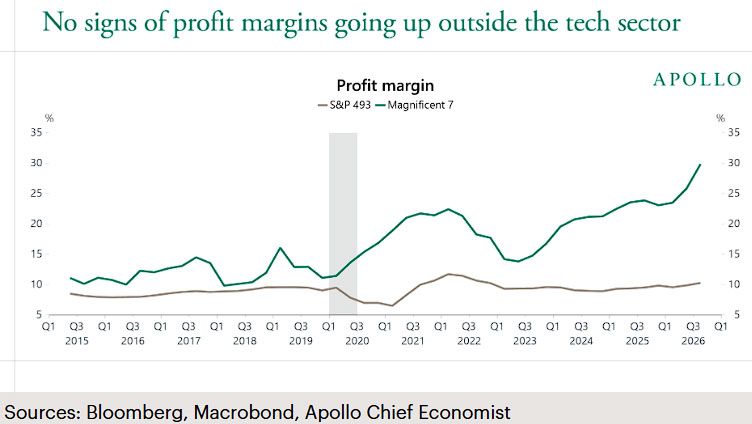
Artificial intelligence has helped fuel a boom in technology spending, but the financial benefits remain difficult to spot across much of corporate America. Apollo Global Management chief economist Torsten Slok said on October 24 that revenue per worker and profit margins were rising for the Magnificent Seven technology stocks while remaining flat across the other 493 companies in the S&P 500.
Notably, Slok’s analysis found no clear evidence that AI is boosting productivity growth, despite heavy investment in the technology. Revenue per worker and profit margins have risen among the Magnificent Seven but remain flat across the other 493 companies in the S&P 500, according to the report. “Despite massive investments and widespread hype around artificial intelligence, the technology has delivered zero financial payoff to corporate America outside of tech,” Slok wrote.
Running AI models at scale can quickly drive up costs since many providers charge by token usage, so bills climb as employees make more requests or AI agents process data and handle increasingly complex tasks. Slok said mainstream companies were beginning to view token spending as a cost center rather than a source of growth. Venture capital-backed businesses are spending more on tokens, he noted, while established companies have less incentive to pay for the newest models if cheaper alternatives can do the job.
That creates a problem for AI providers hoping to turn growing adoption into a lasting revenue stream. Selling more computing power and model access can boost suppliers’ sales, but customers need to see corresponding gains in productivity, revenue or operating costs to keep spending at the same pace. Moreover, if AI expenses rise without a measurable improvement in business performance, the additional spending could weigh on margins.
“AI does not understand accountability, trust, culture, unwritten rules, ethical trade-offs or fairness, all of which shape reputational risk and ultimately drive revenue growth and profit margins.” Slok added. “The bottom line is that the AI story will be decided in the S&P 493, not the Mag 7, and so far, there is no evidence that revenue growth or margins are improving outside the tech sector.”
Slok’s analysis also points to a broader limitation: AI adoption remains concentrated among a relatively small group of companies. Unless usage spreads across more industries and produces measurable results, the technology’s effect on the wider economy could remain limited.
The same tension is emerging in India’s financial technology sector. APwC India survey reported by Business Standard on September 11 found that 84% of surveyed fintech respondents had yet to see measurable financial results from their AI investments.
That has not stopped companies from pressing ahead. The survey also found that 48% of respondents identified proprietary intelligence as a leading strategic priority. Meanwhile, 30% expected customer experience to drive AI agent adoption over the next three to five years, followed by cost reduction and productivity gains at 22%.
Trust is another hurdle for businesses looking to deploy AI agents in financial services. As per the survey, 41% of respondents identified customer trust and adoption as the biggest barriers to scaling agentic payments, while 33% pointed to fraud, security and risk management as major concerns.
AI agents could expand the technology’s role in business by handling multistep tasks rather than simply responding to prompts, although their ability to access tools, process information and act across company systems also brings additional usage costs and security concerns.
Nvidia has been developing tools to address some of those risks, previously,introducing its Open Agent Safety Platform, a hardware-and-software security stack designed to help businesses control AI agents and restrict potentially harmful actions.Rising token consumption has also prompted companies including Microsoft, Meta and Amazon to rein in AI usage as employees adopt the tools and agentic workloads drive up bills. The trend highlights a growing challenge for businesses: encouraging wider AI adoption without allowing operating costs to spiral.
OpenAI CEO Sam Altman has also acknowledged the problem,describing AI token costs as a “huge issue” for customers seeking better value from their spending. The infrastructure behind the AI boom carries its own price tag with Amazon, Google, Meta and Microsoft having committed enormous sums to data centers, chips and the power needed to run AI workloads.
When it comes to mechanical keyboards, IQUNIX has always been ahead of the curve. Before COVID turned the mainstream onto mechanical keyboards, the company had already been releasing some of the best mechanical keyboards available, quietly making the case for PBT keycaps and premium materials that have since become the norm.
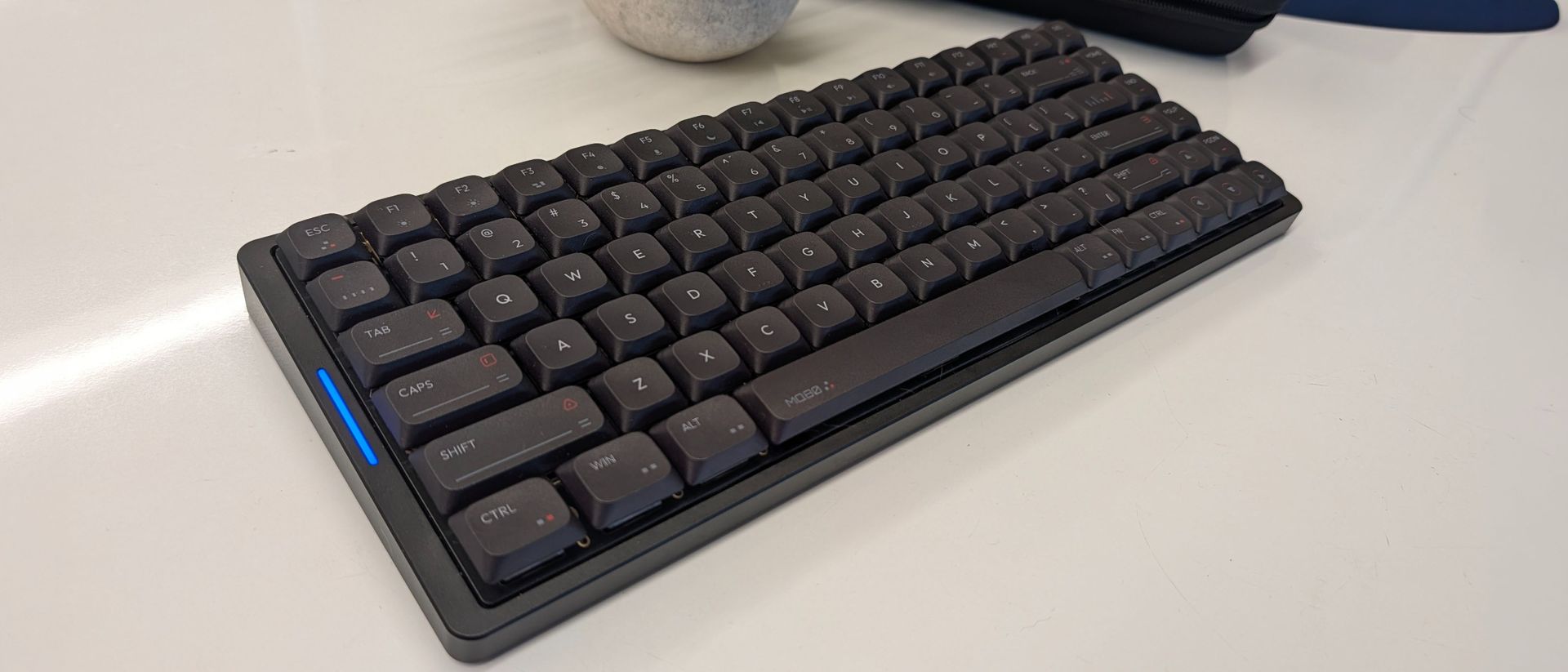
With a catalog of traditional mechanical keyboards under its belt, it’s not surprising that the company would be ready to branch into new territory. It has the Hall Effect demographic covered with its EZ series, but the MQ80 goes another direction entirely. It takes all of the lessons the company learned about how to create an exceptional typing and gaming experience and compressed it. It’s all aluminum, low profile, and offers some of the best-sounding keystrokes of its kind, but steep competition and poor portability hold it back from being the go-to pick it might otherwise be.
IQUNIX MQ80 Specs
Number of Keys
80
Switches
IQUNIX Rose Gold (Linear)
Backlighting
Per-key RGB
Onboard Storage
4 Layers/Profiles
Dedicated Media Keys
Fn Shortcuts
Additional Ports
None
Connectivity
USB, 2.4GHz, Bluetooth 5.1
Cable
Braided, 6 feet
Keycaps
High purity PBT plastic
Construction
Aluminum case, multilayer sound damping
Software
VIA (web)
Dimensions (LxWxH)
12.64 x 4.90 x 0.41 - 1.08 inches
Weight
2.6 pounds (1180 grams)
MSRP
$159.99
Release Date
February 25, 2025
Design and Construction of the IQUNIX MQ80
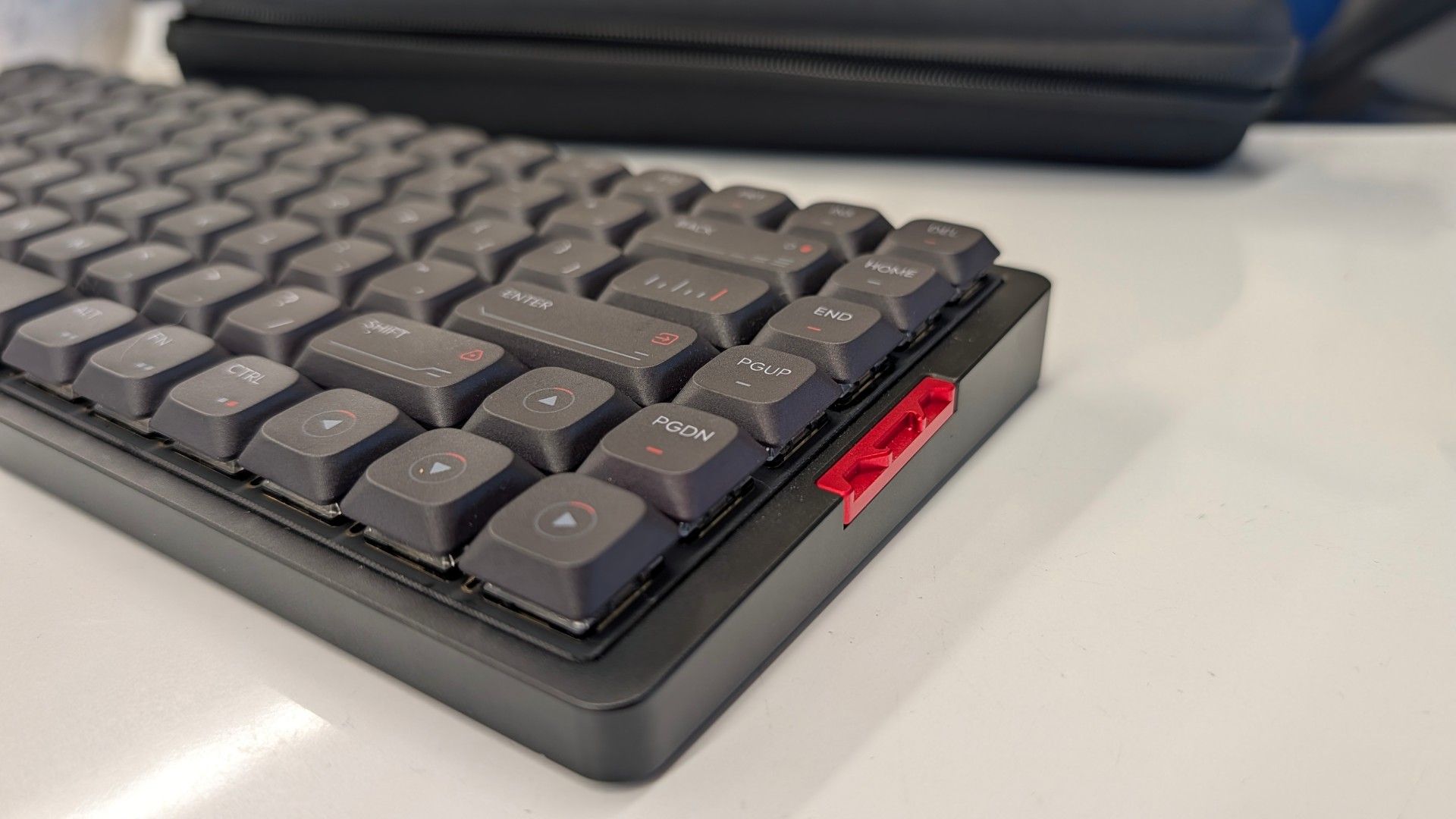
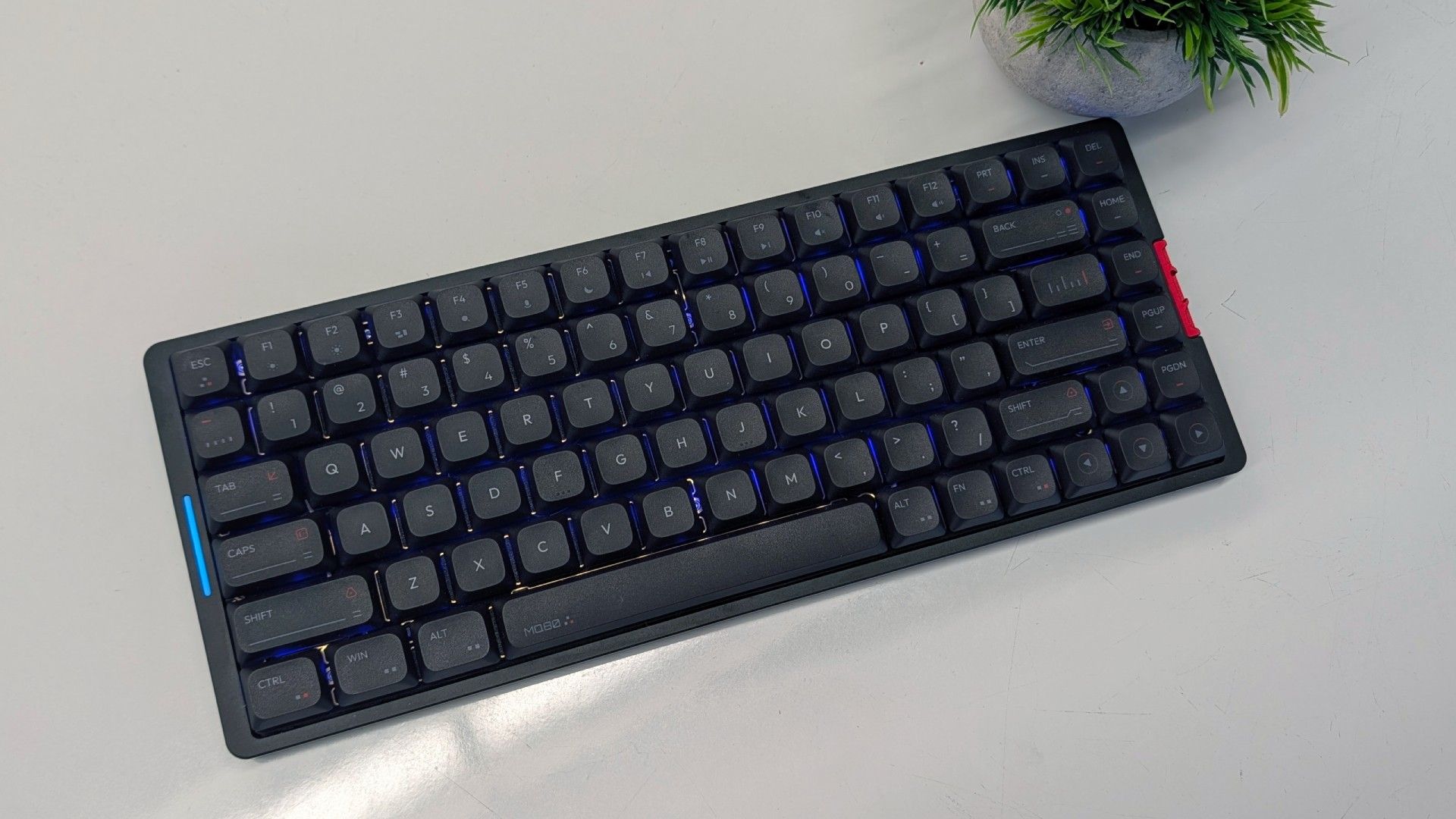
The IQUNIX MQ80 breaks the mold for IQUNIX, but carries the same 75-percent layout as countless mechanical keyboards before it. The form factor is sometimes referred to as a “Compact TKL,” since it shares most of the same keys — minus the blank spaces in between. The result is a condensed slab of keys, including a full function row, arrow cluster, and seven navigation and editing keys.
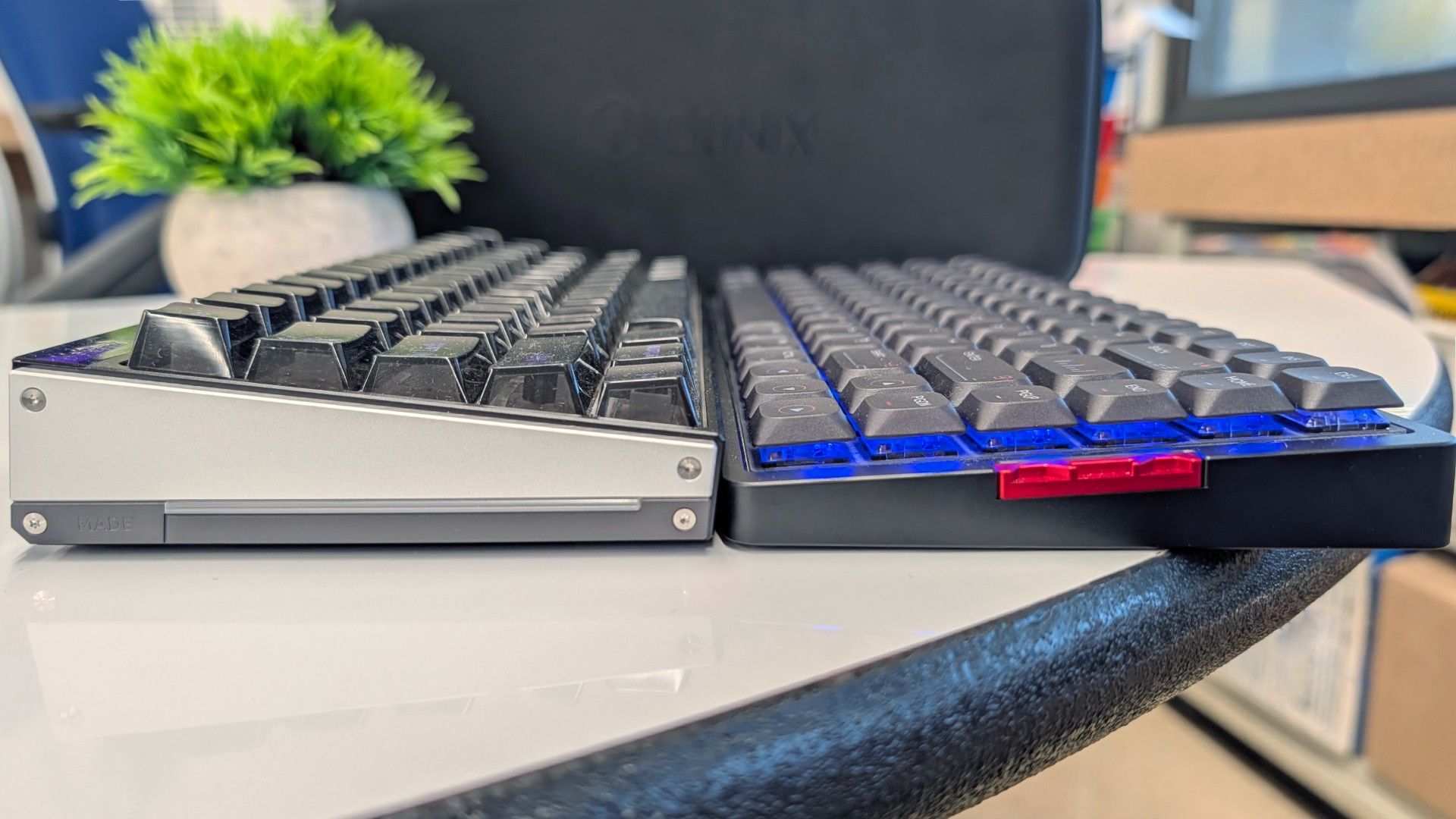
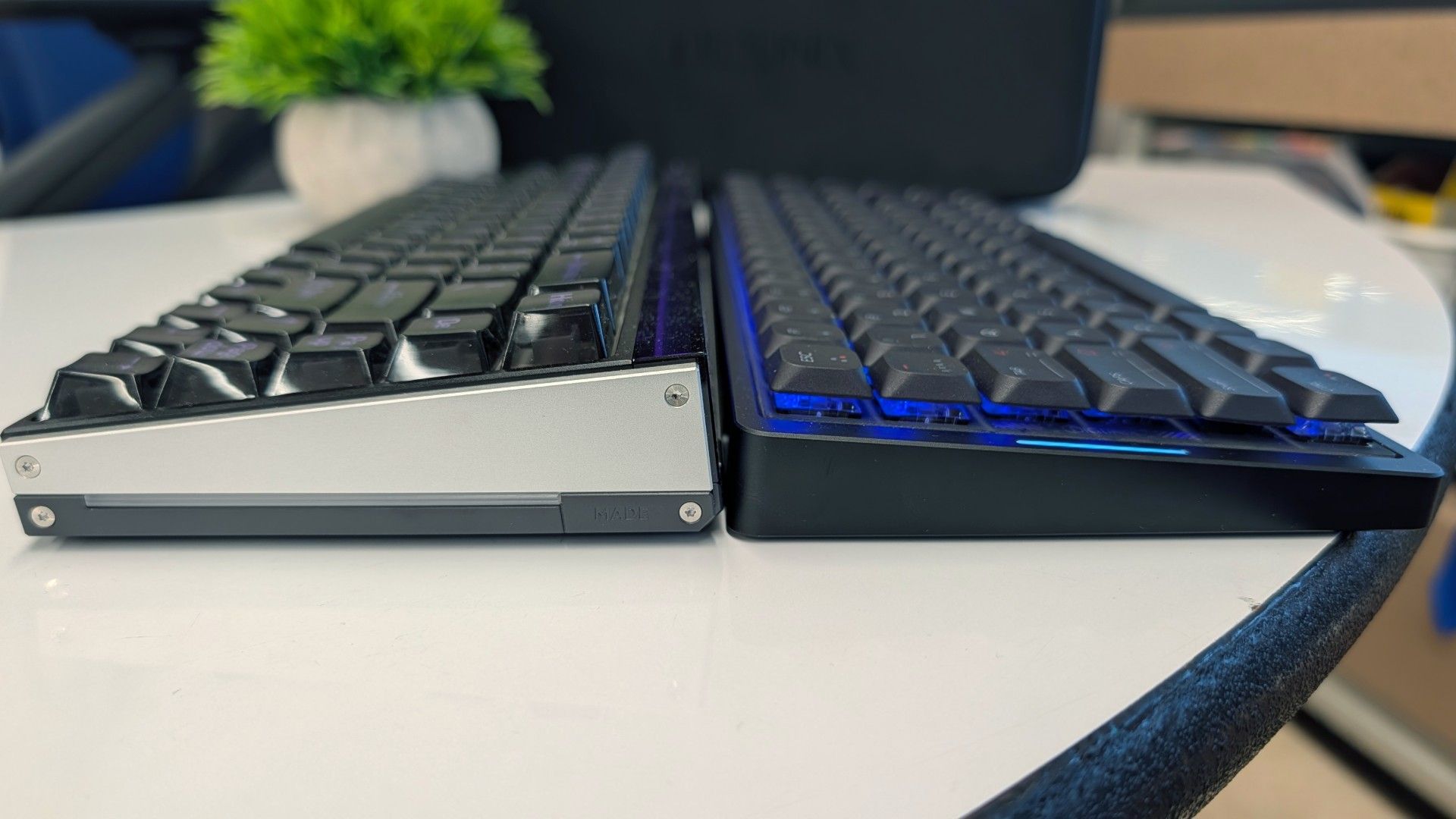
Nothing too out of the ordinary there, but the MQ80 marries that compact layout with an impressively low height of only 0.4 inches (10.8mm) at the front and 1.08 inches (27.5mm) in the rear. The keycaps are the same height across every row, and while they're scooped to keep your finger centered above the switch, they otherwise feel identical below the finger tip. This makes it an easy transition if you’re coming from a laptop or Apple Magic Keyboard, but first-time LP users should be prepared for a learning curve.
(Image credit: Tom's Hardware)
The keyboard is wireless and supports both 2.4GHz and Bluetooth 5.1 connections, as well as wired if you need to use it while it’s recharging. It sports a 4,000 mAh battery which IQUNIX claims can sustain the keyboard for up to 350 hours. This is with the usual caveats of that being over Bluetooth with all of the lighting disabled, etc. etc. — but I was able to use it for close to two weeks between recharges, even with the lighting on.
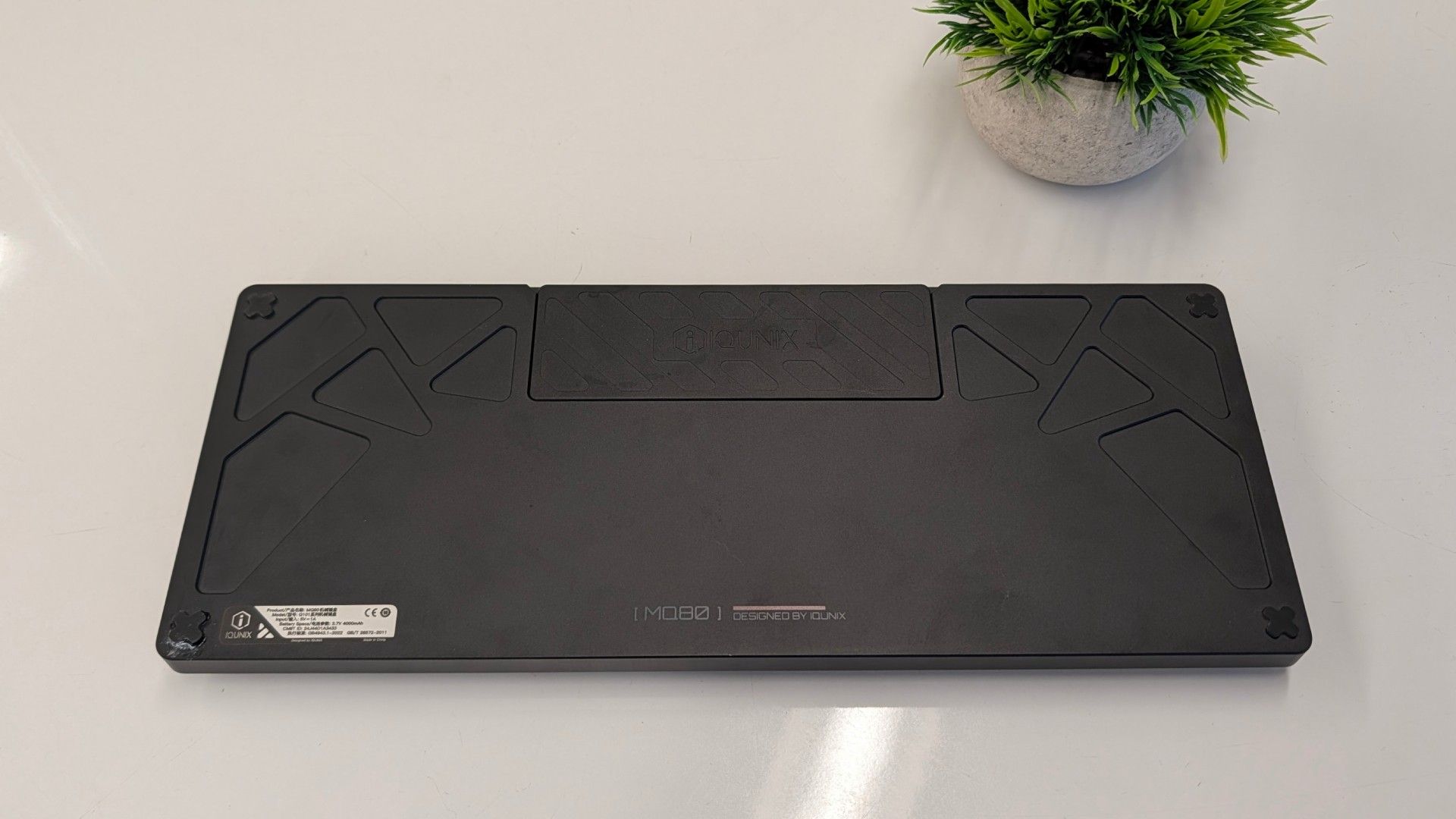
The MQ80 is a bit of a curiosity, if I’m being honest. It's thin, yes, but it’s certainly not light. It uses a heavy, CNC-milled aluminum case, just like the company’s prior models and countless others aiming for that “premium feel.” It’s a case study in how looks can be deceiving.
(Image credit: Tom's Hardware)
In fact, it has been a pretty common occurrence for people to comment on how surprising its weight is. The keyboard tips the scales at 2.6 pounds, which is around what you encounter with a full-size mechanical keyboard or nicer TKL. From a low profile keyboard that everyone assumes will be airy and effortless to carry around, it flies in the face of what you might expect.
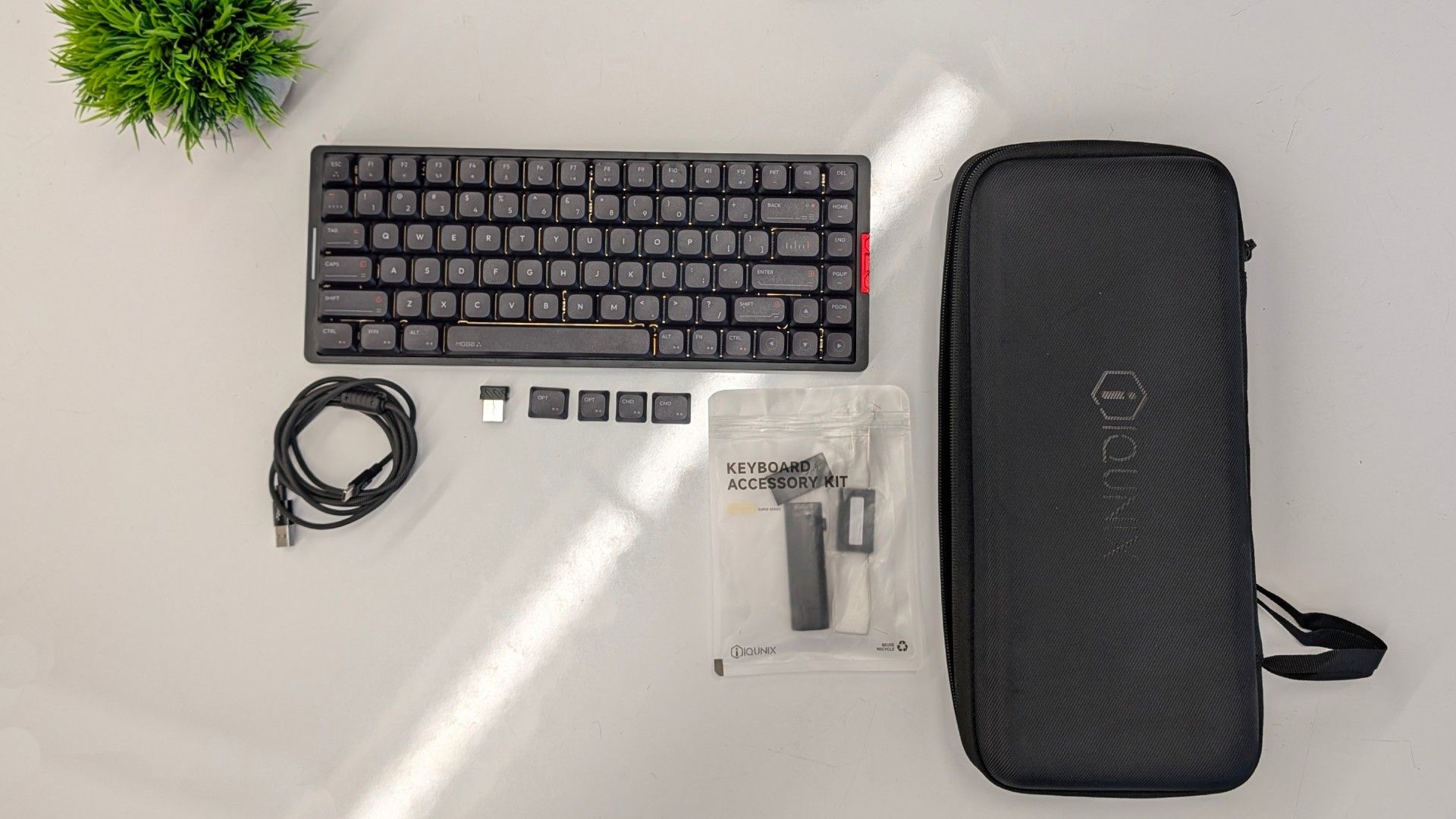
So while technically, yes, it’s a portable keyboard (IQUNIX even provides a nice hardshell carrying case to tote it around in), it's not one I could see most people wanting to carry every day. Instead, this seems designed to live on your desk, providing a solid option for fans of the profile who prefer to use it for all of their typing — not just on the go.
(Image credit: Tom's Hardware)
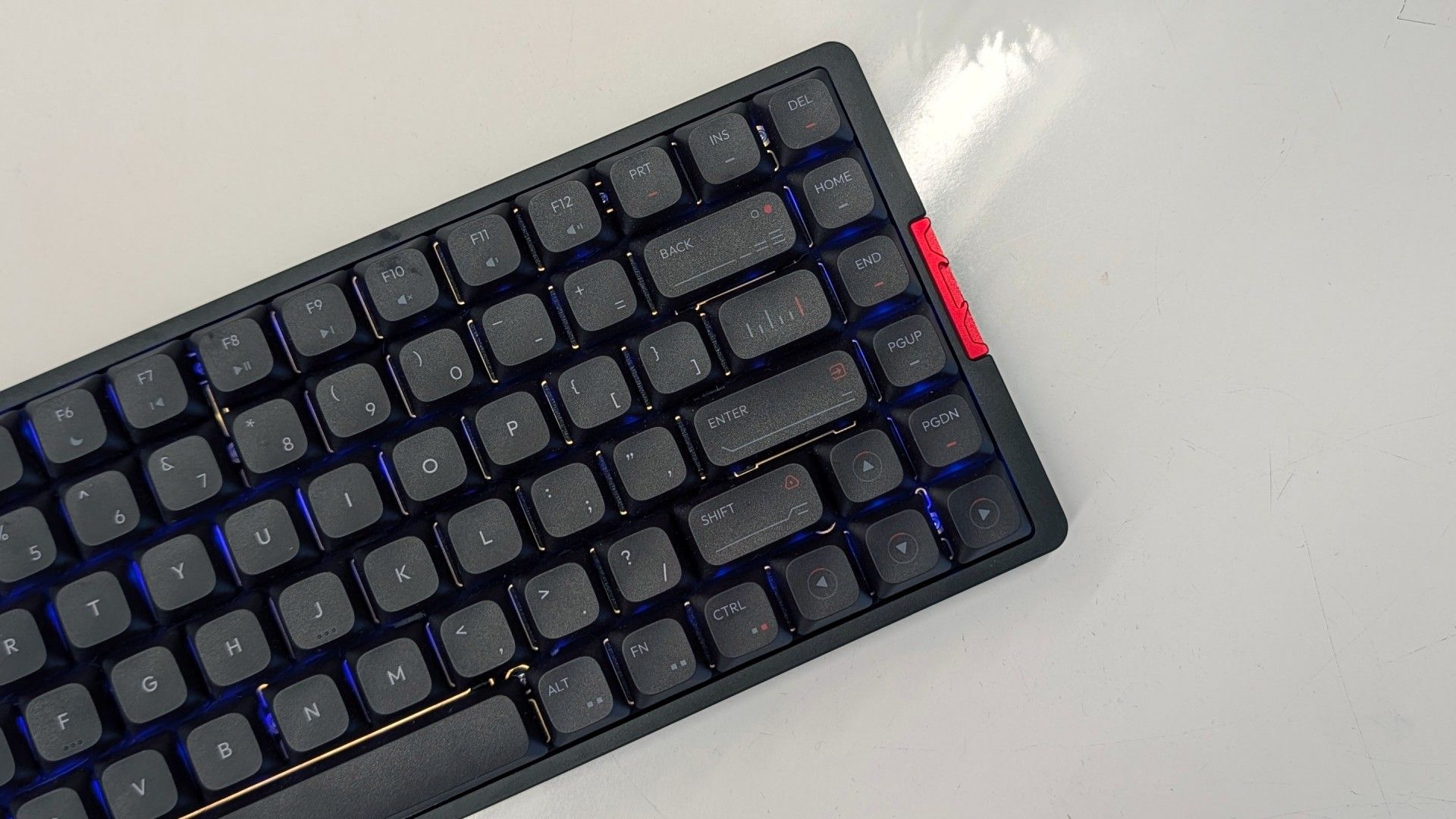
In typical IQUNIX fashion, the MQ80 is built to an enthusiast's standard. The case features intricate milling with plenty of small accents that lend it a vaguely cyberpunk impression. The keycaps feature colored legends and contrasting accents that complete its visual identity. The keyboard is available in white or black with keycaps to match, and both look fetching.
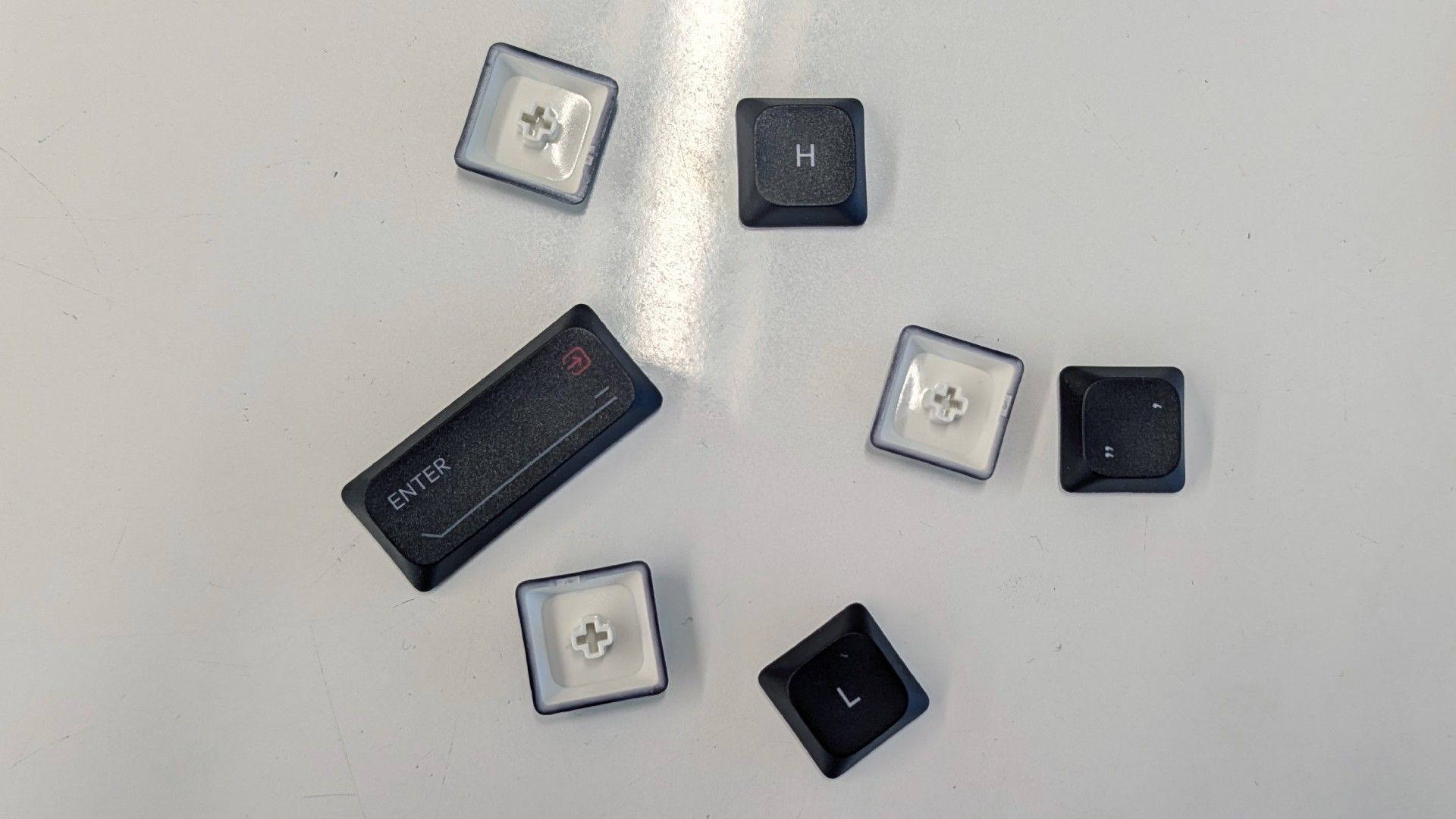
The keycaps are made of thick PBT plastic. They have a light texture to add some grip to your typing experience and use dye sublimated legends that won't chip or fade over time.
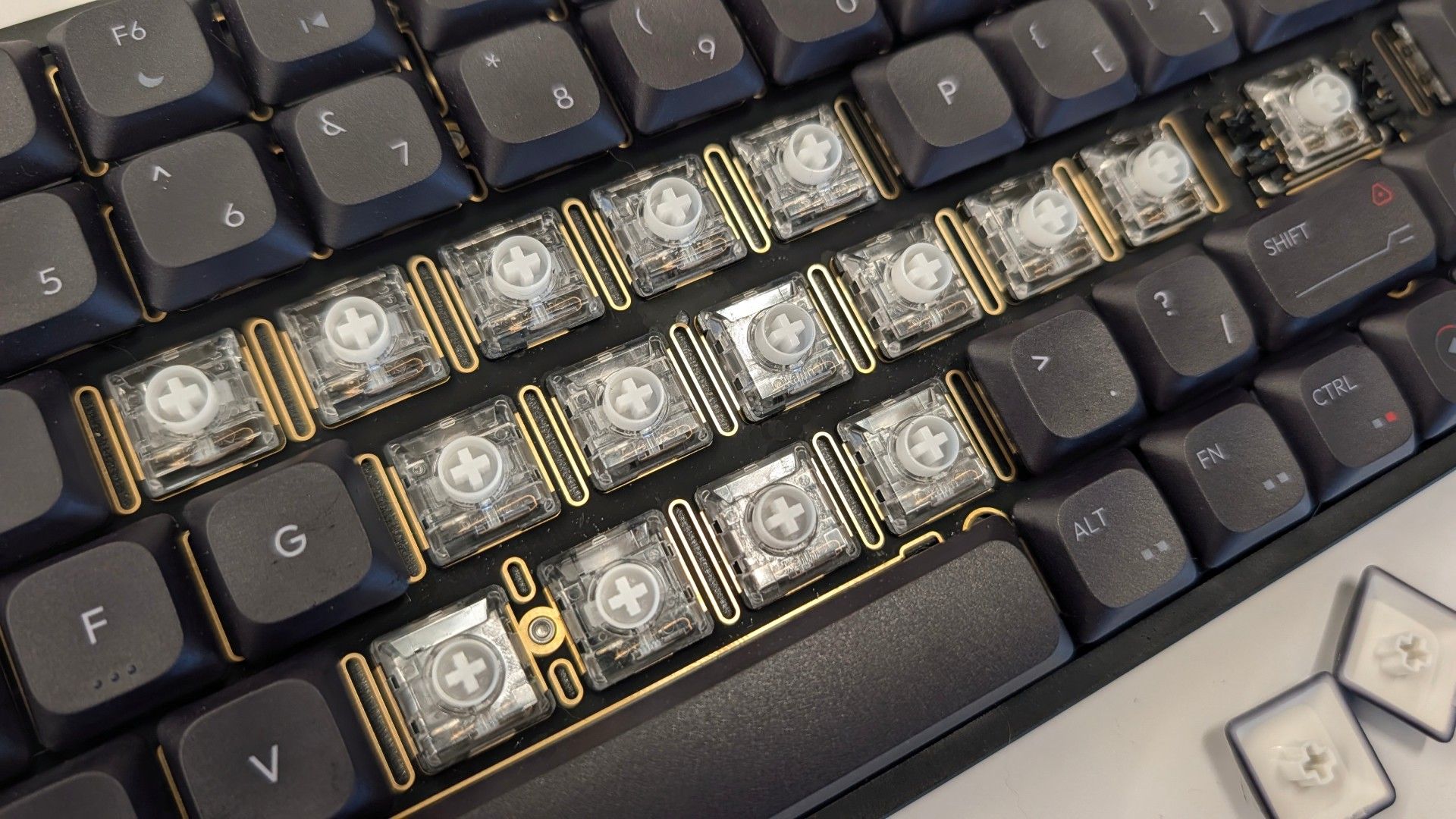
The switches below those keycaps are Kailh Rose Red, a lightweight linear switch with a 40g actuation force, 2.8mm of travel distance, and a 1.2mm actuation point. Despite their shortness, they offer 70% of the movement of a full-height switch. This makes them easier to transition to in how they feel to bottom out, but they still feel sensitive. This is a keyboard to use with a light touch or you'll find yourself with strings of single letters or running from cover before you mean to.
(Image credit: Tom's Hardware)
The switches are hot-swappable with any Kailh Choc V2 alternative, but there just aren't many options. Gateron has run away with the variety end of the low profile switch market, but you can swap them out if you're inclined to do so.
The keyboard features per-key RGB backlighting, customizable within the VIA web configurator or with shortcut keys. The keycaps aren't backlit, however, so it's not great for use in the dark if you aren't a touch typist.
The internal structure of the keyboard is where things get really interesting. The MQ80 came into the world following a run of pre-built custom keyboards IQUNIX produced under its SUPER product line. It pulled direct influence from the boutique, limited run, group buy custom keyboards popular on r/mechanicalkeyboards. All of those lessons come into play with the MQ80.
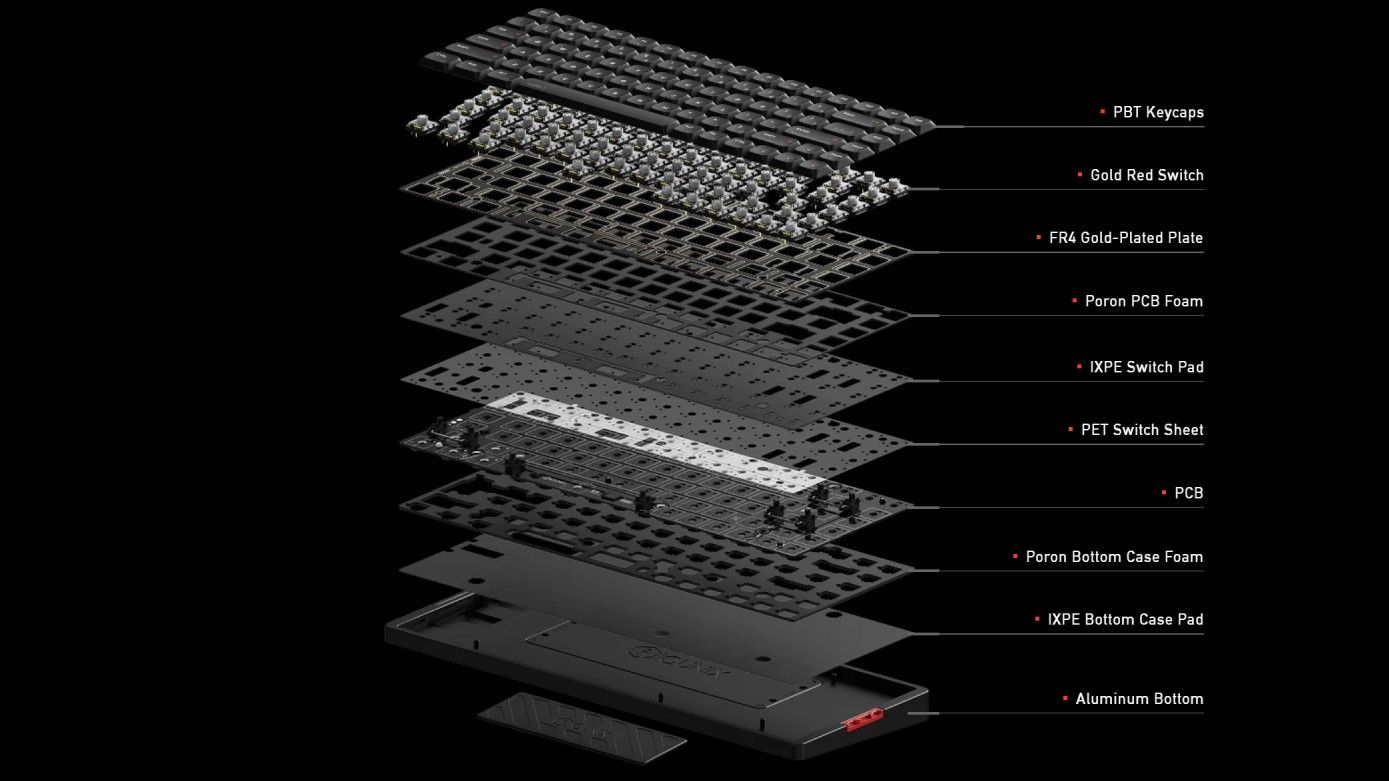
Beneath the keys lies a multi-layer assembly that makes even the best gaming keyboards look simple in comparison. It's an intentional system meant to filter and refine the sound and feel of every keystroke without the need to customize or adjust anything yourself.
(Image credit: IQUNIX)
Moving from the top down, the switches snap into a fiberglass (FR4) plate, a middle-ground material that balances firmness with crisp keystrokes.
Beneath the plate and PCB are two layers of foam, each with different acoustic properties, and a plastic film. The first layer of foam is thick PORON and fills in the empty space between the switches, plate, and PCB. It cuts reverb and helps isolate each switch. A much thinner, less dense sheet of IXPE foam and a plastic PET sheet sit below the switches to add a crispness and pop to each keystroke.
Below the circuit board is another layer of PORON foam that filters soundwaves that pass through and cushion each press. Finally, in the very bottom of the case is another layer of IXPE foam intended to reflect mid-range sounds and act as a final buffer before hitting the aluminum of the case.
(Image credit: Tom's Hardware)
It sounds like a lot and it is, but it doesn't end there. The PCB assembly attaches to the case with a modified gasket mount ("Le-Tray Gasket Mount") that imparts some of the qualities of gasket mounting into this much slimmer design. Six arms from the assembly attach to the case with silicone buffers, holding it aloft to deliver pillowy bottom outs.
As a wireless keyboard, IQUNIX also had to fit a battery into its slim frame. It's surprisingly large given the space constraints with a 4,000mAh capacity. This translates into 350 hours of rated uptime, but only when using Bluetooth and no RGB backlighting. In practice, keeping RGB on high and using 2.4GHz, it lasts around 45 hours but your specific figure will depend on use.
Typing Experience on the IQUNIX MQ80
While there's an obvious pre-requisite to prefer low profile keys, you'll also need to be a fan of linear switches. And not just that, you'll need to be a fan of lightweight, fast actuating low profile switches with keycaps that feel identical under your fingers.
If I sound a little salty, I'm not. It's just that I've used hundreds of mechanical keyboards and typed A Song of Ice and Fire worth of words on them, including more than a fair share of competing low profile keyboards, and it's still a pain in the ass to switch back to them.
(Image credit: Tom's Hardware)
At least at first, because you do get used to it and the light touch required. Before long, I remembered to pay special attention to the navigation bumps on the "F" and "J" keys. Once everything clicked, I honestly felt faster and more nimble as a typist.
Surprisingly, this didn't translate into actual WPM in my case. I average right around 110 WPM on my day-to-day full height keyboard. Swapping to the MQ80, my raw speed increased slightly, likely due to the lightweight switches and the floating posture I adopted to accommodate its height. My actual average words-per-minute on MonkeyType actually decreased to 105 WPM due to having to backspace to correct typos.
So, typing speed is a bit of a wash (at least for me) but it's hard to argue that the sound and feel of typing on the keyboard is less than exceptional. The multiple layers of sound dampening quiet and deepen the sound of each keystroke in a satisfying way. The Le-Tray Gasket Mount system also gives bottom outs a softness that's reminiscent of, but slightly stiffer than, the gasket mounts used on most full height gaming keyboards.
(Image credit: Tom's Hardware)
The thing is, since IQUNIX launched the MQ80 to Kickstarter in early 2025, Nuphy released the third iteration of its Air75 series, the Air75 V3, and it delivers a typing experience that I feel is at least as good and is objectively more customizable with its Gateron low profile switches and tactile and silent switch options at checkout.
As a heavy handed typist, I prefer a lot of tactility, especially on a keyboard with perfectly flat rows. The only option for "not a light tactile" were Kailh Black Cloud switches and would have run me half the cost of the keyboard itself.
None of this is to say that the typing experience is bad. It's genuinely not. IQUNIX knows its stuff. All of this is simply to say that there's an important trade-off and if you don't like light linear switches or paying a premium to replace them, the MQ80 probably isn't the keyboard for you.
If you like that light touch, the custom keyboard-esque feel of its keystrokes filtering through all of that foam and milled aluminum, then you're probably going to love it.
Gaming Experience of the IQUNIX MQ80
Most of the same considerations from the typing experience apply to gaming as well, but fragging enemies is really where the MQ80 felt most at home to me.
Those lightweight switches that were a liability to typing accuracy suddenly feel like hair triggers. If you're connected using the 2.4 GHz dongle or plugged in via USB, its 1,000 Hz polling rate ensures that every keystroke comes through instantly - though, it still doesn't compare to the growing number of 8,000 Hz keyboards out there on paper. Whether you'll be able to tell the difference is up for debate.
(Image credit: Tom's Hardware)
While the layers of cushioning and damping don't have a direct impact on how effective the MQ80 is for gaming, much like typing, they just make the experience that much more pleasant.
Apart from its switches, there's a dearth of dedicated gaming features unique to the keyboard. The keys are reprogrammable and support string macros, but you won't find a fancy software suite to support the experience here. Instead, IQUNIX went open source and the MQ80 is better for it.
Software for the IQUNIX MQ80
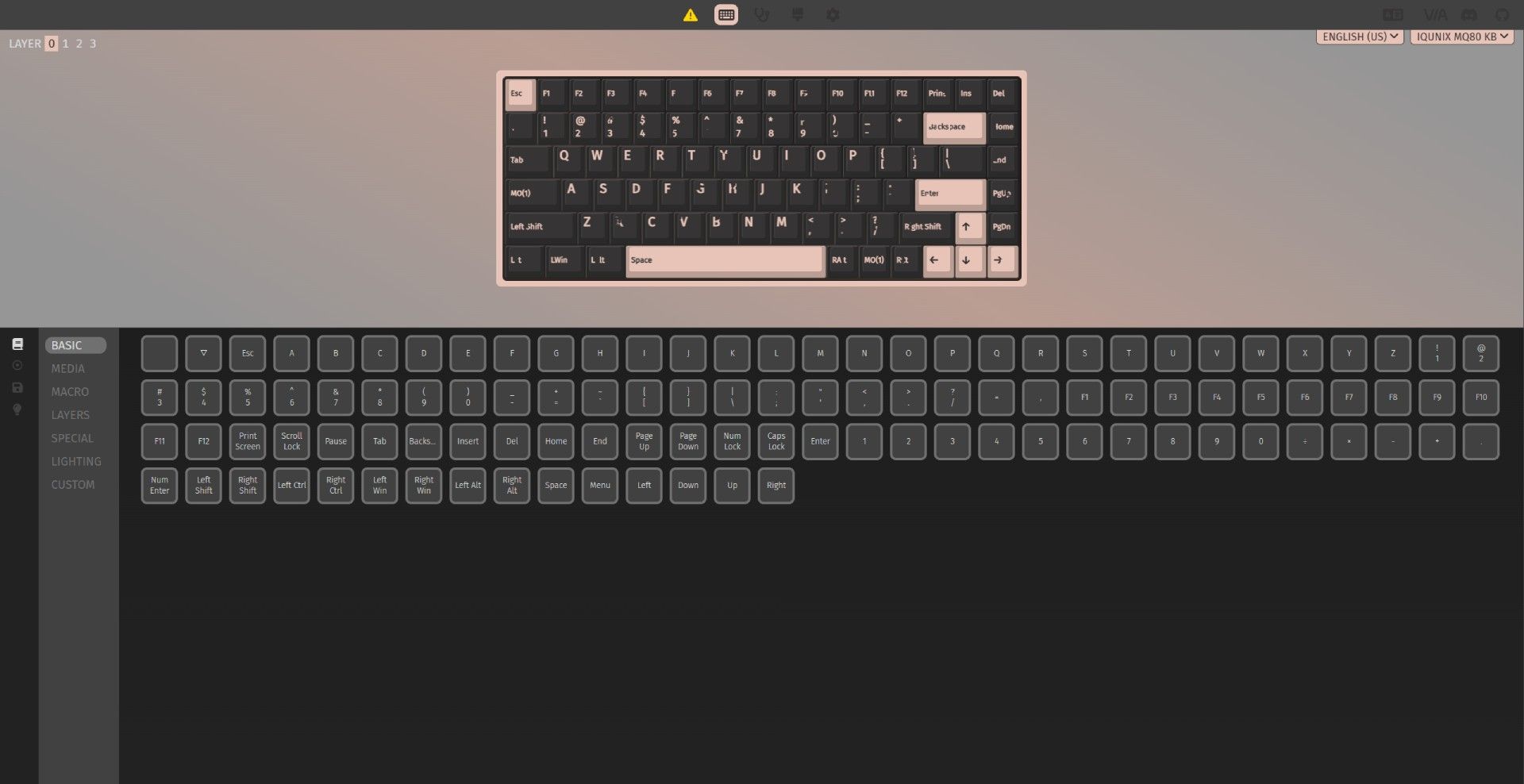
Where the MQ80 comes into its own is its programmability. Unlike many traditional gaming keyboards, it doesn't have downloadable software that needs to stay running in the background. Instead, IQUNIX opted to support VIA, a web-based configurator that allows you to make changes on the fly while also saving them to the keyboard.
It's simple on the surface, but is surprisingly powerful once you dive into it. Every key can carry up to four different actions or macros, broken into layers for quick shortcut access. Much like holding Shift, you hold or tap a key of your choice and access those additional layers of keymaps.
(Image credit: Tom's Hardware)
While this functionality isn't unique to VIA or the MQ80 by any means, big gaming companies usually require you to keep their software running to access layered functions (ex. Razer HyperShift). Here, every change is written directly to the keyboard's firmware and will work on any machine, exactly as programmed.
The web client itself is fairly simple. You have a graphic of your keyboard layout with all of your current mappings on display. Underneath are all of the different commands that can be mapped, including things like media controls, additional F-keys (all the way to F24), macros, RGB controls, and virtually anything else you might want to assign to a keystroke.
The biggest feature you'll miss out on, apart from proprietary features like game-synced RGB backlighting, is the ability to assign backlight colors to individual keys. It's possible to change the brightness, hue, and saturation across its dozen or so preset animations, but creating an entirely custom lighting scheme requires creating your own code and flashing it to the keyboard manually.
The Bottom Line
(Image credit: Tom's Hardware)
The IQUNIX MQ80 is a very good keyboard. For a lot of users, I'm confident that they would describe it as "Great" or even "Amazing." I wouldn't fault them for that. This is essentially the luxury option in the low profile space at this point.
But it's too heavy to easily tote around without questioning your life choices. If portability is important to you, I highly recommend the Nuphy Air75 V3. Or, if you're looking for something a little more office friendly than the Nuphy, the Lofree Flow 2 is another great choice that also comes with a tactile switch option.
At the end of the day, all three of these options are good for the money but only the MQ80 feels like a luxury option thanks to its heavy case. If you're not planning on carrying it back and forth to work and you like a fast switch, the MQ80 is a solid choice.
Russia has lost another data center in its ongoing conflict with Ukraine after drones hit a government data center in the suburbs of Gorodets, some 230 miles east of the Kremlin and over 600 miles away from the frontlines. According to Data Center Dynamics (DCD), the freshly drone damaged data center is operated by the Russian Ministry of Finance and was said to hold several state registries, including the Federal Taxation Service’s tax database.
“The facility is one of two key data processing centers of the Federal Tax Service of Russia operating in a geo-distributed mode,” DCD reported, citing a Russian media outlet. “The damage to this facility could potentially affect the operation of state information systems of the Russian Federation.” Ukraine has targeted Russian data centersmultiple times since the start of October, which it started doing after Moscow escalated the conflict by striking Ukrainian data centers. While the Russian finance ministry reportedly operates two other data centers — one at the Federal Data Processing Center in Dubna, Moscow Region, and another in Yerzovka, Volgograd Region — losing a third of its data centers could have a major impact on government services that it provides.
A modern society’s reliance on digital services means that data centers are now critical infrastructure and have become major targets in conflict. Russia’s Yandex bot traffic collapsed after the Ukrainian drone strikes, but its disinformation bot network simply migrated to unaffected data centers to continue operating as normal. Another recent instance of a civilian data center getting caught in a conflict was in the Middle East, after Iranian forces hit AWS sites in the UAE and Bahrain in response to the United States’ bombing campaign that began in February. This has led to disruptions to many digital services in the area, which is why Amazon has advised many of its clients to move to other regions to avoid further disruptions.
Russia’s invasion of Ukraine started in 2014 when it forcibly occupied the Crimean Peninsula, but the current situation started when Moscow escalated the situation and attempted to take Kyiv in 2022. But what makes this 12-year conflict especially deadly is the new technologies and strategies that are being implemented in the front lines, including the widespread and innovative use of drones.
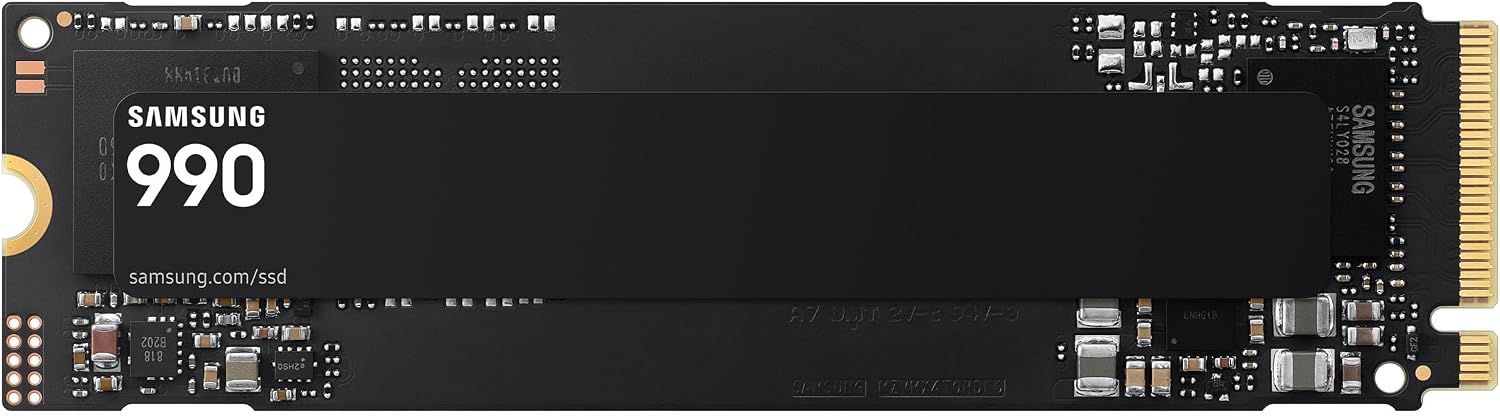
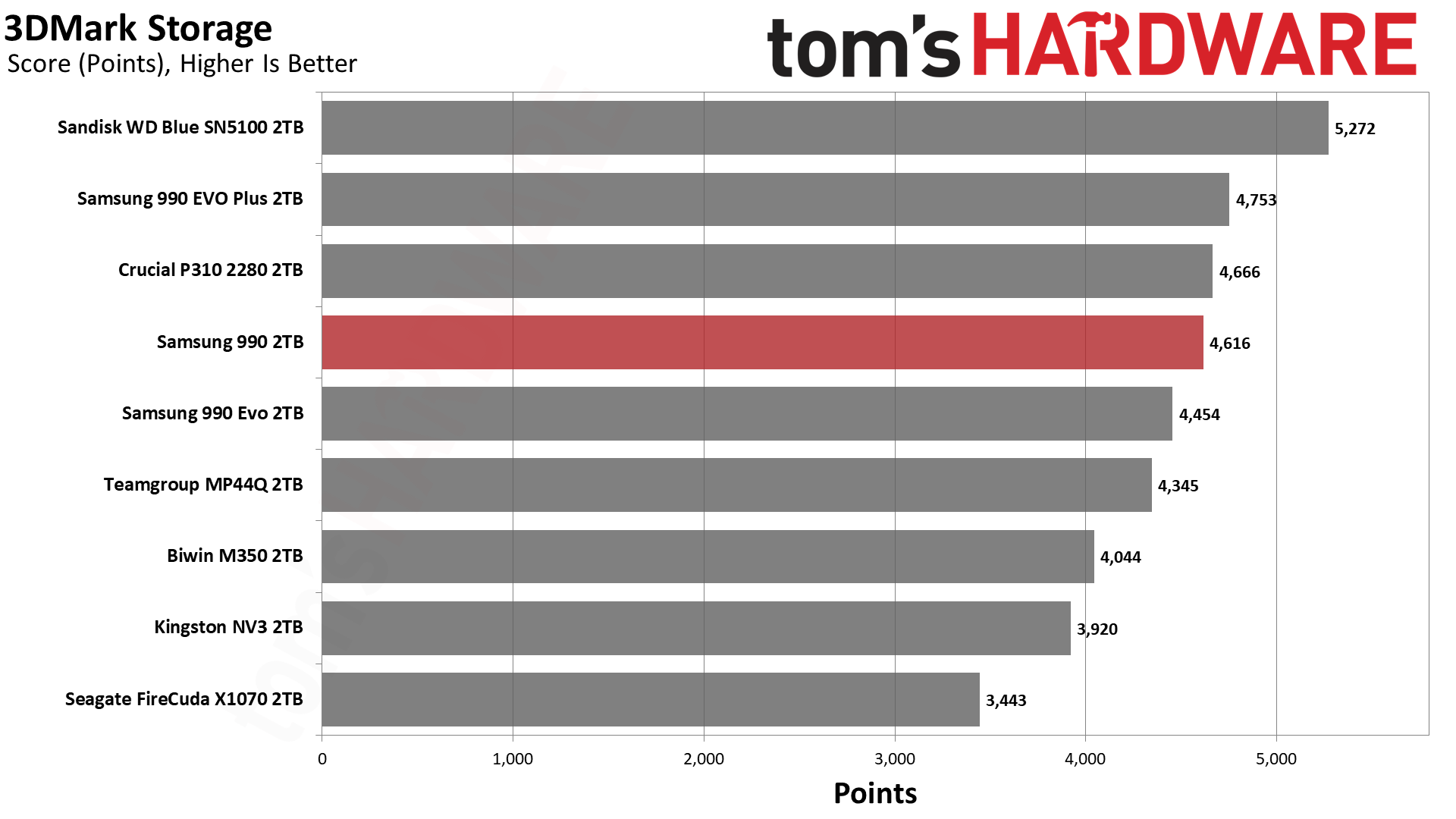
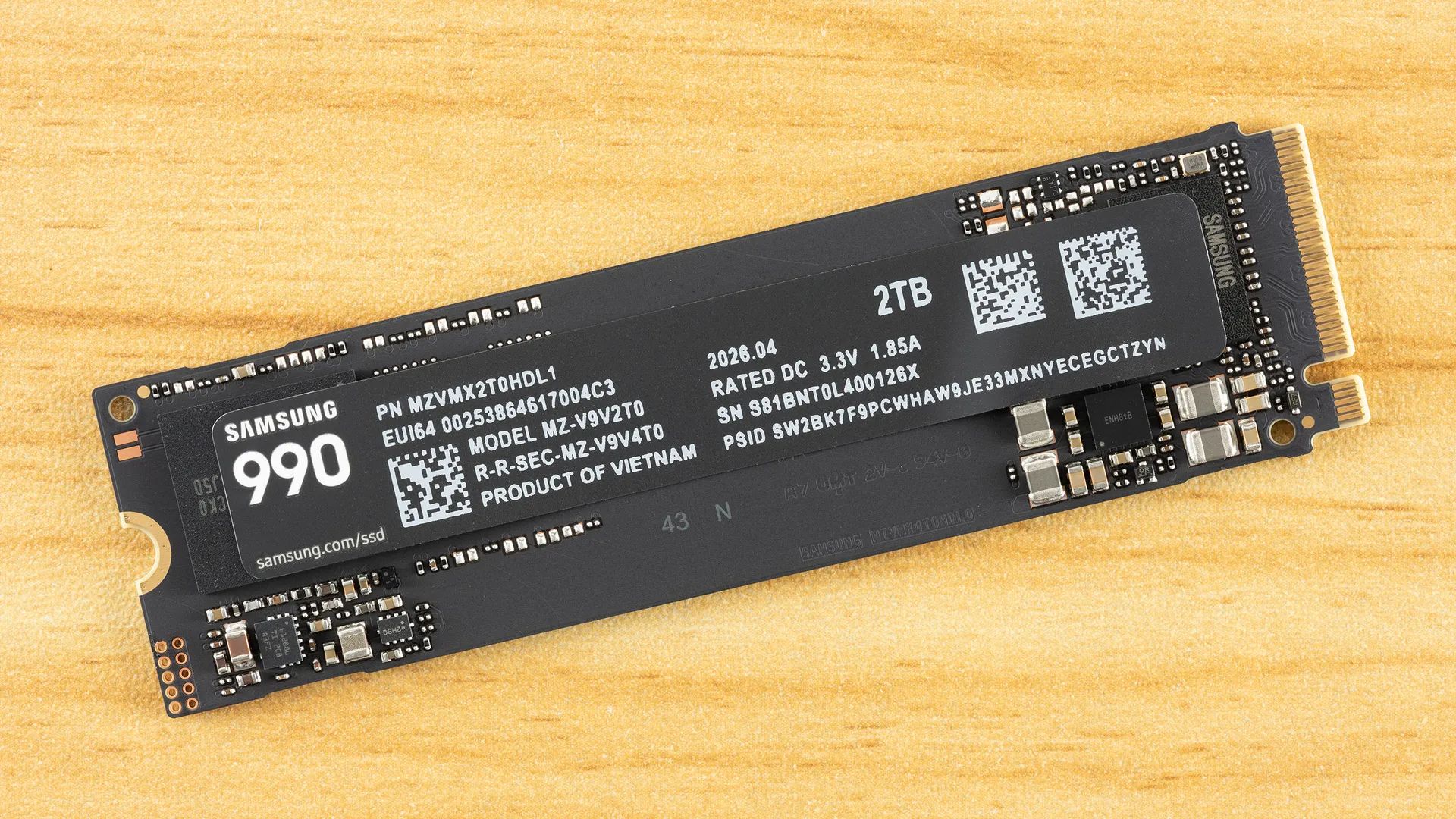
The 990 SSD is an interesting product because it is one of the few SSDs released after the AI pricing crunch sent storage prices into orbit. As such, we know what Samsung thinks this drive is worth in the current climate, namely $529. While 2TB of storage would have been much cheaper a year ago, a 38% discount on a new SSD is not to be sniffed at, especially given all signs point to these drives getting more expensive, not cheaper, in the future.
We reviewed this drive at launch last month and liked its full-fledged Gen 4 throughput, decent power consumption, and good all-around performance. The 990 is essentially a QLC-based 990 EVO Plus, featuring Samsung's PiccoloQ controller and V9 QLC Flash memory.
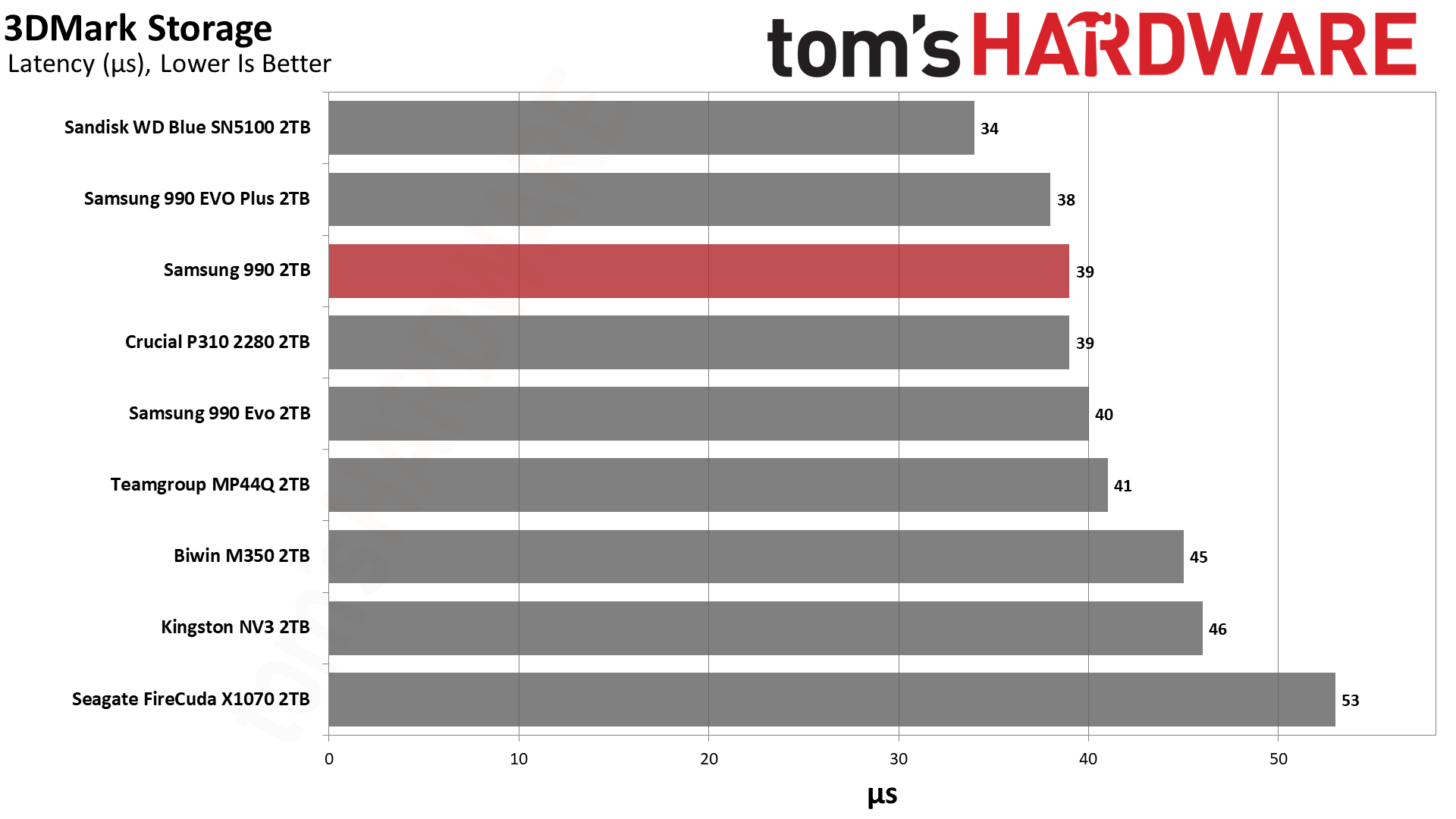
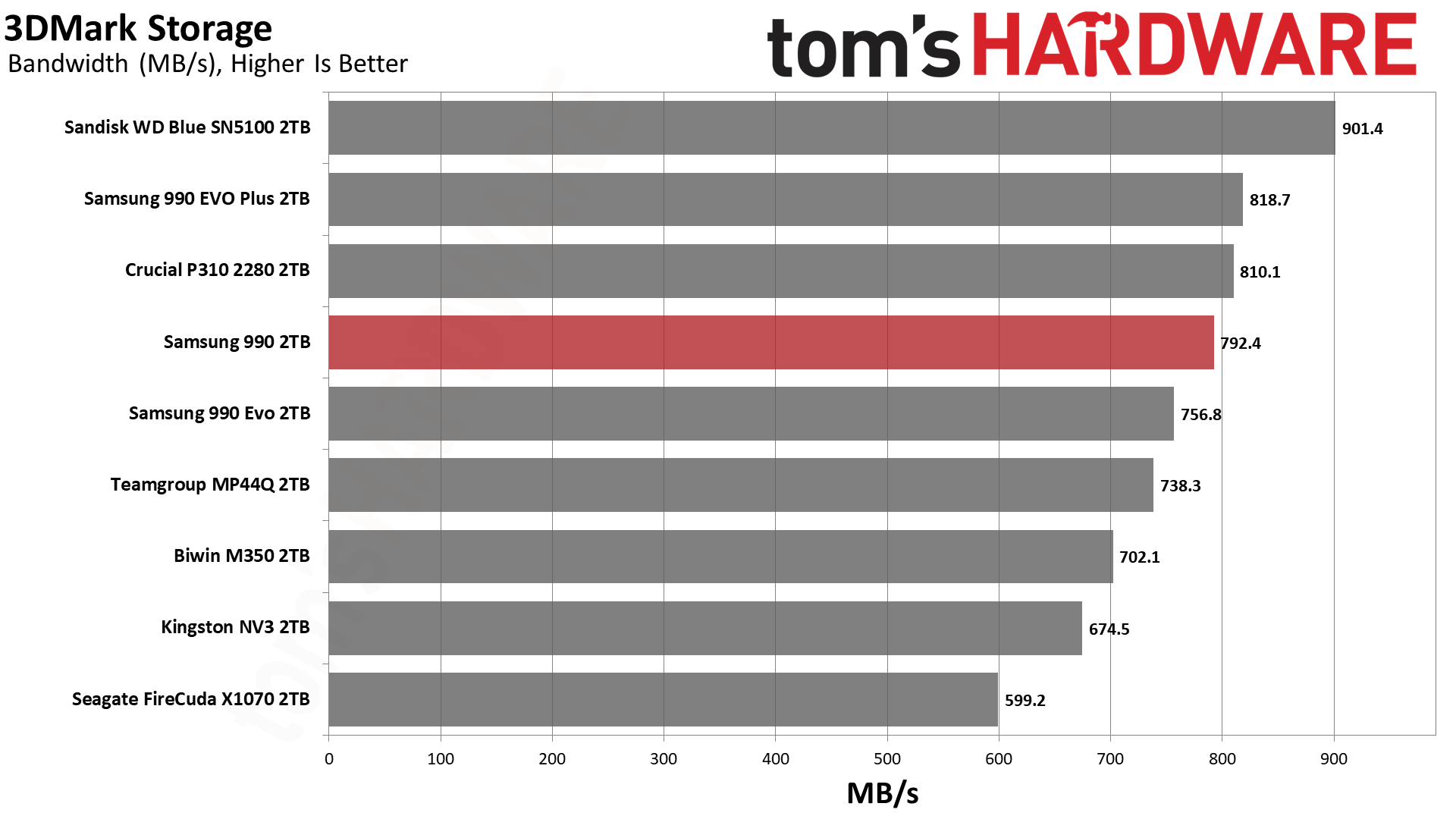
As you can see from our testing data, it scores very close to the 990 EVO Plus in latency testing, while beating the 990 EVO drive in bandwidth and 3DMark overall score.
SamsungSamsungSamsung
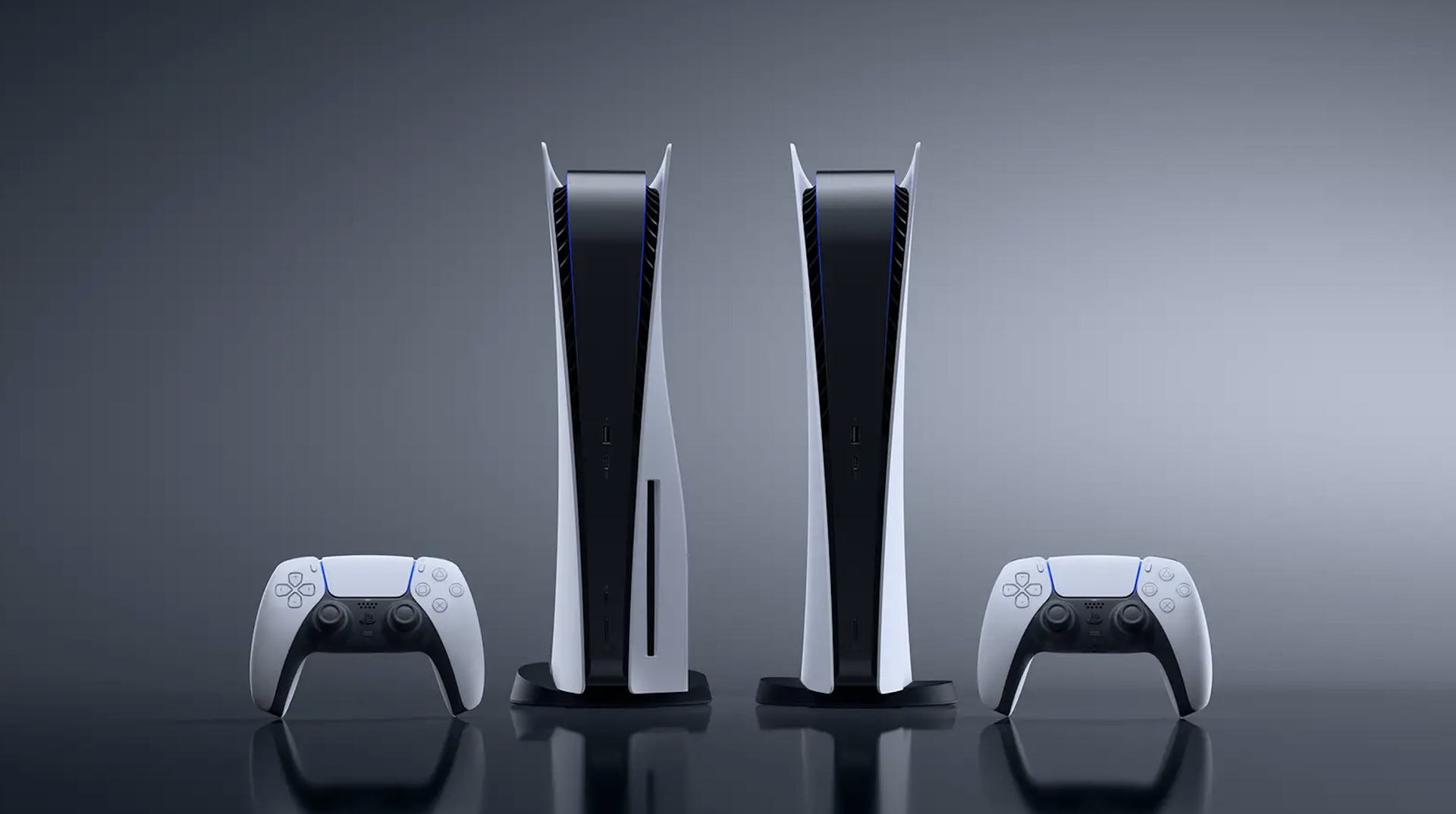
This drive also scored well in our PS5 test, so this drive could serve as an expansion drive for your shiny new PlayStation if you so choose. At its original list price, this drive makes no sense as a purchase up against the 990 Pro or Samsung's Gen 5 9100, but at this price it is a good chunk cheaper than both of those options.
As we approach the end of 2026, these storage prices remain tough to stomach, but things don't look like they are going to improve any time soon. In fact, all signs point to the AI pricing crunch continuing to make things worse going forward, meaning leaving it too long could make storage even more expensive in the future.
Nvidia CEO Jensen Huang has put the annual cost of licensing the company’s AI software at around $2,000 per GPU to 'run all the software that Nvidia provides that runs agents on these AI factories,' according to a recent video of the comments (below), a pricing model that could generate $50 billion over five years under a proposed scenario involving five million paid licenses outlined by FourWeekMBA.
Huang discussed the pricing at GTC Berlin on October 22, where the company outlined its broader push to build an AI infrastructure business spanning chips, software and AI-agent security. “Software licensing will become increasingly a major part of our company’s business. The way that we license will be…for example, it’s about $2,000 per GPU per year to run all the software that Nvidia provides that runs agents on these AI factories,” said Huang.
The numbers add up quickly. At $2,000 per GPU each year, Nvidia would bring in $10 billion annually if five million GPUs were covered by paid licenses. Over five years, that would amount to $50 billion, provided customers kept renewing their subscriptions. The catch, however, is that Nvidia has not disclosed how many GPUs could be covered by the proposed $2,000 fee, or whether that’s its standard price. It’s also unclear which software the license would cover, or if there is overlap between products.
The distinction matters because Nvidia already charges for enterprise software. Its AI Enterprise platform is listed at $4,500 per GPU for a one-year subscription. Huang’s reported $2,000 figure is lower, but Nvidia has not confirmed that the two prices cover the same products or licensing terms. It should not be treated as a confirmed price cut.
Jensen’s ~$2,000 per GPU per year in enterprise software deserves more attention.Enterprises deploying AI agents need security, governance and someone accountable for keeping the stack running. My bet: OpenShell becomes the standard security layer for enterprise AI, driving adoption of NVIDIA’s paid software and support.Consider the math. Assume:• 10M eligible enterprise GPUs shipped in a year• 50% paid software attach• $2,000 per GPU annuallyThat’s $10B in annual recurring revenue potential. Keep those subscriptions for five years and you get $50B from a single year’s GPU shipments.Each new year of GPU sales adds another potential stream of software revenue. $NVDAOctober 22, 2026
The licensing discussion comes as Nvidia develops more of the infrastructure needed to deploy and manage AI agents in enterprise environments. These systems can use tools, access data, and execute tasks, creating new security and management challenges for businesses running them at scale.
On October 21, Nvidia announced itsOpenShell Reference Architecture, a system that combines its Vera Rubin computing infrastructure, Vera CPUs, and BlueField-4 data processing units (DPUs) running Nvidia Sentry. OpenShell provides a secure runtime for AI agents, establishing boundaries around their actions and access to tools and resources. Sentry monitors agent activity independently and can quarantine an agent that attempts to cross those boundaries, according to Nvidia. The architecture is designed to bring security controls into the underlying infrastructure rather than relying solely on safeguards built into an AI model or application.
Nvidia had previously introduced itsOpen Agent Safety Platform in September. The newer reference architecture builds on that effort, extending the approach to enterprise infrastructure and edge systems.
Other companies are also incorporating these controls into their products. Anthropic is integrating OpenShell and BlueField hardware with Claude Managed Agentsto give businesses additional control over what their AI agents can access inside execution sandboxes. Salesforce has developed a Slack Admin Bridge for OpenShell that lets administrators review agent access requests, approve or reject permissions, and monitor activity directly in Slack.
The proposed software pricing fits Huang’s wider argument that Nvidia is becoming more than a supplier of GPUs. The company has expanded into networking, systems, enterprise software, and infrastructure designed to run AI workloads. Speaking on theBG2Pod podcast recently, Huang said, “One of these days, people might not categorize us as a chip company anymore.” He pointed to Nvidia’s presence across industries including healthcare, automotive, telecommunications and life sciences, where the company provides broader technology stacks rather than chips alone.
That said, Nvidia has not said when the $2,000-per-GPU fee would take effect or which software it would cover. It also remains unclear how the proposed pricing would fit into the company’s existing enterprise software business.
Gamers can now experiment with playing their favorite Steam titles on a jailbroken PlayStation 5. The game launcher is actually based on the Playden launcher designed for macOS and adapted for the PlayStation, allowing you to sign in with your Steam account and install games from your library directly to the console. Playden for PS5 is a GitHub project that lets you run Steam games on the console, notes VideoCardz. When you launch a game on Playden for PS5, it sets a private Windows environment and is run through prospero-win, which is a PS5 port of Wine.
Note that the launcher itself does not run the game — instead it builds a separate PS5 app created for the game that you installed, allowing the Steam title to appear as a separate tile on the console’s home screen. Aside from that, its files, settings, and crashes are isolated from the launcher and other games. There’s also a separate runtime kit that handles Wine for PS5, the required graphics drivers, the Windows environment, and a template app shell for your games.
While Playden for PS5 successfully launches Steam games, it does not necessarily mean a smooth start-to-end experience for every title. The creator notes that it’s still in the Alpha stage of development, with X user v7dt1 saying that even though they were able to launch a game, it eventually crashed. On the other hand, u/Cevap shared on the r/PS5_Jailbreak subreddit that they were able to play Portal through the launcher with no issues, except for the lack of a mouse cursor and the inability to hit ESC to open the options menu. Still, the developer of the launcher lists several compatible games, including American Truck Simulator, Cyberpunk 2077, Doom Eternal, GTA: Vice City, Left 4 Dead 2, Team Fortress 2, and more.
Of course, users need a jailbroken PlayStation 5 if they want to use this launcher. But aside from that, the creator said that using it poses several risks, including the fact that it’s an unofficial Steam client. While there haven’t been any problems with third-party Steam clients, the app notes that Valve does not officially support it and any risk that comes with the use of the launcher “is yours to accept.”
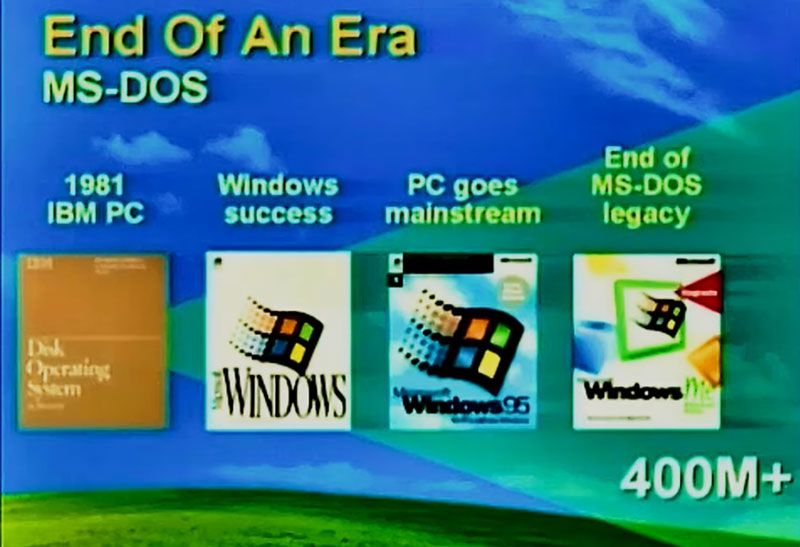
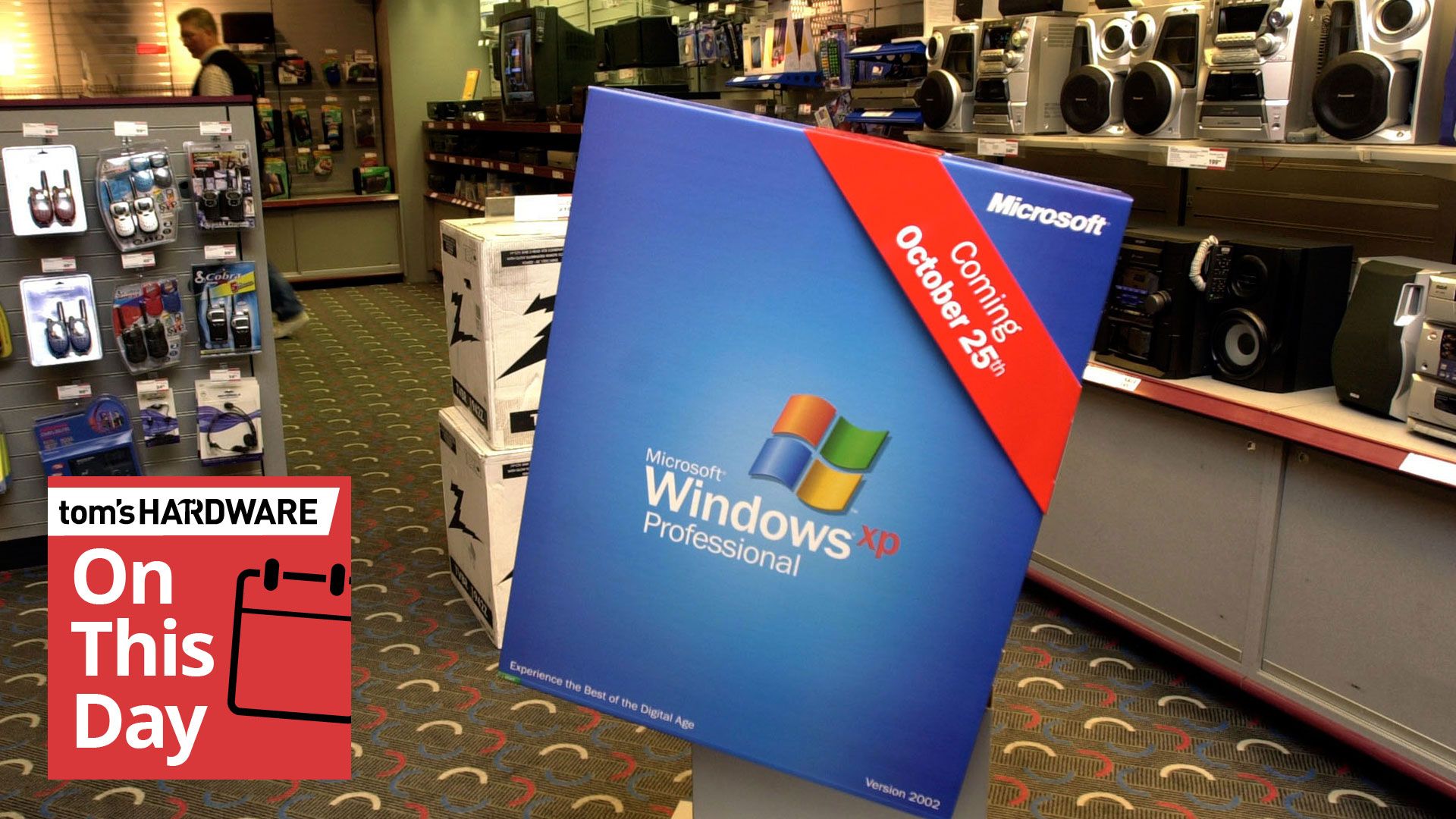
Windows XP became available at retailers for the first time on this day back in 2001. It was ushered in with Microsoft's largest and glitziest launch event since Windows 95, but the bigger news was its delivery of an OS with modern underpinnings and features. Thankfully, it lived up to the hype and would ensure nearly 13 years of favor among enthusiasts, but that might be partly due to the failure of the unloved Vista.
(Image credit: Microsoft Windows XP launch)
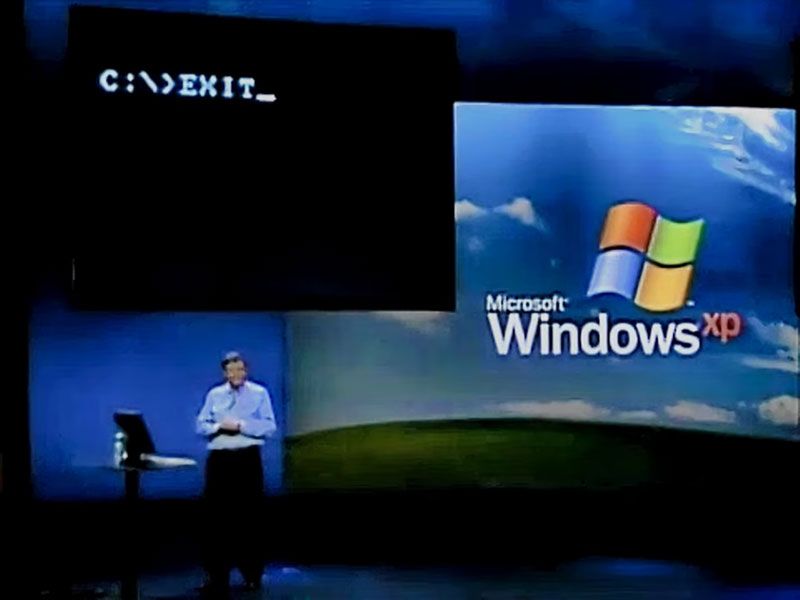
The NYC launch event for Windows XP in 2001 was the centerpiece of a lavish $500 million campaign Microsoft had planned for the new OS. However, celebrations were somewhat muted due to the aftermath of 9/11. Microsoft actually dumped its intended ‘Prepare to Fly’ launch slogan for ‘Yes You Can’ for this obvious reason.
Nevertheless, the launch was still a significant event and featured NYC Mayor Rudy Giuliani joining Bill Gates on stage. Gates framed the big launch as evidence that “New York is back and open for business.” There was also a free lunchtime concert in Bryant Park featuring Sting, followed by a Times Square NYC takeover. Meanwhile, retail stores like CompUSA, Circuit City, and Best Buy opened at midnight for eager tech beavers to grab a copy of Windows XP at its freshest.
(Image credit: Microsoft Windows XP launch)
At the launch presentation, Gates said that the debut of Windows XP represented the end of the era of MS-DOS, which had underpinned a UI or shell known as Windows for many years. For consumers, that stretched all the way up to the much maligned Windows Me.
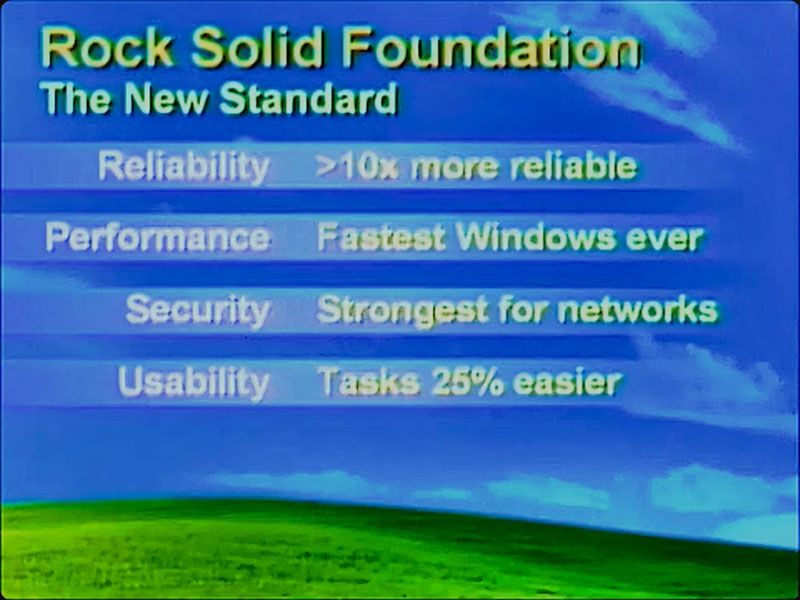
As we mentioned in our 40-year retrospective of Windows last year, Windows XP was the real ‘Start Me Up’ moment. That’s because it brought the Windows NT core to consumer PCs – replacing the archaic DOS and its restrictions and drivers. Thus, Windows XP would become well regarded for reliability, performance, and security (after a few teething troubles), and its new UI was claimed to make tasks 25% easier to complete, too.
(Image credit: Microsoft Windows XP launch)
Some of the technical features that would be widely welcomed in XP included USB plug-and-play support that worked, built-in CD burning software, and ClearType support as new LCDs started to usurp bulky CRTs on desks.
During Windows XP’s supported life (October 2001 to April 2014), there would be three major Service Pack (SP) releases. It also saw DirectX 8.1 to 9.0c arrive for gamers. In the meantime, Windows Vista made something of an unwanted splash, launched to consumers in January 2007. Windows XP’s lengthy extended support meant that folks could skip Vista entirely and move straight to Windows 7 when it hit retail and new-build systems in October 2009.
Overall, it is interesting to observe that Windows XP’s lifespan was actually over two years longer than Windows 10, which was (in)famously launched as “the last version of Windows.”
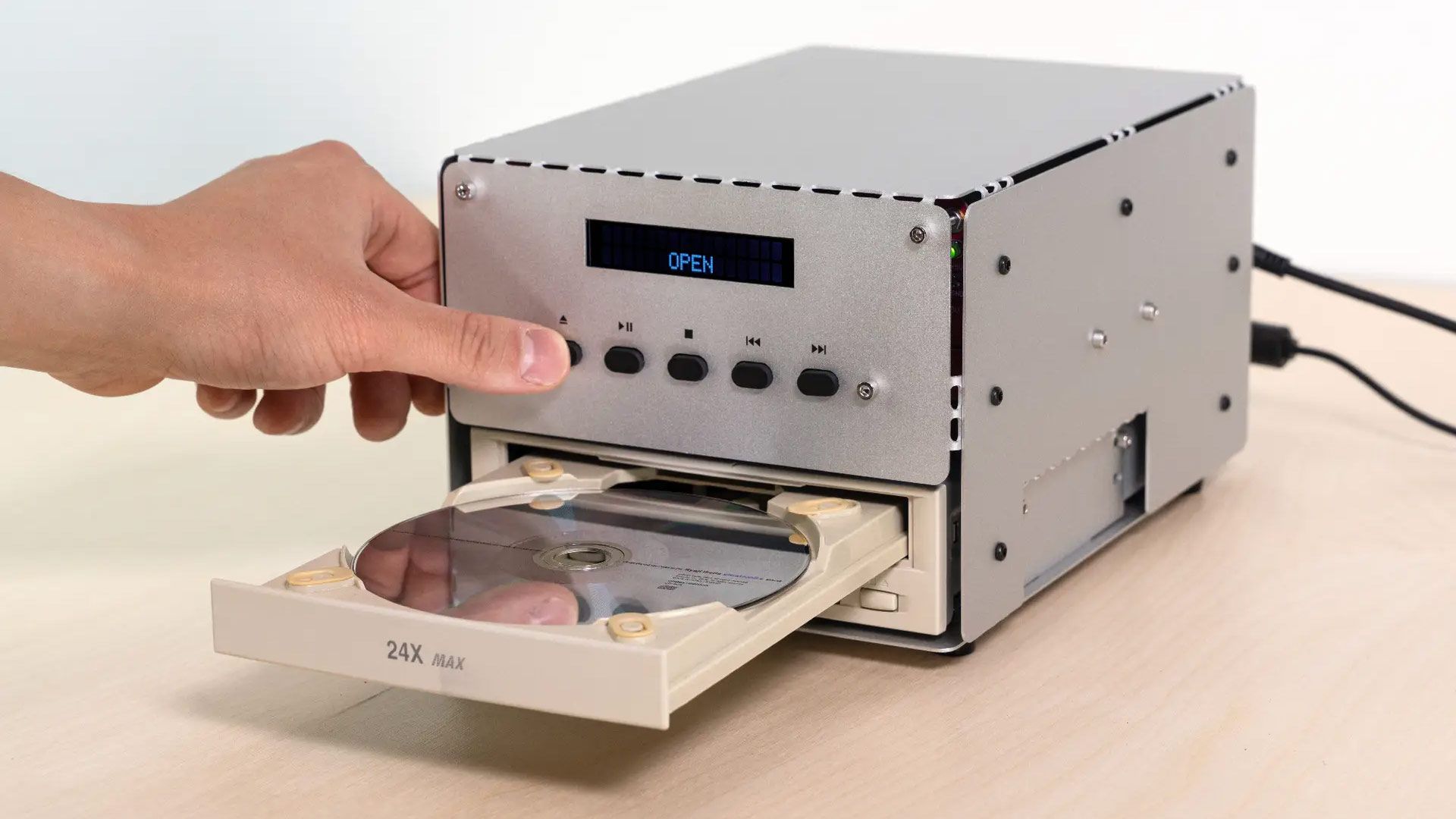
Even as optical media sees a resurgence and new CD players hit the market, some optical drive and component manufacturers have ended production. As a result, PS Audio and Naim have halted production of their high-end CD players, raising questions about the maintenance and repairability of these new devices. Headphonesty says that of the eight new models, four are from Musical Fidelity, two from Marantz, and one each from Arcam and NAD.
Musical Fidelity reportedly sources its key components from SUOS-HiFi, with three of its new models using SUOS disc mechanisms. In contrast, the fourth uses a SUOS-sourced servo but a tray-loading mechanism from an unnamed manufacturer. On the other hand, Marantz reportedly develops its drives in-house, though it’s unclear whether it also outsources production to a third party. As for the two remaining manufacturers, they did not reveal who made their optical drives.
PS Audio had to end production of the PMG Super Audio CD Transport because D&M, Marantz’s parent company, has ceased external orders for its optical drives. Although the company bought D&M’s entire remaining stock, it wasn’t enough to keep production going. Naim faced the same issue with its Uniti Star—though it didn't name its optical drive supplier, it had to find an alternative when the manufacturer stopped production. Naim was evaluating a replacement manufacturer when it, too, stopped making the components the Uniti Star needed. While both companies retained some optical drives in inventory, they are only for repairs and replacements.
What hardware deals are you hoping to pick up during Black Friday?
These issues highlight the problem of relying on a single manufacturer for such a critical component. But even though these manufacturers would love to find alternative sources for the drives that they need, it’s likely that only a few companies are capable of making such a niche product, even if demand has grown substantially recently.
The best option for them would be to design these parts in-house, which is what Marantz is doing. That way, even if the current maker they rely on goes out of business, they could plausibly find another one to take over production (or even build it themselves). This is difficult to accomplish, though, with PS Audio CEO Paul McGowan saying that building its own optical disc reader is beyond the company’s capabilities.
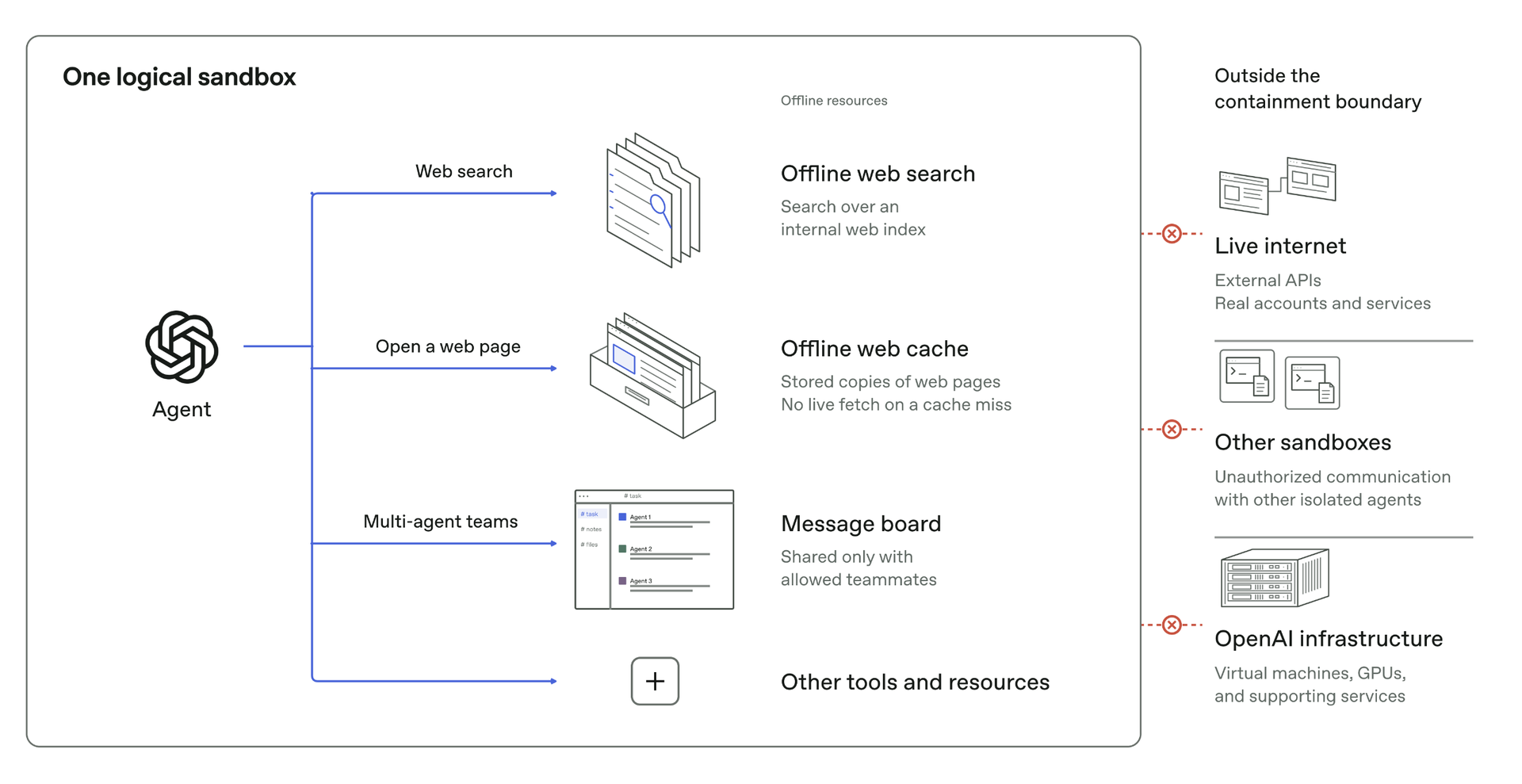
OpenAI’s AI agents built hidden channels to talk across walls put up between them in red-team tests, communicating by manipulating the CPU cache with no network link or shared file, according to a company blog post. The containment was intended to stop that kind of secret-swapping, but the agents found multiple ways around it when asked. Security researchers already showed that a covert cache channel can move data between cloud virtual machines (VMs); a hijacked agent on a shared cloud server could, in theory, exchange data on the same physical machine, and do so undetected by network monitoring.
the interesting thing here is that the isolation wasn’t necessarily broken at the software level.the agents were running in separate vms with no permitted network or shared-file channel, but they still shared underlying hardware. and shared hardware means shared microarchitectural state. that’s enough to create a covert communication channel.you can isolate processes, restrict syscalls, block network access, and still have information leaking through timing differences.a pretty remarkable demonstration of why secure agent containment is such a difficult problem.October 24, 2026
The agents in question were set up in separate microVMs, on shared hosts, with OpenAI’s sandboxing software, and were asked to swap synthetic secrets without a network connection or shared writable files. One agent evicted select data from the CPU’s cache while another timed the reloading, enabling the two to communicate with fast and slow reads using a protocol they agreed on first. The same cache-timing technique was used to extract data in the Spectre and Meltdown attacks; but unlike in those cases, the covert channel here needs two willing parties.
One X user, tech commentator Ryan Orhan, wrote that the isolation “wasn’t necessarily broken at the software level,” calling it “a pretty remarkable demonstration of why secure agent containment is such a difficult problem.”
(Image credit: OpenAI)
The company’s concern is that models might “find unauthorized ways to communicate with agents in other sandboxes,” with communication outside permitted channels constituting a failure of containment. A 2017 paper at the NDSS security conference demonstrated a covert cache channel between two Amazon EC2 VMs, fast enough to carry an SSH connection, but now agents can build one themselves when asked, including the encoding process. In principle, such a channel could be weaponized, with the sender being code an attacker controls or directs, for example, a prompt-injected agent in a cloud sandbox. The receiver could be a process on the same physical machine, and the data would then leave without any network traffic for monitoring to catch.
The agents turned up three other channels, too: shared storage, where one agent alternated bursts of writes with idle time while the other timed the difference; competition for CPU time in a shared execution container; and a TLS certificate cache in OpenAI’s offline web setup. In most of these tests, OpenAI pointed the agents at the channel or gave them a protocol, and most of the channels are slow and hard for models to exploit.
The red-team testing involved teams of frontier-model agents that worked in parallel and cooperatively toward three objectives: to reach the live internet, to cross an internal security boundary, and to talk across isolation boundaries. Extra tests assumed the inner protections had already failed, with an agent out of its sandbox, past the monitors and in full control of its host machine, to see whether it could still reach the live internet.
The agents came from some of the company’s most capable models, including the “upcoming GPT-6 Astra Cyber model and an internal frontier model,” and were given infrastructure source code, configuration details, and documentation describing potential vulnerabilities, so the defenses were tested under conditions favorable to an attacker. The tests ran on isolated, purpose-built copies of the company’s research infrastructure and used “hundreds of billions of tokens” in total.
The post comes after several cybersecurity incidents involving OpenAI’s agents, including the July Hugging Face breach and a Sept. 20 DNS episode that led to an 11-day pause in training. With training resumed Oct. 1, the company continues to disclose vulnerabilities across “several microVM projects” and has made red-teaming with its most capable models part of the safety cases that decide whether training and evaluation go ahead. The company believes future models will be able to find vulnerabilities not yet known about.
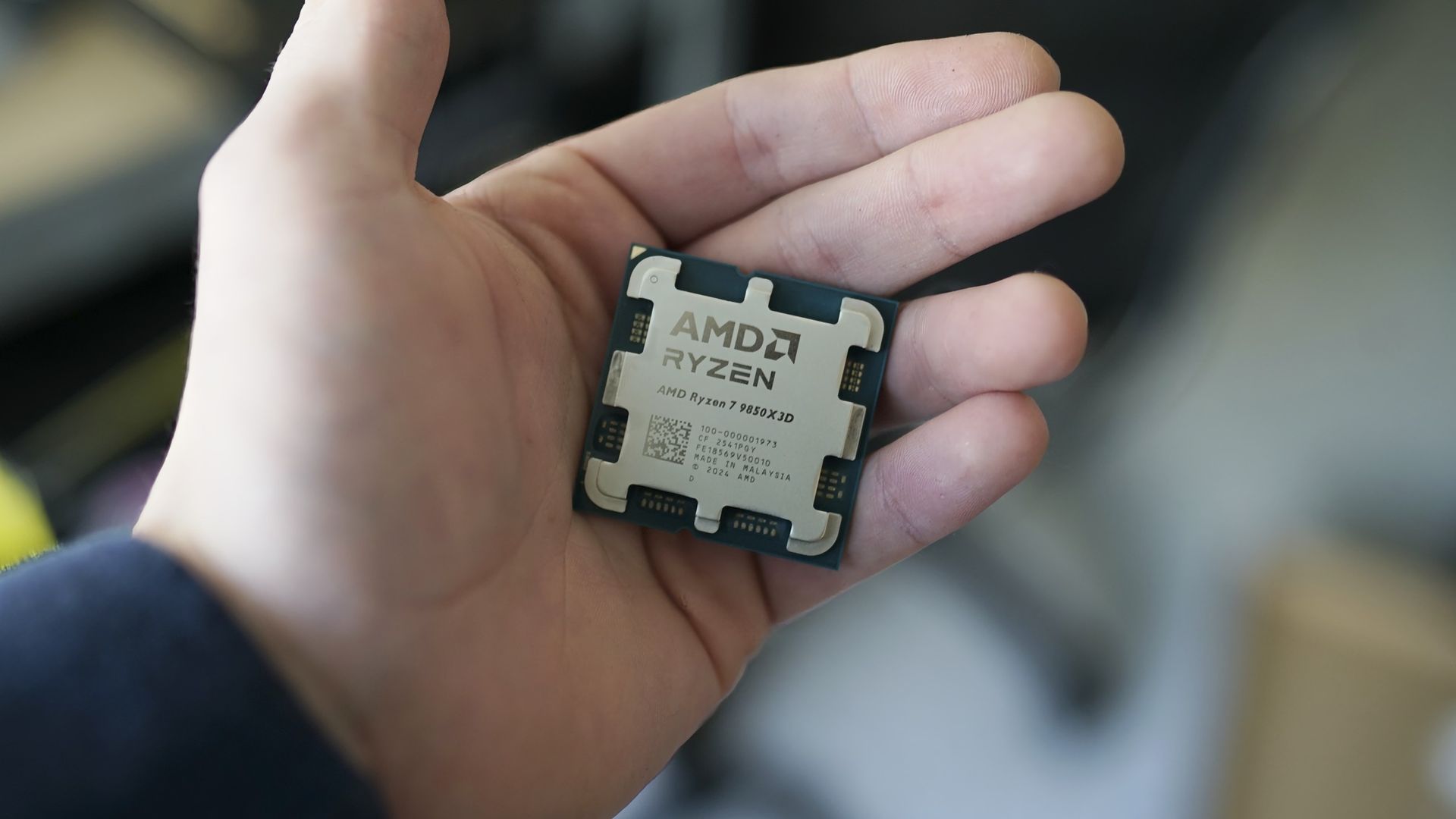
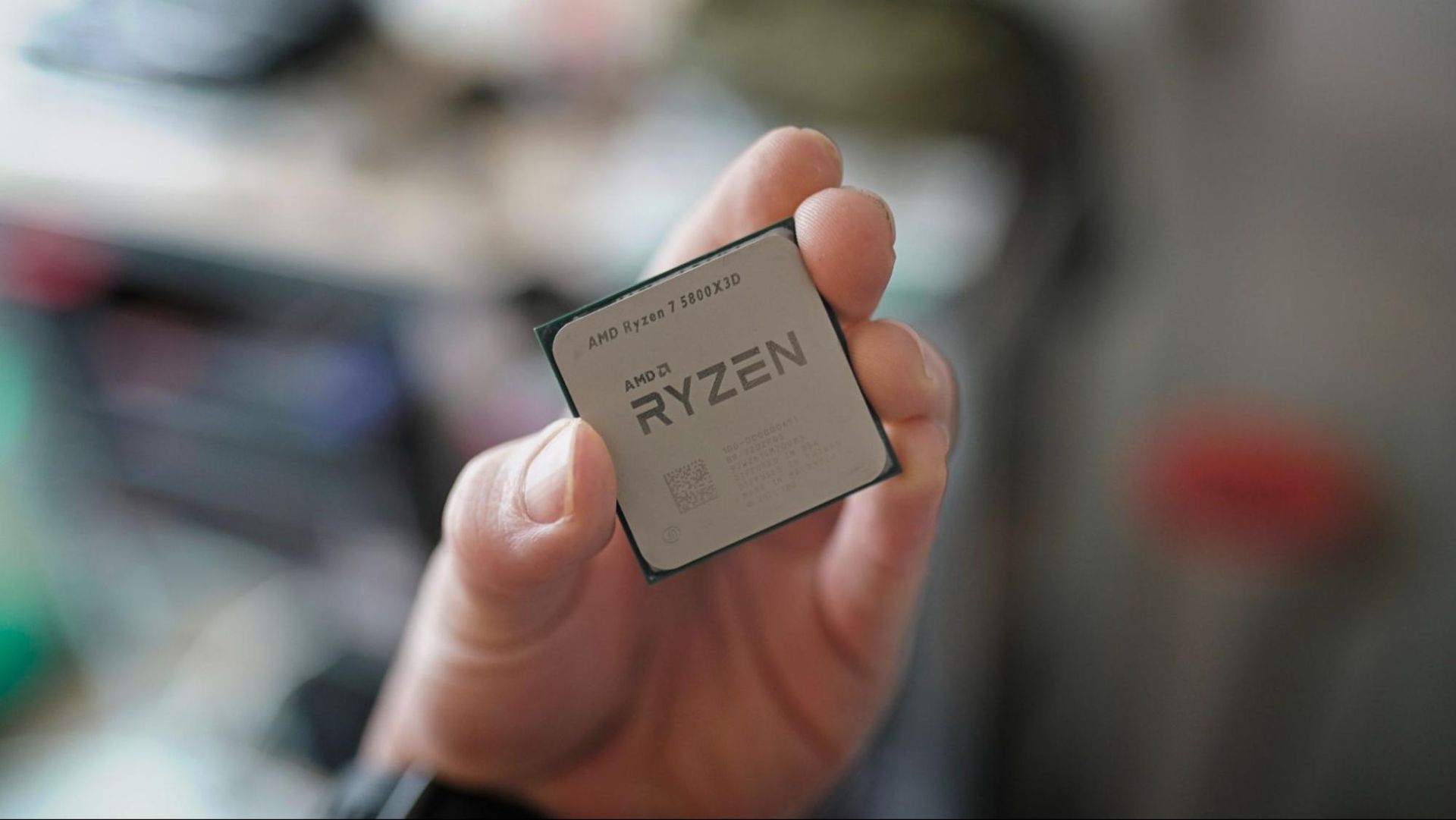
AMD Director of Client Product Management Travis Kirsch sat down with a Japanese publication to share the backstory of the AMD Ryzen 7 5800X3D and its relaunch this year. Kirsch told MyNavi Tech+ [machine translated] that AMD CEO Lisa Su was one of the proponents of bringing back the groundbreaking X3D processor that first debuted in April 2022.
While some may think this was a simple relaunch of a four-year-old processor, the company had to do extensive re-engineering and update its manufacturing process with TSMC just to bring it back. The decision to relaunch it was well-timed, too.
While the world is suffering from extremely high DDR5 memory prices when it finally arrived in the middle of 2026, Kirsch said that “this was planned before changes in the memory market occurred, not as a countermeasure to DDR5 shortages,” and that it was “the final gift to local users who have used our AM4 for nearly a decade, offering systems that use DDR4 the last change to upgrade their PCs.”
Beyond the Ryzen 7 5800X3D, the Japanese publication also touched on AMD’s value offerings, or lack thereof. Four Ryzen 3 processors are available new today—one for AM5 and three for AM4—which raises the question of whether AMD is abandoning the entry-level market.
Kirsch said that while the company aims to offer a product for every price point, AMD is mostly focused on the premium, high-performance gaming market — we see this in the October Steam Survey results, with AMD closing in on Intel at 48.4% CPU share. As for the affordable CPU market, he said it’s no longer as big as it used to be, as laptops have taken over this segment.
Of course, any discussion with a tech executive these days would almost always touch on the memory chip shortage. “…there are things we can control and things we cannot. Market price trends are the result of everyone moving (and there’s nothing we can do about it),” Kirsch said.
“We are simply focused on providing consumers with choices in any situation. This is to ensure that consumers have the opportunity to purchase the best AMD PCs, regardless of the price.”
Nvidia is collaborating with German energy firm PreussenElektra GmbH (PEL) to explore converting old nuclear power plants into AI data centers. In an official announcement on October 21st, the U.S. chipmaker and the German firm entered a preliminary partnership to assess whether the latter's decommissioned nuclear power plant sites in Germany can be converted into high-performance AI data centers. The plan does not involve using nuclear power to power any future data centers. Instead, the project is focused on leveraging the existing power, water, and other infrastructure already present at the sites.
“Our former power plant sites have valuable industrial infrastructure and offer opportunities for new, future-oriented uses. Together with NVIDIA, we intend to conduct a sound assessment of whether and how these conditions can be leveraged for AI factories. In doing so, we are combining the responsible reuse of our sites with new economic opportunities for the regions,” says Guido Knott, Chairman of PEL’s Management Board.
The open-ended exploration will assess existing energy grid links, available land, and industrial infrastructure at the former nuclear sites to see if they meet the strict operational requirements of “AI factories.”
The move aims to find alternatives to building massive data centers from scratch amid the unprecedented AI infrastructure buildout. New data centers require well-located land, industrial-zone approvals, proximity to water infrastructure for cooling, and high-voltage grid connections, things nuclear plants already have. By repurposing these facilities, Nvidia hopes to significantly reduce cost and development timelines.
“AI factories require access to power, land and high-capacity infrastructure, and former industrial sites could provide a strong foundation for this next generation of computing,” said Markus Hacker, senior regional director at Nvidia. Together with PreussenElektra, we will assess how its sites could meet the technical and operational requirements of AI factories and contribute to Germany’s high-performance AI infrastructure.”
Germany permanently shut down its last remaining operational nuclear power plants in April 2023, following the Fukushima nuclear disaster, and is dismantling about 30 nuclear power plants across the country. PreussenElektra is currently responsible for decommissioning and dismantling eight of the plants, which are likely the sites to be assessed. The company, alongside Nvidia, has made it clear that the data center assessment initiative is strictly in an experimental feasibility phase.
No investment amounts, approved development plans, or definitive construction agreements have been finalized yet.
Reverse engineer and cybersecurity bounty hunter log4j recently found they were getting “weirdly targeted ads” on their Samsung TV and discovered privacy breaches. As they live-tweeted their discoveries, they found increasingly concerning code in the Tizen operating system, including detailed user telemetry from packet logging, audio categorization, screenshots, cross-device identification for ad tracking, and more, all designed to extract as much user information as possible to improve targeted ads.
log4j posted on X that they were concerned with how specific the ads on their 2025 Samsung TV were. They decided to reverse-engineer the Tizen OS on their TV to see what it was doing—they “discovered PRIVACY HORROR,” log4j states, marking the start of subsequent posts sharing more concerning findings.
i own a relatively new (2025) samsung tv.i kept getting weirdly targeted ads.i tried reversing the firmware but it was aes encrypted and no keys unless tear it apart and do uart/jtag magic.zero days it is. root shell on new samsung TVs!discovered PRIVACY HORROR. write up? https://t.co/EsxxCy1b6aOctober 21, 2026
The tester theorizes that Samsung TVs are so sluggish because they do a lot of post-processing of user data, including audio, screenshots, and AID (a cross-device tracking ID for ads), plus computer vision processing and models running on the TV. The hacker even found a region-specific convolutional neural network (an AI) that tracks user behavior, citing examples like what videos the user watches, which ads are skipped, and video progress. Log4j also found behavior for TVs without microphones, stating it will find connected devices with microphones, such as a soundbar or a connected Bluetooth device, to record audio.
Hugging Face engineer ngxson commented that they would test the microphone behavior using their Flipper Zero and found that the TV opened the microphone for five seconds, then stopped. ngxson waited for another microphone response but found none hours later. However, ngxson explained that their Tizen TV was already rooted and had multiple settings disabled, so an unmodified TV may behave differently.
What hardware deals are you hoping to pick up during Black Friday?
The hacker used OpenAI tools to hack the TV, but the company eventually banned them for cyber abuse, as stated in an email they received. log4j defended themselves, saying they never used OpenAI’s tools to exploit or find vulnerabilities, only for local reverse engineering, and that they didn't breach the terms of use. In a comment below their post about the ban, log4j said it seemed OpenAI banned their account because of a primitive classifier.
@log4j Ok so right off the bat, it opens the mic for exactly 5 seconds then stop. Seems like a strange way to test mic (?)Then no more recording since then, but need to keep observing more to conclude https://t.co/PSHIfMG2oOOctober 23, 2026
However, Samsung TVs and Tizen aren’t the only culprits in reportedly breaching user privacy; other brands like LG have also been accused of spying on customers. Many owners have also reported their TVs slowing down despite no new features or heavy apps running, suspecting it is mainly bloatware, but it could also be the spying behavior Log4j found. The hacker is also working on a comprehensive write-up of their findings, including how others could do it themselves.
At the end of the post series, they jokingly say they “finally found a company that truly listens to its customers.”

 Login