Is it easier to cheat now than ever? In episode 177 of Overthink, Ellie and David talk about cheating. From micro-cheating on your girlfriend to doping in sports, cheating appears to have escalated in various domains. Your hosts explain the relationship between cheating and rule-breaking, then question norms surrounding cheating in romantic relationships. Why is cheating considered the ultimate dealbreaker? Is it always dishonest? Finally, they address the rise of generative AI cheating in schools and the ethical numbing that promotes it. How is ChatGPT different from using a calculator? And has it become rational for students to cheat? In the Substack Bonus Segment, Ellie and David question whether we should even use the word 'cheating' for romantic relationships rather than infidelity.
Go to https://surfshark.com/overthink or use code OVERTHINK at checkout to get 4 extra months of Surfshark VPN!
Go to Quince.com/overthink for free shipping on your orders and 365-day returns. Now available in Canada, too.
Sign up for your one-dollar-per-month trial today at shopify.com/overthink.
Go to Rula.com/overthink for convenient therapy that’s covered by insurance.
Visit Progressive.com to see if you could save on car insurance.
Overthink is a philosophy podcast hosted by your new favorite professors, Ellie Anderson (Pomona College) and David Peña-Guzmán (San Francisco State University). Check out our episodes for deep dives into concepts such as existential anxiety, empathy, and gaslighting.
Works Discussed:
Stuart Green, “Cheating”
Natasha McKeever, “Is the Requirement of Sexual Exclusivity Consistent with Romantic Love?”
Deborah Rhode, Cheating: Ethics in Everyday Life
James D. Walsh, “Everyone Is Cheating Their Way Through College”
Enjoy our work? Support Overthink via tax-deductible donation: https://www.givecampus.com/fj0w3v
Subscribe to our Substack for ad-free versions of both audio and video episodes, extended episodes, exclusive live chats, and more: https://overthinkpod.substack.com/
Website: overthinkpodcast.com
Substack: overthinkpod.substack.com
Facebook: / overthink-podcast-105420885026249
Apple podcasts: https://podcasts.apple.com/us/podcast...
Spotify: https://open.spotify.com/show/4aIlXHT...
Art19 RSS: https://rss.art19.com/overthink
Find us on Instagram, Twitter, and TikTok at @overthink_pod
Are you paying attention when you scroll online? In episode 176 of Overthink, Ellie and David draw your attention to attention. They explain why attention is so hard to define and debate the extent to which it should be equated with consciousness. Is attention the same thing as consciousness? Or are there important differences between these concepts? They consider different ways that attention has been classified, from “overt vs. covert” to “effortful vs. effortless” to “voluntary vs. involuntary.” Ellie and David then discuss the commodification of attention and how it has been intensified by the digital era, or what Chris Hayes calls “the age of attention.” How has social media changed the way we attend to the world, to ourselves, and to others? Is our attention still our own? Or has it become alienated? In the Substack Bonus Segment, Ellie and David talk about Simone Weil’s and Iris Murdoch’s ethical approaches to attention.
Overthink is a philosophy podcast hosted by your new favorite professors, Ellie Anderson (Pomona College) and David Peña-Guzmán (San Francisco State University). Check out our episodes for deep dives into concepts such as existential anxiety, empathy, and gaslighting.
Works Discussed:
Jelle Bruineberg, “Rethinking the cognitive foundations of the attention economy”
Chris Hayes, The Sirens' Call: How Attention Became the World's Most Endangered Resource
William James, The Principles of Psychology
Carlos Montemayor and Harry Haroutioun Haladjian, Consciousness, Attention, and Conscious Attention
The Friends of Attention, Attensity! A Manifesto of the Attention Liberation Movement
Enjoy our work? Support Overthink via tax-deductible donation: https://www.givecampus.com/fj0w3v
Subscribe to our Substack for ad-free versions of both audio and video episodes, extended episodes, exclusive live chats, and more: https://overthinkpod.substack.com/
Website: overthinkpodcast.com
Substack: overthinkpod.substack.com
Facebook: / overthink-podcast-105420885026249
Apple podcasts: https://podcasts.apple.com/us/podcast...
Spotify: https://open.spotify.com/show/4aIlXHT...
Art19 RSS: https://rss.art19.com/overthink
Find us on Instagram, Twitter, and TikTok at @overthink_pod
Play it cool and play this episode. In episode 175 of Overthink, Ellie and David talk about what it means to be cool. From swag gap relationships to Mark Zuckerberg and the manosphere’s failed attempts at being cool, your hosts examine coolness’s ties to youth and subversion and its opposition to displays of wealth. They trace how coolness emerged from Black American culture in the 1930s, before being associated with Beat Poets and punk musicians. They consider precursors to cool, like the Italian term sprezzatura, and question the ontology and the morality of coolness. Is coolness an attitude or a state? Is it inherently narcissistic? Can you ever successfully “try” to be cool? In the Substack bonus segment, Ellie and David discuss coolness through an ethical perspective.
Go to Quince.com/overthink for free shipping on your orders and 365-day returns. Now available in Canada, too. Go to Rula.com/overthink for convenient therapy that’s covered by insurance.
Overthink is a philosophy podcast hosted by your new favorite professors, Ellie Anderson (Pomona College) and David Peña-Guzmán (San Francisco State University). Check out our episodes for deep dives into concepts such as existential anxiety, empathy, and gaslighting.
Works Discussed:
Joel Dinerstein, “Jazz Cool”
Ted Gioia, The History of Jazz
bell hooks, We Real Cool: Black Men and Masculinity
Dick Pountain and David Robins, Cool Rules: Anatomy of an Attitude
Enjoy our work? Support Overthink via tax-deductible donation: https://www.givecampus.com/fj0w3v
Subscribe to our Substack for ad-free versions of both audio and video episodes, extended episodes, exclusive live chats, and more: https://overthinkpod.substack.com/
Website: overthinkpodcast.com
Substack: overthinkpod.substack.com
Facebook: / overthink-podcast-105420885026249
Apple podcasts: https://podcasts.apple.com/us/podcast...
Spotify: https://open.spotify.com/show/4aIlXHT...
Art19 RSS: https://rss.art19.com/overthink
Find us on Instagram, Twitter, and TikTok at @overthink_pod
What resources do Indigenous studies provide for addressing the crisis of human-made climate change? And how is the climate crisis linked to settler colonialism? In episode 174 of Overthink, Ellie and David chat with Indigenous philosopher and activist Kyle Whyte about his work on climate action. They discuss how Indigenous people are often blocked out of conversations about environmental impact, the common mischaracterization of the land back movement, and the importance of kinship. How are certain groups disproportionately affected by climate change? Is climate change actually a new problem? And how can respecting land rights of Indigenous people offer some solutions to climate change? In the Substack bonus segment, your hosts question who is called upon to respond to the crisis of climate change and how non-Indigenous people should engage in discussions surrounding climate change and colonialism.
Go to Quince.com/overthink for free shipping on your orders and 365-day returns. Now available in Canada, too. Go to Rula.com/overthink for convenient therapy that’s covered by insurance.
Overthink is a philosophy podcast hosted by your new favorite professors, Ellie Anderson (Pomona College) and David Peña-Guzmán (San Francisco State University). Check out our episodes for deep dives into concepts such as existential anxiety, empathy, and gaslighting.
Works Discussed:
Kyle Whyte, “Climate Action at the Speed of Consent”
Kyle Whyte, “Indigenous Climate Change Studies: Indigenizing Futures, Decolonizing the Anthropocene”
Kyle Whyte, “Settler Colonialism, Ecology, and Environmental Injustice”
Enjoy our work? Support Overthink via tax-deductible donation: https://www.givecampus.com/fj0w3v
Subscribe to our Substack for ad-free versions of both audio and video episodes, extended episodes, exclusive live chats, and more: https://overthinkpod.substack.com/
Website: overthinkpodcast.com
Substack: overthinkpod.substack.com
Facebook: https://www.facebook.com/Overthink-podcast-105420885026249
Apple podcasts: https://podcasts.apple.com/us/podcast/overthink/id1538249280
Spotify: https://open.spotify.com/show/4aIlXHTDz5vrc78DyjFg66
Art19 RSS: https://rss.art19.com/overthink
Find us on Instagram, Twitter, and TikTok at @overthink_pod
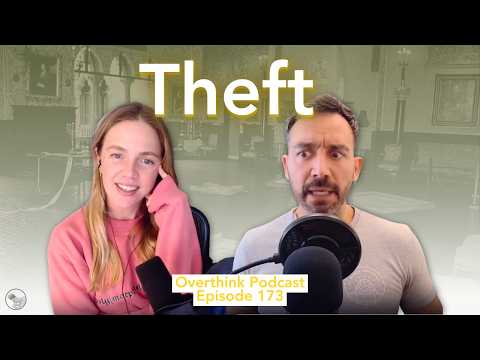
Thou shalt not miss this episode! In episode 173 of Overthink, Ellie and David talk about theft. They discuss our moral intuitions around theft, how feudalism and capitalism may be founded upon an original (and large scale) act that of theft, and the gendered association between kleptomania and women. They also critique the lack of legal repercussions for tech companies that steal information to train new AI models. Finally, they look at representations of theft and capital in film and television. What does the move from heist films to grift docudramas say about 21st century capitalism? And why do we love to take the side of thieves? In the Substack bonus segment, your hosts discuss the ethics of stealing from large corporations.
Go to Quince.com/overthink for free shipping on your orders and 365-day returns. Now available in Canada, too. Go to Rula.com/overthink for convenient therapy that’s covered by insurance.
Overthink is a philosophy podcast hosted by your new favorite professors, Ellie Anderson (Pomona College) and David Peña-Guzmán (San Francisco State University). Check out our episodes for deep dives into concepts such as existential anxiety, empathy, and gaslighting.
Works Discussed:
Elaine Abelson, When Ladies Go A-Thieving: Middle-Class Shoplifters in the Victorian Department Store
Anna Kornbluh “Falling Heists, Rising Grift: Filming Capital in the Already Long Twenty-First Century”
Robert Nichols, Theft Is Property! Dispossession and Critical Theory
Enjoy our work? Support Overthink via tax-deductible donation: https://www.givecampus.com/fj0w3v
Subscribe to our Substack for ad-free versions of both audio and video episodes, extended episodes, exclusive live chats, and more: https://overthinkpod.substack.com/
Website: overthinkpodcast.com
Substack: overthinkpod.substack.com
Facebook: https://www.facebook.com/Overthink-podcast-105420885026249
Apple podcasts: https://podcasts.apple.com/us/podcast/overthink/id1538249280
Spotify: https://open.spotify.com/show/4aIlXHTDz5vrc78DyjFg66
Art19 RSS: https://rss.art19.com/overthink
Find us on Instagram, Twitter, and TikTok at @overthink_pod
In a four-part series, Dr. David M. Peña-Guzmán discusses Nietzsche's Genealogy of Morality. In this third lecture, he discusses Treatise 2, where Nietzsche famously breaks down the history of our moral sentiments. What is the origin of our sense of conscience — and specifically, the origin of bad conscience and guilt? How are our moral lives, such as our ability to make promises, shaped by memory and forgetfulness? And how does Nietzsche trace the origin and ongoing function of punishment?
Does decolonization require violence? In episode 172 of Overthink, Ellie and David take a closer look at Frantz Fanon’s The Wretched of the Earth, “the bible of decolonization.” They discuss Fanon’s bold stance on violence, his condemnation of rituals and dance, and some potential criticisms. They also question what the subjectivity of colonized people looks like given colonialism’s psycho-affective effects. What does violence do for the colonized? Who gets liberation movements off the ground? And what are the challenges that a newly independent nation might face once a colonial power has been overthrown? In the Substack bonus segment, your hosts talk about Fanon’s critique of Africanism and some of the clinical cases Fanon incorporates into this important work.
Go to Quince.com/overthink for free shipping on your orders and 365-day returns. Now available in Canada, too. Go to Rula.com/overthink for convenient therapy that’s covered by insurance.
Overthink is a philosophy podcast hosted by your new favorite professors, Ellie Anderson (Pomona College) and David Peña-Guzmán (San Francisco State University). Check out our episodes for deep dives into concepts such as existential anxiety, empathy, and gaslighting.
Works Discussed:
Frantz Fanon, The Wretched of The Earth
Concerning Violence (2014)
Enjoy our work? Support Overthink via tax-deductible donation: https://www.givecampus.com/fj0w3v
Subscribe to our Substack for ad-free versions of both audio and video episodes, extended episodes, exclusive live chats, and more: https://overthinkpod.substack.com/
Website: overthinkpodcast.com
Substack: overthinkpod.substack.com
Facebook: https://www.facebook.com/Overthink-podcast-105420885026249
Apple podcasts: https://podcasts.apple.com/us/podcast/overthink/id1538249280
Spotify: https://open.spotify.com/show/4aIlXHTDz5vrc78DyjFg66
Art19 RSS: https://rss.art19.com/overthink
Find us on Instagram, Twitter, and TikTok at @overthink_pod

 Login
Login