A única parte do som de cinema gravada no set de filmagem é a fala dos atores. O restante – barulho de tiros, explosões, passos, portas abrindo, portas fechando, bocas beijando, bocas fumando, bocas mascando chiclete, afagos, tapas e socos – tudo isso é feito na pós-produção.
Como esse universo sonoro é criado por artistas de foley, editores de efeito e mixadores? Quais os paralelos entre o som inventado e o som real? Como o áudio cinematográfico mudou com o tempo? Como a tecnologia influenciou essas mudanças? E qual é o peso delas nos filmes que você vê no cinema? E o que, afinal, o alho-poró tem a ver com isso?
Escute e descubra!
*** Você pode assinar o podcast gratuitamente no iTunes, no Spotify e nos principais aplicativos de podcast ***
O núcleo familiar do presidente flertou durante meses com a tese segundo a qual o Brasil deveria ajudar os Estados Unidos a conter a expansão econômica da China na América Latina.
Leia mais (04/11/2019 - 02h00)
Shauneen Lambe on ephibiphobia, fear of the teenager, and why we get youth justice wrong; Alice Bloch considers new possibilities at the frontiers of sex and robotics; George Berridge explains why now is the time to take out shares in the novelist Max Porter
Why Children Follow Rules: Legal socialization and the development of legitimacy by Tom R. Tyler and Rick Trinkner
James Garbarino
Miller’s Children: Why giving teenage killers a second chance matters for all of us by James Garbarino
Turned On: Science, sex and robots by Kate Devlin
Grief is the Thing with Feathers by Max Porter, adapted by Enda Walsh (Barbican Theatre, before heading to New York)
Anna Picard discusses the problems of subject matter and sensationalism in the new opera Jack the Ripper: The Women of Whitechapel; Anna Vaux talks us through the Bauhaus school and its global influence, as well as Lucian Freud's compulsion to create and control
Books
Jack the Ripper:The Women of Whitechapel by Iain Bell, ENO, until April 12
Walter Gropius: Visionary founder of the Bauhaus by Fiona MacCarthy
I’ve been a member of the community over at blenderartists.org (previously elysiun) for a long time (it’ll be 15 years this October according to my profile there).
So it was nice to see when they finally transitioned to using Discourse a little while back.
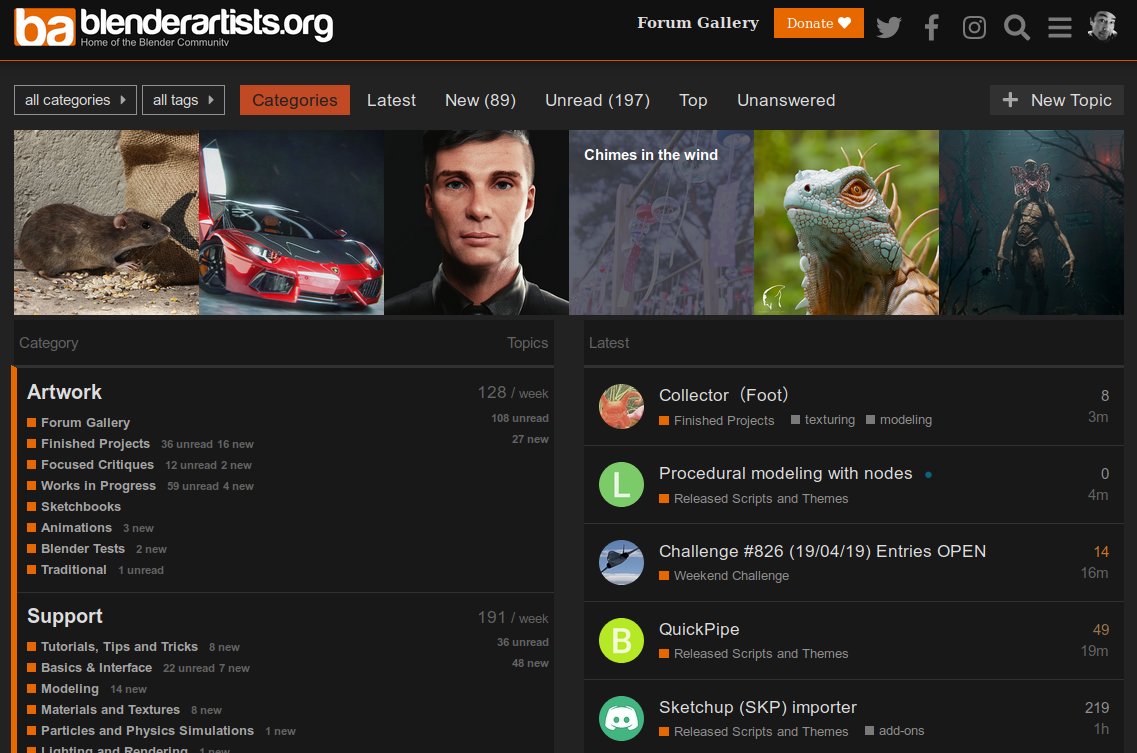
What I really liked, though, was the work that Bart did to specific pages and tag lists to display them.
Here’s what their current homepage looks like:
Current blenderartists.org homepage
They use a different default main page style, “Categories” view, than we do (“Latest”). This just shows the site categories as a column on the left, then the latest posts in a column on the right.
The row of featured images along the top is actually part of a plugin that I’ll get to in a moment.
If you want to change your own default main page view of the forums, you can modify it at your account Preferences → Interface (and change it to Categories):
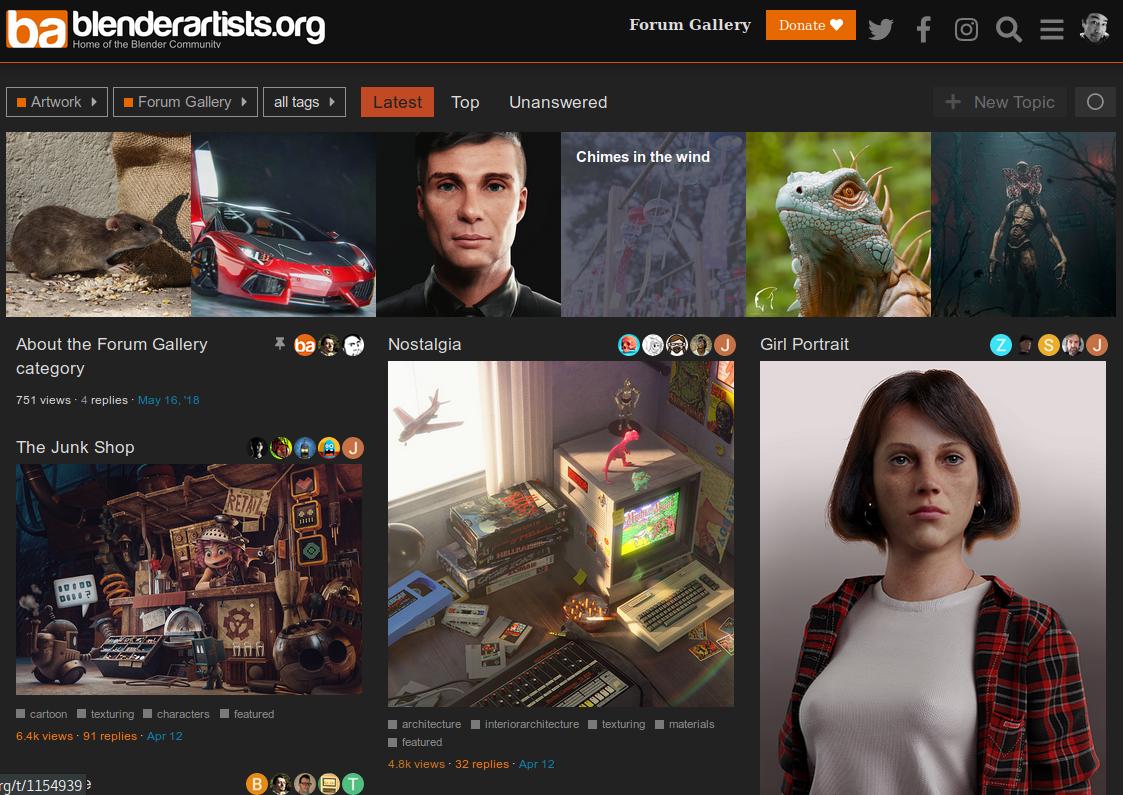
The default landing page is neat, but what they did with their forum gallery page is much neater:
blenderartists.org forum gallery page
They set up the Topic List Previews plugin so the entire category is actually viewed as a tile of images.
I think we can all agree that this is generally a much nicer way to view categories that are heavily image-based.
Of course, I thought this was a natural fit for us as well!
So through the magic of having an invaluable resource like a darix, he was able to make it a reality for us!
We’ve got it implemented now on the Play Raw category (now its own sub-category under the Processing category), the Critique, and the Showcase category.
If you haven’t had a chance to check it out yet, please do. (darix announced it in the thread Play raw posts and you so feel free to give us any further feedback in that topic.)
The Critique category
Keep in mind that for those categories, the preview image will correspond to the first image in the first post. Try to remember to make the first image in those category topics the one you’ll want in the preview.
We haven’t enabled the featured row of images after some initial feedback. We may revisit it again at some point, but hopefully the Play Raw and Showcase categories will look a little better now. It certainly makes the categories a little easier and faster to navigate now that you can see the previews directly on the page.
O carro autônomo já é uma realidade. Desde 2009, veículos sem motorista desenvolvidos pelo Google já rodaram mais de dez milhões de milhas. No Brasil, há empresas e universidades trabalhando no assunto. E conforme esse novo tipo de transporte chegar às ruas, o que vai acontecer em breve, mudanças profundas ocorrerão nas cidades.
Para muitos especialistas, os acidentes e as mortes no trânsito podem cair mais de 90%. Pensando mais para o futuro, se todos os carros forem automatizados, as cidades poderão ser integradas em grandes sistemas inteligentes que regularão a fluidez do trânsito. Nesse mundo utópico, eles só precisarão parar para abastecer ou para manutenção.
Assim, espaços hoje utilizados para estacionamento, para postos de gasolina, concessionárias e oficinas mecânicas poderão ganhar outros usos.
Mas será que é isso mesmo? Ou será que todo esse processo envolve a criação de uma tecnologia desnecessária, que tem o objetivo maior de nos roubar alguns dados, sem olhar de fato para antigos problemas urbanos?
Engenheiro mecânico, professor e responsável pelo desenvolvimento do Veículo Inteligente do Laboratório de Mobilidade Autônoma (VILMA) da Universidade de Campinas (Unicamp).
Mestre pela faculdade de arquitetura e urbanismo da USP, pesquisador colaborador do centro de estudos Sociedade e Tecnologia, da Escola Politécnica da USP, e um dos coordenadores do grupo de estudo Cenários Urbanos Futuros, ligado à FAU.
Quando pousar em Israel, Jair Bolsonaro desmontará a velha estratégia brasileira para lidar com o conflito no Oriente Médio: apoiar a criação de dois Estados, um judeu e um palestino. Concebida em seguida à Guerra dos Seis Dias (1967), essa política rendeu ao Brasil excelentes relações com judeus e árabes.
Leia mais (03/28/2019 - 02h00)
Richard Fortey takes us on an energetic sprint through 65 million years of Europe's complex biological history; David Robey introduces the life and work of Emilio Salgari, the Italian Rider Haggard; Ella Baron, the TLS's regular cartoonist, discusses her work, including this week's European cover.
Books
Europe: A natural history by Tim Flannery
Emilio Salgari: Una mitologia moderna tra letteratura, politica, società (volumes I and II) by Ann Lawson Lucas
Ella Baron's work will be exhibited at Christie's in London, from April 5 to 10
For years the incredible team over at G’MIC (GREYC’s Magic for Image Computing) have been producing an incredible image processing system and many awesome filters to go along with it.
They’ve got an very active and awesome community right here on their forums and they’ve been producing all manner of neat processing filters for photographers, digital artists, and scientists.
Due to the project being under the auspices of a French Research Lab, the GREYC laboratory in Caen, France, they were limited in being able to accept any donations.
I first heard about GREYCstoration (proto-G’MIC) a long time ago (over 10 years) as the only really viable Free Software image denoising option for photographers.
It allowed me to de-noise images on par (or better in many cases) with the then popular Noise Ninja.
It’s been an essential part of my toolkit ever since!
Back then David Tschumperlé was really only looking for postcards from users as a “thank you” and maybe some occasional donations to pay for hot chocolates during the day.
I finally got to buy him a milkshake while at the Libre Graphics Meeting 2014 in Leipzig, Germany and for the value he has provided me with his software I owe him many, many more!
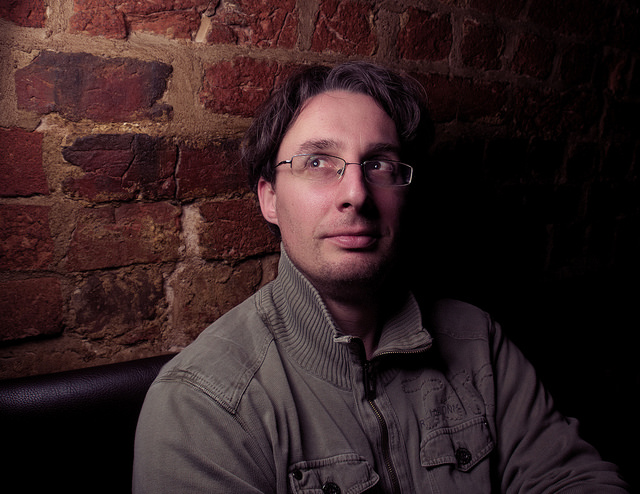
The man, the myth, the legend.
Value is exactly what I want to bring up in this post.
I’m sure many here have had an opportunity to use G’MIC in some form and any attempt at listing the wide range of filters and capabilities it provides would not do it justice.
If you’ve realized some value from the project, now is the time to show some love.
I’ve been lucky to call David a friend for a long time now and I can personally attest to his kindness and sincerity.
With that in mind I implore you: if you have a few spare dollars, euros, yen, pesos, or gold bullion please consider donating to the project and make sure the milkshakes (or hot chocolates) never stop flowing.
David (and Sébastien Fourey!) are a sound investment in providing high value to Free Software artists and photographers!
For a long time David was unable to accept donations from community members.
There were some concerns from the research institution his lab is a part of in France.
Just recently, though, they managed to reach an agreement where the funds flow through a French non-profit called Libre Comme L’Art, LILA, that includes the fabulous Jehan Pagès of the GIMP team as a member and where the ZeMarmot animated film is being produced.
A big “Thank You!” to Jehan and LILA for making this possible!
Jair Bolsonaro trouxe de Washington uma vitória para seu governo. Na Casa Branca, ele obteve concessões para dar aos principais grupos de interesse que o sustentam no poder. A soma de benefícios constitui o maior pacote de apoio já dado pelo incumbente americano ao mandatário brasileiro numa visita inaugural desde 1985.
Leia mais (03/21/2019 - 02h00)
Carol Tavris considers new approaches to the old problem of old age (and the newer problem of old old age); as secularism wanes on the global scale, Rupert Shortt considers whether religion does more harm than good
Books
Bolder: Making the most of our longer lives by Carl Honoré
Borrowed Time: The science of how and why we age by Sue Armstrong
Retirement and Its Discontents: Why we won’t stop working, even if we can by Michelle Pannor Silver
Women Rowing North: Navigating life’s currents and flourishing as we age by Mary Pipher
On the Brink of Everything: Grace, gravity and getting old by Parker J. Palmer
This Chair Rocks: A manifesto against ageism by Ashton Applewhite
Does Religion do More Harm than Good? by Rupert Shortt
“What we often forget in the daily drumbeat of abuses by the dominant tech companies is our complicity in these abuses, and in the fundamental and unsettling ways the internet has changed every one of us.”
As the Universal Declaration of Human Rights enters its seventieth anniversary, Dave Eggers, in the 2018 PEN H. G. Wells lecture, argues that urgent amendments are needed to mitigate the corrosive effects of technology on the societal and the personal. You can read an edited extract from the lecture on the TLS website.
This is a recording of an event that took place on December 16, 2018, at the Bridge Theatre, London.
Phil Baker guides us through the morbid, wistful and yet immensely charming world of the writer and illustrator Edward Gorey; Frances Wilson weighs the pleasures and pains of letter and email writing; Ian Sansom on the struggle to be funny
Books
Born To Be Posthumous: The eccentric life and mysterious genius of Edward Gorey, by Mark Dery
What a Hazard a Letter Is: The strange destiny of the unsent letter, by Caroline Atkins
Written In History: Letters that changed the world, by Simon Sebag Montefiore
In Their Own Words: Volume 2: More letters from history
Wit's End: What wit is, how it works, and why we need it, by James Geary
Messing About In Quotes: A little Oxford dictionary of humorous quotations, compiled by Gyles Brandreth
Na segunda parte do episódio sobre armas de fogo, especialistas falam sobre a falta de controle e de fiscalização, que, na prática, tem feito muita gente sair armado nas ruas impunemente. Também fomos a campo tentar sentir na pele o fascínio por pólvora e metal na esperança de responder por que, afinal, tanta gente ama as armas de fogo?
Eimear McBride is an Irish novelist popularly known for her debut novel, A Girl Is a Half-formed Thing, which won the inaugural Goldsmiths Prize in 2013 and the 2014 Baileys Women's Prize for Fiction.
-------
Click SUBSCRIBE for more high quality content
Visit our website | http://www.hibrow.tv
Follow us on all our social media:
Facebook | https://www.facebook.com/Hibrowser
Twitter | https://twitter.com/HibrowTV
Rafael Bonachela, artistic director of Sydney Dance Company, and the composer Ezio Bosso, together devised the work and music for The Land of Yes and the Land of No as a collaboration with HiBROW. Rafael took the bold move of rehearsing and performing the piece on the steps of St Paul’s Cathedral over three consecutive weekday lunchtimes. The work was received with great enthusiasm, and audiences grew each day as word spread of this extraordinary event. Mobile technology allowed the HiBROW team to immerse themselves in the project, allowing the viewer into the heart of it in a way seldom seen on screen before.
-------
Click SUBSCRIBE for more high quality content
Visit our website | http://www.hibrow.tv
Follow us on all our social media:
Facebook | https://www.facebook.com/Hibrowser
Twitter | https://twitter.com/HibrowTV
For World Book Night 2013 at the Queen Elizabeth Hall in London, novelist Graeme Simsion reads from his book The Rosie Project.
Graeme later spoke exclusively to HiBROW about the pleasures and challenges of writing, turning to professional writing late in life, how he writes, and the books that mean the most to him...
-------
Click SUBSCRIBE for more high quality content
Visit our website | http://www.hibrow.tv
Follow us on all our social media:
Facebook | https://www.facebook.com/Hibrowser
Twitter | https://twitter.com/HibrowTV
Derek Jarman creates a visual evocation of Benjamin Britten’s choral masterpiece, The War Requiem, which blends the Latin Mass of the Dead with the poignant poetry of Wilfred Owen. Dramatised scenes featuring spellbinding performances from an extraordinary cast are interwoven with cinematic, poetic images and harrowing archive footage, which all serve to recreate the horrors of 20th century wars – the loss of innocence, the unbearable suffering, the nightmares, the tragic waste of life. Critically acclaimed on its release, Derek Jarman’s War Requiem is perhaps the visionary director’s greatest film. As a testament to the futility of war it is a unique, poignant and haunting experience.
-------
Click SUBSCRIBE for more high quality content
Visit our website | http://www.hibrow.tv
Follow us on all our social media:
Facebook | https://www.facebook.com/Hibrowser
Twitter | https://twitter.com/HibrowTV

 Login
Login