Dias de sol vermelho, poeira, fumaça, rastros de fogo e calor insuportável colocaram São Paulo entre as cidades com a pior qualidade de ar do mundo. No dia 17 de setembro, o presidente Lula, em reunião com ministros e representantes dos três poderes, falou sobre os incêndios que tomaram conta do país e como a maioria das cidades não estão preparadas para eventos climáticos extremos. Nesta temporada de conversas que não podemos mais adiar, o Pauta Pública recebe a jornalista e mestra em Planejamento Urbano, Gisele Brito. Gisele, que atualmente é coordenadora da área de Direito à Cidade Antirracista do Instituto de Referência Negra Peregum, avalia como as cidades podem e devem se adaptar para atender às populações mais vulneráveis, no combate as desigualdades sociais e a importância de considerar o tema nas eleições municipais.
A especialista aborda os conceitos de racismo ambiental, justiça climática e cidades antirracistas,destacando os impactos sociais e econômicos sobre as comunidades racializadas, como negros e indígenas, no caso do Brasil. Ouça o episódio completo e não esqueça de seguir e curtir o Pauta Pública nas plataformas de áudio.
Saiba que você pode ser aliado da Agência Pública e colaborar com esse trabalho. Saiba mais em apoie.apublica.orgou faça um pix de qualquer valor para contato@apublica.org. Contamos com seu apoio!
Um dos inventores do jornalismo brasileiro, pioneiro da crônica, crítico mordaz da sociedade do começo do século passado, apaixonado pela cidade. São muitos os epítetos de João do Rio, o homenageado da Flip, a Festa Literária Internacional de Paraty, em 2024. Mas quem foi, afinal, João Paulo Emílio Cristóvão dos Santos Coelho Barreto? No 120º episódio do 451 MHz, a editora e curadora da Flip Ana Lima Cecilio e o historiador Luiz Antonio Simas, autor de O Corpo Encantado das Ruas" (Civilização Brasileira, 2019) seguem os passos e revelam curiosidades sobre um dos mais importantes autores do início do século 20. O episódio foi realizado com apoio da Lei de Incentivo à Cultura.
Um recado rápido e um convite: continue acompanhando o Bom Dia Fim do Mundo no feed próprio. Clique aqui
Saiba que você pode ser aliado da Agência Pública e colaborar com esse trabalho. Saiba mais em apoie.apublica.orgou faça um pix de qualquer valor para contato@apublica.org. Contamos com seu apoio!
This week, we start with Donna Summer and finish with a Scotch Woodcock, as Milo Nesbitt goes in search of the future of music, and Roger Domeneghetti sings the praises of a little fish with a big flavour.
'Futuromania: Electronic dreams, desiring machines and tomorrow's music today', by Simon Reynolds
'A Twist in the Tail: How the humble anchovy flavoured western cuisine', by Christopher Beckman
In today’s episode in our series on the history of thinking about thinking machines, David and Shannon discuss Isaac Asimov’s 1955 short story ‘Franchise’, which imagines the American presidential election of 2008 as decided by one voter and a giant computer. Part prophecy, part parody: have either its predictions or its warnings about democracy come true? How does the power of technology shape contemporary politics? And why was Asimov’s vision of the future so reactionary?
To hear a bonus episode on Mary Shelley’s Frankenstein to accompany this series sign up now to PPF+ and get ad-free listening and all our other bonuses too: £5 per month or £50 a year for 24 bonus episodes. https://www.ppfideas.com/join-ppf-plus
The latest edition of our free newsletter is out tomorrow with guides, clips and links for this series: join our mailing list https://www.ppfideas.com/newsletters
Next time: Philip K. Dick’s Do Androids Dream of Electric Sheep?
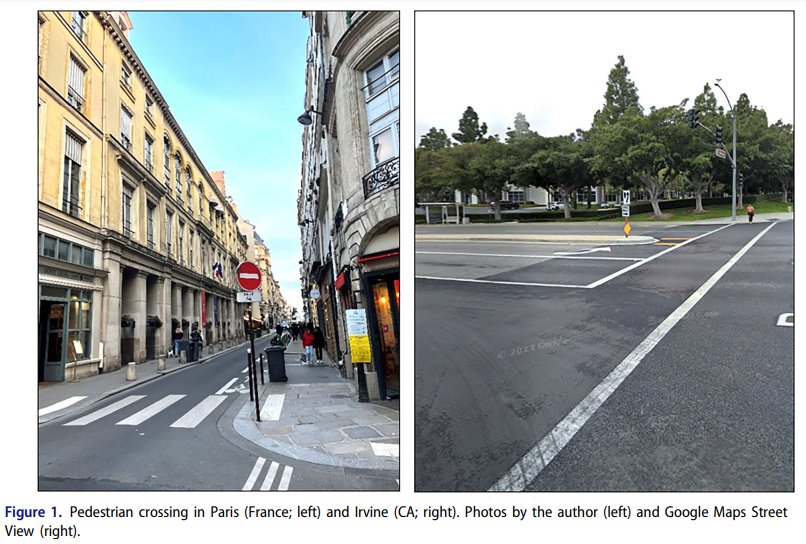
Pedestrians face the greatest risk of automobile collisions when crossing a street: the longer a crossing, the higher their exposure is to oncoming cars. Despite the relevance of crossing distance, few studies have considered its variance within or across entire cities. Given that, we probed pedestrian crossing distance at the municipal scale, leveraging both OpenStreetMap and satellite imagery to quantify crossing distances at roughly 49,000 formal crossings (those parts of the roadway designated for pedestrians to cross), both marked and unmarked, at intersections and at midblock.
We measured formal pedestrian crossings throughout a dense European city (Paris [France]), a dense American city (San Francisco [CA]), and a less-dense, more car-centric American city (Irvine [CA]). This granular approach—covering roughly 49,000 total crossings—identified inter- and intraurban spatial patterns in the distribution of pedestrian crossing distance, including clusters of long crossings that likely deter walking and increase its risk. By overlaying recent pedestrian–vehicle collisions on these novel data sets we found that longer crossing distance correlated with increased likelihood of collisions, raising the salience of traffic-calming interventions.
O barro é memória e território, molda corpos e histórias. Em meio a esse material bruto e ancestral, Marcelino Melo, o Quebradinha, encontrou o impulso para sua primeira exposição individual. "Etnogênese ? O Que É e O Que Pode Ser" nasce de uma faísca despertada em um espetáculo teatral e se transforma em uma pesquisa que o acompanha desde março de 2023. O termo etnogênese, que evoca o surgimento de identidades, agora dá nome à mostra que ocupa o Museu de Arte Contemporânea de Niterói (MAC).
Leia mais (09/25/2024 - 16h00)
Este episódio é a quarta e última parte da minissérie Dois Rios.
Uma história que envolve um presídio em uma ilha, uma vila misteriosa, um punhado de pessoas sendo injustamente despejadas, um professor idealista, uma defensora pública engajada, um espertalhão semeador de discórdia, e uma possível conspiração que se aproxima de algumas das pessoas mais poderosas da política brasileira.
Mestra em História, doutora em Meio Ambiente, professora associada e pró-reitora de extensão e cultura da Universidade do Estado do Rio de Janeiro (UERJ).
Doutor em história, professor do Departamento de Ciências Humanas da Universidade do Estado do Rio de Janeiro (UERJ), e diretor do Ecomuseu Ilha Grande.
Ficha Técnica
Apoio de produção, edição e reportagem: Matheus Marcolino.
Mixagem de som: Vitor Coroa.
Trilha sonora tema: Paulo Gama.
Design das capas dos aplicativos e do site: Cláudia Furnari.
For the first episode in our new series on the history of thinking about thinking machines, David talks to philosopher Shannon Vallor about Fritz Lang’s Metropolis (1927). The last great silent film is the most futuristic: a vision of robots and artificial life, it is also about where the human heart fits into an increasingly mechanised world. Is it prophetic? Is it monstrous? And who are the winners and losers when war is declared on the machines?
To hear a bonus episode on Mary Shelley’s Frankenstein to accompany this series sign up now to PPF+ and get ad-free listening and all our other bonuses too: £5 per month or £50 a year for 24 bonus episodes. https://www.ppfideas.com/join-ppf-plus
Neste sábado (21), o Rock in Rio 2024 abre espaço para a cultura amazônica com uma apresentação inédita no Global Village, que une a Gang do Eletro e as Suraras do Tapajós. A fusão das batidas eletrônicas do eletromelody com as tradições rítmicas do carimbó promete ser um dos momentos mais marcantes do festival, celebrando a diversidade e a força cultural do Norte do Brasil.
Leia mais (09/21/2024 - 11h31)
Os alunos do projeto Cri.Ativos da Favela, da Central Única das Favelas (Cufa), marcaram presença no Rock in Rio, um dos maiores festivais de música e entretenimento do mundo. A iniciativa, fruto de uma parceria entre o Instituto Heineken, Rock in Rio, Favela Filmes e Cufa, levou jovens talentos das favelas cariocas para uma experiência imersiva no festival, conectando-os ao universo do audiovisual e da inteligência artificial. Com isso, eles reafirmam que as favelas são espaços de inovação e criatividade que merecem visibilidade e investimento.
Leia mais (09/20/2024 - 16h12)
“Researchers have argued that wealthy nations rely on a large net appropriation of labour and resources from the rest of the world through unequal exchange in international trade and global commodity chains. Here we assess this empirically by measuring flows of embodied labour in the world economy from 1995–2021, accounting for skill levels, sectors and wages.
We find that, in 2021, the economies of the global North net-appropriated 826 billion hours of embodied labour from the global South, across all skill levels and sectors. The wage value of this net-appropriated labour was equivalent to €16.9 trillion in Northern prices, accounting for skill level. This appropriation roughly doubles the labour that is available for Northern consumption but drains the South of productive capacity that could be used instead for local human needs and development.
Unequal exchange is understood to be driven in part by systematic wage inequalities. We find Southern wages are 87–95% lower than Northern wages for work of equal skill. While Southern workers contribute 90% of the labour that powers the world economy, they receive only 21% of global income.”
Read more (open access): Hickel, J., Hanbury Lemos, M. & Barbour, F. Unequal exchange of labour in the world economy. Nat Commun 15, 6298 (2024). https://doi.org/10.1038/s41467-024-49687-y
Earlier this year Rachel Donald interviewed me for her podcast “Planet: critical”. Here’s the video. Also check out the other episodes, there’s lot of interesting stuff there. https://www.planetcritical.com.
One of Low-tech Magazine’s readers, Arie James Dallas, has started making audio versions of articles. Three articles are available at the moment. Find their playlist here.
Nas últimas semanas, o Pauta Pública tem abordado questões políticas que se aproximam das eleições municipais. Nesta temporada de conversas que não podemos mais adiar, precisamos falar do crescente discurso de ódio entre candidatos à prefeitura de São Paulo. Além das violências verbais, fomos surpreendidos por uma agressão física protagonizada por Datena e Marçal durante um debate promovido pela TV Cultura no último domingo(15).
Neste episódio, falamos sobre a teologia coaching, como uma vertente de discurso que chega na política unindo meritocracia e preceitos empresariais com elementos religiosos. Para isso, recebemos o jornalista e teólogo Ranieri Costa, autor do livro Teologia Coaching: A ilusória ideologia de que nascemos só para vencer, lançado este ano pela editora Fonte Editorial. Ranieri, que também é pastor evangélico, destaca que o problema não está nas crenças individuais, mas na instrumentalização da fé na política e na naturalização de discursos violentos promovidos pela teologia coaching.
Saiba que você pode ser aliado da Agência Pública e colaborar com esse trabalho. Saiba mais em apoie.apublica.orgou faça um pix de qualquer valor para contato@apublica.org. Contamos com seu apoio!
O filme "Ainda Estou Aqui" tem causado grande impacto e emocionado o público! Com um roteiro brilhante de Murilo Hauser e Heitor Lorega, o longa conquistou o prestigiado Prêmio de Melhor Roteiro no Festival Internacional de Veneza 2024, recebendo até dez minutos de aplausos.
Murilo Hauser, renomado por sucessos como "A Vida Invisível" e "O Marinheiro das Montanhas", e Heitor Lorega, que também brilha na direção de arte e produção de curtas como “Duda” e “O Estacionamento”, são os responsáveis por esse roteiro aclamado.
Colabore com a IM no Catarse: https://www.catarse.me/eu_fomento_a_imprensa_mahon_dcde?ref=user_contributed
Imprensa Mahon
A Imprensa Mahon é um canal sem fins lucrativos que busca compartilhar conhecimento para capacitar estudantes, roteiristas e produtores a brilhar no audiovisual. Entrevistamos profissionais de destaque nas diversas áreas da TV, do cinema e das plataformas VOD, todos lindos e altruístas, dispostos a contar os segredos que aprenderam no caminho.
Rebel Ridge has its fair share of cheap thrills and provocative imagery, it is indeed predicted in the meeting at both, an exploitation movie for progressives who want to get some ACAB catharsis with Netflix sheen and not too disturbing politics. There’s a lot to like about it, but it’s a movie that brings out my inner Pauline Kael, which is not something I particularly enjoy, as I much rather trust movies than suspect them, but Saulnier’s film project, the fact that it sticks very closely to an abrasive genre cinema I like while mostly making sure it domesticates its rougher edges, that it keeps bringing political imagery to the fore while keeping it contained, make me very unsure of what I’m seeing. Rebel Ridge feels like a phony movie, even if its spare parts can often be good.
And they are, what is more annoying about Rebel Ridge is that unlike Saulnier’s early work it feels like half of a good movie, I was even willing to go along with some of its more questionable choices until around Anna Sophia Robb gets conveniently kidnapped to set the latter stages in motion. That so much of the back half of the movie hangs around Robb whose performance is alright but who functions as a mix of exposition delivery machine and damsel that serves to sentimentalize and sidestep the political grenades Saulnier toys with setting up, is indicative of the movie limitations. The way it keeps setting up righteous political scenarios and they personalizing them away from politics is one of Rebel Ridge more insidious qualities.
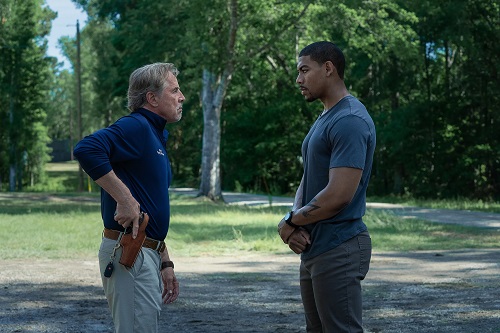
It is very skillfully made, the civil forfeiture conspiracy is careful setup and detailed in a way that is satisfying (Saulnier’s script has that meaty best seller that wants to be sure its reader learned a few things about the territory it is covering quality to it). Andre Pierre as the veteran hero and Don Johnson as the corrupt sheriff are wonderful. Saulnier gets the value of their presences, whatever else he gets credit for understanding that a movie like this need people who just stand out and make you believe in the bigger than life logic of their confrontation. Pierre commands the screen so much he patches up a lot of the holes and Johnson is so loathsome as the face of power disregard for people suffering, he becomes a problem later on when Saulnier decides he can’t actually cash the chips he earned. Pierre’s character is a highly decorated martial arts instructor and the movie is packed with great hand-to-hand combat, fast, precise and brutal.
I should make clear that my problem is not that the ending is safe, of course it is, that’s the compromise that was made for a movie such as this to get support, yeah, there is no doubt that authorities will listen, that evidence of Johnson’s misdeeds will guarantee some punishment, that is true of this, or of Lee’s BlacKKKlansman or Bigelow’s Strange Days. Official ideology won’t allow one to make a movie about tearing down the police in the US any more than it does in China, but can’t it like let it burn a little? Why can’t this conjure some of what Clint Eastwood’s does in The Gauntlet’s climax as his character drives over an entire corrupt police force? The images too clean, the cathartic violence sanitized. Rebel Ridge is one of the better Netflix movies of late, but it feels very much like one.
I’m often reminded of something Molly Haskell wrote about how she loved many classic American movies about women that dealt with its characters freedom and then in the final scenes sent them off to the family prison, making sure they can’t get away with it, those final scenes can be disappointing but they were made with the censors in mind, and who cares about them when the real meaning is in the liberated scenes that come before? Something like Rebel Ridge could operate like this, but its compromises are woven into the movie itself, which is why it limps so much.
The commissioner that will clean up the force in Strange Days feels divorced from everything else in the movie, he is a last second piece of fiction that allows the movie to stage the precipice of social revulsion and back off, the ending here is the opposite, just a natural extension of its careful setup political images. The weirdest thing about Rebel Ridge is how often it indulge in unnecessary both sideisms, does any movie like this one need to repeat multiple times that those guys are family men too? It made me think about how the current American political climate both helps promote a movie like Rebel Ridge as relevant as it makes it hard for it to actually be incisive. Corrupt cops used to be pretty standard villains for a movie like this (think something like the original Road House), but they are now so loaded that someone like Saulnier can canny exploit them while remaining very straitjacket about doing anything interesting with their image.
The movie plays around with its cathartic violence, its meaning is tied up in scenes of Andre Pierre beating up bad cops, that its violence is limited to broken bones and black eyes, that its retribution must always clarify nothing too serious is happening slowly deflates any force it might have. One rarely gets to watch a violent movie so neurotic about its own violence. It is telling that Saulnier sets Pierre up as Rambo with no kills (the promotional materials try hard to draw the comparison) but doesn’t seem interested in even dwelling on what that might mean; if the non-lethal approach to violence is made into a character beat it might break the illusion of retribution. Pulp can’t really work as catharsis if pulp isn’t allowed to overflow with liberated desire. A movie whose libido is continuously cut short.
It makes sense that Rebel Ridge goes from suggesting the whole town is complicit in the damage done by its police force to scapegoat a very corrupt sheriff and this one racist deputy. The movie is predicted in a narrow down of possibilities, phony images of revolt.

 Login
Login