 Login
LoginWhy some countries are once again embracing cluster bombs
The once-banned weapons are making a comeback to deter Russia

This week, David Gallagher remembers Peruvian Nobel laureate Mario Vargas Llosa; and Laurent Binet whisks us to 16th-century Florence to explore the world of his novel Perspectives.
'Perspectives', by Laurent Binet, translated by Sam Taylor
Produced by Charlotte Pardy
Hosted on Acast. See acast.com/privacy for more information.
To conclude this part of our revolutionary ideas series, we explore the overlapping lives and thinking of two emblematic twentieth-century revolutionaries: Lenin and Trotsky. David talks to historian of Russia Edward Acton about what inspired them, what connected them and what divided them. How were they radicalised? How did they interpret the failure of the 1905 revolution? How did they make the 1917 revolution happen?
Available from Saturday on PPF+: Lenin and Trotsky part 2, taking the story on from 1917 to explore civil war, the rise of Stalin and the re-invention of Trotskyism. To get this and all our bonus episodes plus ad-free listening sign up now to PPF+ https://www.ppfideas.com/join-ppf-plus
Out tomorrow a new edition of our free fortnightly newsletter with links, clips and guides to all our recent episodes. Join our mailing list https://www.ppfideas.com/newsletters
Next time the start of a new series: The History of Globalisation
Learn more about your ad choices. Visit podcastchoices.com/adchoices

“Just like the arts-and-crafts movement was a reaction against industrialization, we’re now experiencing a reaction against the smart home. People are looking for more manual, less complicated places to live.”
Read more: Why the Ultrarich Are Unplugging From “Smart Homes”, The Hollywood Reporter, April 2025. Thanks to Manuel.
Today’s episode is the second of our two recent live recordings of PPF, this one in front of an audience at the Bath Curious Minds Festival. David talks to historian Robert Saunders about the life of Winston Churchill and all its twists and turns of fortune: from disgrace in WWI, economic disaster in the 1920s, wilderness in the 1930s, through to redemption in 1945 and rejection by the voters in the same year. How to make sense of it all? Is there a thread that connects the ups and downs? Has there ever – anywhere – been another political life like it?
Out now on PPF+: David discusses the influence of Marinetti’s Futurist Manifesto (1909) – from cars to cod liver oil, from fascism to techno-optimism, from the madness of pre-WWI Europe to the craziness of Silicon Valley today. To get this and all our bonus episodes plus ad-free listening sign up to PPF+ https://www.ppfideas.com/join-ppf-plus
Next time: The History of Revolutionary Ideas: Lenin and Trotsky
Learn more about your ad choices. Visit podcastchoices.com/adchoices


“Suppose Schopenhauer is right that life boils down to a flight from either boredom or pain. Insofar as the vast material abundance of wealthy, industrialised society has had an analgesic effect (there is simply less physical pain than in the past, before fluoride and anaesthesia and sedentary lives), it would seem to have solved one problem only to amplify the other. In place of pain, we have ennui, the quintessential modern condition. It follows directly from overabundance: an endless stream of video “content” or chocolate cake or edibles or any other indulgence cannot deliver lasting satisfaction. Everything gets old eventually, leaving one to grope around for the next fix.”
Read more: The West is Bored to Death, Stuart Whatley, The New Statesman, April 2025.
This week, Peter Holland treads the boards in Elizabethan London in search of Shakespeare before the Globe; and Muriel Zagha on a captivating tale of cheese-making in the Jura.
'The dream factory: London’s first playhouse and the making of William Shakespeare', by Daniel Swift
'Holy Cow', a film by Louise Courvoisier
Produced by Charlotte Pardy
Hosted on Acast. See acast.com/privacy for more information.
Our third Parisian revolution is another explosive night in the theatre, this time in the world of dance. David talks to Dominic Dromgoole about Stravinsky’s The Rite of Spring, which provoked absolute outrage when it premiered in 1913. Is that what its impresario Diaghilev wanted? How did Nijinsky cope? Did the response foreshadow the trauma to come in 1914? And how did the set designer Roerich end up playing a part in American presidential history?
Dominic Dromgoole’s Astonish Me! First Nights that Changed the World is available wherever you get your books https://profilebooks.com/work/astonish-me/
Out this weekend: a new bonus episode on PPF+ exploring the far-reaching impact of Marinetti’s Futurist Manifesto (1909), from pre-WWI Europe to Silicon Valley. Sign up now to get this and all our bonus episodes plus ad-free listening https://www.ppfideas.com/join-ppf-plus
Next time: PPF Live: Churchill – The Politician With Nine Lives
Learn more about your ad choices. Visit podcastchoices.com/adchoices
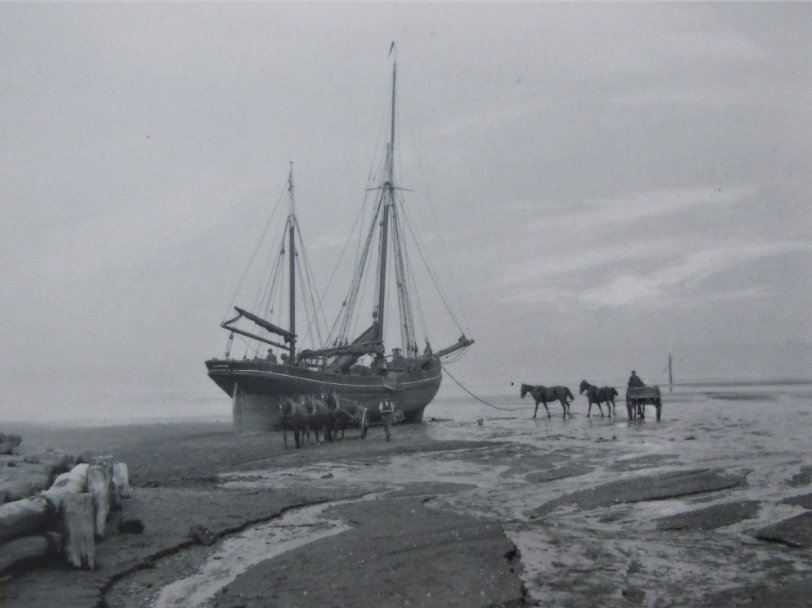
A Collier problem occurs whenever a new technology requires the technology it nominally replaces to function due to efficiency limits. Steam ships replaced sailing ships, but without windjammers the steamships could not function. This led to worldwide exports, paradoxically with large sailing vessels often transporting the coal needed by steamships, as they were more economical to operate on long oceanic sea routes.
Read more: Woods, Steven. “The Collier Problem: Toward a Definition and Application.” Image: Unloading coal from a collier on East Beach in the town of Cromer. Norfolk, England. Image taken on 8 March 1912. Public Domain.
Today’s Parisian revolution is a theatrical performance that produced a riot. David talks to theatre director Dominic Dromgoole about Alfred Jarry’s Ubu Roi (1896), which only ran for a couple of nights but left an indelible mark on the culture of the age and has resonated ever since. Why did a play effectively written by children provoke such a storm among the adults? What made it it blow the mind of W. B. Yeats who was in the audience? How can something so bad be so liberating?
Next time: Stravinsky’s The Rite of Spring
Learn more about your ad choices. Visit podcastchoices.com/adchoices

