This is a small table made using the "kamachi-gumi" technique.
The height is 30 cm, exactly the same height as a typical "chabudai" (low Japanese table).
The kamachi-gumi design uses the same structure as the tatami chair (zaisu) that we released in the previous making-of video, and they match very well when placed next to each other.
Incidentally, Ishitani made this table first, so he did a little trial and error during the construction.
All large woodworking machines are used machines.
Many of them were manufactured more than 40 years ago, and it has become difficult to obtain those in good condition.
The iGarden M1 is a next-generation pool robot featuring a 3-year warranty, an AI-powered 20-minute quick clean mode, and up to 16 hours of runtime on a single charge
Amazon:
https://geni.us/7h53Zo
code: IGDTAL05 (5% off)
Official Website:
link:https://igarden.short.gy/1PMmkC
code:ActionM5 (5% off)
It’s good to be home again. It was an unusually long break, but I appreciate the series of official bank holidays that morph into long weekends away from the computer.
And of course, the catch-up is overwhelming. The creativity inside the WordPress community around content creation, development and design is highly energizing.
And it’s WordPress 7.0 release week! It’s finally here!
So don’t let me keep you any longer. Enjoy!
If you want to stop long enough to send me a note, I’d be delighted to hear from you.
Yours, Birgit
WordCamp Europe is coming up fast. It’ll take place Jun 4 to 6, 2026. The schedule just was posted. If you still are on the fence about getting your ticket. Here are another 49 reasons to head to Krakow. The schedule lists 34 Talks, 3 Panels, 10 Workshops and 2 Keynotes.
For armchair WordCampers, like myself, there will be a livestream. After the WordCamp recordings will be uploaded to YouTube and WordPressTV.
Closing Keynote with Matt Mullenweg on Saturday June 6, 2026.
if you rather stay in North America, WordCamp US just opened up the online ticket booth. It’ll take place from August 16 to August 19, 2026, in Phoenix, AZ. The calls for sponsors and speakers are also available now. The deadline for speaker submissions is next week Friday May 29, 2026.
Developing Gutenberg and WordPress
WordPress 7.0 “Armstrong”
After the decision to remove Real-time Collaboration from the release because it needs more time in the oven, so to speak, the release squad was really busy to produced RC 3 – 5 before the final release on Wednesday May 20, 2026.
Abha Thakor and I talked through a few features for the OpenChannels.fm episode to come out on Tuesday, May 26, 2026.
Justin Nealey product manager at GoDaddy breaks down why WordPress 7.0’s three new APIs matter far more than the headline features for plugin developers. The Connectors API means site owners manage their own AI provider keys centrally; WP AI Client gives you a single provider-agnostic call to invoke any model; and the Abilities API turns your plugin into something the site’s AI agent can reach for autonomously. Together, Nealey argues, your plugin stops being a destination users visit and becomes a verb the agent performs.
Ronak Vanpariya, web developer on Gujarat, India digs into why Real-Time Collaboration was pulled from WordPress 7.0 with a five-point technical post-mortem. You’ll learn how RTC had to work across every corner of the Site Editor, how simultaneous edits triggered race conditions corrupting block data, and how the feature’s reliance on persistent server connections would have overwhelmed shared hosting environments. Memory bloat on older devices and recurring block-tree breakage uncovered by fuzz testing sealed the decision. The feature lives on in the Gutenberg plugin.
Mike McAlister, creator of Ollie, released a video walkthrough of WordPress 7.0covering the features he sees as most impactful for site builders. He walks through the new AI infrastructure — WP AI Client and the Connectors API — content-only pattern editing, customizable mobile menu overlays, block visibility controls for responsive design, per-block custom CSS, visual revisions, the new Icon and Breadcrumbs blocks, an upgraded Font Library screen, and a command palette shortcut.
In other WordPress Core news:
Immediately after the release of WordPress 7.0, Jeff Paul published the WordPress 7.1 Call for Volunteers. Work has already started since the firsty 7.0 Beta in February. The first beta for WordPress 7.1 is roughly eight weeks out and scheduled for July 15, 2026, and the final release for August 19, 2026 aimed at the last day of WordCamp US.
In addition to the punted Real-time collaboration feature, I discovered a few tracking issue for WordPress 7.1 already:
#76525: Block Supports and Design Tools in WordPress 7.1 Opened by Aaron Robertshaw, this tracks new and enhanced block supports for 7.1, carrying over items descoped from 7.0. A living issue is updated as supports are added or dropped from the release scope.
#75707: Block Visibility: Configurable Breakpoints and theme.json Integration The follow-up to 7.0’s block visibility work. The goal is to let themes define custom breakpoints via theme.json and make visibility extensible for future responsive features — laying a solid foundation before more viewport-aware tools arrive.
#76045: DataViews, DataForm, et al. in WordPress 7.1 Tracks continued iteration on DataViews, DataViewsPicker, DataForm, and the Field API. Key work includes migrating @wordpress/dataviews to the new Design System primitives and extending DataForm to PHP-only blocks.
#77199: Block Bindings in WordPress 7.1 Narrowed in scope to match contributor availability. The headline goal is integrating the Block Bindings UI into Block Fields and removing the previous Block Bindings UI, plus adding Block Bindings support for the Cover block.
First-time release lead Paulo Trentin brought us the latest version for the Gutenberg plugin, 23.2. In his release post What’s new in Gutenberg 23.2? (21 May he highlighted: You can now style blocks differently for tablets and phones right from Global Styles, so your designs adapt to each screen. Pop-up dialogs slide up from the bottom on mobile, making them easier to tap one-handed, and animations across the editor now share a consistent feel. You’ll also see smoother Content Types management, friendlier Shortcode handling, clearer Revisions diff markers for better accessibility, and steadier real-time collaboration when teammates edit together.
Justin Tadlock rounds up what’s new for WordPress developers in May 2026, with WordPress 7.0 landing on May 20. You’ll find early details on the Content Types experiment for managing custom post types and taxonomies in Core, a new @wordpress/grid package for building grid-based editor UIs, revisions support extended to templates and patterns, and a wave of block fixes covering the Tabs block, Image alignment, Search block styling, and Global Styles rendering.
If you are interested in learning more about this, the Content Types tracking issue outlines the experiment to bring custom taxonomy and post type management into the WordPress editor. The initial focus is on simple use cases — complex ones stay in plugin territory — with open tasks including a dedicated creation page, richer fields, a quick-edit versus full-edit distinction, and deeper DataViews integration. It’s a living issue and community input is welcome.
John Blackbournclarified WordPress’s PHP support stance in a post that’s worth flagging for developers and hosts. The “beta” label for PHP 8.x support has been retired and removed retroactively from all WordPress versions. It was discouraging hosts and developers from upgrading. In short:
The minimum recommended version remains PHP 8.3;
the minimum supported version is PHP 7.4.
Versions 6.9 and 7.0 now officially fully support PHP 8.5,
Request Logging gives administrators visibility into every AI request fired across Core, plugins, and themes;
Connector Approvals lets admins control which plugins can access configured AI providers.
Beyond governance, you’ll find comment moderation upgrades with sentiment and toxicity sorting right in the dashboard, AI alt text generation baked into the media editor workflow, and editorial workflow terminology tidied up. Looking ahead to 1.1.0, the team is exploring type-ahead suggestions, focus-aware crop suggestions, an AI Playground, and C2PA content provenance tracking for both text and images.
Plugins, Themes, and Tools for #nocode site builders and owners
Jay Walsh, Director of Communications at Woo, announced that WooCommerce stores can now sell directly on YouTube via the Google for WooCommerce extension. You connect your store, tag products from your catalog in videos and Shorts, and they surface as shoppable cards while viewers watch — and also appear in your Channel Shopping tab. The same Merchant Center product feed that powers Google Shopping and Performance Max campaigns keeps everything in sync automatically, with AI-generated ad creative variations across formats included in version 3.6.
OpenRouter for routing across hundreds of models with cost optimization,
LM Studio for fully local inference suited to GDPR-sensitive workflows, and a
Universal OpenAI connector for any OpenAI-compatible endpoint including Ollama, Groq, and Mistral.
All three are built on the same PHP AI Client SDK heading into WordPress Core 7.0, so your setup today carries forward without code changes after the upgrade.
Artur Piszek explains how he uses WordPress as a sync backend for Obsidian with PushMD. This plugin was created with Adam Zielinski, the maker of Playground. It allows you to treat your WordPress site as a git remote using the REST API. You can git clone your blog as plain .md files. Write in Obsidian and push updates to sync. This setup turns your site into a repository without needing an external service. It is also compatible with the upcoming Guidelines/Artifacts system in WordPress Core, which lets you store private notes and configurations there too.
Seth Rubenstein at Pew Research Center shared a preview of PRC Block Bits, now open-sourced on GitHub. Block Bits solves a specific gap between block bindings and RichText: where bindings replace an entire block’s content with dynamic data, a “bit” lets you embed small dynamic pieces — an inline icon, a copyright year, live text — right in the middle of a paragraph or heading. You register bits via a PHP and JS API, choose between a pure-PHP callback or Interactivity API strategy, and an editor toolbar dropdown handles insertion. Built-in bits for icons and copyright ship out of the box.
Theme Development for Full Site Editing and Blocks
Damir Tahiri of Rareview has open-sourced the WordPress starter theme that underpins every one of the agency’s builds. It’s Gutenberg-ready, ships with global style variables, includes a one-command Figma sync, and runs an interactive setup that renames and configures everything automatically. You can grab it on GitHub and use it as the foundation for your own projects.
“Keeping up with Gutenberg – Index 2025” A chronological list of the WordPress Make Blog posts from various teams involved in Gutenberg development: Design, Theme Review Team, Core Editor, Core JS, Core CSS, Test, and Meta team from Jan. 2024 on. Updated by yours truly.
On the WordPress Developer blog, Róbert Mészáros shows you how to get started writing WordPress E2E tests with Playwright, using a book review site built on Block Bindings as the test subject. You’ll set up wp-env and Playwright, write your first test against the admin dashboard, then progress to inserting block variations, verifying patterns with aria snapshots, and testing front-end output by creating posts via the REST API.
Also on the WordPress Developer Blog, Felix Arntz, Senior Software Engineer at Vercel, walks you through building a provider-agnostic image generation plugin using WordPress 7.0’s built-in AI Client. You’ll see how a single wp_ai_client_prompt() call handles provider routing, how support checks gate your UI gracefully when no image-capable provider is configured, and how the REST API and Media Library integration come together. The full source code is on GitHub at wptrainingteam/ai-client-imagegen.
Sérgio Santos, Lead Engineer at 10up/Fueled, diagnoses three specific bugs you hit when using RichText outside a block — in InspectorControls or a Modal. The format toolbar fills route to the wrong slot, the inline toolbar is opt-in via inlineToolbar, and isSelected never turns true outside a block context. Each problem gets a targeted fix, and the pattern has since been packaged as a reusable component in 10up Block Components.
Eric Karkovack walks you through using my.WordPress.net as a safe AI sandbox — no production site at risk. You install WordPress in your browser in two steps, add the AI Assistant app from the apps menu, connect it to Anthropic, OpenAI, or a local Ollama model, and start prompting. It’s a low-stakes way to explore what AI can do inside WordPress before committing it to a live environment, though API costs from OpenAI or Anthropic still apply.
Fresh from last week’s WordCamp Portugal:
Imran Sayed presented The Fastest Way to Build Gutenberg Blocks: Modern Tools, Scripts, and AI at WordCamp Portugal 2026. The talk cuts through the complexity of custom block development by focusing on practical, immediately usable workflows built around modern WordPress tools and scripts.
Milana Cap presented WordPress Gems for Devs: Accessibility with Interactivity API and makes the case that it’s one of the most exciting APIs to land in WordPress in recent releases, with positive implications not just for developer experience but for performance and user experience too.
Jorge Costa presented AI is in WordPress Core. Here’s How to Use It. The talk digs into the AI building blocks already shipped in WordPress Core — the WP AI Client, the Abilities API, and the MCP adapter, and shows you exactly how to bring AI-powered features into your own plugins, themes, and sites.
JuanMa Garrido presented WordPress Development and Management with Claude Code. The talk treats Claude Code as a command center for WordPress work, generating block themes from HTML designs, querying a production site in natural language, installing plugins, and reading error logs, all from the terminal. Three concepts are at the core: Skills, MCP, and the Abilities API.
Now also available via WordPress Playground. There is no need for a test site locally or on a server. Have you been using it? Email me with your experience.
Questions? Suggestions? Ideas? Don’t hesitate to send them via email or send me a message on WordPress Slack or Twitter @bph.
A few things we learned about the Pi 6 and potential for a Zero 3 W.
A link to the AMA: https://www.reddit.com/r/engineering/comments/1tcyfvk/hello_rengineering_were_eben_upton_ceo_james/
Support me on Patreon: https://www.patreon.com/geerlingguy
Sponsor me on GitHub: https://github.com/sponsors/geerlingguy
Merch: https://www.redshirtjeff.com
2nd Channel: https://www.youtube.com/@GeerlingEngineering
3rd Channel: https://www.youtube.com/@Level2Jeff
Contents:
00:00 - Raspberry Pi 6
01:24 - Pi Zero 2W and Zero 3W
02:38 - Microcontrollers
03:23 - Software and support
The humanities & arts have always been a laughingstock in the world of employment. In this video I break down the three reasons humanities graduates struggle to build financially viable careers, and what to do about each one.
Speaking of which, I recently hosted workshop on the principles of Plain English and it'll teach you how to translate complex ideas into writing that lands. I had a ton of fun hosting this one, and now you can access it here:
https://www.amugofinsights.org/session-6-the-principles-of-captivating-writing/
If you want more weekly food for thought around how to study the humanities & become a lifelong learner, sign up for a free weekly newsletter over at: https://www.amugofinsights.org/
Today we begin a Tasmanian road trip series. Our first stop is the magnificent Bay of Fires area on the north east coast.
On this night the sky really was on fire and I enjoyed every minute of my time there.
Direct Paypal Payment Link: https://paypal.me/nightscapeimages?locale.x=en_AU
Video Equipment:
Sony A7siii https://amzn.to/3z7LZ8q
Sony 20mm f1.8 G https://amzn.to/3Bc9sam
Sony 24mm f1.4 GM https://amzn.to/3xMTMYY
Tamron 28-75 f2.8 Sony https://amzn.to/3es44Gw
Tamron 28-200 Sony https://amzn.to/3zeqtz1
DJI Osmo Pocket 3 Combo Kit https://amzn.to/3QYSjuk
Z96 video lights https://amzn.to/2LYYey6
Yongnuo YN300 video lights https://amzn.to/2qTfU6V
Rode Wireless Go ii Radio Microphones https://amzn.to/3wROry9
Magmod Flash Modifiers https://amzn.to/2ElgBZD
As an Amazon Associate I earn from qualifying purchases. I earn a very small commission on the above links if you decide to purchase the item. This commission slowly adds up and greatly helps me to continue creating content for this channel. I very much appreciate your support!
Sentença sem reprise. Acusados de crimes de corrupção, dois ex-ministros de Defesa da China, Wei Fenghe e Li Shangfu, foramcondenados a penas mais brandas do que a pena de morte. Na última quinta-feira (7), uma corte militar do país determinou que ambos fossem punidos com pena de morte com suspensão de dois anos. Na prática, passados dois anos sem novos crimes, a pena de ambos será automaticamente convertida em prisão perpétua. Ambos foram considerados culpados de suborno e tiveram todos os bens pessoais confiscados. Segundo a Xinhua, Li teria sido acusado por ter recebido e oferecido propinas, além de não cumprir responsabilidades políticas. Wei comandou a pasta de defesa entre 2018 e 2023; Li o sucedeu em março de 2023, sumiu da vida pública em agosto daquele ano e foi formalmente afastado em outubro, após pouco mais de seis meses no cargo. As decisões se somam à onda recente de afastamentos no alto escalão militar chinês, que incluiu nos últimos meses até o general Zhang Youxia, militar mais graduado da Comissão Militar Central. Em fevereiro, Xi Jinping fez uma rara menção pública ao processo, dizendo que as Forças Armadas haviam “passado por uma têmpera revolucionária no combate à corrupção”. Analistas leem a cruzada anticorrupção em curso desde 2012 como uma combinação de saneamento institucional e de consolidação política e, no caso das Forças Armadas, as duas dimensões costumam aparecer entrelaçadas.
Cidade x Campo.Junto com os vice-prefeitos chineses que viralizam no Douyin dançando em arrozais, a onda de funcionários influencers ganha corpo desde que Xi Jinping promoveu essa estratégia. As cenas idílicas que esses livestreams projetam, com paisagens, produtos artesanais, oficiais bonzinhos servindo refeições a idosos, ajudam a reforçar uma visão romantizada do interior que circula há tempos nas cidades chinesas: a ideia de que o camponês tem terra para “se virar”, uma casa só sua, e ainda por cima com um custo de vida baixo. É justamente esse imaginário urbano que uma conversa recente entre o jornalista Peng Yuanwen e o ativista Zhou Jian, traduzida peloChina Digital Times, busca discutir. Zhou conta que ao percorrer mais de 3 mil aldeias em 150 condados pobres, ele tentou derrubar as crenças urbanas sobre o campo. Segundo o texto, o camponês não vive da terra, seu trabalho rende, no máximo, o equivalente a R$ 800 a R$ 1.500 por ano, “o suficiente para uns poucos meses de remédio de pressão”; a terra não é de fato dele (o que existe é direito de uso coletivo, sem poder vender, herdar ou usar como garantia); o terreno em que ele mora vale menos do que se imagina; e o “baixo custo de vida” rural é um mito. Entre o campo do algoritmo e o do cotidiano ainda há uma boa distância, e o relato de Peng e Zhou fala, no fundo, sobre tentar encurtar essa narrativa.
Xi recebe Trump. Na semana passada, Beijing recebeu o presidente Donald Trump para sua primeira visita de Estado à China em nove anos. Como tinha de ser, o encontro com Xi Jinping não decepcionou em termos de drama e simbolismo. As duas maiores economias do mundo concordaram em criar conselhos de comércio e investimento, reduzir tarifas de forma recíproca e estabelecer um mecanismo para gerenciar disputas. Também saíram acordos concretos: a China comprará pelo menos 200 aviões da Boeing , mas esse número pode mais do que triplicar e chegar até 750, mas isso só se determinadas condições forem atendidas. Apesar do tom cordial, os resultados, na prática, foram modestos: nenhum grande avanço, apenas uma estabilização das relações e um esforço para evitar que a rivalidade entre as superpotências saísse do controle.
Para além das relações entre Pequim e Washington, Xi e Trump trataram de temas que preocupam o mundo: a situação de Taiwan, as guerras no Irã e na Ucrânia e o papel e ameaça da Coreia do Norte. Quanto ao Irã, os dois líderes concordaram que o Estreito de Ormuz deve permanecer aberto. Xi também deixou um recado pouco sutil ao perguntar a Trump se EUA e China conseguiriam superar a “Armadilha de Tucídides“, a teoria de que potências em ascensão inevitavelmente entram em conflito com as estabelecidas, e criar um novo paradigma para as grandes potências. Com seu típico “otimismo”, Trump respondeu no Truth Social dizendo que Xi estava falando do declínio americano causado por Biden, não pelo seu governo. E para coroar a visita com aquele toque de entretenimento que só essa dupla proporciona, um vídeo viral mostrou Trump dando uma espiadela no caderno de Xi assim que o líder chinês se afastou (recomendamos ver o nosso vídeo da semana).
Outro momento pitoresco da visita ficou por conta do Secretário de Estado Marco Rubio: sancionado pela China duas vezes quando ainda era senador, Rubio só conseguiu entrar no país porque Beijing simplesmente trocouuma letra do seu nome em mandarim, transformando “卢比奥” em “鲁比奥” (Lubiao), ambas têm a mesma pronúncia, caractere diferente, problema resolvido. Do lado chinês, o embaixador Xie Feng aproveitou o encontro para publicar um artigo em tom solene no People’s Daily, defendendo que “cooperação beneficia os dois lados, enquanto confronto prejudica ambos” e que os EUA deveriam abandonar a mentalidade da Guerra Fria e tratar a China como parceira.
E o assunto azedou com Taiwan. Após uma cúpula de dois dias em Pequim com Xi Jinping, Donald Trumpalertou Taiwan a não declarar formalmente sua independência e disse, em entrevista à Fox News, que “não está buscando que alguém vá ser independente” e o que quer mesmo é que “a China se acalme”. A resposta de Taipei veio no sábado pela porta-voz presidencial Karen Kuo, que afirmou ser “evidente por si só” que Taiwan é um país soberano, independente e democrático, mas reforçou o compromisso da ilha em manter o status quo, sem declaração formal e sem unificação, postura já sustentada pelo presidente Lai Ching-te, para quem não há necessidade de declarar o que já se considera fato. No mesmo encontro, Trump disse que decidirá em breve sobre umpacote de venda de armamentos de US$11 bilhões para a ilha, sinal de que, mesmo evitando atrito imediato com Pequim, Washington segue obrigado por lei a fornecer meios de autodefesa a Taipei.
Uma batalha atrás da outra. Poucos dias depois da cúpula entre Xi Jinping e Donald Trump em Pequim, é a vez de Vladimir Putin desembarcar na capital chinesa, visita confirmada por Moscou e Pequim no último sábado, se trata da primeira vez do líder russo ao exterior em 2026. A agenda inclui encontro com Xi para reforçar a “parceria estratégica abrangente” entre os dois países, a possível assinatura de uma declaração conjunta e conversas separadas com o primeiro-ministro sobre cooperação econômica e comercial. A coincidência de calendário, segundo analistas, não foi orquestrada. A visita russa já vinha sendo articulada há meses, mas ganha peso simbólico extra, uma vez que 2026 marca o 30º aniversário da parceria estratégica sino-russa e o 25º do Tratado de Boa Vizinhança, cuja renovação deve entrar em pauta. Entre os temas esperados estão o gasodutoPower of Siberia 2, a guerra na Ucrânia, e a crise no Estreito de Ormuz. O comércio bilateral entre os dois países somou mais de US$228 bilhões em 2025, com Pequim se consolidando como principal comprador de petróleo e gás russos.
Pressão. A famosa RightsCon – a maior conferência de direitos humanos digitais – teve a sua edição de 2026 cancelada. O evento iria acontecer em Lusaka, capital da Zâmbia, entre 5 e 8 de maio. Contudo, a 15ª edição foi cancelada sem muitas explicações duas semanas antes da data para o choque e prejuízo financeiro de muita gente. A nota final de explicação do cancelamento, a organização do evento citou interferência estrangeira. Não demorou muito e questionamentos passaram a surgir sobre isso ter relação com pressão do governo chinês, dado o crescente relacionamento entre a China e a Zâmbia, e o fato da edição de 2025 ter sido realizada em Taipei. Ao que tudo indica, o país asiático exigiu que participantes taiwaneses não comparecessem, e a discussão é elaborada nesta análise no China Digital Times.
Violência contra mulheres chinesas fora da China. Em abril, um tribunal de Munique proferiu uma sentença que chocou a Europa e reacendeu o debate sobre violência sexual e o papel das plataformas digitais. Zhongyi J., um estudante chinês de 28 anos, foi condenado a 11 anos e três meses de prisão por duas tentativas de homicídio e sete estupros agravados contra a sua vizinha, a quem drogou e agrediu sexualmente pelo menos sete vezes entre fevereiro e dezembro de 2024. O réu filmou cada agressão e armazenou os vídeos em um HD externo; em um dos casos, o ataque durou mais de três horas. O caso foi imediatamente comparado ao escândalo Pelicot, que abalou a França em 2024 — e o juiz descreveu os crimes como “atos monstruosos”, declarando que “entramos em território jurídico inexplorado.” Mas o que torna o caso ainda mais perturbador é o contexto coletivo: o julgamento em Munique faz parte de uma investigação mais ampla sobre oito homens que integravam um grupo no Telegram chamado “Autoschule” (Escola de Direção Alemã), no qual coordenavam e compartilhavam imagens dos crimes. O caso levanta questões urgentes sobre a responsabilidade das plataformas de mensagens na proliferação desse tipo de conteúdo — um debate que, infelizmente, ainda está longe de ter uma resposta.
Mo Yan, IA e literatura: o nobel de literatura chinês Mo Yan, disse em evento no Brasil ver na Inteligência Artificial uma esperança para a superação de barreiras linguísticas. Confira como foi a visita dele por aqui.
Taishanese: o Radii China conta por que um “misterioso” idioma falado no filme Sinners está dando o que falar até hoje.
Old school: dois vídeos viralizaram na internet chinesa recentemente exatamente por não usarem inteligência artificial. Esta matéria da Sixth Tone conta como o drama ENEMY e o filme Ji Shi Yi Dao não usaram IA generativa para os efeitos visuais e chamaram atenção pela qualidade da produção.
The Markup and CalMatters showed how website code could make it harder for Californians to exercise their right to remove personal data. Now much of that code has disappeared.
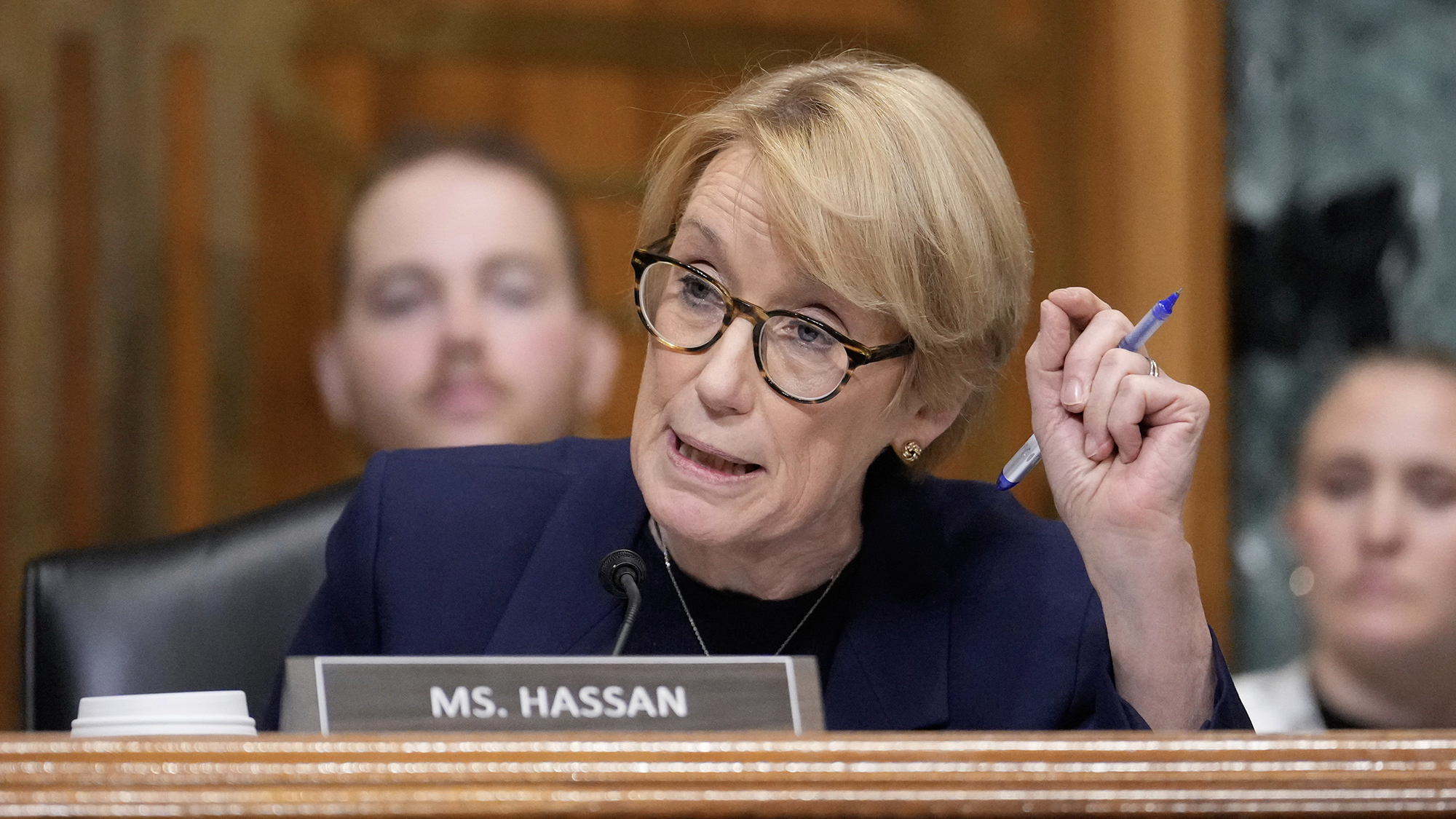
Sen. Maggie Hassan pressed data brokers to make it easier to opt out of their systems, citing an investigation by The Markup and CalMatters, published in partnership with WIRED. U.S. Sen. Maggie Hassan speaks during a Senate Finance Committee on Capitol Hill in Washington, D.C. on March 14, 2025. Photo by Ben Curtis, AP Photo
More data brokers have changed their practices in response to reporting from The Markup and CalMatters as well as a subsequent Senate investigation.
Data brokers — companies that collect and sell access to often-sensitive information on consumers — are required to register in the state of California and provide a way for consumers to request their data be deleted.
Last year, an investigation by The Markup and CalMatters, published in collaboration with WIRED, showed that many of those companies placed code on the web pages for making those requests that prevented them from appearing in search results. The “no-index” code tells search engines like Google not to catalog those pages, making it less likely that anyone would see them. Experts said that’s a hurdle for Californians looking to exercise their legal rights.
Last year’s investigation found 35 data brokers were using the code, 12 of whom soon removed it and allowed their pages to appear in search results.
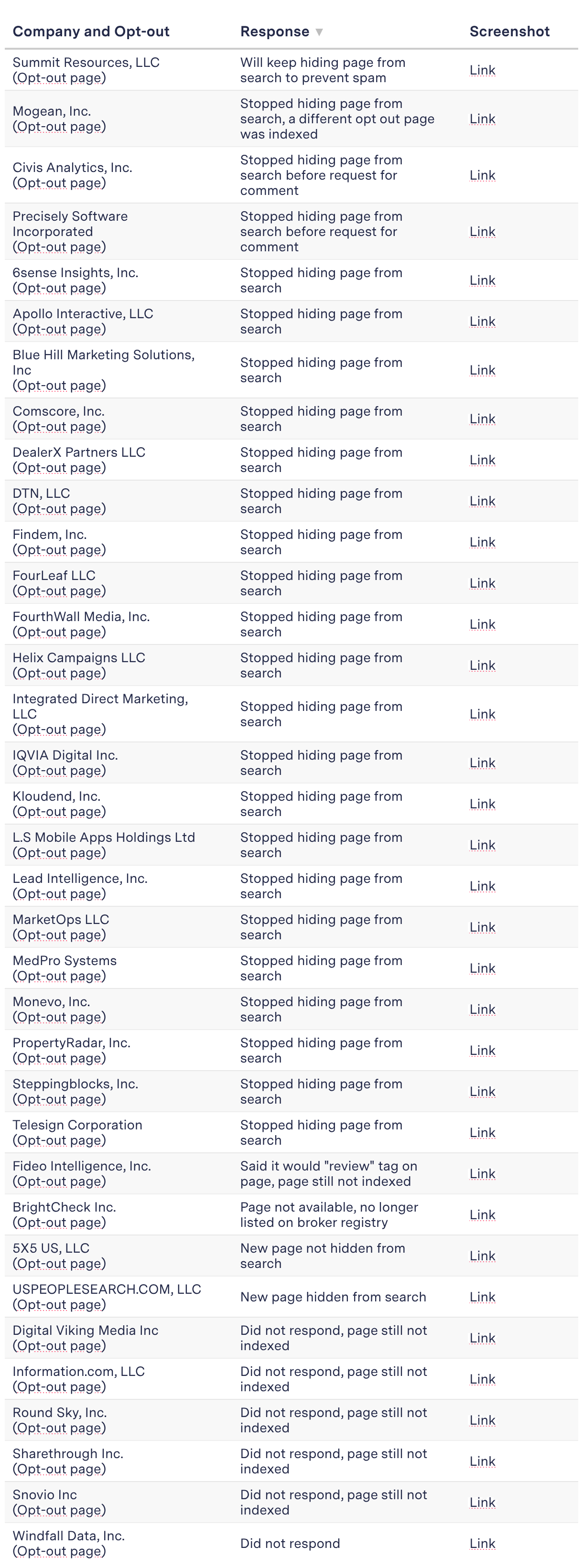
Today, only eight of those 35 brokers are still hiding their deletion pages, according to another review done by The Markup and CalMatters this week. That includes five major data brokers who came under Senate investigation.
After The Markup and CalMatters published their report, the top Democrat on the Senate Joint Economic Committee minority, New Hampshire Democratic Sen. Maggie Hassan, sent letters to five data brokers questioning them about their practices.
Four of the companies — IQVIA Digital, Comscore, Telesign Corporation and 6sense Insights — engaged with the Senate committee about their practices and agreed to make their pages visible in search, according to a report the committee later released. The report also estimated that consumers have lost more than $20 billion from fraud and identity theft related to broker data breaches.
In an addendum to their initial findings released last week, the committee said that the fifth company facing questioning, Findem, also belatedly removed its “no-index” code, making its deletion pages visible in search engines.
One of the data brokers no longer hiding its opt-out page, BrightCheck, has a broken opt-out page and no longer appears on California’s broker registry.
Data brokers that hid opt-out pages from search engines
Of 499 brokers registered with the state of California, The Markup and CalMatters in August 2025 found 35 instructing search engines to ignore pages with instructions on how consumers can remove their data. As of May 2026, only eight had such instructions.
Chart: Tomas Apodaca
·
Source:
California Privacy Protection Agency 2025 Data Broker Registry
Of the eight brokers still hiding their deletion pages, only one, a company called Fideo, responded to a request for comment about whether they would continue using the code on their pages.
Jason Soni, a spokesperson for Fideo, which uses data for crime and fraud prevention purposes, said the company intentionally “chose not to display the application page itself in Google search results for technical and consumer experience reasons.” Consumers, he said, can make requests starting “from our homepage and public privacy resources, which provide the right context, routing, and instructions for privacy requests,” instead of starting at the application page.
“Americans deserve a choice over whether their personal data is collected, used, and sold for profit or not,” Hassan said in a statement released alongside the amended report. “Data brokers like Findem have a responsibility to provide that choice with clear, user-friendly opt-out functions and straightforward privacy policies.
🍽️Si vas a visitar el parque natural más grande de España, que está en Jaén, toma nota de estos sitios para además… comer muy bien.
@diputacionjaen
#MontañasdelSurJaén
#JaénParaísoInterior #EcoturismoSCSV
Colaboración pagada dentro del #PlanDeRecuperación financiado con fondos #NextGenerationEU
Removed for conservation in 2023, several of the muses have been conserved or newly cast in lead. As part of The Muddle of the Muses, three of the statues will be on display in Blackwell Hall: Clio representing History (original lead statue), Calliope representing Epic Poetry (lead reproduction) and Polyhymnia representing Rhetoric (original statue). Don't miss this rare chance to see these remarkable sculptures at eye level and discover the intriguing story behind their conservation. Starting Saturday 23rd of May 2026.
Desde a ascensão do bolsonarismo, em 2018, as eleições presidenciais passaram a ser marcadas por instabilidade, desinformação e dificuldade de prever candidaturas e possíveis resultados. A cinco meses das disputas de 2026, o atual cenário político já é complexo e instável. Lula disputa sua possível última eleição em um contexto atravessado por guerras no mundo, crises econômicas e pela crescente desinformação nas redes sociais, impulsionada pelo avanço da inteligência artificial. Ao mesmo tempo, o bolsonarismo tenta reorganizar sua sucessão política em meio às incertezas sobre a possível candidatura de Flávio Bolsonaro, atualmente envolvido em escândalos e em disputas de narrativa em torno da própria realidade dos fatos.
O Pauta Pública desta semana mergulha neste cenário com um dos maiores nomes do jornalismo brasileiro, Ricardo Kotscho. Na entrevista com a Andrea Dip, ele alerta que o debate público brasileiro vive uma crise que vai muito além dos nomes colocados na disputa presidencial. Kotscho analisa como a desinformação, a fragilidade das instituições e o esvaziamento da participação política ajudam a moldar o cenário atual do país, e destaca a importância do jornalismo no comprometimento com o futuro do país.
Ouça agora!
Saiba que você pode ser aliado da Agência Pública e colaborar com esse trabalho. Saiba mais em apoie.apublica.orgou faça um pix de qualquer valor para contato@apublica.org. Contamos com seu apoio!
O que revela o olhar de quem viveu a guerra? Neste episódio, a escritora Beatriz Bracher fala sobre o romance Guerra — I (Editora 34), primeiro volume da sua trilogia sobre a Guerra do Paraguai. A narrativa, criada pela costura de relatos reais, coloca em primeiro plano vozes que presenciaram o conflito, despertando no leitor o horror à guerra, diz Bracher. Ela também lembra que o convívio entre brancos e negros, senhores e escravizados e pessoas de diferentes regiões do país no front de batalha foi uma primeira descoberta do Brasil pelos brasileiros. A conversa aconteceu durante A Feira do Livro 2025, com mediação do escritor Joca Reiners Terron.
Save time editing with ripple delete and other shortcuts to remove gaps on your timeline. We'll look at creating custom keyboard shortcuts and optimizing our layout for cutting talking head videos.
► Support the channel: https://ko-fi.com/nuxttux
Chapters:
0:00 Opening
Download Kdenlive and Fritction
https://kdenlive.org/
https://friction.graphics/
=============================
#kdenlive #Nuxttux #videoediting
=============================
Subscribe for more content
=============================
Where to find me:
Website: https://www.nuxttux.com/
What are the best books based on real events? What is one book that you would read over and over again? And if you could be friends with a book character, who would you pick?
On this episode of Ask Penguin, host Rhianna Dhillon is joined by Booker Prize-longlisted author Sophie Mackintosh and our Penguin books colleagues in the studio to answer more of your questions and hand out more book recommendations.
Find all the books mentioned in this episode here: https://www.penguin.co.uk/discover/articles/the-best-novels-about-infidelity-ask-penguin-podcast
Sophie Mackintosh is the author of four novels, including The Water Cure and Cursed Bread. She has been longlisted for the Man Booker Prize and the Women's Prize, has won a Betty Trask Award, and has been selected as one of Granta's Best of Young British Novelists. She has been published in Granta, The White Review and TANK magazine among others.
Her new book Permanence follows Clara and Francis – a couple in love, but in secret. When they wake in a strange city, they can finally be together. But as they move between this world and their ordinary lives, cracks begin to show, and they are forced to ask - how long can their love survive?
For more information about the National Year of Reading, click here: https://goallin.org.uk
Ask Penguin is the podcast where your quirkiest, trickiest, and most urgent book questions get answered. Hosted by Rhianna Dhillon, we bring bestselling authors and Penguin insiders to explore some of your favourite books and discover new ones that you are yet to read.
Keep up to date and listen to more episodes here: https://podfollow.com/thepenguinpodcast
-------------------------------------------------------------------------
Subscribe to the Penguin channel:
http://po.st/SubscribePenguinYouTube
0:00 Intro
0:40 What books are based on real events?
03:33 What books can you read over and over again?
07:04 Which book character would you be friends with?
10:26 What are the best short story collections?
12:46 What are the best books where you will hate the main character?
16:24 What are the best books about affairs?
19:36 Outro
171 anos da Assembleia Legislativa do Paraná e nunca ninguém foi cassado, o corporativismo imperou mesmo diante de crimes de assassinato e roubo do dinheiro público, passando por cargos fantasmas, rachadinha e licitações fraudulentas.
O que realmente rompeu com a aliança corporativista foi eu ter defendido minha família de um ataque na rua.
Sabemos a verdade, o rei está nu, o que realmente eles não suportam é que alguém como eu, negro, pobre, sem pai e sem herança, afronte seus interesses na sala de estar da Casa Grande, isso é inadmissível, e por isso tentam me cassar, para mandar um recado às novas gerações, um “cala-boca”.
Mas nossa voz já ganhou a força do vento e se espalhou pelos quatro cantos do país. Os poderosos podem matar duas ou três flores, mas jamais conseguirão impedir a chegada da primavera!
This week, David Streitfeld takes us to Earthsea and the wonderful imagination of Ursula K. Le Guin; and Samantha Ellis on Charlotte Brontë's relationship with material reality.
'The Word for World: The maps of Ursula K. Le Guin', edited by So Mayer and Sarah Shin
'Searoad: Chronicles of Klatsand', by Ursula K. Le Guin
'Ursula K. Le Guin's Book of Cats'
'So Far So Good: Final Poems: 2014-2018'
'A Larger Reality', edited by Conner Bouchard-Roberts
'Charlotte Brontë's Life Through Clothes', by Eleanor Houghton
Inspired by John J. Audubon’s Birds of America, one of the most famous and most valuable books, James Freemantle, the Bodleian Printer in Residence 2025–26, is working on a project, creating a birdwatcher’s notebook referencing some of the better known pages from the Audubon. The book will record so-called ‘vagrant birds,’ those sighted outside their normal range. To see the original Birds of America, visit our free exhibition Wonder of Birds in the Weston Library.

 Login
Login