Normal view
To Storm the Heavens
At his final campaign rally before winning the 2015 Greek general election, Alexis Tsipras gave a warm welcome to the new leader of the Spanish left, Pablo Iglesias, who strode onstage to rapturous applause as Leonard Cohen’s ‘First We Take Manhattan’ blared in the background. Iglesias embraced his Greek counterpart and the two stood with their arms raised in defiance: the image of a confident, insurgent left, poised to take power from a discredited political class at the height of the eurozone crisis.
Iglesias’s party, Podemos, had topped opinion polls in Spain early that year and seemed on course to replicate Syriza’s rise. Combining his personal charisma with an innovative communications style and populist vituperation against Spanish elites, the party had channelled mass discontent at austerity into a new transformative project — all within twelve months of its founding. ‘First we take Athens’, Tsipras tweeted after the rally, ‘then we take Madrid’.
Now, a decade later, both parties are exhausted and increasingly marginal in their respective nations, lacking the strong leadership and political orientation that were once their defining features. What explains this reversal, and what comes in its aftermath?
While Syriza’s trajectory was defined by its failed confrontation with the Troika, Podemos’s story is more complex: not a single moment of truth, but a gradual process of retreat and fragmentation, as its hopes of surpassing the centre-left Spanish Socialist Workers’ Party (PSOE) receded and its poll numbers slid into irreversible decline. At the same time as its electoral ambitions came apart, though, another arc bent in the opposite direction, with Podemos continuing to exert a powerful ideological influence on Spanish politics, turning it into Europe’s progressive outlier.
We can only draw the right lessons from this experiment if we grasp these two distinct dimensions: the failure of Podemos’s radical mission, which flowed from its inability to resolve fundamental strategic and organisational problems, and its strange, lingering afterlife. Governing some of the country’s largest cities and eventually ascending to national office as the junior coalition partner to PSOE, Podemos and its allies made clearer policy gains than left-populist forces elsewhere on the continent. Spain’s recent positions on migration and the welfare state are a reflection of this legacy, which anchored PSOE to the left. Yet the regeneration of the old social-democratic establishment was a bitter pill for a party that had hoped to bury it.
The Podemos Hypothesis
The cracks within Podemos were apparent early on. Sergio Pascual, the party’s first Secretary of Organisation, remembers having ‘mixed feelings’ on the night of the 2015 elections. On the surface the results were impressive, with Podemos securing almost 21 percent of the vote to PSOE’s 22 percent. Yet Pascual knew that this one-point gap made all the difference. ‘We bet everything on the sorpasso of the Socialist Party’, he tells me, ‘sacrificing internal democracy and part of our programmatic identity to achieve it in an immediate electoral blitzkrieg. But once it failed to materialise, we faced a difficult institutional balance of power.’
Many of Podemos’s initial leading cadre, Pascual included, had previously worked as political advisors to leftist governments in Latin America. They saw a parallel between the Pink Tide backlash against neoliberalism and the crisis of representation in austerity-era Spain, arguing that the same conditions which had undermined traditional party systems in countries like Ecuador and Bolivia — allowing left-populist leaders to rapidly assemble new electoral majorities — had now arrived in Europe. The Indignados movement of 2011 was an unmistakable sign, bringing millions to the streets with the chant of ‘They Don’t Represent Us’.
By late 2013, Iglesias’s incendiary appearances on TV panel shows had turned the 35-year-old political scientist into a tribune for the disaffected. The pony-tailed professor eschewed the traditional language of the left and instead presented a series of populist binaries: el pueblo versus la casta, democracy versus oligarchy. After Spain’s existing left-wing party, Izquierda Unida, refused to join a united slate for the 2014 European elections, Podemos ran its own independent campaign with Iglesias’s face on the ballot papers instead of a party logo. It won 8 percent of the national vote. The leadership was convinced that a historic window of opportunity had opened. The task was to capture government within a single electoral cycle.
Blitzkrieg to Attrition
Podemos adopted a top-down organisational structure with a focus on media spectacle and message discipline, built for rapid advance at the ballot box. To ‘storm the heavens’, Iglesias declared, an ‘electoral war machine’ was needed for a twelve-month institutional assault.
One of the Podemos parliamentarians elected in 2015, Txema Guijarro, recalls the ‘epic character’ of that campaign: ‘Our Latin American experiences intoxicated us with the idea that winning was all-or-nothing. But maybe that was part of our miscalculation. In reality, the Spanish parliamentary system was never going to be as conducive to that kind of breakthrough, nor was the political system as fragile as it was in, say, Ecuador.’
The problem of translating the rapid insurgency into a more durable project became visible after the vote, which produced a deadlocked parliament and raised the prospect of a deal between Podemos and PSOE. There was no consensus among the leadership about how to move forward. For Iglesias the plan was simple: try to negotiate a coalition government of near equals, or, if that failed, force fresh elections. This threatened to deepen Spain’s crisis of governability and keep the right-wing government of the Partido Popular in power, but he reckoned it was worth the risk. ‘He knew our outsider appeal had a limited shelf-life’, says Pascual, ‘so he calculated that if PSOE would not share power with us, we should combine our vote with Izquierda Unida’s in a new electoral alliance that would allow us to beat PSOE in a second election’.
The party’s chief strategist, Iñigo Errejón, favoured a more conciliatory approach. He pushed for Podemos to allow PSOE to form a minority government so as to thwart the narrative that they were plunging the country into chaos. And he rejected the idea of forming a pact with Izquierda Unida, which, as he saw it, would mark a retreat from populism — with its below/above binary supplanting left/right — to a conventional strategy of ‘left unity’. Errejón began to organise within the party to challenge Iglesias’s dominance. As factional fighting spilled out into the open, amplified by a hostile media, Podemos lost momentum.
In the end Iglesias’s position won out; IU agreed to join a Unidas Podemos slate ahead of the June 2016 election, which was called to break the impasse in parliament. But much of the damage was already done. With more than a million left-wing voters deciding to stay home, the new alliance was unable to match the tally that Podemos had gotten just six months earlier. There now seemed to be no real possibility of eclipsing PSOE in the short term. The Iglesias and Errejón factions continued to clash: one calling for a line of open confrontation with PSOE, the other wanting to reduce antagonism and win support from wavering Socialists. The internal war accelerated the party’s downward spiral.
The Reset
Iglesias again emerged victorious from this dispute. He built his strategy on the assumption that Spain was headed for a grand coalition of the centre. PSOE had recently launched an internal coup against its progressive leader, Pedro Sánchez, which seemed to suggest that the irreformable establishment was closing ranks. Podemos thus tried to stick to its intransigent position and consolidate its outsider status. But soon enough the political landscape shifted. In a surprise turn, Sánchez took on the old guard of his party, faced down his right-wing challenger and triumphed in the 2017 leadership contest, styling himself as the saviour of the Spanish left.
This closed off much of the political space Podemos had previously occupied. ‘We underestimated Sánchez,’ Guijarro concedes, ‘not least in his ability to push through a certain renovation in his own party. In making his comeback, he incorporated elements of our discourse and programme while minimising any openings available to us institutionally.’
The wider coordinates were also in flux thanks to a partial economic recovery and a reactionary tide of Spanish nationalism unleashed by the failed push for Catalan independence. The supposed threat to Spanish unity was now top of the agenda, and Podemos was struggling to respond. Miguel Urbán, a leading figure in the party’s radical Anticapitalista wing, and a member of the European Parliament until 2024, highlights its misreading of the conjuncture: ‘The electoral war machine model, with its hyperleadership structure, had marginalised early on any role for activists in the party, just when there had been a wave of popular enthusiasm around the project . . . By the time Podemos’s core leadership realised it had gone too far and attempted to reverse course, it had already undermined the conditions that would have made such a change of focus possible.’
The power struggle within Podemos’s leadership meanwhile led to a major split in 2019. Sidelined by Iglesias, Errejón struck a deal with Madrid’s left-wing mayor, Manuela Carmena, to set up a new regional platform called Más Madrid. He took most of his allies from the party with him, launching an unsuccessful bid for the capital’s regional presidency. Guijarro sees this as the result of a broader ‘failure of method’, in which Podemos’s inability to ‘create effective mechanisms for institutional dialogue and bargaining’ made it impossible to mediate internal disagreements.
At this point Iglesias changed tack. The same leader who had previously called for maximal antagonism with PSOE was now increasingly convinced that entering a Sánchez-led coalition was the sole means to stabilise the left, while renewing his own public image and that of the party leadership. By going all-in on this alliance, he argued, Unidas Podemos could block Sánchez’s preferred option: a more piecemeal coalition in which the centre and the right would wield real power, while the radical left would get only minor concessions.
Faustian Pact
The path to this agreement was long, running through two more general elections in 2019, during which Unidas Podemos’s vote share fell even further, to 14.3 percent in April and 12.9 percent in November. Finally, after four elections in four years, Sánchez found himself with no alternatives: he was forced to form Spain’s first left-wing coalition since the 1930s, including five Unidas Podemos ministers, with Iglesias as deputy PM.
When I interviewed Iglesias in his ministerial office in October 2020 he acknowledged it was hard to get an electoral payoff as a junior partner — that PSOE stood to reap the rewards from any progressive measures they pushed through — but he insisted the arrangement had nonetheless opened up new possibilities for his party. ‘This allows us to make up part of the leadership of the state, it allows us to form government cadres which we did not have, it allows us an understanding of and a praxis in the state that you don’t get from local or regional governments. And’, he reminded me, ‘we are young — a political force that reached government after existing for only six years.’
Seven months later, Iglesias had resigned. Governing turned out to be a gruelling process for him and his ministers. Their social agenda came up against fierce PSOE resistance and they swallowed some unpalatable policies in areas like defence and law and order. In the febrile atmosphere of the pandemic, Unidas Podemos engaged in a series of highly charged controversies around lawfare, media bias and free speech, but lacked the heft to force PSOE’s hand on any of these issues. The bitterness of the struggle diminished Iglesias’s public profile. ‘It’s clear’, he conceded on the night he stepped down, ‘that at this point I’m not contributing to the cause’.
Still, Unidas Podemos’s impact on government was real. Even with its limited leverage, it passed measures that were among the standout achievements of the coalition’s first term: a 46 percent rise in the minimum wage, a major new social welfare programme, a Guaranteed Minimum Income scheme, and a successful energy price cap during the Ukraine war which effectively contained inflation. With the far right on the rise, Unidas Podemos also played a key role in resisting its bigotry, calling for migrants to have their status regularised en masse.
As Iglesias exited the stage, much of Podemos’s political capital dissipated along with its dominance on the left. The most popular left leader to emerge during this period was Yolanda Díaz. A labour lawyer and member of the Communist Party, she took up the post of labour minister and was praised for her Covid furlough scheme as well as her major progressive reform of the country’s employment laws, which strengthened collective bargaining rights and massively reduced the use of temporary fixed-term contracts. Her political approach was distinct to the left populism of Podemos: rather than stoking binary antagonisms, she pursued a more cautious tripartism, striking deals between workers, business and the state. When Iglesias anointed her as his successor in the role of deputy PM and figurehead of Unidas Podemos, he passed the baton to someone outside his own party, in what appeared to be a tacit acknowledgement of its exhaustion.
It then fell to Díaz’s new electoral vehicle, Sumar, to reactivate the country’s radical forces, with Errejón brought back into the fold as her de facto second in command. She set about integrating various national and regional formations into an alliance which, like its predecessor, was top-heavy and leader-centred, promising to extend the progress made under the coalition. But unlike Podemos, Sumar’s origins did not lie in a movement wave beyond the established institutions; the fact that it was built exclusively from high office ended up reinforcing its subordination to Sánchez. Díaz’s main task became balancing the competing demands of Sumar’s internal actors and continuing to negotiate from a position of weakness with PSOE. Without a transformative offer, she failed to build out from her pandemic-era popularity and construct a sustainable electoral brand. Sexual misconduct allegations against Errejón further undermined Sumar’s credibility, and it unravelled at striking speed.
Sánchez Hegemonic
This implosion was yet another blow for an already demoralised Spanish left. In retrospect it seems obvious that many of the strategic decisions of left populism — not just in Spain, but elsewhere in the West — were based on a fundamental overconfidence about the pace and extent of the establishment’s decline. When it became clear that the existing order could stave off collapse, the left found itself disoriented, and struggled to develop a more durable approach to institutional politics. It was one thing to channel outrage at elites during a moment of crisis, but another to create mass identification with a political project while putting down the territorial roots and extra-parliamentary structures needed for sustained electoral engagement.
The result was that Unidas Podemos was already in retreat as it entered cabinet. Though it exercised significant influence in certain areas of government policy, the main political beneficiary was Sánchez — who made a show of standing above the tense negotiations between his ministers and acting as the final arbiter. This allowed him to tack left in response to public pressure without giving elites much cause to worry. He struck a delicate compromise between the different elements of the wider governing bloc, carving out greater autonomy from the right of his own party, while advancing or frustrating the left’s priorities as circumstances required. Sánchez broke with the continent-wide assault on migrants and implemented the Podemos policy to secure their status, welcoming 1.5 million new arrivals within three years. He courted major investments in renewables, greening the Spanish energy sector more rapidly than its European peers and lowering utility bills. And he vowed to ‘defend the welfare state tooth and nail’ against cuts and privatisation. On his watch, tax revenues and public spending have soared, while the economy has grown faster than any other major eurozone country.
Yet Sánchez has also thwarted every part of the Podemos programme that relied on confrontation with the Spanish power structure. Even as he and his family became the targets of a concerted lawfare campaign, the PM refused to rein in the reactionary judiciary or democratise the state, for instance by removing the Francoist Official Secrets Act or restrictions on public protest. He has repeatedly shied away from challenging the rentier interests who dominate the property market, allowing the country’s affordability crisis to deepen as young people continue to be priced out of decent housing. His government has been mired in corruption scandals, with senior figures accused of influence peddling and skimming money off state contracts. The limits of his reform agenda are, predictably, being exploited by the right bloc — which has won a series of regional victories, and is determined to dislodge PSOE in next year’s general elections.
Yet perhaps the most consequential change to have taken place under Sánchez is the direction of Spanish foreign policy. With much of Europe’s political class lying supine before Trump II, Sánchez is one of the few Western leaders to have openly challenged Washington: rejecting its calls to raise defence spending to 5 percent, pushing the EU to end its association agreement with Israel, refusing the use of Spanish bases for the war on Iran, and forging closer ties with China and nations of the Global South — with investment in electric vehicles, batteries and other green technologies aimed at unleashing a new phase of industrial development.
This is not an index of Sánchez’s radicalism so much as his wager that Spain has more to gain from adapting to the new geography of global economic power than it does from clinging to the old Atlantic order. There is a certain irony here. Although the left populism of the 2010s drew inspiration from Latin America, its main focus was the gulf between masses and elites within the Spanish nation-state. Sánchez’s social democracy, by contrast, has no Third Worldist influences — it is a simple outgrowth of the PSOE tradition that emerged after the dictatorship — yet it has been effective in grappling with the changing international balance of power. Its willingness to reimagine Spain’s role in the global order and reject the logic of the New Cold War is its most consequential feature, which may have major implications further down the line.
More than a decade after Tsipras and Iglesias electrified the crowds in Athens, we now see Sánchez embracing Lula da Silva at the first ever Spain–Brazil summit in Barcelona — the two leaders promising to build an anti-war, anti-Trump bloc that will unite progressive governments across the planet. This is not an image of rebels primed to storm the heavens, but of statesmen offering protection from the excesses of a dying empire. Instead of a war on the establishment, the new centre left offers a refuge from the brutalities of neofascism. Their ambition for the existing order is not destruction but revivification. In a world sliding towards chaos, it’s easy to see the appeal.
Cómo “ROBAMOS” el paisaje exterior para diseñar este espacio

Un espacio que partía saturado de ductos, sin identidad ni fronteras propias. La respuesta fue simple: todo nace de un centro. Como una gota que cae sobre el agua, generamos círculos concéntricos que organizan mesas, muros, la barra y la luz.
Arriba, una pantalla cilíndrica y un anillo luminoso convierten el desorden técnico en protagonista. Abajo, cuarcita verde, piedra tallada a mano y espejos que reinterpretan el shakkei japonés: el paisaje prestado.
El resultado es un espacio que se reconoce al instante, invita a quedarse y dialoga constantemente con su entorno.
Diseño y construccion por madarq studio
www.madarqstudio.com
instagram: arq.inu
instagram: mad_arq
- SUMAÚMA
- Se na pandemia faltou oxigênio em Manaus, agora familiares sofrem pelo sufocamento da memória
Se na pandemia faltou oxigênio em Manaus, agora familiares sofrem pelo sufocamento da memória
The UK Must Break With Israel
‘We got Gaza wrong’, said Andy Burnham just before becoming Prime Minister. The apology was necessary after Keir Starmer’s two-and-a-half years of supporting the destruction of the Strip and losing progressive voters as a result. But if Burnham’s stance made strategic sense, limiting the contrition to his predecessor’s original mistakes in 2023 was too clever by half. Anyone who cares will know that Labour continued to supply Israel with surveillance data from RAF flights and parts destined for its F-35s, while welcoming its leaders to Britain at the height of the genocide. Throughout this bloody saga, ministers have proudly proclaimed themselves ‘Zionists’, tarred pro-Palestine protests as ‘antisemitic’, introduced a law to prevent repeated marches and banned Palestine Action as a ‘terrorist group’.
Palestine activists are therefore sceptical about Burnham’s supposed reset. Some have cautiously welcomed Ed Miliband’s appointment as foreign secretary, as well as hints that the government may take a stronger line on Israeli settlements, sanction additional Israeli ministers and restrict more arms supplies. Still, few believe that Labour can deliver anything like the change that’s needed.
The Genocide Continues
On Gaza, Burnham still talks only of the ‘disproportionate’ character of ‘what has happened’. This is the language of 2023. It fails to recognise that almost three years of deliberate Israeli destruction have inflicted appalling death, hunger and suffering. Gaza contains the world’s largest population of child amputees, and a new UNICEF study shows that the genocide has imprinted itself in children’s bodies, with one in eight showing signs of stunted growth.
Few apart from Israel’s apologists now doubt the genocide. According to polls, half the British public recognise it, despite media suppression of the term itself. Spain, the only other social-democratic government in Europe, has recognised that this is what is happening, as have Burnham’s cabinet ally, Louise Haigh, and Sadiq Khan, the mayor of London. The PM needs to catch up.
The terminology is important. It captures the defining features of Israel’s policy: that it has, in the language of the Genocide Convention, ‘deliberately inflicted’ on the Palestinian national group ‘conditions of life calculated to bring about its destruction’ in Gaza. The Convention binds the UK to ‘prevent and punish’ genocide when the risk is evident, not years later when a court finally delivers a ruling. This duty was triggered in January 2024, when the International Court of Justice (ICJ) ruled that there was a ‘plausible risk’ and deemed it necessary to order Israel not to commit genocide.
Now, for more than thirty months, Britain has not only failed in its duty but has remained actively complicit in the crime. The ministers, civil servants and commanders involved in negotiating the RAF’s aid to Israel could even be charged for it. Complicity has been fostered by the Labour Party’s longstanding support of Zionism, the Labour right’s reliance on pro-Israel donors, and its weaponisation of antisemitism to undermine Jeremy Corbyn’s leadership. The costs are now apparent in the rubble of Gaza, as well as in Britain’s changing electoral map.
The UK must belatedly fulfil its duty to prevent genocide and make reparation for the policies of the Rishi Sunak and Starmer governments. The genocide is ongoing and nothing has been done to aid the survivors. Meanwhile, Israel continues to expand its control of Gaza and disobey the nominal restrictions imposed by Donald Trump’s ‘peace deal’.
Recognising the genocide means that normal international relations can no longer apply to Israel; the situation demands nothing less than a repudiation of the UK’s alliance with it. The UK-Israel Military Cooperation Agreement, signed by Boris Johnson in 2020, under whose secretive terms Britain has aided the genocide, must be cancelled. Normal economic and cultural relations should be suspended. Members of the IDF who have taken part in the genocide should be denied entry to the UK, and visa-free access for Israelis should be ended to enable this.
Sanction the Occupying State
A coherent anti-genocide policy would certainly require the mother of all U-turns from Burnham. He has retained several ministers in senior roles who bear direct responsibility for the worst policies under Starmer. The temptation will be strong to keep any shift within the bounds of the symbolic and performative.
But that approach has already been tried: Starmer criticised settler excess, banned some weapons sales and sanctioned individual ministers, with little to no impact in winning back former Labour voters. It is betting a lot on Burnham’s communication skills to believe that this will work a second time. The Palestine Action ban also continues to be a major embarrassment. Almost every Labour MP voted for it, with only nine against, even though seven in ten Labour members opposed it. Unless the Supreme Court rules the ban unlawful, Burnham will have to grasp this nettle and lift it.
Labour continues to focus on intensifying violence and displacement in the West Bank, yet its response there seems to be an escalation of Starmer’s token sanctions. Labour Friends of Israel is lobbying against even this, on the grounds that sanctions on settlements will become sanctions on Israel.
But this is precisely what the sanctions should be doing: targeting the occupying state, not just the settlements it has put in place or the individual extremist politicians at its head. The illegality of the occupation was confirmed in 2024 in a comprehensive judgment by the ICJ. The Labour government, despite the faux support for international law of Starmer and his attorney general Richard Hermer, has still to respond to this ruling. A key test of the reset is whether Burnham will rise to the judgment’s challenge.
At the beginning of 2026, Labour might have worried that an anti-Israel stance would seriously undermine Britain’s relationship with the USA. But the fallout of the Iran War means that all bets are off; Israel is increasingly criticised on all sides of US politics. Burnham might reflect that the war into which Israel bounced Trump — and which Starmer aided even while claiming not to (assistance Burnham has apparently decided to continue) — is a major contributor to Britain’s continuing cost of living crisis.
Israel is increasingly the weakest link in both far-right politics and the USA’s imperial network. Breaking with it is not only the right thing to do for Palestine; this could also be how Britain finally begins to move away from its decades-long dependence on the United States. If Burnham and Miliband cannot execute this shift, the Palestine movement, the Green Party, and the left must make it happen.
The Cost of Existence
- Revista Fapesp

- Como a anatomia de abelhas pode salvar a lavoura – e os biomas – das mudanças climáticas
Como a anatomia de abelhas pode salvar a lavoura – e os biomas – das mudanças climáticas
Se uma área natural perde parte de sua vegetação e fauna originais, a simples contagem de espécies sobreviventes não revela a história completa da devastação. Junto com o que se perdeu, se esvai também a diversidade de formas e características físicas que compõem e garantem o equilíbrio dos ecossistemas.
Foi buscando resgatar esse tipo de pistas morfológicas que uma equipe de biólogos se engajou para investigar o passado e o futuro de insetos popularmente reconhecidos como guardiões da biodiversidade no planeta: as abelhas
Para entender como as mudanças climáticas e a destruição de hábitats ameaçam a sobrevivência desses polinizadores, a ciência precisa olhar para trás e investigar a jornada evolutiva esculpida em seus esqueletos. Essa é uma das premissas da fenômica, campo que estuda o fenótipo (a totalidade das características visíveis) com a mesma sistemática com que a genômica mapeia o DNA.
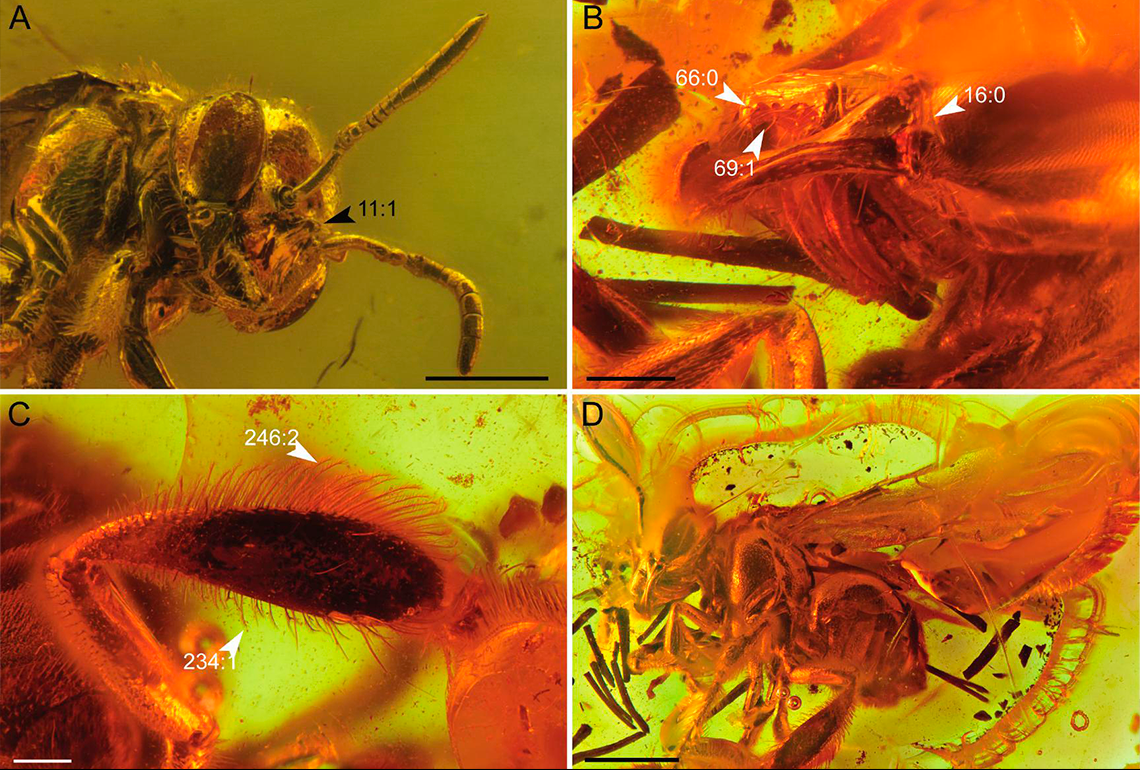
Imagem extraída de Lepeco & Almeida. Bulletin of the American Museum of Natural History (2026). doi: 10.1206/0003-0090.478.1.1Preservada em âmbar, a fêmea da abelha Succinapis micheneri é um dos registros da tribo extinta Melikertini. O painel detalha a anatomia de partes específicas do fóssil (A, B e C) e a visão lateral completa do inseto (D). O estudo milimétrico do esqueleto dessas abelhas restritas ao Hemisfério Norte revela características ancestrais que o DNA não alcança, indicando seu parentesco evolutivo com as abelhas-sem-ferrão atuaisImagem extraída de Lepeco & Almeida. Bulletin of the American Museum of Natural History (2026). doi: 10.1206/0003-0090.478.1.1
Esse resgate da morfologia ancorou dois amplos estudos conduzidos no Programa de Pós-Graduação em Entomologia da Faculdade de Filosofia, Ciências e Letras (FFCLRP-USP), em Ribeirão Preto (SP). Com apoio da FAPESP, os pesquisadores mergulharam na intrincada árvore evolutiva desses insetos. As análises são resultado de cerca de 15 anos de pesquisas e expedições por mais de 30 países em diversos continentes, aliado a visitas e ao intercâmbio de material biológico com acervos de referência, como o do Museu de História Natural de Berlim, na Alemanha, e o do Museu Americano de História Natural, em Nova York.
Imagem extraída de Lepeco & Almeida. Bulletin of the American Museum of Natural History (2026). doi: 10.1206/0003-0090.478.1.1Detalhes anatômicos da abelha-sem-ferrão dominicana (Proplebeia dominicana), incrustada em resina fóssil há cerca de 18 milhões de anos. Mapear detalhes do aparelho bucal com as mandíbulas (esq.) e da vista anterior do pronoto, parte do tórax (dir.), forneceu evidências importantes sobre o lugar da espécie na árvore evolutiva das abelhas-sem-ferrão neotropicaisImagem extraída de Lepeco & Almeida. Bulletin of the American Museum of Natural History (2026). doi: 10.1206/0003-0090.478.1.1
O mapeamento avançou em duas frentes complementares. O biólogo Anderson Lepeco, atualmente doutorando na Universidade Federal do Rio de Janeiro (UFRJ), detalhou a morfologia de uma linhagem específica durante seu mestrado em Entomologia na FFCLRP-USP, dissecando 68 espécies viventes da tribo das abelhas-sem-ferrão (Meliponini), além de incluir na análise anatômica amostras extintas preservadas em âmbar. Os resultados foram publicados em fevereiro de 2026 no Bulletin of the American Museum of Natural History.
Em paralelo, o também biólogo Diego Sasso Porto, que hoje atua como pesquisador associado ao Museu de História Natural da Finlândia, em Helsinque, conduzia seu doutorado sobre a história evolutiva das abelhas catalogando 394 caracteres anatômicos de 116 espécies escolhidas para representar de forma equilibrada as ramificações das grandes famílias espalhadas pelo globo. O trabalho de Porto foi publicado em 19 de agosto, também no Bulletin.
Imagem extraída de Porto & Almeida. Bulletin of the American Museum of Natural History (2026). URI: https://hdl.handle.net/2246/7558A árvore genealógica dos polinizadores: o diagrama circular (cladograma) organiza o grau de parentesco entre as grandes famílias de abelhas do globo. Para interpretá-lo, a leitura é feita do centro para as bordas. O miolo representa o passado profundo e os ancestrais comuns; conforme as linhas se ramificam para fora, ilustram a separação das linhagens ao longo de milhões de anos até chegarem às espécies atuais, indicadas nas fotos das extremidadesImagem extraída de Porto & Almeida. Bulletin of the American Museum of Natural History (2026). URI: https://hdl.handle.net/2246/7558
Eduardo Almeida, coordenador do Laboratório de Biologia Comparada e Abelhas (LBCA) da FFCLRP-USP e orientador das duas pesquisas, comenta que “a genética e a morfologia caminham juntas, uma complementando as lacunas que a outra deixa. Quando olhamos apenas para o genoma, não enxergamos a beleza das formas e dos comportamentos. É a morfologia que nos abre a janela para entender o processo de formação da diversidade biológica.”
As evidências esqueléticas ajudaram a solucionar antigos impasses taxonômicos sobre linhagens extintas, tarefa que a análise de DNA não alcança. Almeida explica que, por muito tempo, houve forte suspeita de que a abelha dominicana (Proplebeia dominicana), incrustada em resina há cerca de 18 milhões de anos, fosse aparentada de abelhas-sem-ferrão viventes que habitam os Neotrópicos. Só faltava uma avaliação morfológica definitiva validando a hipótese – o que ocorreu graças aos estudos.
Outra dúvida pairava sobre a tribo extinta Melikertini, restrita ao Hemisfério Norte. O recorte de Lepeco interligou essas peças: comprovou a relação de proximidade entre a tribo Melikertini e as abelhas-sem-ferrão atuais e confirmou o lugar da abelha dominicana na árvore evolutiva neotropical. Juntos, esses fósseis revelam experimentos evolutivos de linhagens que pararam no tempo e não deixaram descendentes diretos, mas cujas formas físicas ajudam a interpretar o desenvolvimento das espécies viventes hoje. Esses exemplos demonstram morfologia e genética caminhando em paralelo.
Imagem extraída de Lepeco & Almeida. Bulletin of the American Museum of Natural History (2026). doi: 10.1206/0003-0090.478.1.1Detalhe da ponta do aparelho bucal da abelha Paratrigona lineata, espécie que integra o grupo das abelhas de língua longa da família Apidae. O alongamento de partes do aparelho bucal (estrutura equivalente à língua) com formação de flabelo na ponta foram inovações que permitiram a esses polinizadores alcançar o néctar em certos tipos de floresImagem extraída de Lepeco & Almeida. Bulletin of the American Museum of Natural History (2026). doi: 10.1206/0003-0090.478.1.1
A segunda pesquisa, focada na amplitude global das famílias, inovou metodologicamente ao utilizar técnicas estatísticas e computacionais criadas nos últimos anos para calcular a taxa da mudança anatômica. Os testes indicaram que diferentes partes do esqueleto de um inseto não evoluem na mesma marcha. O aparelho bucal das abelhas de língua longa, por exemplo, apresentou um ritmo acelerado de alterações durante o período Cretáceo (há mais de 100 milhões de anos), consolidando uma estabilização estrutural profunda logo em seguida.
Esse pico de adaptações se alinha ao surgimento de novidades evolutivas essenciais, como o alongamento de partes do aparelho bucal (uma estrutura complexa e equivalente à nossa língua) e a formação do flabelo na sua ponta, garantindo a capacidade mecânica desses insetos de sugar o néctar no fundo das flores tubulares. “A evolução produziu soluções diferentes, mas que foram altamente eficientes. A presença de ambos os grupos [de língua curta e de língua longa] há mais de 100 milhões de anos no planeta comprova esse sucesso”, ressalta Almeida.
Imagem extraída de Porto & Almeida. Bulletin of the American Museum of Natural History (2026). URI: https://hdl.handle.net/2246/7558Mapeamento da história evolutiva da anatomia das abelhas indicando, em roxo, o ramo das abelhas de língua longa (famílias Apidae e Megachilidae). O alongamento de estrutura do aparelho bucal desses insetos possivelmente se associa à capacidade de extrair néctar em flores de corola profunda.Imagem extraída de Porto & Almeida. Bulletin of the American Museum of Natural History (2026). URI: https://hdl.handle.net/2246/7558
O futuro da investigação entomológica inclui a digitalização dessas grandes bases de dados anatômicos. Aliado a tecnologias avançadas, como a tomografia microcomputadorizada, esses dados permitirão reconstruções tridimensionais que revelam os insetos de dentro para fora. A partir daí, integrar informações fenotípicas de maneira contínua aos genótipos refinará a compreensão de como cada linhagem reage a estresses ambientais e distúrbios antropogênicos.
Desse modo, haverá mais ferramentas para investigar, por exemplo, as razões pelas quais algumas abelhas desenvolveram ferrões proeminentes e outras aprimoraram estratégias comportamentais distintas de defesa. Outra utilidade prática potencial das abordagens fenômicas é selecionar os polinizadores ideais para lavouras agrícolas e florestas em recuperação, fortalecendo a defesa e a conservação de ecossistemas, especialmente no contexto das mudanças climáticas.
The State Wants to Label Me a Terrorist
Social Democracy Upside Down
Germany’s Rising Right
Europeans born in the early 2000s have never not lived in times of crisis. The Great Recession, the hysteria over migration half-a-decade later, the recent shocks from the war in Ukraine: Europe has been in turmoil for so long that one forgets it could be otherwise. The political establishment has paid a high price, with ‘populists’ on both the left and right booting out incumbents everywhere from Lisbon to Lithuania.
Everywhere, that is, except the Federal Republic of Germany, the largest EU member-state, whose long-term macroeconomic strategy has been to gain an edge on the world market by repressing domestic wage growth and consumption, and using the savings to maximise exports of cars and heavy machinery to China. This model weathered the downturn of the 1980s relatively well. It soldiered on after the global financial crisis under the steady hand of Angela Merkel, who presided over sixteen years of sustained growth and low unemployment, effectively neutralising opposition from across the spectrum, and enjoying the support of two-thirds of the electorate by the time she stepped down in 2021.
For a while, it seemed that Germany’s outlier status could last forever, that it would remain stable and predictable even as its neighbours descended into chaos. But now, as Merkel’s memory fades, the foundations of the German social compromise are beginning to crack. Erstwhile customers in the Global South are becoming competitors, placing the German industrial heartland under growing strain. In June, Volkswagen announced plans to cut some 100,000 jobs. Energy prices are high and growth is slowing. According to a poll conducted late last year, less than half of Germans held positive expectations for themselves or their families for 2026, while only 22 percent described their outlook on the country’s future as optimistic.
The consequences are familiar. While the political centre, embodied by the government of the Christian Democrats and Social Democrats, has not yet collapsed, it appears to be well on its way, with the parties placing second and fourth in the polls respectively. The conservative chancellor, Friedrich Merz, has proven to be profoundly inept. Appointed last year, he is already the least popular chancellor in modern German history. Rather than forming at least a modicum of social consensus, as Merkel did so well, he is pushing a slew of aggressive cuts and ‘reforms’ to the welfare state. Some ten years after the initial populist wave crested, it would appear that Europe’s anchor of stability is now headed for its own. What is the likely outcome?
Searching for Alternatives
The forces harnessing this populist moment in Germany are not exactly new — the far-right Alternative für Deutschland (AfD) was founded in 2013, far-left Die Linke in 2007 — but they have been given a new lease on life after years on the margins of parliamentary politics. This is particularly the case for the AfD, which is still subject to the political ‘firewall’ that all other parliamentary parties including Die Linke have erected around it, but is currently polling in first place nationally and on the cusp of winning a majority in some eastern states, where protest parties of different persuasions have traditionally been most successful.
At least for now, the AfD seems to be the first address for German voters looking to express frustration with the country’s political and economic situation. For years, exit polls have shown the AfD topping the polls among workers and the unemployed, whose economic anxiety has been ignored by the political mainstream. Like far-right parties practically everywhere, it is particularly strong among lower-middle-class men in rural areas. Yet it is increasingly gaining support among industrial trade unionists, at least some of whom have responded to external economic threats by turning inwards, seeking to protect their jobs by excluding potential competitors from the job market. Although its organised presence within the labour movement remains meagre, at least in demographic terms, the AfD is now Germany’s leading workers’ party.
Ironically, the AfD began as something quite different: a Eurosceptic formation founded in opposition to bailouts for Germany’s Southern European neighbours. Populist, perhaps, but certainly not popular. Indeed, the early AfD was eminently middle class and its activist core remains overwhelmingly so to this day. Its stunning success, then, has less to do with a supposedly populist agenda (as critics are keen to point out, the AfD’s economic programme remains well within the neoliberal mainstream) than with a mixture of deft opportunism and blind luck. As xenophobia began to spread in the aftermath of the 2015 ‘summer of migration’, the AfD quickly positioned itself as the anti-migrant party. When protests against lockdowns broke out during the pandemic, it again pivoted in time to become the voice of Covid-scepticism. The anti-migrant and anti-lockdown waves have long since subsided, but the AfD — now shorn of its more moderate layers — has endured, and is now stronger than ever.
Populism in Power
Precisely because of its exclusion from government and polite society, the AfD appears to millions as the only truly authentic voice of protest. The question is whether the party, on track to win a majority in the state of Saxony-Anhalt later this year, might become a victim of its own success: moving from an insurgent outsider to an established governing force. An AfD-led government is certainly an alarming prospect, particularly in a part of the country where its most reactionary elements dominate, but it would not mean the end of parliamentary democracy in Germany, as some alarmist voices tend to imply. The populist decade has already given us several examples of what the European far right in power actually looks like. The governments of Giorgia Meloni in Italy or (until recently) Viktor Orbán in Hungary succeeded in implementing regressive policies, but were — much like their counterparts on the populist left — domesticated by the institutions in which they operated. More importantly, they can, and almost certainly will, be voted out sooner or later, though it is less clear what will come next.
Could Germany’s belated populist turn therefore come to benefit the left? That is hard to say. Die Linke’s path to power has been rocky and winding. Teetering on the brink of political oblivion two years ago, the party has undergone a remarkable rejuvenation under the leadership of Ines Schwerdtner, once the editor of the German edition of Jacobin magazine. Today, it is gaining ground among disaffected centre-left voters and young people in urban areas, but has struggled to win back its traditional eastern electorate from the far right, and has made few inroads among working-class constituencies. As was the case for left populism in the rest of Europe, the resurgence in Germany remains largely restricted to downwardly mobile segments of the professional middle classes. Breaking out of this pattern will be key if Die Linke is to avoid the same fate as Corbynism or similar experiments that came to ruin.
It will also depend on whether the party can learn from the experiences of the last decade. In their book The Populist Moment (2023), Anton Jäger and Arthur Borriello describe this trend among left parties as an attempt to ‘rethink mobilisation for an age of demobilisation; to organise for an age of disorganisation’. But while populism has had distinct success in mobilising an electorate, at least sporadically, long-term organising has proven far more difficult. In countries like Spain and Greece, where the left rode the populist wave into government but lacked corresponding structures on the ground, this project is now for all intents and purposes dead.
Schwerdtner for her part prioritises ‘building a house of stone’, meaning a solid organisation rooted in workplaces and communities, as opposed to a short-term electoral focus. But come September, Die Linke stands a good chance of taking first place in the Berlin elections and coming under pressure to join a cross-party coalition to exclude the AfD in Saxony-Anhalt. There are strong arguments for doing so: Berlin is desperately in need of public investment after years of austerity, and it is hard to see any government without Die Linke making the necessary expenditures. As with Zohran Mamdani in New York, the party hopes to turn the city into a beacon of hope for the rest of the country, showing that democratic socialists can not only govern reliably, but improve the lives of their constituents in a meaningful, lasting way.
At the same time, assuming government responsibility — particularly in a poor state like Saxony-Anhalt, where there is little fiscal room for manoeuvre — risks tainting the party as part of the rotten establishment that sparked the populist wave in the first place. As was the case with Syriza in Greece, Die Linke’s foray in government could ultimately end up bolstering the far-right’s reputation as the only ‘real’ opposition and accelerating the country’s rightward drift. Schwerdtner surely had this dynamic in mind when she spoke of taking ‘difficult decisions’ at Die Linke’s party congress back in June.
Whether or not the AfD or Die Linke find themselves in government later this year, the structural crisis of the German economic model will not be resolved anytime soon. Bearing that in mind, we can expect the populist moment to stretch far into the future, with all the political unpredictability that entails. For Germany’s — and Europe’s — sake, left populism needs to succeed where it failed in the 2010s. That means combining immediate electoral priorities, to restore confidence in the left as a force that can wield effective power, with the slower work of cadre-building and coordinating among our base. These are the foundations on which a house of stone must rest. Without them, parties like Die Linke will, in their desire to halt the advance of the far right at any cost, repeat the same strategic missteps which have undermined their projects in years past.
- SUMAÚMA
- Belo Sun contrata filhos de figurões de Brasília para sua defesa às vésperas de julgamentos cruciais
Belo Sun contrata filhos de figurões de Brasília para sua defesa às vésperas de julgamentos cruciais
SUMAÚMA lança programa de debates sobre a eleição mais importante de 2026: a do Congresso
A ciência ao redor dos ossos
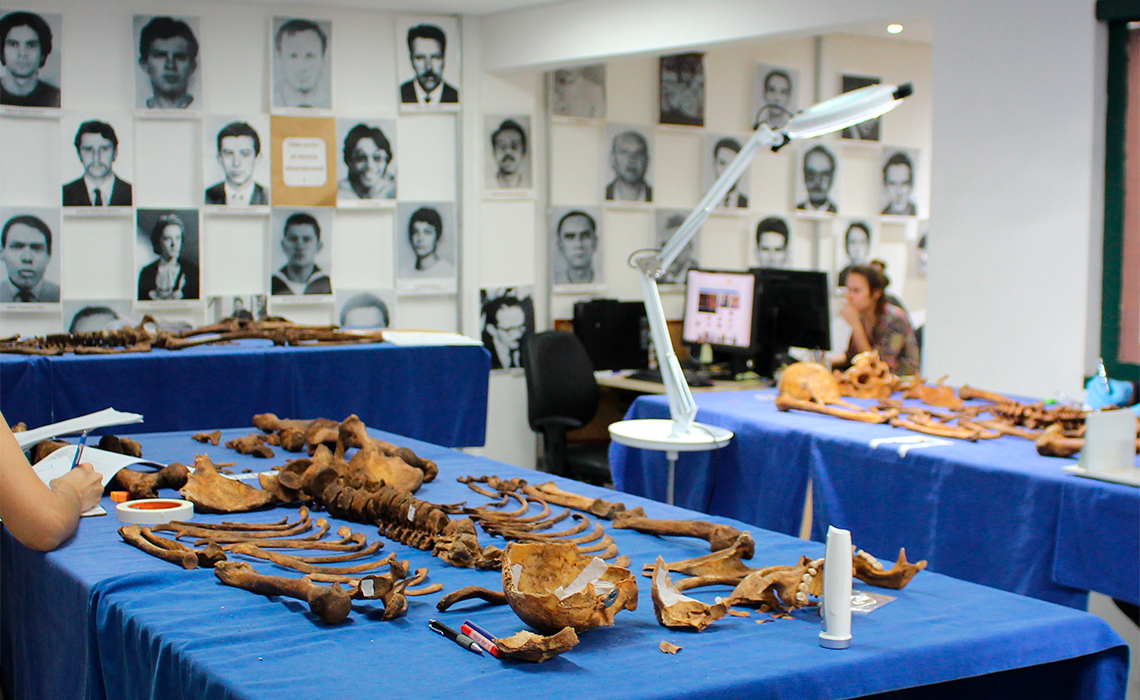
Três pessoas estão em volta de uma mesa com panos azuis em uma sala no Centro de Antropologia e Arqueologia Forense (CAAF), na Universidade Federal de São Paulo (Unifesp). Em cima dos panos, há ossadas humanas. Uma perita pega um dos ossos, segura-o e pergunta para as colegas o que elas acham daquele fragmento. Uma delas observa mais de perto e aponta para uma imagem em uma apostila aberta sobre a mesa. A cena faz parte do cotidiano do laboratório forense que investiga remanescentes de pessoas mortas e desaparecidas durante a ditadura militar no Brasil. Profissionais que trabalham ali investigam remanescentes ósseos de diferentes partes do país que podem pertencer a vítimas da ditadura e têm como missão identificar os corpos e tentar descobrir o que aconteceu com eles. A rotina dos peritos, que foi registrada em vídeo nos últimos quatro anos para uma pesquisa científica, agora se tornou uma exposição imersiva.
A mostra “Fazer falar os ossos: engajamentos presentes com o passado” fica em cartaz entre os dias 14 de agosto e 27 de setembro no Centro Maria Antonia da Universidade de São Paulo (USP), na capital paulista. Além dos espaços de exposição, conta com uma programação paralela de filmes (entre eles “Nuestras Madres”, do cineasta guatemalteco César Díaz, e “Madres Paralelas”, de Pedro Almodóvar), debates, oficinas sobre atividades forenses, história e memória da ditadura militar e mesas redondas com familiares de desaparecidos políticos. A instalação reúne cenas gravadas para o projeto Fazendo Falar os Ossos, financiado pela FAPESP e pela agência suíça SNSF (Swiss National Science Foundation), encabeçado pelas pesquisadoras Fernanda Miranda da Cruz, da Unifesp, e Lorenza Mondada, da Universidade de Basileia, na Suíça, em parceria com o filósofo Edson Teles, coordenador do CAAF.
A exposição nasceu da pesquisa que aproxima a linguística da antropologia forense – a ideia do projeto surgiu de uma conversa informal entre os pesquisadores, em que Teles contou para da Cruz e Mondada sobre como os peritos forenses abriam, pela primeira vez, sacos com remanescentes humanos recém-chegados ao laboratório. “Fiquei muito impressionada [com o relato], porque não eram restos humanos quaisquer”, lembra a pesquisadora suíça, uma vez que as ossadas em questão poderiam ser de desaparecidos da ditadura. Na época, Mondada já trabalhava com investigação de interações sociais em ambientes de trabalho delicados, como salas de cirurgia.
Divulgação / CAAF-UnifespRemanescentes ósseos que podem pertencer a vítimas da ditadura militar no Brasil são analisados no Centro de Antropologia e Arqueologia Forense da Unifesp, na capital paulistaDivulgação / CAAF-Unifesp
Da conversa em 2017, surgiu a vontade de entender os detalhes das interações da equipe forense. O projeto se apoia na etnometodologia, abordagem que investiga como as pessoas constroem e dão sentido às práticas do cotidiano, e na análise de conversa, que examina como a fala e os gestos se organizam, momento a momento, na interação entre as pessoas a partir de detalhes como gestos, olhares e pausas. Da Cruz e Mondada registraram em vídeo, com várias câmeras, a forma como os peritos do CAAF examinavam os ossos e fragmentos, como debatiam os casos que chegavam e as dúvidas que surgiam. Para a análise, a dupla transcreveu as cenas para além das palavras: anotavam instantes em que mãos se moviam, olhares eram trocados, objetos eram manuseados.
Enquanto peritos formados em diferentes áreas do conhecimento buscam montar o quebra-cabeça sobre o que aconteceu com os mortos e desaparecidos da ditadura por meio dos ossos severamente danificados pelo tempo e pela ocultação deliberada, muitas vezes sem informações de contexto relevantes, a dupla brasileiro-suíça procura entender como esse conhecimento é produzido.
Cada milímetro de osso encontrado e cada variação patológica descrita pode ser crucial para recompor a biografia das vítimas, assim como cada detalhe, gesto, comentário e olhar durante a investigação nas longas horas de trabalho.
Entre os achados do levantamento está a noção de que o conhecimento é construído de maneira coletiva. Em diálogo com a tradição dos estudos sobre a produção do conhecimento científico que inclui a etnografia de Bruno Latour e Steve Woolgar, registrada no livro “Vida de Laboratório”, de 1979, as pesquisadoras observam em detalhe como o conhecimento é construído durante as próprias interações no laboratório. “Nos interessa o processo do pensar para além do que se passa na cabeça dos peritos; olhar para o que acontece no entorno da mesa, nos diálogos, na observação particular do material que vai permitir chegar a algum resultado, alguma conclusão sobre quem é aquela pessoa e o que aconteceu com ela”, explica Mondada. “É um saber que se constitui de maneira complexa.”
A análise, publicada em artigo na revista Research on Language and Social Interaction em novembro de 2024, aponta como uma pergunta simples como “o que você acha?” organiza boa parte do trabalho de identificação dos peritos. “Nosso objetivo é revelar aquilo que é mundano para refletir sobre as práticas [no laboratório]”, diz da Cruz. “As interações sociais do cotidiano estão no centro da produção do conhecimento. Quando eu tenho uma dúvida e peço a opinião de um colega, ‘o que você acha?’, o problema se torna coletivo”, aponta Mondada.
Para as pesquisadoras, esse tipo de evidência ajuda a questionar tanto o estereótipo da ciência como produto de um “gênio” que trabalha sozinho quanto a ideia de que a objetividade da ciência prescinde das interações entre os pesquisadores. “Momentos de discordância são muito produtivos para a ciência e a discussão é a base interacional”, diz Mondada. “Se todo mundo concordasse, não haveria conhecimento”, afirma.
DivulgaçãoLorenza Mondada e Fernanda da Cruz trabalhando nas análises linguísticas dos dados do projeto Fazendo falar os ossos, na Universidade de Basileia, na SuíçaDivulgação
Em outro artigo, publicado em 2025 na revista Ethnographic Studies, as pesquisadoras detalham o ato dos peritos de medir os ossos no laboratório. Na ciência tradicional, a medição indica uma ideia de objetividade, mas as interações mostram que há subjetividade na aplicação da metodologia. Duas peritas precisam medir fêmures para calcular a estatura de um indivíduo e também para descobrir se dois ossos são de uma mesma pessoa. Há mais de um método possível sendo discutido para os cálculos. Na interação, elas negociam os movimentos e alinham as ações para chegar a alguma conclusão. O estudo demonstra que a objetividade da medição não reside simplesmente no instrumento, mas também nos procedimentos compartilhados de checagem e validação entre as cientistas.
Na exposição, o público é convidado a ver cenas como essas em trechos dos vídeos gravados para o projeto – ao todo, são mais de 180 horas de material audiovisual. O espaço está dividido em cinco ambientes, com 14 instalações que apresentam vídeos em TVs, telas e projeções. Em uma delas, as imagens são exibidas em uma tela dentro de um saco preto, do tipo utilizado para transportar corpos. Em outra, o visitante observa, por pequenos orifícios em uma parede, cenas do manuseio dos ossos com o som estridente de uma lixadeira que serve para extrair o DNA dos ossos. “É uma realidade desconfortável, mas permite uma experiência imersiva”, explica Mondada.
Além de sensibilizar o público sobre a construção do conhecimento forense, a mostra espera provocar uma reflexão sobre os desaparecidos e mortos da ditadura, uma marca na história brasileira. “Ossos não falam e não há ossos de verdade na exposição; mas a ditadura e as investigações sobre esse período não são uma história do passado, são do presente”, diz da Cruz. No CAAF, os peritos lidam diariamente com uma pergunta que segue em aberto: onde estão os desaparecidos? Para Mondada, expor esse cotidiano é pensar em como o conhecimento sobre a ditadura está presente na ciência e na política, além da história. “É uma questão de democracia, de memória histórica e de não esquecer o que aconteceu”, reflete.
Exposição: Fazer falar os ossos: engajamentos presentes com o passado
Curadoria: Lorenza Mondada, Fernanda Cruz e Edson Teles
Abertura: sexta-feira, 14 de agosto de 2026, às 18h
Período em cartaz: 14 de agosto a 27 de setembro de 2026
Horário de visitação: terça a domingo, das 10h às 18h
Local: Centro Maria Antonia da USP – Rua Maria Antônia, 258, São Paulo
Entrada: gratuita
Mais informações: www.mariantonia.prceu.usp.br | https://www.instagram.com/fazerfalarosossos
Racismo e exclusão no mercado do amor
Na literatura e na poesia, são vários os aforismos que descrevem o amor como um sentimento puro e desinteressado. Mas a ideia de que o amor é cego não se sustenta na vida real. Pesquisas da socióloga Maria Chaves Jardim, professora do Departamento de Ciências Sociais da Unesp de Araraquara e do Programa de Pós-Graduação em Ciências Sociais da mesma universidade, mostram que relações afetivas também são atravessadas por desigualdades sociais e que mulheres negras ocupam a posição mais vulnerável no chamado mercado do afeto.
Desde 2017, no Núcleo de Estudos e Pesquisa sobre Emoções, Sociedade, Poder, Organização e Mercado (Nespom), Jardim investiga como aplicativos de relacionamento reproduzem — em vez de reduzir — desigualdades presentes na sociedade. Em um estudo de etnografia digital, financiado pela FAPESP, a pesquisadora interagiu com mais de uma centena de homens nos aplicativos Tinder e Badoo, realizou 15 entrevistas presenciais e conversou com integrantes de um grupo virtual fechado em que mulheres compartilham experiências relacionadas à vida afetiva e suas estratégias para fazer sucesso nos aplicativos.
Os resultados mostram que as ferramentas estão longe de democratizar o acesso ao amor e reproduzem constrangimentos sociais presentes fora do ambiente digital, favorecendo determinados perfis e excluindo outros. Padrões estéticos e preconceitos influenciam diretamente quem é visto como desejável e quem permanece invisível.
A interpretação parte da sociologia econômica, que entende o mercado como um espaço moldado por valores e relações sociais, e não como um ambiente neutro. “Não há aqui uma mágica, um cupido. Há elementos sociais e, entre eles, a exclusão de mulheres fora do padrão estético — que estão acima do peso ou têm o tom de pele diferente daquele considerado legítimo, que é o branco”, afirma Jardim.
A popularização dos aplicativos de namoro trouxe a promessa de ampliar as possibilidades de encontro. Com opções para diferentes perfis e interesses — como idosos, veganos e tantos outros —, criou-se a ideia de um mercado afetivo mais acessível. “Esse discurso é uma falácia, especialmente para mulheres pretas, dado o contexto de vulnerabilidade social, econômica e política no qual grande parte delas se encontra”, afirma Paulo Carvalho Moura, doutorando em Ciências Sociais na Unesp e integrante do Nespom.
Segundo Moura, os aplicativos não eliminam desigualdades, apenas reorganizam e reforçam preconceitos já existentes. “O ambiente digital não é livre de constrangimentos sociais. Trata-se de um mercado com hierarquias e padrões, considerando fatores como raça, gênero, escolaridade e gosto cultural”, destaca.
Quem fica de fora
Se o primeiro estudo mostrou como os aplicativos reproduzem desigualdades, uma pesquisa posterior, publicada na revista Tomo em parceria com Renata Paoliello, também da Unesp, buscou compreender de que maneira essas dinâmicas afetam especificamente a experiência de mulheres negras.
O grupo analisou dados de 64 mulheres negras com diferentes perfis socioeconômicos para avaliar o impacto da cor da pele nas experiências afetivas. O primeiro grupo reunia 45 delas, das quais 40 tinham diploma superior. O segundo era formado por 19 mulheres pretas, sem diploma superior, moradoras de um bairro popular de Araraquara. A conclusão foi direta: mulheres negras enfrentam barreiras estruturais também no mercado do afeto. “O amor, como todas as relações sociais, tem relação com poder. Alguns terão mais acesso a ele do que outros, pois o sentimento está sustentado por valores que carregamos no inconsciente, e o racismo é um deles”, explica Jardim.
Entre as entrevistadas, surgem padrões recorrentes de sofrimento relacionados ao racismo, sofrido desde a infância e adolescência, à invisibilidade afetiva e a relacionamentos abusivos. Embora frustrações amorosas façam parte da experiência de muitas, Jardim observa que elas costumam ser retratadas de formas distintas. Com frequência, o debate público associa as dificuldades enfrentadas por mulheres brancas ao dilema entre casamento e carreira. Já entre as mulheres pretas ouvidas pela pesquisa, o obstáculo aparece antes mesmo desse ponto: muitas descrevem dificuldades para estabelecer relações afetivas estáveis. “O dilema da mulher branca pressupõe uma possibilidade de escolha. A da mulher preta não contempla isso”, comenta a pesquisadora.
Segundo Thaís Caetano de Souza, doutoranda em Ciências Sociais pela Unesp e integrante do Nespom, essa diferença ajuda a compreender por que muitas afirmam não conseguir sequer acessar o modelo de relacionamento romântico tradicional. “A desigualdade aparece de forma mais profunda para mulheres pretas. Elas não estão reorganizando a vida afetiva em prol de projetos profissionais; elas simplesmente não possuem uma vida afetiva no modelo romântico de construção de uma família”, afirma.
Quando o amor não se concretiza
O desejo por relações estáveis aparece na fala das entrevistadas, seja na expectativa do casamento, seja experiências cotidianas simples, como andar de mãos dadas com o parceiro. Jardim coloca seus dados da pesquisa de campo em diálogo com as teorias existentes na sociologia sobre o amor, como o amor romântico, o amor confluente, o poliamor e o chamado “amor líquido”, caracterizado por relações frágeis e instáveis. Entre parte das mulheres pretas ouvidas na pesquisa, porém, esta última acaba sendo percebida como a única possibilidade concreta.
Como consequência, muitas relatam início tardio da vida afetiva e sexual e, em alguns casos, o estabelecimento de relações marcadas pela falta de compromisso ou pela posição de amante, não por escolha, mas pela escassez de alternativas percebidas.
Outro padrão recorrente é o tipo de abordagem recebida nos aplicativos: convites de cunho sexual, que reforçam a objetificação e reduzem as possibilidades de construção de vínculos duradouros. Diante dessas barreiras, algumas relatam optar pelo celibato definitivo, enquanto outras acabam construindo famílias como mães solo. Esse quadro contrasta com o estereótipo historicamente atribuído às negras como pessoas naturalmente hipersexualizadas. Entre as mulheres pretas com diploma universitário, a pesquisadora observou que muitas optam pela solidão afetiva em vez de aceitar relacionamentos “líquidos”.
As experiências narradas pelas participantes da pesquisa não aparecem isoladamente. Indicadores nacionais mostram que as desigualdades observadas nas entrevistas também se refletem na formação de casais e famílias no Brasil. Dados do Censo de 2022 do IBGE revelam maior probabilidade de casamento para mulheres brancas (51%) do que para pretas (44%). Já entre as mães solo, negras (pretas e pardas) representam cerca de 90% do total entre 2022 e 2023, segundo pesquisa do Instituto Brasileiro de Economia da Fundação Getulio Vargas (Ibre-FGV).
As consequências desse processo, no entanto, não se limitam às trajetórias afetivas. Elas também repercutem na saúde mental das entrevistadas. Segundo Jardim, os impactos emocionais da exclusão afetiva vão além do sentimento de rejeição e da baixa autoestima. A equipe agora pretende investigar de forma mais aprofundada suas consequências para a saúde mental das mulheres pretas. “Esse quadro pode contribuir para o adoecimento psíquico, incluindo depressão e processos de medicalização, e será objeto da próxima etapa da pesquisa”, afirma.
Para a pesquisadora, um dos principais efeitos do estudo é deslocar a responsabilidade do plano individual para o coletivo. Ao reconhecer que essas experiências refletem desigualdades estruturais, muitas deixam de atribuir exclusivamente a si mesmas a culpa pelo chamado “fracasso afetivo”.
“Isso não resolve os problemas pessoais, mas produz uma tomada de consciência de que se trata de uma questão social. É uma forma de compreender que o problema não está nelas, mas na maneira como a sociedade organiza seus preconceitos, colocando em uma hierarquia quais são as mulheres dignas de serem amadas e as que não merecem o amor”, conclui.
Garimpando o solo atrás de avanços tecnológicos
Em 2004, Andre Geim e Konstantin Novoselov, ambos físicos da Universidade de Manchester, no Reino Unido, utilizaram uma fita adesiva comum para isolar, pela primeira vez, uma folha atômica de grafite, inaugurando uma nova classe de materiais. Conhecido como grafeno, o material conduzia eletricidade tão bem quanto o cobre, era um excelente condutor de calor e, embora sua estrutura muito compacta de carbono o fizesse muito denso, sua espessura ultrafina conferia extrema flexibilidade. A própria obtenção do grafeno foi considerada um feito surpreendente na época, dado que era impensável que materiais cristalinos formados por apenas uma camada atômica fossem estáveis. Tamanho foi o impacto da descoberta que, seis anos após a obtenção do grafeno, a dupla foi agraciada com o Nobel de Física.
Embora mais de duas décadas tenham se passado desde a descoberta de Geim e Novoselov, cientistas continuam explorando essa nova classe de materiais, conhecida como materiais bidimensionais (2D) ou lamelares. Esses materiais consistem em uma ou poucas camadas atômicas e exibem comportamentos físicos que muitas vezes desaparecem em suas formas tridimensionais, ampliando o leque de potenciais aplicações tecnológicas.
A física Ingrid Barcelos, pesquisadora do Laboratório Nacional de Luz Síncrotron (LNLS), parte do Centro Nacional de Pesquisa em Energia e Materiais (Cnpem), integra um dos grupos brasileiros dedicados ao estudo desses materiais. A pesquisa de Barcelos é centrada no estudo de materiais 2D derivados de filossilicatos, minerais encontrados na natureza, e conta com financiamento da FAPESP. Segundo Barcelos, embora os filossilicatos sejam muito abundantes na natureza, eles ainda são pouco estudados. A pesquisadora ressalta que, devido ao seu baixo custo quando comparados a materiais 2D sintéticos, esses minerais se apresentam como opções acessíveis para aplicações tecnológicas. Além de serem potencialmente mais sustentáveis, já que têm origem natural e não são processados, causando menor impacto ambiental ao serem descartados.
Do grafeno aos minerais naturais
Os filossilicatos são formados pela combinação de átomos de silício e oxigênio, que se organizam estruturalmente em camadas empilhadas, formando o mineral. Assim como Geim e Novoselov, Barcelos utiliza fitas adesivas para esfoliar, ou seja, separar mecanicamente as camadas desses minerais, produzindo flocos de espessuras nanométricas. Segundo a pesquisadora, a separação desses materiais em camadas ultrafinas só é possível pois as interações entre as diferentes camadas sobrepostas são fracas o suficiente para permitir a separação, enquanto as ligações entre os átomos de cada camada são fortes o suficiente para manter a integridade da camada. “É como se você tivesse um pacote de folhas A4 em que você consegue tirar folha por folha desse pacote. E cada folha é uma camada atômica”, explica.
Barcelos conta que os filossilicatos possuem características físicas que conferem propriedades de isolantes elétricos a esses materiais. Segundo ela, no universo de materiais 2D, poucos apresentam esse comportamento, e um dos mais utilizados, o nitreto de boro hexagonal, apresenta custo elevado para obtenção do material com alta qualidade cristalina e produção concentrada em poucos locais no mundo, o que limita o seu acesso.
Why some people mow a lawn better than others.

- pikara magazine
- Para la justicia en España, la violación dentro del matrimonio no existía hasta hace 30 años
Para la justicia en España, la violación dentro del matrimonio no existía hasta hace 30 años
En 1995, el Tribunal Supremo dijo que no existen supuestos derechos a la prestación sexual dentro del matrimonio.
La entrada Para la justicia en España, la violación dentro del matrimonio no existía hasta hace 30 años se publicó primero en Pikara Magazine.